In the Eyes of Algorithms, Oil and Memecoin Are No Different

marsbitОпубліковано о 2026-03-12Востаннє оновлено о 2026-03-12

Анотація

In 1974, Henry Kissinger’s “petrodollar” deal with Saudi Arabia helped sustain the global dominance of the U.S. dollar after the collapse of the gold standard. Fifty years later, oil markets are being shaken not by physical supply chains, but by digital signals. A single social media post by U.S. Energy Secretary Chris Wright on X triggered a flash crash in oil prices. He claimed the U.S. Navy had escorted a tanker through the Strait of Hormuz—a critical chokepoint for global oil transit. Within minutes, WTI crude fell 17%, erasing billions in market value. The post was soon deleted after a White House denial, and prices partially rebounded, but the damage was done. The incident highlights how algorithmic trading systems now drive market reactions. Algorithms scanned the post, detected keywords like “Navy,” “escorted,” and “Hormuz,” and executed sell orders in milliseconds—far faster than human traders could react. Oil, once governed by physical supply and geopolitical agreements, now behaves like a meme-driven instrument, vulnerable to unverified information. This event underscores a broader shift: the “memefication” of assets. In an age of AI and social media, even traditional commodities like oil can be swayed by narratives, emotions, and digital misinformation. The very foundations of market consensus have grown fragile, accelerated by algorithms that trade on speed, not substance. Perhaps, in the end, the meme has won.

In 1974, then-U.S. Secretary of State Henry Kissinger flew to Riyadh and struck a deal that would reshape the world order: Saudi Arabia would sell oil, accepting only U.S. dollars; and these dollars would then be recycled to purchase U.S. Treasury bonds.

At that time, Nixon had just severed the link between the dollar and gold. Inflation was spiraling out of control in the U.S., dollar reserves were depleted, gold was flowing out in large quantities, and the Bretton Woods system had collapsed. At that moment, many believed the golden age of the U.S. dollar was over.

But the deal Kissinger struck with Saudi Arabia established what later became known as the "petrodollar" system. It was this system that gave the U.S. dollar another half-century of life after the collapse of the gold standard.

This is also why any threat to block oil shipping lanes is not merely an energy issue for the United States, but a shock to the very foundation of the dollar system. This explains why the narrow, throat-like Strait of Hormuz has been regarded by the U.S. as a critical chokepoint that must be defended for the past fifty years, even resorting to military force if necessary.

Understanding this historical background helps us make sense of today's situation.

In the early hours this morning, while most of China was still asleep, a violent shock lasting less than an hour in the global crude oil futures market wiped out tens of billions of dollars in market value.

The cause was a social media post.

U.S. Secretary of Energy Chris Wright posted on platform X: "The U.S. Navy has successfully escorted an oil tanker through the Strait of Hormuz to ensure oil continues to flow to global markets."
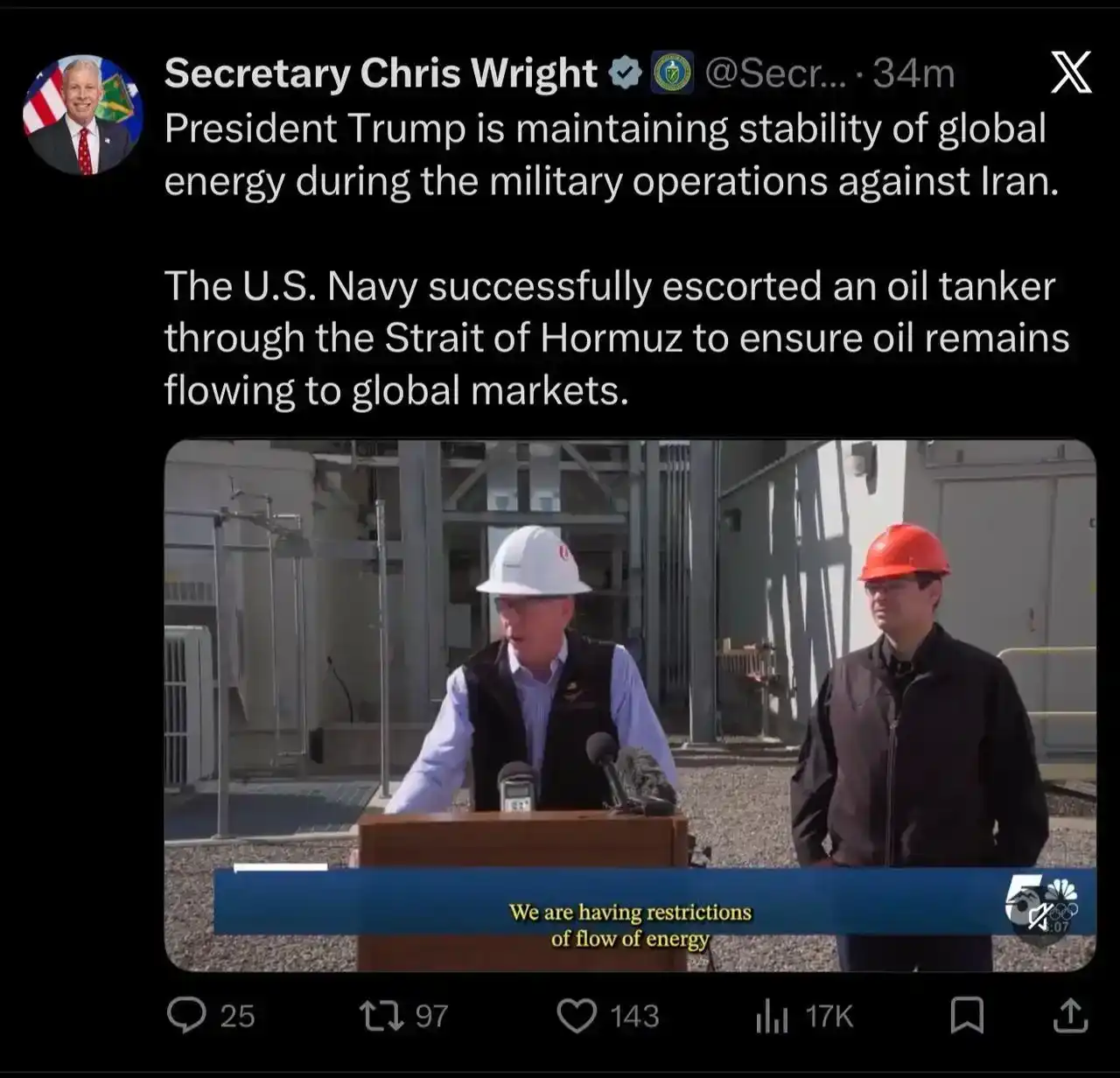
After this tweet was posted, the price of WTI crude oil plummeted within minutes, at one point falling by 17% and briefly dropping below $80 per barrel. In the preceding weeks, due to tensions in the Middle East, Brent crude had just surged from $70 to $120.
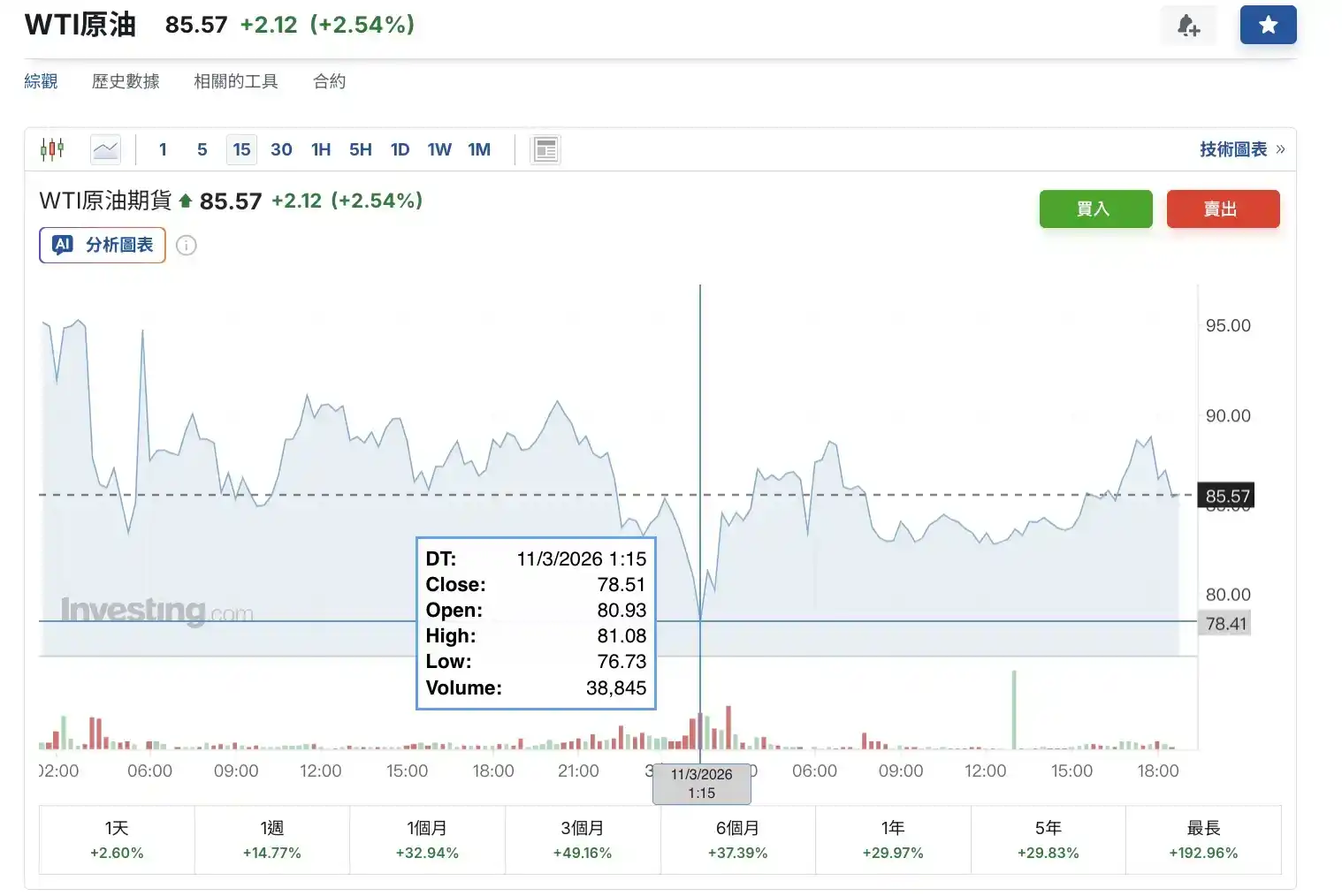
For traders betting on further oil price increases, this moment was a nightmare.

However, the plot quickly reversed.

Less than an hour later, White House Press Secretary Karoline Leavitt urgently clarified at a press briefing: the U.S. Navy is currently not escorting any oil tankers. Subsequently, Energy Secretary Chris Wright silently deleted the post without any explanation. Oil prices rebounded but failed to return to their initial levels.

One post, from publication to deletion, lasted less than sixty minutes. But the mark it left on the global financial markets far exceeded that single hour.

Since the escalation of U.S.-Iran tensions in late February, the博弈 (game) around oil has intensified. Especially after Iran announced the blockade of the Strait of Hormuz, the sudden closure of this narrow waterway, which handles about one-fifth of global crude oil shipments, caused a massive shock to the global energy market. As the situation escalated, international oil prices soared from $70 to $120 per barrel within days, putting the energy market in a state of high tension.

Almost every trader was waiting for the same signal: when will the Strait of Hormuz reopen. Under this collective anxiety, any slight movement could trigger violent price fluctuations. The rapid decline triggered by the Energy Secretary's post was a concentrated manifestation of this sentiment.

So, why could the oil price fall 17% in just a few minutes? Because humans can hardly react that fast, but algorithms can. A significant portion of today's financial market trading volume comes from high-frequency trading algorithms and AI trading systems. They scan the entire internet in real-time, including government officials' social media accounts, grabbing keywords and automatically placing orders.

That post contained three keywords: Navy, Escorted, Hormuz. The algorithms identified these words, combined with contextual semantics, and quickly reached a conclusion: the blockade is lifted, supply is restored, the logic for rising oil prices is weakened.

So the programs immediately sold.

All this happened in about 0.003 seconds.

The algorithm does not call to confirm if a tanker has actually traversed the strait; it only recognizes text and pursues speed. An unverified post, within this mechanistic "collective unconscious," was instantly converted into tens of billions of dollars in evaporated market value.

A real oil tanker crossing the Strait of Hormuz requires hours of sailing, actual military escort, and bears the cost of fuel and real-world risks. A post about an "escort" took only 0.003 seconds to cause violent fluctuations in the price of this major commodity.

In other words, oil, the king of commodities once dominated by supply and demand fundamentals, inventory data, and production agreements, has now, to some extent, become not much different from a Meme.

During the last U.S. election, Trump and Musk keenly sensed that this is an information age. One created Truth Social, the other bought Twitter.

And as the information age has developed to its current state, government officials' social media accounts have become one of the market's most sensitive information sources. This also means that power itself has begun to possess a certain Meme attribute: extremely fast propagation,极高 (extremely high) emotional concentration, and极易 (extremely easy) to be misread and amplified.

Traditional policy information transmission is slow and meticulous. White House statements, State Department bulletins, Defense Department press conferences—these mechanisms inherently involve verification, proofreading, and layers of confirmation. But when officials directly post policy-related information on X, these steps are skipped.

We can foresee that as we delve further into the AI Agent era, the speed of information capture and trading will increase exponentially, with sharp rises and falls occurring in mere milliseconds.

From a more macro perspective, this incident perhaps indicates a larger change: we are entering an era of "comprehensive asset Meme-ification." Almost any financial asset can, at some point, be driven by sentiment, narrative, and social media.

Kissinger used oil to extend the dollar's life for fifty years. But he probably never imagined that one day oil itself would also become a Meme.

No asset possesses a truly unbreakable fundamental moat. All moats are essentially built upon a certain consensus. And under the dual acceleration of social media and algorithmic trading, this consensus is more fragile and more dangerous than ever before.

Perhaps, in a sense, this is also the victory of the Meme.

Пов'язані питання

QWhat was the significance of the deal between Henry Kissinger and Saudi Arabia in 1974?

AThe deal established the 'petrodollar' system, where Saudi Arabia sold oil exclusively for US dollars, and those dollars were then reinvested in US Treasury bonds. This system helped sustain the US dollar's dominance after the collapse of the Bretton Woods system.

QHow did a social media post cause a sharp drop in oil prices?

AA post by US Energy Secretary Chris Wright on X claimed the US Navy escorted a tanker through the Strait of Hormuz, signaling eased supply constraints. Algorithmic trading systems quickly parsed the keywords and sold oil futures, causing prices to drop 17% in minutes.

QWhy is the Strait of Hormuz strategically important?

AThe Strait of Hormuz is a critical chokepoint for global oil transport, handling about one-fifth of the world's oil supply. Its closure or threat of closure can significantly impact global energy markets and geopolitical stability.

QWhat role do algorithms play in modern financial markets?

AAlgorithms and AI trading systems execute trades at high speeds by scanning real-time data, including social media, for keywords and market signals. They can trigger massive market movements within milliseconds based on unverified information.

QWhat does the article suggest about the nature of assets in today's economy?

AThe article argues that assets, including traditional commodities like oil, are becoming 'meme-like'—driven by narratives, emotions, and social media rather than fundamental supply-demand dynamics, making markets more volatile and consensus-based.

Пов'язані матеріали

Arthur Hayes' 10,000-Word New Article: When Will the AI Wave Peak? Will the Bubble Burst? Why Am I Fiercely Buying ETH?

In his latest essay, "When Will the AI Wave Peak? Will the Bubble Burst? Why Am I Loading Up on ETH?", crypto veteran Arthur Hayes presents a contrarian thesis on the AI investment boom, framing it as an impending credit bubble rather than a tech growth story. Hayes argues that massive AI infrastructure spending (AI CAPEX) is fundamentally a real estate play—building data centers—disguised as high-growth technology. This misclassification leads to dangerous capital misallocation. He predicts the bubble is a credit bubble akin to the 2008 financial crisis, not an earnings bubble like the 2000 dot-com bust. The turning point will not be AI companies failing to profit, but a slowdown in the growth rate of data center construction, which will cause over-leveraged players to falter. He anticipates AI CAPEX growth will slow by mid-to-late 2027, entering a "slowdown phase" in 2028. However, credit will continue flowing due to profitable lending, government pressure, and implicit bailout guarantees. This creates a period of misallocation where credit exceeds valuable projects. Hayes draws parallels to the 2006-2007 housing market "no man's land." Governments, particularly the US, will inevitably print money to bail out the system, possibly through direct equity purchases via SPVs—a form of "Equity QE." This massive future liquidity injection, exceeding the 2008 crisis response, will ultimately flow into crypto, specifically Bitcoin, potentially driving it past $1 million. Regarding the current crypto market, Hayes believes the AI boom has sucked away liquidity, contributing to Bitcoin's correction. He expects Bitcoin to bottom as AI capital misallocation accelerates, with the excess fiat liquidity eventually fueling its next bull run. Finally, Hayes reveals a major personal trade: aggressively accumulating ETH. He targets $5,000 by end-2026, betting on a new narrative where Ethereum becomes the settlement layer for TradFi RWA tokenization, citing projects like Robinhood using Arbitrum L2s as a catalyst. He views ETH as a hated, high-Lindy asset with strong liquidity, presenting an asymmetric opportunity.

Odaily星球日报7 хв тому

Arthur Hayes' 10,000-Word New Article: When Will the AI Wave Peak? Will the Bubble Burst? Why Am I Fiercely Buying ETH?

Odaily星球日报7 хв тому

Stunning, Musk Joins Forces with Huang Jen-hsun to Deploy the Stellar Brain! AI Computing Center Launched into Space

SpaceX, in its first public earnings report, has announced a partnership with NVIDIA to launch Starmind, an orbital AI computing network. This initiative aims to move AI's computational foundation into space to solve the critical challenges of energy consumption and heat dissipation faced by terrestrial data centers. The core concept involves deploying data centers equipped with NVIDIA's advanced GPUs (like the upcoming Rubin) into sun-synchronous orbit. Key advantages include near-continuous solar power for energy, the vacuum of space for highly efficient radiative cooling, and the absence of terrestrial constraints like land use and grid capacity. The first computational node, the Starmind AI1 satellite, is described as a massive vehicle with a 75-meter wingspan, generating 210 kW of solar power to run a 150 kW computing payload—equivalent to a full NVIDIA GB300 supercomputer rack. These "compute satellites" will connect to users via SpaceX's existing Starlink constellation using high-speed laser links, promising low-latency access from anywhere on Earth. SpaceX's ability to realize this vision is underpinned by its Starship rocket, designed for low-cost, high-frequency launches to transport thousands of satellites, and massive planned manufacturing facilities like the Gigasat factory and the Terafab chip plant. Elon Musk framed the project within the context of the Kardashev Scale, proposing Starmind as humanity's first substantive step toward becoming a Type II civilization capable of harnessing a star's energy. The ultimate goal is to deploy one terawatt of computational power in space, with even more ambitious plans involving lunar-based manufacturing and launch systems. The report positions Starmind not merely as a commercial AI service, but as a foundational infrastructure project to expand human intelligence and capability beyond Earth, leveraging SpaceX's integrated strengths in rockets, satellites, and global connectivity.

marsbit58 хв тому

Stunning, Musk Joins Forces with Huang Jen-hsun to Deploy the Stellar Brain! AI Computing Center Launched into Space

marsbit58 хв тому

Despite the sell-off, Goldman Sachs remains bullish on Samsung and SK Hynix. Here's why.

Goldman Sachs maintains "Buy" ratings on Samsung Electronics and SK Hynix despite recent stock declines. Its bullish view centers on three core arguments. Firstly, it expects HBM (High Bandwidth Memory) pricing to re-establish a premium over conventional DRAM by 2027, with a projected blended ASP of around $2.9/Gb. This is driven by tight supply-demand dynamics, increasing manufacturing complexity for newer HBM generations, and the need to restore its historical price premium. Secondly, the volatility of the memory cycle is expected to moderate due to widespread adoption of 3-5 year Long-Term Agreements (LTAs) with key customers. These contracts, covering a significant portion of planned capacity, feature mechanisms like price floors, prepayments, and penalties, reducing supplier risk and improving earnings visibility. Thirdly, inventory levels remain low at key suppliers and major customers, providing a buffer against a sharp downturn. Furthermore, robust demand from enterprise SSDs for AI servers is seen offsetting weakness in consumer segments like smartphones and PCs, preventing NAND markets from slipping into oversupply in the near term. While risks exist—such as potential weaker AI demand or aggressive capacity expansion—Goldman Sachs believes the combination of HBM repricing, LTAs, and low inventory underpins a more stable earnings outlook for the leading Korean memory makers.

marsbit1 год тому

Despite the sell-off, Goldman Sachs remains bullish on Samsung and SK Hynix. Here's why.

marsbit1 год тому

Korean Cryptocurrency Market Platform Kimpga Integrates with Global Web3 Data Platform RootData, Providing Popularity and Growth Scores for Token Projects

South Korean cryptocurrency market data platform Kimpga (kimpga.com) has announced a data partnership with the global Web3 project data platform RootData. As a result, Kimpga has integrated comprehensive token project information directly into its platform services. The integration introduces a new "RD Score" column within Kimpga's market listings. Clicking the score opens a detailed data window that displays the "RD Popularity Index," the "RD Growth Index," and key fundamental project data such as leading investors, core team members, and project category tags. For example, for Solana (SOL), users can view its indices and identify major backers like Polychain Capital, a16z, and Multicoin Capital directly from the interface, with links to full RootData project pages for deeper research. Jin Jae-yong, a representative of Kimpga, stated that the partnership allows users to quickly assess a project's fundamental strength, including its development team and investor lineup, without leaving the market data screen. This addresses a key challenge for investors who previously had to rely solely on price and premium data. RootData is a widely used global platform providing Web3 project details on funding history, team composition, and investor portfolios for due diligence and investment analysis. Kimpga, which boasts 10 million cumulative users, is a leading Korean crypto market platform providing real-time data and price premiums from over 18 domestic and international exchanges. This collaboration with RootData follows Kimpga's previous partnership with the token rating platform APYWA, further enriching its data offering to support user investment decisions.

marsbit1 год тому

Korean Cryptocurrency Market Platform Kimpga Integrates with Global Web3 Data Platform RootData, Providing Popularity and Growth Scores for Token Projects

marsbit1 год тому

Торгівля

Спот
活动图片