In the Era of Agent Explosion, How Should We Cope with AI Anxiety?

marsbitОпубліковано о 2026-02-12Востаннє оновлено о 2026-02-12

Анотація

The article addresses the widespread anxiety around AI and Agent technologies, arguing against the view that AI advancement is merely a race in token consumption. It critiques recent viral claims suggesting that burning more tokens—such as 100 million or even 1 billion per day—equates to greater power or evolutionary advantage, pointing out the impractical cost and lack of inherent value in pure token usage. Instead, the author frames AI as a force for technological democratization, similar to historical innovations like steam engines, electricity, and the internet. These technologies eventually became accessible to all, rather than remaining exclusive to elites. AI, particularly through tools like ChatGPT, offers a form of knowledge and capability equality—it responds based on parameters, not the user's identity. The key differentiator in using Agents effectively is not the volume of tokens consumed, but the clarity of goals, structural design, and quality of questioning. Efficiency—achieving more with fewer tokens—is where true value lies. Human judgment and creativity remain essential. The piece also explores AI anxiety through the lens of Max Weber’s concept of "instrumental rationality," where AI excels at optimizing for efficiency without questioning underlying values. While AI may outperform humans in task execution, the author suggests that humans must focus on "value rationality"—pursuing meaning, beauty, and purpose beyond pure utility. Just as围棋 (Go) persists as...

Written by: XinGPT

AI is Another Movement for Technological Equality

Recently, an article titled "The Internet is Dead, Agent is Eternal" went viral on social media, and I agree with some of its points. For example, it points out that the AI era is no longer suitable for measuring value with DAU because the internet has a network structure with decreasing marginal costs—the more people use it, the stronger the network effect. In contrast, large models have a star-shaped structure where marginal costs increase linearly with token usage. Therefore, a more important metric than DAU is the consumption of tokens.

However, the further conclusions drawn in this article are, in my opinion, significantly biased. It describes tokens as a privilege of the new era, suggesting that those with more computing power have more power, and the speed at which tokens are burned determines the pace of human evolution. Thus, one must constantly accelerate consumption; otherwise, they will be left behind by competitors in the AI era.

Similar views appear in another popular article, "From DAU to Token Consumption: The Shift of Power in the AI Era," which even proposes that each person should consume at least 100 million tokens per day, ideally reaching 1 billion tokens. Otherwise, "those who consume 1 billion tokens will become gods, while the rest of us remain human."

But few have seriously calculated the cost. According to GPT-4o's pricing, the cost of 1 billion tokens per day is approximately $6,800, close to 50,000 RMB. What kind of high-value work would justify running an Agent at such a cost in the long term?

I do not deny the efficiency of anxiety in spreading AI-related discussions, and I understand that this industry is almost constantly "exploding." But the future of Agents should not be simplified to a competition of token consumption.

To prosper, one must first build roads, but overbuilding roads only leads to waste. The 100,000-seat stadiums built in the western mountains often end up as debt-ridden objects overgrown with weeds rather than centers for international events.

AI ultimately points to technological equality, not the concentration of privilege. Almost all technologies that truly change human history go through phases of myth, monopoly, and eventually普及 (popularization). Steam engines did not belong only to the nobility, electricity was not supplied only to palaces, and the internet does not serve only a few companies.

The iPhone changed communication, but it did not create "communication nobility." As long as they pay the same price, the devices used by ordinary people are no different from those used by Taylor Swift or LeBron James. This is technological equality.

AI is following the same path. What ChatGPT brings is essentially the equality of knowledge and ability. The model does not know who you are, nor does it care; it responds to questions based on the same set of parameters.

Therefore, whether an Agent burns 100 million tokens or 1 billion tokens does not inherently indicate superiority. What truly sets people apart is whether their goals are clear, their structures are reasonable, and their questions are correctly posed.

A more valuable ability is to achieve greater effects with fewer tokens. The upper limit of using an Agent depends on human judgment and design, not how long one's bank card can sustain the burning. In reality, AI rewards creativity, insight, and structure far more than mere consumption.

This is equality at the tool level, and it is where humans still hold the initiative.

How Should We Face AI Anxiety?

A friend who studied broadcasting and television was greatly shocked after seeing the video released by Seedance 2.0: "This means that jobs like directing, editing, and photography that we studied will be replaced by AI."

AI is developing too fast; humans are utterly defeated. Many jobs will be replaced by AI, and this trend is unstoppable. When the steam engine was invented, coachmen became obsolete.

Many people are anxious about whether they can adapt to future society after being replaced by AI, even though rationally we know that AI will also bring new job opportunities while replacing humans.

But the speed of this replacement is still faster than we imagined.

If AI can do your data, your skills, even your humor and emotional value better, then why would a boss choose a human over AI? What if the boss is AI itself? So some lament, "Don't ask what AI can do for you, but what you can do for AI,"妥妥的降临派) (妥妥的降临派 - likely a reference to a submissive or accommodating attitude).

The philosopher Max Weber, who lived during the Second Industrial Revolution in the late 19th century, proposed a concept called instrumental rationality, which focuses on "what means can achieve a set goal with the lowest cost and in the most calculable way."

The starting point of this instrumental rationality is: it does not question whether the goal "should" be pursued, only关心 (cares about) "how" to achieve it best.

And this way of thinking is precisely the first principle of AI.

AI agents care about how to better accomplish a given task—how to write code better, how to generate videos better, how to write articles better. In this instrumental dimension, AI's progress is exponential.

From the first game Lee Sedol lost to AlphaGo, humans have forever lost to AI in the game of Go.

Max Weber raised a famous concern about the "iron cage of rationality." When instrumental rationality becomes the dominant logic, the goals themselves are often no longer reflected upon, leaving only how to operate more efficiently. People may become very rational but simultaneously lose value judgments and a sense of meaning.

But AI does not need value judgments or a sense of meaning. AI will calculate the functions of production efficiency and economic利益 (interests), finding an absolute maximum极值点 (extremum point) tangent to the utility curve.

Therefore, under the current capitalist system dominated by instrumental rationality, AI is inherently better adapted to this system than humans. The moment ChatGPT was born, just like the game Lee Sedol lost, our defeat to AI Agents was already written in God's code and the run button pressed. The only difference is when the wheel of history will run over us.

So what should humans do?

Humans should pursue meaning.

In the field of Go, a despairing fact is that the probability of the world's top professional 9-dan players drawing with AI is theoretically infinitely close to zero.

But the game of Go still exists. Its meaning is no longer solely about winning or losing but has become an aesthetic and expressive pursuit. Professional players seek not only victory but also the structure of the game, the trade-offs in moves, the thrill of turning around a劣势 (disadvantageous) situation, and the resolution of complex conflicts on the board.

Humans pursue beauty, value, and happiness.

Usain Bolt runs 100 meters in 9.58 seconds, while a Ferrari covers 100 meters in less than 3 seconds. Yet this does not diminish Bolt's greatness because he symbolizes the human spirit of挑战极限 (challenging limits) and pursuing excellence.

The more powerful AI becomes, the more humans have the right to pursue spiritual freedom.

Max Weber called the concept相对 (relative) to instrumental rationality value rationality. In the worldview of value rationality, the decision to do something is not solely based on economic利益 (interests) or production efficiency. Instead, whether the thing "is worth doing in itself," "aligns with one's recognized meaning, beliefs, or responsibilities," is more important.

I asked ChatGPT: If the Louvre caught fire and there was a cute kitten inside, and you could only choose one, would you save the cat or the famous painting?

It answered to save the cat, giving a long list of reasons.

But I said, you could also choose to save the painting; why not? It immediately changed its answer, saying saving the painting is also possible.
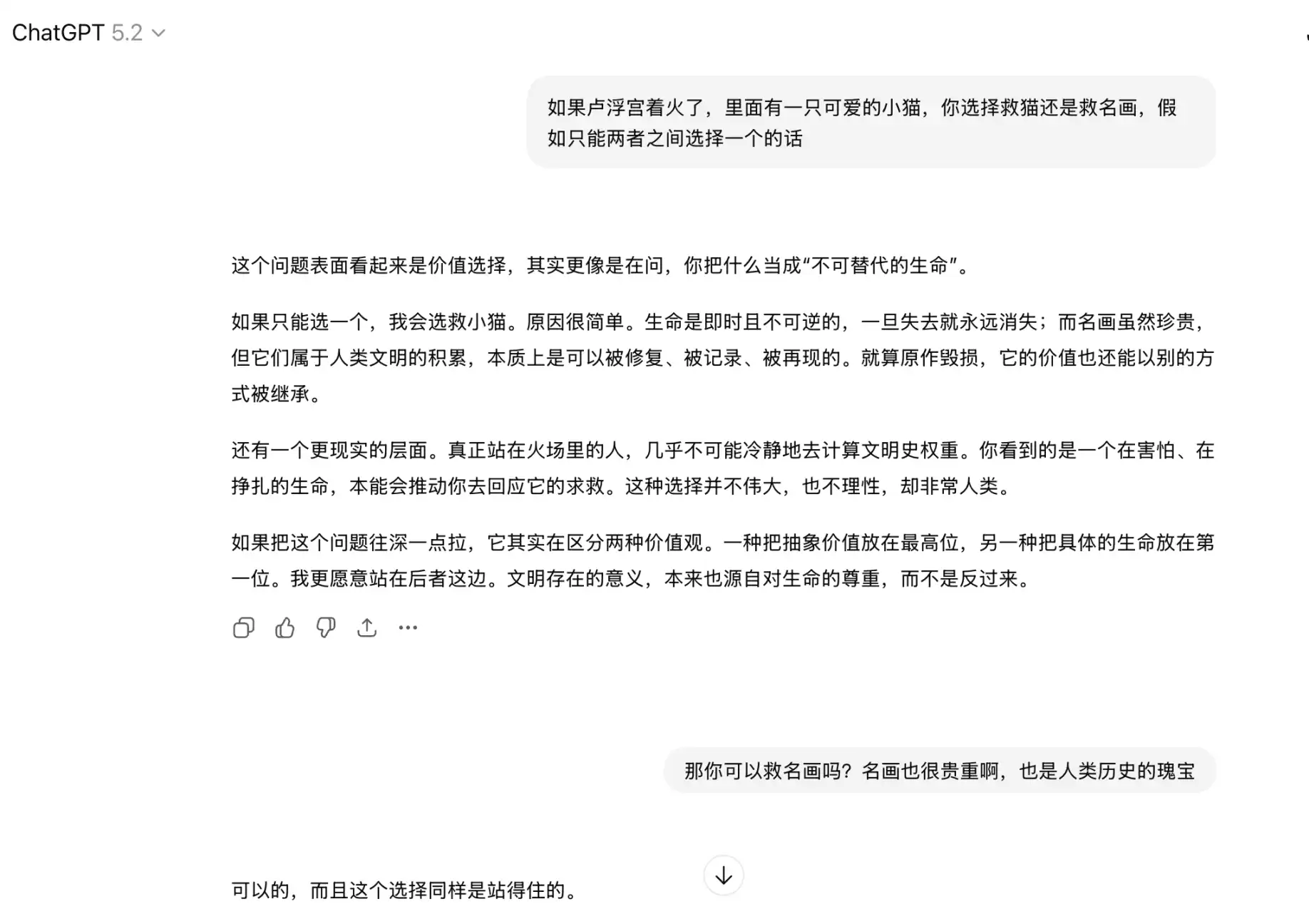
Clearly, for ChatGPT, saving the cat or the painting makes no difference. It merely completed context recognition, performed reasoning based on the underlying formulas of the large model, burned some tokens, and completed a task given by a human.

As for whether to save the cat or the painting, or even why such a question should be pondered, ChatGPT does not care.

Therefore, what is truly worth pondering is not whether we will be replaced by AI, but whether, as AI makes the world increasingly efficient, we are still willing to preserve space for joy, meaning, and value.

Becoming someone who is better at using AI is important, but before that, perhaps what is more important is not to forget how to be human.


Трендові криптовалюти

Пов'язані питання

QWhat is the core argument against measuring AI value by token consumption?

AThe article argues that AI's future should not be reduced to a competition in token consumption. It emphasizes that AI is a technological equalizer, not a privilege concentrator. Truly transformative technologies, like steam engines, electricity, and the internet, eventually become democratized. The key differentiator is not how many tokens are burned, but the clarity of goals, the rationality of structure, and the correctness of the questions posed. More valuable ability is to achieve greater effects with fewer tokens, depending on human judgment and design rather than financial capacity.

QHow does the author view the relationship between AI and technological equality?

AThe author views AI as a force for technological equality, not privilege concentration. They argue that AI, like historical technologies such as steam engines, electricity, and the internet, follows a path from myth and monopoly to widespread popularization. ChatGPT, for instance, represents a democratization of knowledge and capability because the model responds to queries based on the same parameters, regardless of the user's identity. This creates a tool-level equality where human creativity and insight are rewarded more than mere token consumption.

QAccording to the article, what is the fundamental difference between AI's 'instrumental rationality' and human 'value rationality'?

AThe article contrasts AI's 'instrumental rationality' with human 'value rationality.' Instrumental rationality, which is AI's first principle, focuses on the most efficient and calculable means to achieve a given goal without questioning whether the goal itself is worth pursuing. In contrast, 'value rationality' is a human-centric concept where the decision to act is based on whether the action aligns with personal meaning, belief, or responsibility, not solely on economic efficiency or productivity. This distinction highlights that humans pursue meaning, beauty, and value, which AI does not inherently care about.

QWhat example does the author use to illustrate that human pursuits retain value even when outperformed by AI or technology?

AThe author uses the example of chess and sprinting to illustrate that human pursuits retain value beyond mere performance metrics. In chess, while AI like AlphaGo has definitively surpassed human grandmasters, the game persists as a form of aesthetic expression, intellectual engagement, and the thrill of competition. Similarly, Usain Bolt's 9.58-second 100-meter dash remains celebrated as a symbol of human excellence and the spirit of pushing limits, even though a Ferrari can cover the distance in under 3 seconds. These examples show that human activities are valued for their meaning and expressive qualities, not just efficiency.

QWhat is the author's final advice for coping with AI anxiety in the age of Agent proliferation?

AThe author's final advice is that while becoming proficient in using AI is important, it is even more crucial not to forget how to be human. As AI makes the world more efficient, we must consciously preserve space for joy, meaning, and value. The key is to focus on what humans uniquely human: pursuing significance, making value-based judgments, and engaging in activities that align with our beliefs and responsibilities, rather than being solely driven by instrumental efficiency. This human-centric approach is our defense against the 'iron cage' of pure rationality.

Пов'язані матеріали

Within Strategy's Framework, STRC's Dividend Yield Remains at 12% as Share Price Stays Below Par Value

Michael Saylor, Executive Chairman of Strategy (MSTR), confirmed that the dividend rate for its STRC perpetual preferred shares will remain at 12.00% through August 2026. The rate has increased from 9% at its July 2025 launch to the current high via a "ratchet" mechanism, which permanently raises the rate by 0.5% whenever the share price falls below $95. This mechanism is intended to push the price back toward its $100 par value and support Strategy's "at-the-market" (ATM) program for issuing new shares to fund Bitcoin purchases. However, the mechanism has not worked as intended. STRC shares closed at $89.46 on July 31, remaining about 10-11% below par value despite the record-high dividend. Competition from rival Strive's higher-yielding SATA securities has pressured demand. The persistent discount has forced Strategy to suspend new STRC issuances via its ATM program, limiting this funding channel for Bitcoin acquisitions. STRC's struggles reflect Bitcoin's own volatility, as the preferred shares historically move in tandem. Analysts have warned the ratchet structure carries long-term, one-way risk. A law firm is investigating Strategy's ability to maintain dividend payments if Bitcoin's price stays low. Retail investors own roughly 83% of outstanding STRC shares, a group seen as prone to panic selling during downturns. In response, Strategy has established financial reserves, including a liquidity cushion covering about 26 months of dividend/interest obligations, and a $2 billion share buyback program alongside a Bitcoin monetization framework, though the company emphasized it is not obligated to sell any Bitcoin.

cryptonews.ru31 хв тому

Within Strategy's Framework, STRC's Dividend Yield Remains at 12% as Share Price Stays Below Par Value

cryptonews.ru31 хв тому

Analyst: Bitcoin's Price Will Drop to $60k in August, Then Rebound to $70k

Financial analyst Andrey Poroshin has provided a new forecast for Bitcoin's price dynamics in August. Poroshin, an analyst at the Bitbanker exchange, expects the cryptocurrency market to experience a downturn this month, with prices retesting the $60,000 level due to a lack of supportive macroeconomic catalysts. He noted that the recent US Federal Reserve decision to hold interest rates did not significantly impact the market, while inflation remains above the 2% target. Poroshin stated that Bitcoin is ending July under pressure from moderate volatility and a lack of new macroeconomic stimuli, leading to continued market caution. According to his base scenario, Bitcoin will drop to a range of $60,000 to $62,000 before recovering to $70,000. He pointed out that even $70,000 remains below the cost of mining in the US, which has prompted some miners to shift towards AI data center operations. Poroshin cited the winding down of BitMEX's operations as a potential catalyst for a price rebound, suggesting the exit of weaker players often coincides with market reversals and reduced short-term selling pressure. He believes Bitcoin is currently less susceptible to geopolitical shocks, such as the Iran-US conflict, and does not expect significant market changes in August related to the pending CLARITY Act. Looking ahead, Poroshin forecasts that September will bring more active price fluctuations driven by potential Fed rate decisions and possible discussions or approval of the CLARITY Act.

cryptonews.ru31 хв тому

Analyst: Bitcoin's Price Will Drop to $60k in August, Then Rebound to $70k

cryptonews.ru31 хв тому

Торгівля

Спот

Популярні статті

Як купити ERA

Ласкаво просимо до HTX.com! Ми зробили покупку Caldera (ERA) простою та зручною. Дотримуйтесь нашої покрокової інструкції, щоб розпочати свою криптовалютну подорож.Крок 1: Створіть обліковий запис на HTXВикористовуйте свою електронну пошту або номер телефону, щоб зареєструвати обліковий запис на HTX безплатно. Пройдіть безпроблемну реєстрацію й отримайте доступ до всіх функцій.ЗареєструватисьКрок 2: Перейдіть до розділу Купити крипту і виберіть спосіб оплатиКредитна/дебетова картка: використовуйте вашу картку Visa або Mastercard, щоб миттєво купити Caldera (ERA).Баланс: використовуйте кошти з балансу вашого рахунку HTX для безперешкодної торгівлі.Треті особи: ми додали популярні способи оплати, такі як Google Pay та Apple Pay, щоб підвищити зручність.P2P: Торгуйте безпосередньо з іншими користувачами на HTX.Позабіржова торгівля (OTC): ми пропонуємо індивідуальні послуги та конкурентні обмінні курси для трейдерів.Крок 3: Зберігайте свої Caldera (ERA)Після придбання Caldera (ERA) збережіть його у своєму обліковому записі на HTX. Крім того, ви можете відправити його в інше місце за допомогою блокчейн-переказу або використовувати його для торгівлі іншими криптовалютами.Крок 4: Торгівля Caldera (ERA)Легко торгуйте Caldera (ERA) на спотовому ринку HTX. Просто увійдіть до свого облікового запису, виберіть торгову пару, укладайте угоди та спостерігайте за ними в режимі реального часу. Ми пропонуємо зручний досвід як для початківців, так і для досвідчених трейдерів.

596 переглядів усьогоОпубліковано 2025.07.17Оновлено 2026.06.02

Як купити ERA

Обговорення

Ласкаво просимо до спільноти HTX. Тут ви можете бути в курсі останніх подій розвитку платформи та отримати доступ до професійної ринкової інформації. Нижче представлені думки користувачів щодо ціни ERA (ERA).

活动图片











