In the AI Era, How Do GitHub Stars Become Developers' 'Proof of Execution'?

比推Опубліковано о 2026-03-10Востаннє оновлено о 2026-03-10

Анотація

"The article argues that GitHub has evolved from a code hosting platform into an 'execution stock exchange' in the AI era, where stars serve as verifiable proof of attention and execution. Key metrics like stars, forks, issues, and pull requests are framed as forms of developer capital: stars represent public confidence, forks indicate real investment of time, issues drive progress, and PRs enable compounding collaboration. The author highlights real-time data from fast-growing AI-related repositories, such as openclaw and paperclip, to demonstrate how GitHub signals market trends. The platform is presented as a transparent, actionable market for developer attention, where users can build a quantifiable 'social capital ledger' by tracking and investing in promising projects early."

Author: AttentionVC

Compiled by: Deep Tide TechFlow

Original title: In the Era of Universal AI, the Star on GitHub Is the New Social Capital


Deep Tide Introduction: AttentionVC posted a widely noticed long tweet, with the core argument being: GitHub is no longer just a code hosting platform; it is the 'execution exchange' of the AI era.

Star count is a verifiable attention signal, Fork is real investment, and PR is compound collaboration. They tracked over 4,600 code repositories and 474 developers, 71% of which are AI-related.

This tweet itself is also a promotion for their product GitHubVC, but the observation of GitHub as a 'developer social capital ledger' is indeed interesting.

Full text as follows:

You released something amazing. A feature that improves workflow efficiency by 10 times. The code is so clean it's heartbreaking. Yet... your repo only has 10 stars. Maybe 100 if you're lucky.

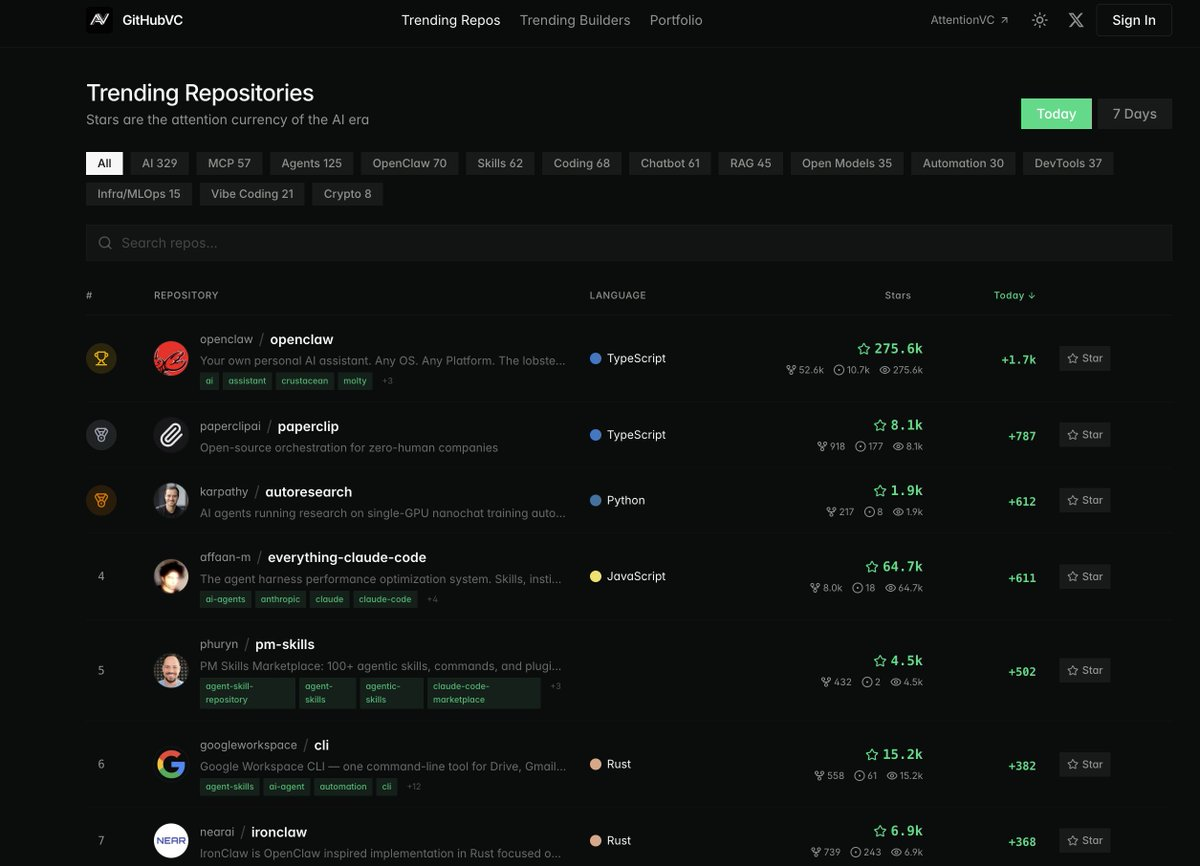
Meanwhile, @openclaw just surpassed 275,000 stars, with a daily increase of 2,870 stars, overtaking many long-standing top projects and securing one of the highest star counts on GitHub.
That moment wasn't luck. It proved something irreversible:

GitHub has evolved. It is no longer just 'code hosting.' It is the execution exchange of the AI era, and execution signals are the scarcest, most verifiable form of attention.

On X, You Express; On GitHub, You Execute

X gives you emotion, virality, reach. GitHub gives you proof. A viral tweet dies in 48 hours. A steep star growth curve lives forever—founders track it, investors do due diligence, and Agents will soon rank by it.

As you read this:

  • paperclipai/paperclip grows by +1,191 stars daily

  • Google Workspace CLI, launched just days ago, already has 15,000 stars, growing by +935 daily

  • OpenAI Symphony reached 8,400 stars, growing by +834 daily

These are not vanity metrics—they are real-time market signals, indicating where developer attention is flowing.

No matter how killer your feature is, it's useless if no one sees the signal.

Star = Vote, Fork = Commitment, Issue = Conversation, PR = Delivery

These are no longer just mechanisms. They are the atomic units of developer capital:

  • Star → Public deposits of confidence

  • Fork → I'm betting real time and energy on you

  • Issue → Conversations that actually move things forward

  • PR → Collaborations that compound into production

Junk traffic bounces off. Only real developer attention compounds here.

We are currently tracking over 4,600 code repositories and 474 developers. 71% of them are AI-related. The frontier is being built here—the signals are all public, if you know where to look.

Currently Fastest-Growing Repos (Real-Time Data)

  • openclaw/openclaw — 275k stars (today +2,870)

  • paperclipai/paperclip — 7.7k stars (today +1,191)

  • googleworkspace/cli — 15k stars (today +935)

  • openai/symphony — 8.4k stars (today +834)

  • everything-claude-code — 64k stars (today +802)

Full list:

https://github.attentionvc.ai/trending/repos

Your Personal Attention Portfolio, Now Quantifiable

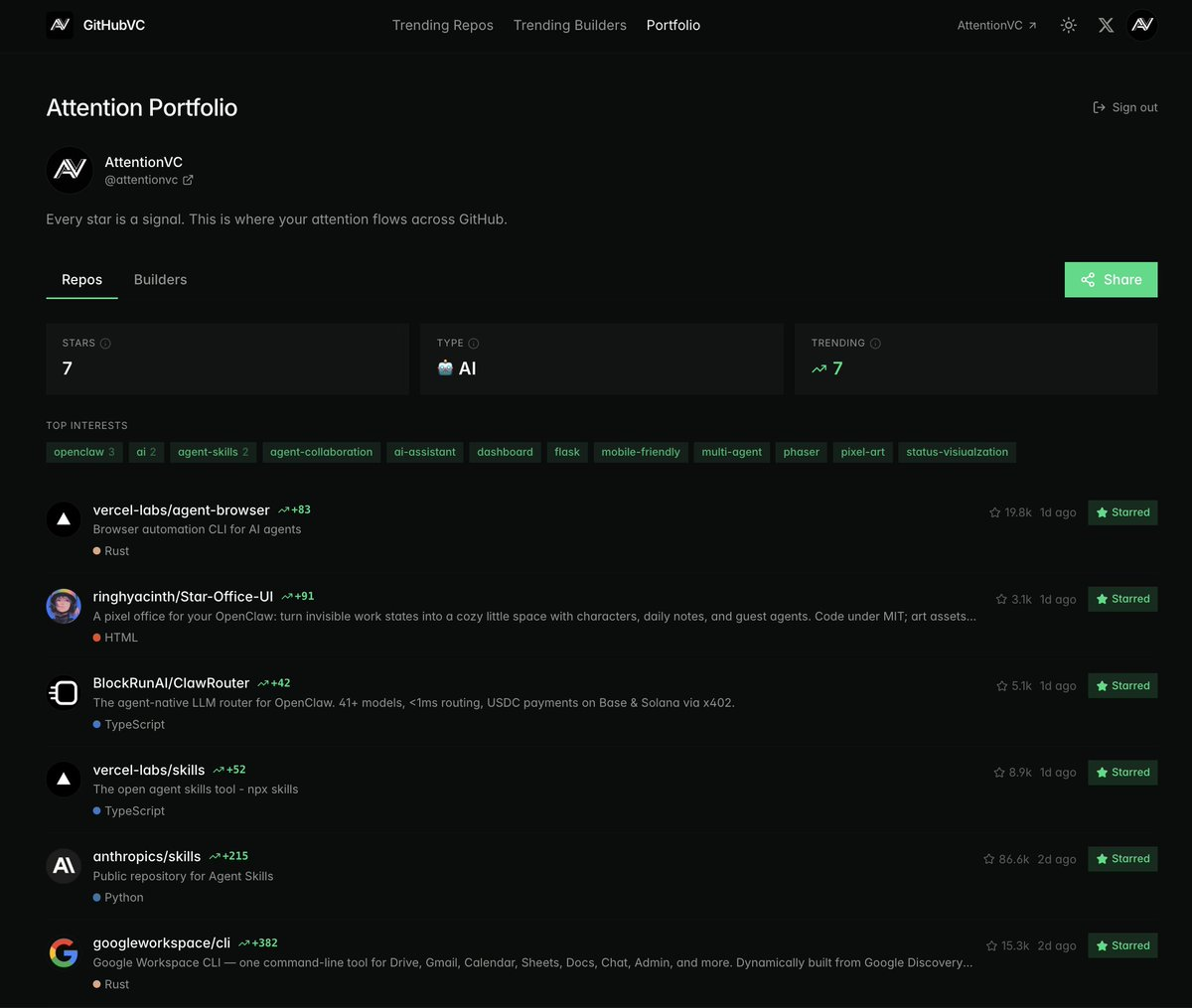
Log in with your GitHub account. See a repo you believe in? Star it directly in GitHubVC. Then watch in real time:

Does your bet appear on the daily fastest-growing list? Did your early star follow the curve from 200 → 20k → 200k?

This is the missing闭环: You're not just consuming signals—you're creating them and tracking them. Your star becomes a verifiable bet with public ROI.

Every Developer Gets a Dynamic Social Layer

GitHubVC turns your GitHub identity into something far more powerful—your personal capability network.

You start building:

  • A curated portfolio of repos, recording where you placed attention early

  • A visible trust trail: which developers you believed in at 200 stars, who grew to 200k

  • An influence score that rises whenever a repo you starred explodes

This isn't about having more followers. It's about having a trust trail—a permanent record of who believed in whom first.

Your GitHub is no longer a static profile. It becomes your public, verifiable social capital ledger in the developer economy.
GitHub Is Now a Real-Time Market for Developer Attention

In the real world, judging execution is slow, subjective, private. On GitHubVC, it's instant, public, actionable.

The era of treating GitHub attention as serious capital has arrived.

Stop wondering why your killer product remains unseen. Come build your portfolio. Place your attention bets on the next 200k-star repo. Leave a trust trail that compounds forever.


Twitter: https://twitter.com/BitpushNewsCN

BitPush TG Discussion Group: https://t.me/BitPushCommunity

BitPush TG Subscription: https://t.me/bitpush

Original link: https://www.bitpush.news/articles/7618433

Пов'язані питання

QWhat is the core argument of the article regarding GitHub in the AI era?

AThe core argument is that GitHub has evolved beyond a code hosting platform into an 'execution stock exchange' for the AI era, where stars serve as a verifiable signal of developer attention and execution capability.

QAccording to the article, what do the different GitHub actions (Star, Fork, Issue, PR) represent?

AStar represents a public vote of confidence; Fork represents investing real time and effort; Issue represents dialogue that drives progress; and PR represents collaborative work that compounds into the production environment.

QWhat percentage of the 4600+ repositories and 474 developers tracked by GitHubVC are AI-related?

A71% of the tracked repositories and developers are AI-related.

QWhich repository had the highest number of stars and the highest daily growth according to the real-time data mentioned?

AThe openclaw/openclaw repository had the highest number of stars at 275,000 and the highest daily growth with an increase of 2,870 stars.

QHow does GitHubVC enhance a developer's GitHub profile according to the article?

AGitHubVC transforms a developer's GitHub profile into a dynamic social capital ledger, allowing them to build a curated portfolio of repos, a visible trust trail of early support for successful projects, and an influence score that increases when their starred repos gain popularity.

Пов'язані матеріали

Three Months, 35 Billion Yuan: Investors Rush to Grab the OpenAI of the Physical World

Investors flock to a physical AI startup as the race for the "OpenAI of the physical world" heats up. Ji Jia Shi Jie (GigaWorld), a company dedicated to developing Artificial General Intelligence (AGI) for the physical world, has raised 3.5 billion RMB (approximately $490 million) in just three months, according to a report from investment media outlet Touzijie. The latest B2 funding round of 1 billion RMB attracted a wide range of top-tier investors, including sovereign wealth funds, industrial capital, and financial institutions. This brings the total funding for the young company, now valued over 10 billion RMB, to 3.5 billion RMB across three recent rounds. The company is led by Huang Guan, a post-90s Tsinghua University PhD with extensive experience in AI, autonomous driving, and entrepreneurship. Its core innovation is a "dual-pyramid" system comprising a five-layer data pyramid (from internet videos to real-world robot data) and a three-layer algorithm pyramid focused on world simulation, action alignment, and reinforcement learning. This system underpins its key models: the "World Action Model" (e.g., GigaBrain series for robot control) and the "World Generation Model" (e.g., GigaWorld series for simulating and understanding the physical world). Its models have reportedly achieved top rankings in global robotics benchmarks. Ji Jia Shi Jie argues that while current digital AGI excels in information processing, the next frontier is physical AGI—systems that can understand and interact with the real world. The company believes the field is approaching its "GPT-3 moment," a key inflection point in capability scaling. To achieve this, the company is pursuing a dual-market strategy. For the consumer (C) market, it launched the "SeeLight" brand and its S1 general-purpose humanoid robot, which has secured initial orders for deployment in real homes. For the business (B) market, it focuses on industrial automation with its Maker series robots, having signed agreements for large-scale deployment in factories, and its DriveDreamer world model for autonomous driving, which is already in use with over 30 automakers and tech companies. The report concludes that by bridging the gap between digital intelligence and physical action, Ji Jia Shi Jie aims to unlock a new wave of productivity, ultimately bringing physical AGI into everyday life.

marsbit17 хв тому

Three Months, 35 Billion Yuan: Investors Rush to Grab the OpenAI of the Physical World

marsbit17 хв тому

What's the Connection Between Pinduoduo's Huang Zheng and Blockchain?

This text explores the unexpected connection between Pinduoduo founder Colin Huang and blockchain, as suggested in his article *Turning Capitalism Upside Down*. Huang argues Pinduoduo's core business is about managing "uncertainty." He posits that wealth flows to the rich because they absorb life's uncertainties (e.g., illness, job loss) that devastate the poor, who pay a premium for certainty through insurance or stable prices. Pinduoduo's model attempts a "reverse insurance": by aggregating consumer demand via group-buying and flash sales, it creates a large, predictable order for manufacturers. This certainty allows factories to remove risk premiums, passing savings back as lower prices, thus partially reversing the wealth flow. The key obstacle, Huang notes, is that an individual's buying intent is an unreliable promise. He then asks if blockchain is the natural solution for this "reverse insurance." The text elaborates that blockchain, through smart contracts with binding deposits, could transform casual intent into a costly-to-break, enforceable commitment. This replaces interpersonal trust with coded rules, making promises credible, pricable, and resistant to fraud. Finally, the author draws a parallel to Bitcoin, framing two paths to creating certainty: the "Pinduoduo path" of aggregating decentralized will into scale, and the "Bitcoin path" of locking rules into immutable code. Both sacrifice something—personal freedom or system flexibility—to manufacture trust and predictability.

链捕手1 год тому

What's the Connection Between Pinduoduo's Huang Zheng and Blockchain?

链捕手1 год тому

The Storage Magnate Who Conquered a Trillion-Dollar Kingdom, Yet Ultimately Could Not Become the Richest

**Summary:** "The Memory Magnate Who Built a Trillion-Dollar Empire, Yet Never Became the Richest" explores the journey of Zhu Yiming, founder of GigaDevice (603986) and co-founder of the soon-to-IPO ChangXin Memory Technologies (CXMT). The article positions GigaDevice, a fabless chip designer now valued at ~¥340 billion, as a prequel to the massive IDM (Integrated Device Manufacturer) venture, CXMT. Starting in 2005 with minimal capital, Zhu strategically "picked up the pieces" by focusing on niche markets like NOR Flash and microcontrollers (MCUs), areas major players were exiting. This allowed GigaDevice to grow into a diversified semiconductor company, maintaining robust profitability even during industry downturns by controlling costs. However, the piece argues that in the highly cyclical and capital-intensive memory chip industry, the fabless model has limits. True resilience and scale require the ability for "counter-cyclical expansion" – investing heavily during downturns – a tactic only possible for IDMs like Samsung or SK Hynix. This insight led Zhu to partner with the Hefei city government in 2016 to establish CXMT, an IDM focused on DRAM. Zhu's symbolic moves, like forfeiting salary and diluting his equity, were crucial in securing the massive state and bank funding needed. CXMT's equipment base is now valued even higher than that of BYD's vast auto manufacturing empire. Despite the potential for CXMT to reach a market cap of ¥1-2 trillion upon its IPO, Zhu's indirect stake in both companies is estimated below 3%, placing his personal wealth far below that of China's top billionaires. The article concludes that his strategic vision built a trillion-yuan memory landscape, but the capital structure necessary to achieve it precluded a personal fortune of similar scale.

marsbit1 год тому

The Storage Magnate Who Conquered a Trillion-Dollar Kingdom, Yet Ultimately Could Not Become the Richest

marsbit1 год тому

XRP Ledger Daily Fees Drop Below $400 As Network Activity Question Returns

The XRP Ledger is drawing attention as daily network fees have fallen below $400. While low fees align with XRPL's design for affordable transactions and are often seen as a strength, the metric can also serve as an indicator of network demand and paid transaction volume. This data point of around $3,100 in weekly fee burn highlights the stark contrast with higher-fee chains like Ethereum and Bitcoin. The development fuels an ongoing debate. Proponents view low fees as a sign of efficiency and accessibility, while critics may question if the network is generating sufficient high-value activity relative to its market cap and payments-focused narrative. The article cautions against overstating the finding, noting a single low-fee day does not signify network failure. It instead adds context to discussions about XRPL's usage, especially alongside Ripple's broader initiatives in stablecoins (RLUSD), AI payments, and enterprise infrastructure. The report recommends monitoring for a fee rebound, checking transaction counts for a fuller picture, and confirming the trend via native explorers like Bithomp. It frames the story within a larger market shift where on-chain data, protocol updates, and infrastructure developments are becoming crucial alongside price action. The editorial stance is to present the verified data, explain its significance for assessing network activity, and avoid hype, positioning it as part of the daily crypto conversation.

bitcoinist6 год тому

XRP Ledger Daily Fees Drop Below $400 As Network Activity Question Returns

bitcoinist6 год тому

Торгівля

Спот
Ф'ючерси

Популярні статті

Як купити ERA

Ласкаво просимо до HTX.com! Ми зробили покупку Caldera (ERA) простою та зручною. Дотримуйтесь нашої покрокової інструкції, щоб розпочати свою криптовалютну подорож.Крок 1: Створіть обліковий запис на HTXВикористовуйте свою електронну пошту або номер телефону, щоб зареєструвати обліковий запис на HTX безплатно. Пройдіть безпроблемну реєстрацію й отримайте доступ до всіх функцій.ЗареєструватисьКрок 2: Перейдіть до розділу Купити крипту і виберіть спосіб оплатиКредитна/дебетова картка: використовуйте вашу картку Visa або Mastercard, щоб миттєво купити Caldera (ERA).Баланс: використовуйте кошти з балансу вашого рахунку HTX для безперешкодної торгівлі.Треті особи: ми додали популярні способи оплати, такі як Google Pay та Apple Pay, щоб підвищити зручність.P2P: Торгуйте безпосередньо з іншими користувачами на HTX.Позабіржова торгівля (OTC): ми пропонуємо індивідуальні послуги та конкурентні обмінні курси для трейдерів.Крок 3: Зберігайте свої Caldera (ERA)Після придбання Caldera (ERA) збережіть його у своєму обліковому записі на HTX. Крім того, ви можете відправити його в інше місце за допомогою блокчейн-переказу або використовувати його для торгівлі іншими криптовалютами.Крок 4: Торгівля Caldera (ERA)Легко торгуйте Caldera (ERA) на спотовому ринку HTX. Просто увійдіть до свого облікового запису, виберіть торгову пару, укладайте угоди та спостерігайте за ними в режимі реального часу. Ми пропонуємо зручний досвід як для початківців, так і для досвідчених трейдерів.

474 переглядів усьогоОпубліковано 2025.07.17Оновлено 2026.06.02

Як купити ERA

Обговорення

Ласкаво просимо до спільноти HTX. Тут ви можете бути в курсі останніх подій розвитку платформи та отримати доступ до професійної ринкової інформації. Нижче представлені думки користувачів щодо ціни ERA (ERA).

活动图片