In Just 70 Days, Polymarket Easily Rakes in Tens of Millions in Fees

Odaily星球日报Опубліковано о 2026-03-16Востаннє оновлено о 2026-03-16

Анотація

Polymarket, a prediction market platform, has generated over $11.2 million in fees in just 70 days since introducing transaction fees on January 6. Initially applied only to "15-minute crypto up/down" markets, the fee structure charges more when odds are near 50% (up to 1.56%) and less when they approach 0% or 100%. By March 6, fees were expanded to all crypto-related markets, which now drive most of the revenue. Weekly fee income has shown consistent growth, reaching $1.84 million in a recent week. If current trading volume and structure continue, Polymarket’s annualized revenue is estimated at $58.4 million under a conservative model. A more aggressive projection—assuming fees are applied to all markets—could yield up to $360 million per year. The platform has also distributed $13.41 million in liquidity provider incentives, which March revenue is on track to cover entirely. Polymarket’s revenue potential hinges on two factors: continued growth in trading volume and further expansion of fee-based markets. The platform has effectively proven the profitability of the prediction market model, positioning it as a highly efficient revenue generator in the crypto ecosystem.

Original | Odaily Planet Daily (@OdailyChina)

Author | Azuma (@azuma_eth)

On January 6th of this year, Polymarket officially ended its "zero-fee" model, beginning a trial implementation of transaction fees starting with the "15-minute cryptocurrency up/down" markets. The specific fee rate varies with the market's real-time odds — the closer the odds are to 0% or 100%, the lower the fee; conversely, the closer the odds are to 50%, the higher the fee, up to a maximum of 1.56%.

Later, on January 28th, about three weeks after the fees were introduced, we published an article titled "Data Estimates Show Polymarket Could Easily Exceed $100 Million in Annual Revenue, Assuming...". The article provided a static estimate based on Polymarket's trading volume and activity structure at the time: in the most conservative scenario, if the scope of fee-charging markets remained unchanged, Polymarket was projected to generate approximately $38 million in annual income; in the most aggressive scenario, if Polymarket extended fees to all markets, it was projected to earn $418 million in annual fee revenue.

When we last estimated Polymarket's revenue, we were hampered by an overly short observation period and too few calculable samples. Now, nearly two months later, we have used richer data to re-estimate Polymarket's revenue expectations. The results show that the so-called "conservative" estimate was indeed too conservative, and the "aggressive" expectation isn't too exaggerated.

Changes in Revenue Data

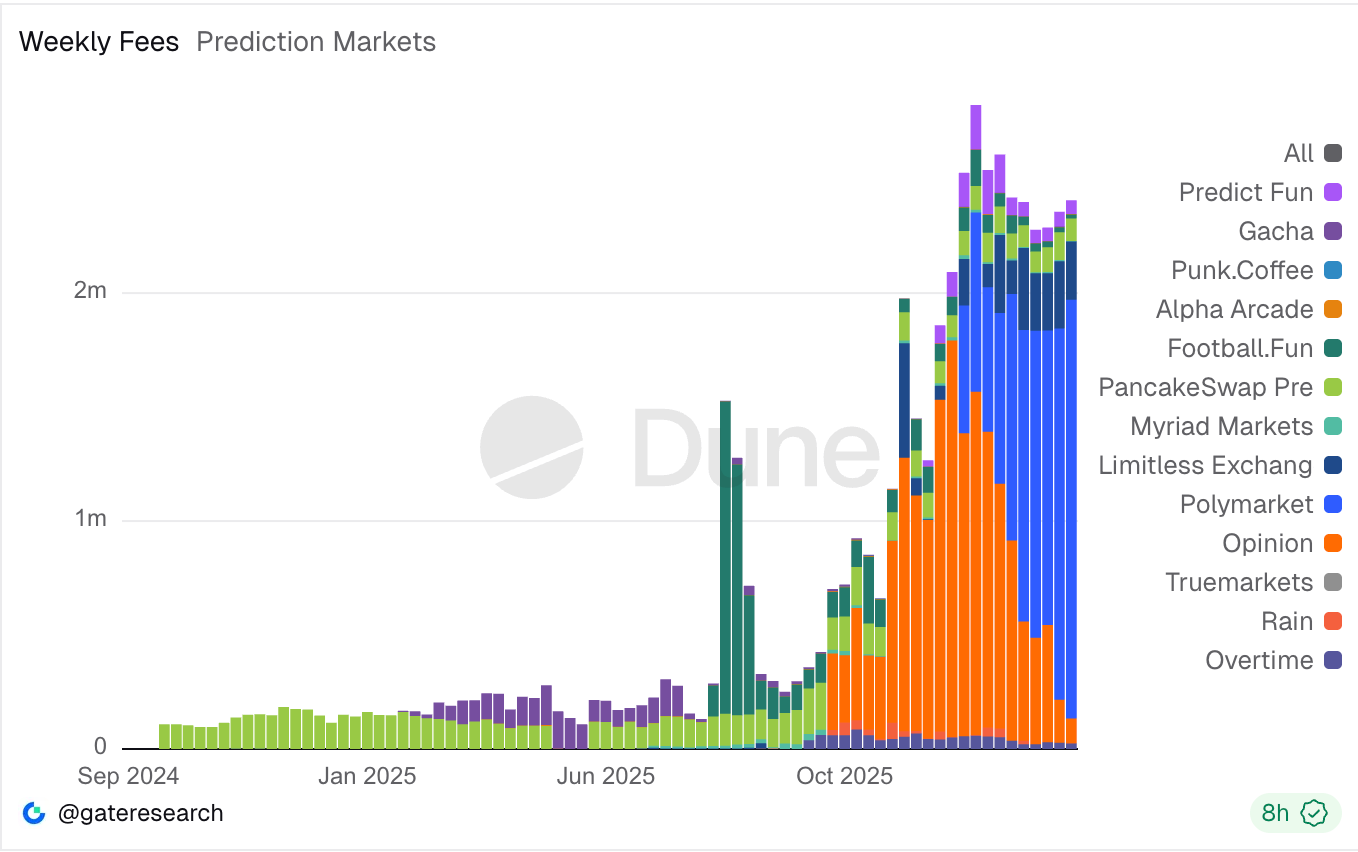
According to data compiled by Gate Research on Dune, since transaction fees were introduced on January 6th, Polymarket has accumulated over $11.2 million in fee revenue.

Using the most conservative method for another static estimate, assuming the trading volume and activity structure of the relevant markets remain unchanged, Polymarket is projected to generate approximately $58.4 million in annual revenue.
However, this estimation method does not accurately reflect Polymarket's revenue-generating capability.

The reason is that Polymarket's revenue data is clearly in a growth trend — over the past 10 weeks, the platform's weekly fee revenue has been $560,000, $786,000, $633,000, $749,000, $1.08 million, $1.28 million, $1.35 million, $1.29 million, $1.63 million, $1.84 million... showing almost weekly significant growth.

Reasons for Revenue Growth

There are two reasons for the growth in Polymarket's fee revenue. First, Polymarket has expanded the scope of fee-charging markets; second, Polymarket's overall trading volume and the trading volume in fee-charging markets have been growing continuously.

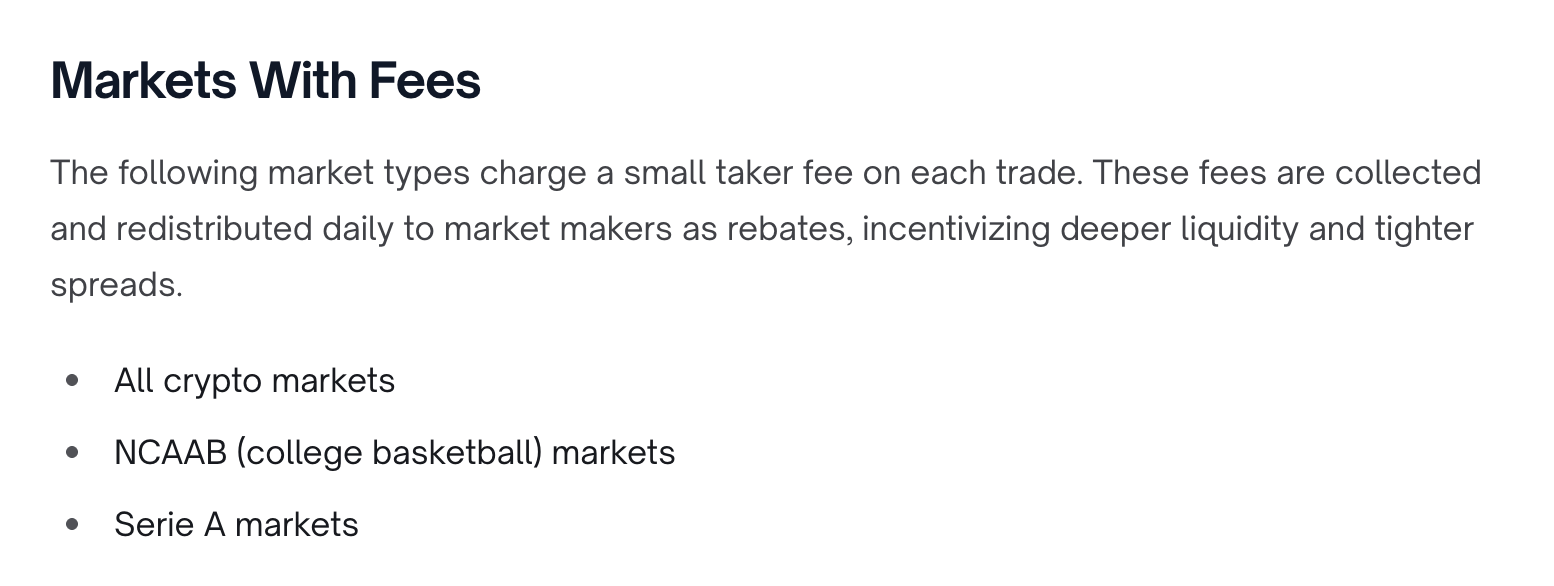
Regarding the scope of fee-charging markets, Polymarket extended the fee mechanism to all cryptocurrency-related markets on March 6th. Additionally, even earlier, it had begun trialing fee collection in sports markets like NCAA and Serie A. However, the former (cryptocurrency-related markets) currently remains the primary source of fee revenue.
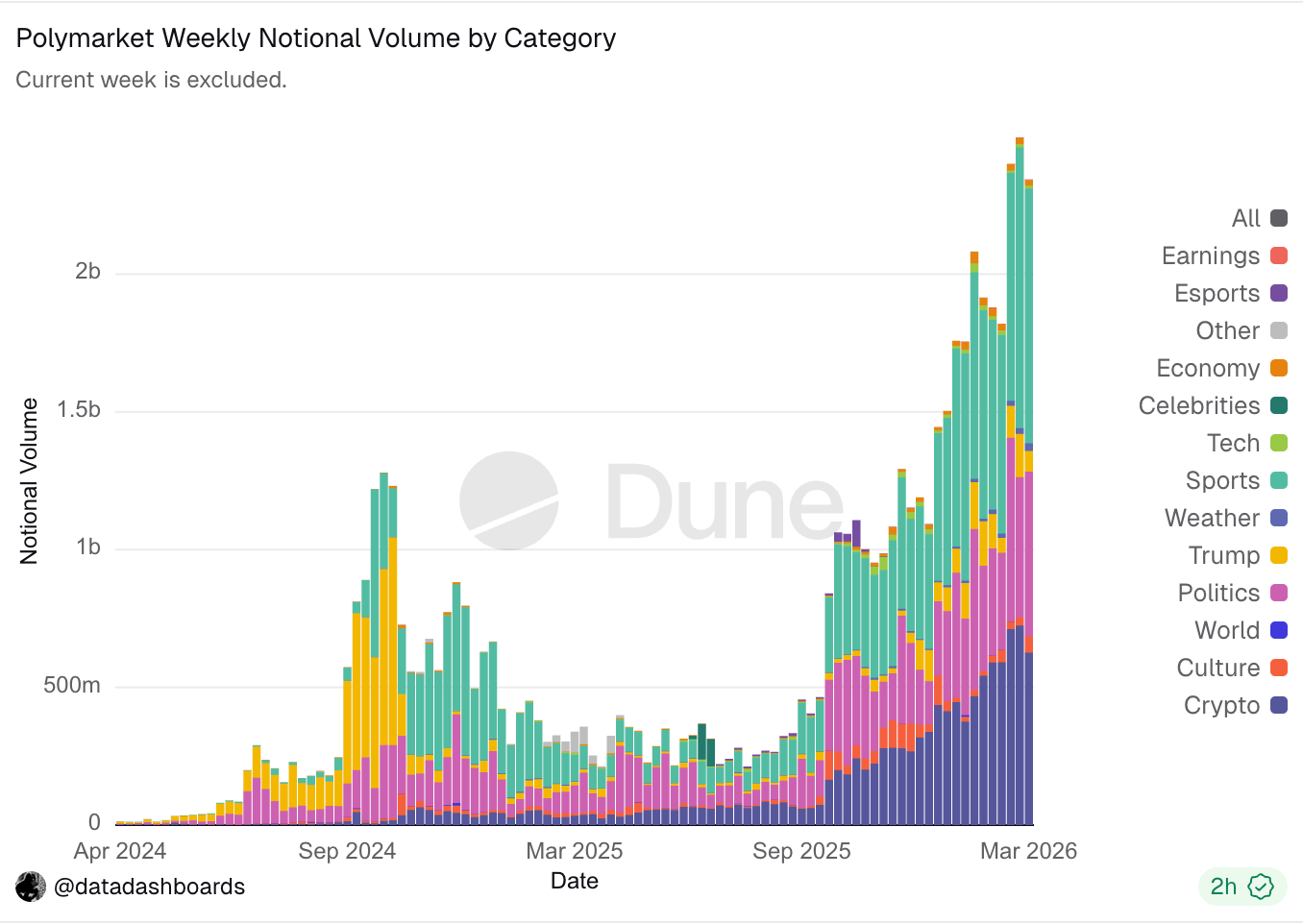
Regarding trading volume, the data dashboard compiled by Data Dashboards on Dune shows that Polymarket's weekly overall trading volume and cryptocurrency market volume (the bottom purple bars) have been growing steadily.
Future Revenue Projections

When we last projected Polymarket's revenue, we had to manually extract the trading volume proportion of "15-minute cryptocurrency up/down" related markets within all cryptocurrency-related markets. But now, since Polymarket extended fees to all cryptocurrency-related markets on March 6th, this estimation is much more straightforward. As for NCAA and Serie A, perhaps because the former hasn't entered the "March Madness" official tournament yet, and the latter has relatively low cultural attention in the US, the trading volume scale of these markets is significantly smaller compared to cryptocurrencies, so they are temporarily ignored here.

Taking data from the only full week after March 6th (March 9th-15th), the trading volume of cryptocurrency-related events accounted for 26.7% of the platform's total trading volume that week. In the same week, Polymarket's fee revenue was approximately $1.84 million. Based on this ratio for a static projection, under the current trading volume level and structure, if Polymarket introduces a similar fee model across all markets, it is projected to bring in $360 million in annual revenue for the platform.

The Money Printer is Already Running

It is worth mentioning that, as a key measure for Polymarket to expand liquidity, the platform has so far distributed a total of $13.41 million in subsidies to liquidity providers (LPs). In contrast, if the data for the remainder of March can continue the performance of the first half, the fee revenue generated by Polymarket within this month alone could cover the total expenditure on liquidity subsidies.

Polymarket has largely proven the revenue-generating capability of this new form of prediction markets. Future revenue growth will mainly depend on two variables — how much more trading volume can grow, and whether fees can be further extended to more markets.

If these two variables continue to trend upwards, prediction markets might become the simplest and most direct "money printer" in the cryptocurrency industry.


Пов'язані питання

QWhen did Polymarket start charging transaction fees, and what was the initial market targeted?

APolymarket started charging transaction fees on January 6, beginning with the '15-minute cryptocurrency up/down' markets.

QHow much fee revenue has Polymarket accumulated since it began charging fees?

APolymarket has accumulated over $11.2 million in fee revenue since it started charging transaction fees.

QWhat are the two main reasons for the growth in Polymarket's fee revenue?

AThe two main reasons are the expansion of fee-charging markets to include all crypto-related markets and the continuous growth in overall trading volume, particularly in cryptocurrency markets.

QWhat is the estimated annual revenue for Polymarket if fees are extended to all markets, according to the latest data?

AIf fees are extended to all markets, the estimated annual revenue for Polymarket is approximately $360 million, based on current trading volume and structure.

QHow does Polymarket's fee revenue compare to the subsidies it has provided to liquidity providers (LPs)?

APolymarket has provided a total of $13.41 million in subsidies to LPs. If the revenue trend from the first half of March continues, the fee income for the month alone could cover the total subsidies paid to LPs so far.

Пов'язані матеріали

TurboFlow Announces Strategic Partnership with Global Giant Susquehanna Crypto, Introducing Wall Street Institutional-Grade Liquidity and Dynamic Odds Market Structure Support

TurboFlow announces a strategic partnership with Susquehanna Crypto, a leading global proprietary digital asset trading firm. As part of this collaboration, Susquehanna Crypto will act as an on-chain liquidity provider and market maker for all TurboFlow products. This partnership brings institutional-grade liquidity, market-making support, and expertise in professional trading, market structure, price discovery, and risk management to the TurboFlow ecosystem. This marks a significant milestone for TurboFlow as it expands its product suite, which includes perpetual contracts and newly launched Event Contracts with durations as short as 30 seconds. Enhanced liquidity depth, efficient price discovery, and market stability are becoming increasingly critical for user experience. Notably, TurboFlow is transitioning its Event Contracts from a traditional fixed-odds model to a more dynamic, market-driven odds structure. Susquehanna Crypto will inject deep liquidity through TurboFlow's proprietary PFOF (Payment for Order Flow) architecture. This aims to ensure minimal slippage and millisecond-level execution for users, even during extreme market volatility, whether trading 1000x leveraged perpetuals or short-duration event contracts. Looking ahead, TurboFlow plans to onboard more top-tier institutional market makers to build a diversified liquidity network. The platform will continue expanding its product ecosystem across several verticals: Event Contracts (extending to assets like crude oil and gold), prediction markets and Telegram Mini Apps, and perpetual contracts. TurboFlow's mission is to democratize trading by making professional-grade infrastructure and a simplified, engaging experience accessible to all users.

链捕手19 хв тому

TurboFlow Announces Strategic Partnership with Global Giant Susquehanna Crypto, Introducing Wall Street Institutional-Grade Liquidity and Dynamic Odds Market Structure Support

链捕手19 хв тому

$30 Billion DeFi Capital Exodus: LayerZero Stumbles, Chainlink Feasts

Following the major DeFi security incident involving Kelp DAO, a significant migration of funds is underway from the cross-chain protocol LayerZero to Chainlink's CCIP (Cross-Chain Interoperability Protocol). Over $30 billion in Total Value Locked (TVL) from protocols like Kelp DAO, Solv Protocol, Re, and Tydro has moved to Chainlink in the past week, driven by security concerns. LayerZero is facing a severe trust crisis after the attack. Initially denying responsibility, LayerZero Labs has now issued a public apology, acknowledging management oversights. These include a vulnerable "1/1" single-node configuration for its Decentralized Verification Network (DVN) and past misuse of a multi-signature wallet by a team member. The protocol's weekly bridge volume has slumped to near-historic lows of around $470 million. In contrast, Chainlink is experiencing a surge in adoption and activity. Its independent active addresses recently hit multi-month highs, and whales have been accumulating LINK tokens. Beyond DeFi, Chainlink is securing partnerships with traditional finance giants like DTCC, European stock exchange operator SIX Group, and asset manager Amundi. While LayerZero has announced security upgrades—such as migrating to stronger multi-signature configurations and developing a second DVN client—and contributed to a rescue fund, the event underscores that security is becoming a decisive competitive factor as DeFi matures.

marsbit1 год тому

$30 Billion DeFi Capital Exodus: LayerZero Stumbles, Chainlink Feasts

marsbit1 год тому

The $13 Trillion Repo Market Is Quietly Being Rewritten by Blockchain

The $13 trillion repurchase agreement (repo) market, a crucial artery for global short-term funding, is experiencing a significant transformation through blockchain technology. After years of limited impact in finance, blockchain is finding substantial adoption in repo transactions. Major institutions like JPMorgan Chase, HSBC, and Broadridge are deploying tokenized repo platforms, with daily volumes already reaching tens of billions of dollars. Traditional repo markets operate with fixed hours, rely on intermediaries, and involve manual, time-consuming processes. Tokenized repos, by contrast, use blockchain to create digital tokens representing cash and securities collateral. This enables near-instantaneous settlement, 24/7 trading, automated execution, and enhanced auditability. The key drivers for adoption include maturing technology, more receptive regulators, and growing client recognition of tangible benefits like reduced operational friction and capital efficiency. Analyses, such as one from Broadridge, indicate that moving a portion of repo activity onto blockchain can significantly reduce a bank's required liquidity buffers, potentially freeing up billions in capital. The infrastructure is also seen as foundational for a future of round-the-clock trading for traditional assets. Challenges remain, including the existence of fragmented blockchain networks, the need for stress testing under extreme market conditions, and the loss of operational flexibility compared to manual processes. However, the industry consensus is that these are implementation hurdles. Tokenized repo has moved beyond pilot stages to become one of blockchain's most concrete and impactful applications in traditional finance, marking a pivotal shift in how a core market functions.

marsbit1 год тому

The $13 Trillion Repo Market Is Quietly Being Rewritten by Blockchain

marsbit1 год тому

Торгівля

Спот
Ф'ючерси
活动图片




