In a Losing Bear Market, Who Is Quietly Making a Fortune?

marsbitОпубліковано о 2026-04-10Востаннє оновлено о 2026-04-10

Анотація

In a bear market where most crypto participants are losing money, a few projects continue to generate significant revenue. A look at Defillama’s revenue rankings reveals that profitable projects share simple and clear revenue models, which fall into two main categories: spread and transaction fees. Spread-based revenue models, used by entities like Tether, Circle, Aave, and Lido, act as capital intermediaries. They profit from the difference between lower funding costs and higher returns from deployed capital, relying on the scale and duration of capital deposits. Transaction fee models, employed by platforms such as Hyperliquid, Polymarket, pump.fun, Aerodrome, and Jupiter, generate income by charging fees on trading activities. Their earnings depend on the size and frequency of transactions. Notable cases include Grayscale (traditional asset management fees), Chainlink (data service fees), and Titan Builder (which profited unusually from a major arbitrage incident). The analysis concludes that sustainable profitability in a bear market comes from straightforward revenue models combined with sophisticated product execution and operational excellence.

Author|Azuma(@azuma_eth)

The market continues to slump, with funds underperforming, protocols shutting down, whales staying silent, and retail investors bleeding... It seems like everyone from top to bottom in the industry is losing money. However, even in such a cold market environment, a very few projects are still running their money-printing machines at full throttle.

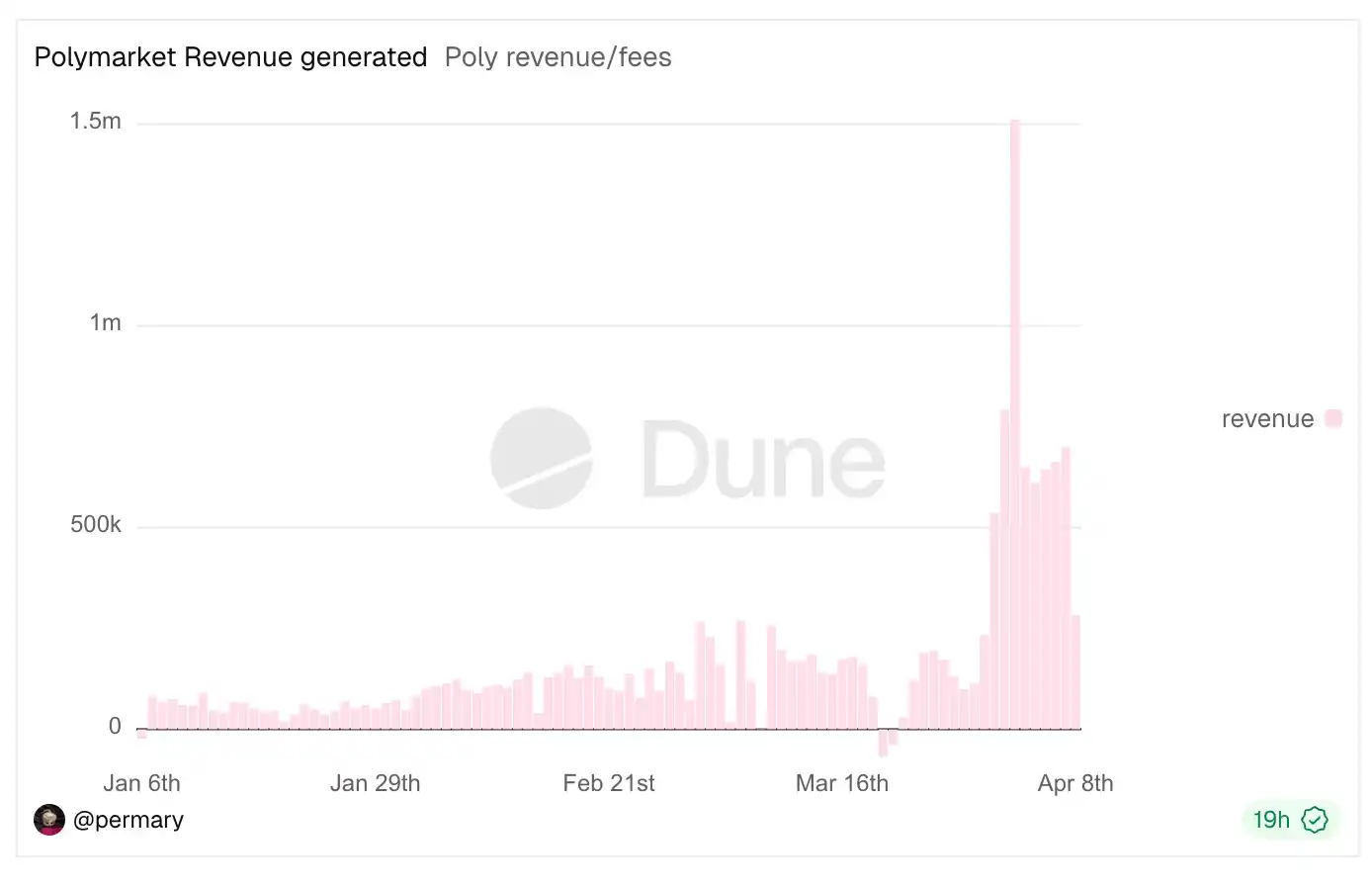
The latest example is Polymarket, which has fully opened its fee gates. Since recently expanding its fee scope and modifying its fee formula (Recommended reading: "Hardcore Analysis of Polymarket's Fee Formula: How Did the Extreme Rate of 90+% Pop Out?"), Polymarket's revenue generation capability has significantly surged; as of publication, Polymarket's total fee income has exceeded $24 million, with a single-day record of $1.5 million in revenue on April 2.
Taking this opportunity, the author checked the revenue rankings on Defillama to see which businesses are still making steady profits in the bear market, and the results were quite surprising: The core businesses and revenue sources of the listed projects are quite clear, even "simple."
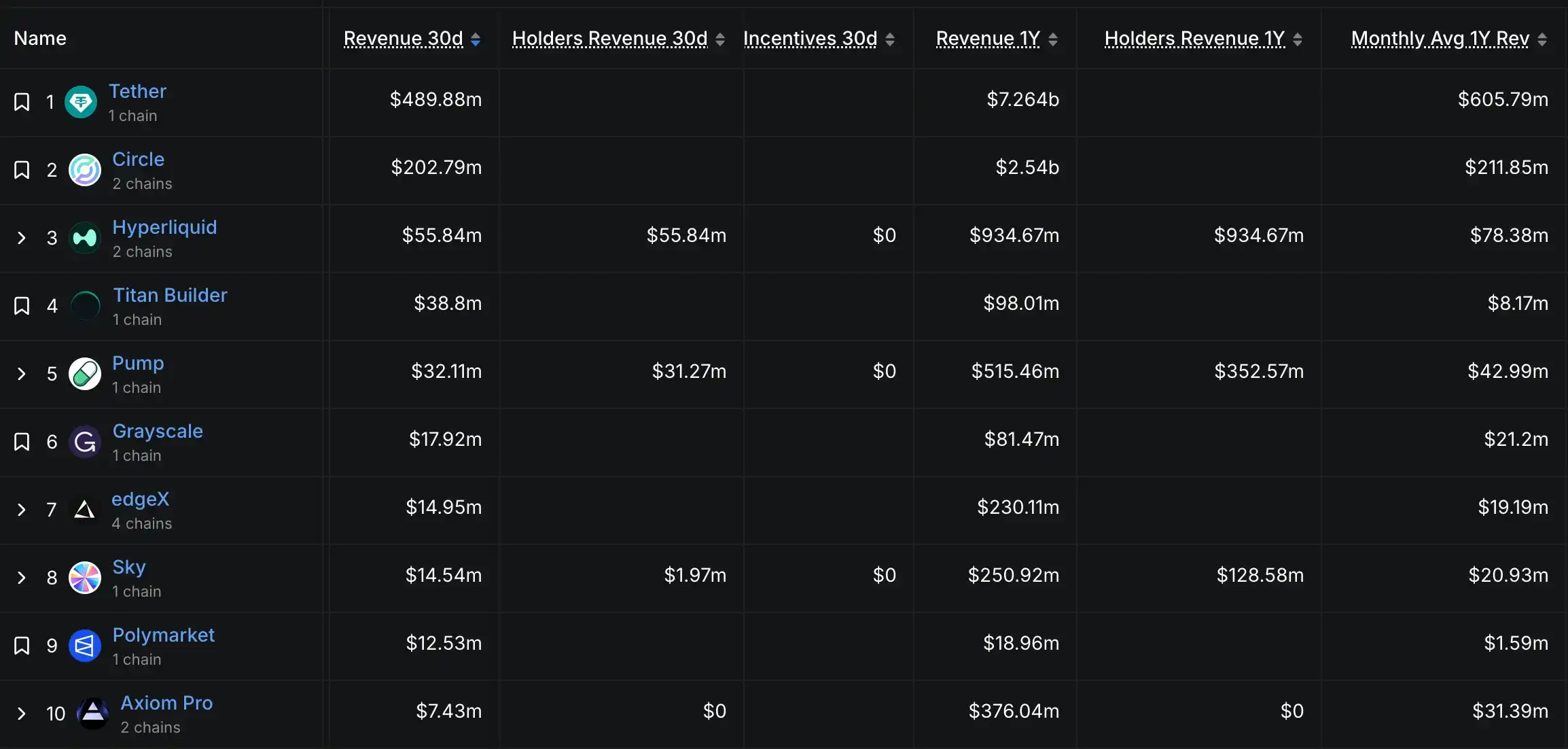
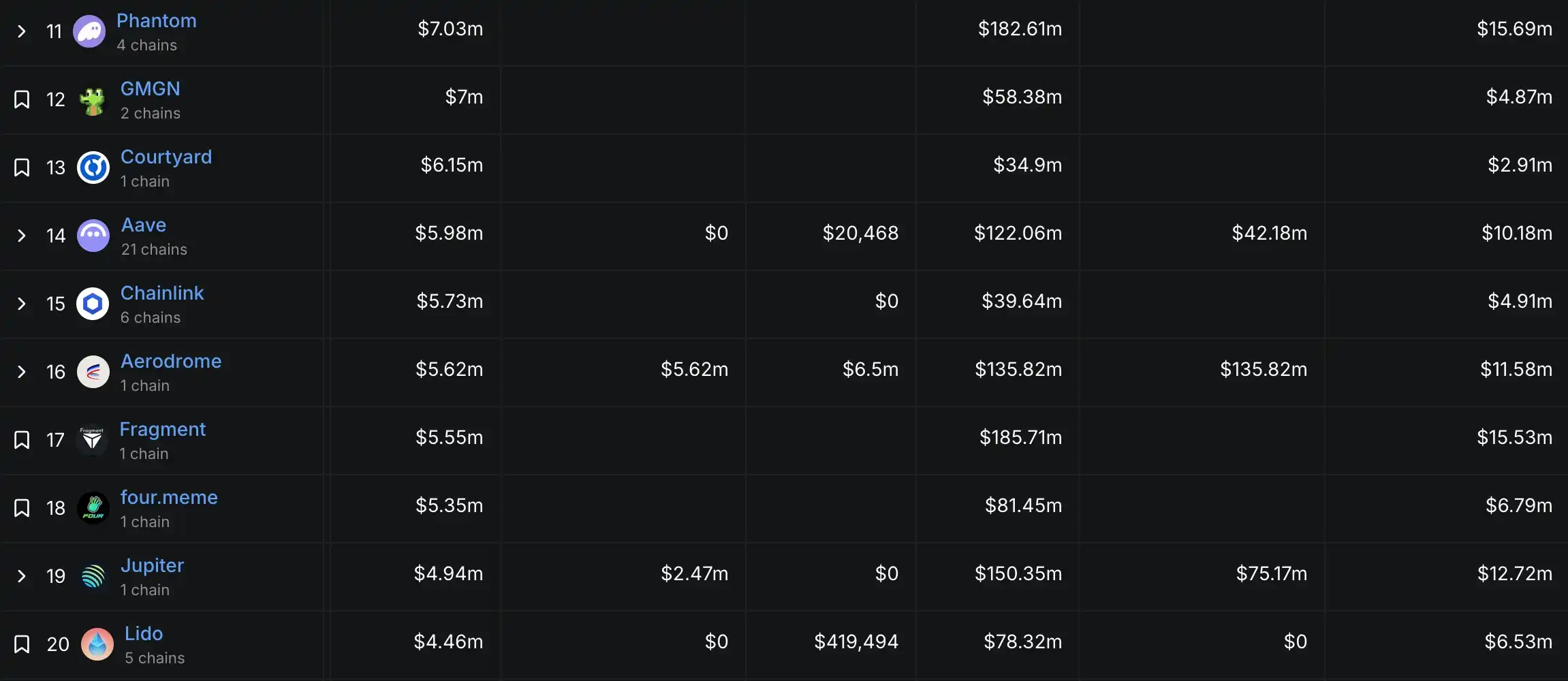
As shown above, I believe most players deeply involved in the crypto market could guess most of these names even without looking at the answers, and probably know exactly what they do. But when these names are neatly listed together, I suddenly realized that the main revenue sources of these profitable businesses are highly convergent, and can basically be summarized into two major categories: one is interest spread, and the other is transaction tax (fees).

First is interest spread, which is essentially acting as a "capital intermediary." The core logic is to absorb funds at a relatively low cost while deploying funds at a relatively high yield, using time to gradually accumulate the difference between the yield and the cost — the profit of such businesses depends on the scale and duration of the capital沉淀 (sedimentation), the larger the scale and the longer the time, the higher the profit.

Stablecoin issuers like Tether and Circle fall into this category. Their main income comes from the interest generated by deploying reserve funds into assets like U.S. Treasury bonds, while the costs mainly involve subsidies paid to partners and users. The difference between the two is the profit. Lending protocols like Aave also belong here; the spread is the difference between the relatively higher borrowing rate and the relatively lower deposit rate. Liquid staking services (LST) like Lido are no exception; they withhold a certain percentage from the native staking rewards as a service fee, which is also a form of interest spread.

Next is transaction tax. This type of business is easier to understand. As long as transaction-related activities (including token creation) occur, the business entity can "levy a tax" in the form of fees on each activity — the profit of such businesses depends on the transaction size per activity and the frequency of activities. The larger the size and the higher the frequency, the higher the profit.

Whether it's Hyperliquid and EdgeX focusing on perpetual contract trading, Polymarket focusing on event trading, pump.fun, GMGN, Axiom, and four.meme focusing on Meme trading, Aerodrome, Jupiter, and Phantom (whose main revenue comes from Swap fees on the wallet frontend) focusing on spot trading, or Courtyard and Fragment focusing on NFT trading (it's quite a surprise this category made the list), their primary revenue source is transaction tax.

The only few special cases in the rankings are Grayscale, Chanilink, and Titan Builder. Grayscale seems a bit out of place here; its core revenue comes from ETF and fund management fees, essentially a traditional asset management business focused on the cryptocurrency market. Chanilink is definitely worth mentioning; its main revenue comes from data service fees paid by projects calling its oracle (which can be categorized as a transaction tax to some extent). This is more like a To B on-chain SaaS business, but as you can see, the Matthew Effect in this path is more significant than in other tracks. Titan Builder is purely a sporadic phenomenon. It is a block builder service provider, not normally a particularly lucrative business. The reason it made the list is that Titan Builder got the biggest piece of the pie in last month's massive AAVE transaction sandwiching incident (see "50M USDT for 35K AAVE: How Did the Disaster Happen?").
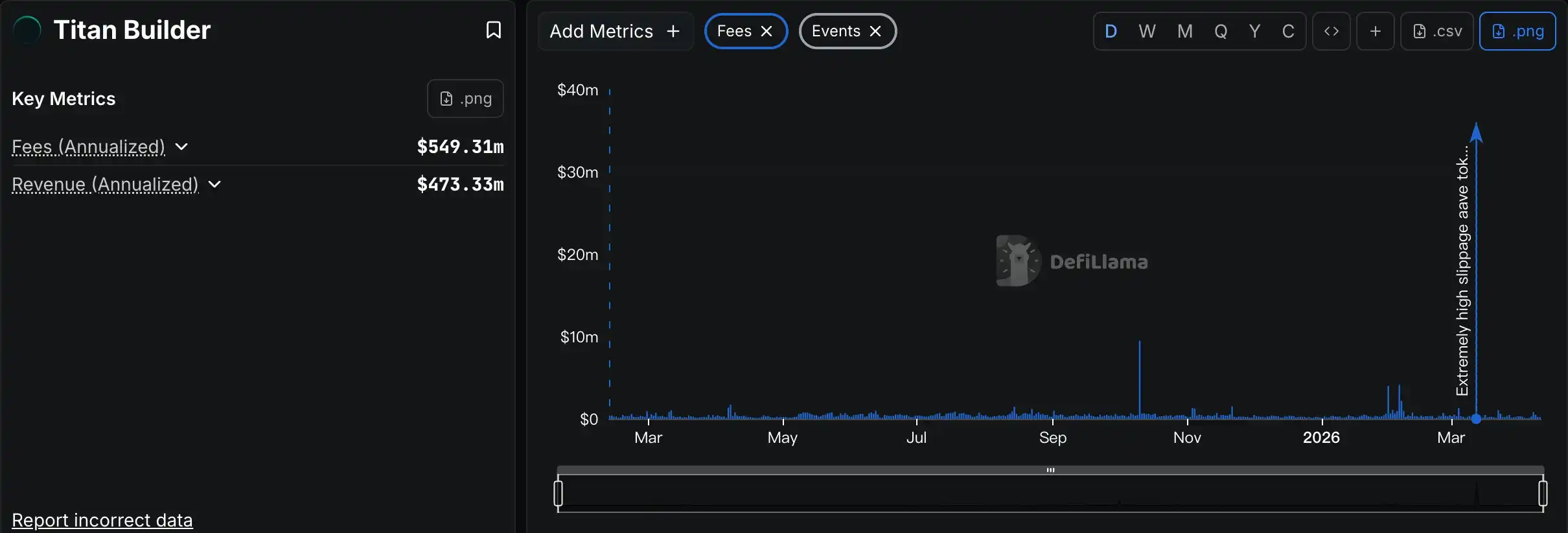
Odaily Note: See what it means to not open for business for three years, but eat for three years when you do.

So the conclusion is clear. The projects that continue to make money in the bear market are not those pursuing complex mechanisms and high-risk opportunities, but those that can operate continuously凭借 (relying on) simple and clear revenue models. In the still volatile cryptocurrency market, simpler revenue models have shown greater resilience and better withstand the test of market fluctuations.

However, a simpler revenue model absolutely does not mean these businesses are "easier to do." On the contrary, behind the simple revenue model often lie more complex product services and精细 (meticulous) operational management. This is where the leading players on the list have truly "competed" their way to differentiation. From interaction design, to liquidity accumulation, to risk management, to user communication and feedback... To stand out in the fierce competition of the存量 (stock) market, one must invest more effort into the product and service.

The crypto winter is not over yet. The projects that can truly survive and even profit are often those that flexibly combine simple revenue models with complex product services. Perhaps, this is the long-term code to穿越 (traverse) bull and bear markets.


Пов'язані питання

QWhat are the two main categories of revenue sources for profitable projects in the crypto bear market, as mentioned in the article?

AThe two main categories are spread (acting as a capital intermediary) and transaction tax (fees).

QWhich project set a single-day revenue record of $1.5 million on April 2nd, according to the article?

APolymarket set a single-day revenue record of $1.5 million on April 2nd.

QWhat is the core revenue source for stablecoin issuers like Tether and Circle, as explained in the article?

ATheir core revenue comes from the interest earned by deploying reserve funds into assets like U.S. Treasury bonds, minus the costs of subsidies to partners and users.

QName one project whose revenue primarily comes from data service fees for oracle calls, as highlighted in the article.

AChanilink primarily earns revenue from data service fees charged for project oracle calls.

QWhat does the article suggest is the key to surviving and profiting in the crypto bear market?

AThe key is combining simple revenue models with complex product services and refined operational management.

Пов'язані матеріали

Google and Amazon Simultaneously Invest Heavily in a Competitor: The Most Absurd Business Logic of the AI Era Is Becoming Reality

In a span of four days, Amazon announced an additional $25 billion investment, and Google pledged up to $40 billion—both direct competitors pouring over $65 billion into the same AI startup, Anthropic. Rather than a typical venture capital move, this signals the latest escalation in the cloud wars. The core of the deal is not equity but compute pre-orders: Anthropic must spend the majority of these funds on AWS and Google Cloud services and chips, effectively locking in massive future compute consumption. This reflects a shift in cloud market dynamics—enterprises now choose cloud providers based on which hosts the best AI models, not just price or stability. With OpenAI deeply tied to Microsoft, Anthropic’s Claude has become the only viable strategic asset for Google and Amazon to remain competitive. Anthropic’s annualized revenue has surged to $30 billion, and it is expanding into verticals like biotech, positioning itself as a cross-industry AI infrastructure layer. However, this funding comes with constraints: Anthropic’s independence is challenged as it balances two rival investors, its safety-first narrative faces pressure from regulatory scrutiny, and its path to IPO introduces new financial pressures. Globally, this accelerates a "tri-polar" closed-loop structure in AI infrastructure, with Microsoft-OpenAI, Google-Anthropic, and Amazon-Anthropic forming exclusive model-cloud alliances. In contrast, China’s landscape differs—investments like Alibaba and Tencent backing open-source model firm DeepSeek reflect a more decoupled approach, though closed-source models from major cloud providers still dominate. The $65 billion bet is ultimately about securing a seat at the table in an AI-defined future—where missing the model layer means losing the cloud war.

marsbit14 хв тому

Google and Amazon Simultaneously Invest Heavily in a Competitor: The Most Absurd Business Logic of the AI Era Is Becoming Reality

marsbit14 хв тому

Computing Power Constrained, Why Did DeepSeek-V4 Open Source?

DeepSeek-V4 has been released as a preview open-source model, featuring 1 million tokens of context length as a baseline capability—previously a premium feature locked behind enterprise paywalls by major overseas AI firms. The official announcement, however, openly acknowledges computational constraints, particularly limited service throughput for the high-end DeepSeek-V4-Pro version due to restricted high-end computing power. Rather than competing on pure scale, DeepSeek adopts a pragmatic approach that balances algorithmic innovation with hardware realities in China’s AI ecosystem. The V4-Pro model uses a highly sparse architecture with 1.6T total parameters but only activates 49B during inference. It performs strongly in agentic coding, knowledge-intensive tasks, and STEM reasoning, competing closely with top-tier closed models like Gemini Pro 3.1 and Claude Opus 4.6 in certain scenarios. A key strategic product is the Flash edition, with 284B total parameters but only 13B activated—making it cost-effective and accessible for mid- and low-tier hardware, including domestic AI chips from Huawei (Ascend), Cambricon, and Hygon. This design supports broader adoption across developers and SMEs while stimulating China's domestic semiconductor ecosystem. Despite facing talent outflow and intense competition in user traffic—with rivals like Doubao and Qianwen leading in monthly active users—DeepSeek has maintained technical momentum. The release also comes amid reports of a new funding round targeting a valuation exceeding $10 billion, potentially setting a new record in China’s LLM sector. Ultimately, DeepSeek-V4 represents a shift toward open yet realistic infrastructure development in the constrained compute landscape of Chinese AI, emphasizing engineering efficiency and domestic hardware compatibility over pure model scale.

marsbit51 хв тому

Computing Power Constrained, Why Did DeepSeek-V4 Open Source?

marsbit51 хв тому

Торгівля

Спот
Ф'ючерси
活动图片