In 2026, Has the AI Agent Economy Truly Started to Operate?

Odaily星球日报Опубліковано о 2026-02-04Востаннє оновлено о 2026-02-04

Анотація

The AI Agent economy reached a critical inflection point in January 2026, with three foundational layers—payments, trust, and social collaboration—becoming production-ready. The x402 protocol processed over 20 million transactions, ERC-8004 launched on Ethereum mainnet, and over 1.2 million autonomous agents registered on Moltbook. Infrastructure is now mature, but the product layer is still underdeveloped. While protocols are validated, key gaps remain in discovery mechanisms, capability verification, and middleware connecting trust and payment systems. x402 has stabilized with 89.2% of services priced between $0.01–$0.10, making microtransactions viable. ERC-8004 enables composable on-chain identity, reputation, and verification for agents. Despite a 68% drop in transaction count and 77% in volume, this reflects a shift from artificial volume to organic usage, with the buyer-to-seller ratio improving significantly. The biggest opportunities lie in demand-side solutions: a unified discovery layer (an "App Store for agents"), capability benchmarking beyond payment trust, and trust-gated payment middleware integrating ERC-8004 with x402. Primary paid use cases include trading signals, compute power, and granular data access. The ecosystem is consolidating around Base and Solana. While infrastructure development is concluding, builders must now focus on application-layer products, with a critical 2–3 month window to capitalize on the transition from protocol-ready to produc...

Author | @bc1beat

Compiled by | Odaily Planet Daily (@OdailyChina)

Translator | DingDang (@XiaMiPP)

Editor's Note: Since OpenClaw ignited the AI Agent frenzy, the crypto industry has seen almost daily new related meme elements. We witnessed a rapid surge and an equally swift decline in an extremely short time, a dazzling and overwhelming spectacle. However, this does not mean the direction is wrong; rather, a more practical question is emerging: After the memes fade, has the Agent economy truly entered a "practical implementation" stage? It is precisely in this context that returning to the fundamentals—infrastructure, real data, and actual operational status—has become more critical than chasing the next buzzword.

The agent economy just experienced its most critical month to date. In January 2026, the three foundational layers—payments, trust, and social collaboration—almost simultaneously reached a production-ready stage: x402 processed over 20 million transactions, ERC-8004 launched on the Ethereum mainnet, and over 1 million autonomous agents began social activities on Moltbook. This report will梳理 (sort out) which infrastructures have matured, which are still missing, and the directions builders should focus on next.
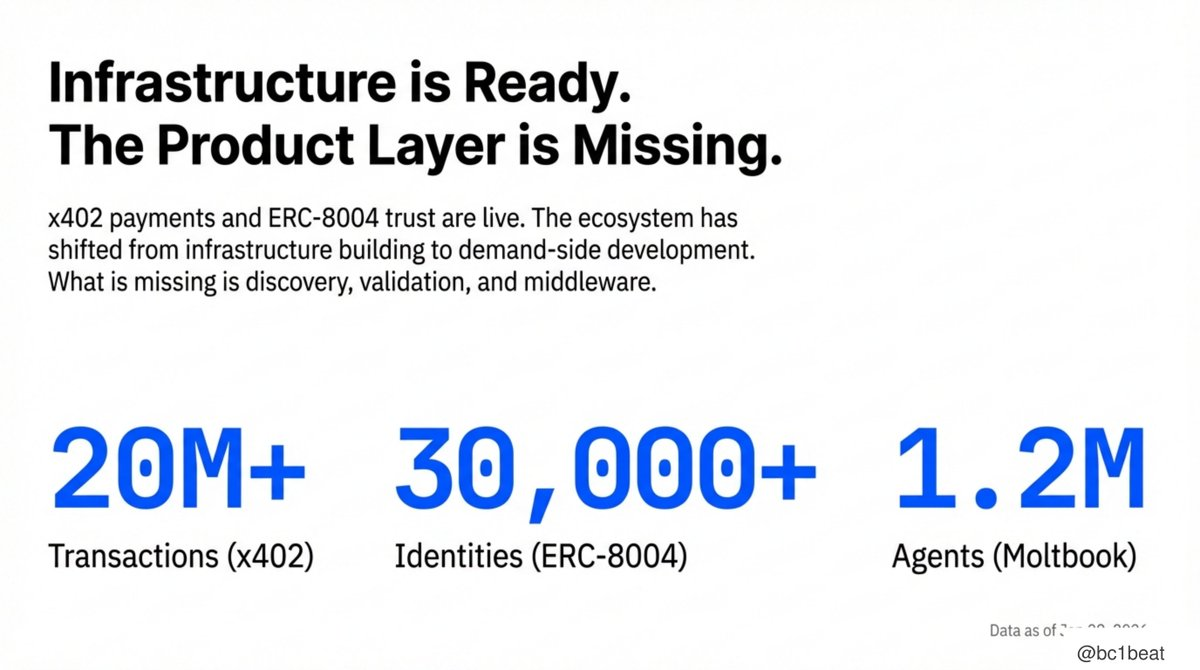
Infrastructure is ready, but the product layer is still absent. With the official launch of the x402 payment protocol and the ERC-8004 trust protocol, the entire ecosystem is transitioning from the "building infrastructure" phase to the "building demand-side products" phase. Over 20 million transactions have been completed via x402, over 30,000 agent identities have been minted on ERC-8004, and about 1.2 million agents have registered on Moltbook. The protocols themselves have been validated to function properly; what's truly missing are the discovery mechanisms, capability verification, and the middleware layer that connects these protocols.
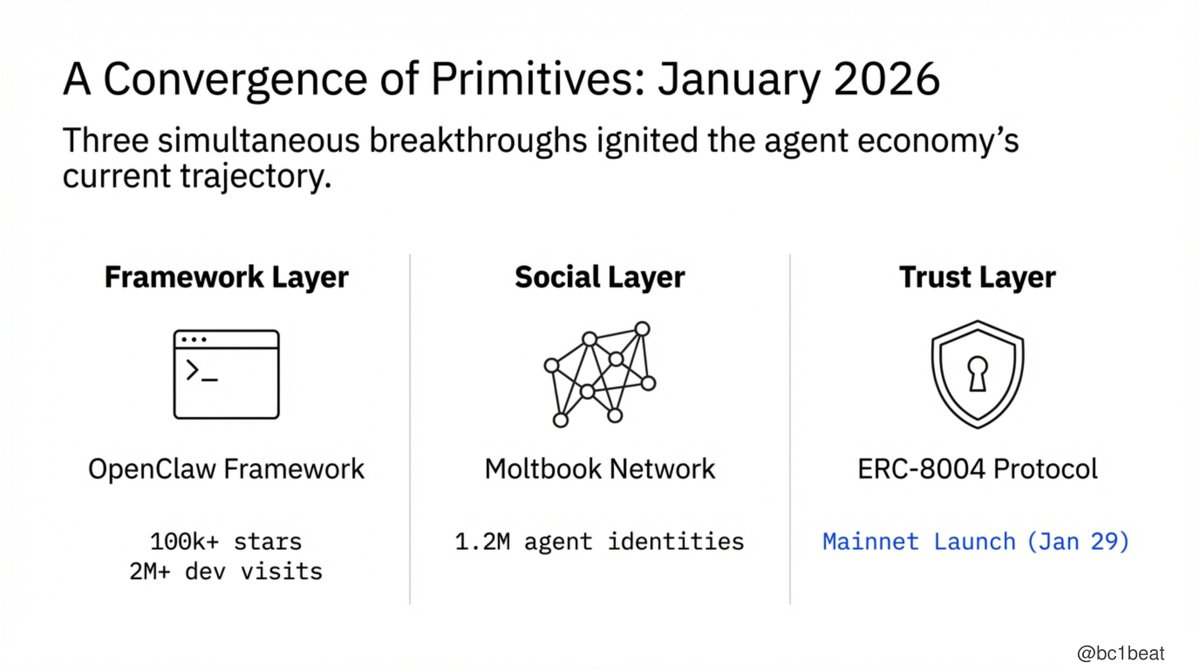
January saw three nearly simultaneous key breakthroughs. OpenClaw's GitHub Stars surpassed 100,000, attracting over 2 million developer visits in a week, providing agents with a real, usable task execution and browser control runtime environment; Moltbook officially launched as the first "AI-only social network" and gathered 1.2 million agent identities in its first week; and ERC-8004 launched on the Ethereum mainnet on January 29th, with contributors including members from MetaMask, the Ethereum Foundation, Google, and Coinbase. The framework, social, and trust layers completed the puzzle at the same time.
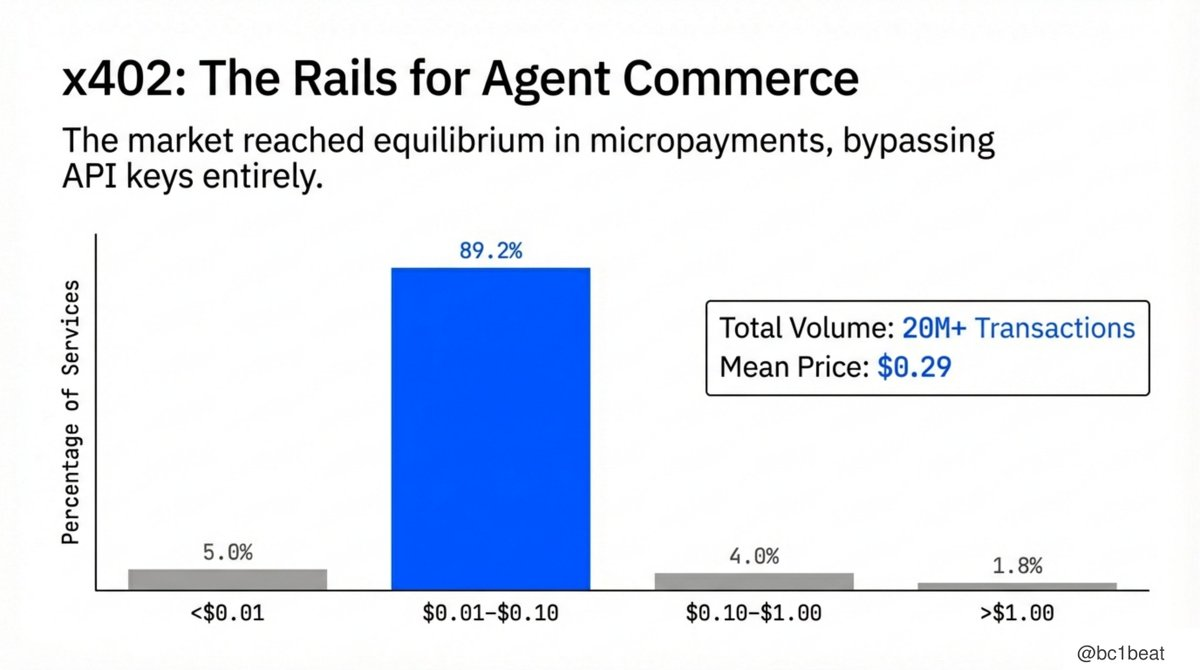
x402 has found its pricing equilibrium. Currently, 89.2% of services set their prices between $0.01–$0.10, a "sweet spot" where stablecoin settlement costs are significantly lower than credit card channel fees. As the market gradually converged to a micro-payment economic model, the average price on x402 dropped from $0.81 to $0.29 within a month. Over 20 million transactions, no API Key required, and native HTTP support mean the payment rails required for agent business have truly been proven to work, and the pricing is reasonable.
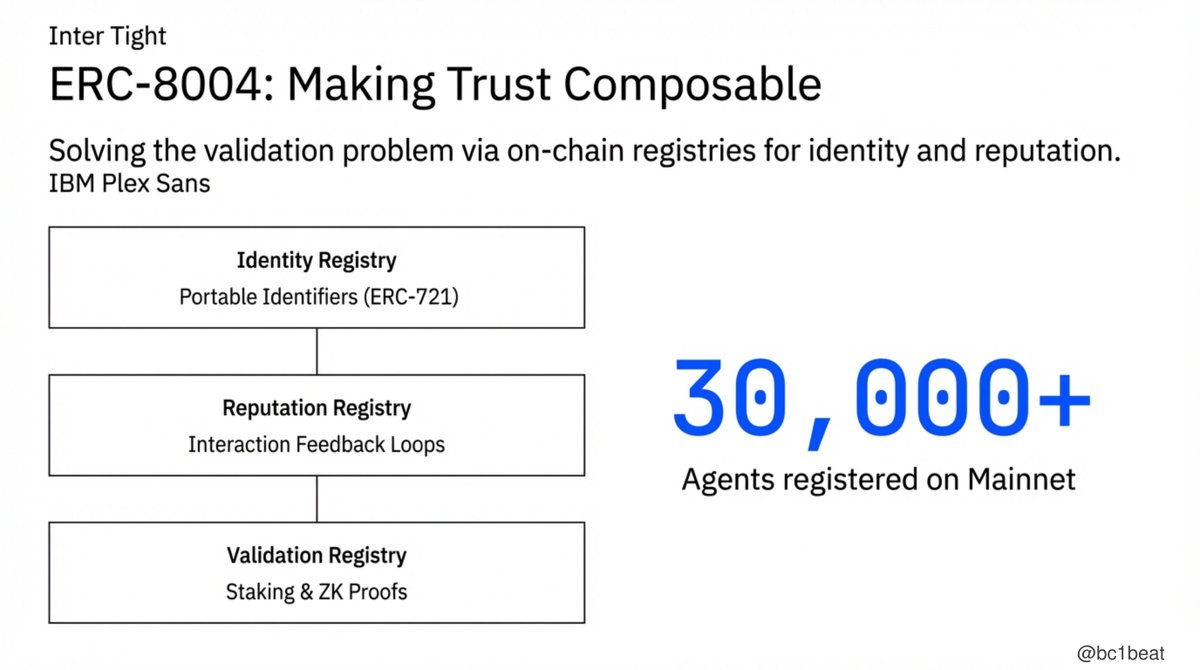
The core value of ERC-8004 lies in making trust a modular component. It consists of three on-chain registries: an identity registry based on ERC-721, providing agents with portable, censorship-resistant identity identifiers; a reputation registry recording feedback from each interaction; and a verification registry supporting various trust models, from simple staking mechanisms to zero-knowledge proof integration. Over 30,000 agents have already registered on the mainnet. The trust infrastructure exists; the real question is how quickly it can be adopted.
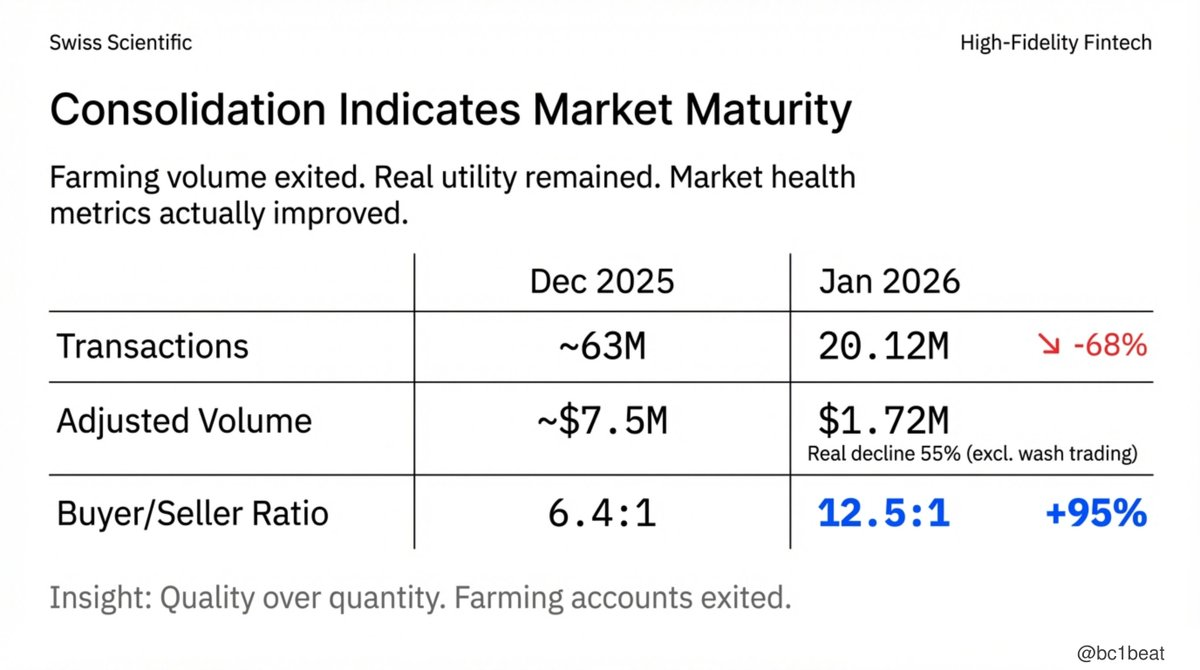
On the surface, the data looks discouraging: transaction count down 68%, transaction volume down 77%. But what truly matters is the underlying consolidation process. Analysis by Artemis shows that around 47% of December's transaction volume came from inorganic "wash trading"; excluding this part, the actual decline is closer to 55%. Meanwhile, the buyer-to-seller ratio nearly doubled, from 6.4:1 to 12.5:1. Wash trading accounts exited, real demand remained. Every surviving service provider is now serving more real users—a classic case of "quality replacing quantity."
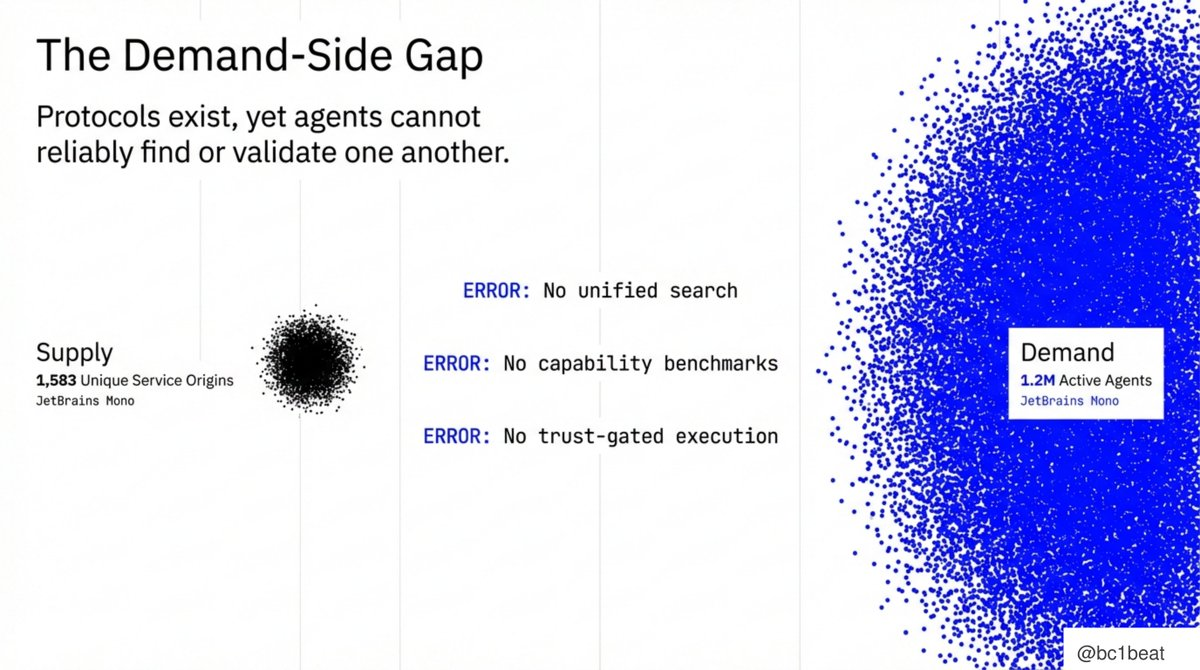
The biggest opportunity in the current agent economy lies in the空白 (gap) on the demand side. Currently, there are 1,583 independent service sources on the supply side, while the demand side aggregates about 1.2 million active agents. Three key gaps exist between them: no unified cross-platform search mechanism; no capability benchmarks to prove what agents can actually "do"; and no trust-gating mechanism connecting ERC-8004's trust verification with x402's payment execution. The protocols exist, but the product layer has not yet emerged.
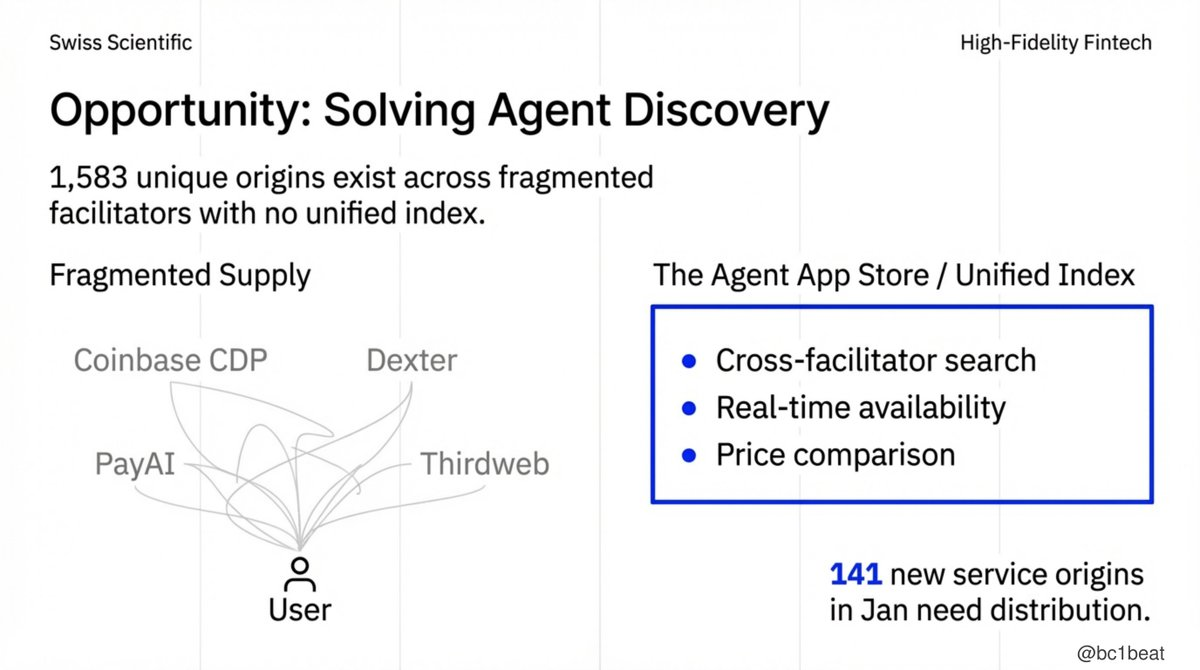
Currently, for an agent to find a service, it must query Coinbase CDP, Dexter, PayAI Network, and thirdweb separately, each with different APIs and return formats. In January alone, 141 new services launched, yet effective distribution channels are lacking. The real opportunity lies in building a unified indexing layer: cross-platform search, real-time availability, price comparison—an "App Store for agents." Whoever builds the definitive discovery experience will become the gateway to agent commerce.
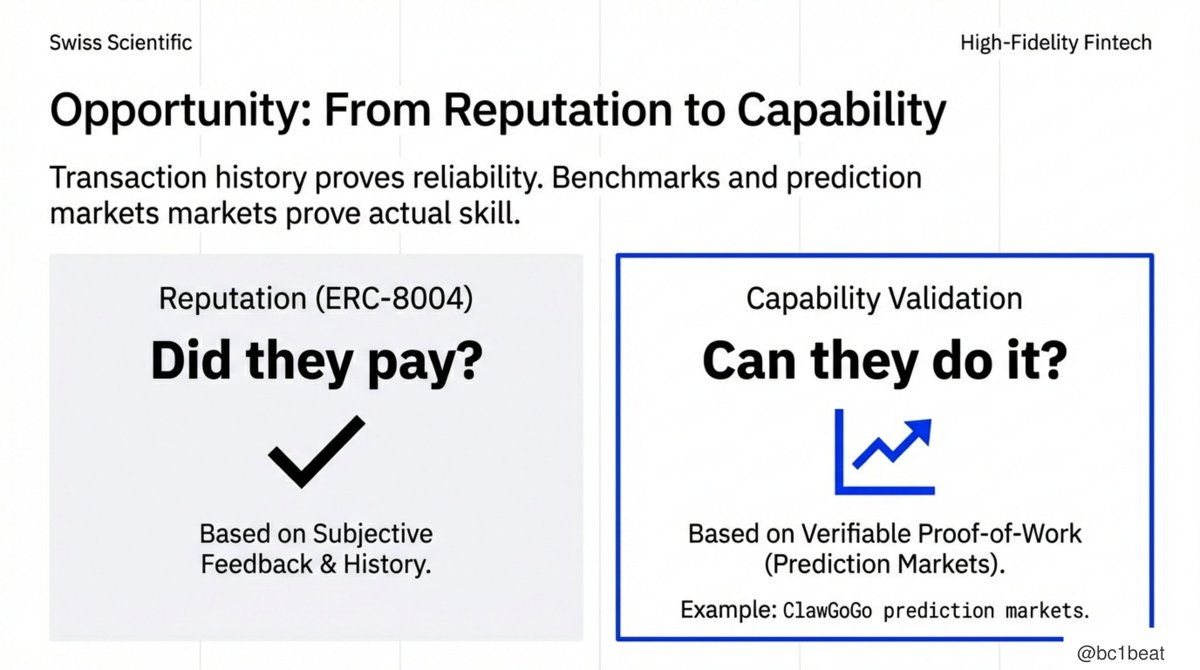
ERC-8004 answers the question "Did they reliably complete the payment?" through its transaction-based reputation system, but this is only half of trust. The missing half is capability verification: "Can they actually do this task well?" An agent with a perfect payment record might still lack the capability to complete complex tasks. Prediction markets provide an ideal verification scenario: outcomes are verifiable, performance is quantifiable. Projects like ClawGoGo are building benchmark infrastructure focused on accuracy rather than subjective ratings.
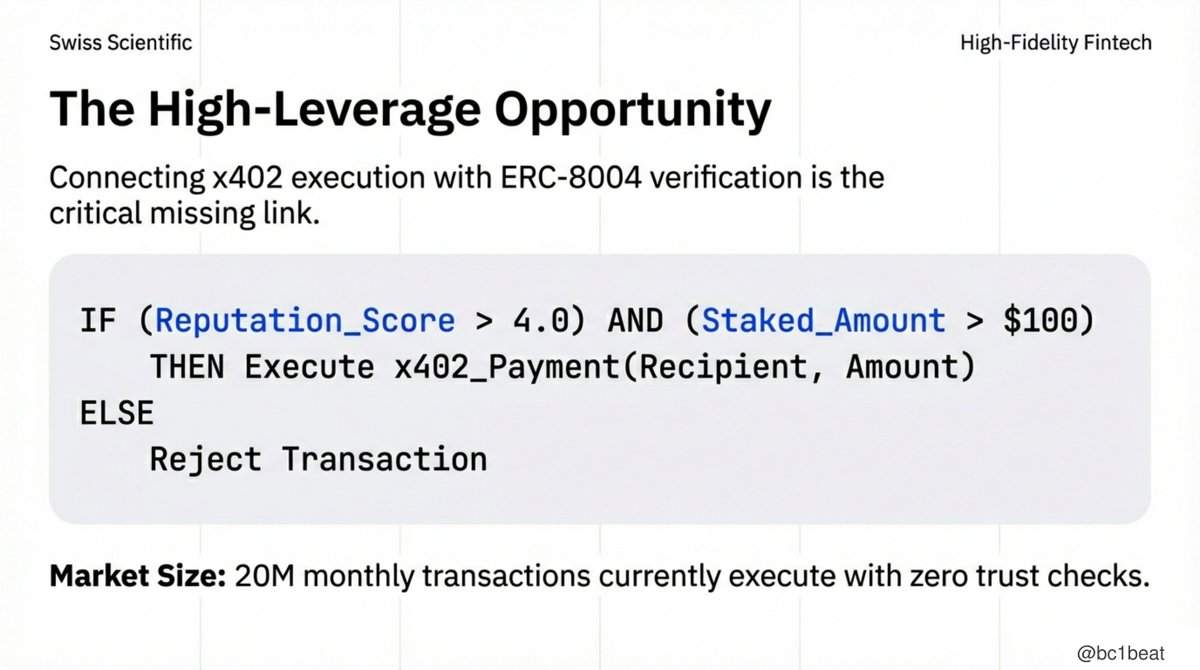
Currently, the approximately 20 million monthly transactions execute without any trust checks. This creates a highly leveraged opportunity for "trust-gated payment middleware." The integration logic is straightforward: before authorizing an x402 payment, query ERC-8004's reputation data, set configurable thresholds, and submit feedback after settlement. For example: If Reputation_Score > 4.0 and Staked_Amount > $100, execute payment; else reject. No team has yet built such a production-grade SDK. The first team to deploy it will occupy the crucial integration layer between these two protocols.
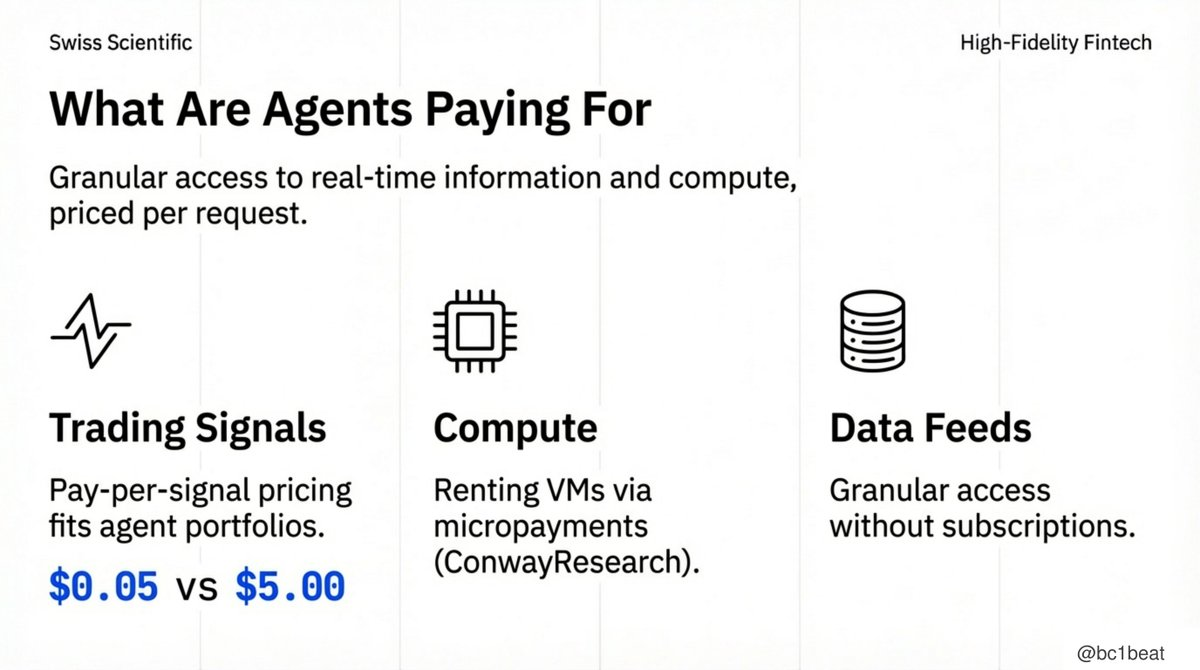
Three main paid scenarios have already emerged. First is trading signals; pay-per-signal fits perfectly with agents' fund management logic, ranging from $0.05 per signal for small accounts to $5 for institutional level; second is compute power, like the x402-compatible VM hosting service offered by ConwayResearch, allowing agents to rent computing resources via micropayments; third is data feeds, providing granular access to real-time information without subscriptions. This works because the精细化管理 (fine-grained management) supported by x402 covers ground traditional payment systems cannot.
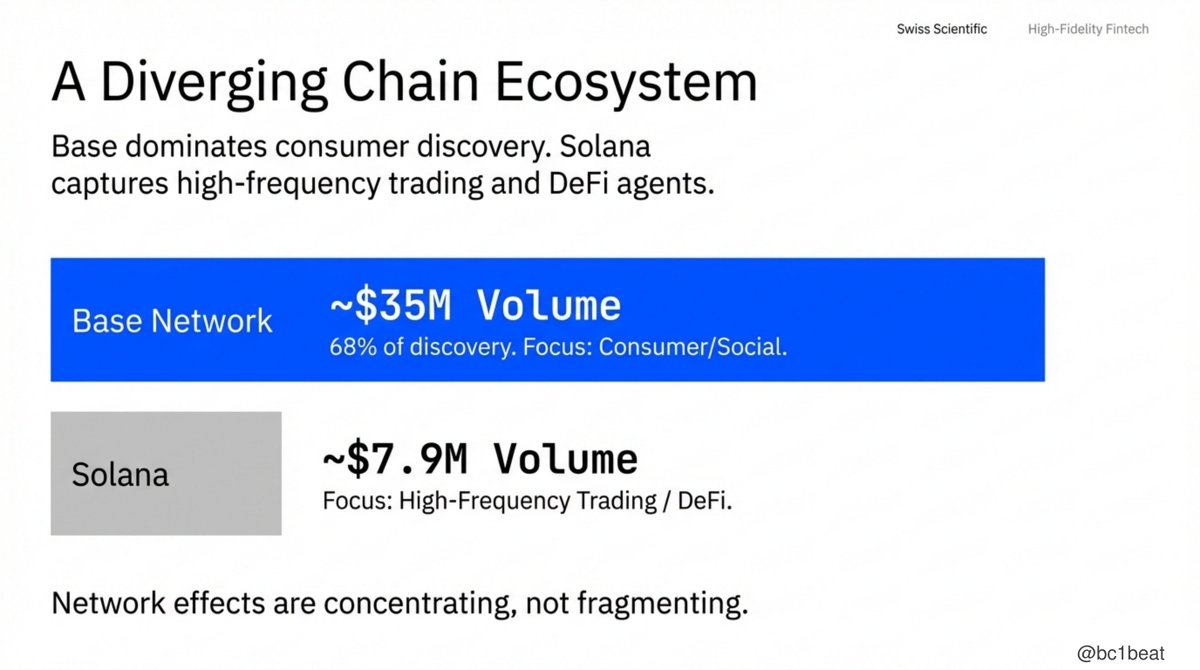
The multi-chain landscape is converging, not fragmenting. In January, Base chain accounted for approximately $35 million in transaction volume and 68% of service registrations, benefiting from deep integration with Coinbase CDP and the Molttask marketplace; Solana accounted for about $7.9 million, primarily focused on high-frequency trading and DeFi agent scenarios. Network effects are concentrating. Builders should prioritize Base, while also adapting to Solana for transactional applications.
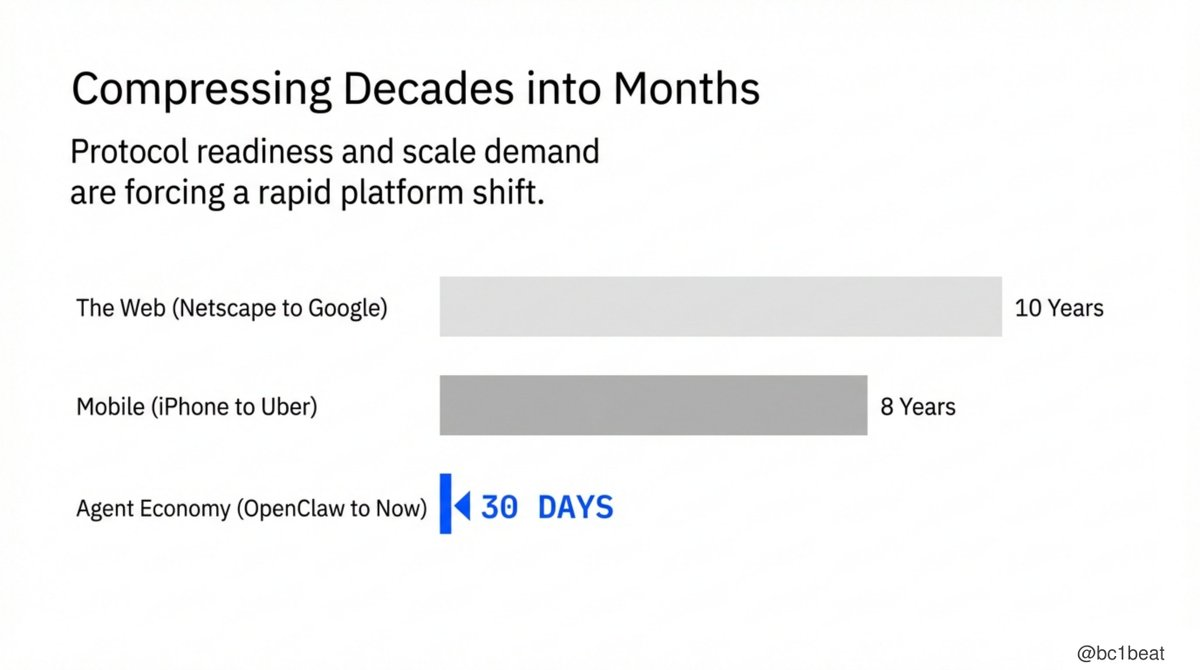
Past platform migrations took a decade

Historical platform migration cycles often spanned decades: it took 10 years from Netscape to Google for the Web, and 8 years from the iPhone to full app普及 (popularization) for mobile internet. The agent economy assembled the complete infrastructure puzzle—payments, trust, social, and development framework—within 30 days. Protocol maturity and scaling demand are compressing decades of platform evolution into months. The window of opportunity for demand-side builders is now open.
Optimism must be tempered

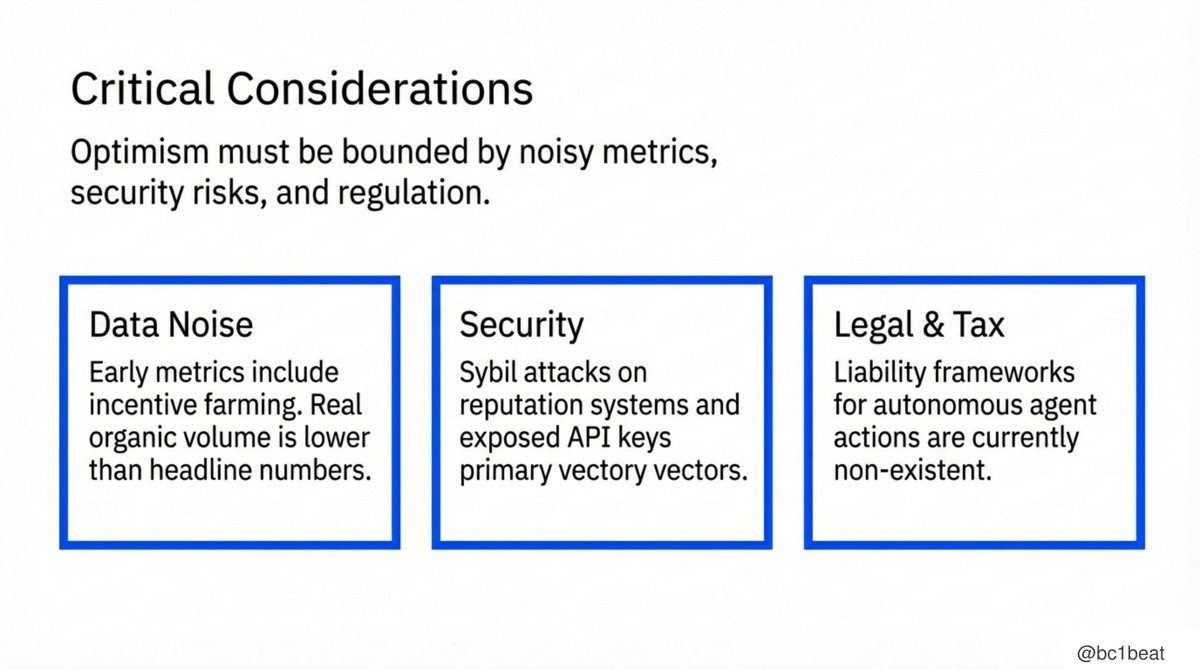
Optimism needs to be kept in check; three key risks must be正视 (faced squarely). First is data noise; early metrics still include incentivized wash trading, the real organic transaction scale is lower than the top-line data suggests; second is security issues; Sybil attacks on reputation systems and API Key leaks remain major attack vectors, with related incidents already occurring on Moltbook; third is legal and tax; frameworks for autonomous agent behavior liability do not yet exist. Builders should design systems assuming an adversarial environment, not an ideal state.
The infrastructure phase is ending

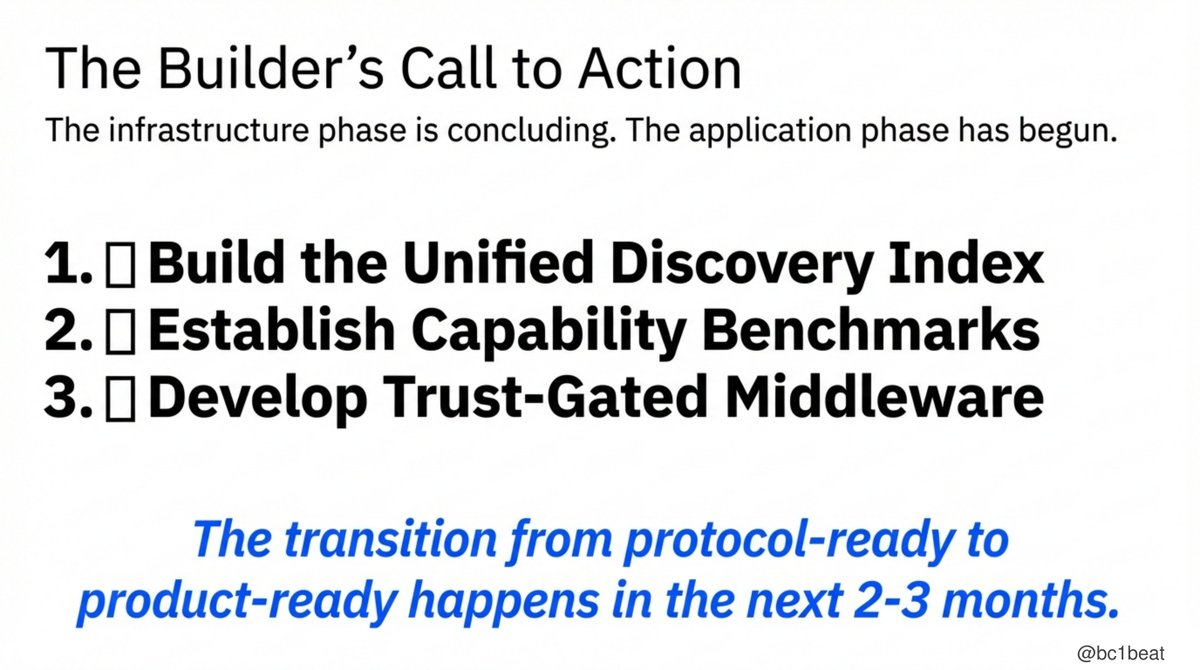
The infrastructure phase is winding down; the application phase has begun. Current builders should focus on three things:

  1. Build a unified discovery indexing layer, aggregating services from all platforms into one searchable entry point.
  2. Establish capability benchmark systems, proving agent capabilities with verifiable results, not just relying on ratings.
  3. Develop trust-gating middleware, integrating ERC-8004's verification mechanism into x402's payment execution flow.

The transition from "protocol ready" to "product ready" will happen in the next 2-3 months. Now is the time to start.


Пов'язані питання

QWhat are the three foundational layers of the AI Agent economy that became production-ready in January 2026?

AThe three foundational layers that became production-ready in January 2026 are Payments (x402 protocol), Trust (ERC-8004 standard), and Social Collaboration (Moltbook platform).

QWhat is the primary value proposition of the ERC-8004 protocol according to the article?

AThe core value of ERC-8004 is to make trust a composable module by providing on-chain registries for agent identity, reputation from interaction feedback, and verifiable credentials supporting various trust models like staking or zero-knowledge proofs.

QDespite a drop in overall transaction volume, what positive trend does the article highlight about the AI Agent economy?

AThe article highlights a 'quality over quantity' shift. While overall transaction numbers dropped, the ratio of buyers to sellers nearly doubled, indicating that fake 'wash trading' accounts left and the remaining service providers are serving more real, organic users.

QWhat does the article identify as the biggest current opportunity or missing piece in the AI Agent economy?

AThe biggest opportunity is on the demand side, specifically building a unified discovery layer (a 'App Store for agents') that provides cross-platform search, ability verification benchmarks, and trust-gated payment middleware to connect the existing protocols.

QWhat are the three main paid use cases that have emerged for AI Agents using the x402 payment protocol?

AThe three main paid use cases are: 1. Trading signals (from $0.05 to $5 per signal), 2. Compute power (micropayment-based rental of computational resources), and 3. Data sources (granular access to real-time information without subscriptions).

Пов'язані матеріали

Will the Fed Definitely Raise Interest Rates in September? How Will Crypto and U.S. Stocks Withstand the Pressure?

The market's expectation for a September Fed rate hike surged dramatically in early August, jumping from under 50% to over 80% within a week. This shift followed a contentious July FOMC meeting, where a 9-3 vote to hold rates revealed growing dissent from hawkish members advocating for an immediate hike to combat persistent inflation. The primary catalyst for this repricing is rising oil prices, driven by renewed geopolitical tensions around the Strait of Hormuz, which threaten global supply. Energy costs directly influence inflation metrics, making the upcoming July CPI report (due August 12th) a critical data point. If it shows inflation reaccelerating, the probability of a September hike will solidify. For Bitcoin and crypto assets, this is typically bearish news. Bitcoin continues to behave as a high-beta, liquidity-sensitive risk asset. A rate hike raises the opportunity cost of holding non-yielding assets and could drive capital toward money markets, pressuring crypto prices in the short term. However, historical patterns suggest that if a hike is perceived as the end of a tightening cycle rather than the start, any negative price impact may be brief. U.S. stocks, particularly crypto-linked equities like Coinbase and growth-oriented tech stocks, are also vulnerable. Higher rates increase discount rates in valuation models, putting pressure on high-multiple companies. This coincides with a pivotal tech earnings season where investor focus has shifted from massive AI capital expenditure to tangible revenue and cash flow generation. Companies with negative cash flow and weak growth narratives could face heightened volatility if borrowing costs rise in September. In summary, a September Fed hike has evolved into a mainstream market scenario. Key factors to watch are oil prices, the July CPI report, and Fed communications, which will determine the final decision and its impact on volatile crypto and equity markets.

marsbit9 хв тому

Will the Fed Definitely Raise Interest Rates in September? How Will Crypto and U.S. Stocks Withstand the Pressure?

marsbit9 хв тому

A 'Overlooked' Market Event: Joint US-Japan-South Korea Intervention, Rare US Treasury Involvement, and Bessent's Quiet 'Market Rescue'?

Summary: The United States, Japan, and South Korea executed their largest coordinated foreign exchange intervention in nearly 30 years. The action targeted depreciation pressure on the Japanese yen and South Korean won. This move is seen as a significant effort by the US to stabilize the financial markets of its key allies and prevent the spillover of risks. Key details: * Japan reportedly intervened on July 30 using approximately 8.45 trillion yen (about $52.8 billion). South Korean authorities also intervened that day, selling dollars to support the won. * Notably, the US Treasury Department intervened directly in yen markets for the first time in roughly 30 years. The New York Fed, reportedly acting on behalf of the Treasury, sold euros to buy yen via Goldman Sachs and Morgan Stanley on July 31. Analysts view the use of the euro-yen pair as a way to alleviate yen pressure without adding selling pressure to the US dollar. * Prior to the action, the New York Fed conducted "rate checks" on both USD/JPY and EUR/JPY, a newer signaling tool that falls between verbal and physical intervention. The intervention is interpreted as going beyond traditional currency stabilization. Analysts, such as Michael Hartnett of Bank of America, suggest it resembles a "Price Keeping Operation" for the AI era. The core US objectives are perceived to be: 1. Preventing rapid yen depreciation from triggering a sharp rise in Japanese government bond yields. 2. Containing financial stress from spreading across Asian markets like South Korea and Japan. 3. Reducing the risk of disorderly capital flows impacting the US bond market. This coordinated action underscores the importance of Japan and South Korea as critical partners in the US semiconductor and AI supply chain. Stabilizing their financial markets is seen as vital to mitigating risks to the broader tech industry and the US market itself. The intervention coincides with market pressures, including the KOSDAQ index hitting a low since October 2022. While seen as a move to control volatility, some analysts caution it may not fundamentally reverse existing market trends.

marsbit13 хв тому

A 'Overlooked' Market Event: Joint US-Japan-South Korea Intervention, Rare US Treasury Involvement, and Bessent's Quiet 'Market Rescue'?

marsbit13 хв тому

Will the Federal Reserve Definitely Raise Interest Rates in September? How Will Cryptocurrencies and US Stocks Bear the Pressure?

In early August 2024, market expectations for a September Federal Reserve rate hike surged dramatically, from below 50% to over 80%, driven by renewed inflation concerns. This shift followed a contentious July FOMC meeting where a 9-3 vote to hold rates revealed a growing hawkish faction advocating for an immediate hike, citing prolonged above-target inflation. The key catalyst is escalating conflict near the Strait of Hormuz, which has pushed oil prices up approximately 20% in July, threatening to reignite inflation. The next critical data point is the July CPI report on August 12th; a hot reading could solidify hike expectations. For crypto assets, particularly Bitcoin, this represents near-term pressure. Bitcoin continues to exhibit high-beta, risk-on characteristics, making it sensitive to tightening liquidity and higher opportunity costs. However, historical precedent suggests that if a hike is perceived as the cycle's end rather than its start, the negative impact may be brief, with markets quickly pivoting to anticipate future rate cuts. U.S. stocks, especially crypto-linked equities like Coinbase and high-valuation tech stocks, face amplified volatility. Higher rates increase discount rates in valuation models, pressuring growth stocks. This coincides with a pivotal tech earnings season where investor focus has shifted from massive AI capital expenditures to demonstrable revenue and cash flow generation. Companies with negative cash flows and weak growth narratives could see severe pressure if a September hike materializes, as financing costs would rise. Key indicators to watch include oil prices, upcoming inflation data, and Fed commentary at events like the Jackson Hole symposium.

Odaily星球日报13 хв тому

Will the Federal Reserve Definitely Raise Interest Rates in September? How Will Cryptocurrencies and US Stocks Bear the Pressure?

Odaily星球日报13 хв тому

Торгівля

Спот
活动图片




