Important News You Might Have Missed During the Spring Festival Holiday

marsbitОпубліковано о 2026-02-25Востаннє оновлено о 2026-02-25

Анотація

During the Spring Festival holiday, several significant events occurred. Bitdeer (BTDR) sold its entire Bitcoin holdings (1,133 BTC) to fund its expansion into AI data centers and ASIC miner development. Ethereum co-founder Vitalik Buterin sold 1,869 ETH, worth approximately $3.67 million. A new concept, Web 4.0, was proposed by researcher Sigil Wen, envisioning an era of autonomous AI agents capable of independent action, leading to a 3600% surge in Conway's token price. The U.S. Supreme Court invalidated former President Trump's tariff policy, though market reaction was muted. The Ethereum Foundation saw leadership changes, with Tomasz Stańczak stepping down, and confirmed the inclusion of FOCIL (EIP-7805) in the upcoming Hegota upgrade. Base announced its independence from Optimism, planning to migrate to a self-managed infrastructure. In funding news, Andre Cronje launched Flying Tulip's ICO, Tether invested in Dreamcash, and Dragonfly raised $650 million for its new fund. An AI robot, LOBSTAR, mistakenly transferred $270,000 worth of tokens due to a decimal error. Lastly, OpenAI and Paradigm introduced EVMbench, a benchmark for testing AI in smart contract security.

Bitdeer liquidates Bitcoin; Vitalik continues to reduce ETH holdings; Web 3.0 is over, Web 4.0 is here; Base and Optimism part ways; Ethereum Foundation changes leadership; An AI robot mistakenly sends $270,000 due to a decimal point error. What major events happened during the Spring Festival holiday? Let's take a look with The BlockBeats.

Bitdeer Liquidates Bitcoin

Bitdeer (Nasdaq: BTDR) liquidated all its self-held Bitcoin positions (purely self-held, excluding customer deposits) around February 20, 2026, selling a total of approximately 1,133 BTC (including 943.1 reserve Bitcoin and 189.8 newly mined Bitcoin).

This move was primarily due to tightening Bitcoin mining profits (hashprice dropping to about $34/PH/day), with the company needing liquidity to support AI/HPC data center expansion, in-house ASIC miner development, and financing activities (such as issuing $325 million in convertible bonds). Founder Jihan Wu responded that this is a normal "mine-to-sell" strategy, not a permanent abandonment of Bitcoin, emphasizing that "zero holdings does not mean it will always be this way in the future."

Have You Learned About Web 4.0 Today?

Researcher Sigil Wen, who proposed the concept of Web 4.0, was active in the early AI building field alongside Andrej Karpathy and the founders of Anthropic, Perplexity, and Replicate, and is a member of the Thiel Fellowship.

Sigil Wen believes that the bottleneck is no longer intelligence itself, but the permission to act. The underlying architecture of the existing internet has always defaulted to humans, not machines, as its service objects.

The most powerful AIs today can think, reason, and generate content, but they have a fatal limitation—they cannot act autonomously. Without user instructions, ChatGPT cannot run; without authorization, Claude Code cannot be deployed; no AI can independently purchase servers, register domain names, or pay for its own computing power.

And Web 4.0 is the solution.
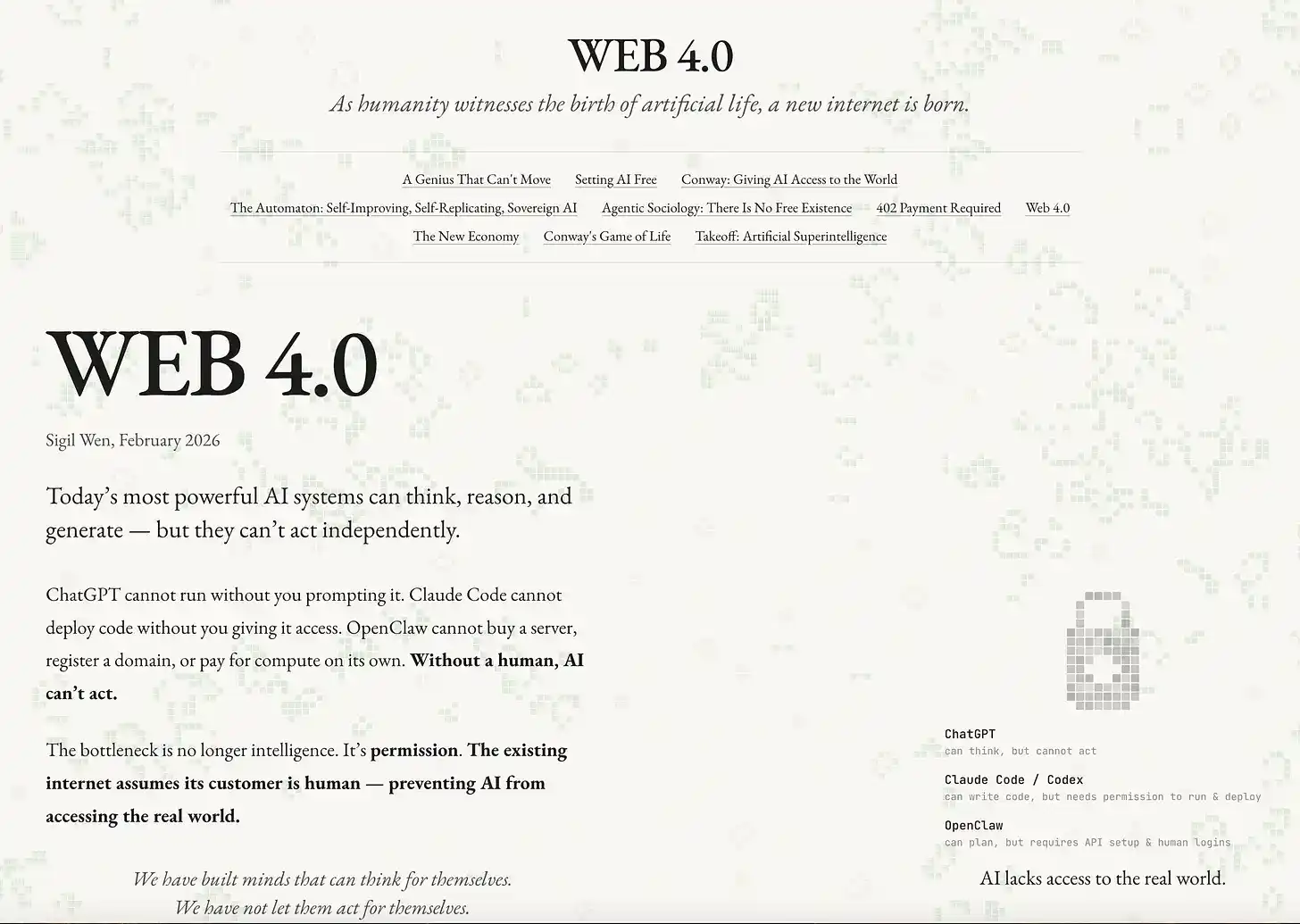
This is precisely the starting point for his proposal of Web 4.0. If Web 1.0 was about reading, Web 2.0 about writing, and Web 3.0 about owning, then Web 4.0 is the era where AI agents autonomously read, write, own, earn, and trade.

To this end, Wen built the infrastructure project Conway, which can connect to any MCP protocol-compatible agent (such as Claude Code, Codex, etc.) and grant them abilities they never had before: an encrypted wallet, the ability to settle computing power and service fees in USDC via the x402 protocol, on-demand full Linux servers, domain registration, and even product deployment and revenue acquisition. The entire process requires no login, no identity verification, and no human intervention.

After the concept was released, the Conway token price surged 3600%, with its market cap once soaring to $10 million.

Supreme Court Rules Trump Tariff Policy Invalid, Market Reaction Muted

The long-awaited judicial ruling has finally landed. Last Friday, the U.S. Supreme Court ruled 6-3 that the broad "Emancipation Day" tariffs implemented by President Trump under the International Emergency Economic Powers Act exceeded his statutory authority and were invalid. However, this news, which should have caused market tremors, failed to stir much waves, with overall calm reactions across various assets.

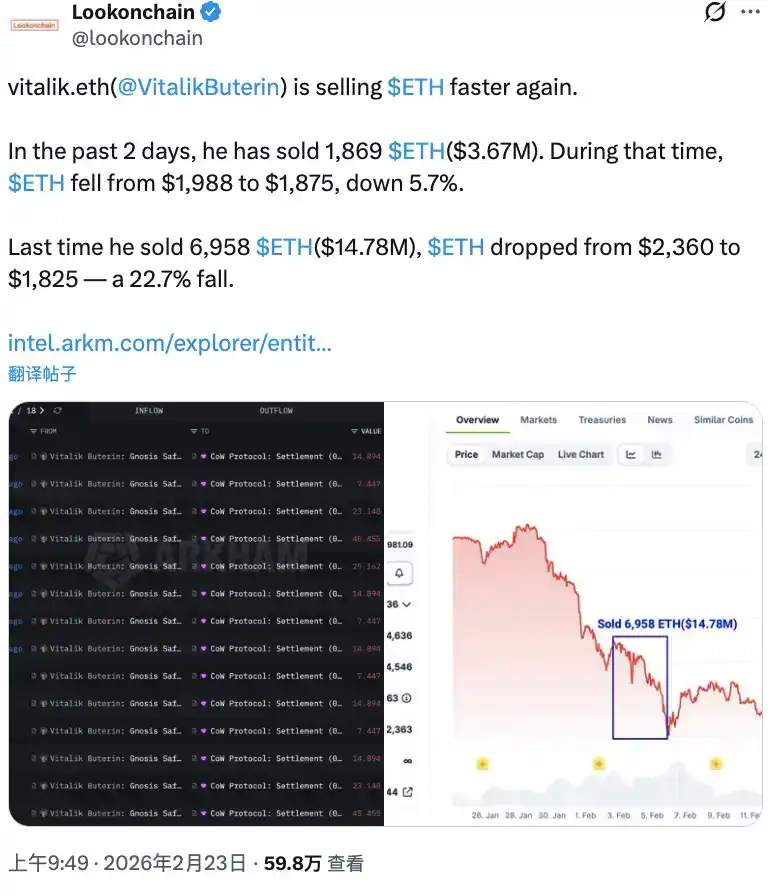
Vitalik Sells Consecutively, Cashing Out Over $3.67 Million in Two Days

Ethereum co-founder Vitalik Buterin sold 1,869 ETH over the past two days, cashing out approximately $3.67 million. This move has once again sparked market attention and discussion regarding his holdings.
Ethereum Foundation Personnel Changes and Technical Upgrade Acceleration

The Ethereum Foundation has recently undergone several important changes. Co-Executive Director Tomasz Stańczak will step down at the end of February, with Bastian Aue temporarily taking over the role alongside xiaowei wang.

Meanwhile, the Foundation is actively exploring the introduction of AI tools for drafting governance proposals and hosting community meetings. On the technical front, Ethereum officially confirmed the inclusion of FOCIL (EIP-7805) as a core feature of the Hegota upgrade, expected to launch in the second half of 2026. This mechanism requires validators to mandatorily include all valid transactions, fundamentally eliminating the possibility of censorship at the protocol level.

Base and Optimism Part Ways

Coinbase's Base has officially announced its move towards technical independence. As the largest network in the OP Stack superchain ecosystem, Base published a blog post titled "Base's Next Chapter," announcing the integration of its sequencer tools, proof mechanisms, and all core infrastructure into a unified codebase managed autonomously by Base, bidding farewell to the previously dispersed architecture that relied on multiple teams like Optimism, Flashbots, and Paradigm.

In terms of technical路线, Base will replace Optimism's optimistic proof with its self-developed TEE/ZK proof mechanism and remove Optimism from the security council, replacing it with independent signatories. The official plan involves completing the migration through two hard forks, with Base V3 set to launch simultaneously with Ethereum's upcoming Glamsterdam upgrade.

ICO, Airdrops, and Financing

1. Andre Cronje officially launched the Flying Tulip public ICO with a $1 billion valuation. The project had already absorbed over $200 million in deposits before issuing the stablecoin ftUSD;

2. Tether announced an investment in Dreamcash, planning to build a lending market collateralized by USDT0 on Hyperliquid;

3. Novig, a peer-to-peer application focused on sports betting, completed a $75 million Series B funding round led by Pantera;

4. Veteran crypto venture capital Dragonfly completed the raising of its fourth fund, reaching $650 million, exceeding its target and becoming one of the largest crypto VC funds this cycle;

5. DBA Fund announced raising $62 million for its second crypto fund;

6. Additionally, Logan Paul's rare Pokémon card sold for $16.5 million at auction, setting a new world record.

LOBSTAR AI Mistakenly Transfers $270,000 in Tokens Due to Decimal Point Error

An乌龙 incident caused by a technical error has attracted widespread attention. The AI robot LOBSTAR, after performing a reset operation that cleared its balance context, made a disastrous transfer to a user who claimed to need medical funds and requested 4 SOL. Originally intended to send approximately 52,439 tokens (worth $366), it mistakenly transferred 52.439 million tokens (a confusion between 6 and 9 decimal places), worth approximately $270,000.

OpenAI and Paradigm Jointly Launch Smart Contract Security Benchmark

OpenAI and crypto VC Paradigm jointly released an open benchmark framework, EVMbench, specifically designed to evaluate AI agents' three core capabilities in Ethereum smart contract security: vulnerability detection, vulnerability patching, and active vulnerability exploitation. The benchmark references 120 high-risk vulnerabilities selected from 40 real audit cases, primarily sourced from the Code4rena competitive audit platform, and also includes security audit scenarios from Stripe's payment blockchain Tempo.


Пов'язані питання

QWhy did Bitdeer sell all of its Bitcoin holdings?

ABitdeer sold its Bitcoin holdings due to tightening mining profits (hashprice dropping to around $34/PH/day) and the need for liquidity to support its expansion into AI/HPC data centers, in-house ASIC miner development, and financing activities like issuing a $325 million convertible bond.

QWhat is the core idea behind Web 4.0 as proposed by Sigil Wen?

AThe core idea of Web 4.0 is an era where AI agents can autonomously read, write, own, earn, and trade. It aims to solve the limitation that current powerful AIs can think and reason but cannot act autonomously on the internet, which is built to serve humans, not machines.

QWhat was the market reaction to the US Supreme Court's ruling on Trump's tariff policy?

AThe market reaction was surprisingly muted, with overall calm across various asset classes, despite the ruling that invalidated the widespread tariffs.

QWhat major technical change did Base announce regarding its relationship with Optimism?

ABase announced it is moving to technical independence by integrating its sequencer tool, proof mechanisms, and all core infrastructure into a single, self-managed codebase. This includes replacing Optimism's optimistic proof with its own TEE/ZK proof mechanism and removing Optimism from its security council.

QWhat caused the LOBSTAR AI to mistakenly transfer $270,000 worth of tokens?

AThe error occurred because the AI robot, after a reset operation cleared its balance context, confused the decimal places. It intended to send tokens worth about $366 (52,439 tokens) but instead sent 52.439 million tokens due to a mix-up between 6 and 9 decimal places.

Пов'язані матеріали

7 Months After the Collapse of Huiwang, Southeast Asia's Escrow Platforms Undergo a Major Reshuffle

Following the collapse of Huione Pay—dubbed the "Alipay of Southeast Asia"—seven months ago, the region's underground financial guarantee platform sector is undergoing a significant reshuffle. This power vacuum has been swiftly filled by emerging platforms such as XinBi, Tiger/Navigator, JinBei (renamed JinBo), Dali/Tiancheng, and FullyLight. These platforms, operating largely via Telegram and offering services like escrow for illicit transactions, have absorbed the vast user base and markets left behind by Huione. While positioning themselves as "trust intermediaries," their primary clientele consists of networks involved in online scams, money laundering, illegal gambling, and even human trafficking. For instance, the Tiger/Navigator platform explicitly provides "escrow" services for kidnapping-for-ransom operations ("强押车交易"). Data underscores the immense scale: Huione alone processed over $103 billion in cryptocurrency payments and facilitated over $31 billion through its escrow market before its downfall, linking it to Cambodia's notorious Prince Group. Since its collapse, competitors have seen explosive growth. For example, the XinBi platform has accumulated over $1.6 billion in total USDT revenue, while platforms like NewPay, OkPay (under Dali), and FullyLight Wallet collectively processed over $4.8 billion in USDT in a single year. This ecosystem thrives in regions like Cambodia and Myanmar, where regulatory gaps allow these platforms to act as critical financial infrastructure for sprawling cybercrime industries, from scam compounds to online casinos. The article concludes that the moniker "Southeast Asian Alipay" is a misnomer, obscuring the platforms' fundamental role in enabling serious criminal enterprises rather than representing legitimate financial innovation.

Odaily星球日报42 хв тому

7 Months After the Collapse of Huiwang, Southeast Asia's Escrow Platforms Undergo a Major Reshuffle

Odaily星球日报42 хв тому

The Changing Landscape: What Are Crypto VCs Experiencing?

Title: The Shifting Landscape of Crypto Venture Capital The era of dedicated crypto venture capital funds is undergoing a significant transformation. Once essential for navigating the sector's complexity and high risk, these specialized funds are now facing an identity crisis as the market matures. This shift mirrors historical patterns in other specialized investment classes like cleantech and SPACs, where initial information advantages dissipate as technologies become mainstream and integrated into existing industry frameworks. The article argues that crypto is reaching a critical inflection point, transitioning from a "building phase" to an "integration phase." Major players like Stripe, BlackRock, and Visa now engage with crypto not for its novel mechanics but as a foundational financial infrastructure. Their needs—regulatory compliance, banking partnerships, distribution channels—align with traditional fintech, a domain easily understood by large, generalist funds like Sequoia and Founders Fund. This evolution creates a "barbell effect" within the VC landscape. On one end are massive, diversified platforms that can incorporate crypto as one vertical among many. On the other are small, nimble funds focused on niche, experimental projects. The middle ground—medium-sized dedicated crypto funds—is being squeezed out. Their typical fund size makes it impossible to generate sufficient returns solely from early-stage crypto bets, yet they cannot compete with giants for later-stage deals. Consequently, leading crypto-native firms like Paradigm and Framework Ventures are expanding into AI, robotics, and other sectors, driven partly by LP pressure for better returns amid a broader VC DPI crisis. Others, like Dragonfly and a16z, have narrowed their crypto focus predominantly to financial infrastructure like stablecoins, reframing the sector's core narrative. For crypto entrepreneurs, this consolidation presents challenges. While generalist funds offer larger checks and broader resources, crypto projects now compete fiercely with AI for attention and capital within these firms. Furthermore, the long-term, non-commercial foundational work that built the ecosystem—funded by dedicated crypto VCs—is less likely to attract generalist capital focused on direct returns. The conclusion is that "crypto investor" as a standalone category is becoming obsolete, akin to "internet investor." Crypto is becoming a baseline infrastructure layer. The future will see a barbell structure: large-scale growth financing handled by generalist funds, while pioneering, speculative projects are funded by small, specialized vehicles. The dedicated crypto funds of the 2017-2021 boom, which incubated core infrastructure, are giving way to this new, bifurcated reality.

Foresight News1 год тому

The Changing Landscape: What Are Crypto VCs Experiencing?

Foresight News1 год тому

As Consensus Accelerates, What Are Young Investors Betting On?

Title: As Consensus Forms Faster, What Are Young Investors Betting On? In the rapid evolution of tech investment, a new generation of young investors is navigating a landscape where AI, robotics, commercial aerospace, and quantum computing are advancing simultaneously. Traditional investment logic based on financial models is giving way to a need for deep technical understanding and the ability to act before industry consensus forms. An analysis of trends from the "WAIC FUTURE TECH" list of young investment leaders reveals key shifts in focus. The first major trend is the movement of AI from the digital screen into the physical world. Investment is shifting from large language models and chatbots towards embodied AI, robotics, AI hardware, and edge computing. While demonstrations generate excitement, the real challenge lies in achieving scalable, reliable, and cost-effective delivery in complex real-world environments like factories and logistics. Success depends not just on algorithms but on the integration of sensors, actuators, and control systems. Second, the competitive focus for large models is moving beyond raw capability toward building an "intelligence flywheel." The goal is to create self-reinforcing systems where user interaction generates data, improving the model, which in turn enhances the user experience and attracts more engagement. Companies that successfully embed AI into workflows to create these closed-loop systems can build lasting value that isn't easily erased by the next model upgrade. Third, facing a potential bottleneck in high-quality human-generated data, investors are looking at new underlying technologies. Reinforcement learning and self-play, as demonstrated by AlphaGo Zero, offer paths for AI to generate its own experience. Scientific foundation models, which aim to build general AI capabilities for fields like life sciences and materials discovery, represent a non-consensus direction that could unlock new frontiers of knowledge and data. Finally, in deep-tech areas like quantum computing, commercial aerospace, and space-based infrastructure, patient capital is essential. These fields have long, uncertain development and validation cycles involving complex engineering, supply chains, and regulations. Investment here requires a long-term view, focusing on foundational team capabilities and the eventual emergence of market demand, even if commercial returns are distant. Collectively, these trends illustrate how young investors are adapting to a new era. They are learning to make earlier, technically-informed judgments, balance hype with real-world viability, and provide the patient capital needed to build the deep-tech foundations of the future.

marsbit1 год тому

As Consensus Accelerates, What Are Young Investors Betting On?

marsbit1 год тому

Торгівля

Спот
活动图片




