If U.S. Treasury Yields Soar Above 5%, Will Bitcoin Fall Below $50,000?

marsbitОпубліковано о 2026-03-25Востаннє оновлено о 2026-03-25

Анотація

An article explores the potential impact of rising U.S. Treasury yields above 5% on Bitcoin's price, suggesting it could fall below $50,000. The analysis is prompted by the recent U.S.-Israel conflict with Iran, which has driven oil prices higher and fueled inflation fears, pushing bond yields up. Historically, prolonged oil-related conflicts lead to sustained yield increases and pressure on risk assets like stocks. Given Bitcoin's high correlation with the S&P 500, similar downward pressure is expected. Technical analysis indicates a bearish flag pattern for Bitcoin, with a break below it potentially leading to a drop to $50,000 or lower. Prediction markets also show a high probability of Bitcoin falling below $55,000 in 2026. However, BitMEX co-founder Arthur Hayes notes that prolonged conflict might force the Fed to print more money, which could ultimately benefit Bitcoin.

Written by: Cointelegraph

Compiled by: AiddiaoJP, Foresight News

During the war between the U.S. and Iran, Bitcoin has been one of the strongest performing assets. However, as the bond market shows signs of being 'out of control,' Bitcoin's upward momentum is beginning to show signs of exhaustion.

Key Points:

  • If the U.S.-Iran war prolongs, the benchmark U.S. Treasury yield could rise by 200 basis points.
  • Historical experience suggests that oil-related conflicts tend to push up inflation and suppress risk appetite. Based on this, it is speculated that Bitcoin's price could fall below $50,000 in 2026.

Oil Supply Shock Could Push U.S. Treasury Yields Above 5%

Since the U.S. and Israel launched attacks on Iran on February 28, the benchmark 10-year U.S. Treasury yield has climbed to about 4.42%, hitting a nine-month high.
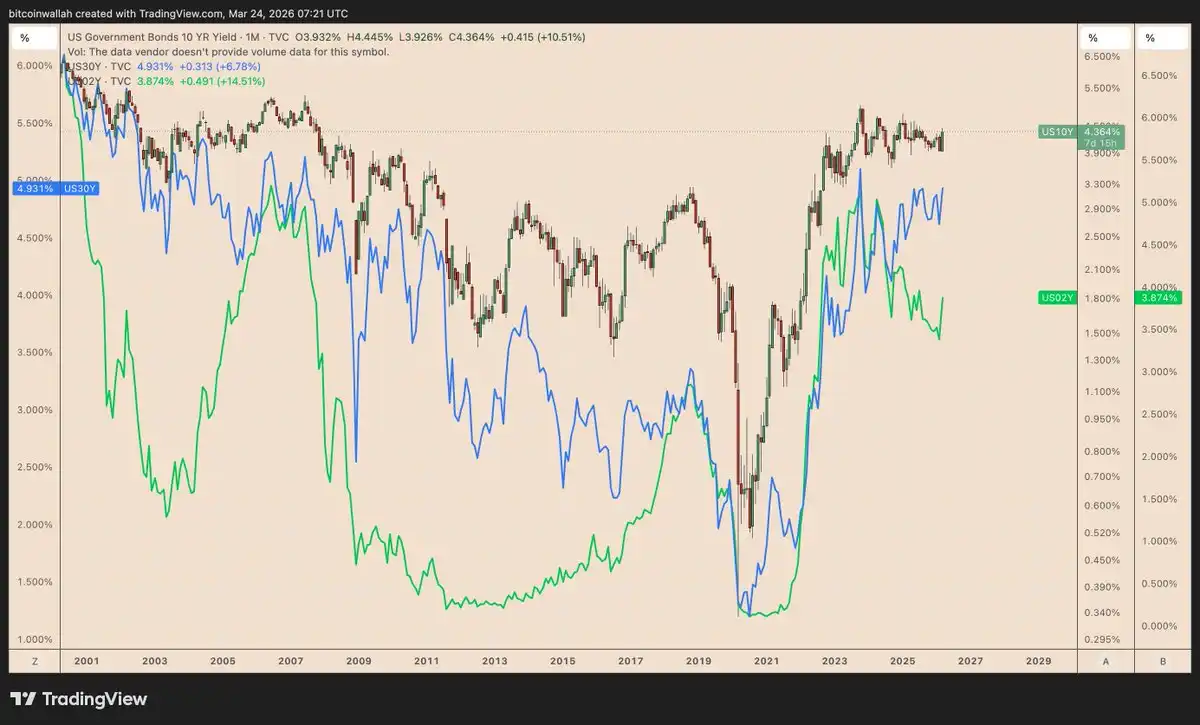
Monthly performance of U.S. 2-year, 10-year, and 30-year Treasury yields. Source: TradingView

Among them, the 30-year Treasury yield rose to about 4.97%, and the 2-year Treasury yield also increased to the range of 3.95% to 3.98%.

Affected by the war, oil prices have surged, exacerbating market concerns about rising inflation, thereby pushing Treasury yields higher. Against this backdrop, the market widely expects no rate cuts within 2026.

U.S. President Donald Trump announced a five-day suspension of operations, temporarily alleviating immediate concerns about strikes on Iranian energy facilities. However, as Iran denies any negotiations and cross-border attacks continue as of Tuesday, the conflict situation remains effectively uncontrolled.
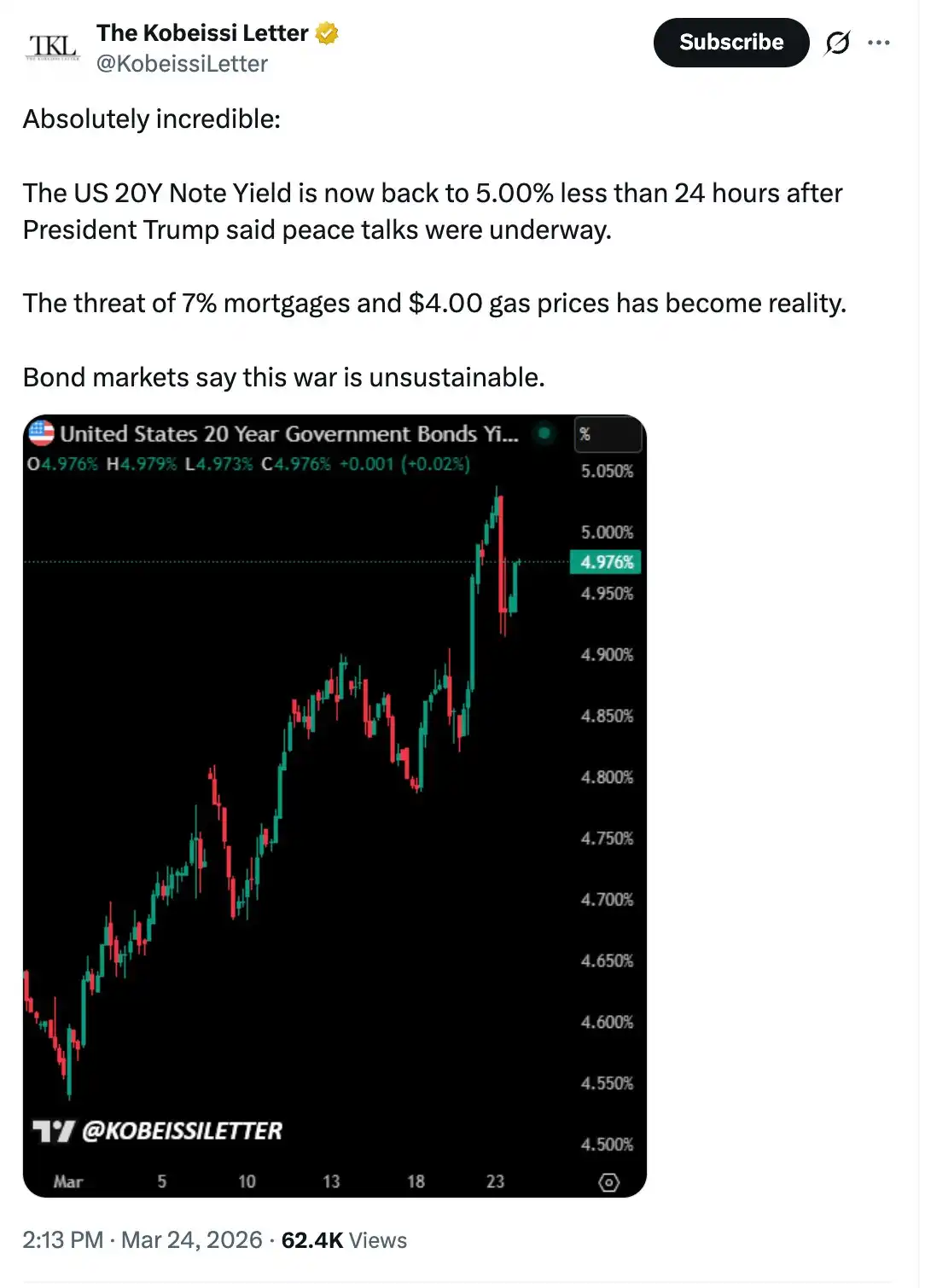
Source: X

Market observers have expressed concerns, believing that U.S. Treasury yields face further upside risks. Technical analysts further pointed out that if the 10-year Treasury yield breaks through the current symmetrical triangle pattern, it could rise by 200 basis points to 6.4%.
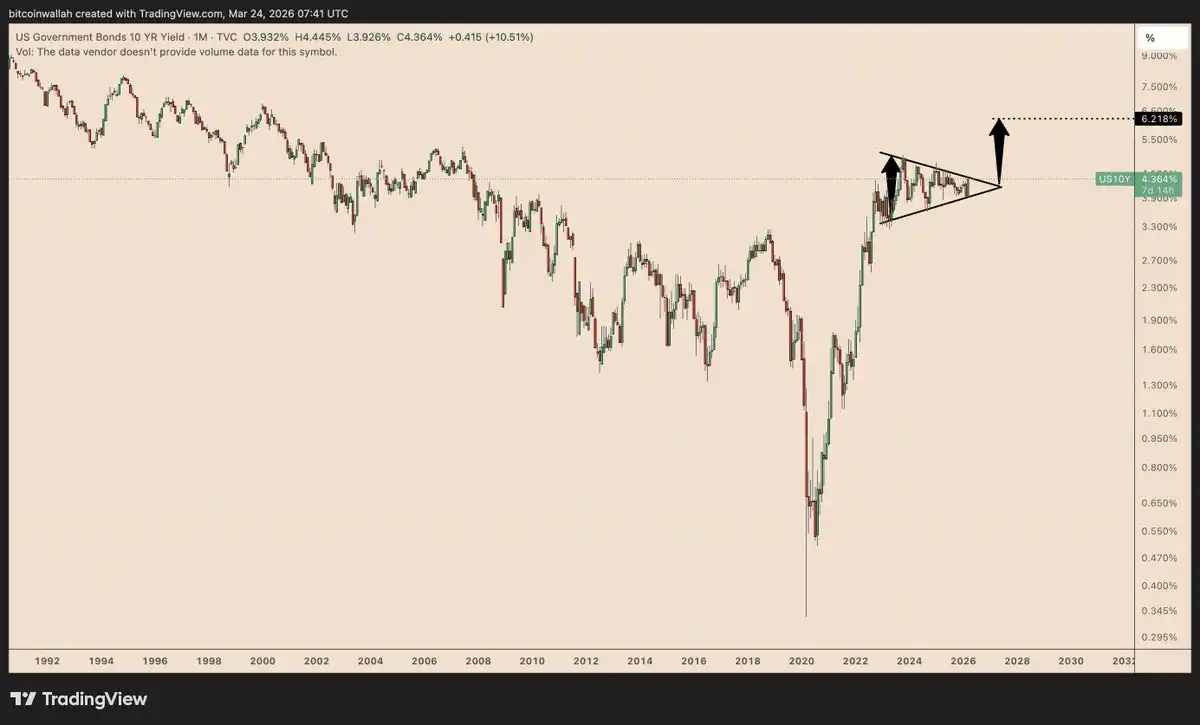
Monthly chart of U.S. 10-year Treasury yield. Source: TradingView

Rising yields increase the opportunity cost of holding risk assets such as stocks and Bitcoin. If Bitcoin continues to exhibit risk asset attributes, a break above 5% in the 10-year Treasury yield could trigger selling pressure in the Bitcoin market.

Historical Cases of Oil-Related Shocks

Historically, short-term oil-related conflicts typically cause sharp but brief fluctuations in Treasury yields and stock markets, while long-term supply shocks can push yields up persistently and suppress stock markets continuously.

During the 1973 Yom Kippur War and the Arab oil embargo, Treasury yields initially rose slightly, then climbed significantly as inflation intensified, with the S&P 500 index falling about 41% to 48% during the 'stagflation' phase.
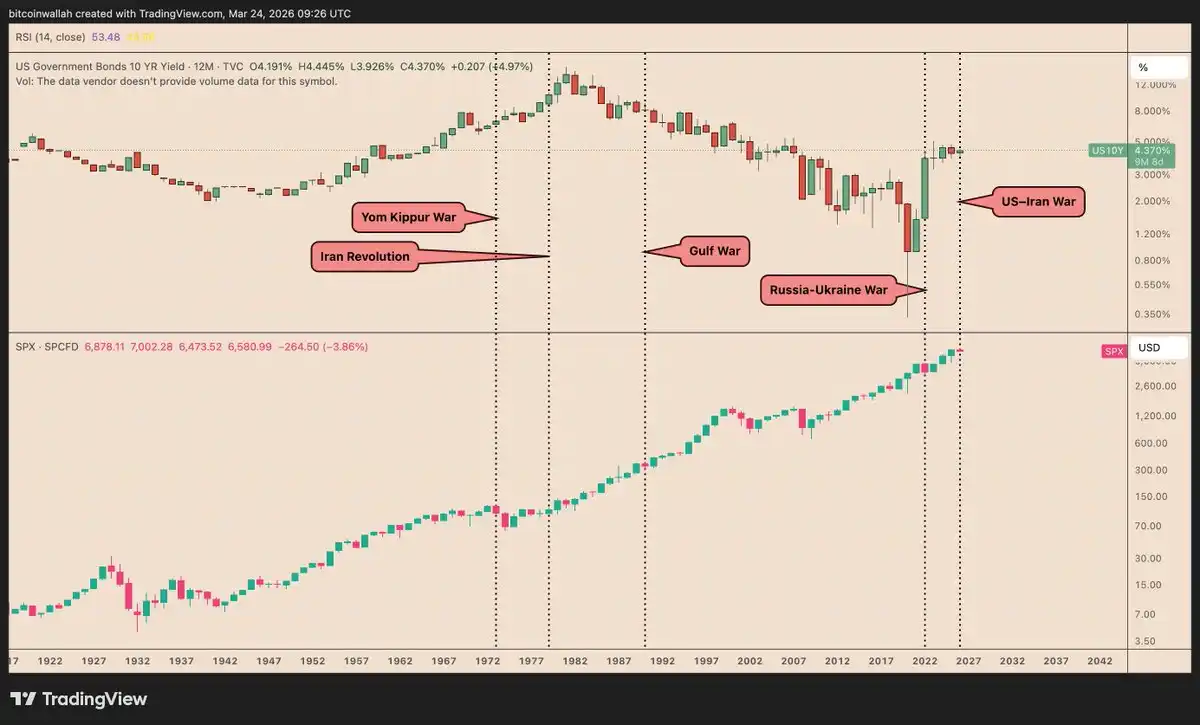
Annual chart of U.S. 10-year Treasury yield and S&P 500 index. Source: TradingView

During the 1979 Iranian Revolution, the bond market reaction was more intense, with the 10-year Treasury yield rising about 150 to 200 basis points in the following year, while the stock market correction was relatively moderate.

During the 1990-1991 Gulf War, the 10-year Treasury yield rose about 50 to 70 basis points, and the S&P 500 index fell about 16% to 20%, rebounding after the conflict was brought under control.

After the outbreak of the Russia-Ukraine conflict in 2022, there was also a rise in Treasury yields and a short-term drop of 5% to 10% in the S&P 500 index.

The current conflict between the U.S., Israel, and Iran seems to be in the early stages of these historical patterns. If the conflict escalates further and oil prices remain high, Treasury yields could rise further, and risk assets may face a new round of downward pressure.

Bitcoin still maintains a high correlation with the S&P 500 index. Therefore, unless the conflict situation eases quickly, Bitcoin's price is likely to face greater downward pressure.

To What Level Could Bitcoin's Price Drop?

From a technical analysis perspective, if Bitcoin's price breaks below the current bear flag pattern, it could further drop to $50,000 or even lower in the coming months.
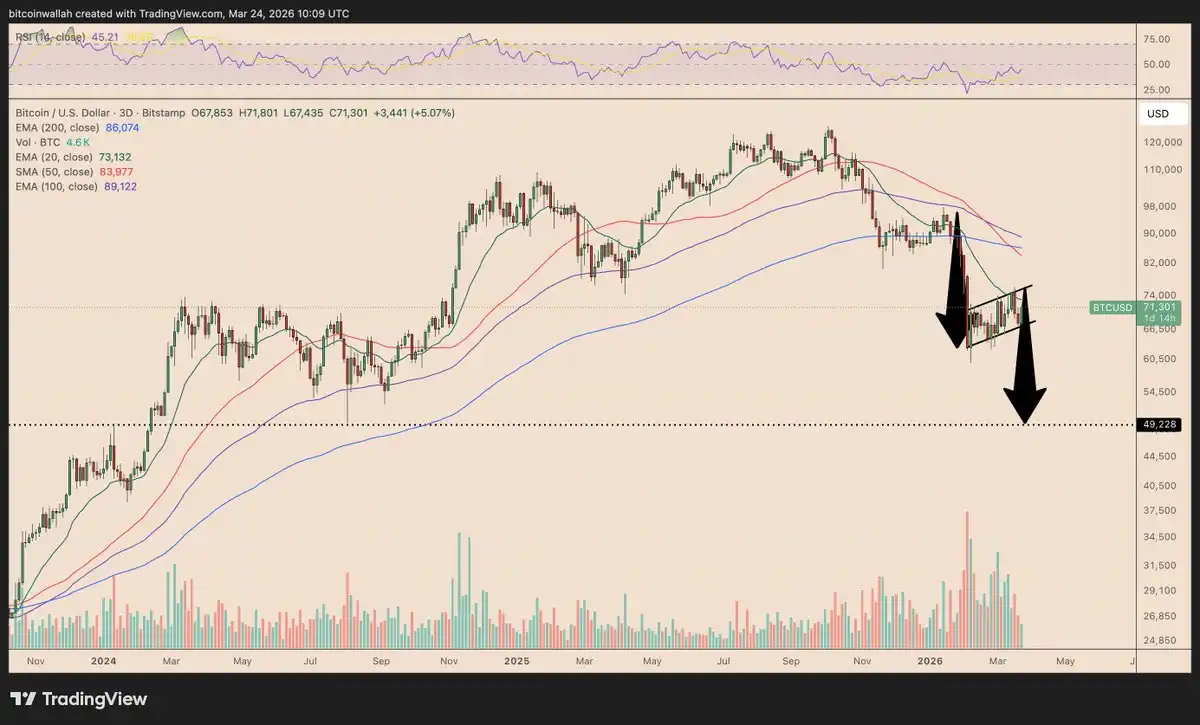
Bitcoin/USD three-day price chart. Source: TradingView

This technical expectation is largely consistent with trading data from prediction markets. Currently, traders estimate a 70% probability that Bitcoin will fall below $55,000 in 2026, and a 46% probability it will fall below $45,000.

BitMEX co-founder Arthur Hayes stated that if the U.S.-Iran war prolongs, it could force the Federal Reserve to adopt loose monetary policies, which would be a positive factor for Bitcoin.

He noted: 'The longer the conflict lasts, the more likely the Fed is to print money to support the U.S. war machine.' He further added:

'When central banks start printing money, I will choose to buy Bitcoin.'

Пов'язані питання

QWhat is the main concern regarding US Treasury yields and Bitcoin's price according to the article?

AThe article suggests that if the US 10-year Treasury yield rises above 5%, it could trigger selling pressure in the Bitcoin market, potentially causing its price to fall below $50,000.

QHow have oil-related conflicts historically impacted Treasury yields and risk assets like stocks?

AHistorically, short-term oil-related conflicts caused sharp but brief volatility in yields and stocks, while prolonged supply shocks led to sustained yield increases and prolonged stock market declines, as seen during the 1973 Yom Kippur War and the 1979 Iranian Revolution.

QWhat technical pattern does the article mention for Bitcoin's price, and what is the predicted downside target?

AThe article mentions a bearish flag pattern for Bitcoin's price. If this pattern breaks down, the price could decline to $50,000 or lower in the coming months.

QAccording to market traders, what is the probability of Bitcoin falling below $55,000 and $45,000 in 2026?

ATraders estimate a 70% probability of Bitcoin falling below $55,000 and a 46% probability of it dropping below $45,000 in 2026.

QWhat contrasting view does BitMEX co-founder Arthur Hayes present regarding the impact of prolonged US-Iran war on Bitcoin?

AArthur Hayes argues that a prolonged US-Iran war could force the Federal Reserve to adopt loose monetary policy and print money, which would ultimately be bullish for Bitcoin as he states, 'When central banks start printing money, I will choose to buy Bitcoin.'

Пов'язані матеріали

Lowering Expectations for BTC's Next Bull Market

The author, Alex Xu, explains his decision to significantly reduce his Bitcoin holdings (from full to ~30% of his portfolio) during the current bull cycle, citing a lowered long-term outlook for BTC's price appreciation in the next cycle. He outlines six key reasons for this reduced expectation: 1. **Diminished Growth Drivers:** The narrative of exponential user adoption has largely played out with institutional ETF adoption. The next major growth phase—adoption by sovereign national reserves or central banks—seems unlikely in the near future. 2. **Personal Opportunity Cost:** More attractive investment opportunities have emerged in other assets, such as undervalued companies. 3. **Industry-Wide Contraction:** The broader crypto industry is struggling, with most Web3 business models (SocialFi, GameFi, DePIN) failing. This overall萧条 (depression) reduces the fundamental demand and consensus for Bitcoin. 4. **Strain on Major Buyer:** MicroStrategy, a major corporate buyer of BTC, faces rising financing expenses for its debt, which could slow its purchasing rate and create significant marginal pressure on the market. 5. **Increased Competition from Gold:** The emergence of "tokenized gold" has closed the functional gap (portability, divisibility) between physical gold and Bitcoin, offering a strong competitor in the non-sovereign store-of-value space. 6. **Security Budget Concerns:** The block reward halving continues to exacerbate the long-standing issue of funding Bitcoin's network security, with new fee source explorations like Ordinals and L2s largely failing. The author's decision to hold a significant (though reduced) position reflects a cautious, not bearish, outlook. He remains open to increasing his exposure if the fundamental reasons for his skepticism change or if new positive catalysts emerge.

marsbit38 хв тому

Lowering Expectations for BTC's Next Bull Market

marsbit38 хв тому

Can Iran 'Control' the Strait of Hormuz?

Iran has announced a comprehensive plan to assert control over the strategic Strait of Hormuz, a critical global oil shipping chokepoint. The proposed measures include requiring all vessels to obtain Iranian permission for passage, imposing fees for security, environmental protection, and navigation management—preferably paid in Iranian rials—and absolutely banning Israeli ships. Vessels from countries deemed hostile by Iran’s top security bodies may also be barred. Analysts suggest Iran’s motives are multifaceted: increasing pressure on the U.S. and Israel by leveraging control over oil transit to influence global prices and inflation; creating a new revenue stream, potentially exceeding $7.7 billion annually, to counter Western sanctions and support postwar reconstruction; and using transit permissions as bargaining chips in future negotiations, notably with the U.S. However, the plan faces significant practical and diplomatic challenges. Enforcing comprehensive interception and fee collection in the busy waterway, patrolled by international military forces, would be difficult. The U.S. has already countering with a blockade of Iranian ports and threats to intercept any ship paying fees, potentially strangling Iran’s oil exports and fee revenue. Broad international opposition, led by European and Gulf states, and legal controversies further complicate implementation. The proposal may ultimately serve more as a negotiating tactic than a feasible policy, with its execution remaining highly uncertain.

marsbit1 год тому

Can Iran 'Control' the Strait of Hormuz?

marsbit1 год тому

Торгівля

Спот
Ф'ючерси

Популярні статті

Як купити WAR

Ласкаво просимо до HTX.com! Ми зробили покупку WAR (WAR) простою та зручною. Дотримуйтесь нашої покрокової інструкції, щоб розпочати свою криптовалютну подорож.Крок 1: Створіть обліковий запис на HTXВикористовуйте свою електронну пошту або номер телефону, щоб зареєструвати обліковий запис на HTX безплатно. Пройдіть безпроблемну реєстрацію й отримайте доступ до всіх функцій.ЗареєструватисьКрок 2: Перейдіть до розділу Купити крипту і виберіть спосіб оплатиКредитна/дебетова картка: використовуйте вашу картку Visa або Mastercard, щоб миттєво купити WAR (WAR).Баланс: використовуйте кошти з балансу вашого рахунку HTX для безперешкодної торгівлі.Треті особи: ми додали популярні способи оплати, такі як Google Pay та Apple Pay, щоб підвищити зручність.P2P: Торгуйте безпосередньо з іншими користувачами на HTX.Позабіржова торгівля (OTC): ми пропонуємо індивідуальні послуги та конкурентні обмінні курси для трейдерів.Крок 3: Зберігайте свої WAR (WAR)Після придбання WAR (WAR) збережіть його у своєму обліковому записі на HTX. Крім того, ви можете відправити його в інше місце за допомогою блокчейн-переказу або використовувати його для торгівлі іншими криптовалютами.Крок 4: Торгівля WAR (WAR)Легко торгуйте WAR (WAR) на спотовому ринку HTX. Просто увійдіть до свого облікового запису, виберіть торгову пару, укладайте угоди та спостерігайте за ними в режимі реального часу. Ми пропонуємо зручний досвід як для початківців, так і для досвідчених трейдерів.

179 переглядів усьогоОпубліковано 2024.12.11Оновлено 2026.04.23

Як купити WAR

Обговорення

Ласкаво просимо до спільноти HTX. Тут ви можете бути в курсі останніх подій розвитку платформи та отримати доступ до професійної ринкової інформації. Нижче представлені думки користувачів щодо ціни WAR (WAR).

活动图片