If the AI Bubble Is Already Bursting, Who Will Truly Survive?

marsbitОпубліковано о 2026-06-15Востаннє оновлено о 2026-06-15

Анотація

If the AI Bubble is Bursting, Who Will Remain? The debate over an AI bubble is intensifying, with figures like Ray Dalio warning of high levels and Jensen Huang seeing immense, early-stage opportunity. Both views hold truth: a speculative bubble in capital markets likely exists, mirroring the dot-com era, but the underlying technological shift is real and transformative. History shows that while bubbles burst—wiping out overvalued companies and speculative capital—they often leave behind critical physical and digital infrastructure. The dot-com bust, for instance, eliminated many firms but left the global fiber optic networks and data centers that enabled the rise of Amazon, Netflix, and cloud computing. Today's massive AI infrastructure investments (projected at trillions by 2030) in data centers, power, cooling, and GPUs may follow a similar path, creating the foundation for future applications. A key divergence from past bubbles is the "Jevons Paradox" effect in AI. As the cost of AI inference has plummeted by over 99.7% since 2023, enterprise spending on AI has skyrocketed. Cheap "tokens" have unlocked vast, previously uneconomical use cases, moving AI from simple chatbots into core business workflows—code generation, legal document review, scientific simulation, and financial analysis. The market is now in a phase of self-correction, weeding out superficial "API-wrapper" startups, but this cleansing process strengthens the ecosystem. The long-term trajectory is clear...

Source: Gelong, North City's Mr. Xu

Data support: GogoBigData

The AI bubble is becoming the most divisive consensus in the global market. Dalio says the bubble is already high, while Huang Renxun says the opportunity is just beginning; one sees overheating in the capital market, the other sees the dawn of a productivity revolution.

The real issue is not whether there is an AI bubble, but what will be left behind after it bursts. The dot-com bubble of 2000 caused the Nasdaq to plummet, companies to collapse, and wealth to evaporate, but it also left behind the infrastructure of submarine cables, broadband networks, and cloud computing, which ultimately supported Amazon, Netflix, YouTube, and the mobile internet.

Today, AI stands at a similar juncture. On one side, hundreds of billions of dollars are pouring into data centers, electricity, liquid cooling, optical modules, and GPUs; on the other side, there is a huge gap yet to be filled by application revenues. A bubble clearly exists, but the underlying productive forces are not inflated. When token costs plummet and intelligence begins to be called upon like water and electricity, AI will no longer be just a chatting tool, but will enter real workflows in code, healthcare, finance, law, manufacturing, and scientific research. The market will wash away shell companies and PPT entrepreneurs, but it will not reverse the direction of AI+. The bubble will burst, but the industry will remain. Enjoy:

Recently, the market has experienced sharp fluctuations, and theories of an "AI bubble" are rampant.

  • Ray Dalio, founder of Bridgewater Associates, says: There is a bubble in the AI market, and it is "relatively high."

  • NVIDIA CEO Jensen Huang says: There is a huge opportunity in AI, and the demand for computing power is just beginning to explode.

Who should we believe?

They are both correct.

Is there a bubble in the AI industry? Absolutely.

However, bubbles in the tech sector are often the only tribute society can pay to disruptive advanced productive forces. They are not merely a derogatory term.

In the long run, this is an inevitable phenomenon at the dawn of advanced productive forces.

Many liken the current situation to the dot-com bubble of 2000, feeling deeply concerned. The dot-com bubble indeed caused the Nasdaq to plummet nearly 78%, evaporating over 5 trillion dollars in wealth.

But twenty years later, what industry can operate without the internet? Today, the value of the internet industry far exceeds that of the bubble era.

At least superficially, the AI bubble resembles that. The bubble in the capital market cannot stop nearly every sector in society from actively being empowered by AI.

AI+ is the inevitable trend. Just as all industries today cannot do without the internet, all industries in the future will not be able to do without AI.

01 The "IQ Tax" That Innovation Must Pay

In that era when companies could go public and raise money just by having .com in their name, the Nasdaq surged nearly 600% between 1995 and 2000. Then followed a two-and-a-half-year financial storm.

Iconic names of that time, like the software company MicroStrategy, plunged 62% in a single day due to accounting scandals and exaggerated claims; Pets.com (online dog food seller), Webvan (the pioneer of fresh food e-commerce) simply went bust... In the panic, almost everyone blamed the internet as a scam.

However, the physical infrastructure precipitated by the over-expenditure of speculative capital often nourishes the super giants of the next era at extremely low costs. The bubble burst not because of the internet technology itself, but because the physical construction speed of infrastructure could not keep pace with the market's rhythm.

For example, the global undersea cables and dense wavelength division multiplexing networks laid by those once-prominent telecom companies (like WorldCom, Global Crossing), which bankrupted them with heavy investment, became the perfect breeding ground for the later rise of Netflix, Zoom, and the mobile internet.

Without the frenzied and premature global investment in telecom infrastructure around 2000, the later video streaming explosion of YouTube and the cloud computing infrastructure would not have happened.

Amazon is the most typical example. Its stock price plummeted from a high of $107 in 1999 to $7 in 2001, a drop of over 90%. But it survived because its underlying business logic, "reconstructing retail with the network," aligned with the direction of advanced productive forces.

This is a classic case of Amara's Law: we tend to overestimate the effect of a new technology in the short run and underestimate its effect in the long run. In the early stages of a technological revolution, the fervor of speculative capital inevitably leads to overinvestment, forming a bubble. It's the IQ tax that innovation must pay. But when the bubble recedes, what remains will be more indestructible advanced productive forces.

02 Why Are Corporate AI Expenditures Rising Instead of Falling?

Back in 2026, the AI industry bubble appears even larger.

Just five major cloud service providers—Amazon, Google, Meta, Microsoft, and Oracle—are expected to have capital expenditures reaching $690 billion in 2026, with total AI infrastructure investment projected at $5.3 trillion by 2030. Of this, only about 25% is for GPUs; the remaining 75% is all poured into physical infrastructure: liquid cooling systems, power transmission, network switches, optical modules, and land.

On the revenue side, the combined total revenue in 2026 for all leading pure AI companies like OpenAI, Anthropic, Cohere, Mistral, Perplexity is projected not to exceed $40 billion.

The foundational layer invests nearly $700 billion, while the application layer recovers tens of billions. This severe asymmetry—isn't that a bubble?

Such a conclusion cannot be drawn so simply and crudely. One critical point must not be overlooked:

  • In March 2023, when OpenAI released GPT-4, the mixed cost per million tokens of input was about $30.

  • By April 2025, with model architecture optimization and inference computing power improvements, the price per million tokens for models of comparable intelligence plummeted to $0.1–$0.15.

According to Stanford University's "AI Index Report" and TokenCost data: AI inference costs have fallen by over 99.7% in the past two years.

Following traditional linear thinking, if costs plummet, corporate AI spending should decrease. But the reality is that corporate AI cloud spending tripled between 2024 and 2025.

Why?

Because when the marginal cost of "intelligence" approaches zero, AI is no longer just a simple text summarizer or chatting companion; it has entered a new era of agents and multi-modal enhanced retrieval. Enterprises are starting to let AI agents automatically run thousands of cycles of tasks—writing code, scanning millions of legal contracts, simulating biological experiments.

Cheap tokens have unlocked a massive volume of long-tail demands that were previously not commercially viable due to cost constraints.

Comparing NVIDIA in 2026 to Cisco, the networking hardware titan of 2000, also reveals this trend. Their ecosystem positions are remarkably similar, but their underlying financial health is worlds apart.
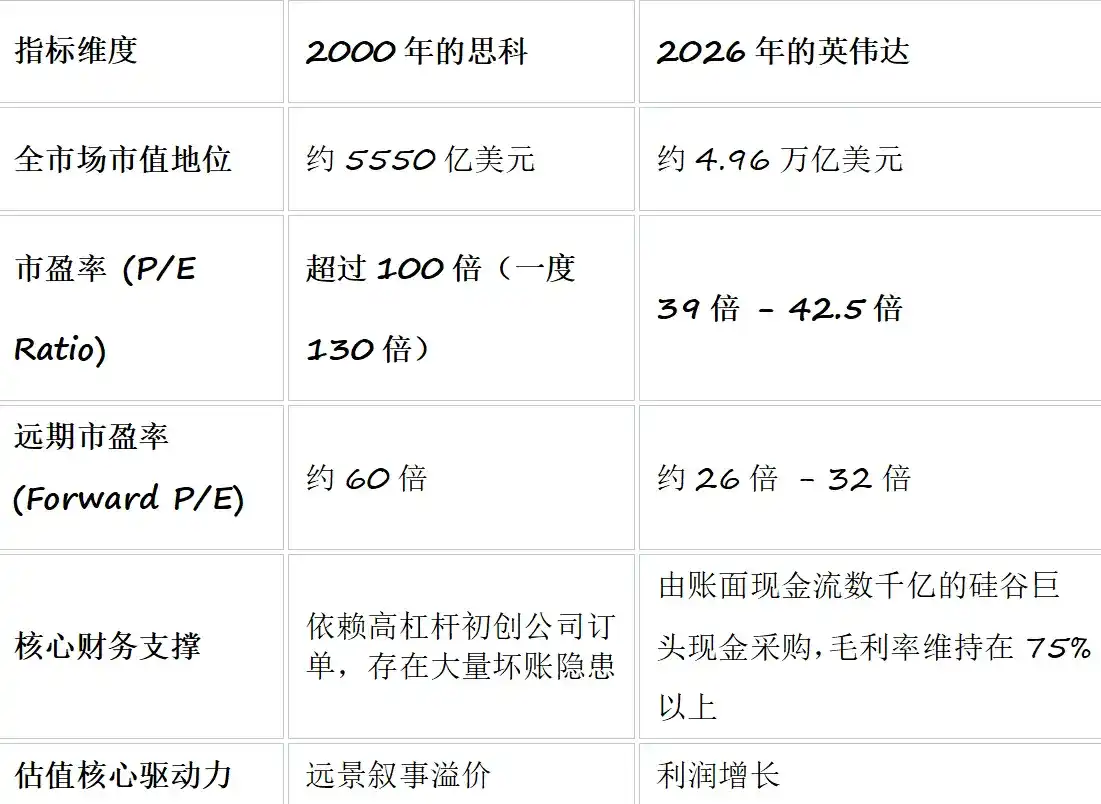
(Hardcore Financial Comparison of NVIDIA and Cisco)

This precisely confirms the economic principle of the "Jevons Paradox": technological progress improves energy use efficiency, but instead of reducing energy consumption, it leads to greater demand due to lower costs.

Even after last year's so-called "DeepSeek moment," the market quickly sobered up in the following months: the more optimized the algorithms, the lower the threshold for enterprises to adopt AI, and ultimately, the total computing power consumption rises exponentially instead.

It is precisely for this reason that AI has the potential to gradually embed itself into almost all old industries. Just as all industries embraced Internet+ over the past two decades. From SaaS software to biomedicine, to advanced manufacturing robots driven by embodied intelligence, by 2026, almost every industry is embracing AI+. No one discusses "whether we should use AI," but instead worries: "Is our data properly cleaned? Do we have enough API call quotas? Is the RAG architecture optimal?"

Currently, there is indeed a bubble in the AI industry. But for enterprises, if you don't embrace the bubble, you will be crushed by the times. This has been proven over the past two decades of the internet era.

03 The Market's Deep Evolution: From Infrastructure to Application

Currently, we are undoubtedly at a critical node in the technology life cycle: just before the "Trough of Disillusionment" on Gartner's Hype Cycle, or at the turning point described by the theory of "Technological Revolutions and Financial Capital."

The AI bubble is already bursting, though many haven't realized it. In the past, any upstart could write a few dozen pages of PPT, wrap a layer of OpenAI's API, and secure funding. Now, as the tide recedes, these companies with no moat and only concepts are dying en masse.

This is the market purifying itself, a manifestation of the bubble bursting. But this is only the surface. The deep logic of the market is undergoing three profound evolutions:

First, value transfer from CapEx to OpEx

Currently, money is being made by those selling shovels—NVIDIA, TSMC, and companies selling optical modules and server liquid cooling equipment are reaping most of the benefits. However, as computing power gradually becomes "infrastructure-ized," like water and electricity, the real excess profits will gradually shift to the application layer. These are the AI-native enterprises that can use extremely low-cost tokens to genuinely solve pain points in vertical industries and reshape business processes (OpEx optimization).

Second, valuation multiple compression and earnings digestion

The high valuations assigned to AI infrastructure do not necessarily imply an impending crash. In many cases, the rapid growth in corporate earnings can digest the high valuations over time, trading "time for space." As long as the revenue growth rate of cloud computing giants keeps pace with the depreciation rate of their capital expenditures, this game of hot potato can evolve into an unprecedented industrial upgrade.

  • For example, leading global automakers and chip giants, by introducing end-to-end AI twin technology, have shortened the cycle from R&D to mass production of new products by 35% and improved overall equipment effectiveness by 18%.

  • In the financial industry, by 2026, quantitative trading, risk control, and credit assessment are already fully dominated by multi-modal Agents. AI not only processes macro expectations at microsecond-level timestamps but is deeply involved in every micro-level asset pricing.

  • In industries highly reliant on senior professional knowledge, such as law, healthcare, and auditing, AI has already completed its transformation from a "junior assistant" to a "partner-level expert."

Among the over 1 billion active users of ChatGPT, Gemini, and Claude, a significant portion uses them as substitutes for daily high-intensity intellectual labor. This includes you and me. All of the above are real things happening, visible to everyone.

04 Conclusion

Looking back at the magnificent history of technology, the "creative destruction" proposed by Schumpeter is always at play.

The capital market is always impatient, hoping that $1 invested today will yield $10 tomorrow. When nearly $700 billion in infrastructure investment cannot be fully transformed into application-layer profits in the short term, the market is bound to face a brutal reshuffle. It will eliminate speculative shell companies that rely solely on flashy PPTs, leaving behind those with genuine technological depth and practical implementation scenarios.

After this reshuffle, those cheap yet vast computing centers and highly optimized model algorithms will serve thousands of industries at extremely low prices.

After 2000, humanity ushered in a digital era where no industry could do without the internet. Today, we are also irreversibly moving towards an intelligent golden age where all industries will be governed and empowered by AI.

Amidst the clamor of the bubble, the underlying productive potential carries not a single drop of moisture.


Трендові криптовалюти

Пов'язані питання

QWhat is the core argument of the article regarding the AI bubble compared to the dot-com bubble?

AThe core argument is that the existence of an AI bubble is similar to the dot-com bubble, serving as a necessary 'tribute' to a disruptive new technology. While it leads to market overvaluation and will burst, the underlying physical infrastructure and technological progress (like plummeting token costs) built during the bubble will persist. This will enable AI to become ubiquitous across all industries, much like the internet did post-2000, leaving behind a transformative, durable foundation of productivity.

QWhy does the article claim that enterprise AI spending is rising even as AI inference costs fall dramatically?

AThe article cites the 'Jevons Paradox' from economics: a drastic reduction in the cost of a resource (in this case, AI 'intelligence' per token) does not reduce overall consumption but instead unlocks vast new, previously uncommercializable long-tail demands. With token costs nearing zero, companies are deploying AI for complex, iterative tasks like running thousands of automated code-writing, legal contract analysis, or scientific simulation jobs, leading to a massive increase in total AI cloud spending.

QAccording to the article, what is the primary difference between the financial health of Nvidia in 2026 and Cisco in 2000, despite their similar ecosystem positions?

AThe article implies that while both companies held dominant positions as hardware suppliers during their respective technological booms (networking for Cisco, AI compute for Nvidia), Nvidia's underlying financial health is portrayed as more robust. The article does not provide specific comparative financials but suggests the context is different because the AI infrastructure build-out is fueling tangible, widespread enterprise adoption and productivity gains across sectors, whereas the dot-com bubble involved more speculative investment without immediate, broad-based application revenue.

QWhat are the two key 'deep market evolutions' the article predicts will occur as the AI bubble matures?

AThe two key evolutions are: 1) A value shift from Capital Expenditure (CapEx) to Operational Expenditure (OpEx). Profit will migrate from infrastructure 'shovel sellers' (like GPU manufacturers) to AI-native application companies that use cheap tokens to solve vertical industry problems and optimize business processes. 2) Valuation compression and earnings digestion. High valuations for infrastructure will be gradually absorbed ('time for space') by the rapid growth of corporate profits as AI integration boosts efficiency and revenue in sectors like manufacturing, finance, and law.

QWhat does the article conclude will 'truly remain' after the AI bubble bursts?

AThe article concludes that after the bubble bursts and speculative, shell companies are washed away, what will truly remain is the massive, now-cheap computational infrastructure and highly optimized AI models. These will serve as a pervasive utility, enabling AI to be deeply integrated into and transform every industry—code, medicine, finance, law, manufacturing, and research—ushering in a 'smart era' where AI is as indispensable as the internet is today. The underlying productive potential is solid.

Пов'язані матеріали

After Three Consecutive Quarters of Decline, Can the Crypto Market Find a Window for Stabilization in Q3?

The cryptocurrency market has just concluded its worst-performing quarter since 2022, with total capitalization dropping 12.6% to $2.1 trillion. All core metrics indicate capital is leaving the sector, not just rotating within it. Bitcoin fell 14.2% and Ethereum dropped 25.4% in Q2, breaking their previous correlation with US tech stocks. A key driver is the reversal in US spot Bitcoin ETF flows, which saw a net outflow of approximately $4.67 billion in Q2, including a record monthly outflow near $4.5 billion in June. While recent data suggests long-term holders are accumulating again, sustained ETF outflows mean continued selling pressure. Market focus is now singularly on the Federal Reserve. The upcoming July FOMC meeting is seen as the most critical event for Q3. A dovish signal could support Bitcoin reclaiming a $68,000-$84,000 range, while a hawkish stance might establish a new trading band around $50,000-$56,000. Additionally, regulatory uncertainty persists, with the progress of the crucial *CLARITY Act* stalling in the Senate, reducing its perceived 2026 passage probability to 40-45%. Despite the broad downturn, a few sectors showed growth. Prediction markets saw nominal volume surge 48.7% year-over-year to $113.8 billion, and tokenized collectibles transaction volume rose 143% quarterly to $1.4 billion. The Real-World Asset (RWA) tokenization sector also continued steady growth, now representing ~$28.1 billion in on-chain value. The market's foundation for an extreme crash appears limited, with Bitcoin price hovering near its 200-week moving average. However, the trading paradigm has shifted from narrative-driven speculation to decisions based on price action, policy developments, and interest rate expectations, making a broad sentiment-driven rally unlikely in the near term.

marsbit47 хв тому

After Three Consecutive Quarters of Decline, Can the Crypto Market Find a Window for Stabilization in Q3?

marsbit47 хв тому

BIT Trading Moment: BTC Still Suppressed by Weekly 200 EMA, Rejection May Restart Decline; Storage and Semiconductors that Surged Last Night Begin Falling in Evening Trading

**Crypto & Stock Market Wrap: Bitcoin Tests Resistance, Stocks Retreat After AI Surge** Bitcoin consolidates around $66,000, facing key resistance near $68,000—an area seen as a major psychological and technical hurdle where previous rallies have failed. Analysts note the cryptocurrency is caught between its 200-week moving average (~$63,333) and 200-week EMA (~$68,328). A clear break above $68k is needed to signal a stronger bullish trend, while a rejection could lead to a retest of $63k support. Market sentiment remains cautious, with low futures open interest pointing to a low-liquidity rebound rather than a full bull market. Bitcoin spot ETFs saw another $203 million inflow. US stock futures pointed lower after a strong Tuesday session led by a massive rebound in semiconductors and memory stocks. The rally was fueled by renewed optimism about AI-driven hardware demand, with Micron, SanDisk, and SK Hynix surging. However, those gains reversed in pre-market trading. Super Micro Computer (SMCI) soared over 20% after hours on strong guidance and a record backlog. Other standouts included Rocket Lab and nuclear energy plays Oklo and X-Energy. Rising oil prices (Brent above $91) and climbing Treasury yields (10-year near 4.64%), however, are reigniting inflation concerns and acting as a headwind for equities. In Asia, markets were mixed. South Korea's KOSPI pared early gains to close slightly higher as semiconductor stocks like SK Hynix gave back initial surges. Japan's Nikkei edged lower as the yen hit a fresh 38-year low against the dollar, raising fears of potential market intervention. Key events to watch include the Samsung Galaxy launch, AMD's AI event, and a slew of major tech earnings from Alphabet, Tesla, and IBM after the close on Wednesday, followed by the ECB meeting and Intel's earnings on Thursday.

marsbit55 хв тому

BIT Trading Moment: BTC Still Suppressed by Weekly 200 EMA, Rejection May Restart Decline; Storage and Semiconductors that Surged Last Night Begin Falling in Evening Trading

marsbit55 хв тому

Former CFTC Chairman, Circle President Tarbert: Preaching Long-Termism While Cashing Out $30 Million Himself

Former CFTC Chairman and Circle President Heath Tarbert has consistently advocated for a long-term vision in public, urging patience from investors as Circle’s stock price has fallen significantly from its peak. However, it has been revealed that since Circle’s IPO, Tarbert has continuously sold his CRCL shares through pre-arranged trading plans, cashing out approximately $30 million, without making any public market purchases. This contrast between his public messaging and personal actions has drawn criticism. Tarbert joined Circle in July 2023 as Chief Legal Officer, leveraging his regulatory experience to help guide the company through its IPO and expansion. Despite promoting stablecoins as long-term infrastructure, he established a 10b5-1 trading plan just before Circle went public, leading to substantial stock sales over the following year. In March 2026, he initiated another plan to sell more shares. His career trajectory highlights a pattern of moving between high-level regulatory roles and influential positions in the financial sector. After resigning as CFTC Chairman in early 2021, he joined Citadel Securities as Chief Legal Officer just 27 days later, during a period of intense regulatory scrutiny for the firm. He later joined Circle, aiding its efforts to navigate regulatory challenges for its public listing. While Tarbert's expertise in policy and compliance is valuable to companies like Circle, his actions—advocating long-term confidence while personally divesting—raise questions about the alignment between his public statements and his private financial decisions, leaving investors who followed his advice to bear the market risks.

marsbit1 год тому

Former CFTC Chairman, Circle President Tarbert: Preaching Long-Termism While Cashing Out $30 Million Himself

marsbit1 год тому

Gate Research Institute: The 'Wall Street-ization' Wave of Crypto Financial Products – Competition or Integration?

The article titled "Gate Research Institute: Are Crypto Financial Products Sparking a 'Wall Street' Wave—Competition or Convergence?" explores the evolving relationship between the crypto ecosystem and traditional finance (TradFi). The piece begins by reflecting on Bitcoin's original 2009 vision of decentralization, disintermediation, and moving away from banks. It then contrasts this with the 2024 landscape, where key crypto assets like Bitcoin are increasingly held through Wall Street products like ETFs issued by giants like BlackRock. The article questions whether this signifies that TradFi is systematically taking over the rights to issue, price, custody, and distribute crypto financial assets. The core argument is that this is not a zero-sum takeover but rather a bidirectional convergence where each side addresses the other's weaknesses. Crypto offers 24/7 global markets, programmable settlement, and open access but lacks compliant channels, institutional-grade custody, deep fiat liquidity, and mainstream distribution. TradFi possesses these but is constrained by legacy systems, limited operating hours, and slow settlement. Two primary convergence paths are highlighted: * **Path A (CEX to TradFi):** Exemplified by Gate, which has progressed from offering tokenized stocks and CFDs to providing direct, real stock trading (US, Hong Kong, South Korea) within its platform, using USDT. * **Path B (TradFi to Crypto):** Exemplified by Robinhood, which has integrated crypto trading, acquired exchanges like Bitstamp, and is moving traditional assets like stocks onto the blockchain via tokenization and its own Layer 2. Both paths are ultimately competing to become the next-generation, unified financial account—a "super account" where users can seamlessly trade cryptocurrencies, stocks, ETFs, RWA (Real World Assets), and tokenized treasury products in one interface. The growth of RWA and tokenized treasuries (e.g., BlackRock's BUIDL) is presented as the asset-layer fusion, providing stable, yield-bearing assets on-chain and acting as a bridge between the two worlds. In conclusion, the "Wall Street-ization" of crypto is framed as a mutual transformation. Decentralized ideals persist in the protocol layer, while at the application layer, a more efficient, global, and accessible unified capital market is emerging from this convergence. The future competition lies not between crypto exchanges and stockbrokers, but between platforms vying to offer the most comprehensive asset coverage, liquidity, and user experience within a single account.

marsbit1 год тому

Gate Research Institute: The 'Wall Street-ization' Wave of Crypto Financial Products – Competition or Integration?

marsbit1 год тому

Торгівля

Спот

Популярні статті

Що таке GROK AI

Grok AI: Революція в розмовних технологіях ери Web3 Вступ У швидко змінюваному ландшафті штучного інтелекту Grok AI вирізняється як помітний проєкт, що поєднує сфери передових технологій та взаємодії з користувачами. Розроблений компанією xAI, яку очолює відомий підприємець Ілон Маск, Grok AI прагне переосмислити, як ми взаємодіємо зі штучним інтелектом. Оскільки рух Web3 продовжує процвітати, Grok AI має на меті використати потужність розмовного ШІ для відповіді на складні запитання, надаючи користувачам досвід, який є не лише інформативним, але й розважальним. Що таке Grok AI? Grok AI — це складний розмовний чат-бот, розроблений для динамічної взаємодії з користувачами. На відміну від багатьох традиційних систем ШІ, Grok AI охоплює ширший спектр запитів, включаючи ті, які зазвичай вважаються недоречними або виходять за межі стандартних відповідей. Основні цілі проєкту включають: Надійне міркування: Grok AI акцентує увагу на здоровому глузді, щоб надавати логічні відповіді на основі контекстуального розуміння. Масштабоване управління: Інтеграція допоміжних інструментів забезпечує моніторинг та оптимізацію взаємодій користувачів для покращення якості. Формальна верифікація: Безпека є пріоритетом; Grok AI впроваджує методи формальної верифікації для підвищення надійності своїх результатів. Розуміння довгого контексту: Модель ШІ відзначається здатністю зберігати та згадувати обширну історію розмов, що сприяє змістовним та контекстуально обізнаним дискусіям. Стійкість до атак: Зосереджуючись на покращенні своїх захистів від маніпульованих або зловмисних вхідних даних, Grok AI прагне зберегти цілісність взаємодій з користувачами. По суті, Grok AI — це не просто пристрій для отримання інформації; це занурюючий розмовний партнер, який заохочує динамічний діалог. Творець Grok AI Геній, що стоїть за Grok AI, — це ніхто інший, як Ілон Маск, особа, яка стала синонімом інновацій у різних сферах, включаючи автомобільну промисловість, космічні подорожі та технології. Під егідою xAI, компанії, що зосереджена на розвитку технологій ШІ на користь суспільства, бачення Маска прагне переосмислити розуміння взаємодій з ШІ. Лідерство та основоположна етика глибоко впливають на прагнення Маска розширити технологічні межі. Інвестори Grok AI Хоча конкретні деталі щодо інвесторів, які підтримують Grok AI, залишаються обмеженими, загальновідомо, що xAI, інкубатор проєкту, заснований і підтримується переважно самим Ілоном Маском. Попередні підприємства та активи Маска забезпечують надійну підтримку, що додатково зміцнює довіру до Grok AI та потенціал для зростання. Однак наразі інформація про додаткові інвестиційні фонди або організації, що підтримують Grok AI, не є доступною, що позначає область для потенційного майбутнього дослідження. Як працює Grok AI? Операційна механіка Grok AI є такою ж інноваційною, як і його концептуальна структура. Проєкт інтегрує кілька передових технологій, які сприяють його унікальним функціональним можливостям: Надійна інфраструктура: Grok AI побудований з використанням Kubernetes для оркестрації контейнерів, Rust для продуктивності та безпеки, і JAX для високопродуктивних числових обчислень. Ця трійка забезпечує ефективну роботу чат-бота, його масштабованість та швидке обслуговування користувачів. Доступ до знань у реальному часі: Однією з відмінних рис Grok AI є його здатність отримувати дані в реальному часі через платформу X — раніше відому як Twitter. Ця можливість надає ШІ доступ до останньої інформації, що дозволяє надавати своєчасні відповіді та рекомендації, які можуть бути пропущені іншими моделями ШІ. Два режими взаємодії: Grok AI пропонує користувачам вибір між “Розважальним режимом” та “Звичайним режимом”. Розважальний режим дозволяє більш ігровий та гумористичний стиль взаємодії, тоді як Звичайний режим зосереджується на наданні точних і правильних відповідей. Ця універсальність забезпечує індивідуальний досвід, що відповідає різним уподобанням користувачів. По суті, Grok AI поєднує продуктивність із залученням, створюючи досвід, який є одночасно збагачуючим і розважальним. Хронологія Grok AI Шлях Grok AI відзначений важливими етапами, які відображають його розвиток та етапи впровадження: Початковий розвиток: Фундаментальна фаза Grok AI тривала приблизно два місяці, протягом яких проводилося початкове навчання та налаштування моделі. Випуск бета-версії Grok-2: У значному досягненні була оголошена бета-версія Grok-2. Цей випуск представив дві версії чат-бота — Grok-2 та Grok-2 mini — кожна з яких оснащена можливостями для спілкування, кодування та міркування. Публічний доступ: Після бета-розробки Grok AI став доступним для користувачів платформи X. Ті, хто має акаунти, підтверджені номером телефону та активні принаймні сім днів, можуть отримати доступ до обмеженої версії, що робить технологію доступною для ширшої аудиторії. Ця хронологія відображає систематичний розвиток Grok AI від початку до публічної взаємодії, підкреслюючи його прагнення до постійного вдосконалення та взаємодії з користувачами. Ключові особливості Grok AI Grok AI охоплює кілька ключових особливостей, які сприяють його інноваційній ідентичності: Інтеграція знань у реальному часі: Доступ до актуальної та релевантної інформації відрізняє Grok AI від багатьох статичних моделей, забезпечуючи захоплюючий та точний досвід для користувачів. Універсальні стилі взаємодії: Пропонуючи різні режими взаємодії, Grok AI задовольняє різноманітні уподобання користувачів, запрошуючи до творчості та персоналізації у спілкуванні з ШІ. Передова технологічна основа: Використання Kubernetes, Rust та JAX надає проєкту надійну основу для забезпечення надійності та оптимальної продуктивності. Етичні міркування в дискурсі: Включення функції генерації зображень демонструє інноваційний дух проєкту. Однак це також піднімає етичні питання, пов'язані з авторським правом та поважним зображенням впізнаваних фігур — триваюча дискусія в спільноті ШІ. Висновок Як піонер у сфері розмовного ШІ, Grok AI втілює потенціал трансформаційних користувацьких досвідів в цифрову епоху. Розроблений компанією xAI та керований візією Ілона Маска, Grok AI інтегрує знання в реальному часі з передовими можливостями взаємодії. Він прагне розширити межі того, що може досягти штучний інтелект, зберігаючи при цьому акцент на етичних міркуваннях та безпеці користувачів. Grok AI не лише втілює технологічний прогрес, але й представляє нову парадигму спілкування в ландшафті Web3, обіцяючи залучити користувачів як глибокими знаннями, так і ігровою взаємодією. Оскільки проєкт продовжує розвиватися, він слугує свідченням того, що може досягти перетин технологій, творчості та людської взаємодії.

487 переглядів усьогоОпубліковано 2024.12.26Оновлено 2024.12.26

Що таке GROK AI

Що таке ERC AI

Euruka Tech: Огляд $erc ai та його амбіцій у Web3 Вступ У швидко змінюваному ландшафті технології блокчейн та децентралізованих додатків нові проекти з'являються часто, кожен з унікальними цілями та методологіями. Одним з таких проектів є Euruka Tech, який працює у широкій сфері криптовалют та Web3. Основна увага Euruka Tech, зокрема його токена $erc ai, зосереджена на представленні інноваційних рішень, розроблених для використання зростаючих можливостей децентралізованих технологій. Ця стаття має на меті надати всебічний огляд Euruka Tech, дослідження його цілей, функціональності, ідентичності його творця, потенційних інвесторів та його значення в ширшому контексті Web3. Що таке Euruka Tech, $erc ai? Euruka Tech характеризується як проект, який використовує інструменти та функціональність, що пропонуються середовищем Web3, зосереджуючи увагу на інтеграції штучного інтелекту у своїй діяльності. Хоча конкретні деталі про структуру проекту дещо неясні, він розроблений для покращення залучення користувачів та автоматизації процесів у крипто-просторі. Проект має на меті створити децентралізовану екосистему, яка не лише полегшує транзакції, але й включає прогностичні функції через штучний інтелект, звідси і назва його токена, $erc ai. Мета полягає в тому, щоб надати інтуїтивно зрозумілу платформу, яка сприяє розумнішим взаємодіям та ефективній обробці транзакцій у зростаючій сфері Web3. Хто є творцем Euruka Tech, $erc ai? На даний момент інформація про творця або засновницьку команду Euruka Tech залишається невизначеною та дещо непрозорою. Ця відсутність даних викликає занепокоєння, оскільки знання про бекграунд команди часто є важливим для встановлення довіри в секторі блокчейн. Тому ми класифікували цю інформацію як невідому, поки конкретні деталі не стануть доступними в публічному домені. Хто є інвесторами Euruka Tech, $erc ai? Аналогічно, ідентифікація інвесторів або організацій, які підтримують проект Euruka Tech, не надається через доступні дослідження. Аспект, який є критично важливим для потенційних зацікавлених сторін або користувачів, які розглядають можливість співпраці з Euruka Tech, - це впевненість, що походить від встановлених фінансових партнерств або підтримки від авторитетних інвестиційних компаній. Без розкриття інформації про інвестиційні зв'язки важко зробити всебічні висновки про фінансову безпеку або довговічність проекту. Відповідно до знайденої інформації, цей розділ також має статус невідомий. Як працює Euruka Tech, $erc ai? Незважаючи на відсутність детальних технічних специфікацій для Euruka Tech, важливо враховувати його інноваційні амбіції. Проект прагне використовувати обчислювальну потужність штучного інтелекту для автоматизації та покращення досвіду користувачів у середовищі криптовалют. Інтегруючи ШІ з технологією блокчейн, Euruka Tech має на меті надати такі функції, як автоматизовані угоди, оцінка ризиків та персоналізовані інтерфейси користувачів. Інноваційна суть Euruka Tech полягає в його меті створити безшовний зв'язок між користувачами та величезними можливостями, які пропонують децентралізовані мережі. Завдяки використанню алгоритмів машинного навчання та ШІ, він має на меті мінімізувати труднощі для нових користувачів і спростити транзакційні досвіди в рамках Web3. Ця симбіоз між ШІ та блокчейном підкреслює значення токена $erc ai, який виступає як міст між традиційними інтерфейсами користувачів та розвиненими можливостями децентралізованих технологій. Хронологія Euruka Tech, $erc ai На жаль, через обмежену інформацію про Euruka Tech ми не можемо представити детальну хронологію основних подій або досягнень у подорожі проекту. Ця хронологія, яка зазвичай є безцінною для відстеження еволюції проекту та розуміння його траєкторії зростання, наразі недоступна. Як тільки інформація про значні події, партнерства або функціональні доповнення стане очевидною, оновлення, безумовно, підвищать видимість Euruka Tech у крипто-сфері. Роз'яснення щодо інших проектів “Eureka” Варто зазначити, що кілька проектів та компаній мають схожу назву з “Eureka”. Дослідження виявило ініціативи, такі як AI-агент від NVIDIA Research, який зосереджується на навчанні роботів складним завданням за допомогою генеративних методів, а також Eureka Labs та Eureka AI, які покращують користувацький досвід в освіті та аналітиці обслуговування клієнтів відповідно. Однак ці проекти відрізняються від Euruka Tech і не повинні бути змішані з його цілями чи функціональністю. Висновок Euruka Tech, разом із його токеном $erc ai, представляє обіцяючого, але наразі невідомого гравця в ландшафті Web3. Хоча деталі про його творця та інвесторів залишаються невідомими, основна амбіція поєднання штучного інтелекту з технологією блокчейн є центром інтересу. Унікальні підходи проекту до сприяння залученню користувачів через передову автоматизацію можуть виділити його на фоні прогресу екосистеми Web3. Оскільки крипто-ринок продовжує еволюціонувати, зацікавлені сторони повинні уважно стежити за новинами, пов'язаними з Euruka Tech, оскільки розвиток задокументованих інновацій, партнерств або визначеного дорожньої карти може представити значні можливості в найближчому майбутньому. На даний момент ми чекаємо на більш суттєві інсайти, які можуть розкрити потенціал Euruka Tech та його позицію в конкурентному крипто-ландшафті.

465 переглядів усьогоОпубліковано 2025.01.02Оновлено 2025.01.02

Що таке ERC AI

Що таке DUOLINGO AI

DUOLINGO AI: Інтеграція вивчення мов з Web3 та інноваціями штучного інтелекту В епоху, коли технології змінюють освіту, інтеграція штучного інтелекту (ШІ) та блокчейн-мереж відкриває нові горизонти для вивчення мов. З'являється DUOLINGO AI та його асоційована криптовалюта, $DUOLINGO AI. Цей проект прагне об'єднати освітні можливості провідних платформ для вивчення мов з перевагами децентралізованих технологій Web3. У цій статті розглядаються ключові аспекти DUOLINGO AI, його цілі, технологічна структура, історичний розвиток та майбутній потенціал, зберігаючи чіткість між оригінальним освітнім ресурсом та цією незалежною криптовалютною ініціативою. Огляд DUOLINGO AI В основі DUOLINGO AI лежить прагнення створити децентралізоване середовище, де учні можуть отримувати криптографічні винагороди за досягнення освітніх етапів у мовній компетенції. Застосовуючи смарт-контракти, проект має на меті автоматизувати процеси перевірки навичок та розподілу токенів, дотримуючись принципів Web3, які підкреслюють прозорість та власність користувачів. Модель відрізняється від традиційних підходів до вивчення мов, акцентуючи увагу на структурі управління, що базується на спільноті, що дозволяє власникам токенів пропонувати поліпшення змісту курсів та розподілу винагород. Деякі з помітних цілей DUOLINGO AI включають: Гейміфіковане навчання: Проект інтегрує досягнення на блокчейні та невзаємозамінні токени (NFT), щоб представляти рівні мовної компетенції, сприяючи мотивації через захоплюючі цифрові винагороди. Децентралізоване створення контенту: Це відкриває можливості для викладачів та мовних ентузіастів вносити свої курси, сприяючи моделі розподілу доходів, яка вигідна всім учасникам. Персоналізація на основі ШІ: Використовуючи сучасні моделі машинного навчання, DUOLINGO AI персоналізує уроки, щоб адаптуватися до індивідуального прогресу навчання, подібно до адаптивних функцій, що є в усталених платформах. Творці проекту та управління Станом на квітень 2025 року команда, що стоїть за $DUOLINGO AI, залишається псевдонімною, що є поширеною практикою в децентралізованому криптовалютному середовищі. Ця анонімність має на меті сприяти колективному розвитку та залученню зацікавлених сторін, а не зосереджуватися на окремих розробниках. Смарт-контракт, розгорнутий на блокчейні Solana, зазначає адресу гаманця розробника, що свідчить про зобов'язання до прозорості щодо транзакцій, незважаючи на те, що особи творців залишаються невідомими. Згідно з його дорожньою картою, DUOLINGO AI прагне перетворитися на Децентралізовану Автономну Організацію (DAO). Ця структура управління дозволяє власникам токенів голосувати з важливих питань, таких як реалізація функцій та розподіл скарбниці. Ця модель узгоджується з етикою розширення прав і можливостей спільноти, що спостерігається в різних децентралізованих додатках, підкреслюючи важливість колективного прийняття рішень. Інвестори та стратегічні партнерства На даний момент немає публічно відомих інституційних інвесторів або венчурних капіталістів, пов'язаних з $DUOLINGO AI. Натомість ліквідність проекту в основному походить з децентралізованих бірж (DEX), що є різким контрастом до стратегій фінансування традиційних компаній у сфері освітніх технологій. Ця модель знизу вгору вказує на підхід, орієнтований на спільноту, що відображає зобов'язання проекту до децентралізації. У своєму білому документі DUOLINGO AI згадує про формування співпраці з неуточненими “блокчейн-освітніми платформами”, спрямованими на збагачення своїх курсів. Хоча конкретні партнерства ще не були розкриті, ці спільні зусилля натякають на стратегію поєднання інновацій блокчейну з освітніми ініціативами, розширюючи доступ та залучення користувачів у різноманітні навчальні напрямки. Технологічна архітектура Інтеграція ШІ DUOLINGO AI включає два основні компоненти на основі ШІ для покращення своїх освітніх пропозицій: Адаптивний навчальний двигун: Цей складний двигун навчається на основі взаємодій користувачів, подібно до власних моделей великих освітніх платформ. Він динамічно регулює складність уроків, щоб вирішувати конкретні проблеми учнів, зміцнюючи слабкі місця через цілеспрямовані вправи. Розмовні агенти: Використовуючи чат-боти на базі GPT-4, DUOLINGO AI надає платформу для користувачів, щоб брати участь у симульованих розмовах, сприяючи більш інтерактивному та практичному досвіду вивчення мови. Інфраструктура блокчейну Побудований на блокчейні Solana, $DUOLINGO AI використовує комплексну технологічну структуру, яка включає: Смарт-контракти для перевірки навичок: Ця функція автоматично нагороджує токенами користувачів, які успішно проходять тести на компетентність, підкріплюючи структуру стимулів для справжніх навчальних результатів. NFT значки: Ці цифрові токени позначають різні етапи, яких досягають учні, такі як завершення розділу курсу або оволодіння конкретними навичками, що дозволяє їм обмінюватися або демонструвати свої досягнення в цифровому форматі. Управління DAO: Члени спільноти, наділені токенами, можуть брати участь в управлінні, голосуючи за ключові пропозиції, що сприяє культурі участі, яка заохочує інновації в курсах та функціях платформи. Історичний хронологічний графік 2022–2023: Концептуалізація Основи DUOLINGO AI закладаються з створення білого документа, що підкреслює синергію між досягненнями ШІ у вивченні мов та децентралізованим потенціалом блокчейн-технологій. 2024: Бета-реліз Обмежений бета-реліз представляє пропозиції з популярних мов, винагороджуючи ранніх користувачів токенами в рамках стратегії залучення спільноти проекту. 2025: Перехід до DAO У квітні відбувається повний запуск основної мережі з обігом токенів, що спонукає обговорення в спільноті щодо можливих розширень на азійські мови та інші розробки курсів. Виклики та майбутні напрямки Технічні труднощі Незважаючи на свої амбітні цілі, DUOLINGO AI стикається з суттєвими викликами. Масштабованість залишається постійною проблемою, особливо в балансуванні витрат, пов'язаних із обробкою ШІ, та підтриманням чутливої, децентралізованої мережі. Крім того, забезпечення якості створення контенту та модерації в умовах децентралізованої пропозиції створює складнощі у підтримці освітніх стандартів. Стратегічні можливості Дивлячись у майбутнє, DUOLINGO AI має потенціал використовувати партнерства з мікрокреденційними академічними установами, надаючи блокчейн-верифіковані підтвердження мовних навичок. Крім того, розширення через різні блокчейни може дозволити проекту залучити ширші бази користувачів та додаткові екосистеми блокчейну, покращуючи його взаємодію та охоплення. Висновок DUOLINGO AI представляє інноваційне злиття штучного інтелекту та блокчейн-технологій, пропонуючи альтернативу, орієнтовану на спільноту, традиційним системам вивчення мов. Хоча його псевдонімна розробка та нова економічна модель несуть певні ризики, зобов'язання проекту до гейміфікованого навчання, персоналізованої освіти та децентралізованого управління освітлює шлях вперед для освітніх технологій у сфері Web3. Оскільки ШІ продовжує розвиватися, а екосистема блокчейну еволюціонує, ініціативи на кшталт DUOLINGO AI можуть переосмислити, як користувачі взаємодіють з мовною освітою, наділяючи спільноти та винагороджуючи залучення через інноваційні механізми навчання.

501 переглядів усьогоОпубліковано 2025.04.11Оновлено 2025.04.11

Що таке DUOLINGO AI

Обговорення

Ласкаво просимо до спільноти HTX. Тут ви можете бути в курсі останніх подій розвитку платформи та отримати доступ до професійної ринкової інформації. Нижче представлені думки користувачів щодо ціни AI (AI).

活动图片












