IBIT Options Metrics Live on Glassnode

insights.glassnodeОпубліковано о 2026-05-14Востаннє оновлено о 2026-05-14

Анотація

Glassnode has expanded its institutional-grade options analytics to include BlackRock's iShares Bitcoin Trust ETF (IBIT), the largest U.S. spot Bitcoin ETF. This development signifies Bitcoin's maturation within traditional finance, as options represent the final layer of a mature financial market, requiring deep liquidity and sophisticated risk management. IBIT options enable asset managers to hedge, traders to access Bitcoin-linked volatility, and analysts to gauge institutional positioning. A key insight is the divergence between IBIT and crypto-native venues like Deribit. For instance, as of May 5, IBIT's 1-month options skew showed a stronger preference for downside protection compared to Deribit's, indicating differing risk appetites between traditional and crypto-native participants. The new metrics suite provides over 40 data points, including open interest, volume, max pain, ATM implied volatility across tenors, and proprietary skew analytics like the IBIT Skew Index. These tools allow professionals to measure TradFi Bitcoin sentiment, compare institutional and crypto-native market views, monitor hedging pressure, and track volatility risk. IBIT options data is becoming a crucial signal for understanding Bitcoin's integration into global portfolios and institutional risk frameworks.

For most of its history, Bitcoin price discovery was dominated by spot exchanges, offshore perpetual futures, and crypto-native derivatives venues. That is no longer the full story.

Since the approval of U.S. spot Bitcoin ETFs in 2024, Bitcoin has increasingly moved into traditional financial rails, where advisors, asset managers, hedge funds, banks, and structured product desks can access exposure through familiar instruments.

This progression is not accidental. Equity markets, FX, commodities, rates, every mature financial market has progressed along this path: spot markets first, followed by futures, and ultimately options. Options are the last layer to scale because they require the deepest liquidity, the most sophisticated risk management, and the broadest base of end-users (hedgers, overwriters, dealers, vol arbs). When options open interest rivals or exceeds futures notional, the asset has graduated.

At Glassnode, we've now expanded our options coverage to IBIT, bringing the same institutional-grade volatility intelligence used across crypto-native options markets to the largest U.S. spot Bitcoin ETF.

View the new metrics in Glassnode Studio. Available to all Professional plan users.

Explore IBIT metrics

Understanding IBIT Options

The approval of U.S. spot Bitcoin ETFs in 2024 was a watershed moment for crypto markets. Reuters described the decision as a major step for crypto’s mainstream acceptance, giving investors a regulated ETF wrapper for Bitcoin exposure. Since then, professional investors have increasingly used ETFs as the access layer for Bitcoin. BlackRock’s iShares Bitcoin Trust ETF, IBIT, has become the largest and most liquid U.S. spot Bitcoin ETF. As of April 29, 2026, IBIT reported more than $61.1B in net assets and a 30-day average daily volume above 41M shares.

Options are the next logical step.

Once an asset reaches sufficient scale in spot markets, participants require tools to hedge exposure, monetize volatility, structure positions, and express views across different time horizons. That is exactly what IBIT options enable.

  • For asset managers, IBIT options can support hedging and portfolio overlays.
  • For volatility traders, they create a listed U.S. market for Bitcoin-linked implied volatility.
  • For structured-product desks, they provide inputs for payoff construction.
  • For analysts, they offer a new source of information about institutional positioning and risk appetite.

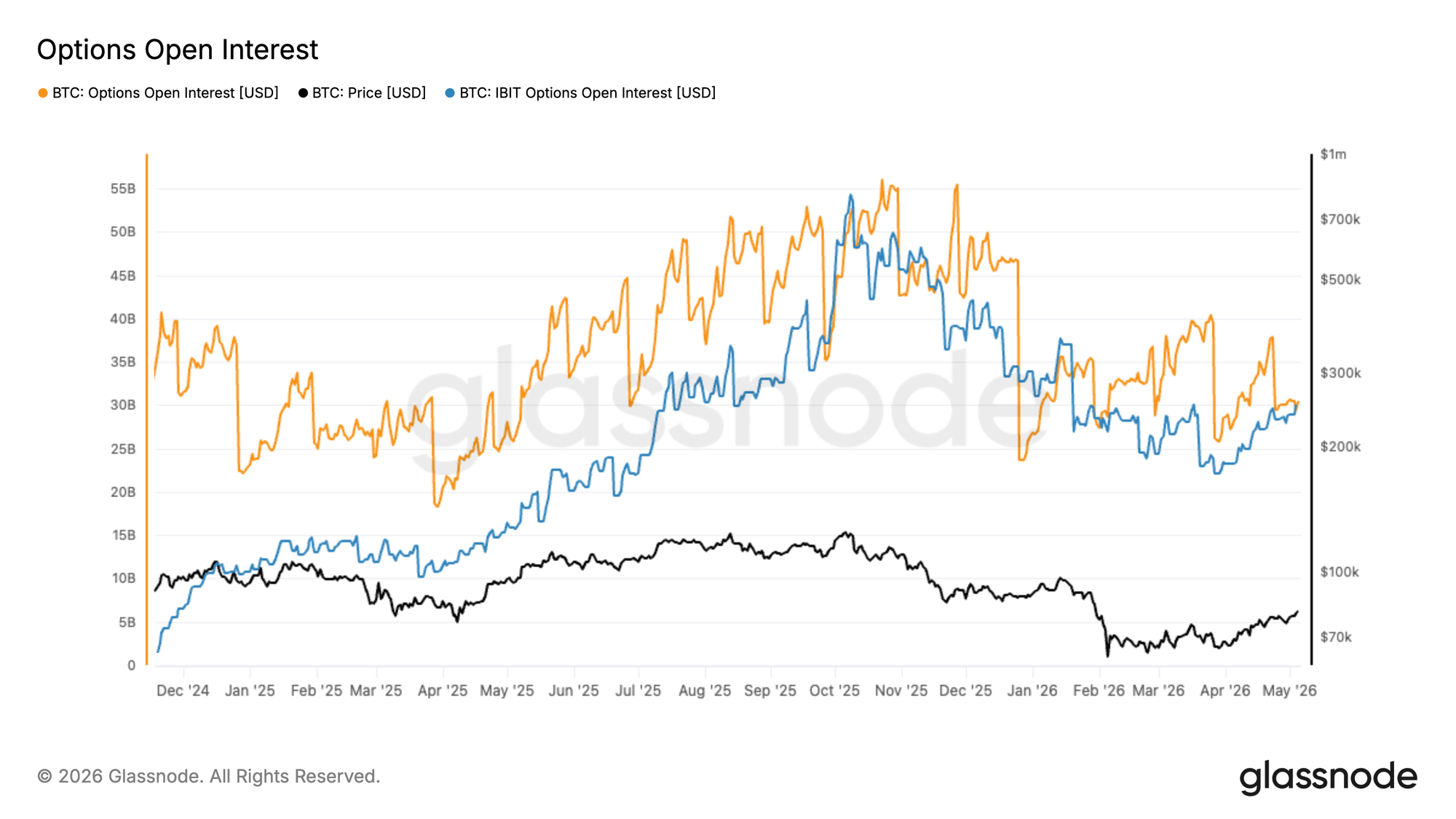
Recent market data illustrates how quickly this market is maturing. IBIT options open interest was reported at around $27.6B, briefly surpassing Deribit’s Bitcoin options open interest of around $26.9B — a major milestone for U.S.-listed, regulated Bitcoin derivatives.
Why IBIT Options Matter

Options markets are where investors express more complex views than simple spot buying or selling. They reveal how participants price upside, downside, tail risk, volatility, and event risk.

In traditional markets, options are essential for understanding positioning and sentiment across equities, indices, rates, and commodities. As Bitcoin becomes more integrated into global portfolios, its options market is becoming equally important. Thus, IBIT options are particularly relevant for digital asset market analysis because they sit at the intersection of two worlds:

  • The Bitcoin market, where volatility, leverage, and directional positioning have historically been shaped by crypto-native exchanges.
  • The traditional ETF market, where regulated brokerage access, advisor platforms, structured products, and institutional risk frameworks play a larger role.

That makes IBIT options a powerful lens into how traditional finance is adopting Bitcoin — not only as a spot allocation, but also as a tradable, hedgeable, and volatility-sensitive asset.

IBIT vs Deribit: Two Different Views of the Bitcoin Market

One of the most important use cases is comparing IBIT options with crypto-native options venues such as Deribit.

Deribit remains a core liquidity venue for Bitcoin and Ethereum options. Deribit BTC options volume regularly exceeds 20,000 contracts, representing more than $2B in daily notional volume. But IBIT options represent a different flow profile.

Deribit is more crypto-native, global, and offshore. IBIT is U.S.-listed, ETF-based, and embedded in traditional brokerage and institutional workflows.

A divergence between IBIT and Deribit implied volatility can indicate that traditional finance and crypto-native markets are pricing Bitcoin risk differently. A richer call wing in IBIT may reflect stronger ETF-linked demand for upside exposure. A stronger put wing may indicate hedging pressure from ETF holders. Differences in term structure may indicate that TradFi participants are pricing event risk differently from crypto-native traders. The analytical value comes from comparing both markets directly.

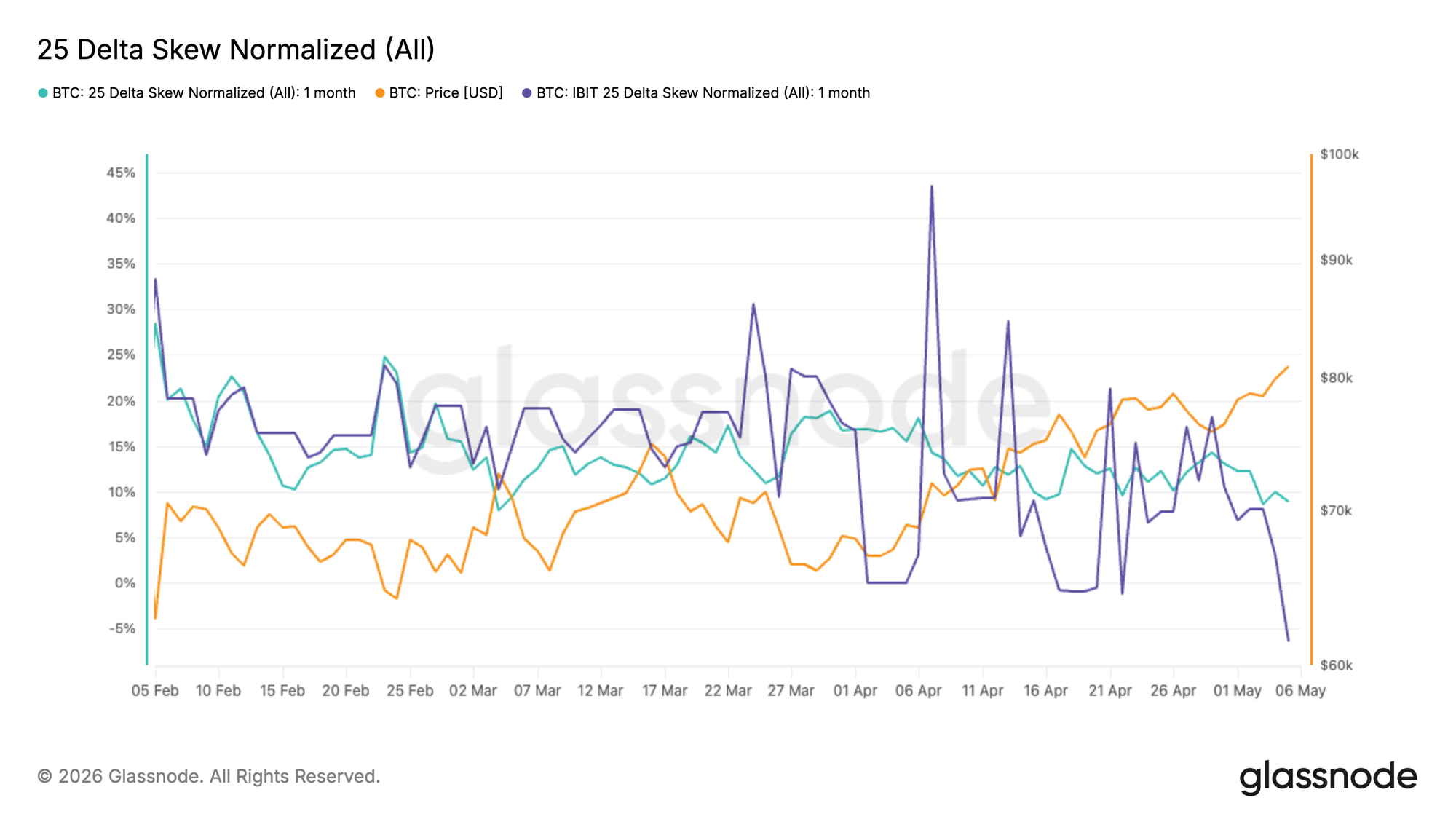
For example, as of May 5, Bitcoin options markets were pricing 1-month risk differently across venues. Deribit’s 1-month 25-delta skew remained modestly call-biased, while IBIT’s comparable skew stayed materially more put-skewed, leaving an approximately 15 percentage-point gap on the same underlying BTC exposure.

This suggests a meaningful venue-level divergence at the 1-month tenor, with IBIT and Deribit reflecting different risk-pricing dynamics across a more institutional ETF options market and a more crypto-native venue.
View live chart

In this context, ETF-linked options investors appear to be assigning a higher premium to short-term downside protection, while crypto-native options markets remain comparatively less defensive.

Glassnode's IBIT Options Metrics and Analytics

We've extended our options analytics framework to IBIT, bringing users the same institutional-grade intelligence used across crypto-native options markets to the largest U.S. spot Bitcoin ETF.

Core IBIT Options Metrics

This first release of 40+ metrics provides the foundation: open interest, volume, max pain, and interpolated IV.

Open Interest, Volume & Max Pain

  • IBIT Options Open Interest: Total OI across all IBIT option contracts. The single most important gauge of institutional engagement on the ETF.
  • IBIT Options Open Interest by Maturity: Distribution of call and put OI across expiration dates. Directly comparable against Deribit's term structure to spot tenor dispersion.
  • IBIT Options Volume: 24h rolling trading volume.
  • IBIT Options Volume Put/Call Ratio: Classic sentiment indicator. Read alongside Deribit's P/C ratio to separate institutional positioning from retail/native flow.
  • IBIT Options Max Pain: Strike where expiring options would cause maximum loss to holders. Useful for anticipating pinning behavior near monthly expiries.
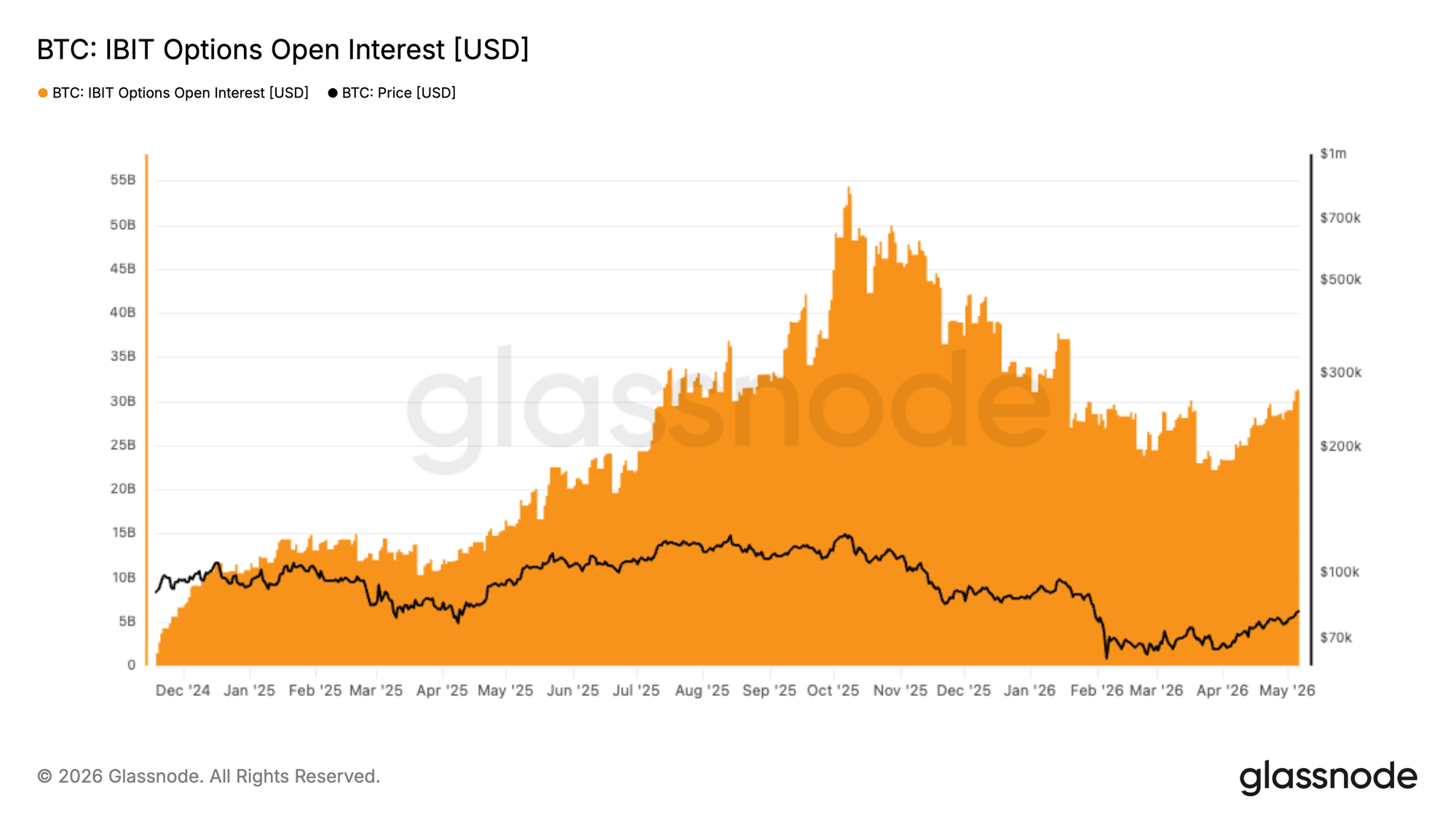
View live chart

IBIT Options ATM Implied Volatility

The new IBIT Options ATM Implied Volatility metrics provide a normalized view of how the U.S. ETF options market is pricing Bitcoin volatility across the term structure.

By tracking ATM IV across 1-week, 1-month, 3-month, and 6-month tenors, users can monitor how volatility expectations evolve through time — from short-term event risk to longer-term macro and positioning regimes. Rising ATM IV often reflects greater uncertainty, higher demand for optionality, or deteriorating sentiment, while falling ATM IV can point to calmer market conditions and reduced demand for protection.
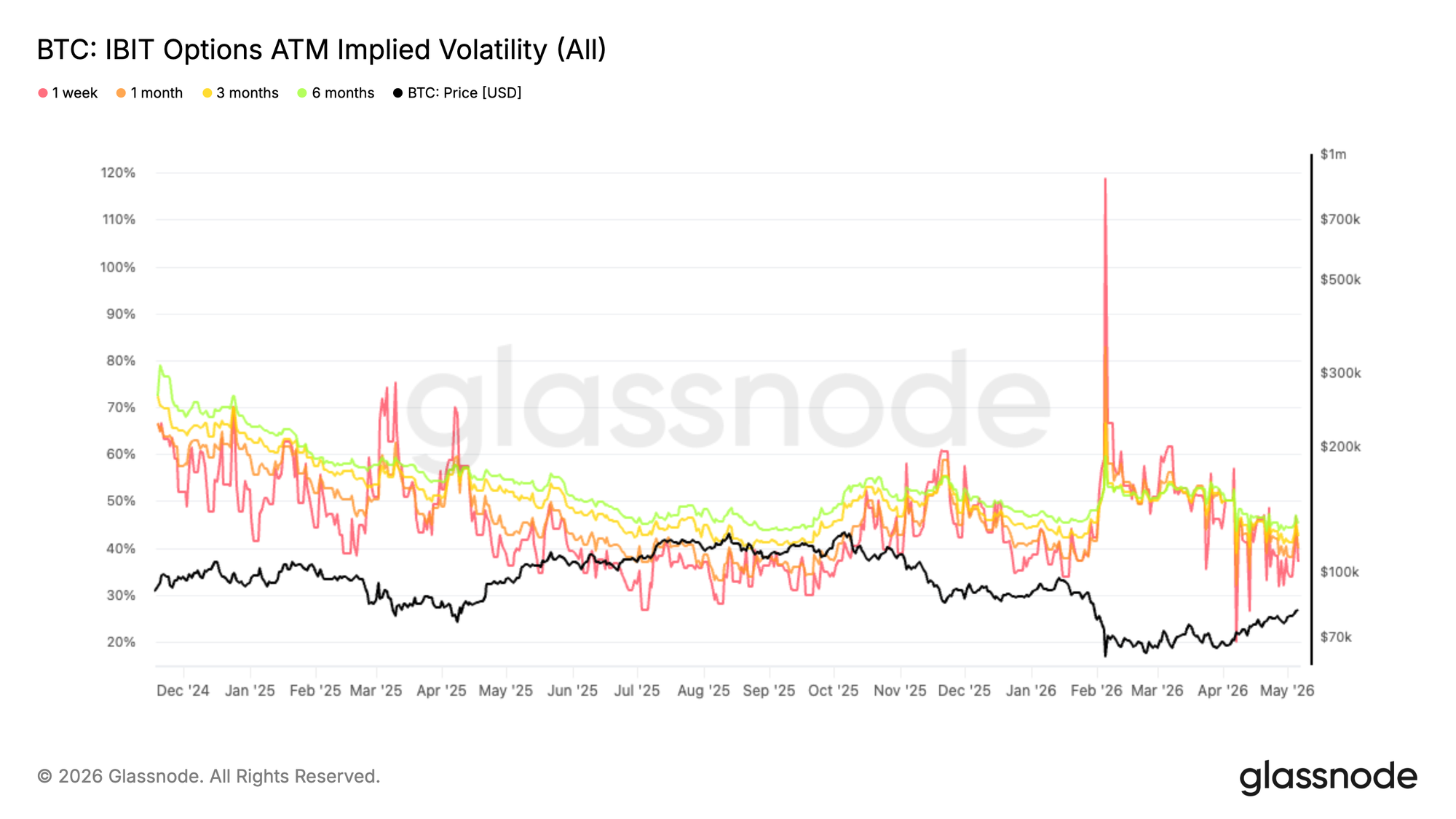
View live chart

Interpolated Implied Volatility by Delta

Smooth, model-interpolated IV at fixed deltas — no more jagged strike-listing artifacts.

  • IBIT Call IV / Put IV at Delta 5, 10, 15, 20, 25, 50

This grid lets you zoom into specific risk zones — crash insurance at 10D puts, squeeze tails at 5D calls, the core smile around 50D — and compare cleanly across time and against Deribit's BTC IV grid.

IBIT Options Skew Metrics

The newest layer delivers proprietary skew analytics, following the same architecture we use for our Glassnode Skew Index across BTC, ETH, SOL, XRP, now applied to IBIT.

IBIT Skew Index & Components:

  • IBIT Skew Index — Single measure of option-market asymmetry, integrating prices across broader sections of the volatility surface (not just two points like classical 25-delta skew). Positive = upside-focused IV dominates. Negative = downside hedging dominates.
  • IBIT Skew Ratio — Ratio of upside to downside IV. Above 1: upside premium. Below 1: downside premium.
  • IBIT Upside Implied Volatility — Upside-focused IV from OTM calls, integrated across strikes and time-weighted to fixed tenors.
  • IBIT Downside Implied Volatility — Downside-focused IV from OTM puts, same construction.

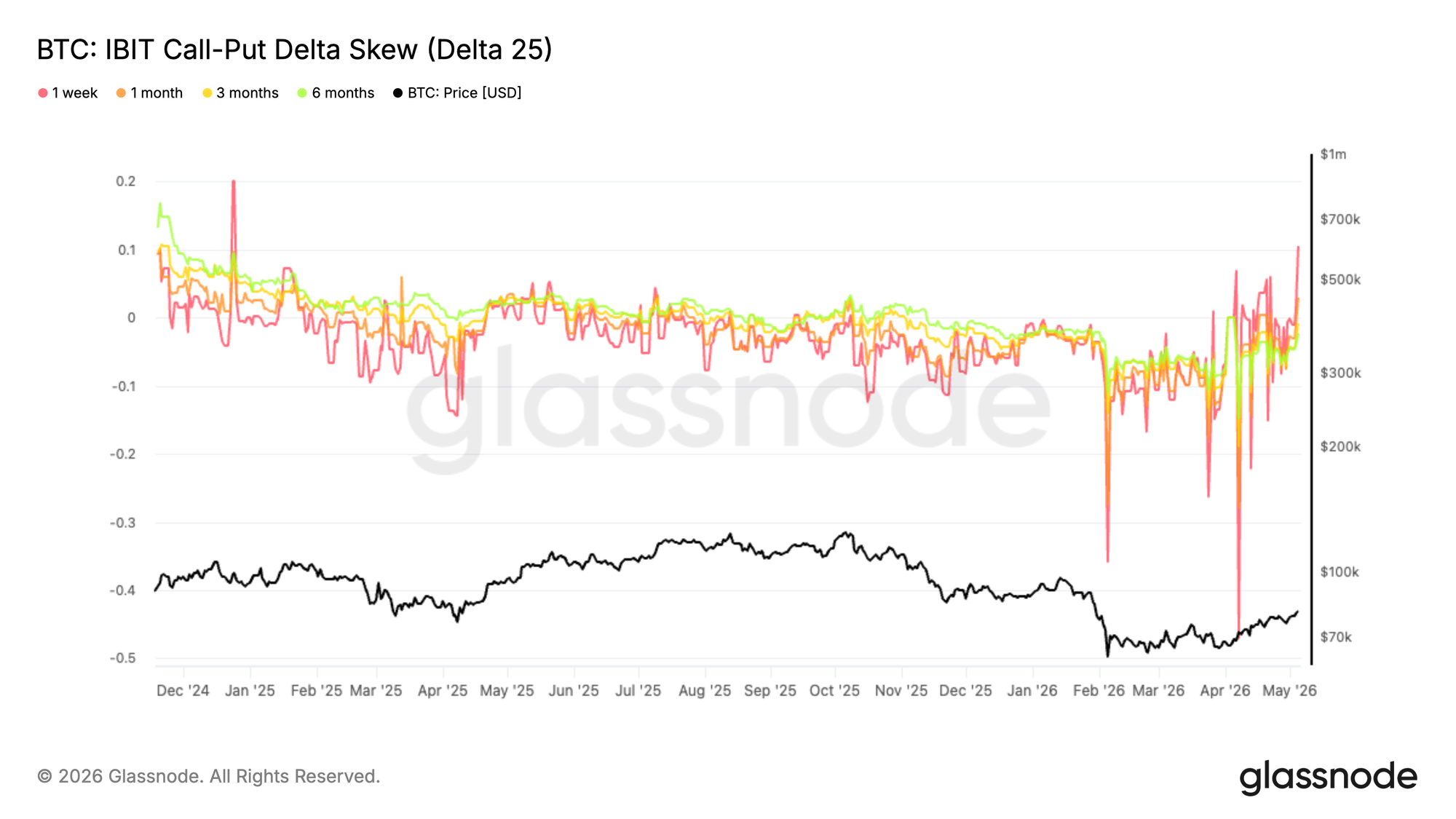
IBIT Call–Put Delta Skew (unnormalized, by tenor)

Time series of model-interpolated call–put IV skew — call IV minus put IV at each target delta, expressed directly in IV points.

  • Delta 5, 10, 15, 20, 25
View live metric

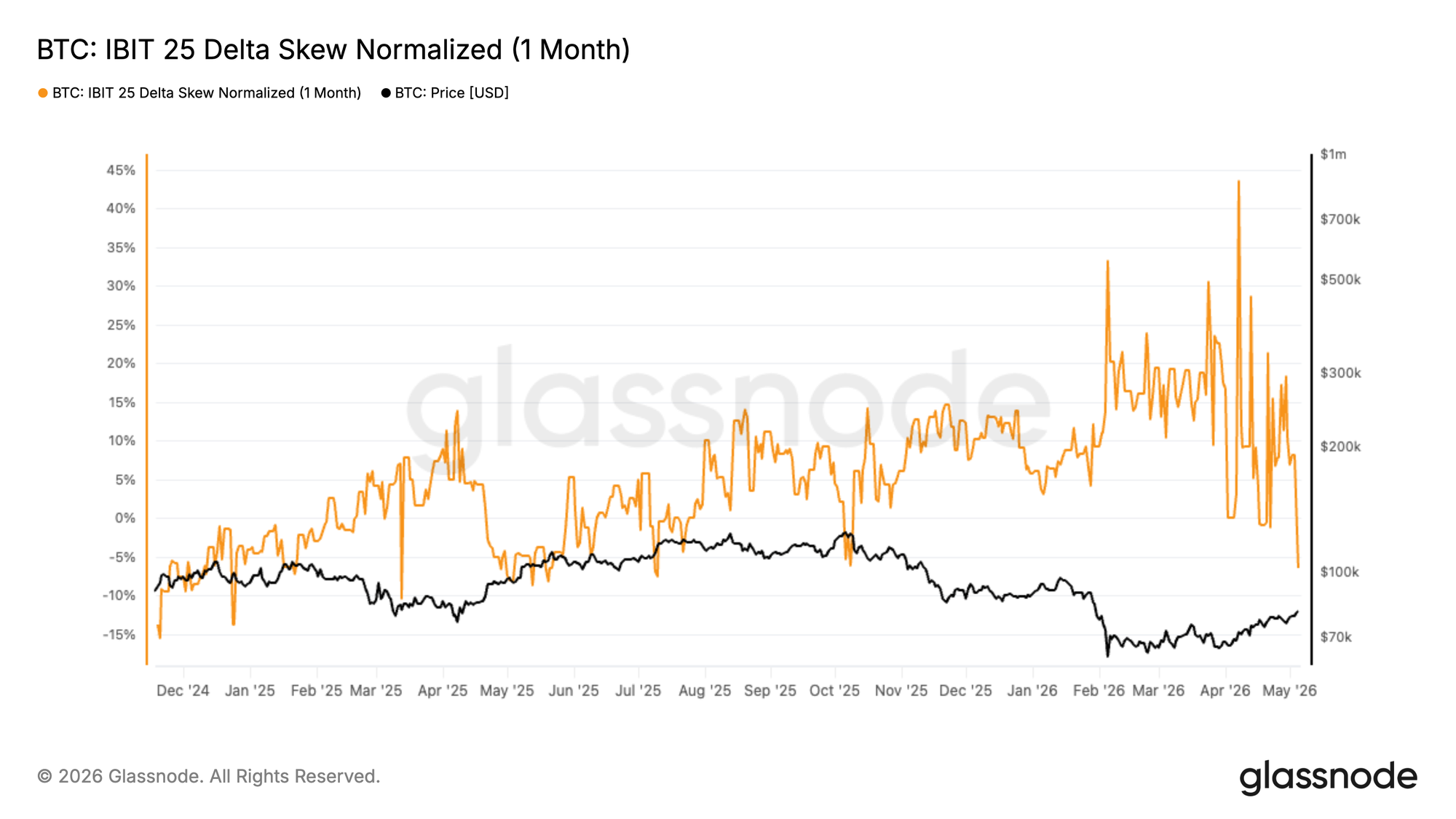
IBIT 25-Delta Skew Normalized (by tenor)

The classical 25-delta skew (25-delta put IV minus 25-delta call IV), normalized by ATM IV — making readings comparable across volatility regimes.

  • 1 Week, 1 Month
View live metric

IBIT Implied Volatility Heatmaps

Visual surfaces for the IBIT volatility structure:

IBIT Implied Volatility Heatmap (by Delta) — Heatmaps of model-interpolated IV across option delta at fixed tenors. Vertical axis = delta (positive for calls, negative for puts).

  • 1 Week, 1 Month, 3 Months, 6 Months

IBIT Implied Volatility Moneyness Heatmap — IV across moneyness buckets at a fixed tenor, from deep OTM puts to deep OTM calls.

  • 1 Month, 3 Months, 6 Months

The heatmaps make skew asymmetries, tail-risk pricing, and term-structure dislocations visible at a glance, where individual time series can require triangulation.
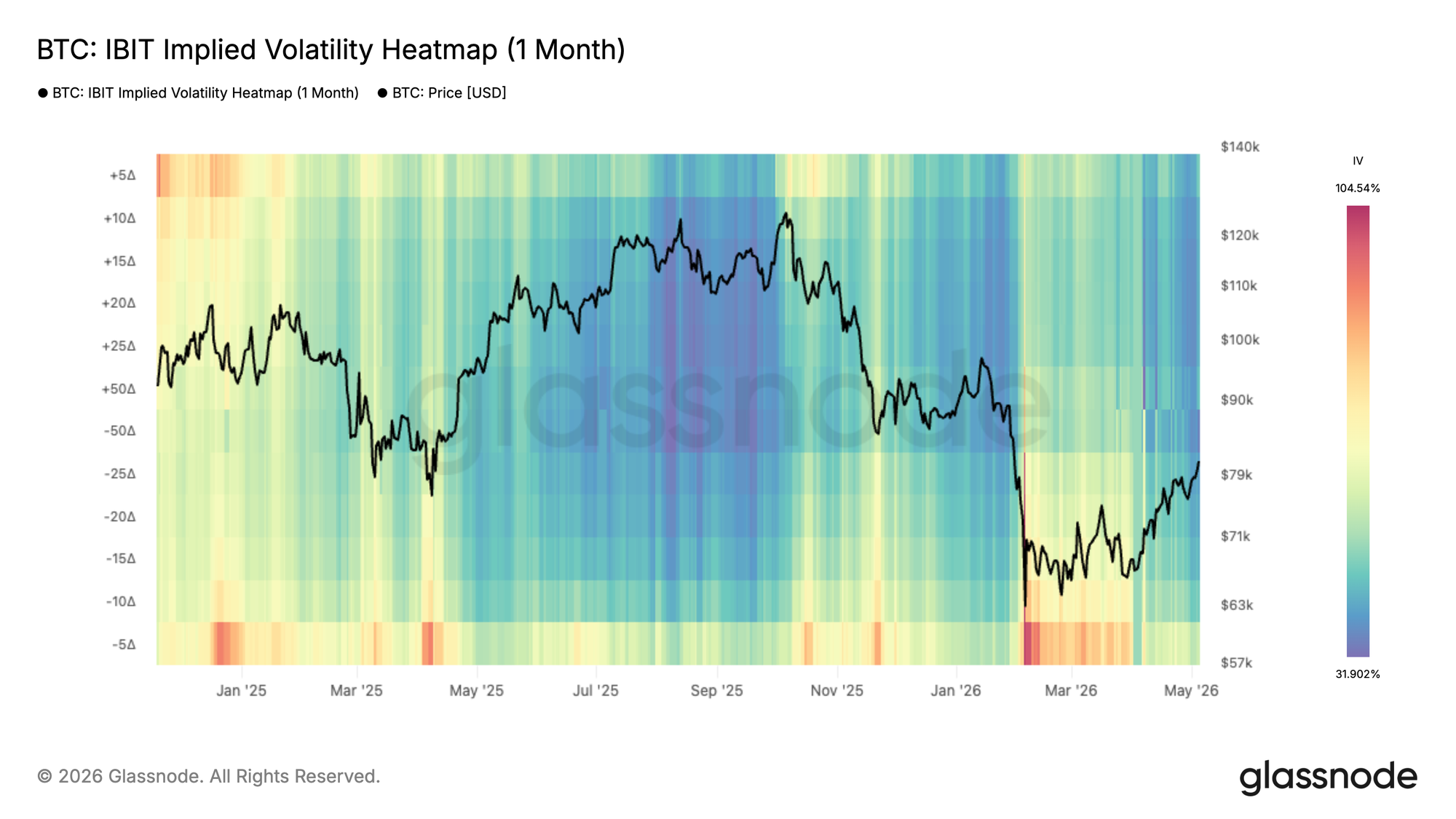
View live metric

Applications of IBIT Options Data

IBIT options data can be used across several workflows.

  1. Measure TradFi Bitcoin Sentiment

IBIT options provide a direct view into how ETF-linked participants are pricing Bitcoin risk. Call demand, put demand, skew, and term structure can reveal whether the market is positioning for upside, hedging downside, or pricing near-term event risk.

  1. Compare Institutional and Crypto-Native Views

By comparing IBIT metrics with Deribit metrics, clients can identify differences between traditional-market and crypto-native pricing. For example:

  • Is IBIT skew more bullish or more defensive than Deribit?
  • Are IBIT options pricing higher or lower volatility for the same tenor?
  • Is upside demand stronger in ETF markets than offshore crypto venues?
  • Are ETF investors hedging drawdowns more aggressively than crypto-native traders?

These divergences can become actionable research signals.

  1. Monitor Hedging Pressure

Put/call ratios, downside IV, and normalized skew can help identify when ETF holders may be using options defensively. This is especially useful around macro events, ETF flow reversals, large expiries, and Bitcoin drawdowns.

  1. Track Volatility Risk Across Tenors

The term structure of IBIT implied volatility shows how the market prices short-term versus long-term uncertainty. A steep front-end can indicate event risk. A richer back-end can indicate structural demand for longer-dated exposure.

The Takeaway

IBIT options are a sign that Bitcoin is moving further into mature institutional market structure.

  • Spot ETFs made Bitcoin easier to hold.
  • Futures made it easier to hedge directionally.
  • Options make it possible to price volatility, skew, convexity, and risk across time.

As IBIT options continue to grow, they are likely to become one of the most important signals for Bitcoin sentiment and institutional positioning. Glassnode’s IBIT options suite gives clients the tools to track that shift in real time.

Options data is a major focus for Glassnode's product development. Every quarter, we are scaling our coverage with new metrics that extend the depth of our volatility tooling, broaden analytical use cases, and give professionals a more complete view of positioning and risk across the digital assets market.


  • Follow us on X for timely market updates and analysis
  • Join our Telegram channel for regular market insights
  • For on-chain metrics, dashboards, and alerts, visit Glassnode Studio

Disclaimer: This report is for informational and educational purposes only. The analysis represents a limited case study with significant constraints and should not be interpreted as investment advice or definitive trading signals. Past performance patterns do not guarantee future results. Always conduct thorough due diligence and consider multiple factors before making investment decisions.


Пов'язані питання

QAccording to the article, what is the significance of IBIT options surpassing Deribit's Bitcoin options in open interest?

AIBIT options open interest briefly surpassing Deribit's Bitcoin options open interest (approx. $27.6B vs. $26.9B) is described as a major milestone. It signifies the maturation of U.S.-listed, regulated Bitcoin derivatives and demonstrates that Bitcoin is moving deeper into traditional financial market structures.

QWhat key analytical value does comparing IBIT options with Deribit's options offer?

AComparing IBIT and Deribit options allows for the identification of divergences in how traditional finance (TradFi) and crypto-native markets price Bitcoin risk. For instance, differences in implied volatility skew can indicate whether ETF-linked participants are demanding more downside protection (put-skew) compared to crypto-native traders, offering insights into differing institutional positioning and risk appetite.

QName three core categories of IBIT options metrics that Glassnode has introduced.

AThree core categories are: 1) Core IBIT Options Metrics (Open Interest, Volume, Max Pain, ATM IV), 2) IBIT Options Skew Metrics (Skew Index, Skew Ratio, Call-Put Delta Skew), and 3) IBIT Implied Volatility Heatmaps (by Delta and by Moneyness).

QHow does the article describe the typical progression of a mature financial market, and where do options fit in?

AThe article states that every mature financial market progresses along this path: spot markets first, followed by futures, and ultimately options. Options are described as the last layer to scale because they require the deepest liquidity, the most sophisticated risk management, and the broadest base of end-users.

QWhat are two specific applications of IBIT options data mentioned in the article?

ATwo applications are: 1) Measuring TradFi Bitcoin sentiment by analyzing call/put demand, skew, and term structure from ETF-linked participants. 2) Monitoring hedging pressure by tracking put/call ratios, downside implied volatility, and normalized skew to identify when ETF holders are using options defensively.

Пов'язані матеріали

IOSG Founder: Web3 Is 'Losing Blood,' How Can Practitioners Survive Better?

IOSG Founder: Web3 Is "Bleeding Out" – How Can Practitioners Survive Better? In a candid reflection, the founder of IOSG Ventures voices deep concerns about the current state of Web3, describing an ecosystem experiencing severe "blood loss." Despite the recent MuShanghai event showcasing a successful pivot towards a more diverse, global community, a somber reality persists: many crypto-native attendees were there exploring exits or new labels in biotech, AI, and robotics. The core issue is identified as a breakdown in the ecosystem's positive feedback loop. Alarmingly, underestimated "low-probability bad events" are occurring simultaneously: a significant brain drain of Chinese developers to AI, a lack of breakout applications despite massive funding, and a widening credibility gap for practitioners globally, often stigmatized as scam artists. This has created a dire接班人 (successor) problem, with the next generation seeing little professional prestige or financial upside in crypto compared to fields like AI. A significant portion of the critique focuses on Ethereum and Vitalik Buterin. While not pessimistic about Ethereum's technology, the founder worries that critical development windows were missed by focusing on niche technical narratives like ZK and L2 instead of mass-market applications. A more urgent concern is that Vitalik may be isolated in an "information bubble," shielded from the grassroots community's hardships by layers of intermediaries, preventing crucial feedback from reaching him. The call is for Vitalik to return to a founder's mindset, re-engage directly with the community, and rally efforts for the next decade. The divergence between U.S. and Chinese OG (Original Gangster) ecosystems is stark. While many U.S. builders reinvest their wealth into the ecosystem, the Chinese scene suffers from a severe lack of "造血能力" (blood-making ability), with most market-driven funds struggling and many early success stories cashing out entirely. This threatens the entire Asian Web3 ecosystem's survival. For individual practitioners, survival advice is pragmatic: find your core "why," maintain life balance beyond token prices, continuously learn new skills (like AI), form small, trusted alliances for mutual support, and practice self-compassion. The industry's greatest need is not money or tech, but lighthouses—individuals at all levels who offer mentorship, grants, referrals, and honest reflection to guide others. The piece concludes with a direct appeal: OGs must pay forward the opportunities the industry gave them; founders must not struggle alone; and builders must continue their work, ensuring it remains a viable profession. The survival of Web3's "cathedral" depends not on any single leader but on the collective responsibility of everyone who remains.

marsbit20 хв тому

IOSG Founder: Web3 Is 'Losing Blood,' How Can Practitioners Survive Better?

marsbit20 хв тому

Deficits, Inflation, and the New Fed: The Deep Logic Behind US Bond Yields Breaking 5% and the Market Reset

In the week of May 15-19, 2026, U.S. long-term Treasury yields surged to multi-year highs, with the 30-year yield hitting 5.2%, a level unseen since 2007, and the 10-year yield climbing to 4.687%. Equity markets declined in response. Four primary factors are driving the rise in yields. First, stubborn inflation persists, with April wholesale prices rising 6% year-over-year, fueling expectations of potential future Fed rate hikes instead of cuts. Second, newly confirmed Fed Chair Kevin Warsh inherits a complex inflation battle, with markets closely awaiting his first FOMC meeting. Third, deteriorating U.S. fiscal health, marked by large deficits and rising debt servicing costs, is eroding the traditional "safe-haven" premium for Treasuries. Fourth, the "One Big Beautiful Bill" tax cuts are projected to add trillions to the national debt, contributing to Moody's recent credit rating downgrade. Rising yields pressure stocks through several channels: a higher discount rate reduces the present value of future earnings (especially for growth stocks); rising risk-free rates compress equity risk premiums, making bonds relatively more attractive; higher borrowing costs impact consumers and corporations; and a stronger dollar affects multinational earnings. For investors, the environment favors value and financial stocks over long-duration growth stocks. Bond investors find attractive yields in short to intermediate maturities, while income investors see the best fixed-income opportunities in over a decade. Key developments to watch include Chair Warsh's first FOMC meeting, upcoming inflation data, Treasury auction demand, and whether the 30-year yield approaches 6%, a level that could trigger a more sustained equity valuation reset. The bond market's message is clear: the era of cheap government borrowing is over, posing a central challenge for markets in late 2026.

marsbit21 хв тому

Deficits, Inflation, and the New Fed: The Deep Logic Behind US Bond Yields Breaking 5% and the Market Reset

marsbit21 хв тому

Is MicroStrategy Selling Bitcoin Not a Bearish Signal? Deconstructing the 5 Financial Logics Behind Corporate Bitcoin Divestment

The article "Is Strategy Selling Bitcoin Not a Bearish Signal? Decoding 5 Financial Logics Behind Corporate Bitcoin Divestment" analyzes why companies might sell their bitcoin holdings, arguing it's not necessarily negative. It begins by noting the market's surprise at Strategy's potential sale, contrasting its previous "never sell" stance. The core argument is that corporate decisions prioritize shareholder value, and selling bitcoin can be a rational strategic choice. The article outlines five key financial reasons for such sales: 1. **Increase Bitcoin Holdings Per Share:** Companies can use proceeds from bitcoin sales to repurchase shares when the stock price is undervalued relative to its bitcoin assets. This reduces the outstanding share count, potentially increasing the bitcoin amount backing each remaining share. 2. **Optimize Capital Structure & Reduce Financing Costs:** Building cash reserves through bitcoin sales can improve credit ratings (as favored by agencies like S&P), leading to lower future borrowing costs. Repaying debt with sale proceeds also reduces financial leverage. 3. **Legitimate Tax Planning:** In the absence of wash-sale rules for bitcoin in the US, companies can sell to realize capital losses, then repurchase, lowering the tax basis of their holdings and creating tax offsets. 4. **Counter Negative Market Narratives:** A controlled, non-disruptive sale could demonstrate market resilience and disprove fears that corporate selling would crash the market, thereby normalizing bitcoin as a corporate treasury asset. 5. **Repurchase Preferred Stock at a Discount:** If a company's preferred stock trades significantly below its face value, using bitcoin sale proceeds to repurchase it can retire expensive liabilities at a profit, saving on future dividend payments. The conclusion emphasizes that bitcoin's monetary properties offer flexibility. Strategic sales can protect corporate and shareholder interests, making asset utilization more important than rigid "hold" mandates.

marsbit51 хв тому

Is MicroStrategy Selling Bitcoin Not a Bearish Signal? Deconstructing the 5 Financial Logics Behind Corporate Bitcoin Divestment

marsbit51 хв тому

Why Did Zhipu Surge Nearly 30% in a Single Day?

"Global AI Model Unicorn" Zhipu's stock surged nearly 30% in a single day, reaching a new market cap high. The catalyst was the launch of its GLM-5.1-highspeed API, boasting a generation speed of **400 tokens per second**, setting a new global benchmark. This speed, roughly 3-5 times faster than industry leaders like OpenAI's GPT-4o and Anthropic's Claude, is achieved **without compromising the full-scale model's capabilities**. In the era of AI Agents requiring dozens of self-calls, such latency reduction is critical, transforming speed from a system metric into a determinant of intelligence limits. The breakthrough stems from a three-layer technical overhaul: 1. **TileRT Inference Engine**: Compiles the entire model into a continuous, always-on computation pipeline using "Warp Specialization," minimizing GPU idle time by having different processor groups handle data loading, computation, and communication in parallel. 2. **Heterogeneous Parallelism for MLA**: To efficiently run the GLM-5.1 model using the MLA attention mechanism, TileRT employs a heterogeneous strategy. One GPU handles sparse indexing/routing, while the others perform dense computation, optimizing for MLA's unique workflow. 3. **ZCube Network Architecture**: Replaces the standard Spine-Leaf (ROFT) network topology with a flat, dual-group interconnect. This design creates a single optimal path between any two GPUs, eliminating network congestion at scale and reducing latency. The business impact is significant: a 15% increase in cluster throughput (free extra capacity), a 40.6% reduction in tail latency (improved stability), and a one-third cut in networking hardware costs. Long-term, this innovation challenges the dominance of NVIDIA's integrated hardware-software stack (GPU+NVLink+InfiniBand), potentially benefiting manufacturers of high-density Leaf switches and optical modules while lowering the software barrier for domestic AI chips like Huawei's Ascend. The innovation proves that more can be achieved with the same compute, reshaping the infrastructure beyond just GPUs.

marsbit2 год тому

Why Did Zhipu Surge Nearly 30% in a Single Day?

marsbit2 год тому

Торгівля

Спот
Ф'ючерси
活动图片