I Dropped Out of High School, Learned with AI, and Made a Comeback as an OpenAI Researcher

深潮Опубліковано о 2025-12-17Востаннє оновлено о 2025-12-17

Анотація

The article tells the story of Gabriel Petersson, who dropped out of high school in Sweden and eventually became a research scientist at OpenAI working on the Sora video project. He achieved this through a self-directed, AI-powered learning method he calls "recursive knowledge filling." Instead of following a traditional "bottom-up" educational path, he starts with a concrete project and uses AI to deeply understand each component through relentless questioning. He treats AI not as a tool to generate answers, but as an infinitely patient tutor. For example, to learn about diffusion models, he began by asking an AI for the core concepts, then had it generate code. He then interrogated every part of that code, asking "why" and "how" until he built an intuitive understanding from the top down. This method allows him to rapidly acquire the essence of a subject in days rather than years. The author contrasts this with how most people use AI, which often leads to a decline in their own critical thinking and skills, as evidenced by research. The key difference is mindset: using AI as a "co-pilot for thinking" rather than an "answer generator." The article concludes with a five-step framework for applying this method to learn any subject and suggests that this approach could lead to a future of more "one-person companies" where individuals use AI to master multiple disciplines. The core advice is to never stop at the first answer—to keep asking questions.

Author: Jin Guanghao

A while ago, I attended an AI gathering in Shanghai.

The event itself covered a lot about AI implementation.

But what impressed me the most was a learning method shared by an investor veteran.

He said this method saved him and changed his criteria for evaluating people in investments.

What exactly is it? It's learning to "ask questions."

When you're interested in a question, go talk to DeepSeek, keep talking until it can't answer anymore.

This technique of "infinite questioning" was quite shocking to hear at the time, but after the event, I put it aside.

I didn't try it, nor did I think about it again.

Until recently, when I came across the story of Gabriel Petersson dropping out of school, using AI to learn, and joining OpenAI.

It suddenly dawned on me what that veteran meant by "asking to the end" in this AI era.
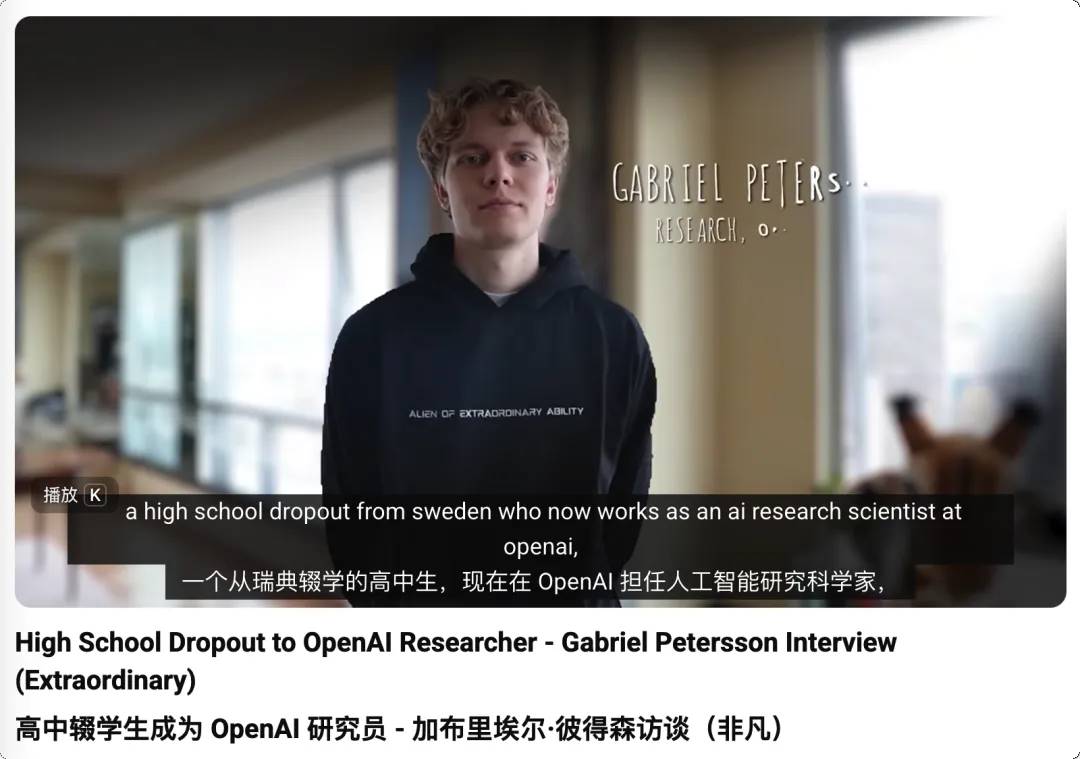
Gabriel's Interview Podcast | Image: YouTube

01 "High School Dropout" Makes a Comeback as OpenAI Researcher

Gabriel is from Sweden and dropped out of high school.
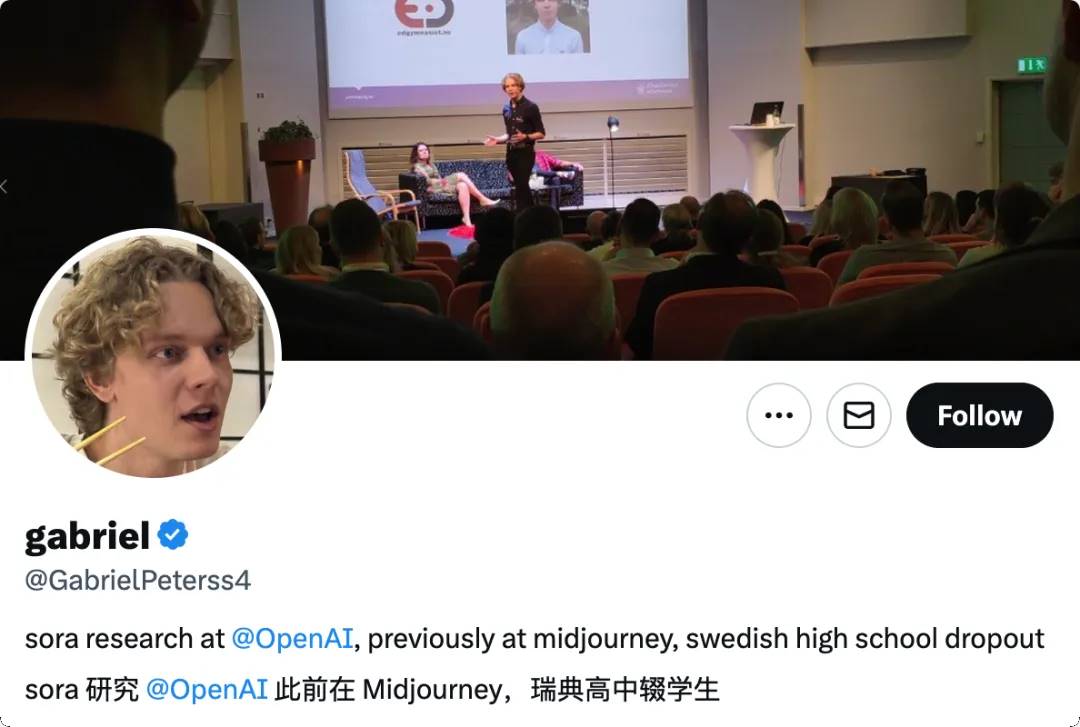
Gabriel's Social Media Profile | Image: X

He used to think he was too dumb to ever work in AI.

The turning point came a few years ago.

His cousin started a startup in Stockholm, working on an e-commerce product recommendation system, and asked him to help.

So Gabriel went. With little technical background and no savings, he even slept on the couch in the company's common lounge for a whole year during the early startup phase.

But he learned a lot that year. Not in school, but forced by the pressure of real problems: programming, sales, system integration.

Later, to optimize his learning efficiency, he switched to being a contractor, allowing him more flexibility in choosing projects, specifically seeking out the best engineers to collaborate with and actively seeking feedback.

When applying for a U.S. visa, he faced an awkward problem: this type of visa requires proof of "extraordinary ability" in the field, typically needing academic publications, paper citations, etc.

How could a high school dropout have these?

Gabriel came up with a solution: he compiled his high-quality technical posts from programmer communities as a substitute for "academic contributions." This proposal was actually approved by immigration.

After arriving in San Francisco, he continued to use ChatGPT to self-study math and machine learning.

Now he is a research scientist at OpenAI, working on building the Sora video model.

At this point, you must be curious, how did he do it?

Gabriel's Viewpoint | Image: X

02 Recursive Knowledge Filling: A Counterintuitive Learning Method

The answer is "infinite questioning"—find a specific problem and solve it thoroughly with AI.

Gabriel's learning method is contrary to most people's intuition.

The traditional learning path is "bottom-up": build the foundation first, then learn applications. For example, to learn machine learning, you first need linear algebra, probability, calculus, then statistical learning, then deep learning, and finally you can touch actual projects. This process might take years.

His method is "top-down": start directly with a specific project, solve problems as they arise, and fill knowledge gaps when discovered.

He said in the podcast that this method was hard to promote before because you needed an omniscient teacher to always tell you "what to learn next."

But now, ChatGPT is that teacher.
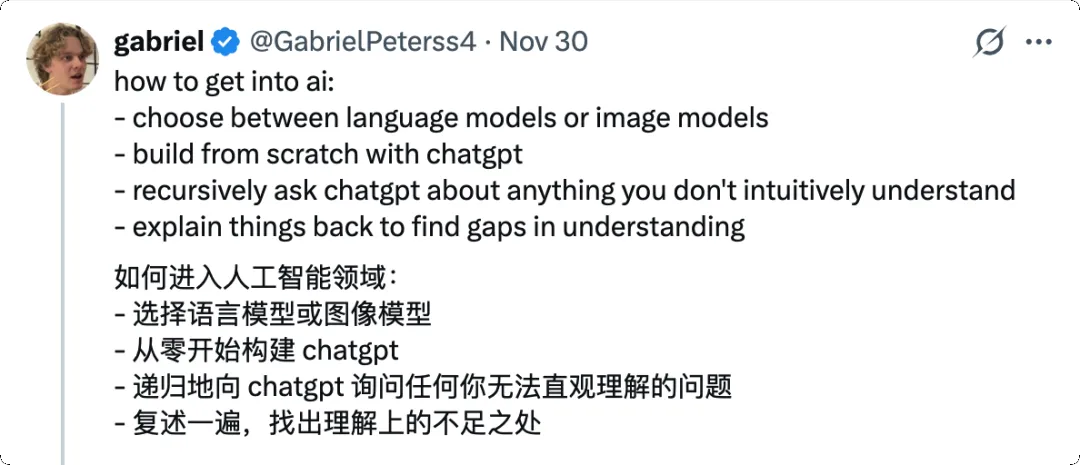
Gabriel's Viewpoint | Image: X

How exactly? He gave an example: how to learn diffusion models.

Step one, start with the macro concept. He asks ChatGPT: "I want to learn about video models, what's the core concept?" AI tells him: autoencoders.

Step two, code first. He asks ChatGPT to directly write a piece of diffusion model code. At first, many parts are incomprehensible, but that's okay, just get the code running first. Once it runs, you have a basis for debugging.

Step three, the core: recursive questioning. He asks questions about every module in the code.

Drill down layer by layer like this until the underlying logic is thoroughly understood. Then return to the previous layer and ask about the next module.

He calls this process "recursive knowledge filling."
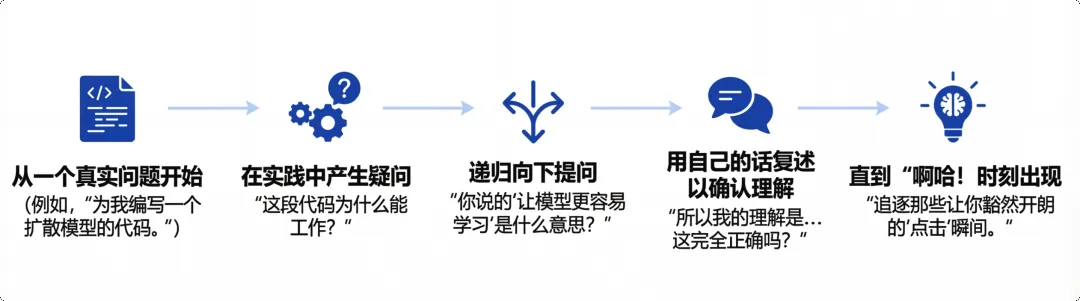
Recursive Knowledge Filling | Image: nanobaba2

This is much faster than studying step-by-step for six years; it might take just three days to build basic intuition.

If you're familiar with the Socratic method, you'll find this is essentially the same idea: approaching the essence of things through layered questioning, where every answer is the starting point for the next question.

Only now, he uses AI as the person being questioned, and since AI is nearly omniscient, it continuously expresses the essence of things in an easy-to-understand way to the questioner.

In fact, by adopting this approach, Gabriel performs "knowledge extraction" from AI, learning the essence of things.

03 Most of Us Using AI Are Actually Getting Dumber

After listening to the podcast, Gabriel's story made me wonder:

Why can he learn so well using AI, while many people feel they are regressing after using AI?

This isn't just my subjective feeling.

A 2025 Microsoft Research paper shows [1] that when people frequently use generative AI, their use of critical thinking significantly decreases.

In other words, we outsource our thinking to AI, and then our own thinking ability atrophies.

Skills follow the "use it or lose it" rule: when we use AI to write code, our ability to code by hand and brain quietly deteriorates.

The working style of "vibe coding" with AI seems efficient, but in the long run, the programmer's own skills decline.

You throw requirements to AI, it spits out a bunch of code, you run it, feel great. But if you turn off AI and try to write the core logic by hand, many find their minds blank.

A more extreme case comes from the medical field. A medical paper points out [2] that doctors' colonoscopy detection skills decreased by 6% three months after introducing AI assistance.

This number seems small, but think: this is real clinical diagnostic ability, concerning patients' health and lives.

So the question is: the same tool, why do some get stronger and some weaker?

The difference lies in what you treat AI as.

If you treat AI as a tool to do work for you, letting it write code, write articles, make decisions for you, then your ability will indeed degrade. Because you skip the thinking process and only get the result. Results can be copied and pasted, but thinking ability doesn't grow out of thin air.

But if you treat AI as a coach or mentor, using it to test your understanding, question your blind spots, force yourself to clarify vague concepts: then you are actually using AI to accelerate your learning cycle.

The core of Gabriel's method is not "let AI learn for me" but "let AI learn with me." He is always the one actively asking questions; AI just provides feedback and material. Every "why" is asked by himself, every layer of understanding is dug by himself.

This reminds me of an old saying: Give a man a fish, and you feed him for a day; teach a man to fish, and you feed him for a lifetime.
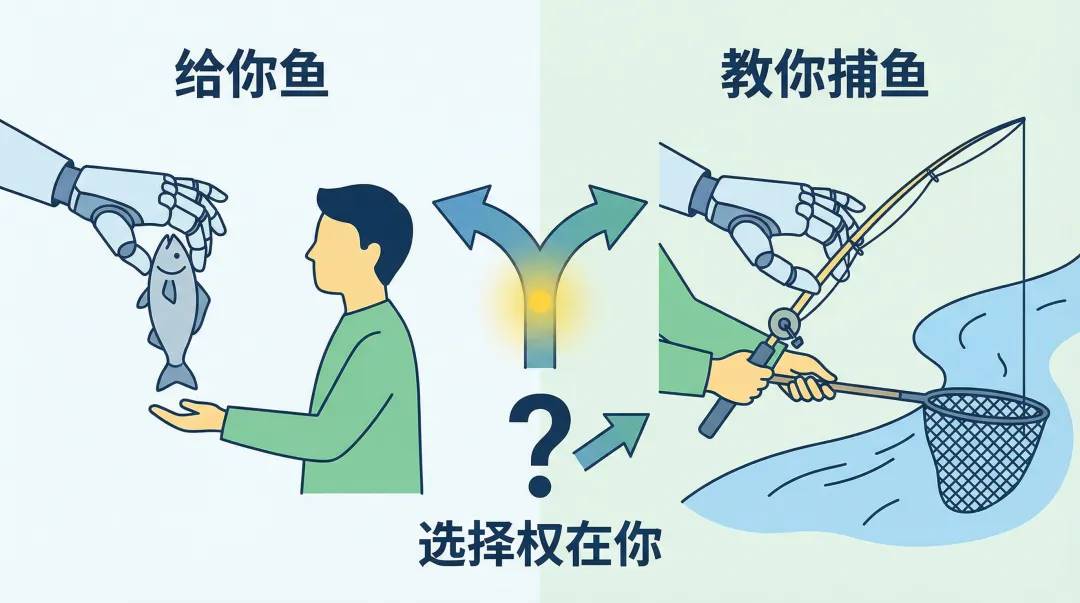
Recursive Knowledge Filling | Image: nanobaba2

04 Some Practical Insights

At this point, some might ask: I'm not in AI research, nor a programmer, what use is this method to me?

I think Gabriel's methodology can be abstracted into a more universal five-step framework. Everyone can use AI to learn any unfamiliar field.

1. Start from actual problems, not from chapter one of a textbook.

Whatever you want to learn, just start doing it, and fill in the gaps when you get stuck.

Knowledge learned this way has context and purpose, much more effective than memorizing concepts in isolation.
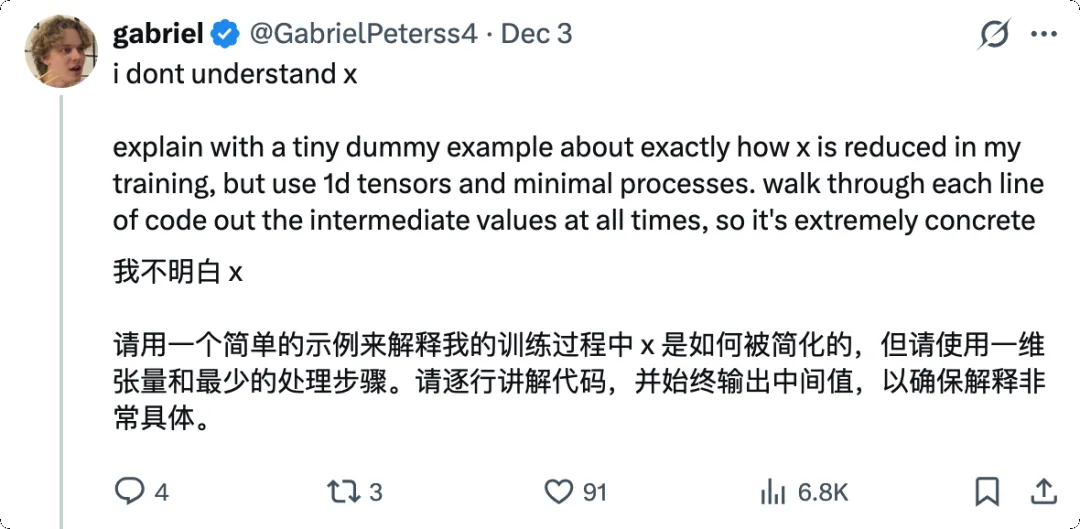
Gabriel's Viewpoint | Image: X

2. Treat AI as an infinitely patient tutor.

You can ask it any stupid question, have it explain the same concept in different ways, ask it to "explain like I'm five."

It won't laugh at you, nor will it get impatient.

3. Actively question until you build intuition. Don't settle for superficial understanding.

Can you restate a concept in your own words? Give an example not mentioned in the original text?

Explain it to a layperson? If not, keep asking.

4. There's a trap to be wary of: AI can also hallucinate.

During recursive questioning, if the AI explains a underlying concept wrong, you might go further down the wrong path.

So it's advised to cross-validate with multiple AIs at key nodes, ensuring the foundation of your questioning is solid.

5. Record your questioning process.

This forms reusable knowledge assets: next time you encounter a similar problem, you have a complete thought process to review.

In traditional观念, the value of tools lies in reducing resistance and improving efficiency.

But learning is恰恰相反: moderate resistance, necessary friction, is反而 the prerequisite for learning. If everything is too smooth, the brain enters power-saving mode and remembers nothing.

Gabriel's recursive questioning本质上 creates friction.

He constantly asks why, constantly pushes himself to the edge of not understanding, then slowly fills the gaps.

This process is uncomfortable, but it's this discomfort that truly embeds knowledge into long-term memory.

05 Future Career Trends

In this era, the monopoly of academic qualifications is being broken, but the cognitive threshold is invisibly rising.

Most people only use AI as an "answer generator," while a very few, like Gabriel, use AI as a "thinking exerciser."

Actually, similar uses have already appeared in different fields.

For example, on Jike, I see many parents using nanobanana to tutor their children. But they don't let AI give the answer directly; instead, they have AI generate解题 steps, showing the thinking process step by step, then analyze the logic of each step with the child.

This way, the child learns not the answer, but the method of solving the problem.

Prompt "Solve the given integral and write the complete solution on a whiteboard" | Image: nanobaba2

Others use features like Listenhub or NotebookLM to convert long articles or papers into podcast form, with two AI voices discussing, explaining, and questioning. Some think this is lazy, but others find that listening to the conversation and then going back to the original text actually improves comprehension efficiency.

Because the conversation naturally raises questions, forcing you to think: Do I really understand this point?
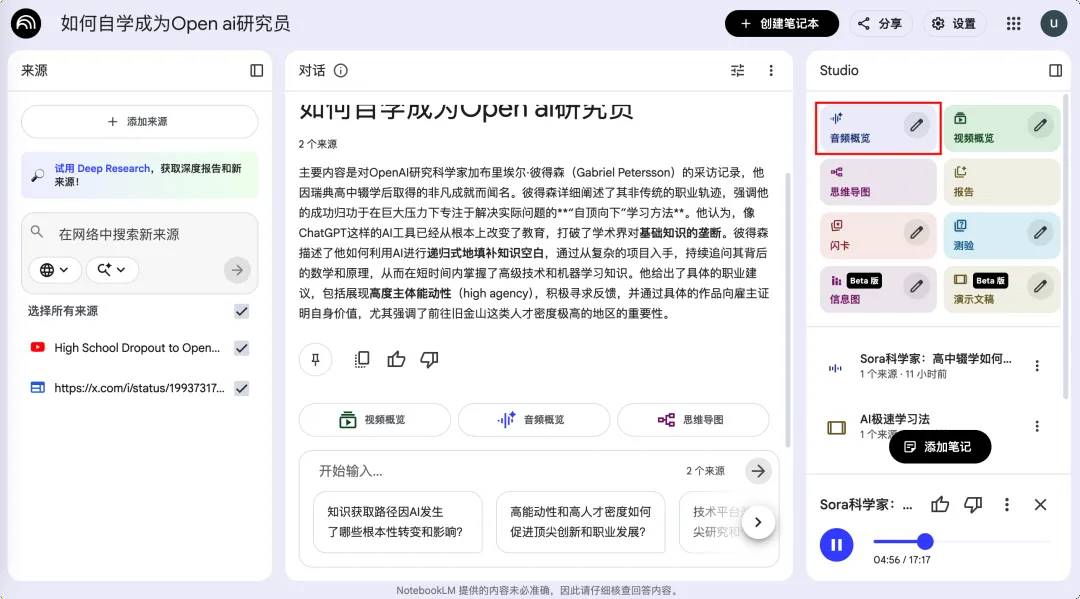
Gabriel's Interview Podcast to Podcast | Image: notebooklm

This points to a future career trend: specialized and versatile.

Before, to create a product, you needed to know front-end, back-end, design, operations, marketing. Now, you can, like Gabriel, use the "recursive gap-filling" method to quickly master 80% of the knowledge in your weak areas.

You were originally a programmer; by using AI to补全 design and business logic, you can become a product manager.

You were originally a good content creator; through AI, you can quickly补全 coding skills and become an independent developer.

Based on this trend, it can be inferred: "Perhaps, in the future, more 'one-person company' forms will appear."

06 Reclaim Your Initiative

Now, thinking back to that investor veteran's words, I understand what he really meant.

"Keep asking until it can't answer."

This phrase is a great mindset in the AI era.

If we are satisfied with the first answer AI gives, we are quietly degenerating.

But if we can, through questioning, force AI to explain the logic thoroughly, then internalize it into our own intuition: then AI truly becomes our external tool, not us becoming appendages of AI.

Don't let ChatGPT think for you; let it think with you.

Gabriel went from a dropout sleeping on a couch to an OpenAI researcher.

There's no secret in between, just tens of thousands of questions.

In this era full of anxiety about being replaced by AI, the most practical weapon might be:

Don't stop at the first answer, keep asking.

Трендові криптовалюти

Пов'язані питання

QWhat is the core learning method Gabriel Petersson used to become an OpenAI researcher without a high school diploma?

AGabriel Petersson used a 'recursive knowledge filling' method, which involves starting with a practical project, using AI to ask infinite questions, and drilling down into each concept until he fully understood it, rather than following a traditional bottom-up learning path.

QHow does the 'recursive knowledge filling' method work in practice when learning a new concept like diffusion models?

AHe starts by asking AI for the core concepts, then gets code examples to run, and recursively questions every module in the code until he understands the underlying logic, filling knowledge gaps layer by layer.

QWhat negative effect can frequent use of generative AI have on human cognitive abilities, according to the article?

AFrequent use of generative AI can lead to a decline in critical thinking skills, as people outsource their thinking to AI, causing their own abilities to atrophy due to disuse.

QWhat is the key difference between using AI as a tool for outsourcing work versus using it as a learning coach?

AUsing AI as a tool for outsourcing work leads to skill degradation because it bypasses the thinking process, while using it as a coach involves active questioning and probing, which accelerates learning and deepens understanding.

QWhat future career trend does the article suggest is emerging due to AI-enabled learning methods like Gabriel's?

AThe article suggests a trend towards 'one-person companies,' where individuals can use AI to quickly master multiple domains, such as a programmer learning design and business logic to become a product manager or a content creator becoming an independent developer.

Пов'язані матеріали

Crypto Miners' Big AI Gamble: Valuations Enter Differentiation Stage, Comeback Fight Proves Tough

Crypto Mining Firms' AI Bet: Valuation Divergence and a Challenging Transformation Facing declining profitability in crypto mining, mining companies are pivoting to AI infrastructure, capitalizing on their existing power resources, land, and data center expertise to offer GPU compute power. This transition narrative has boosted their stock prices significantly, with firms like Hut 8 and Bitfarms seeing gains over 100% year-to-date, far outpacing Bitcoin. This has led to a market valuation split, with pioneers like CoreWeave reaching a $62.8B market cap, while others remain below $5B. The market currently prioritizes growth potential over short-term profits, which remain under pressure due to heavy capital expenditures for AI build-outs and crypto asset volatility. However, the transformation is a high-stakes gamble. Bitcoin mining profitability is shrinking, with the average production cost around $63,707 and miner margins contracting. While AI offers a more lucrative long-term path, it requires massive investment—estimated at a $500B near-term funding gap. Success now hinges on execution: delivering on contracted power capacity, securing quality tenants like major cloud providers, and managing the immense financial burden. The valuation focus is shifting from mere power capacity to project delivery, future cash flows, and tenant quality, making this a difficult but critical turnaround attempt.

链捕手4 хв тому

Crypto Miners' Big AI Gamble: Valuations Enter Differentiation Stage, Comeback Fight Proves Tough

链捕手4 хв тому

Analysis of the Latest Portfolio Adjustment by the "Top Player" in the U.S. Stock Market: $9 Billion Short on NVIDIA, Shifting Focus to Power and Memory Sectors

AI investor Leopold Aschenbrenner has made a significant portfolio shift, taking a $9 billion nominal short position against top AI infrastructure stocks like NVIDIA, ASML, and Oracle. Simultaneously, he is redirecting capital towards what he sees as the next critical bottlenecks in the AI boom: power, memory, and data center networking, alongside private investments in AI model companies like Anthropic. This move is interpreted not as a call that the AI bubble has burst, but as a rotation within the infrastructure stack. The analysis highlights NVIDIA's recent $25 billion bond issuance as a potential signal, questioning why a cash-rich company would seek external debt despite high profits and increased dividends/buybacks. The core investment thesis is that the initial, crowded "picks and shovels" trade in semiconductors is maturing. The next wave of capital is expected to flow into the physical and logistical constraints of AI expansion: electricity supply, memory chip capacity, data center construction, and enabling technologies like optical networking (fiber) for high-bandwidth communication, where copper remains crucial for short distances. Aschenbrenner's substantial (approx. 20% of fund) private stake in Anthropic is noted as a key part of his strategy—investing directly in the "mine" (AI models) rather than just the "shovels." The discussion concludes that while certain segments may be overvalued, the overarching AI infrastructure demand driven by real product usage remains robust. The most promising long-term investments are seen in essential, non-sexy infrastructure—particularly energy and power companies—whose demand is viewed as a global constant irrespective of AI's cyclicality.

marsbit25 хв тому

Analysis of the Latest Portfolio Adjustment by the "Top Player" in the U.S. Stock Market: $9 Billion Short on NVIDIA, Shifting Focus to Power and Memory Sectors

marsbit25 хв тому

BIT Research: Liquidity is Disappearing, Will Bitcoin Replay the Bottoming Pattern of 2022?

The crypto market is currently in an adjustment phase driven by policy expectations and liquidity shifts. Despite a brief rebound fueled by geopolitical easing and SpaceX's strong IPO performance, unexpectedly hawkish signals from new Fed Chair Kevin Warsh have removed anticipated easing support. Concurrently, stablecoin liquidity is shrinking, with insufficient new capital inflows, pushing the market into a typically quiet summer period. Pricing lacks catalysts for a sustained rally. Daily trading volume has significantly contracted, stablecoin growth has slowed markedly, and the supportive effect of Strategy's (formerly MicroStrategy) STRC preferred stock-financed Bitcoin purchases is fading. Amid policy uncertainty, seasonal weakness, and liquidity contraction, Bitcoin faces near-term downward pressure. Warsh's hawkish pivot and refusal to provide a clear policy outlook have increased risk premiums, historically unfavorable for Bitcoin. Technically, the trend remains bearish below $73,700, with $62,446 as critical support. A break below could accelerate declines, though a prolonged consolidation phase, similar to 2022's bottoming process, is possible. Liquidity is a core constraint. Current daily volume is around $500 billion, roughly 25% of the peak during the July-Oct 2025 rally. The 12-month growth rates for USDT and USDC have fallen to ~20%, with 6-month growth near zero, indicating weak new inflows. Bitcoin ETF and Strategy-driven inflows have also weakened, with a 30-day rolling net outflow. With inflation at 4.2% above the Fed's target, combined hawkish policy, seasonal factors, and liquidity shortages challenge Bitcoin's ability to hold above $60,000. However, this adjustment phase may be forming a cyclical low this summer, potentially setting the stage for the next bull cycle.

marsbit53 хв тому

BIT Research: Liquidity is Disappearing, Will Bitcoin Replay the Bottoming Pattern of 2022?

marsbit53 хв тому

Who Makes the Best Use of Claude Code? The Answer Might Not Be Programmers

Claude Code Usage Report Summary (Based on ~400k sessions) Core Finding: In agentic programming with Claude Code, a clear division of labor has emerged: humans primarily decide *what* to build (planning decisions), while Claude decides *how* to build it (execution decisions). Key Insights: 1. **Effectiveness is not limited to programmers.** In code-generation tasks, success rates for users in non-technical fields (law, finance, management, research) are nearing those of software engineers. What matters most is the user's domain expertise and understanding of the problem to be solved. 2. **Domain expertise drives success and efficiency.** Sessions where users exhibited "expert" proficiency in the task's domain saw verified success rates double compared to "novice" sessions. Experts also delegated more work per instruction, with Claude executing more actions and producing more output. 3. **AI is amplifying, not replacing, domain knowledge.** Claude Code lowers the *implementation* barrier, not the *judgment* barrier. The value of knowing the "what" and "why" is increasing relative to just knowing the "how" to code. 4. **Usage is evolving.** Over a 7-month period (Oct '25 - Apr '26), the share of sessions for debugging halved, while use for software operations, data analysis, and non-code writing roughly doubled. The estimated economic value of typical tasks increased by ~25%. Conclusion: The data suggests coding agents are making programming background less critical for completing technical tasks. However, they reward and amplify deep domain understanding. The ability to successfully direct an AI agent stems more from mastery of a specific field than from coding skill itself. The primary gains come from being competent in a domain; deep specialization adds only marginal additional advantage. This may signal a shift where software creation becomes integrated into various professions.

marsbit1 год тому

Who Makes the Best Use of Claude Code? The Answer Might Not Be Programmers

marsbit1 год тому

Торгівля

Спот
Ф'ючерси

Популярні статті

Що таке XAG

XAGUSDT Перпетуальний контракт - це торговий символ для срібла, ціна якого вказана в доларах США, що представляє 1 тройську унцію срібла.

4 переглядів усьогоОпубліковано 2026.06.18Оновлено 2026.06.18

Що таке XAG

Як купити XAG

Ласкаво просимо до HTX.com! Ми зробили покупку Silver (XAG) простою та зручною. Дотримуйтесь нашої покрокової інструкції, щоб розпочати свою криптовалютну подорож.Крок 1: Створіть обліковий запис на HTXВикористовуйте свою електронну пошту або номер телефону, щоб зареєструвати обліковий запис на HTX безплатно. Пройдіть безпроблемну реєстрацію й отримайте доступ до всіх функцій.ЗареєструватисьКрок 2: Перейдіть до розділу Купити крипту і виберіть спосіб оплатиКредитна/дебетова картка: використовуйте вашу картку Visa або Mastercard, щоб миттєво купити Silver (XAG).Баланс: використовуйте кошти з балансу вашого рахунку HTX для безперешкодної торгівлі.Треті особи: ми додали популярні способи оплати, такі як Google Pay та Apple Pay, щоб підвищити зручність.P2P: Торгуйте безпосередньо з іншими користувачами на HTX.Позабіржова торгівля (OTC): ми пропонуємо індивідуальні послуги та конкурентні обмінні курси для трейдерів.Крок 3: Зберігайте свої Silver (XAG)Після придбання Silver (XAG) збережіть його у своєму обліковому записі на HTX. Крім того, ви можете відправити його в інше місце за допомогою блокчейн-переказу або використовувати його для торгівлі іншими криптовалютами.Крок 4: Торгівля Silver (XAG)Легко торгуйте Silver (XAG) на спотовому ринку HTX. Просто увійдіть до свого облікового запису, виберіть торгову пару, укладайте угоди та спостерігайте за ними в режимі реального часу. Ми пропонуємо зручний досвід як для початківців, так і для досвідчених трейдерів.

5 переглядів усьогоОпубліковано 2026.06.18Оновлено 2026.06.18

Як купити XAG

Як купити XAU

Ласкаво просимо до HTX.com! Ми зробили покупку Gold (XAU) простою та зручною. Дотримуйтесь нашої покрокової інструкції, щоб розпочати свою криптовалютну подорож.Крок 1: Створіть обліковий запис на HTXВикористовуйте свою електронну пошту або номер телефону, щоб зареєструвати обліковий запис на HTX безплатно. Пройдіть безпроблемну реєстрацію й отримайте доступ до всіх функцій.ЗареєструватисьКрок 2: Перейдіть до розділу Купити крипту і виберіть спосіб оплатиКредитна/дебетова картка: використовуйте вашу картку Visa або Mastercard, щоб миттєво купити Gold (XAU).Баланс: використовуйте кошти з балансу вашого рахунку HTX для безперешкодної торгівлі.Треті особи: ми додали популярні способи оплати, такі як Google Pay та Apple Pay, щоб підвищити зручність.P2P: Торгуйте безпосередньо з іншими користувачами на HTX.Позабіржова торгівля (OTC): ми пропонуємо індивідуальні послуги та конкурентні обмінні курси для трейдерів.Крок 3: Зберігайте свої Gold (XAU)Після придбання Gold (XAU) збережіть його у своєму обліковому записі на HTX. Крім того, ви можете відправити його в інше місце за допомогою блокчейн-переказу або використовувати його для торгівлі іншими криптовалютами.Крок 4: Торгівля Gold (XAU)Легко торгуйте Gold (XAU) на спотовому ринку HTX. Просто увійдіть до свого облікового запису, виберіть торгову пару, укладайте угоди та спостерігайте за ними в режимі реального часу. Ми пропонуємо зручний досвід як для початківців, так і для досвідчених трейдерів.

3 переглядів усьогоОпубліковано 2026.06.18Оновлено 2026.06.18

Як купити XAU

Обговорення

Ласкаво просимо до спільноти HTX. Тут ви можете бути в курсі останніх подій розвитку платформи та отримати доступ до професійної ринкової інформації. Нижче представлені думки користувачів щодо ціни A (A).

活动图片