Hyperliquid Traders Drive CXMT Trading Volumes to Peak Levels on IPO Day

cryptonews.ruОпубліковано о 2026-07-27Востаннє оновлено о 2026-07-27

Анотація

On July 27th, ChangXin Memory Technologies (CXMT), a major Chinese DRAM manufacturer, made its highly anticipated debut on the Shanghai Stock Exchange (SSE), becoming China's most valuable publicly traded AI-infrastructure company. The IPO coincided with record trading volumes for CXMT on the Hyperliquid blockchain platform (HIP-3), peaking at over $9 million. The stock surged 470-530% at its debut, pushing its market cap over $483 billion, driven by massive demand exceeding the IPO's supply. On Hyperliquid, pre-IPO trading saw prices fluctuate significantly, with the futures market reaching $234 million in early hours. Notably, a former major Bitcoin trader shifted entirely to trading CXMT futures. The event highlights how crypto derivatives platforms are being used for early price discovery and potential hedging against volatility in major traditional market IPOs.

ChangXin Memory Technologies (CXMT) held its long-awaited IPO on Monday, July 27th. The stock listing coincided with a surge of activity on the Hyperliquid exchange, as CXMT attracted attention from both large and retail traders.

CXMT's IPO was expected to be the largest stock listing on the Shanghai Stock Exchange since 2011. As Cryptopolitan reported, the buzz around Chinese AI-related stocks was seen as a new opportunity, and crypto traders immediately seized it.
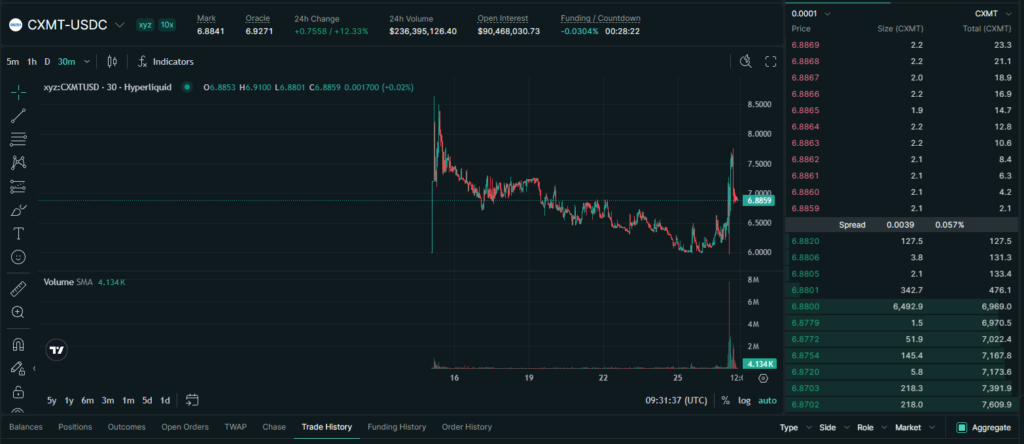
The CXMT exchange saw a record surge in activity, alongside an influx of large crypto investors taking directional positions in one of mainland China's largest IPOs. | Source: HIP-3

The CXMT exchange is already available through TradeXYZ after the platform acquired rights to this ticker on Hyperliquid for 500 HYPE.

As of July 27th, CXMT on HIP-3 exceeded $45 million, and after an initial record spike, daily trading volume reached a new peak, surpassing $9 million. The IPO day saw significant selling as both perpetual futures and the underlying shares were in price discovery.

CXMT Shares Soar in Shanghai Trading

Chipmaker CXMT became China's most valuable AI infrastructure company after its shares surged 470-530% upon its debut on the Shanghai exchange. The company's total market capitalization is estimated at over $483 billion, making it the most valuable company listed on an exchange in mainland China.

The stock market debut also tests the resilience of forecasts for chipmaker and AI-related stocks. CXMT is a major DRAM producer, a basic component used in consumer electronics and data centers.

Funds raised from the IPO are expected to be directed towards production expansion and additional R&D.

Beyond CXMT's business model, a key driver for the rapid price surge was peak demand for the shares, significantly exceeding IPO volumes.

The demand spread to blockchain trading as well, with Hyperliquid offering an entry point for early price discovery speculation. On the first day of trading, the HIP-3 market for CXMT reached 1.14% of the volumes on the Shanghai Stock Exchange, jumping to $234 million in the first hours after the IPO.

Former Major $BTC Market Player Shifts to CXMT

On the HIP-3 platform, the price of CXMT shares fluctuated from over $8 to $5.99. The price range set by perpetual futures traders was closer to the actual IPO price than the company's initial target price of $1.20 per share.

Following the IPO, the HIP-3 company held 13 large positions in CXMT shares, of which seven showed bullish sentiment, taking long positions.

The leader still holds a short position with a notional value of $17.87 million. After the price rise, the volume investment leader incurred an unrealized loss of $1.24 million.

Another major player, primarily known for their positions in $BTC, has fully switched to trading CXMT. Their position still stands at $4.81 million, fluctuating between a profit of $300k and small temporary losses. Large players are still waiting for the stock to choose its own direction in the first days after the IPO.

At this point, it is unknown whether any of the major investors managed to secure IPO shares directly from the company. In that case, selling CXMT shares short would be a hedging strategy in case of a sharp price drop after the initial hype. Such a scenario also points to Hyperliquid as a hedging tool that could be used in other upcoming major IPOs.

end-content

Пов'язані питання

QWhat company conducted a highly anticipated IPO and what was the date?

AThe company ChangXin Memory Technologies (CXMT) conducted its highly anticipated IPO on Monday, July 27th.

QWhich trading platform acquired the rights to trade the CXMT ticker on Hyperliquid?

AThe trading platform TradeXYZ acquired the rights to trade the CXMT ticker on Hyperliquid for 500 HYPE.

QHow much did CXMT's shares surge on its Shanghai stock exchange debut?

ACXMT's shares surged 470-530% on its debut on the Shanghai stock exchange.

QWhat was the estimated total market capitalization of CXMT after its IPO?

AThe estimated total market capitalization of CXMT after its IPO was over $483 billion.

QWhat did a trader known for major Bitcoin positions do regarding CXMT, according to the article?

AAccording to the article, a trader known for major Bitcoin positions fully switched to trading CXMT, with a current position worth $4.81 million.

Пов'язані матеріали

In Jinjiang, Fujian, a Storage Super Unicorn Lies Quiet

In Fujian's Jinjiang, a city known for sportswear, lies a quiet semiconductor giant: Fujian Jinhua Integrated Circuit Co. (JHICC). Once a promising domestic DRAM manufacturer alongside Yangtze Memory and ChangXin Memory Technologies (CXMT), its journey was derailed in 2018 when the U.S. placed it on an Entity List and filed criminal charges for alleged trade secret theft. This halted production for years. A turning point came in February 2024 when a U.S. federal court found JHICC not guilty. However, it had lost crucial time. While CXMT soared to become a top-valued A-share company in 2024, JHICC, with an estimated valuation of 80 billion RMB, was just restarting. Its current output is primarily customized DDR4 chips, not the advanced DDR5/HBM demanded for AI, but it still benefits from the broader memory chip upcycle. JHICC's story is tied to Chen Zhengkun, a veteran engineer who left Micron to lead the venture. Founded in 2016 with state-backed funding, JHICC partnered with Taiwan's UMC to develop DRAM technology. Rapid progress was cut short by the U.S. actions, which Micron initiated, partly due to its heavy reliance on the Chinese market. Post-sanctions, Chen's team worked to rebuild the production line with reduced reliance on U.S. technology. According to its records, JHICC achieved small-scale production and revenue growth under immense pressure. It now focuses on the stable "niche" DRAM market (e.g., TVs, routers) with a monthly capacity of ~40,000 wafers, aiming for 60,000 by 2026. It holds over 1,000 patents but remains on the Entity List. For Jinjiang, investing in JHICC was a bold industrial leap. The local government provided unwavering financial and logistical support during the crisis, helping the company survive. JHICC has become the anchor for a growing local semiconductor cluster. Though its scale lags behind domestic peers, JHICC's persistence symbolizes a hard-won foothold in a global market long dominated by Samsung, SK Hynix, and Micron. Having missed one boom, it seeks a place in the new AI-driven memory supercycle.

marsbit1 год тому

In Jinjiang, Fujian, a Storage Super Unicorn Lies Quiet

marsbit1 год тому

Торгівля

Спот
活动图片




