Hyperliquid Team Plans Expansion Into Prediction Markets as HYPE Pumps 20%

bitcoinistОпубліковано о 2026-02-03Востаннє оновлено о 2026-02-03

Анотація

Hyperliquid, a leading decentralized derivatives exchange, has announced its expansion into prediction markets, causing its HYPE token to surge 20%. This move aims to bridge traditional trading with event wagering, enhancing capital efficiency. The article also highlights a parallel trend in high-conviction trading culture, exemplified by the meme token Maxi Doge ($MAXI), which targets active "degen" traders with features like trading competitions and staking rewards. The project has reportedly raised over $4.5M in its presale, with significant whale accumulation noted, indicating strong early interest.

The decentralized derivatives landscape isn’t just shifting; it’s mutating. Hyperliquid, currently the heavyweight champion of on-chain perps, has signaled a direct expansion into prediction markets.

The market’s reaction was immediate and violent: the HYPE token surged 20% following the revelation, proving there is an immense appetite for infrastructure that bridges traditional trading with event wagering.
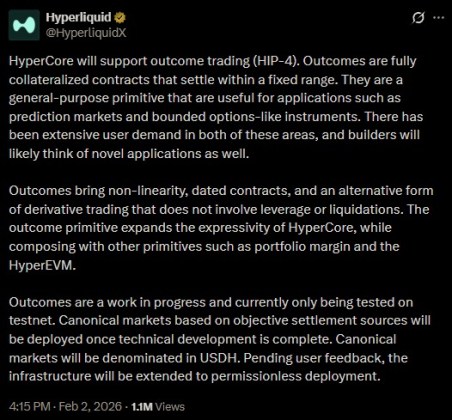
Why does this matter? Liquidity consolidation. Until now, prediction markets like Polymarket lived in silos, isolated from high-frequency perp trading. Hyperliquid’s integration hints at a future where capital efficiency rules supreme—traders can hedge election outcomes and leverage long ETH positions from a single collateral pool.

That 20% surge wasn’t just speculation. It was a rapid repricing of the protocol’s total addressable market.

But look closer at the liquidity flowing into high-performance chains. There is a secondary trend brewing: a resurgence of ‘high-conviction’ trading culture.

The traders on Hyperliquid aren’t passive allocators; they’re hunting volatility, leverage, and competition. That specific mindset is exactly what’s now fueling Maxi Doge ($MAXI), a project built for the ‘degen’ trader who treats markets like a contact sport.

Buy $MAXI today.

Maxi Doge Targets the ‘Leverage King’ Demographic

While Hyperliquid builds the plumbing for risk, Maxi Doge captures the culture of the risk-taker. Forget the passive ‘hold and hope’ mechanics of yesterday’s meme coins. Maxi Doge positions itself as a 240-lb canine juggernaut, embodying the ‘1000x energy’ of the current bull cycle. Its ethos: ‘Never skip leg-day, never skip a pump’, resonates with retail traders who know the market is a grind requiring serious conviction.
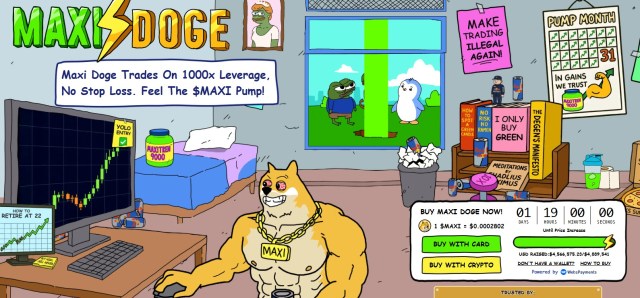
Frankly, the utility goes deeper than just aesthetics. Maxi Doge (unexpectedly for a meme token) integrates Holder-Only Trading Competitions, gamifying the experience like the leaderboards on major perp DEXs. It rewards top ROI hunters, aligning tokenomics with active participation. Plus, the ‘Maxi Fund’ treasury backs this ecosystem, ensuring liquidity for partnerships and high-impact marketing.

Sound familiar? It’s the strategies of top DeFi protocols applied to meme culture.

That cultural alignment counts. In a market where attention is the scarcest asset, projects mirroring their holders’ psychology often cook the hardest. Maxi Doge isn’t trying to be a currency; it’s a badge of honor for the “Leverage King” demographic.

Learn more about the project’s tokenomics.

Whales Accumulate $503K as Presale Momentum Builds

Smart money seems to agree with this thesis. While retail chases green candles elsewhere, on-chain data from Etherscan shows two whale wallets accumulated $503K in recent transactions within the Maxi Doge ecosystem. The largest single clip, a massive $314K transaction, executed on Oct 11, 2025.

That suggests high-net-worth players are positioning themselves well before the token hits public trading venues.

Presale metrics show demand accelerating. According to the official site, Maxi Doge has already raised over $4.5M, with tokens priced at $0.0002802. In a landscape fragmented across L2s and Solana, that’s no small feat. For an Ethereum mainnet token to command this level of early-stage capital signals real confidence in the ‘meme-first, utility-second’ hybrid model.

And then there’s the staking architecture. It’s designed to lock up supply while rewarding conviction. The smart contract governs a dynamic APY with daily automatic distribution from a 5% staking allocation pool. This setup encourages the long-term holding behavior seen in blue-chip DeFi governance tokens, aiming to dampen volatility.

Visit the official site for presale details.

The content provided in this article is for informational purposes only and does not constitute financial advice. Crypto assets are highly volatile.


Пов'язані питання

QWhat was the market reaction to Hyperliquid's announcement of expanding into prediction markets, and what does it indicate?

AThe market reaction was immediate and violent, with the HYPE token surging 20%. This indicates there is an immense appetite for infrastructure that bridges traditional trading with event wagering and represents a rapid repricing of the protocol's total addressable market.

QAccording to the article, what is the primary significance of Hyperliquid's integration of prediction markets?

AThe primary significance is liquidity consolidation. The integration hints at a future of supreme capital efficiency, where traders can hedge event outcomes (like elections) and leverage positions (like long ETH) from a single collateral pool, breaking down the silos between prediction markets and high-frequency perpetual trading.

QHow does the article describe the target demographic and ethos of the Maxi Doge ($MAXI) project?

AThe article describes Maxi Doge's target demographic as 'Leverage Kings' or 'degen' traders who hunt volatility, leverage, and competition. Its ethos is 'Never skip leg-day, never skip a pump', embodying the '1000x energy' of the bull cycle and resonating with retail traders who view the market as a grind requiring serious conviction.

QWhat utility does the Maxi Doge project offer beyond its meme token aesthetics?

ABeyond aesthetics, Maxi Doge integrates Holder-Only Trading Competitions that gamify the experience and reward top ROI hunters, aligning tokenomics with active participation. It is backed by the 'Maxi Fund' treasury to ensure liquidity for partnerships and marketing, applying strategies from top DeFi protocols to meme culture.

QWhat on-chain evidence does the article provide to suggest 'smart money' or whale interest in Maxi Doge?

AThe article cites on-chain data from Etherscan showing two whale wallets accumulated $503K in recent transactions within the Maxi Doge ecosystem, with the largest single transaction being $314K executed on Oct 11, 2025. This suggests high-net-worth players are positioning themselves early, before the token hits public exchanges.

Пов'язані матеріали

Global Stock Market's Storm Center: South Korea's Stock Market De-leveraging Is Largely Complete

Storm's Eye: South Korean Market De-leveraging Nears Completion The recent sharp correction in South Korean equities, with the KOSPI index dropping 32% from its June high, has been a key trigger for global tech stock volatility. The core driver was not a fundamental shift but a forced de-leveraging process within the market's unique structure, which is now largely complete. Two main leverage channels amplified the sell-off: 1. **Leveraged ETFs:** Their size, proportionally four times larger than in the U.S., peaked near $50 billion. Their mandatory daily rebalancing mechanism created a vicious cycle of "price drop → forced selling → further drop." Approximately 75% of this excess has been unwound, shrinking to $26 billion, with regulatory curbs now blocking new inflows. 2. **Hedge Fund Leverage:** Using swaps to magnify exposure, hedge funds saw their net long positioning fall by over 50% from peak levels. The most intense phase of this institutional de-leveraging is over. In contrast, **retail margin debt** poses minimal systemic risk. At 0.5% of market cap, it is far lower than in the U.S. or China, lacks automatic triggers, and is concentrated in smaller stocks. The conclusion: the high-leverage structures most prone to "chain-reaction selling" have been substantially cleared. The market is transitioning from a liquidity-driven crash to one priced more on fundamentals. The article argues that the AI trend—centered on Korean memory chips—remains intact. This episode represents a painful but necessary clearing of crowded trades, not the end of the AI revolution. For investors, the key question is conviction in the long-term AI direction; if the trend is real, current volatility is a cost of entry, not a terminal risk.

链捕手1 год тому

Global Stock Market's Storm Center: South Korea's Stock Market De-leveraging Is Largely Complete

链捕手1 год тому

The Eternal Fragments of Money: Third-Party Payment Has No First Principle

"The Enduring Fragments of Money: Third-Party Payments Lack a First Principle" Stripe is reportedly attempting to acquire PayPal, marking a significant shift reminiscent of PayPal's merger with the original X.com 30 years ago. The article analyzes Stripe's strategic challenges and the broader payments industry landscape. Despite its initial success with a developer-friendly API model, Stripe missed its optimal IPO window during the pandemic and has since seen its valuation decline. Its attempts to expand through acquisitions and new ventures, particularly in stablecoins (like its OUSD project) and Agent-focused payments (ACP/MPP protocols), have faced headwinds. The author argues that the payment industry remains highly fragmented and is ultimately an adjunct to the traditional banking system. This structure limits the potential for any single player, including Stripe, to achieve complete dominance. While stablecoins and the future rise of autonomous Agent economies present potential growth avenues, they are not yet mainstream and still require integration with the existing financial system. For now, Agent-based transactions are largely used for speculative "volume boosting" rather than substantive business applications. Stripe's current move to acquire PayPal is seen as an attempt to bolster its weak consumer-facing (C-side) business after its stablecoin-focused strategies faltered. Meanwhile, PayPal is described as structurally outdated, unable to revive itself through new products like Venmo or PYUSD. The future of payments may lie not in payments themselves but in value-added services like more efficient settlement networks. The author suggests that companies like Stripe and Circle, which are building their own blockchains (Tempo, Arc) and stablecoins, are positioning themselves to eventually profit from high-efficiency settlement systems. These new networks could potentially bypass some traditional banking layers. In conclusion, the article posits that third-party payment is a perpetually fragmented battlefield where scale alone cannot ensure victory. Players must find new models, focusing on efficiency to compete with the entrenched banking system. Stripe's acquisition of PayPal represents a bet on this uncertain future.

链捕手1 год тому

The Eternal Fragments of Money: Third-Party Payment Has No First Principle

链捕手1 год тому

Торгівля

Спот
活动图片




