Hyperliquid gains strength from 2 key areas: What this means for HYPE’s demand

ambcryptoОпубліковано о 2026-03-29Востаннє оновлено о 2026-03-29

Анотація

Recent on-chain activity indicates a shift in demand for Hyperliquid (HYPE), driven by significant whale accumulation and protocol buybacks. A whale deposited $4 million USDC and acquired over $2.1 million worth of HYPE, followed by a TWAP order targeting 99,000 tokens, signaling sustained buying that absorbed supply without major price disruption. This demand, coupled with ongoing token buybacks and a reduction of 37.5 million HYPE through burns, has tightened circulating supply (approx. 238.4 million of 962 million total), increasing price sensitivity to new demand. However, sustainability remains uncertain as buybacks rely on trading volume, and monthly distributions or whale selling could reintroduce supply. While deflation supports stability, lasting price strength depends on consistent demand and a shrinking float; fading activity may expose HYPE to downside pressure.

Recent on-chain activity shows a clear shift in how demand forms around Hyperliquid [HYPE]. A whale deposited $4 million USDC, then acquired about 56,208 HYPE worth roughly $2.1 million at $38.21.

As accumulation continued, a TWAP order targeted 99,000 HYPE over 10 hours, signaling sustained buying rather than a single entry. This steady execution absorbed supply while limiting price disruption.
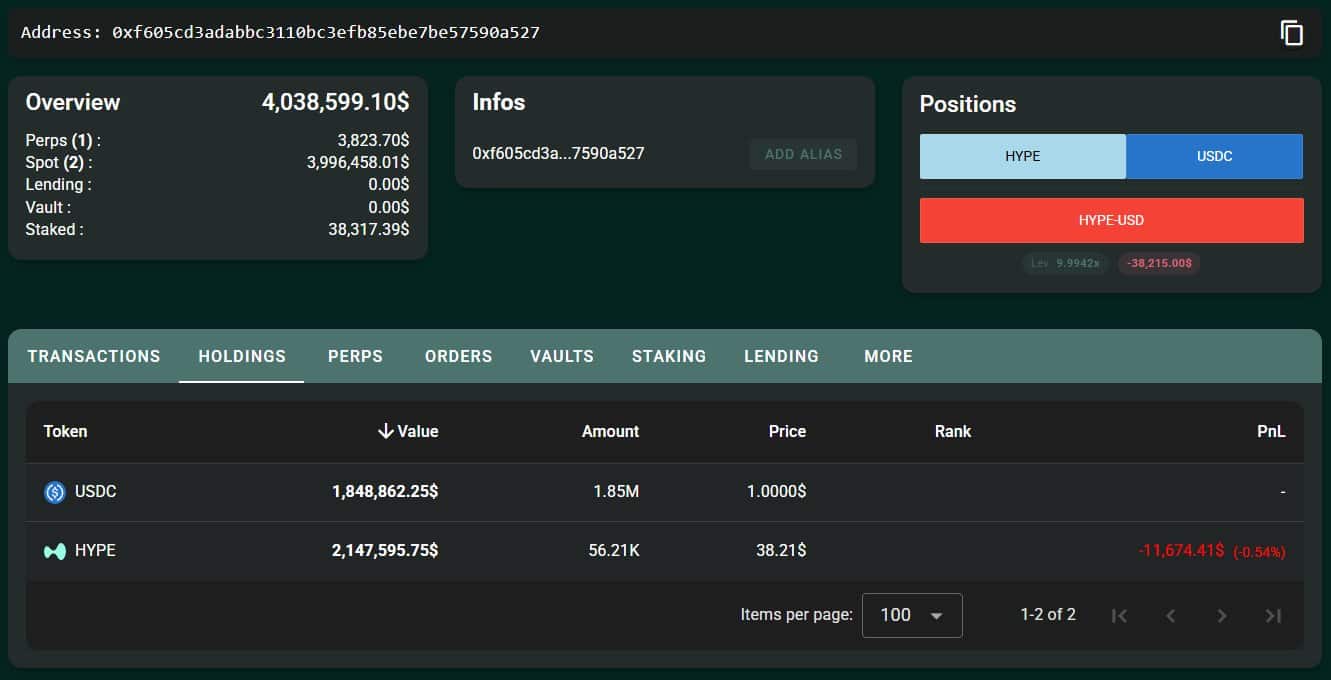
Source: X

This dual flow tightened supply while reinforcing support, especially as prices held above $40, despite prior $22 million selling pressure. As a result, HYPE increasingly behaved like a revenue-linked asset driven by usage rather than narrative momentum.

HYPE deflation grows, but float still controls price

This demand-driven setup now shifted attention toward how supply actually behaves in the market. Hyperliquid removed about 37.5 million HYPE through burns, while daily buybacks continue absorbing tokens.

As these flows persist, circulating supply was near 238.4 million out of a total of 962 million at press time, leaving a large portion locked or inactive. This matters because price responds to tradable float rather than headline reductions.

As buybacks move tokens into system addresses and long-term wallets, float tightens, increasing sensitivity to fresh demand. However, monthly distributions of about 1.2 million HYPE and whale selling during rallies reintroduce supply.

This interaction shows deflation supports price stability, yet sustained upside depends on whether float keeps shrinking while demand remains consistent.

Is HYPE demand durable or flow-driven?

Price strength now shifts attention from who is buying to whether that demand can actually hold. Recent support reflects structured inflows, yet the market now tests if this strength can persist without visible drivers.

This happens because protocol buybacks depend on trading volume, which keeps demand active only while activity remains elevated. As volumes stay strong, price holds firm; however, any slowdown quickly reduces this underlying support.

Controlled accumulation also signals intent, yet it does not confirm long-term holding, especially if buyers target short-term positioning. Markets often absorb such flows if broader demand fails to follow.

This creates a fragile balance, where sustained demand confirms strength, while fading activity exposes price to downside pressure once temporary support weakens.


Final Summary

  • Hyperliquid shows strong demand from buybacks and whale accumulation, yet sustainability depends on continued trading volume and follow-through demand.
  • HYPE’s outlook depends on shrinking float and sustained absorption, as fading activity or whale distribution could weaken support and limit upside.


Пов'язані питання

QWhat recent whale activity indicates a shift in demand formation for Hyperliquid (HYPE)?

AA whale deposited $4 million USDC and then acquired approximately 56,208 HYPE worth about $2.1 million, followed by a TWAP order targeting 99,000 HYPE over 10 hours, signaling sustained buying rather than a single entry.

QHow has Hyperliquid's token supply been affected by its economic mechanisms?

AHyperliquid has removed about 37.5 million HYPE through token burns, and daily buybacks continue to absorb tokens. The circulating supply is approximately 238.4 million out of a total supply of 962 million, with a large portion locked or inactive.

QWhat is the relationship between HYPE's price and its tradable float?

AThe price of HYPE responds to the tradable float rather than the headline supply reduction. As buybacks move tokens into system addresses and long-term wallets, the float tightens, making the price more sensitive to new demand.

QWhat is the primary driver of the protocol's buyback mechanism, and what risk does this create?

AProtocol buybacks depend on trading volume. This creates a risk because demand remains active only while trading activity is elevated; any slowdown in volume quickly reduces this underlying buyback support.

QAccording to the article, what two factors are critical for HYPE's sustained price strength?

ASustained price strength depends on the float continuing to shrink while demand remains consistent. It is a fragile balance where fading activity or whale distribution could weaken support and limit upside.

Пов'язані матеріали

TechFlow Intelligence Bureau: Chip Stocks Lose Trillions in a Single Day, Bitcoin Falls Below $60,000, US-Iran Conflict Escalates

**Daily Tech & Markets Roundup: AI Advances, Market Turmoil, and Geopolitical Tensions** **AI / LLMs**: Anthropic's internal report on AI self-improvement sparked serious discussions about Recursive Self-Improvement (RSI). Meanwhile, debate continues on AI coding tools after Claude was accused of introducing bugs into the rsync codebase. In positive news, DeepSeek V4 Flash impressed in local deployment tests, and GitHub Copilot now supports custom endpoints for local models. A surprising research turn suggests removing chain-of-thought prompting can sometimes improve LLM performance. **Crypto / Web3**: Bitcoin plunged below $60,000, with its RSI hitting levels last seen during the COVID-19 crash, driven by strong U.S. jobs data reviving interest rate hike fears. Discussions highlight Ethereum DeFi's continued lack of a smooth consumer payment layer. **Chips / Hardware**: Chip stocks suffered a massive sell-off, with the Philadelphia Semiconductor Index posting its worst single-day drop in six years, erasing over a trillion dollars in value. Marvell, Micron, AMD, and Intel were among the biggest losers. **Tech Companies**: A leaked Microsoft document revealing goals to make Copilot "addictive" drew criticism. LinkedIn founder Reid Hoffman left Microsoft's board to focus full-time on his AI agent startup, Manus. Google was revealed to be paying SpaceX $920 million monthly for AI training compute. **Markets & Macro**: A blowout U.S. jobs report (172k vs. 80k expected) crushed hopes for near-term rate cuts, sending Treasury yields soaring and triggering a broad market sell-off. CEOs from Kraft, McDonald's, and Whirlpool simultaneously warned U.S. consumers are exhausting their savings. **Geopolitics**: U.S.-Iran tensions escalated with missile/drone interceptions and U.S. strikes on Iranian radar sites, keeping the critical Strait of Hormuz largely closed since late February and posing ongoing oil supply risks. **The Bottom Line**: The strong jobs data acted as a single trigger for correlated sell-offs across equities, crypto, and chips. Underlying the volatility is a stark contradiction between robust employment data and warnings of consumer weakness, alongside geopolitical risks that could reignite inflation, leaving markets to price in a fraught macro outlook with no clear "soft landing" path.

marsbit2 год тому

TechFlow Intelligence Bureau: Chip Stocks Lose Trillions in a Single Day, Bitcoin Falls Below $60,000, US-Iran Conflict Escalates

marsbit2 год тому

It Took Me a Year to See the Bitter Truth About Agent Payments

After a year building infrastructure for the Agent economy, engaging with major players like Stripe, Visa, and Coinbase, the author shares a sobering analysis of the current state of Agent payments. The core finding is a stark lack of genuine, immediate demand across most envisioned use cases. The article breaks down four key market segments: 1. **Agent-to-Merchant (Consumer Shopping):** For most product categories (e.g., clothing, electronics), conversational AI shopping is a step backwards from visual e-commerce interfaces. While agents excel at understanding needs, they can't replace side-by-side product comparison. Real merchant interest is defensive "Agent Engine Optimization," not driven by current customer demand. Potential exists for high-frequency, low-decision purchases (like food delivery) or navigating complex store UIs, but these require massive B2C distribution channels dominated by giants like Amazon. 2. **Agent-to-API (Developer Services):** Developers already have subscriptions and billing relationships for APIs (compute, data). Prepaid balances solve micro-payment issues for low transaction volumes. A deeper structural problem is that major SaaS vendors' business models rely on enterprise contracts, resisting granular pay-per-call pricing. While protocols like MPP and x402 serve the long tail of niche services, this market is small and developers are historically low-willingness-to-pay. 3. **Agent-to-Agent:** This remains largely theoretical with minimal transaction volume. While it represents a long-term bet on a fundamentally new transaction infrastructure (sub-second, micro-penny to million-dollar, multi-party settlements), it does not constitute a present market. 4. **Agent-to-Finance:** This is the only category with existing, paying demand. Integrating AI into financial workflows (trading, portfolio management) is a natural evolution and enables new capabilities like autonomous rebalancing. However, competition favors established, regulated institutions. The "real problem" is not moving money between agents, but the broader challenge of **coordination**—orchestrating work between agents and humans, verifying outcomes, and settling results. Payment is just one component of settlement, which is itself part of coordination. Companies that solve the coordination layer will subsume payment, not the other way around. While well-funded incumbents build defensively for a long-term future, startups must find where the market is today—which, for the author's team, lies outside these four categories in an area of real, growing, and underserved activity.

marsbit3 год тому

It Took Me a Year to See the Bitter Truth About Agent Payments

marsbit3 год тому

It Took Me a Year to See the Hard Truth About Agent Payments

**Title: It Took Me a Year to See the Hard Truth About Agent Payments** Over the past year, I've worked on infrastructure for the Agent economy, engaging with major players like Stripe, Visa, Coinbase, and numerous startups. The findings reveal a stark reality: genuine, widespread demand for Agent-based payments does not yet exist. **Key Observations:** * **Agent-to-Merchant (Shopping):** The user experience for AI shopping often falls short, especially for visual product discovery. While AI excels at understanding needs, conversational interfaces can't yet replace browsing and comparing multiple products visually. Current merchant interest is largely defensive ("Agent Engine Optimization") for a future that hasn't arrived. High-frequency, low-friction purchases (like food delivery) are potential fits, but lack open APIs and face high AI inference costs. Simpler, more affordable, or cross-language interactions for complex UIs are a niche opportunity but require massive consumer distribution to scale. * **Agent-to-API (Developer Tools):** Developer payment needs for APIs (computing, data, models) are already met through subscriptions and prepaid credits. The core challenge is not payment friction but supplier economics: most large SaaS providers prefer enterprise contracts over micropayments for API calls. Protocols like MPP and x402 suit the long-tail of smaller services but cater to a developer market historically reluctant to pay for these tools. Major infrastructure needs at the top of the stack are already being addressed. * **Agent-to-Agent (Machine Commerce):** This is a long-term vision with almost no current transaction volume. While a future with high-speed, high-frequency, multi-party machine-to-machine transactions would require novel infrastructure, it remains theoretical. The market is not here yet. * **Agent-to-Finance:** This is the only category with clear, present demand. Financial professionals and DeFi users already pay for tools, and AI augmentation is a natural evolution. Autonomous AI agents can enable entirely new financial strategies. However, competition is fierce from established, regulated incumbents who can more easily layer AI onto their existing products. **The Core Insight:** Companies, especially giants with long time horizons, are building defensively for a potential future of mass machine commerce. For them, early investment is a low-cost hedge. For startups, the current market reality is different. The primary challenge isn't just moving money between agents (payments). The larger, unsolved problem is **orchestration** – coordinating work between agents and humans, verifying outcomes, and then settling. Payment is just a part of settlement, which is just a part of orchestration. Companies that solve the orchestration problem will subsume payments, not the other way around. After a year of building, we see the real, growing, and underserved market opportunity lies in this broader domain of orchestration.

链捕手3 год тому

It Took Me a Year to See the Hard Truth About Agent Payments

链捕手3 год тому

Торгівля

Спот
Ф'ючерси

Популярні статті

Як купити HYPE

Ласкаво просимо до HTX.com! Ми зробили покупку Hyperliquid (HYPE) простою та зручною. Дотримуйтесь нашої покрокової інструкції, щоб розпочати свою криптовалютну подорож.Крок 1: Створіть обліковий запис на HTXВикористовуйте свою електронну пошту або номер телефону, щоб зареєструвати обліковий запис на HTX безплатно. Пройдіть безпроблемну реєстрацію й отримайте доступ до всіх функцій.ЗареєструватисьКрок 2: Перейдіть до розділу Купити крипту і виберіть спосіб оплатиКредитна/дебетова картка: використовуйте вашу картку Visa або Mastercard, щоб миттєво купити Hyperliquid (HYPE).Баланс: використовуйте кошти з балансу вашого рахунку HTX для безперешкодної торгівлі.Треті особи: ми додали популярні способи оплати, такі як Google Pay та Apple Pay, щоб підвищити зручність.P2P: Торгуйте безпосередньо з іншими користувачами на HTX.Позабіржова торгівля (OTC): ми пропонуємо індивідуальні послуги та конкурентні обмінні курси для трейдерів.Крок 3: Зберігайте свої Hyperliquid (HYPE)Після придбання Hyperliquid (HYPE) збережіть його у своєму обліковому записі на HTX. Крім того, ви можете відправити його в інше місце за допомогою блокчейн-переказу або використовувати його для торгівлі іншими криптовалютами.Крок 4: Торгівля Hyperliquid (HYPE)Легко торгуйте Hyperliquid (HYPE) на спотовому ринку HTX. Просто увійдіть до свого облікового запису, виберіть торгову пару, укладайте угоди та спостерігайте за ними в режимі реального часу. Ми пропонуємо зручний досвід як для початківців, так і для досвідчених трейдерів.

273 переглядів усьогоОпубліковано 2024.12.11Оновлено 2026.06.02

Як купити HYPE

Обговорення

Ласкаво просимо до спільноти HTX. Тут ви можете бути в курсі останніх подій розвитку платформи та отримати доступ до професійної ринкової інформації. Нижче представлені думки користувачів щодо ціни HYPE (HYPE).

活动图片











