How Will the Price Move Before SpaceX's Next Share Unlock?

marsbitОпубліковано о 2026-06-15Востаннє оновлено о 2026-06-15

Анотація

TL;DR Investors buying SPCX after SpaceX's IPO are not simply investing in a typical tech stock. It’s a high-valuation asset driven by Musk's narrative, Starlink, and space transport potential, but with a key twist: a very small initial float of ~4% has led to significant post-listing price appreciation. The current price action reflects a timing gap. Before the first lock-up expiration (estimated around August, subject to official confirmation), scarcity and high demand could continue to push prices up. Short-term bulls focus on low float, FOMO, and potential index inclusion. However, bears point to the supply dynamics that will change post-lockup. Existing shareholders still hold over 95% of shares, which will be released in stages starting from the first unlock window. This introduces future selling pressure from low-cost holders. The upcoming Q2 earnings report is a critical catalyst before the unlock. It will test whether the company's fundamentals can justify the current ~$2.1T valuation. Strong results could support the pre-unlock momentum, while weak figures could amplify concerns about future supply. The trading thesis is shifting from immediate scarcity ("can't buy enough") to evaluating future absorption capacity ("who will buy when more supply hits"). The path ahead hinges on the specifics of the unlock schedule, Q2 earnings performance, and whether anticipated passive index buying materializes.

TL;DR

After entering the public market in the form of SPCX, investors are not buying an ordinary tech IPO stock.

On one side are words like Musk, Starlink, space transportation, defense contracts, and the Mars narrative—terms that inherently carry valuation premiums. On the other side is a stock that surged on its first day, closing with a market cap of approximately $2.1 trillion, but with a very small float of tradable shares in the initial listing period. The real question for ordinary investors is straightforward: Is buying SPCX now a bet on the public market's most scarce space asset, or is it providing liquidity for existing shareholders to exit in the future?

Discussions on X and among Chinese investors in recent days have also centered on this divide. Bulls believe that the low float, FOMO, the Musk narrative, and potential passive buying from future index inclusion could continue to push the stock price higher before the first unlock. Bears are looking at another table: aside from the IPO shares, existing shareholders still hold over 95%+ of the shares. As lock-up periods expire in phases, the secondary market will face more low-cost shares entering the trading pool.

What's being traded in SPCX right now is not just the ultimate vision of SpaceX, but a timing gap: How high can price be squeezed by supply scarcity before the first unlock? And after the first unlock, how much of the narrative premium will be digested by the new supply?

First-Day Surge Amplifies the Low-Float Squeeze

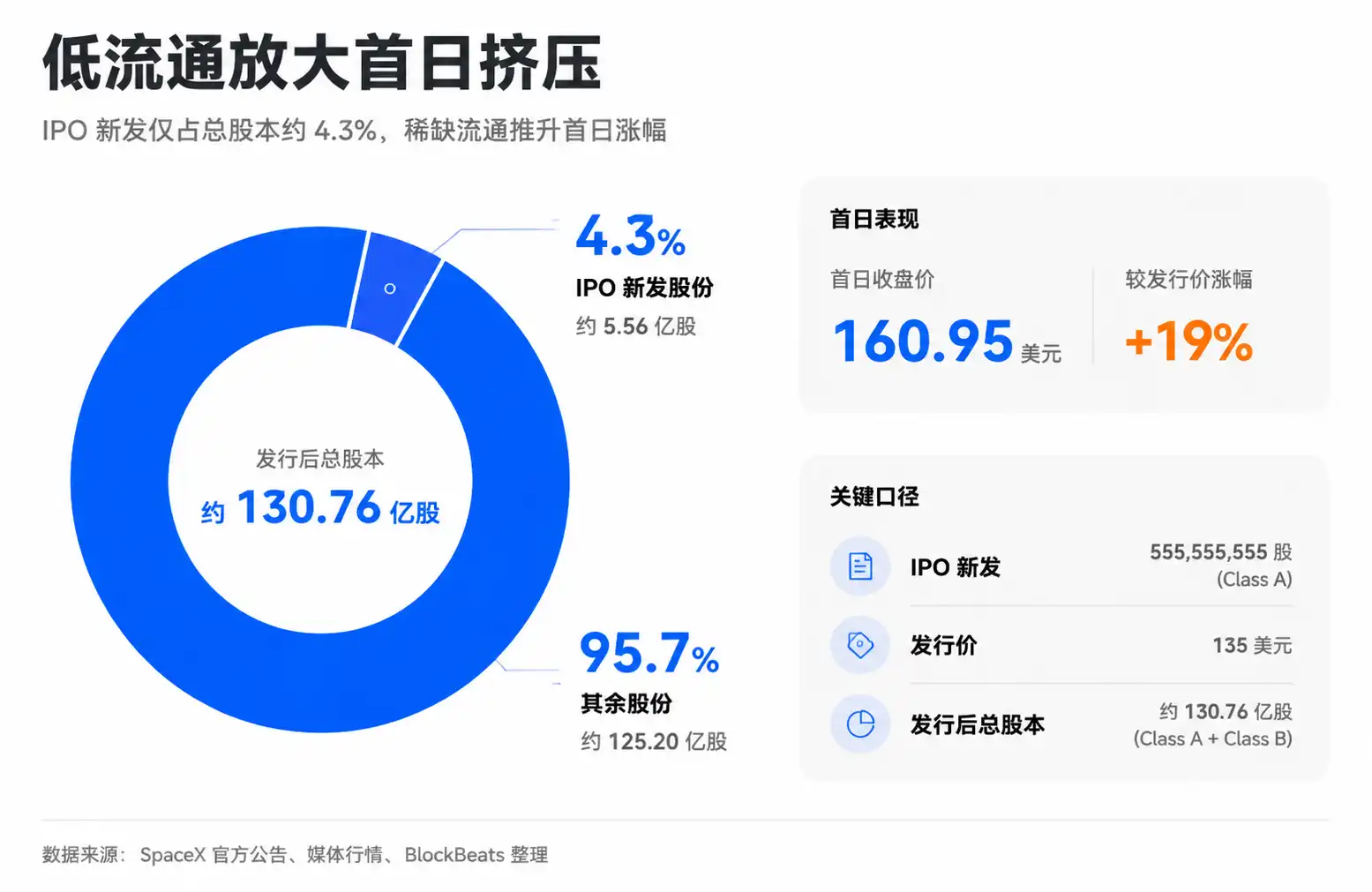
According to SpaceX's official announcement, the company's IPO issued 555,555,555 Class A shares at an offering price of $135, expected to trade as 'SPCX' on the Nasdaq Global Select Market and Nasdaq Texas starting June 12, with an additional 83,333,333 shares in an over-allotment option. Multiple media reports indicate that SPCX closed at around $160.95 on its first day, up approximately 19% from the offering price, with a closing market cap of about $2.1 trillion.

This leaves ample room for short-term capital imagination. For a newly listed large-cap stock, this isn't just about IPO hype; it's the market pricing a scarce asset at an extremely high valuation.

Low float is the first building block to understand this trading round. The prospectus shows that post-IPO, there are approximately 7.38 billion Class A shares and 5.696 billion Class B shares. The IPO newly issued shares account for just over 4% of the total shares outstanding. In other words, the proportion of shares actually entering public trading initially through the IPO is very low.

When a stock has limited supply, and buying interest is pushed up by hype, media, social platforms, and institutional imagination, prices are prone to a squeeze. It's not that the fundamentals suddenly became stronger overnight, but that there are many wanting to buy and few able to sell.
This explains why some investors see SPCX as a short-term trading opportunity rather than viewing it solely through traditional valuation models. Starlink provides a clearer revenue base, space launch and defense businesses offer scarcity, and Musk himself amplifies the asset's narrative. For short-term capital, these factors don't necessarily need to immediately translate into profits; as long as they can attract sustained buying interest, that's enough to support strength in the initial listing period.

Potential index fund inflows are another variable in the bull narrative. The logic is simple: If SPCX is included in major indices in the future, funds tracking those indices must allocate according to the rules. This type of buying is usually not due to active bullishness on the company, but because they must follow the index. When the float is small, passive buying could further amplify the supply-demand mismatch.

But this remains a trading hypothesis for now. There is no official confirmation of index inclusion, and the so-called allocation window cannot be considered a definite arrangement. For SPCX, index fund flows are not a realized positive catalyst, but an option bulls use to explain why short-term buying interest might persist.

The First Unlock Will Change the Supply Curve

The risk for SPCX is not that "the company isn't great," but that the relationship between its stock price and the supply of tradable shares will change.

The purpose of IPO lock-up periods is to prevent existing shareholders and employees from selling immediately after listing, which would impact the new stock's price. What many ordinary investors often overlook is that lock-ups are, first and foremost, a supply issue. The pressure the market can bear is completely different for the same company's stock when the float is tiny versus when a large number of shares become sellable.

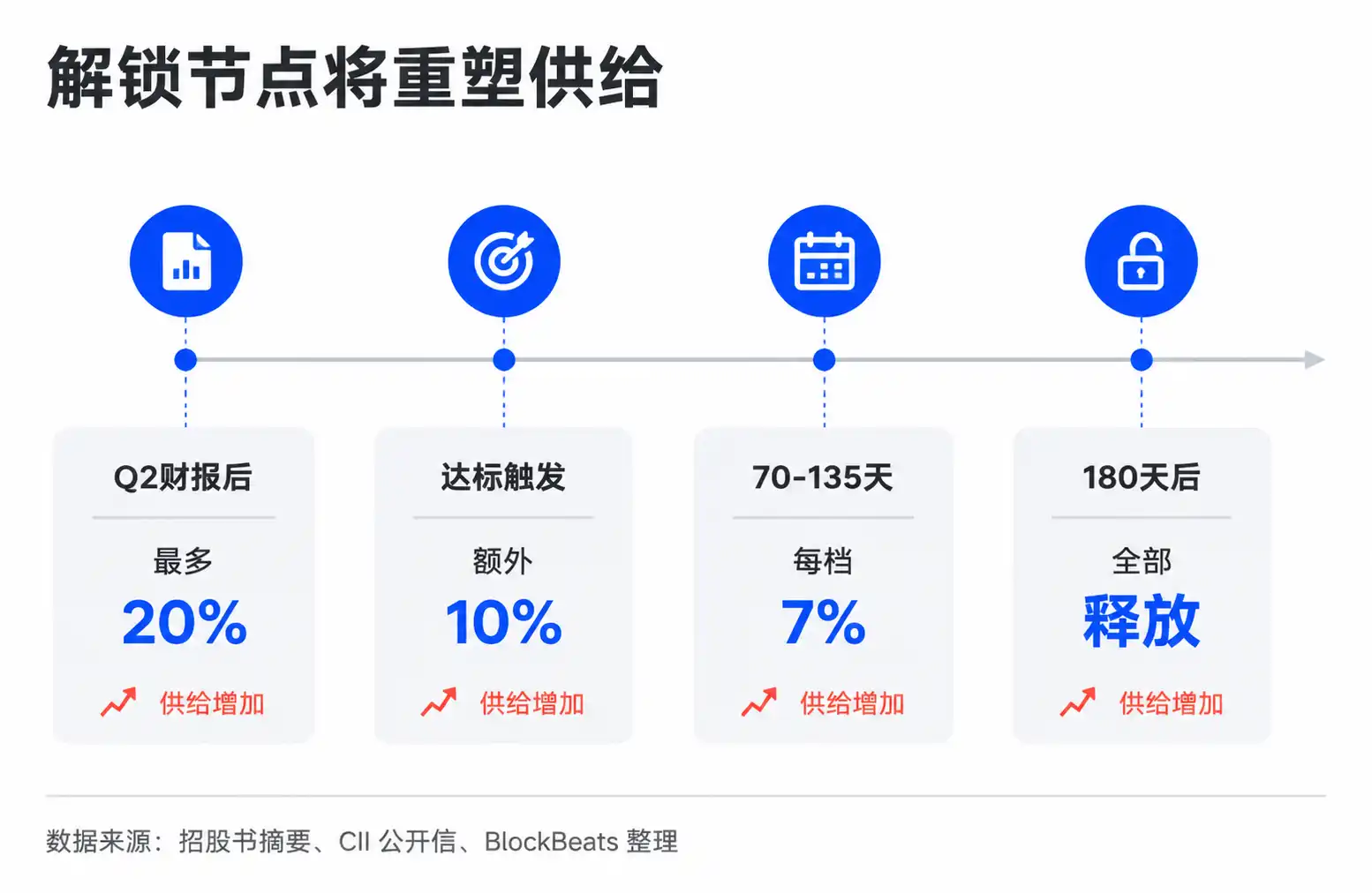
SPCX's unlock schedule is not a simple "one-time release after 180 days." The prospectus shows that 180-day locked-up shares become transferable in phases starting the second full trading day after the Q2 2026 earnings release, with up to 20% initially. If the stock price meets certain conditions at that time, such as being at least 30% above the IPO price for at least 5 out of 10 consecutive trading days, an additional 10% may be released. Subsequently, 7% can be released at each of the 70, 90, 105, 120, and 135-day marks, with the full release after 180 days.

The specific release date for Q2 earnings has not been confirmed yet. Based on typical disclosure timelines, the initial window discussed in the market could fall around August, but this remains subject to subsequent announcements and SEC filings. The documents also show that Musk's shares are locked for 366 days, with some major shareholders extending their lock-up until after the Q2 2027 earnings release, also releasing in stages.

This is the core of what bears are focused on. As long as the first unlock hasn't arrived, the low float is the bull's friend. Once the unlock approaches, the low float becomes a risk warning, because the market will start asking in advance: Exactly how many low-cost shares are preparing to be sold?
Potential selling pressure does not mean a certain crash on the unlock day. Its more common impact is to make buying more cautious, make rebounds easier to encounter selling, and make valuation expansion more difficult. Especially when a stock has already been pushed above $2 trillion in its early listing period, new supply—even if not dumped all at once—will change the market's judgment on "who will be the buyer."

Therefore, "Can it still rise before the first unlock?" and "Is it worth chasing in the medium term?" can both be valid questions. Short-term, tight supply, hot sentiment, and a strong narrative could still squeeze the price higher. Medium-term, the exit demand from existing shareholders and employees is real, and their cost basis is typically far lower than that of secondary market buyers. These two assessments are looking at different timeframes.

High Valuation Makes Earnings an Amplifier

If SPCX were just a low-float new stock, the unlock pressure would already be significant enough. What makes it more complex is that it's also a low-float new stock placed in an extremely high valuation range.

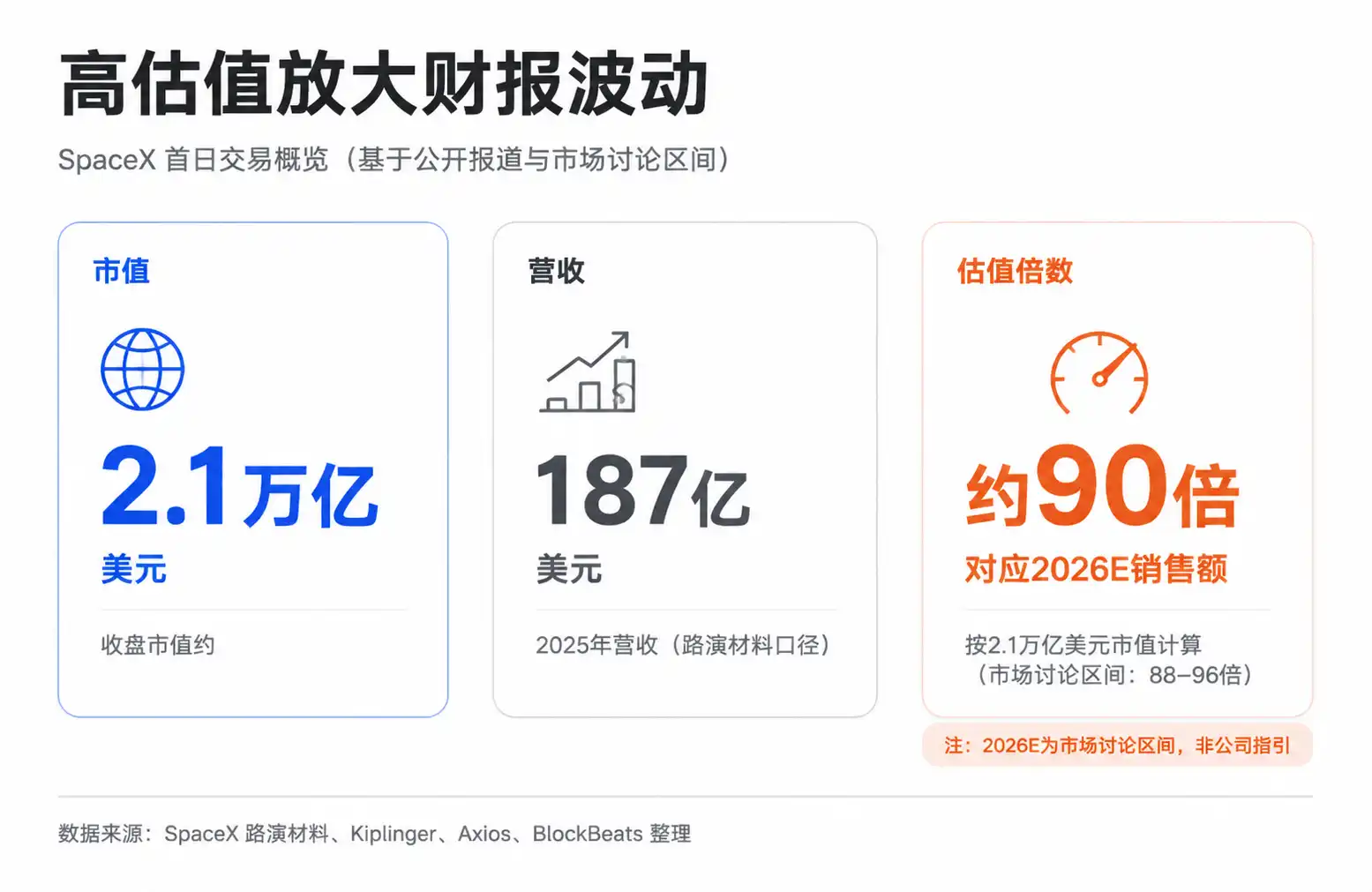
According to SpaceX's roadshow materials, the company's 2025 revenue was approximately $18.7 billion. Market discussions for 2026 revenue mostly range from $22 billion to $24 billion, but this is not company-confirmed guidance. Based on the first-day closing market cap of about $2.1 trillion, the market is clearly not buying just the current Starlink revenue, but a long-term option on satellite internet, commercial space, defense partnerships, Starship transport capability, and even the synergy of the Musk ecosystem.

Paying a high price for a future story is not inherently a problem. This state has repeatedly occurred in tech stock history: when the market believes a company holds a scarce gateway, it discounts profits many years out into the current price. The problem is, this kind of pricing is very sensitive to timing. Once earnings, orders, profit margins, or user growth fail to keep pace with the imagination, the market doesn't necessarily deny the endgame, but will reassess the speed of realization.

This makes the Q2 earnings a critical node before the first unlock. It's not just the first report card after listing; it could also become an amplifier for unlock expectations. If earnings are strong, bulls will argue that fundamentals can support the valuation, and the short-term squeeze logic can continue. If earnings are weak, bears will link it to the unlock window: fundamentals haven't yet justified the current market cap, and more shares are about to be released—why should the secondary market buy at these highs?
This is another difference between SPCX and mature tech stocks. Earnings impacts for mature tech stocks are more reflected in profit forecasts and valuation multiples. SPCX's earnings will also affect trading confidence around the lock-up period. It needs to answer two questions simultaneously: Can business growth support the long-term narrative, and when tradable supply is about to increase, will there still be enough buying interest to absorb it?

Analogy to TGE: The Core is Low Float with an Expiration Date

Within the Chinese investor community, some have drawn an analogy between SPCX and "small float trading post-TGE for top-tier VC projects."

TGE is the token generation event for crypto projects. When many top projects first launch, the circulating supply is low, the narrative is strong, and early investor and team tokens are locked. In the initial period post-launch, due to scarce buyable tokens and high attention, prices are easily pushed up. But as the unlock cycle approaches, the market starts pricing in future selling pressure ahead of time, and prices may enter a digestion phase.

This analogy isn't entirely accurate. Stock IPOs and crypto token offerings differ in regulation, information disclosure, and investor structure. But it captures the same market mechanism: Low float is not a long-term positive, but a supply-demand mismatch with an expiration date.

Within this framework, SPCX's post-listing trading can be broken into several stages. In the initial listing period, the market primarily rewards scarcity and narrative, with buyers focused on whether the squeeze can continue. Approaching the first unlock, trading becomes more complex, with investors simultaneously calculating new supply, earnings catalysts, and potential index inclusion. As larger-scale unlocks approach, the market shifts from "can't buy" to "can it be absorbed?".

This also explains why community discussions feature a combination of "short-term optimistic, medium-term cautious" views. It's not indecision, but different time slices within the same supply-demand framework. During the low-float phase, bulls have an easier advantage. During the unlock phase, bear logic begins to strengthen. What needs to be judged is not whether SpaceX is great, but whether the current price has already priced in the scarcity premium expected before the first unlock.
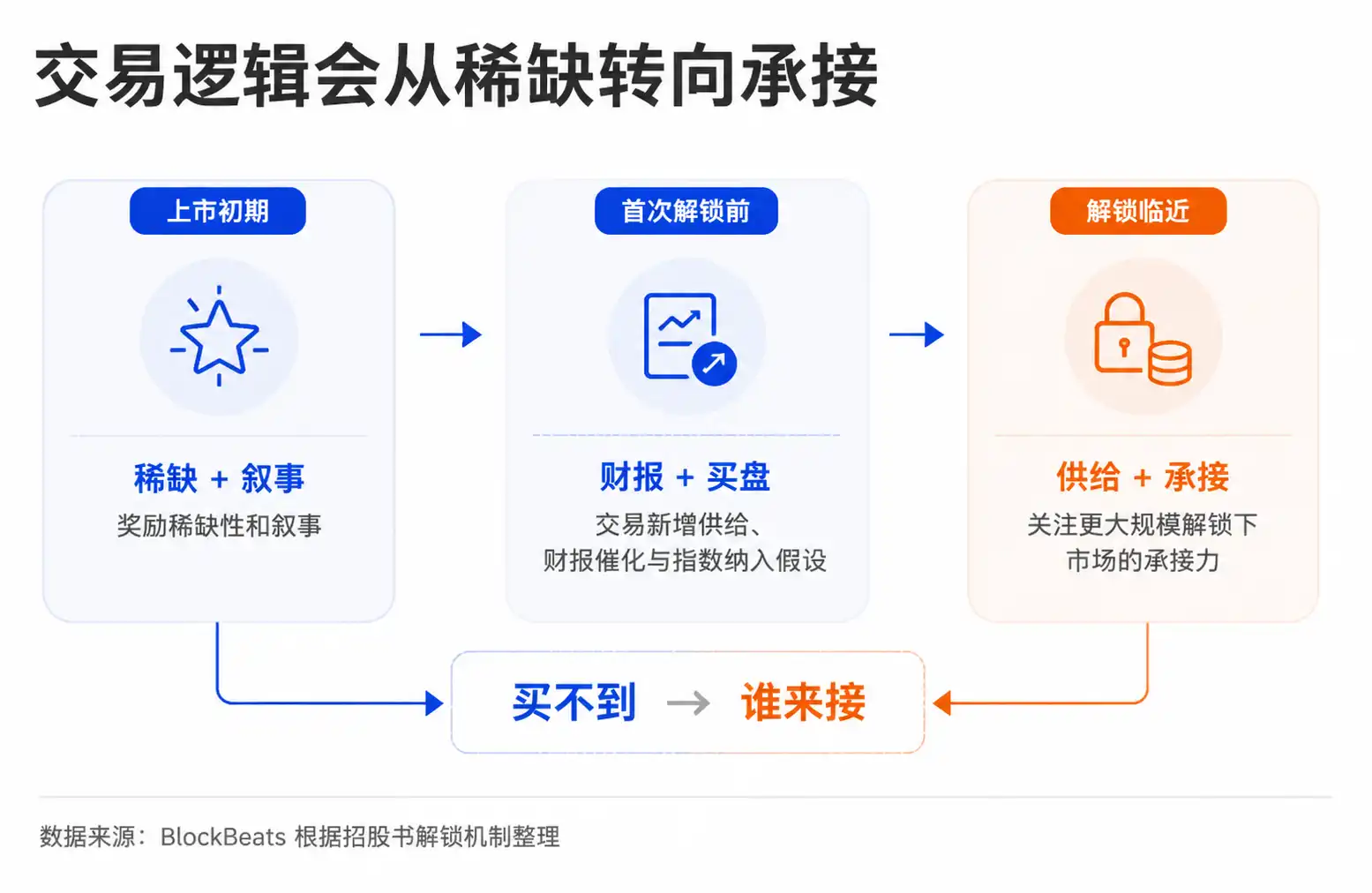
The Path Forward Depends on Unlock Details, Earnings, and Passive Buying

The key validation points for SPCX's subsequent price action lie not in the Mars narrative or social media sentiment, but in several more concrete variables.

The first thing to watch is the final documents and subsequent company disclosures regarding the unlock arrangements. The initial transferable percentage, price trigger conditions, earnings release timing, and scope of extended lock-up shareholders will all directly impact the future supply curve. For investors, this is more important than single-day price movements.

Next is whether the Q2 earnings can support the current valuation. SPCX's long-term story is vast, but what the secondary market needs to watch in the short term is still revenue, orders, profit margins, and cash flow. Stronger earnings make it easier for the low-float squeeze to persist. Weaker earnings make unlock selling pressure more likely to become the main pricing driver.

Index inclusion also needs continued observation, but before clear announcements, it remains merely a bullish trading hypothesis. If subsequent inclusion and allocation demand materialize, it may cushion some unlock pressure in the short term, but it does not equate to permanently absorbing the exit demand from existing shareholders and employees.

Right now, SPCX resembles more of a supply-demand experiment with a countdown. Before the first unlock, low float and a strong narrative could still keep prices resilient. After the first unlock, the market will begin testing how much real buying power this $2 trillion-plus space asset truly commands. For ordinary investors, more important than guessing a target price is to watch this inflection point: When the story shifts from "can't buy" to "who will buy," the trading logic has already changed.


Пов'язані питання

QWhat is the core dilemma for ordinary investors regarding SPCX's IPO?

AThe core dilemma is whether buying SPCX is investing in a rare, valuable space asset or simply providing liquidity for existing shareholders to exit in the future.

QWhat is the primary driver behind SPCX's significant first-day price surge according to the article?

AThe primary driver is the scarcity caused by a low initial public float, where high demand from investors fueled by hype, media, and strong narratives far exceeds the limited number of shares available for trading.

QWhat critical market dynamic will change with the arrival of the first lock-up expiration for SPCX?

AThe first lock-up expiration will fundamentally alter the supply curve by introducing a significant amount of new, low-cost shares into the tradable pool, shifting market focus from scarcity ('can't buy') to absorption capacity ('who will buy').

QWhy is the upcoming Q2 earnings report particularly crucial for SPCX's stock price trajectory?

AThe Q2 report is crucial because it serves as an amplifier ahead of the first lock-up. Strong results could justify high valuations and extend the scarcity-driven rally, while weak results could exacerbate concerns about absorbing future supply increases, putting downward pressure on the price.

QHow does the article analogize SPCX's post-IPO trading dynamic to crypto projects?

AThe article draws an analogy to a crypto project's Token Generation Event (TGE), where initial low circulating supply and strong narrative can inflate price, but this dynamic has an expiration date as upcoming unlock schedules make the market preemptively trade the future selling pressure.

Пов'язані матеріали

An AI Version of the 'Subprime Crisis'? A Hidden Debt of $1.8 Trillion is Accumulating in the Shadows Amid the Frenzy

Amidst the AI infrastructure construction boom, a massive debt expansion is forming, with the most dangerous portion remaining off-balance sheets. Morgan Stanley research reveals approximately $1.8 trillion in off-balance-sheet exposures, including nearly $1 trillion in purchase commitments and over $800 billion in non-active lease contracts. These future cash outflows are not recorded as liabilities. The leverage of hyperscale cloud companies has surged from 0.9x to 1.8x in just two quarters. Private credit firms like Apollo and Blackstone are shifting leverage into the supply chain through complex, opaque SPV (Special Purpose Vehicle) financing structures. Global AI-related bond issuance has skyrocketed, with annual volume projected to exceed $570 billion. However, capital expenditure growth is outpacing revenue and free cash flow. Major cloud providers may see free cash flow approach zero or turn negative in 2026. A significant 'depreciation cliff' looms as vast amounts of current capital spending, recorded as 'construction in progress,' have yet to begin depreciating, artificially inflating current profit margins. Future depreciation could severely pressure earnings. The core risk is identified as a series of timing mismatches, not an immediate solvency crisis. Investment is racing ahead of monetization, leverage is being obscured, and accounting classifications hinder comparability. The entire financing structure faces a fundamental stress test if AI commercialization lags or enterprise clients shift to cheaper alternatives, potentially triggering chain reactions within the highly interconnected funding ecosystem.

marsbit9 хв тому

An AI Version of the 'Subprime Crisis'? A Hidden Debt of $1.8 Trillion is Accumulating in the Shadows Amid the Frenzy

marsbit9 хв тому

SemiAnalysis Dissects Huawei's Kirin 9030: Process Technology Halted, So They Folded the Chip

SemiAnalysis has published a detailed teardown report on the HiSilicon Kirin 9030 Pro chipset found in Huawei's Mate 80 Pro. Fabricated using SMIC's most advanced N+3 node without EUV lithography, the analysis reveals significant technical achievements and strategic shifts. The report indicates SMIC's N+3 has achieved transistor density comparable to TSMC's N6 (113.4 vs 107.7 MTr/mm²), primarily through aggressive use of Self-Aligned Quadruple Patterning (SAQP) for its metal layers. This results in a notably small 32.5nm M0 metal pitch. However, SemiAnalysis notes this achievement comes with significantly higher process complexity, cost, and potential yield challenges compared to competitors using more advanced tools. The Kirin 9030 design maximizes this constrained density. While its GPU performance has improved ~70% and matches Qualcomm's 2022 flagship level, the CPU core's IPC lags behind current top-tier designs from Apple and Qualcomm, a gap attributed to the underlying manufacturing technology rather than design capability. Facing long-term restrictions on advanced tools, Huawei is charting a new path. The report highlights the company's "LogicFolding" roadmap, a 3D stacking technique aimed at shortening signal paths to boost performance and efficiency. The goal is to reach 5GHz frequency and a projected density of 295 MTr/mm² by 2031. SemiAnalysis concludes that export controls have not halted China's chip progress but have fundamentally altered its trajectory, making it more expensive and complex. This has spurred innovation in alternative areas like 3D stacking and domestic EDA tool development, with Huawei's supply chain also beginning to integrate Chinese memory from CXMT.

marsbit56 хв тому

SemiAnalysis Dissects Huawei's Kirin 9030: Process Technology Halted, So They Folded the Chip

marsbit56 хв тому

Bitcoin Short-Term Bullish Structure Validated, HYPE Low-Entry Window Opens | Guest Analysis

**Market Analysis Summary (Week of June 2026)** **Overall Market Context:** The market environment is exceptionally complex, with the unexpected US-Iran agreement and the reopening of the Strait of Hormuz triggering a global asset repricing and significant volatility. This heightened noise underscores the importance of a structured analytical framework. **Bitcoin (BTC) Analysis & Strategy:** * **Current Status:** The price has climbed above $65,000, currently in a rebound phase (segment 38-39) following a complex 12-segment correction from the May high of $82,850. * **Key Levels:** * **Primary Resistance:** $69,500–$70,500. A successful breakout above $65,000 targets this zone. * **Primary Support:** $65,000 (immediate), followed by $59,000–$60,000 and $55,000. * **Weekly Outlook & Strategy:** The focus is on the confirmation of the $65,000 level. * **Bullish Scenario (Hold $65K):** A move toward the $69.5K–$70.5K resistance zone is anticipated, which is a potential area for initiating medium-term short positions. * **Bearish Scenario (Break below $65K):** A retest of the $60,000–$62,000 support range is likely. * **Medium-Term Strategy:** Currently neutral. Plan to establish short positions (up to 60% allocation) either in the $69.5K–$70.5K resistance zone upon signs of rejection, or on a confirmed breakdown below $65,000 and further below $59K–$60K. * **Short-Term Strategy:** Utilize 30% capital for scalping opportunities based on support/resistance levels, using 30/60-minute charts. **HYPE Analysis & Strategy:** * **Current Status:** The price has stabilized around $52 after a four-segment decline from the June high of $75.87 and is now in a rebound (segment 50-51). * **Key Levels:** * **Primary Resistance:** $62.50–$64.57. Watch for potential rejection here to form a lower high. * **Primary Support:** $52–$55.50, followed by $47–$49. * **Weekly Outlook & Strategy:** Adopt a "buy on dips, avoid chasing rallies" approach. * **Core View:** Monitor the price action and potential formation of a lower high ("endpoint 51") in the $62.50–$64.57 resistance zone. * **Short-Term Strategy:** Consider light long positions (max 30% allocation) if the price finds support and shows reversal signals in the $52–$54.50 or deeper $47–$49 support zones, confirmed by proprietary quantitative bottom signals. **Trade Review:** Last week's HYPE short-term long trade, executed based on proprietary "Price Difference" and "Momentum" model signals, yielded a profit of approximately 11.88%. The entry was near $54.39 and exit near $60.85. **Risk Management Reminder:** Always set an initial stop-loss upon entry. Move stop-loss to breakeven at +1% profit, then trail it upwards to lock in gains as the trade progresses. *Disclaimer: All analysis, models, and strategies are based on personal technical analysis for educational purposes only, not investment advice. The market carries inherent risk.*

Odaily星球日报1 год тому

Bitcoin Short-Term Bullish Structure Validated, HYPE Low-Entry Window Opens | Guest Analysis

Odaily星球日报1 год тому

Торгівля

Спот
Ф'ючерси

Популярні статті

Що таке $S$

Розуміння SPERO: Комплексний огляд Вступ до SPERO Оскільки ландшафт інновацій продовжує еволюціонувати, виникнення технологій web3 та криптовалютних проектів відіграє ключову роль у формуванні цифрового майбутнього. Один з проектів, який привернув увагу в цій динамічній сфері, — це SPERO, позначений як SPERO,$$s$. Ця стаття має на меті зібрати та представити детальну інформацію про SPERO, щоб допомогти ентузіастам та інвесторам зрозуміти його основи, цілі та інновації в рамках web3 та крипто-сектору. Що таке SPERO,$$s$? SPERO,$$s$ — це унікальний проект у криптопросторі, який прагне використати принципи децентралізації та технології блокчейн для створення екосистеми, що сприяє залученню, корисності та фінансовій інклюзії. Проект розроблений для полегшення взаємодії між користувачами новими способами, надаючи їм інноваційні фінансові рішення та послуги. У своїй основі SPERO,$$s$ прагне надати можливості індивідам, забезпечуючи інструменти та платформи, які покращують користувацький досвід у криптовалютному просторі. Це включає в себе можливість більш гнучких методів транзакцій, сприяння ініціативам, що підтримуються спільнотою, та створення шляхів для фінансових можливостей через децентралізовані додатки (dApps). Основна концепція SPERO,$$s$ обертається навколо інклюзивності, прагнучи зменшити розриви в традиційній фінансовій системі, використовуючи переваги технології блокчейн. Хто є творцем SPERO,$$s$? Особистість творця SPERO,$$s$ залишається дещо невідомою, оскільки є обмежені публічно доступні ресурси, що надають детальну інформацію про його засновників. Ця відсутність прозорості може бути наслідком зобов'язання проекту до децентралізації — етики, яку багато проектів web3 поділяють, ставлячи колективні внески вище за індивідуальне визнання. Зосереджуючи обговорення навколо спільноти та її колективних цілей, SPERO,$$s$ втілює суть наділення без виділення конкретних осіб. Таким чином, розуміння етики та місії SPERO є більш важливим, ніж ідентифікація єдиного творця. Хто є інвесторами SPERO,$$s$? SPERO,$$s$ підтримується різноманітними інвесторами, починаючи від венчурних капіталістів до ангельських інвесторів, які прагнуть сприяти інноваціям у крипто-секторі. Зосередження цих інвесторів зазвичай узгоджується з місією SPERO — пріоритет надається проектам, які обіцяють технологічний прогрес у суспільстві, фінансову інклюзію та децентралізоване управління. Ці інвесторські фонди зазвичай зацікавлені в проектах, які не лише пропонують інноваційні продукти, але й позитивно впливають на спільноту блокчейн та її екосистеми. Підтримка з боку цих інвесторів підкріплює SPERO,$$s$ як значного конкурента в швидко змінюваній сфері крипто-проектів. Як працює SPERO,$$s$? SPERO,$$s$ використовує багатогранну структуру, яка відрізняє його від традиційних криптовалютних проектів. Ось деякі ключові особливості, які підкреслюють його унікальність та інноваційність: Децентралізоване управління: SPERO,$$s$ інтегрує моделі децентралізованого управління, надаючи користувачам можливість активно брати участь у процесах прийняття рішень щодо майбутнього проекту. Цей підхід сприяє відчуттю власності та відповідальності серед членів спільноти. Корисність токена: SPERO,$$s$ використовує свій власний криптовалютний токен, розроблений для виконання різних функцій в екосистемі. Ці токени дозволяють здійснювати транзакції, отримувати винагороди та полегшувати послуги, що пропонуються на платформі, підвищуючи загальну залученість та корисність. Шарова архітектура: Технічна архітектура SPERO,$$s$ підтримує модульність та масштабованість, що дозволяє безперешкодно інтегрувати додаткові функції та додатки в міру розвитку проекту. Ця адаптивність є надзвичайно важливою для збереження актуальності в постійно змінюваному крипто-ландшафті. Залучення спільноти: Проект підкреслює ініціативи, що підтримуються спільнотою, використовуючи механізми, які стимулюють співпрацю та зворотний зв'язок. Підтримуючи сильну спільноту, SPERO,$$s$ може краще задовольняти потреби користувачів та адаптуватися до ринкових тенденцій. Фокус на інклюзію: Пропонуючи низькі комісії за транзакції та зручні інтерфейси, SPERO,$$s$ прагне залучити різноманітну базу користувачів, включаючи осіб, які раніше не брали участі в крипто-просторі. Це зобов'язання до інклюзії узгоджується з його загальною місією наділення через доступність. Хронологія SPERO,$$s$ Розуміння історії проекту надає важливі уявлення про його розвиток та етапи. Нижче наведено пропоновану хронологію, що відображає значні події в еволюції SPERO,$$s$: Етап концептуалізації та ідеації: Початкові ідеї, що стали основою SPERO,$$s$, були сформовані, тісно пов'язані з принципами децентралізації та фокусом на спільноті в індустрії блокчейн. Запуск білого паперу проекту: Після концептуального етапу був випущений комплексний білий папір, що детально описує бачення, цілі та технологічну інфраструктуру SPERO,$$s$, щоб залучити інтерес та зворотний зв'язок від спільноти. Створення спільноти та ранні залучення: Активні зусилля були спрямовані на створення спільноти ранніх прихильників та потенційних інвесторів, що полегшило обговорення цілей проекту та отримання підтримки. Подія генерації токенів: SPERO,$$s$ провів подію генерації токенів (TGE) для розподілу своїх рідних токенів серед ранніх прихильників та встановлення початкової ліквідності в екосистемі. Запуск початкового dApp: Перший децентралізований додаток (dApp), пов'язаний з SPERO,$$s$, став доступним, дозволяючи користувачам взаємодіяти з основними функціями платформи. Постійний розвиток та партнерства: Безперервні оновлення та вдосконалення пропозицій проекту, включаючи стратегічні партнерства з іншими учасниками блокчейн-простору, сформували SPERO,$$s$ у конкурентоспроможного та еволюціонуючого гравця на крипто-ринку. Висновок SPERO,$$s$ є свідченням потенціалу web3 та криптовалют для революціонізації фінансових систем та наділення індивідів. Завдяки зобов'язанню до децентралізованого управління, залучення спільноти та інноваційно спроектованих функцій, він прокладає шлях до більш інклюзивного фінансового ландшафту. Як і з будь-якими інвестиціями в швидко змінюваному крипто-просторі, потенційним інвесторам та користувачам рекомендується ретельно досліджувати та обдумано взаємодіяти з поточними подіями в SPERO,$$s$. Проект демонструє інноваційний дух крипто-індустрії, запрошуючи до подальшого дослідження його численних можливостей. Хоча подорож SPERO,$$s$ ще триває, його основні принципи можуть справді вплинути на майбутнє того, як ми взаємодіємо з технологією, фінансами та один з одним у взаємопов'язаних цифрових екосистемах.

73 переглядів усьогоОпубліковано 2024.12.17Оновлено 2024.12.17

Що таке $S$

Що таке AGENT S

Агент S: Майбутнє автономної взаємодії в Web3 Вступ У постійно змінюваному ландшафті Web3 та криптовалюти інновації постійно переосмислюють, як люди взаємодіють з цифровими платформами. Один з таких новаторських проектів, Агент S, обіцяє революціонізувати взаємодію людини з комп'ютером через свою відкриту агентну структуру. Прокладаючи шлях для автономних взаємодій, Агент S прагне спростити складні завдання, пропонуючи трансформаційні застосування в штучному інтелекті (ШІ). Це детальне дослідження заглиблюється в складності проекту, його унікальні особливості та наслідки для сфери криптовалюти. Що таке Агент S? Агент S є революційною відкритою агентною структурою, спеціально розробленою для вирішення трьох основних викликів в автоматизації комп'ютерних завдань: Набуття специфічних знань у галузі: Структура інтелектуально навчається з різних зовнішніх джерел знань та внутрішнього досвіду. Цей подвійний підхід дозволяє їй створити багатий репозиторій специфічних знань у галузі, покращуючи її продуктивність у виконанні завдань. Планування на довгих горизонтах завдань: Агент S використовує планування з підкріпленням досвіду, стратегічний підхід, який полегшує ефективний розподіл та виконання складних завдань. Ця функція значно підвищує її здатність ефективно та результативно управляти кількома підзавданнями. Обробка динамічних, неоднорідних інтерфейсів: Проект представляє Інтерфейс Агент-Комп'ютер (ACI), інноваційне рішення, яке покращує взаємодію між агентами та користувачами. Використовуючи багатомодальні великі мовні моделі (MLLMs), Агент S може безперешкодно орієнтуватися та маніпулювати різноманітними графічними інтерфейсами користувача. Завдяки цим новаторським функціям Агент S надає надійну структуру, яка вирішує складнощі, пов'язані з автоматизацією людської взаємодії з машинами, прокладаючи шлях для численних застосувань у ШІ та за його межами. Хто є творцем Агент S? Хоча концепція Агент S є фундаментально новаторською, конкретна інформація про його творця залишається невідомою. Творець наразі невідомий, що підкреслює або початкову стадію проекту, або стратегічний вибір зберегти засновників у таємниці. Незважаючи на анонімність, акцент залишається на можливостях та потенціалі структури. Хто є інвесторами Агент S? Оскільки Агент S є відносно новим у криптографічній екосистемі, детальна інформація про його інвесторів та фінансових спонсорів не задокументована. Відсутність публічно доступних відомостей про інвестиційні фонди або організації, що підтримують проект, викликає питання щодо його фінансової структури та дорожньої карти розвитку. Розуміння підтримки є критично важливим для оцінки стійкості проекту та потенційного впливу на ринок. Як працює Агент S? В основі Агент S лежить передова технологія, яка дозволяє йому ефективно функціонувати в різних умовах. Його операційна модель побудована навколо кількох ключових функцій: Взаємодія з комп'ютером, подібна до людської: Структура пропонує розширене планування ШІ, прагнучи зробити взаємодії з комп'ютерами більш інтуїтивними. Імітуючи людську поведінку при виконанні завдань, вона обіцяє підвищити досвід користувачів. Наративна пам'ять: Використовується для використання високорівневого досвіду, Агент S використовує наративну пам'ять для відстеження історій завдань, тим самим покращуючи свої процеси прийняття рішень. Епізодична пам'ять: Ця функція надає користувачам покрокові інструкції, дозволяючи структурі пропонувати контекстуальну підтримку в міру виконання завдань. Підтримка OpenACI: Завдяки можливості працювати локально, Агент S дозволяє користувачам зберігати контроль над своїми взаємодіями та робочими процесами, узгоджуючи з децентралізованою етикою Web3. Легка інтеграція з зовнішніми API: Його універсальність і сумісність з різними платформами ШІ забезпечують те, що Агент S може безперешкодно вписатися в існуючі технологічні екосистеми, роблячи його привабливим вибором для розробників та організацій. Ці функціональні можливості колективно сприяють унікальному положенню Агент S у крипто-просторі, оскільки він автоматизує складні, багатоступеневі завдання з мінімальним втручанням людини. У міру розвитку проекту його потенційні застосування в Web3 можуть переосмислити, як відбуваються цифрові взаємодії. Хронологія Агент S Розробка та етапи Агент S можуть бути узагальнені в хронології, яка підкреслює його значні події: 27 вересня 2024 року: Концепція Агент S була представлена в комплексній науковій статті під назвою “Відкрита агентна структура, яка використовує комп'ютери як людина”, що демонструє основи проекту. 10 жовтня 2024 року: Наукова стаття була опублікована на arXiv, пропонуючи детальне дослідження структури та її оцінки продуктивності на основі бенчмарку OSWorld. 12 жовтня 2024 року: Було випущено відеопрезентацію, що надає візуальне уявлення про можливості та особливості Агент S, ще більше залучаючи потенційних користувачів та інвесторів. Ці маркери в хронології не лише ілюструють прогрес Агент S, але й вказують на його прихильність до прозорості та залучення громади. Ключові моменти про Агент S У міру розвитку структури Агент S кілька ключових характеристик виділяються, підкреслюючи її новаторський характер та потенціал: Інноваційна структура: Розроблена для забезпечення інтуїтивного використання комп'ютерів, подібного до людської взаємодії, Агент S пропонує новий підхід до автоматизації завдань. Автономна взаємодія: Здатність автономно взаємодіяти з комп'ютерами через GUI означає стрибок до більш інтелектуальних та ефективних обчислювальних рішень. Автоматизація складних завдань: Завдяки своїй надійній методології він може автоматизувати складні, багатоступеневі завдання, роблячи процеси швидшими та менш схильними до помилок. Безперервне вдосконалення: Механізми навчання дозволяють Агенту S покращуватися на основі минулого досвіду, постійно підвищуючи свою продуктивність та ефективність. Універсальність: Його адаптивність до різних операційних середовищ, таких як OSWorld та WindowsAgentArena, забезпечує його здатність служити широкому спектру застосувань. Оскільки Агент S займає своє місце в ландшафті Web3 та криптовалюти, його потенціал покращити можливості взаємодії та автоматизувати процеси означає значний прогрес у технологіях ШІ. Завдяки своїй інноваційній структурі Агент S є прикладом майбутнього цифрових взаємодій, обіцяючи більш безперешкодний та ефективний досвід для користувачів у різних галузях. Висновок Агент S представляє собою сміливий крок вперед у поєднанні ШІ та Web3, з можливістю переосмислити, як ми взаємодіємо з технологією. Хоча проект все ще на ранніх стадіях, можливості для його застосування є величезними та переконливими. Завдяки своїй комплексній структурі, що вирішує критичні виклики, Агент S прагне вивести автономні взаємодії на передній план цифрового досвіду. У міру того, як ми заглиблюємося в сфери криптовалюти та децентралізації, проекти, подібні до Агент S, безсумнівно, відіграватимуть ключову роль у формуванні майбутнього технологій та співпраці людини з комп'ютером.

699 переглядів усьогоОпубліковано 2025.01.14Оновлено 2025.01.14

Що таке AGENT S

Як купити S

Ласкаво просимо до HTX.com! Ми зробили покупку Sonic (S) простою та зручною. Дотримуйтесь нашої покрокової інструкції, щоб розпочати свою криптовалютну подорож.Крок 1: Створіть обліковий запис на HTXВикористовуйте свою електронну пошту або номер телефону, щоб зареєструвати обліковий запис на HTX безплатно. Пройдіть безпроблемну реєстрацію й отримайте доступ до всіх функцій.ЗареєструватисьКрок 2: Перейдіть до розділу Купити крипту і виберіть спосіб оплатиКредитна/дебетова картка: використовуйте вашу картку Visa або Mastercard, щоб миттєво купити Sonic (S).Баланс: використовуйте кошти з балансу вашого рахунку HTX для безперешкодної торгівлі.Треті особи: ми додали популярні способи оплати, такі як Google Pay та Apple Pay, щоб підвищити зручність.P2P: Торгуйте безпосередньо з іншими користувачами на HTX.Позабіржова торгівля (OTC): ми пропонуємо індивідуальні послуги та конкурентні обмінні курси для трейдерів.Крок 3: Зберігайте свої Sonic (S)Після придбання Sonic (S) збережіть його у своєму обліковому записі на HTX. Крім того, ви можете відправити його в інше місце за допомогою блокчейн-переказу або використовувати його для торгівлі іншими криптовалютами.Крок 4: Торгівля Sonic (S)Легко торгуйте Sonic (S) на спотовому ринку HTX. Просто увійдіть до свого облікового запису, виберіть торгову пару, укладайте угоди та спостерігайте за ними в режимі реального часу. Ми пропонуємо зручний досвід як для початківців, так і для досвідчених трейдерів.

1.5k переглядів усьогоОпубліковано 2025.01.15Оновлено 2026.06.02

Як купити S

Обговорення

Ласкаво просимо до спільноти HTX. Тут ви можете бути в курсі останніх подій розвитку платформи та отримати доступ до професійної ринкової інформації. Нижче представлені думки користувачів щодо ціни S (S).

活动图片