How to Systematically Track High-Win-Rate Addresses on Polymarket?

marsbitОпубліковано о 2026-03-02Востаннє оновлено о 2026-03-02

Анотація

This article explores methods to systematically identify and track high-success-rate addresses on Polymarket, a blockchain-based prediction market where all transactions are publicly recorded on-chain. It highlights that while data is transparent, the key challenge lies in extracting meaningful signals from vast datasets to detect addresses with potential informational advantages. The piece outlines common characteristics of such addresses: new wallets making large, concentrated bets; specialization in specific verticals; abnormal changes in position size; and exceptionally precise timing, repeatedly entering positions hours before major news breaks. A three-step systematic approach is recommended: First, filter addresses based on sustained profitability (e.g., 30-day positive returns, >55% win rate) using leaderboards like Polymarket Analytics. Second, analyze their holdings in specific event markets, focusing on addresses that are consistently among the top holders before full market pricing. Third, scrutinize their on-chain behavior: entry timing relative to news, position-building patterns (e.g., rapid, concentrated entries), holding periods, and trading focus. Advanced strategies include monitoring exit behavior (e.g., large, unexplained sell-offs), conducting wallet clustering analysis to find linked addresses, tracking unusual volume spikes in low-liquidity markets, and cross-referencing on-chain activity with external real-world data for validation. The goal is to ...

An address on Polymarket turned $35,000 into $442,000, achieving a 12.6x return. Notably, the position was established hours before a major market movement, and the trades were largely settled before the news spread to mainstream channels. This is not an isolated incident. Before the news of the "Venezuela Raid" political event became public, three addresses made moves in advance and collectively profited $630,000 from the same event.

If such trading occurred in traditional financial markets, one might easily think of information asymmetry. However, in prediction markets, all fund flows and position changes are recorded on the public blockchain; there are no hidden accounts or private transactions.

Being public does not mean there is no gap. The key is not whether you can see the trades, but whether you can discern the truly informative signals from the massive amount of data.
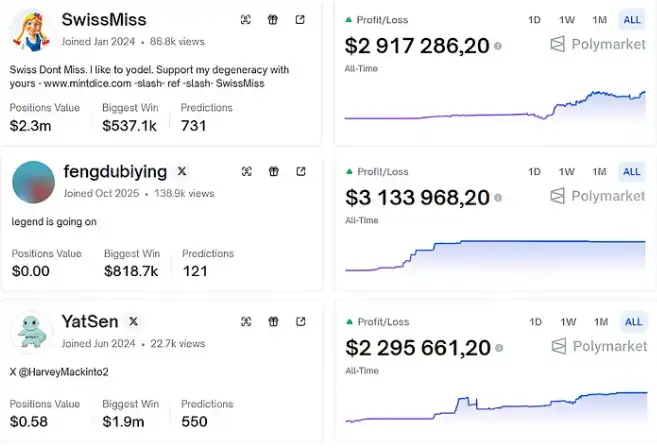
Every Trade on Polymarket is Public Data

Many prediction market participants still view Polymarket as a traditional betting platform: watch the odds, pick a direction, and bet on the outcome. But Polymarket's underlying structure is completely different from DraftKings or ordinary sports betting. All transactions occur on-chain; fund flows, position sizes, and entry/exit timings are all publicly viewable. The operational paths of the most accurate and timely addresses are not post-hoc speculation but real-time on-chain records.
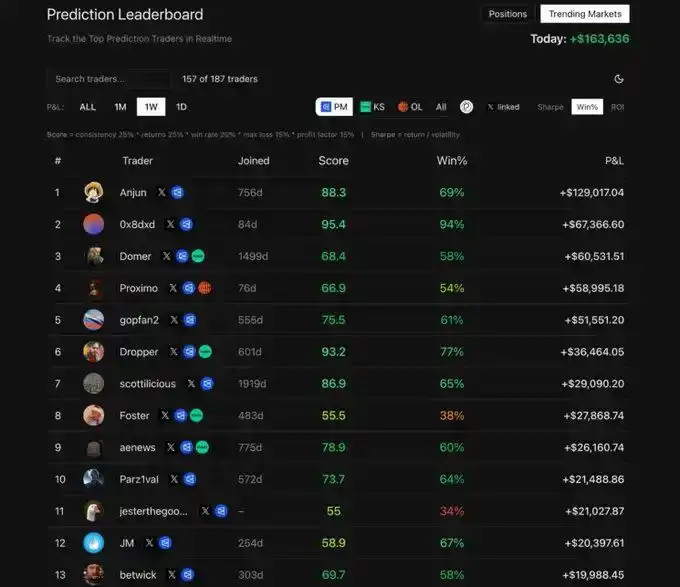
Polymarket's API is also open. Transaction records, market data, and historical trades can be directly called by anyone; there is no permission barrier.

Therefore, the gap is not about who can see the data, but about who can extract meaning from it. On-chain information is public, but what is truly valuable is the ability to identify wallets worth tracking continuously and to recognize behavioral changes before prices fully reflect them.

What Characteristics Do True "Informed Addresses" Typically Have?

It is important to emphasize that not all profitable wallets imply insider information. Some traders have solid research capabilities, while others rely on quantitative models and algorithmic advantages. However, when profitability is repeatedly coupled with specific behavioral patterns, one can observe structural features that distinguish them from mere "luck."

· Type 1: New Addresses Combined with Unusually Large Bets

A wallet created just days ago, with very few transactions, suddenly invests a large amount of capital in a low-liquidity niche market. This behavior is uncommon. Especially in the absence of public catalysts, large, concentrated positions often carry stronger informational significance.

· Type 2: Highly Vertical Trading Focus

Some addresses do not operate across markets but focus long-term on a specific niche, maintaining a stable and significant win rate in that area. They do not diversify across crypto prices, elections, sports, etc., but concentrate their firepower on a single theme, with more decisive position decisions.

· Type 3: Abnormal Changes in Position Size

When an address that has been betting with medium size for a long time suddenly significantly increases its position size in a particular market, this behavior often indicates a change in the strength of conviction. Position size itself is an attitude; a sudden change in scale usually reflects an upgrade in information or belief.

· Type 4: Overly Precise Timing

Occasional early positioning can be attributed to coincidence, but if an address repeatedly completes its positions hours before major news announcements, with highly consistent direction, this temporal lead is difficult to explain simply as luck. Once is random; repeated occurrences are more likely to reflect an information advantage.

How to Systematically Screen for Potential "Information-Advantaged Addresses"

· Step 1: Analyze Performance on Polymarket Leaderboards

Start with the leaderboard on Polymarket Analytics (link: https://polymarketanalytics.com/traders), sorted by 30-day P&L, using recent stable profitability as the first filter. Focus on wallet addresses with an overall positive return over 30 consecutive days, a win rate above 55%, and total profit significantly higher than total loss. Also, confirm that their trading is concentrated in markets with real liquidity, not low-volume prediction events with little participation.
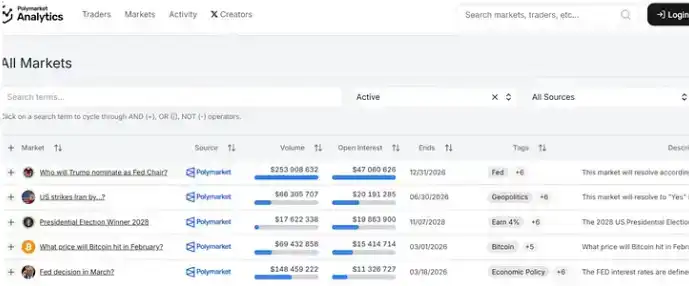
The goal at this stage is not to directly judge whether they have an information advantage, but to build a watchlist of addresses with sustained profitability. A consistent profit record is the foundation for subsequent behavioral analysis.

· Step 2: Analyze Position Structure in Specific Events

After the initial screening, drill down into specific trading events. Enter active prediction markets and check the Top Holders list for that event. Polymarket publicly displays the addresses with the largest current positions; these large positions often represent stronger conviction.
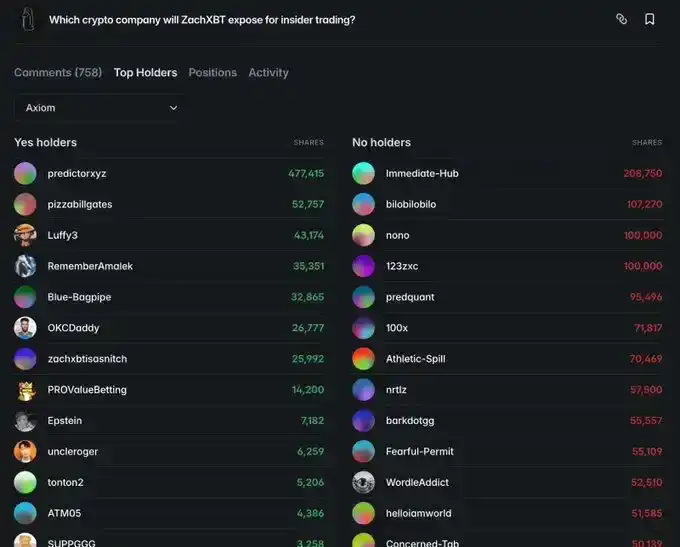
The key is not whether an address hits a single large bet, but whether its behavior is persistent. If a wallet repeatedly appears in the top holder lists for multiple significant events, and these positions were established before the market was fully priced, this repetition itself constitutes a signal.

Hitting once might be chance, but repeatedly making large, early-stage positions with consistent direction and validated outcomes often indicates a judgment system with a stable advantage.

· Step 3: Analyze Trading Behavior and Position Timing

After identifying candidate addresses, further analyze their on-chain transaction history, focusing on entry timing, position structure, and holding rhythm.
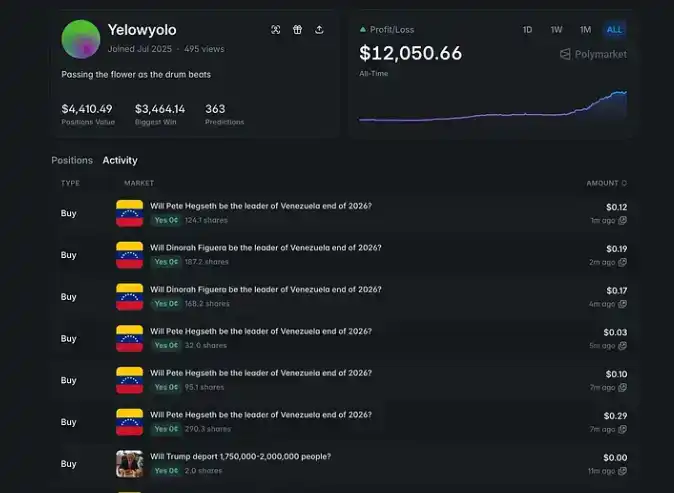
First, observe the entry time. If the purchase occurs hours before the official news release and repeats multiple times, the timing advantage itself becomes an important variable; entering after media reports is more likely to be just information following.

Second, analyze the method of position building. Mature traders typically build positions in batches and add gradually, while wallets with strong information judgment often complete concentrated layouts quickly within a short time window because their opportunity is limited.

Furthermore, pay attention to the holding period. Some high-quality addresses choose to exit during the middle of the trend发酵, rather than waiting for the tail end of extreme volatility, indicating their goal is to capture the main trend rather than marginal profits.

Finally, observe their trading scope. Addresses that are highly vertical and long-term focused on a single niche are more likely to form stable information advantages; addresses that frequently operate across sectors are more likely to rely on market sentiment rather than specific domain judgment.

Advanced Address Tracking Strategies

After mastering the basic screening methods, what truly makes the difference is the further dissection of the details of fund behavior.

First, focus on exit behavior, not just entry timing. Addresses with information advantages often not only position early but also actively reduce positions before potential negative news emerges. When a large address with a long, stable holding history suddenly significantly reduces its position without obvious catalysts, the informational content of this action is often higher than the initial buy. Especially when the reduction reaches a significant proportion, this change itself is a signal.

Second, perform wallet clustering analysis using on-chain data. Connections between addresses are not completely untraceable. Identical funding sources, similar Gas usage patterns, and transactions occurring consecutively within a very short time may reveal relationships between addresses. Many seemingly "new" accounts can often be traced back to a long-active old address through 2 or 3 fund transfers. Tracking along the fund flow path helps identify new potential high-quality accounts before the market notices.

Additionally, pay attention to abnormal volume changes in niche markets. If a market with usually small daily trading volume suddenly experiences a large influx of funds without public news, this structural increase in volume often means some participants have acted early. Analyzing the specific addresses driving the volume change can help build a new watchlist.

Finally, cross-validate on-chain behavior with external public information. The so-called "Pizza Index" once inferred potential military action from abnormal order volumes at pizzerias near the Pentagon. Similarly, flight tracking data, social media activity of key figures, adjustments to public calendars, and other information can provide corroboration or counter-verification for on-chain position behavior. The linkage between on-chain capital flows and real-world signals can often strengthen the reliability of judgment.


Пов'язані питання

QWhat are the key characteristics of potentially high-performing addresses on Polymarket?

AKey characteristics include: 1) New addresses making unusually large bets, 2) High specialization in a narrow trading domain, 3) Abnormal changes in position size indicating conviction shifts, and 4) Exceptionally precise timing of trades before major news breaks.

QHow can one systematically identify addresses with potential information advantages on Polymarket?

AA systematic approach involves: 1) Analyzing the Polymarket Analytics leaderboard for consistently profitable addresses, 2) Examining specific event holders lists for large, early positions, and 3) Conducting deep analysis of transaction timing, position structure, and holding patterns.

QWhy is transaction timing particularly important when analyzing Polymarket addresses?

ATransaction timing is crucial because addresses that consistently establish positions hours before major news becomes public, rather than after media coverage begins, demonstrate a potential information advantage that cannot be easily explained by luck alone.

QWhat advanced strategies can be used for tracking high-performance addresses beyond basic screening?

AAdvanced strategies include: analyzing exit behaviors and sudden position reductions, conducting wallet clustering through on-chain data analysis, monitoring unusual volume spikes in niche markets, and cross-referencing on-chain activity with external real-world signals.

QHow does Polymarket's structure differ from traditional betting platforms in terms of data transparency?

AUnlike traditional platforms, all Polymarket transactions occur on-chain, making fund flows, position sizes, and entry/exit timestamps publicly visible and accessible through open APIs, creating a transparent environment where performance is verifiable through public blockchain data.

Пов'язані матеріали

Stuck Polymarket: The Real Test After Riding the Traffic Boom Has Arrived

Polymarket, a leading prediction market platform, is facing significant technical challenges as its growth outpaces its current infrastructure on Polygon. Users are experiencing laggy transactions, unresponsive orders, and delayed confirmations, severely impacting the trading experience. In response, DeFi Engineering VP Josh Stevens outlined a comprehensive engineering overhaul. The plan includes reducing on-chain data delays, fixing order cancellation issues, rebuilding the central limit order book (CLOB), improving website performance, and developing a unified SDK and API. A major revelation was the ongoing "chain migration," indicating a potential move away from Polygon. The core issue is that Polymarket has evolved from a simple prediction market into a high-frequency trading platform, making Polygon's limitations—such as block space, gas fees, and block time—a ceiling for further growth. The migration is not just a simple chain switch but a fundamental rebuild of its trading system to support more complex products like perpetual contracts (Perps). This announcement has sparked competition among chains like Solana, Sui, and Algorand, all vying to host Polymarket. For Polygon, losing this key application, which contributes significantly to its gas fee revenue, would be a major setback. The real test for Polymarket is no longer attracting users but proving it can provide a stable, reliable trading environment that retains them.

Odaily星球日报Щойно

Stuck Polymarket: The Real Test After Riding the Traffic Boom Has Arrived

Odaily星球日报Щойно

Lowering Expectations for BTC's Next Bull Market

The author, Alex Xu, explains his decision to significantly reduce his Bitcoin holdings (from full to ~30% of his portfolio) during the current bull cycle, citing a lowered long-term outlook for BTC's price appreciation in the next cycle. He outlines six key reasons for this reduced expectation: 1. **Diminished Growth Drivers:** The narrative of exponential user adoption has largely played out with institutional ETF adoption. The next major growth phase—adoption by sovereign national reserves or central banks—seems unlikely in the near future. 2. **Personal Opportunity Cost:** More attractive investment opportunities have emerged in other assets, such as undervalued companies. 3. **Industry-Wide Contraction:** The broader crypto industry is struggling, with most Web3 business models (SocialFi, GameFi, DePIN) failing. This overall萧条 (depression) reduces the fundamental demand and consensus for Bitcoin. 4. **Strain on Major Buyer:** MicroStrategy, a major corporate buyer of BTC, faces rising financing expenses for its debt, which could slow its purchasing rate and create significant marginal pressure on the market. 5. **Increased Competition from Gold:** The emergence of "tokenized gold" has closed the functional gap (portability, divisibility) between physical gold and Bitcoin, offering a strong competitor in the non-sovereign store-of-value space. 6. **Security Budget Concerns:** The block reward halving continues to exacerbate the long-standing issue of funding Bitcoin's network security, with new fee source explorations like Ordinals and L2s largely failing. The author's decision to hold a significant (though reduced) position reflects a cautious, not bearish, outlook. He remains open to increasing his exposure if the fundamental reasons for his skepticism change or if new positive catalysts emerge.

marsbit39 хв тому

Lowering Expectations for BTC's Next Bull Market

marsbit39 хв тому

Can Iran 'Control' the Strait of Hormuz?

Iran has announced a comprehensive plan to assert control over the strategic Strait of Hormuz, a critical global oil shipping chokepoint. The proposed measures include requiring all vessels to obtain Iranian permission for passage, imposing fees for security, environmental protection, and navigation management—preferably paid in Iranian rials—and absolutely banning Israeli ships. Vessels from countries deemed hostile by Iran’s top security bodies may also be barred. Analysts suggest Iran’s motives are multifaceted: increasing pressure on the U.S. and Israel by leveraging control over oil transit to influence global prices and inflation; creating a new revenue stream, potentially exceeding $7.7 billion annually, to counter Western sanctions and support postwar reconstruction; and using transit permissions as bargaining chips in future negotiations, notably with the U.S. However, the plan faces significant practical and diplomatic challenges. Enforcing comprehensive interception and fee collection in the busy waterway, patrolled by international military forces, would be difficult. The U.S. has already countering with a blockade of Iranian ports and threats to intercept any ship paying fees, potentially strangling Iran’s oil exports and fee revenue. Broad international opposition, led by European and Gulf states, and legal controversies further complicate implementation. The proposal may ultimately serve more as a negotiating tactic than a feasible policy, with its execution remaining highly uncertain.

marsbit1 год тому

Can Iran 'Control' the Strait of Hormuz?

marsbit1 год тому

Торгівля

Спот
Ф'ючерси

Популярні статті

Як купити WIN

Ласкаво просимо до HTX.com! Ми зробили покупку WINkLink (WIN) простою та зручною. Дотримуйтесь нашої покрокової інструкції, щоб розпочати свою криптовалютну подорож.Крок 1: Створіть обліковий запис на HTXВикористовуйте свою електронну пошту або номер телефону, щоб зареєструвати обліковий запис на HTX безплатно. Пройдіть безпроблемну реєстрацію й отримайте доступ до всіх функцій.ЗареєструватисьКрок 2: Перейдіть до розділу Купити крипту і виберіть спосіб оплатиКредитна/дебетова картка: використовуйте вашу картку Visa або Mastercard, щоб миттєво купити WINkLink (WIN).Баланс: використовуйте кошти з балансу вашого рахунку HTX для безперешкодної торгівлі.Треті особи: ми додали популярні способи оплати, такі як Google Pay та Apple Pay, щоб підвищити зручність.P2P: Торгуйте безпосередньо з іншими користувачами на HTX.Позабіржова торгівля (OTC): ми пропонуємо індивідуальні послуги та конкурентні обмінні курси для трейдерів.Крок 3: Зберігайте свої WINkLink (WIN)Після придбання WINkLink (WIN) збережіть його у своєму обліковому записі на HTX. Крім того, ви можете відправити його в інше місце за допомогою блокчейн-переказу або використовувати його для торгівлі іншими криптовалютами.Крок 4: Торгівля WINkLink (WIN)Легко торгуйте WINkLink (WIN) на спотовому ринку HTX. Просто увійдіть до свого облікового запису, виберіть торгову пару, укладайте угоди та спостерігайте за ними в режимі реального часу. Ми пропонуємо зручний досвід як для початківців, так і для досвідчених трейдерів.

273 переглядів усьогоОпубліковано 2024.12.11Оновлено 2025.03.21

Як купити WIN

Обговорення

Ласкаво просимо до спільноти HTX. Тут ви можете бути в курсі останніх подій розвитку платформи та отримати доступ до професійної ринкової інформації. Нижче представлені думки користувачів щодо ціни WIN (WIN).

活动图片