How to Make Web3 Products Inherently Viral? Four Years of User Growth Lessons from an Entrepreneur

比推Опубліковано о 2025-12-30Востаннє оновлено о 2025-12-30

Анотація

The author, a Web3 founder with four years of experience, shares seven key lessons learned from building consumer-facing crypto products after previously working on failed infrastructure projects. Key insights include: 1. Target younger users (ages 13-21) who are more open to adopting new technologies. 2. Design products with built-in virality to reduce marketing costs, as crypto users expect incentives and trust is low. 3. Implement user-requested features quickly (within 2-3 days) to build trust and prevent churn to competitors. 4. Choose simple, memorable product names for easier word-of-mouth sharing. 5. Engage with users directly through cold DMs despite low response rates, focusing on acquiring 10-20 dedicated early users. 6. Iterate rapidly based on user behavior rather than just feedback, prioritizing what they actually pay for. 7. Simplify websites and onboarding to minimize cognitive load and clicks, ensuring the core value is immediately apparent. The author emphasizes that speed, user-centric design, and marketing are more critical than technical perfection in consumer crypto.

Author: Rishabh Gupta

Compiled by: Jiahuan, ChainCatcher

Original title:7 Painful Lessons from 4 Years of Web3 Entrepreneurship


As a budding founder, I spent years pouring my heart into three infrastructure-layer projects that ultimately failed. In 2025, I started building a consumer product that people actually want to use. Here, I share my hard-earned insights on user acquisition and fundraising.

I've been in this industry for about 4 years.

In 2023, when "account abstraction" was the hottest topic in the circle, I started developing in the EVM ecosystem. At that time, everyone was building SDKs (Software Development Kits) for account abstract wallets. Rollup scaling solutions were also hot—Optimism, Arbitrum, and various RaaS (Rollup as a Service) dominated.

As a math enthusiast, I was deeply attracted to ZK (Zero-Knowledge proofs), believing it would change the world (I firmly believe it will, eventually).

I mistakenly believed that: Complexity == Credibility.

When VCs asked about application scenarios, I would confidently list zkML (Zero-Knowledge Machine Learning), zk identity, zk voting—but even today, no one is really using these areas. I mistook amazing technology for a useful product.

Over time, I began to believe that the more complex an idea was, the greater its chance of success.

VCs also told me that in the crypto space, building infrastructure was the only path to success.

It took me nearly 2 years and over 500 rejections to realize this wasn't for me.

Entering the Solana Ecosystem

This was a completely new ecosystem for me—here, people care about application scenarios. Even meme coins are okay, because revenue matters.

Speed matters. Distribution matters.

Having built consumer applications on Solana for 7 months, here are my insights:

1. Build for Young Users Willing to Try New Things

Try to develop for young people who are naturally receptive to new products.

In the consumer crypto space, this usually means people trading in the "trenches" or young users aged 13-21.

A 2024 study by the Consumer Technology Association showed that 86% of Gen Z (11-26 years old) consider technology core to life—a higher percentage than any older generation. They own more devices and are more willing to spend on tech products.

They are more willing to try new apps, experiment with new features, and change habits.

Users over 25 are generally less willing to adopt new workflows unless there is a very strong incentive.

(Note: If you're in the institutional business, this may not apply.)

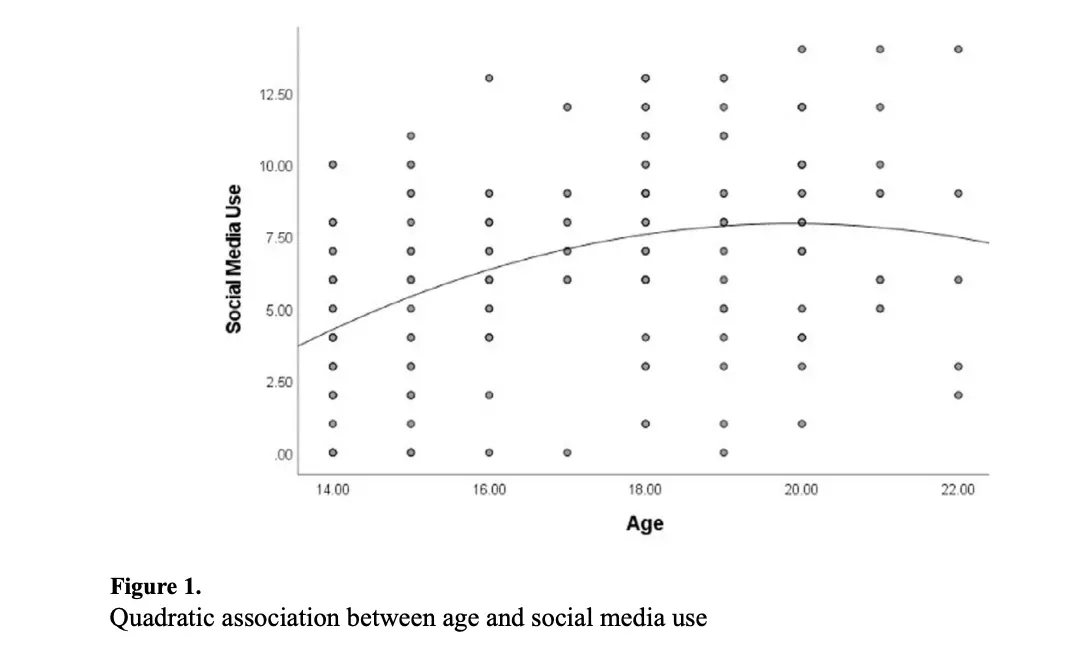
Research shows that social activity peaks around age 20-21. This means products built for young people are inherently more shareable.
2. Make the Product Inherently "Viral" to Reduce Marketing Costs

If you don't have a huge marketing or advertising budget, the product itself must be the traffic channel.

In crypto, shareability is especially important because:

  • KOL marketing is very expensive.

  • Trust is extremely low.

  • Everyone expects rewards or incentives.
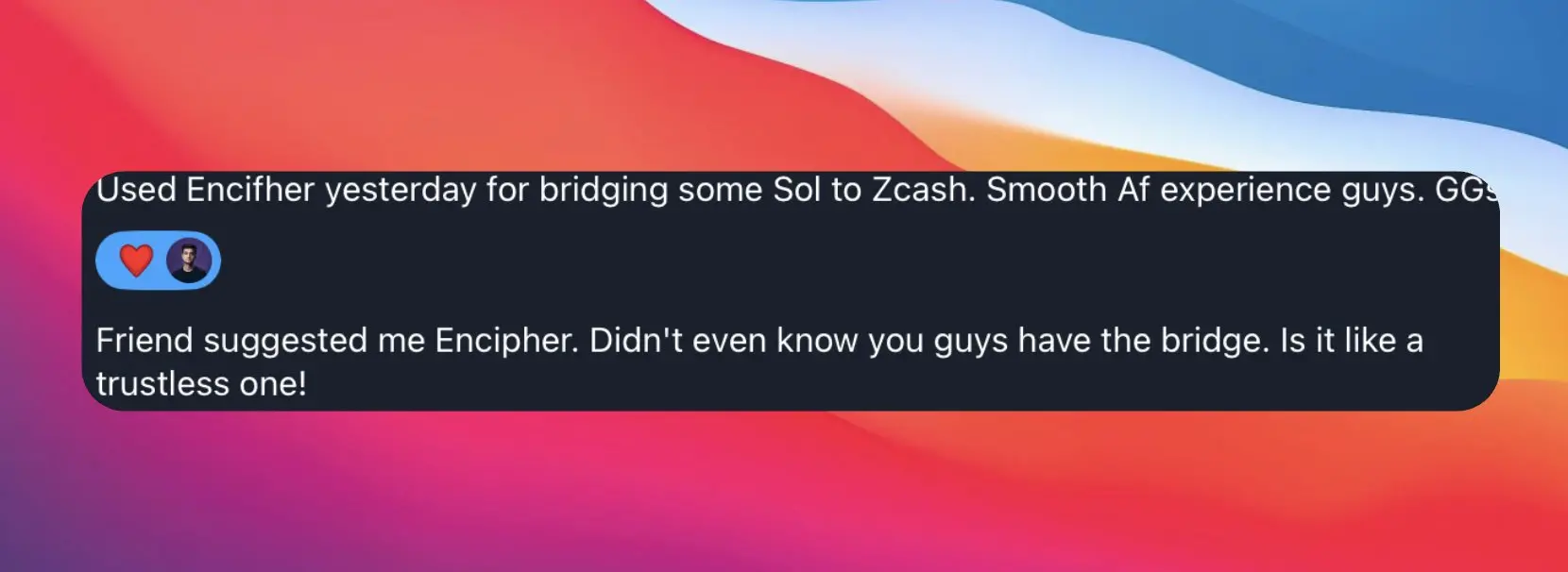
If your product gives users a reason to spontaneously share it with friends and communities, you've earned publicity without burning money. This is hard, but it's worth optimizing for from day one.

3. Launch Features Users Request as Soon as Possible

When users report a poor experience or a bug, fix it immediately, especially if it's a pain point that hinders use.

I used to wait until the end of the day to apply patches. The result was users DMing me: "Since your app doesn't have this feature, I'm going to use Product Y for now."

Once users go to a competitor and form a habit, it's hard to pull them back.

So, try to fix things immediately (ideally within 2-5 hours).

If multiple users request a feature and it's feasible:

  • Build it within 2-3 days.

  • Tell them it was launched based on their feedback.

  • Maybe even give them a reward.

This builds deep trust. Users will start to feel the product "belongs to them," and this sense of emotional ownership is incredibly powerful in early-stage products.
4. The App Name is Very Important

This seems simple, but many people (including me) have messed it up.

The app name should be highly recognizable and easy to share verbally.

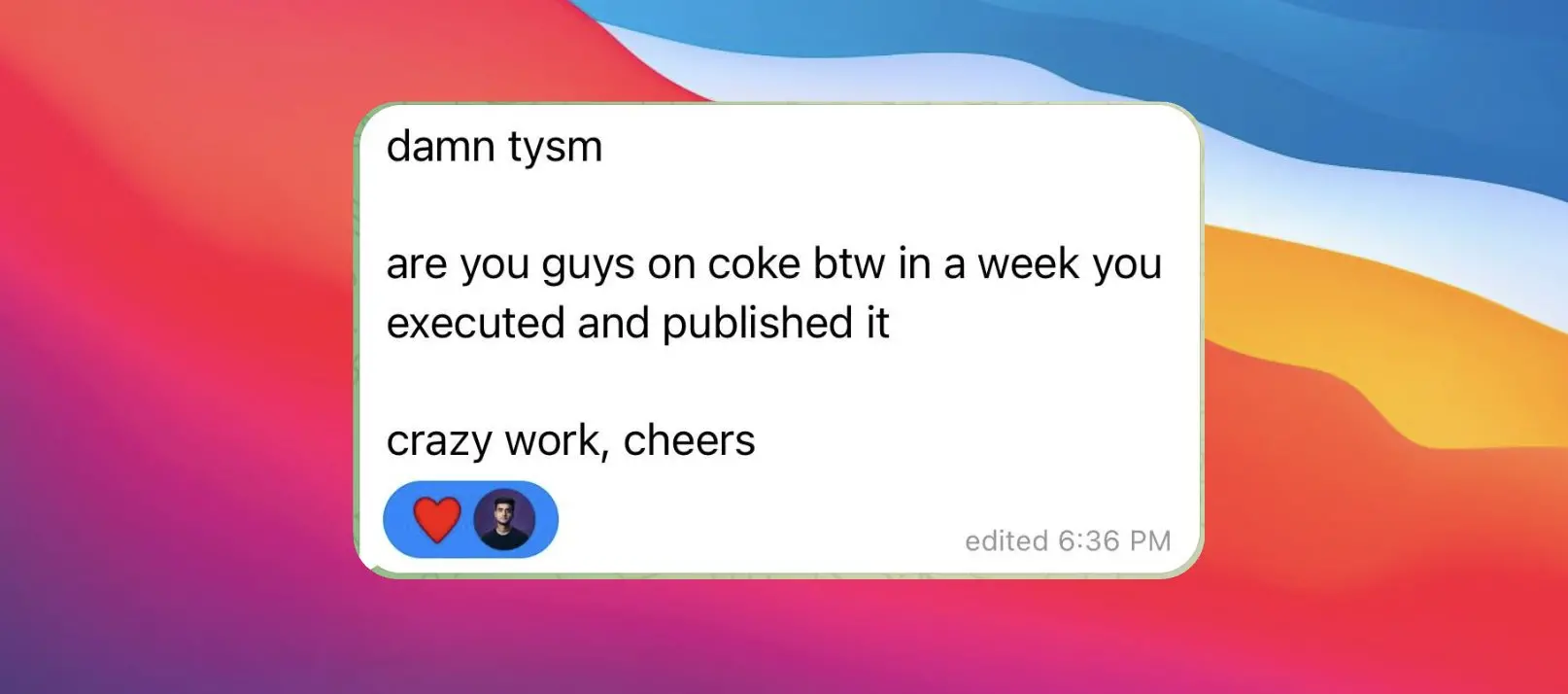
My previous product was called "Encifher," a name extremely hard to remember. Even investors and partners would misspell it when creating group chats.

So we later changed it to encrypt.trade. Simple, memorable, sexy.

5. Talking to Users is Hard, But Essential

Finding and talking to users is extremely difficult, especially when what you're building isn't part of the current "hot narrative."

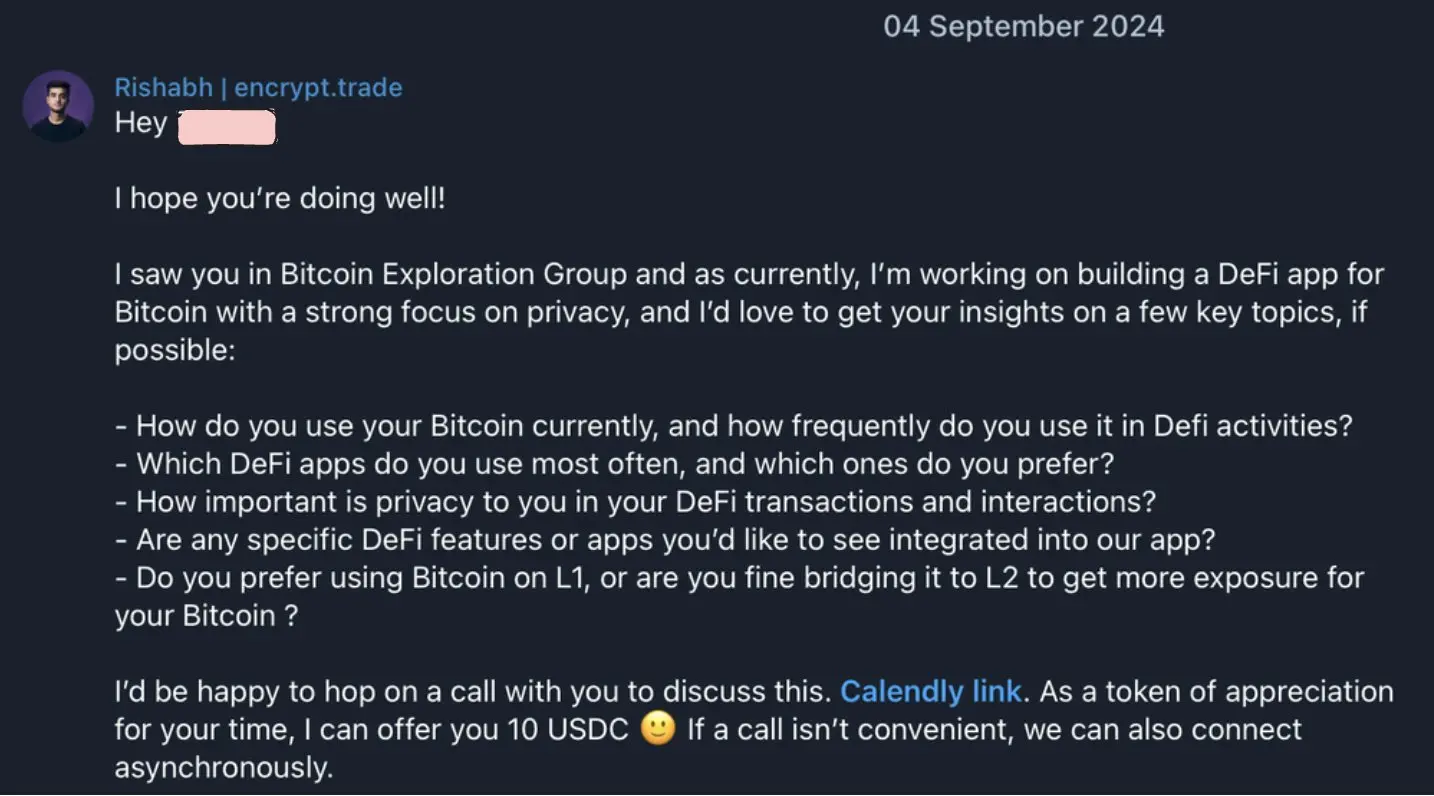
When I started working on privacy, it wasn't popular. I contacted nearly 1000 people via Cold-DM: maybe 10 out of 100 would reply. Only 3-4 of those could provide substantial help.
I talked to anyone who showed the slightest interest

I iterated on the product with them

Framing a Cold-DM is also an iterative process. Here are some key points to note:

  • Start with a warm greeting.

  • Put the highlights (funding status, trading volume, etc.) at the beginning.

  • Mention where you found them.

  • Give a friendly call to action.

  • Always remember to follow up.

There's no perfect Cold-DM; you must A/B test to find what works for your target audience.

Here's a decent Cold-DM template to use: But be aware, this process is slow and exhausting.
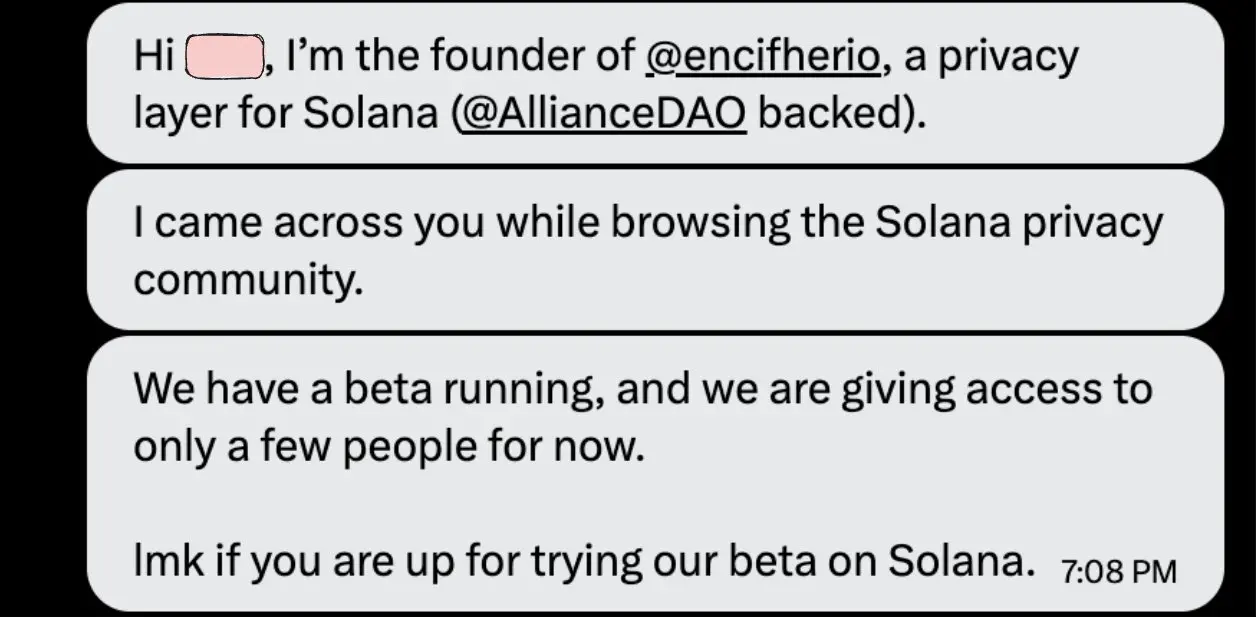

In the crypto circle, few people reply to DMs because scams are everywhere.

Low reply rates are the norm (I know, it's a bit frustrating).

Nevertheless, you must do it.

Your goal at this stage is not to get 1000 users.

Your goal is 10-20 early users who care about the problem, are willing to try the product, and will provide honest feedback.

These early users will become your support system.

Early products often go wrong; these users will help you through that phase.

6. Iterate Quickly

The crypto industry changes rapidly, and attention spans are extremely short.

You must study user behavior, not just listen to their words:

  • What are they doing repeatedly?

  • What kind of workarounds are they using?

  • What are they already willing to pay for? (Many ideas sound good, but if users aren't willing to pay, it can't survive.)

7. Make Your Website Simple to the Point of Being "Foolproof"

Never make any assumptions about the user's knowledge.

As a developer, you've stared at the product for hundreds of hours and find it obvious, but for someone entering for the first time, it's completely foreign.

  • Don't introduce new terminology or complex processes.

  • Minimize the number of clicks.

  • The core value should be presented within 5 seconds of entering the app.

Conclusion

Building consumer crypto products is both fun and challenging. Speed of iteration, user-centric thinking, and marketing ability are more important than perfect technology. This is completely different from B2B.


Twitter:https://twitter.com/BitpushNewsCN

Bitpush TG Discussion Group:https://t.me/BitPushCommunity

Bitpush TG Subscription: https://t.me/bitpush

Original link:https://www.bitpush.news/articles/7599210

Пов'язані питання

QWhat is one of the key lessons the founder learned about building Web3 products for user growth?

AOne key lesson is to build for young, early-adopter users (like those aged 13-21) who are naturally more receptive to new products and have higher social activity, making the product more inherently shareable.

QWhy is it important for a Web3 product to have built-in shareability?

ABuilt-in shareability is crucial because KOL marketing is expensive, trust is low in crypto, and users expect rewards. If the product gives users a reason to share it with friends and communities organically, it reduces marketing costs and drives growth without burning cash.

QHow should founders handle user feedback and feature requests according to the article?

AFounders should address user feedback and bugs immediately, ideally within 2-5 hours for critical issues. If multiple users request a feasible feature, build it within 2-3 days, inform them it was based on their feedback, and even offer rewards to build deep trust and a sense of ownership.

QWhat did the founder realize about product names after his experience with 'Encifher'?

AHe realized that product names should be highly recognizable and easy to share verbally. 'Encifher' was hard to remember and often misspelled, so he changed it to 'encrypt.trade' for simplicity, memorability, and appeal.

QWhat is the recommended approach for cold outreach (Cold-DM) to potential users?

AThe approach includes starting with a warm greeting, highlighting key points (like funding or traction) upfront, mentioning where you found them, giving a friendly call-to-action, and always following up. The goal isn't to get thousands of users but to find 10-20 early users who care and provide honest feedback.

Пов'язані матеріали

In Conversation with Ray Dalio: We Are Currently in an AI Bubble, with 1% of My Portfolio in Bitcoin

Ray Dalio, founder of Bridgewater Associates, warns in an interview that the current AI boom shows classic bubble characteristics, which could lead to significant economic downturns as seen in past cycles like 1929 or 2000. He explains that speculative enthusiasm, fueled by debt and overvaluation, often precedes a crash when rising rates or taxation force asset sales, causing widespread losses and recession. Dalio also outlines his "Big Cycle" theory, describing an approximate 80-year pattern where widening wealth gaps, massive government deficits, and shifting geopolitical power (like China's rise) create internal conflict and global instability. He emphasizes that we are in a late-cycle, transitional phase where traditional powers like the US and UK face decline. For personal wealth protection, Dalio advises diversification beyond cash into assets like stocks, bonds, real estate, and particularly gold, which he prefers over Bitcoin. While he holds about 1% of his portfolio in Bitcoin as a non-printable hard asset, he views gold as more secure from technological or governmental threats. Regarding AI's impact, Dalio believes it will disproportionately benefit capital owners, worsening inequality by replacing both physical and cognitive labor. He suggests that human intuition and emotional intelligence, combined with AI, will be key for future workers. On taxation, Dalio argues that wealth taxes are impractical and risk triggering asset sell-offs, reducing productive investment. He points to the UK as a cautionary example of debt, low productivity, and political strife. Geopolitically, Dalio foresees a more regionalized world, with the US showing weakness in prolonged conflicts like with Iran, akin to past imperial declines. The ideal outcome, he suggests, is coexisting powerful blocs (e.g., Americas, China-Asia Pacific) without major war.

marsbit23 хв тому

In Conversation with Ray Dalio: We Are Currently in an AI Bubble, with 1% of My Portfolio in Bitcoin

marsbit23 хв тому

Daily 7.2 Trillion KRW: Foreign Capital's Record Net Buying on Friday! Wall Street Says Headwinds for Korean Stock Fund Flows Have Subsided

South Korean stock market sees a dramatic shift in fund flows. On July 31, foreign investors made a record net purchase of approximately KRW 7.2 trillion in KOSPI stocks, marking a fundamental reversal from the persistent large-scale net outflows seen in previous months. This contributed to a significant narrowing of foreign net selling in July to KRW 9.8 trillion, down sharply from KRW 48.4 trillion in June and KRW 44.5 trillion in May. Simultaneously, domestic institutional pressure eased. South Korean pension funds and asset managers turned to a net buying position in July, purchasing KRW 1.0 trillion worth of KOSPI shares, contrasting with net sales in May and June. Market volatility is expected to be dampened by new financial regulations. Effective July 31, the Financial Services Commission tightened access for retail investors to single-stock leveraged ETFs by raising the minimum cash deposit requirement. Trading volumes for these products subsequently dropped to about 50% of their monthly average. Citigroup Research maintains its year-end KOSPI target of 10,000 points. The firm cites several supportive factors: the substantial easing of headwinds from capital outflows, a robust fundamental outlook for the semiconductor sector, historically low market valuations, strong economic fundamentals, and the potential for policy support from financial authorities if needed.

marsbit23 хв тому

Daily 7.2 Trillion KRW: Foreign Capital's Record Net Buying on Friday! Wall Street Says Headwinds for Korean Stock Fund Flows Have Subsided

marsbit23 хв тому

Thanks to Dice Rolls, Bitcoin Keys Are Stored Offline, But Not Everyone Will Do It

The article discusses using dice rolls to generate secure Bitcoin wallet seeds, providing entropy independent of potentially flawed hardware random number generators. It explains that each fair dice roll offers about 2.585 bits of entropy, with around 50 rolls needed for a standard 12-word seed phrase and 99+ recommended for higher security. This method gained attention after a vulnerability was revealed in some Coldcard hardware wallets, where a faulty firmware RNG (dating back to 2021) compromised generated keys. The analysis notes that while a dice-generated main seed was safe from this specific flaw, other Coldcard functions (like creating paper wallets, backup keys, or passwords) could still be vulnerable if they used the defective RNG. The piece argues that while dice-based entropy is technically robust, the manual process is error-prone, tedious, and unrealistic for most new users, who might make mistakes in recording or inputting rolls. It concludes that while manual entropy generation should remain an option for advanced users, the long-term goal is to develop reliable, user-friendly hardware and software that securely generates randomness without requiring specialized knowledge. Coldcard users are advised to check their firmware version and replace any secondary secrets (like paper wallet keys) created with vulnerable devices, while also considering multi-signature setups with devices from different manufacturers for added security.

cryptonews.ru5 год тому

Thanks to Dice Rolls, Bitcoin Keys Are Stored Offline, But Not Everyone Will Do It

cryptonews.ru5 год тому

Торгівля

Спот
活动图片





