How to Deal with Trump? Here's the 'Deal-Maker's Playbook'

marsbitОпубліковано о 2026-03-11Востаннє оновлено о 2026-03-11

Анотація

The Kobeissi Letter outlines a consistent 10-step "conflict playbook" used by former President Trump in geopolitical and trade disputes, from Iran to tariffs. It begins with verbal pressure and strategic posturing, often followed by "Friday night surprise" actions to allow market digestion. Markets initially bet on quick deals, but Trump’s "forever war" rhetoric reverses optimism, forcing repricing. A conditional de-escalation signal (like Trump’s recent Iran comments) emerges when structural market stress (oil >$90, stocks down 5%) or political costs mount. Eventually, deals are struck, triggering violent market reversals due to defensive positioning. Three scenarios are projected for the next 2-4 weeks, all pointing to an eventual agreement—Trump’s conflicts consistently end with deals, not prolonged war.

Every conflict involving Trump follows the same script.

According to Xinhua News Agency, Trump spoke about the Iran conflict in Miami on the 9th: he believes the conflict will end "soon," but "not" this week. This statement sounds ambiguous, but if you've been tracking his approach to handling geopolitical conflicts, you'll recognize it as a familiar signal—negotiation terms are quietly taking shape.

This is precisely the seventh step described by The Kobeissi Letter—the emergence of conditional de-escalation signals. After the market has already begun seriously pricing in a "longer fight," conditional cooling rhetoric appears—not a retreat, but a test of whether the opponent and the market can withstand the next stage of escalation.

In a report dated March 3, The Kobeissi Letter, an independent U.S. macro market research newsletter, systematically reviewed every geopolitical and trade conflict involving Trump since his inauguration in January 2025, from tariff wars, the arrest of Venezuela's Maduro, and Greenland negotiations, to the current Iran conflict. The negotiation logic Trump follows in handling these conflicts is highly consistent.

This research compiles a complete 10-step "conflict script" for Trump's approach to conflicts: from verbal pressure and posturing, to a preference for making key moves on Friday nights, to the spread of risk premiums across stocks, bonds, and commodities, and finally ending with a "deal" that triggers violent market repricing. For the next 2 to 4 weeks, the institution outlines three scenarios, with the outcome likely still being an agreement—but before that, the market may have to endure another round of pain.

Step One to Step Three: From Verbal Pressure to the "Friday Night Surprise"

Trump's conflicts often don't start with the first missile or the first tariff notice, but with linguistic pressure to "make a deal."

The Kobeissi Letter defines the starting point of Trump's conflict mode as verbal pressure. Taking the Iran conflict as an example, the first strike on Iranian nuclear facilities occurred on February 28, but as early as two months prior, Trump had repeatedly posted on Truth Social that "a massive fleet is heading towards Iran" and continuously urged Iran to "make a deal."
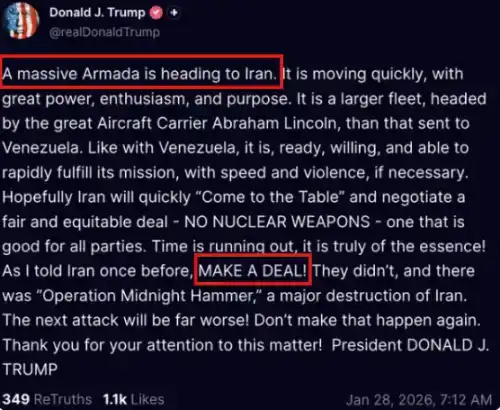
The institution points out that this pattern was equally clear in the Venezuela and EU tariff events: Trump announced the closure of Venezuelan airspace more than a month before taking action against Venezuela; before imposing tariffs on the EU, he continuously threatened Denmark and claimed it was "time" to acquire Greenland.

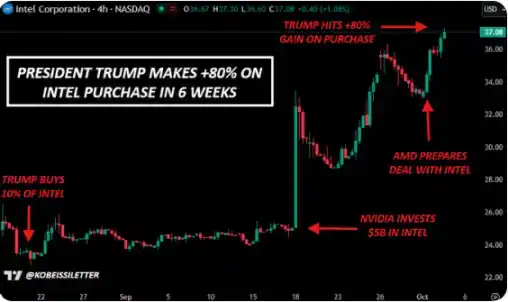
The second step is strategic posturing and demonstration of strength, including visible preparatory actions like military deployments and public ally coordination, aimed at enhancing credibility without triggering full-scale conflict. The institution cites Trump's meeting with Intel CEO Lip-Bu Tan in August 2025 as an example—prior to this, Trump had publicly demanded his "immediate resignation," after which both sides reached an agreement for a 10% government stake. This investment recorded over 80% paper gains in less than two months.
The third step is the signature "Friday Night Surprise." The Kobeissi Letter's statistics show that Trump's major actions are highly concentrated from Friday night to early Saturday morning, including: the June 21 U.S.-Israel joint airstrike on Iranian nuclear facilities, the September 1 strike on drug boats in the Caribbean, the October 10 threat of 100% tariffs on China, the November 29 closure of Venezuelan airspace, the December 25 military action in Nigeria, and the February 28 airstrike on Iran.

Why always act on Friday night? The report suggests that if major news breaks during trading hours, liquidity dries up instantly, algorithmic programs amplify volatility, and intraday panic intensifies. Announcing on Friday evening gives investors, institutions, and governments the entire weekend to digest the information.

More importantly, Trump is highly sensitive to severe market volatility—he needs a time window to observe market reactions and leave room for possible negotiations. According to this script, after acting on Friday night, Trump often begins hinting at the possibility of a "deal" before the Sunday futures market opens. In the case of Iran, that signal did not come.

Step Four to Step Six: How the Market Gets "Educated"

After the third step, the research divides the market's typical reaction into three layers:

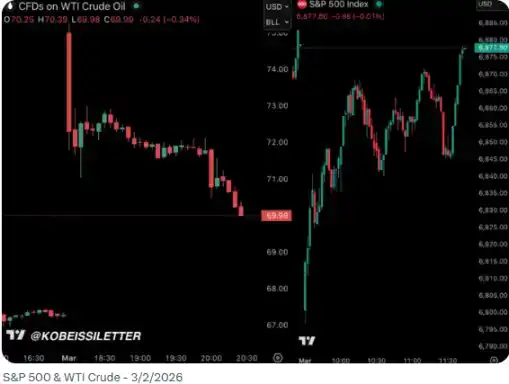
Step Four: The shock occurs, but the market initially bets on a "quick deal." The report describes a common path: severe volatility occurs during the Sunday night session (18:00 EST), but by the time the Monday cash market opens, some of the moves are "reversed," as investors assume Trump loves deals and the conflict won't drag on. The research cites the March 2 movement as an example: WTI crude oil erased about 70% of its gains at one point, and the S&P 500 even turned green, but these moves were subsequently reversed, with oil hitting new highs and stocks hitting new lows.
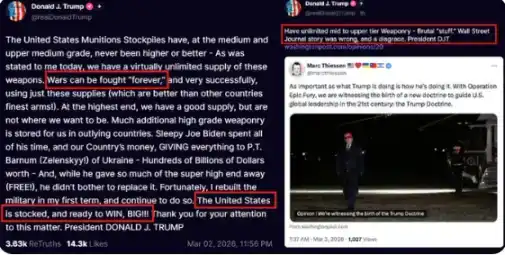
Step Five: Trump uses rhetoric like "we can fight forever" to burst the market's optimism. After investors buy the dip, the market is often hit with a counter-punch. On March 2, Trump publicly stated that "the war can go on forever" and that the U.S. has "unlimited mid-to-high-end weapons." The Kobeissi Letter believes this "forever" type of statement is more of a negotiation tactic, showing the bearable upper limit, but does not equate to a genuine desire for a prolonged war.
Step Six: The market begins formally pricing in a "longer duration." As of the report's writing on March 3, Brent crude oil prices broke above $85/barrel for the first time in nearly two years; the Dow Jones Index fell over 1100 points in a single day; stocks fell to weekly lows, and defensive capital outflows accelerated. This stage marks a structural shift in market psychology—"The first dip is bought because investors expect an agreement is coming; the second dip is bought because investors believe the escalation is temporary; the third dip is when positions begin to change structurally."

Step Seven to Step Eight: De-escalation Signals and the Market Feedback Loop

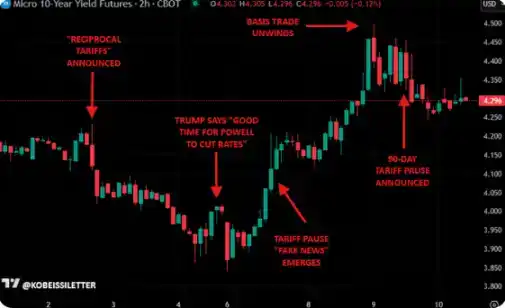
Step Seven is the emergence of conditional de-escalation signals, which corresponds to the stage of Trump's latest statement on the 9th. The Kobeissi Letter emphasizes that the time window between Step Six and Step Seven is "highly uncertain"—in the early 2025 tariff war, this transition took months, ultimately catalyzed by a rapid surge in U.S. Treasury yields before tariffs were "paused" on April 9.

The institution points out that the historical catalysts prompting Trump to back down have either been the target actively seeking to "make a deal" or a structural break in the market. On the Iran issue, this catalyst would be the collapse of the Iranian government or some event with structural implications for the U.S. and global economy.
Step Eight is the feedback loop between the market and politics. The financial market itself has become part of the negotiation environment, as oil prices, stock markets, and inflation expectations in turn influence the political narrative.

Trump has three policy priorities: being a "peace president," suppressing inflation, and lowering U.S. gasoline prices. From this, it follows that: rising oil prices, if prolonged, directly conflict with his goals, especially in a critical midterm election year.

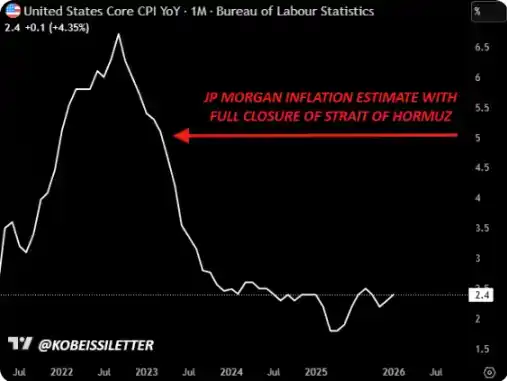
According to JPMorgan estimates, a blockade of the Strait of Hormuz could push oil prices to $120-$130/barrel and cause U.S. CPI inflation to soar to around 5%. Based on this, the institution set three key monitoring thresholds: Brent crude sustaining above $90/barrel, a stock market decline of 5% or more, and a gasoline price increase of over 10%. "When these thresholds are breached, the probability of negotiation-related headlines appearing increases significantly."
Step Nine to Step Ten: Agreement Reached and Violent Repricing

Step Nine is agreement reached and narrative framing. The Kobeissi Letter points out that every major confrontation within Trump's framework ultimately ends with a narrative of "maximum pressure in exchange for concessions," whether it's trade deals with China, the EU, India, corporate negotiations with Intel or in the rare earths sector, or the multiple conflicts Trump helped end in 2025.

On the Iran issue, the institution believes that if the Iranian government does not collapse, the final agreement might involve a ceasefire linked to nuclear issues, a regional security arrangement with enforcement mechanisms, or a sanctions adjustment plan conditional on compliance benchmarks. "The specific architecture is far less important than the timing and narrative framework."

Step Ten is violent market repricing and declaration of political victory. The Kobeissi Letter emphasizes that market repricing after an agreement is announced is often sudden rather than gradual, because investors are generally in defensive positions by then—energy exposure is high, equity risk has been compressed, and volatility remains elevated due to latent uncertainty.

Once uncertainty dissipates abruptly, these positions are rapidly unwound. The institution cites historical cases from April, August, October 2025 and January 2026, noting that each time tariffs were paused or a framework agreement was announced, stocks surged sharply, while oil prices plummeted rapidly as expectations for the reopening of shipping channels were established.

Three Paths for the Next 2-4 Weeks: "The Deal Will Be Back on the Table"

The Kobeissi Letter outlines three scenarios for the next two to four weeks.

Scenario One: Escalation briefly intensifies, oil prices rise, stocks fall, then negotiation language suddenly appears, and the market reverses sharply due to overly defensive positioning.

Scenario Two: The conflict continues in a controlled but sustained manner, oil prices remain high without sharp spikes, stocks wait for clarity amid high volatility, and an agreement is reached under sustained pressure later this month.

Scenario Three: Regional escalation expands significantly, including substantial disruption to shipping channels or direct involvement by more state actors. Oil prices would move towards triple digits, and global risk assets face deeper repricing. Given historical precedent and the current critical midterm election year, the probability of the third scenario is low, but not impossible.

Regardless of the path, the common bet of this handbook is clear: Trump does not like "forever wars"; he is better at pushing escalation to a sufficient leverage point, then writing the ending as a "deal." The Kobeissi Letter concludes: "Don't forget, in the 13 months since Trump took office, every conflict he has been involved in has ended with a deal. Trump is a dealmaker. Follow the pattern, and you will be rewarded."

Пов'язані питання

QWhat are the first three steps in Trump's conflict playbook according to The Kobeissi Letter?

AThe first three steps are: 1) Verbal pressure, starting with language pushing the other side to 'make a deal'. 2) Strategic posturing and demonstration of force, including military deployments and public ally coordination to build credibility. 3) The signature 'Friday night surprise', where major actions are concentrated from Friday night to Saturday morning.

QWhy does Trump prefer to make major announcements on Friday nights?

AAnnouncing major actions on Friday night gives investors, institutions, and governments the entire weekend to digest the information, preventing instant liquidity drying up and panic amplification by algorithms during trading hours. It also provides a time window for Trump to observe market reactions and leave room for potential negotiations.

QWhat is the significance of Step 7 (Conditional De-escalation Signal) in the conflict playbook?

AStep 7 signifies the appearance of conditional de-escalation rhetoric. It is a signal that negotiation terms are quietly taking shape, indicating a tentative cooling of rhetoric—not a retreat—but a test to see if the opponent and the market can withstand the next phase of escalation.

QWhat three market thresholds does The Kobeissi Letter identify as key catalysts for triggering negotiations?

AThe three key market thresholds are: 1) Brent crude oil sustaining above $90 per barrel. 2) The stock market falling by 5% or more. 3) Gasoline prices rising by more than 10%. When these thresholds are hit, the probability of negotiation-related headlines increases significantly.

QWhat is the common outcome of every major confrontation Trump has been involved in since his inauguration, according to the report?

AAccording to The Kobeissi Letter, every major confrontation Trump has been involved in since his inauguration nearly 13 months prior has ended with a deal being made. He is characterized as a dealmaker who uses escalation to gain enough leverage to ultimately frame the outcome as a 'transaction'.

Пов'язані матеріали

The AI Investment Landscape Is Being Reshaped: Beyond the 'Magnificent Seven', What Opportunities Lie in the Semiconductor Supply Chain?

AI Investment Map is Reshaping: Opportunities Beyond the 'Magnificent Seven' Since ChatGPT ignited the AI wave, investment initially focused on the "Magnificent Seven" tech giants dominating cloud infrastructure. However, the rise of DeepSeek and debates on AI capital expenditure effectiveness are shifting this dynamic. Investors now recognize opportunities deeper in the supply chain—the companies providing the essential "picks and shovels." Early concerns about an AI investment "arms race" and potential low returns were partly alleviated by strong Q1 earnings from cloud providers, validating robust compute demand. This has highlighted a more certain investment thesis: regardless of which AI applications ultimately win, massive capital expenditure will first fuel demand for semiconductors and related components. This "pick-and-shovel" logic has driven semiconductor ETFs to record highs. Key beneficiaries include: * **Memory Chipmakers (e.g., SK Hynix, Samsung, Micron)**: High Bandwidth Memory (HBM) is a critical bottleneck for AI training. * **Photonics Companies**: Crucial for high-speed data transfer within AI data centers. * **The Broader "AI-11" Semiconductor Ecosystem**: This encompasses foundries & lithography (TSMC, ASML), logic & custom chips (AMD, Broadcom, Intel, Marvell), and enterprise storage (SanDisk, Western Digital). Every dollar of AI infrastructure spending flows through this chain. While the "Magnificent Seven" remain dominant in market size, their earnings growth premium over the rest of the S&P 500 ("S&P 493") is narrowing. Market attention and marginal investment are shifting towards the expanding semiconductor supply chain. The investment narrative is evolving from "betting on the ultimate AI winner" to "investing in the certainty of the infrastructure build-out." Understanding this shift from the demand side to the supply side is key to identifying future AI investment opportunities.

marsbit3 хв тому

The AI Investment Landscape Is Being Reshaped: Beyond the 'Magnificent Seven', What Opportunities Lie in the Semiconductor Supply Chain?

marsbit3 хв тому

600 People, $66 Billion: The First Major Cash-Out in the Era of Large Models

The first systematic "big cash-out" of the AI era occurred in October 2025, when over 600 current and former OpenAI employees sold a total of $6.6 billion in shares via a secondary market. Approximately 75 individuals maxed out a $30 million per-person sale limit, while around 525 others cashed out an average of $8.3 million each. This event, exceeding the scale of any 2024 US IPO, functioned as a "shadow IPO." It marked a radical departure from the traditional Silicon Valley path of waiting for a public listing, instead allowing employees to convert equity to cash after just two years of tenure—a direct retention tool in a fiercely competitive talent market where rivals like Meta have offered packages worth hundreds of millions. This massive liquidity event presents a dual-edged sword for OpenAI. While it helps retain talent, it also risks triggering a brain drain as newly wealthy employees may depart. Furthermore, it creates a dilemma for those who sold: they forfeited potential future gains as the company's valuation soared from $400 billion to $852 billion within months. In stark contrast, employees at rival Anthropic demonstrated greater reluctance to sell during their own secondary offering. The financial narratives of the two labs also diverge sharply. OpenAI, while achieving over $20 billion in annualized revenue by 2025, faces massive projected losses (up to $14 billion in 2026), a long path to cash flow positivity, and significant revenue-sharing payments to Microsoft. Anthropic reports rapid revenue growth, improving gross margins, and a faster path to profitability. OpenAI's trajectory is thus balanced precariously between skyrocketing valuation based on funding narratives and the pressures of sustained financial losses post-cash-out. The event underscores that the AI race has evolved into a capital and human experiment, where immense wealth crystallizes the complex calculations of greed, fear, and ambition within the industry.

marsbit22 хв тому

600 People, $66 Billion: The First Major Cash-Out in the Era of Large Models

marsbit22 хв тому

NVIDIA Begins Adding Soap to the Bubble

NVIDIA is taking on a dual role: not just as a leading chip supplier, but as a massive capital allocator across the entire AI supply chain. In 2026, the company has committed over $40 billion in investments within five months, targeting everything from optical fiber manufacturing and data center operations to foundational AI model development. This investment spree, described as a systematic "sprinkler" approach, primarily funds companies that are major buyers of NVIDIA's own GPUs. Critics, including analysts from Goldman Sachs, label this a "circular revenue" loop—comparable to a supplier financing a customer to buy more of its products. A prominent example is NVIDIA's investment in OpenAI, which is expected to generate around $13 billion in revenue for NVIDIA, much of which may be reinvested back into OpenAI. While CEO Jensen Huang dismisses the "circular financing" critique as "absurd," arguing the investments are confidence votes in long-term generational shifts, some analysts express discomfort. They note that while investments in critical supply chain components like optics are strategically sound, funding new cloud providers like CoreWeave feels like "pre-paying for your own GPUs." The strategy carries significant risks. If the AI investment cycle turns, the market may question how much demand is genuine versus artificially sustained by NVIDIA's own balance sheet. Despite posting record-breaking earnings—$215.9 billion in annual revenue and $120 billion in net profit for FY2026—NVIDIA's stock fell after its report, signaling that "beating expectations" may no longer be enough to assure investors about the duration of the AI spending boom. The article concludes that while a bubble isn't necessarily a fraud, NVIDIA's actions resemble adding soap to a bubble—making it appear more robust and durable. This creates a complex scenario requiring extreme冷静 from investors to distinguish between real structural growth and financial engineering.

marsbit39 хв тому

NVIDIA Begins Adding Soap to the Bubble

marsbit39 хв тому

Short Positions Have Been Squeezed Out: Will the Next Leg of the U.S. Stock AI Rally Continue in Seoul?

"Short Squeeze Exhausted: Will the Next Leg of the AI Rally Continue in Seoul?" A Nomura report suggests the US AI stock rally, which saw the S&P 500 rise ~16.6% in 28 days largely driven by 10 key stocks, may be pausing. The fuel from short covering, CTA fund positioning, and volatility-control strategies is nearing its limit. For the rally to continue, new momentum from retail and sentiment-driven FOMO (Fear Of Missing Out) is needed. South Korea's market provided a potential answer on the very day the report was published. The KOSPI index surged 4.32%, triggering a buy-side circuit breaker, led by massive gains in chip giants SK Hynix (+11.98%) and Samsung. This surge is characterized by retail "hynix FOMO" and overseas funds precisely buying into AI themes via chip-focused ETFs, shifting from broad Korean market ETFs. The Korean rally is a high-beta extension of the US AI capital expenditure story, as major cloud providers plan massive infrastructure spending, directly benefiting memory chip leaders. However, this linkage also implies vulnerability. The sustainability of this next leg depends on whether US tech stocks correct, the trajectory of US inflation (with upcoming CPI data key), and geopolitical tensions around the Strait of Hormuz. Seoul has emerged as the new epicenter of the AI trade, but its fate remains tied to these broader macro and market dynamics.

marsbit44 хв тому

Short Positions Have Been Squeezed Out: Will the Next Leg of the U.S. Stock AI Rally Continue in Seoul?

marsbit44 хв тому

Торгівля

Спот
Ф'ючерси

Популярні статті

Що таке $S$

Розуміння SPERO: Комплексний огляд Вступ до SPERO Оскільки ландшафт інновацій продовжує еволюціонувати, виникнення технологій web3 та криптовалютних проектів відіграє ключову роль у формуванні цифрового майбутнього. Один з проектів, який привернув увагу в цій динамічній сфері, — це SPERO, позначений як SPERO,$$s$. Ця стаття має на меті зібрати та представити детальну інформацію про SPERO, щоб допомогти ентузіастам та інвесторам зрозуміти його основи, цілі та інновації в рамках web3 та крипто-сектору. Що таке SPERO,$$s$? SPERO,$$s$ — це унікальний проект у криптопросторі, який прагне використати принципи децентралізації та технології блокчейн для створення екосистеми, що сприяє залученню, корисності та фінансовій інклюзії. Проект розроблений для полегшення взаємодії між користувачами новими способами, надаючи їм інноваційні фінансові рішення та послуги. У своїй основі SPERO,$$s$ прагне надати можливості індивідам, забезпечуючи інструменти та платформи, які покращують користувацький досвід у криптовалютному просторі. Це включає в себе можливість більш гнучких методів транзакцій, сприяння ініціативам, що підтримуються спільнотою, та створення шляхів для фінансових можливостей через децентралізовані додатки (dApps). Основна концепція SPERO,$$s$ обертається навколо інклюзивності, прагнучи зменшити розриви в традиційній фінансовій системі, використовуючи переваги технології блокчейн. Хто є творцем SPERO,$$s$? Особистість творця SPERO,$$s$ залишається дещо невідомою, оскільки є обмежені публічно доступні ресурси, що надають детальну інформацію про його засновників. Ця відсутність прозорості може бути наслідком зобов'язання проекту до децентралізації — етики, яку багато проектів web3 поділяють, ставлячи колективні внески вище за індивідуальне визнання. Зосереджуючи обговорення навколо спільноти та її колективних цілей, SPERO,$$s$ втілює суть наділення без виділення конкретних осіб. Таким чином, розуміння етики та місії SPERO є більш важливим, ніж ідентифікація єдиного творця. Хто є інвесторами SPERO,$$s$? SPERO,$$s$ підтримується різноманітними інвесторами, починаючи від венчурних капіталістів до ангельських інвесторів, які прагнуть сприяти інноваціям у крипто-секторі. Зосередження цих інвесторів зазвичай узгоджується з місією SPERO — пріоритет надається проектам, які обіцяють технологічний прогрес у суспільстві, фінансову інклюзію та децентралізоване управління. Ці інвесторські фонди зазвичай зацікавлені в проектах, які не лише пропонують інноваційні продукти, але й позитивно впливають на спільноту блокчейн та її екосистеми. Підтримка з боку цих інвесторів підкріплює SPERO,$$s$ як значного конкурента в швидко змінюваній сфері крипто-проектів. Як працює SPERO,$$s$? SPERO,$$s$ використовує багатогранну структуру, яка відрізняє його від традиційних криптовалютних проектів. Ось деякі ключові особливості, які підкреслюють його унікальність та інноваційність: Децентралізоване управління: SPERO,$$s$ інтегрує моделі децентралізованого управління, надаючи користувачам можливість активно брати участь у процесах прийняття рішень щодо майбутнього проекту. Цей підхід сприяє відчуттю власності та відповідальності серед членів спільноти. Корисність токена: SPERO,$$s$ використовує свій власний криптовалютний токен, розроблений для виконання різних функцій в екосистемі. Ці токени дозволяють здійснювати транзакції, отримувати винагороди та полегшувати послуги, що пропонуються на платформі, підвищуючи загальну залученість та корисність. Шарова архітектура: Технічна архітектура SPERO,$$s$ підтримує модульність та масштабованість, що дозволяє безперешкодно інтегрувати додаткові функції та додатки в міру розвитку проекту. Ця адаптивність є надзвичайно важливою для збереження актуальності в постійно змінюваному крипто-ландшафті. Залучення спільноти: Проект підкреслює ініціативи, що підтримуються спільнотою, використовуючи механізми, які стимулюють співпрацю та зворотний зв'язок. Підтримуючи сильну спільноту, SPERO,$$s$ може краще задовольняти потреби користувачів та адаптуватися до ринкових тенденцій. Фокус на інклюзію: Пропонуючи низькі комісії за транзакції та зручні інтерфейси, SPERO,$$s$ прагне залучити різноманітну базу користувачів, включаючи осіб, які раніше не брали участі в крипто-просторі. Це зобов'язання до інклюзії узгоджується з його загальною місією наділення через доступність. Хронологія SPERO,$$s$ Розуміння історії проекту надає важливі уявлення про його розвиток та етапи. Нижче наведено пропоновану хронологію, що відображає значні події в еволюції SPERO,$$s$: Етап концептуалізації та ідеації: Початкові ідеї, що стали основою SPERO,$$s$, були сформовані, тісно пов'язані з принципами децентралізації та фокусом на спільноті в індустрії блокчейн. Запуск білого паперу проекту: Після концептуального етапу був випущений комплексний білий папір, що детально описує бачення, цілі та технологічну інфраструктуру SPERO,$$s$, щоб залучити інтерес та зворотний зв'язок від спільноти. Створення спільноти та ранні залучення: Активні зусилля були спрямовані на створення спільноти ранніх прихильників та потенційних інвесторів, що полегшило обговорення цілей проекту та отримання підтримки. Подія генерації токенів: SPERO,$$s$ провів подію генерації токенів (TGE) для розподілу своїх рідних токенів серед ранніх прихильників та встановлення початкової ліквідності в екосистемі. Запуск початкового dApp: Перший децентралізований додаток (dApp), пов'язаний з SPERO,$$s$, став доступним, дозволяючи користувачам взаємодіяти з основними функціями платформи. Постійний розвиток та партнерства: Безперервні оновлення та вдосконалення пропозицій проекту, включаючи стратегічні партнерства з іншими учасниками блокчейн-простору, сформували SPERO,$$s$ у конкурентоспроможного та еволюціонуючого гравця на крипто-ринку. Висновок SPERO,$$s$ є свідченням потенціалу web3 та криптовалют для революціонізації фінансових систем та наділення індивідів. Завдяки зобов'язанню до децентралізованого управління, залучення спільноти та інноваційно спроектованих функцій, він прокладає шлях до більш інклюзивного фінансового ландшафту. Як і з будь-якими інвестиціями в швидко змінюваному крипто-просторі, потенційним інвесторам та користувачам рекомендується ретельно досліджувати та обдумано взаємодіяти з поточними подіями в SPERO,$$s$. Проект демонструє інноваційний дух крипто-індустрії, запрошуючи до подальшого дослідження його численних можливостей. Хоча подорож SPERO,$$s$ ще триває, його основні принципи можуть справді вплинути на майбутнє того, як ми взаємодіємо з технологією, фінансами та один з одним у взаємопов'язаних цифрових екосистемах.

73 переглядів усьогоОпубліковано 2024.12.17Оновлено 2024.12.17

Що таке $S$

Що таке AGENT S

Агент S: Майбутнє автономної взаємодії в Web3 Вступ У постійно змінюваному ландшафті Web3 та криптовалюти інновації постійно переосмислюють, як люди взаємодіють з цифровими платформами. Один з таких новаторських проектів, Агент S, обіцяє революціонізувати взаємодію людини з комп'ютером через свою відкриту агентну структуру. Прокладаючи шлях для автономних взаємодій, Агент S прагне спростити складні завдання, пропонуючи трансформаційні застосування в штучному інтелекті (ШІ). Це детальне дослідження заглиблюється в складності проекту, його унікальні особливості та наслідки для сфери криптовалюти. Що таке Агент S? Агент S є революційною відкритою агентною структурою, спеціально розробленою для вирішення трьох основних викликів в автоматизації комп'ютерних завдань: Набуття специфічних знань у галузі: Структура інтелектуально навчається з різних зовнішніх джерел знань та внутрішнього досвіду. Цей подвійний підхід дозволяє їй створити багатий репозиторій специфічних знань у галузі, покращуючи її продуктивність у виконанні завдань. Планування на довгих горизонтах завдань: Агент S використовує планування з підкріпленням досвіду, стратегічний підхід, який полегшує ефективний розподіл та виконання складних завдань. Ця функція значно підвищує її здатність ефективно та результативно управляти кількома підзавданнями. Обробка динамічних, неоднорідних інтерфейсів: Проект представляє Інтерфейс Агент-Комп'ютер (ACI), інноваційне рішення, яке покращує взаємодію між агентами та користувачами. Використовуючи багатомодальні великі мовні моделі (MLLMs), Агент S може безперешкодно орієнтуватися та маніпулювати різноманітними графічними інтерфейсами користувача. Завдяки цим новаторським функціям Агент S надає надійну структуру, яка вирішує складнощі, пов'язані з автоматизацією людської взаємодії з машинами, прокладаючи шлях для численних застосувань у ШІ та за його межами. Хто є творцем Агент S? Хоча концепція Агент S є фундаментально новаторською, конкретна інформація про його творця залишається невідомою. Творець наразі невідомий, що підкреслює або початкову стадію проекту, або стратегічний вибір зберегти засновників у таємниці. Незважаючи на анонімність, акцент залишається на можливостях та потенціалі структури. Хто є інвесторами Агент S? Оскільки Агент S є відносно новим у криптографічній екосистемі, детальна інформація про його інвесторів та фінансових спонсорів не задокументована. Відсутність публічно доступних відомостей про інвестиційні фонди або організації, що підтримують проект, викликає питання щодо його фінансової структури та дорожньої карти розвитку. Розуміння підтримки є критично важливим для оцінки стійкості проекту та потенційного впливу на ринок. Як працює Агент S? В основі Агент S лежить передова технологія, яка дозволяє йому ефективно функціонувати в різних умовах. Його операційна модель побудована навколо кількох ключових функцій: Взаємодія з комп'ютером, подібна до людської: Структура пропонує розширене планування ШІ, прагнучи зробити взаємодії з комп'ютерами більш інтуїтивними. Імітуючи людську поведінку при виконанні завдань, вона обіцяє підвищити досвід користувачів. Наративна пам'ять: Використовується для використання високорівневого досвіду, Агент S використовує наративну пам'ять для відстеження історій завдань, тим самим покращуючи свої процеси прийняття рішень. Епізодична пам'ять: Ця функція надає користувачам покрокові інструкції, дозволяючи структурі пропонувати контекстуальну підтримку в міру виконання завдань. Підтримка OpenACI: Завдяки можливості працювати локально, Агент S дозволяє користувачам зберігати контроль над своїми взаємодіями та робочими процесами, узгоджуючи з децентралізованою етикою Web3. Легка інтеграція з зовнішніми API: Його універсальність і сумісність з різними платформами ШІ забезпечують те, що Агент S може безперешкодно вписатися в існуючі технологічні екосистеми, роблячи його привабливим вибором для розробників та організацій. Ці функціональні можливості колективно сприяють унікальному положенню Агент S у крипто-просторі, оскільки він автоматизує складні, багатоступеневі завдання з мінімальним втручанням людини. У міру розвитку проекту його потенційні застосування в Web3 можуть переосмислити, як відбуваються цифрові взаємодії. Хронологія Агент S Розробка та етапи Агент S можуть бути узагальнені в хронології, яка підкреслює його значні події: 27 вересня 2024 року: Концепція Агент S була представлена в комплексній науковій статті під назвою “Відкрита агентна структура, яка використовує комп'ютери як людина”, що демонструє основи проекту. 10 жовтня 2024 року: Наукова стаття була опублікована на arXiv, пропонуючи детальне дослідження структури та її оцінки продуктивності на основі бенчмарку OSWorld. 12 жовтня 2024 року: Було випущено відеопрезентацію, що надає візуальне уявлення про можливості та особливості Агент S, ще більше залучаючи потенційних користувачів та інвесторів. Ці маркери в хронології не лише ілюструють прогрес Агент S, але й вказують на його прихильність до прозорості та залучення громади. Ключові моменти про Агент S У міру розвитку структури Агент S кілька ключових характеристик виділяються, підкреслюючи її новаторський характер та потенціал: Інноваційна структура: Розроблена для забезпечення інтуїтивного використання комп'ютерів, подібного до людської взаємодії, Агент S пропонує новий підхід до автоматизації завдань. Автономна взаємодія: Здатність автономно взаємодіяти з комп'ютерами через GUI означає стрибок до більш інтелектуальних та ефективних обчислювальних рішень. Автоматизація складних завдань: Завдяки своїй надійній методології він може автоматизувати складні, багатоступеневі завдання, роблячи процеси швидшими та менш схильними до помилок. Безперервне вдосконалення: Механізми навчання дозволяють Агенту S покращуватися на основі минулого досвіду, постійно підвищуючи свою продуктивність та ефективність. Універсальність: Його адаптивність до різних операційних середовищ, таких як OSWorld та WindowsAgentArena, забезпечує його здатність служити широкому спектру застосувань. Оскільки Агент S займає своє місце в ландшафті Web3 та криптовалюти, його потенціал покращити можливості взаємодії та автоматизувати процеси означає значний прогрес у технологіях ШІ. Завдяки своїй інноваційній структурі Агент S є прикладом майбутнього цифрових взаємодій, обіцяючи більш безперешкодний та ефективний досвід для користувачів у різних галузях. Висновок Агент S представляє собою сміливий крок вперед у поєднанні ШІ та Web3, з можливістю переосмислити, як ми взаємодіємо з технологією. Хоча проект все ще на ранніх стадіях, можливості для його застосування є величезними та переконливими. Завдяки своїй комплексній структурі, що вирішує критичні виклики, Агент S прагне вивести автономні взаємодії на передній план цифрового досвіду. У міру того, як ми заглиблюємося в сфери криптовалюти та децентралізації, проекти, подібні до Агент S, безсумнівно, відіграватимуть ключову роль у формуванні майбутнього технологій та співпраці людини з комп'ютером.

621 переглядів усьогоОпубліковано 2025.01.14Оновлено 2025.01.14

Що таке AGENT S

Як купити S

Ласкаво просимо до HTX.com! Ми зробили покупку Sonic (S) простою та зручною. Дотримуйтесь нашої покрокової інструкції, щоб розпочати свою криптовалютну подорож.Крок 1: Створіть обліковий запис на HTXВикористовуйте свою електронну пошту або номер телефону, щоб зареєструвати обліковий запис на HTX безплатно. Пройдіть безпроблемну реєстрацію й отримайте доступ до всіх функцій.ЗареєструватисьКрок 2: Перейдіть до розділу Купити крипту і виберіть спосіб оплатиКредитна/дебетова картка: використовуйте вашу картку Visa або Mastercard, щоб миттєво купити Sonic (S).Баланс: використовуйте кошти з балансу вашого рахунку HTX для безперешкодної торгівлі.Треті особи: ми додали популярні способи оплати, такі як Google Pay та Apple Pay, щоб підвищити зручність.P2P: Торгуйте безпосередньо з іншими користувачами на HTX.Позабіржова торгівля (OTC): ми пропонуємо індивідуальні послуги та конкурентні обмінні курси для трейдерів.Крок 3: Зберігайте свої Sonic (S)Після придбання Sonic (S) збережіть його у своєму обліковому записі на HTX. Крім того, ви можете відправити його в інше місце за допомогою блокчейн-переказу або використовувати його для торгівлі іншими криптовалютами.Крок 4: Торгівля Sonic (S)Легко торгуйте Sonic (S) на спотовому ринку HTX. Просто увійдіть до свого облікового запису, виберіть торгову пару, укладайте угоди та спостерігайте за ними в режимі реального часу. Ми пропонуємо зручний досвід як для початківців, так і для досвідчених трейдерів.

1.4k переглядів усьогоОпубліковано 2025.01.15Оновлено 2025.03.21

Як купити S

Обговорення

Ласкаво просимо до спільноти HTX. Тут ви можете бути в курсі останніх подій розвитку платформи та отримати доступ до професійної ринкової інформації. Нижче представлені думки користувачів щодо ціни S (S).

活动图片