How Should Crypto VCs Survive? When Top Projects No Longer Need Institutional Funding

marsbitОпубліковано о 2026-04-13Востаннє оновлено о 2026-04-13

Анотація

Cryptocurrency venture capital is at a watershed moment. Token exits, once the primary driver of outsized returns, are undergoing a major reset. The definition of token value is being rewritten in real-time, yet no standard valuation framework has emerged. Key market shifts include the rise of tokens with real, on-chain revenue (like HYPE), which exposed the weakness of governance tokens with no fundamentals; a supply shock from meme coins (e.g., PUMP) fragmenting liquidity; and competition from prediction markets, stock perps, and leveraged ETFs diverting retail speculative capital. This has compressed token lifecycles and cratered holding periods. VCs now face critical questions: Are they underwriting equity, tokens, or a hybrid? What is the best practice for on-chain value accrual beyond potentially toxic buybacks? Will the "crypto premium" vanish entirely, forcing valuations to align with public equities and crashing many Layer 1 tokens? The result is a divergence: early-stage investors are becoming more price-sensitive on token projects, while appetite for equity deals is growing. Later-stage crypto VCs are increasingly competing with traditional funds in "Web2.5" deals. To survive, crypto VCs must find their product-market fit with founders. Capital alone is no longer sufficient. Winning the best deals—from projects that may not even need institutional funding—requires providing unmatched brand value and non-capital advantages.

Author: Catrina,Partner at Portal Ventures

Compiled by: Jiahuan, ChainCatcher

Crypto venture capital is at a watershed moment. Over the past three cycles, token exits have been the primary driver of outsized returns, but they are now undergoing a major reset. The definition of token value is being rewritten in real-time, yet an industry-standard valuation framework has yet to emerge.

What Exactly Is Happening?

This time, the crypto market structure is being simultaneously impacted by multiple unprecedented forces, completely upending it:

1. The emergence of HYPE awakened the token market, proving that token prices can have real revenue backing, with over 97% of its eight to nine-figure revenue generated on-chain.

This has thoroughly disillusioned the market regarding governance tokens propped up by narratives but hollow in fundamentals—think of the L1s and "governance tokens" that primarily existed to navigate the ambiguities of securities laws (which made direct revenue distribution unfeasible). HYPE reset market expectations almost overnight: revenue is now scrutinized more strictly and has become the basic ante to play.

2. Chain Reaction and Backlash on Other Token Projects

Before 2025, if you had on-chain revenue, you were considered a security; after HYPE, if you ask most hedge funds, they'll tell you that if you don't have on-chain revenue, you'll go to zero. This has left most projects, especially non-DeFi ones, in a dilemma, scrambling to adapt.

3. PUMP Brought a Stunning Supply Shock to the System.

The explosion of supply from meme coin mania, by diverting attention and liquidity, has fundamentally disrupted the market structure. On Solana alone, the number of newly generated tokens surged from about 2-4 thousand per year to a peak of 40-50 thousand. This effectively split the not-much-grown liquidity cake into about one-twentieth. Chasing alpha, the same buyer demographic has shifted its attention and capital to speculating on meme coins rather than holding altcoins.

4. Accelerated Diversion of Retail Speculative Capital.

Prediction markets, stock perpetuals (perps), and leveraged ETF trading are now directly competing for the same pool of capital that would have flowed into altcoins. Meanwhile, the maturation of tokenization technology has made leveraged trading of blue-chip stocks possible—these stocks don't carry the risk of going to zero like most altcoins, are subject to much stricter regulation, and are more transparent with lower information asymmetry risks.

The result is a severe compression of the token lifecycle: the time from peak to trough has shortened dramatically, retail willingness to "hold" tokens has plummeted, replaced by faster capital rotation.

Some Big Questions Every VC Is Asking Themselves and Their Peers

1. Are we underwriting equity, tokens, or a combination of both?

The biggest challenge here is that we have no new playbook for value accrual in token projects—even the most successful projects like Aave still face controversy between the DAO and equity.

2. What is the best practice for on-chain value accrual?

The most common is token buybacks, but that doesn't mean it's right. We have long been against the prevailing trend of token buybacks: it is toxic and puts founders with real revenue in a bind.

The incentive is completely wrong: stock buybacks happen after a company has finished investing in growth, whereas crypto buybacks are increasingly demanded immediately, driven by retail/public perception (a completely fickle and irrational thing).

You might burn $10 million that could have been reinvested for nothing, and the very next day that value could vanish due to some random market maker getting liquidated.

Public companies buy back stock when it's undervalued. Token buybacks get front-run at every turn, so they are often executed at local highs.

Especially if you are a B2B business generating off-chain revenue, this is a futile exercise. In my opinion, when your revenue is less than $20 million, there is absolutely no reason to do buybacks just to please retail instead of reinvesting the capital into growth.

I really like this report from fourpillars, which shows that buybacks in the high nine-figures did almost nothing to help projects set a long-term price floor.
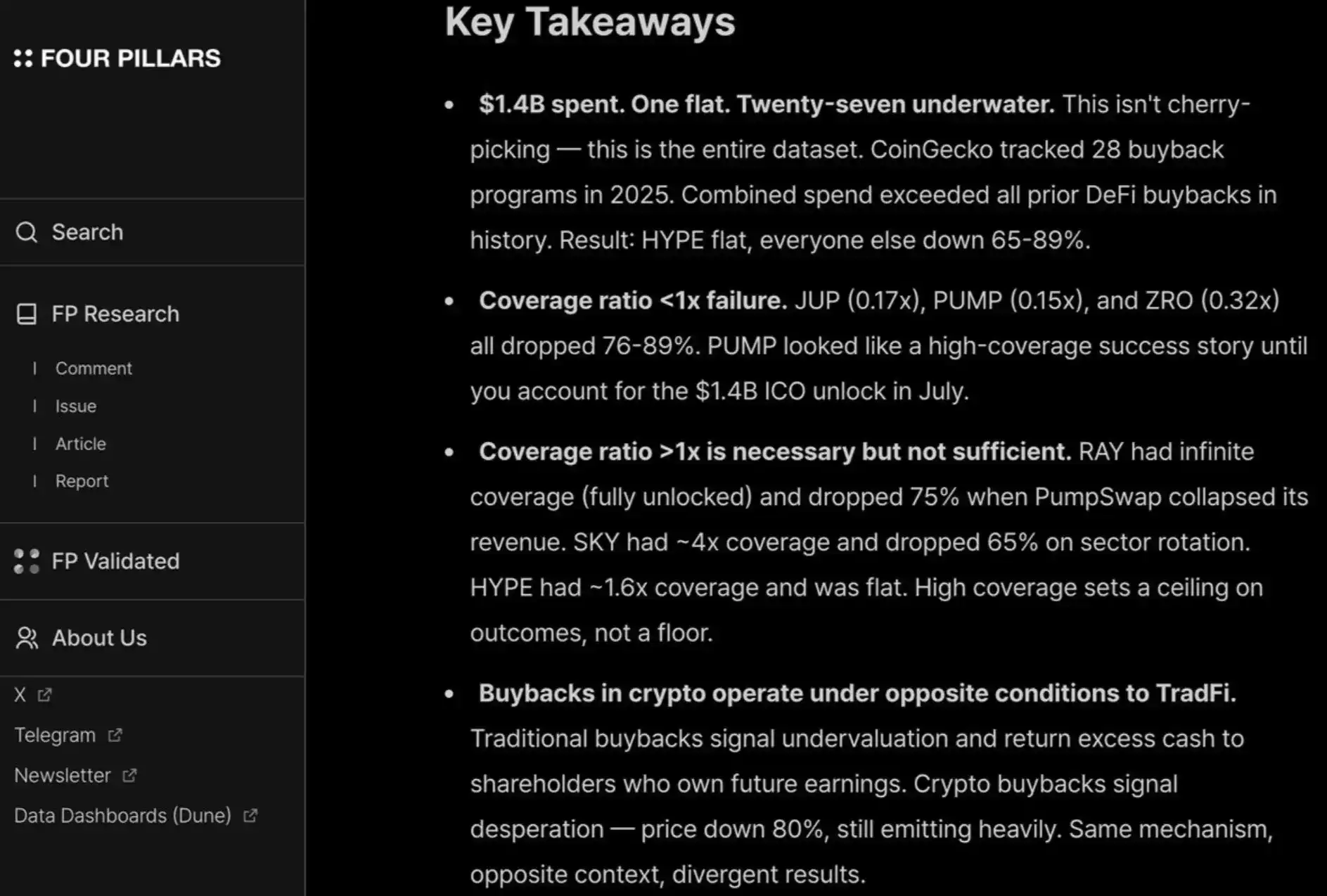
Beyond that, to keep retail and hedge funds happy, you must also conduct buybacks consistently and transparently, like HYPE does. Any failure to do so is punished, as seen with PUMP's P/E ratio (based on fully diluted valuation) being only 6x because the public "doesn't trust" them—despite the fact that they have verifiably burned $1.4 billion in revenue that could have gone to the treasury.

Here is some further reading on "on-chain value accrual mechanisms that work without burning money"

3. Will the "crypto premium" disappear entirely?

This would mean that in the future, all projects will be valued based on multiples similar to public stocks (roughly 2 to 30x revenue). Take a moment to think about what this implies—if true, we would see most L1 public chains fall more than 95% from current prices, with exceptions like TRON, HYPE, and other revenue-generating DeFi projects. And this is even without considering token vesting.
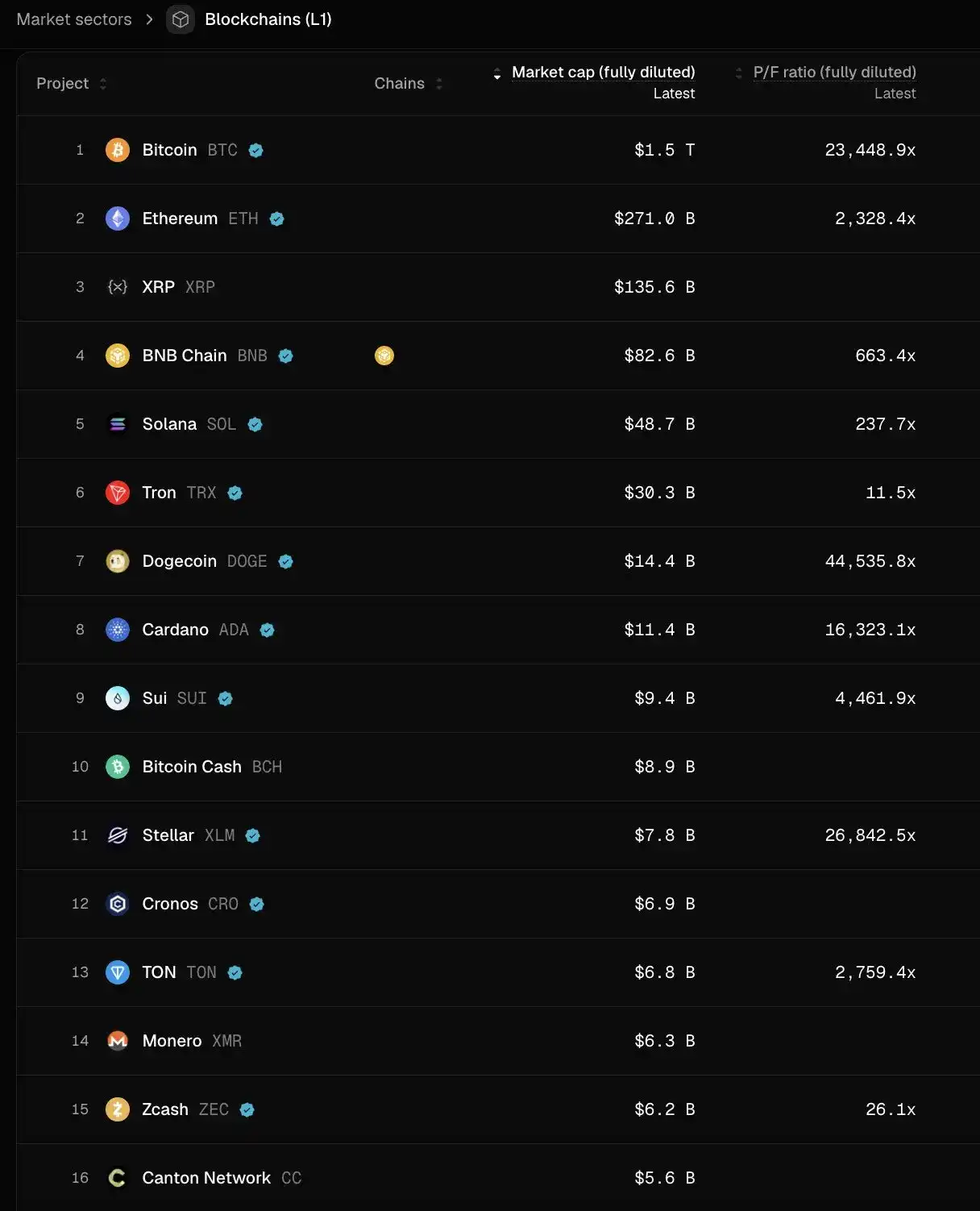
Personally, I don't think it will be like this—HYPE set an extremely exceptional expectation, making many investors impatient for "day one revenue/user traction" from early-stage startups. For sustaining innovations like payments and DeFi companies, yes, this is a reasonable expectation.

But disruptive innovation takes time to build, launch, grow, and then see revenue grow exponentially.

In the past two cycles, we had excessive patience and blind optimism for so-called "disruptive technologies"—new L1s, esoteric concepts like Flashbots/MEV raising up to Series 8-9, and now the pendulum has swung too far the other way, only willing to back DeFi projects.

The pendulum will swing back. While evaluating DeFi projects based on "quantitative" fundamentals is indeed a net positive for the industry maturity, for non-DeFi categories, "qualitative" fundamentals also need to be considered: culture, technological innovation, disruptive concepts, security, decentralization, brand equity, and industry connectivity. And these traits are not simply reflected in TVL and on-chain buybacks.

What to Do Now?

Return expectations for token projects have been significantly compressed, while equity businesses have not seen a comparable decline. This divergence is particularly evident in early-stage versus growth-stage projects.

Early-stage investors have become much more price-sensitive when underwriting projects that might exit via tokens. At the same time, appetite for equity businesses has increased, especially given the favorable M&A environment. This is completely different from the situation in 2022-2024, when token exits were the preferred liquidity path, underpinned by the assumption that the token valuation premium would persist.

Later-stage investors, those with the strongest brand equity and value-add in the crypto-native context, are increasingly moving away from purely "crypto-native" deals. Instead, they are pivoting to support more "Web2.5" companies, whose underwriting is anchored by revenue traction.

This pushes them into unfamiliar territory, competing head-on with firms like Ribbit, Founders Fund—institutions that have deeper backgrounds in traditional fintech, stronger portfolio synergies, and better visibility into early-stage deal flow outside of crypto.

The crypto VC space is entering a period of value validation. The right to survive depends on VCs finding their own PMF (Product-Market Fit) with founders, where the "product" is a combination of capital, brand alignment, and value-add.

For the highest-quality deals, VCs need to sell themselves to founders to win the right to be on the cap table, especially as some of the most successful projects in recent years have needed almost no institutional capital (e.g., Axiom) or none at all (e.g., HYPE). If capital is the only thing a VC provides, it will almost certainly be eliminated.

Those VCs qualified to remain in the game need to be very clear about what they can offer in terms of brand alignment (which is what prompts the best founders to engage in the first place) and value-add (which ultimately determines their right to win the deal).

Пов'язані питання

QWhat are the main forces that have disrupted the crypto market structure according to the article?

AThe crypto market structure is being disrupted by multiple unprecedented forces: 1) The emergence of HYPE, which demonstrated that token prices can be supported by real on-chain revenue, resetting market expectations. 2) A chain reaction that penalizes other token projects without on-chain revenue. 3) The massive supply shock from the memecoin frenzy (e.g., PUMP), which fragments liquidity and attention. 4) The accelerated diversion of retail speculative capital into prediction markets, stock perps, and leveraged ETFs, compressing the token lifecycle.

QHow has the HYPE project changed the market's expectations for tokens?

AHYPE proved that a token's price can be backed by substantial, real on-chain revenue, with over 97% of its nine-to-ten-figure revenue generated on-chain. This has led to a 'de-memeing' of governance tokens that relied on narrative over fundamentals. It reset market expectations, making on-chain revenue a fundamental requirement for entry, and subjecting revenue to much stricter scrutiny.

QWhy does the author argue against the prevalent trend of token buybacks?

AThe author argues that token buybacks are often 'toxic' and put founders with real revenue in a difficult position. The motivation is wrong: stock buybacks occur after a company has invested in growth, whereas crypto buybacks are increasingly demanded by fickle and irrational retail/public perception for immediate action. They are often executed at local price highs due to front-running and can be rendered worthless by a random market maker's liquidation. For a B2B business with sub-$20M in revenue, it's counterproductive to buy back tokens to please retail instead of reinvesting in growth.

QWhat does the article suggest about the future of the 'crypto premium'?

AThe article suggests there is a question of whether the 'crypto premium' will disappear entirely, meaning all projects would be valued based on multiples similar to public stocks (around 2x to 30x revenue). If this happens, it would imply a further drop of over 95% for most L1 blockchains. However, the author personally believes the pendulum will swing back. While quantitative fundamentals are a net positive for DeFi, qualitative fundamentals (culture, tech innovation, disruptive concepts, security, decentralization, brand equity) must also be considered for non-DeFi categories, and these are not reflected in TVL or buybacks alone.

QHow must crypto VCs adapt to survive in the current market environment according to the article?

ATo survive, crypto VCs must find their Product-Market Fit (PMF) with founders, where their 'product' is a combination of capital, brand credibility, and value-add. For the highest-quality deals, VCs must sell themselves to founders to earn a place on the cap table, especially as top projects may no longer need institutional capital (e.g., Axiom, HYPE). If capital is the only thing a VC provides, it will likely be eliminated. Surviving VCs need to be very clear about what brand credibility they offer to attract top founders and what value-add they provide to win deals.

Пов'язані матеріали

Coinbase Vice President: The Wars Over Cryptocurrency Regulation Are Over

Coinbase's new Vice President, Ryan VanGrak, declared that regulatory wars in the cryptocurrency sector are over. Since taking office on July 9, 2026, he has shifted the company's approach from litigation and sanctions to focusing on growth and innovation. The industry can now concentrate on development rather than fighting for its right to exist. He highlighted that the Digital Asset Market Clarity Act (CLARITY Act), which aims to establish a clear federal regulatory framework dividing oversight between the SEC and CFTC, has gained significant momentum. This framework is intended to provide proper supervision, investor protection, and maintain U.S. leadership in digital assets. VanGrak's appointment marks a strategic shift from a "wartime" to a "peacetime" advisor, replacing former Chief Legal Officer Paul Grewal, who oversaw major litigation, including a dismissed 2023 SEC lawsuit. With his background at Citadel Securities and the SEC, VanGrak brings deep regulatory and institutional finance expertise as Coinbase expands beyond a simple exchange into a broader financial services provider, offering stocks, futures, prediction markets, and AI tools. For investors, bipartisan support for crypto legislation like the CLARITY Act represents a major shift from the enforcement-focused environment of 2023-2024. Lawmakers are now focused on *how* to regulate crypto, not *if* it should exist. However, risks remain, as the bill's passage is not yet guaranteed.

cryptonews.ru16 хв тому

Coinbase Vice President: The Wars Over Cryptocurrency Regulation Are Over

cryptonews.ru16 хв тому

Deep Dive into FWA: An Intriguing Experiment Turning NFTs into "On-Chain Gachapon"

A Deep Dive into FWA: The “On-Chain Gacha” Experiment for NFTs Fake World Assets (FWA), created by TokenWorks, introduces an innovative “NFT gacha machine” fully operating on-chain. Users can deposit eligible NFTs paired with ETH (called Backing) to create a Position, acting as a prize pool. Others can then pay a uniform Acquisition Price for a chance to win a random NFT from the pool. The core mechanism features a reverse probability system: Positions with lower Backing have a higher chance of being selected, serving as common prizes, while high-Backing Positions are rare “jackpots.” The acquisition price is calculated based on the harmonic mean of all Backings, keeping entry costs low. When a Position is won, the purchaser must choose: keep the NFT or accept the Standing Bid (85% of the Backing, claimable in ETH or $FWA tokens), returning the NFT to the original depositor. The protocol involves two main roles. Depositors provide liquidity (NFT + ETH), earning a share of fees from each draw, distributed equally per active Position, plus potential $FWA rewards. Purchasers pay to spin the gacha, receiving $FWA rewards for participation. A special “Crown” reward goes to the Position with the highest Backing. The $FWA token has a fixed supply and is initially obtainable only through protocol participation (depositing or purchasing), with external buying disabled early on to reduce sell pressure. Its value is supported by a built-in buy pressure: when purchasers opt for the $FWA settlement on a Standing Bid, the protocol uses the backing ETH to buy $FWA from the market. Revenue for the protocol comes from a 1% fee on each draw, a 1% settlement fee when an NFT is kept, and the 15% discount from Standing Bid settlements (currently allocated to the protocol). The design cleverly blends Uniswap-style liquidity provision, gacha mechanics, and tokenomics to create a novel, self-regulating marketplace for NFT liquidity and engagement.

marsbit30 хв тому

Deep Dive into FWA: An Intriguing Experiment Turning NFTs into "On-Chain Gachapon"

marsbit30 хв тому

10,000 Scientists Get 1 Year of Free Access: OpenAI Brings the Scientific Research Pipeline into ChatGPT

OpenAI has launched the "ChatGPT for Academic Researchers" program, offering free one-year access to its flagship models for 100,000 university researchers globally, with 10,000 spots available this summer. Selected institutions include prestigious centers like ENS Paris and the IAS at Princeton. The initiative provides an integrated research workspace within ChatGPT, bundling tools like ChatGPT, ChatGPT Work, and Codex, along with expanded Deep Research capabilities, higher usage limits, and specialized tools for life sciences. The suite connects to platforms like Zotero and GitHub, aiming to streamline the entire research workflow from literature review and coding to data analysis and manuscript drafting. OpenAI notes that about 1.3 million people already use ChatGPT weekly for advanced science and math. The program targets building long-term user dependency by embedding these tools into daily research habits. However, access comes with limitations: it does not include API credits or model weights, and eligibility is restricted to verified academic researchers from supported countries. This approach contrasts with Anthropic's "AI for Science" program, which offers API credits but not an integrated workspace. Both companies emphasize preventing misuse by withholding model weights, a point of contention for AI researchers seeking transparency. The core strategy remains clear: provide a powerful, integrated environment to foster user reliance ahead of the post-free period.

marsbit35 хв тому

10,000 Scientists Get 1 Year of Free Access: OpenAI Brings the Scientific Research Pipeline into ChatGPT

marsbit35 хв тому

What's Going On with Gigadevice? Major Shareholder Cashes Out 44 Billion, Then Announces 20 Billion Buyback

Gigadevice Innovation, a leading Chinese memory chip company, has executed a controversial financial maneuver. The company's controlling shareholder and chairman, Zhu Yiming, sold approximately 44 billion RMB worth of his shares between early May and mid-June 2026, capitalizing on a soaring stock price that peaked at 846.66 RMB on June 29th. Following a subsequent stock crash—plummeting to around 350 RMB in 22 trading days and erasing over 330 billion RMB in market value—Zhu announced a combined "market rescue" plan on July 29th. This plan includes his personal commitment to buy back at least 1 billion RMB in shares and a company proposal to repurchase 1 to 2 billion RMB worth of stock. This sequence of high-selling followed by a low-buying plan has confused and unsettled many of the company's 240,000 retail investors. The stock's dramatic decline was attributed to several factors: the successful IPO of its sister company, Changxin Technologies, which ended Gigadevice's status as a primary investment proxy for the domestic memory sector; a Morgan Stanley report warning of a potential peak in the memory chip cycle; and a severe loss of market confidence triggered by the chairman's massive sell-off. While the sell-off was procedurally compliant, its timing has been criticized. The company's fundamentals appear strong, with preliminary H1 2026 results showing revenue up 177% year-on-year to 11.5 billion RMB and net profit skyrocketing 1099% to 6.9 billion RMB, driven by a boom in memory chips and MCU demand. However, a significant portion (2.05 billion RMB) of this profit came from non-recurring gains like securities investment, and the memory industry is notoriously cyclical. Analysts highlight the company's role in the domestic substitution of niche DRAM and NOR Flash memory, with some maintaining bullish price targets. Yet, the recent events underscore key risks: its fabless model creates dependency on foundries like Changxin, and the chairman's actions have raised serious questions about management's alignment with minority shareholders. The promised buybacks cannot commence until December 13th due to a mandatory six-month cooling-off period following an insider sale, leaving the stock vulnerable in the interim.

marsbit35 хв тому

What's Going On with Gigadevice? Major Shareholder Cashes Out 44 Billion, Then Announces 20 Billion Buyback

marsbit35 хв тому

Торгівля

Спот
活动图片