How prediction markets raise insider trading and credit risks

cointelegraphОпубліковано о 2025-12-09Востаннє оновлено о 2025-12-09

Анотація

Prediction markets like Kalshi and Polymarket are experiencing significant growth, with billions in trading volume, but face scrutiny over ethical and financial risks. Concerns include insider trading, as seen in a manipulated map edit during the Russo-Ukrainian War that influenced a Polymarket bet resolution, and wash trading, which comprised up to 60% of volume on Polymarket. Regulators, including the CFTC, have granted some approvals, but states are challenging these platforms over gambling classifications. Analysts warn that easy access and gamified interfaces could lead to credit overextension and loan defaults, introducing new risks for lenders and consumers.

Prediction markets like Kalshi and Polymarket are growing, generating billions of dollars in volume. But some observers are concerned about the ethical problems and potential credit risks posed by major prediction betting platforms.

Last week, Polymarket saw a notional volume of over $1.2 billion, according to Dune Analytics. Media giant CNBC has entered into a partnership with prediction market Kalshi to integrate prediction data in its TV, digital and subscription platforms.

On the back of this success, Kalshi co-founder Tarek Mansour has mentioned creating “a tradable asset out of any difference in opinion,” stating that prediction markets could soon surpass the stock market in size.

Regulators in some jurisdictions are taking efforts to curb their activities. Concerns over wash and insider trading have surfaced in recent weeks, and some analysts believe it’s making credit risks worse.
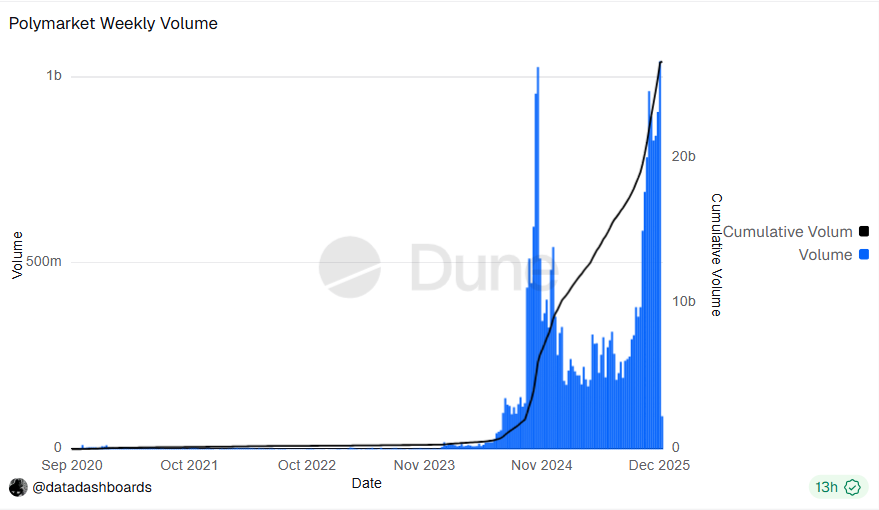
Weekly volumes on Polymarket are frequently over $1 billion. Source: Dune

Russo-Ukrainian War map altered, prediction market bet resolved

Prediction markets have opened up a range of possibilities for setting wagers on events. These can range from a specific element of a sports match to the outcome of a war. In some instances, this has led to insider manipulation to resolve a market in a certain way.

This is what may have happened in November, when the Institute for the Study of War (ISW) announced an unauthorized edit to its map of the Russo-Ukrainian War. The map is used by media organizations worldwide to track changes to frontline positions.

The edit concerned the ISW’s map of Myrnohrad, where Ukrainian troops have been defending the city against the Russian Pokrovsk offensive since July 2024. The unauthorized change to the map of the city coincided with the resolution of a bet on Polymarket, “Will Russia capture Myrnohrad by...” and then a series of dates.

The market resolution was triggered if Russia held an intersection between two streets, Vatutina Vulytsya and Puhachova Vulytsya. According to 404 Media, on Nov. 15, someone edited the map to show Russian troops had taken the intersection. Just minutes after the market resolved, the edit disappeared.
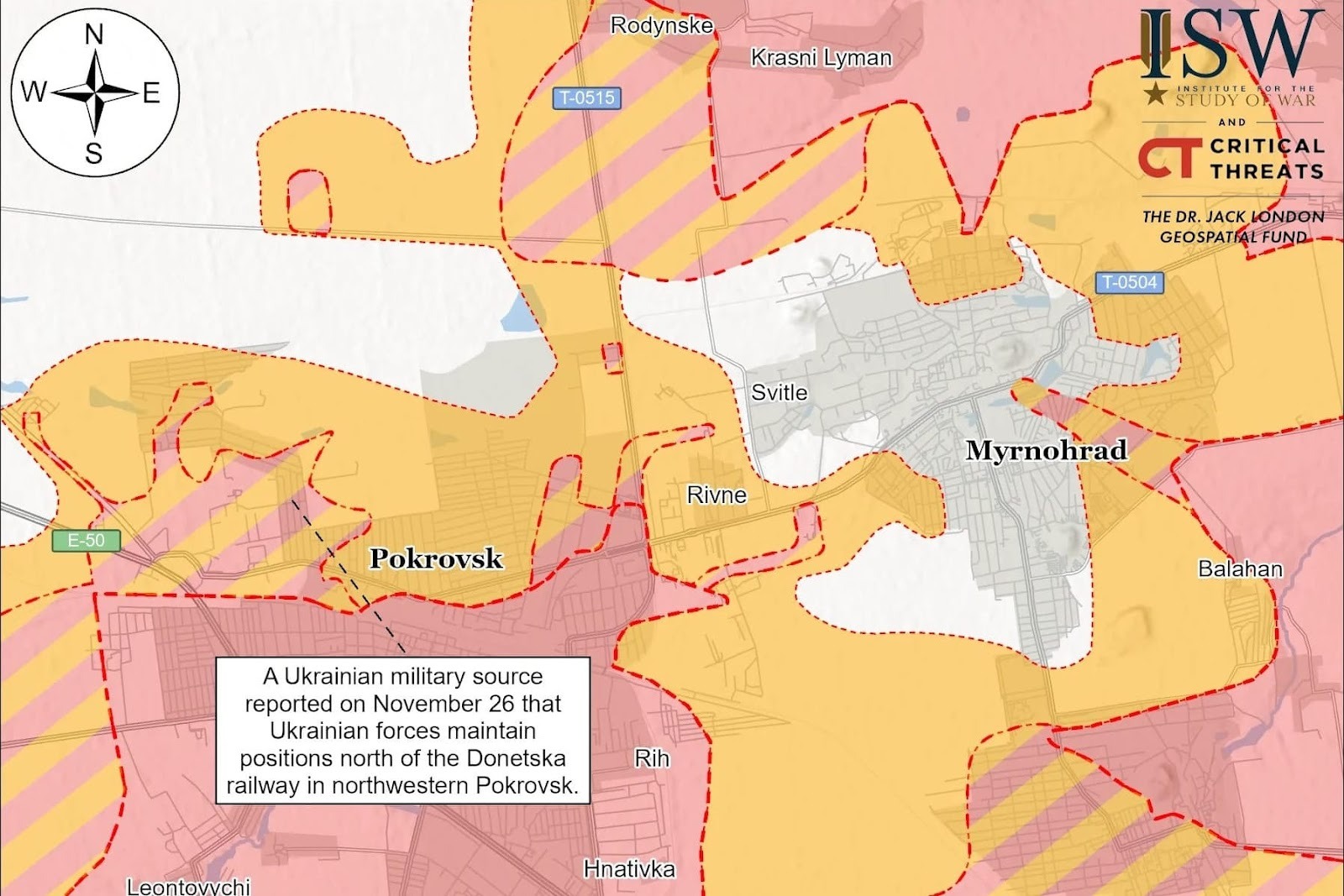

The updated Nov. 17 ISW map did not show that Russian forces controlled the intersection. Source: ISW, 404

The ISW announced the unapproved edit on Nov. 17. It noted that, “The map does not represent battlefield changes in real-time, and all adjustments made during our workday are subject to review and change over the course of the day.”

In this instance, not only was insider knowledge allegedly used to manipulate data, but that manipulation could have affected the public perception of an ongoing violent conflict.

Other examples have also surfaced. Pseudonymous trader AlphaRaccoo netted over $1 million in bets relating to Google search result rankings. He also reportedly made $150,000 by predicting the exact day Google would launch a new version of its Gemini AI model.

Jeong Haeju, a senior software engineer at Meta, said, “He’s a Google insider milking Polymarket for quick money. It’s one of the wildest things I’ve seen on the platform.”
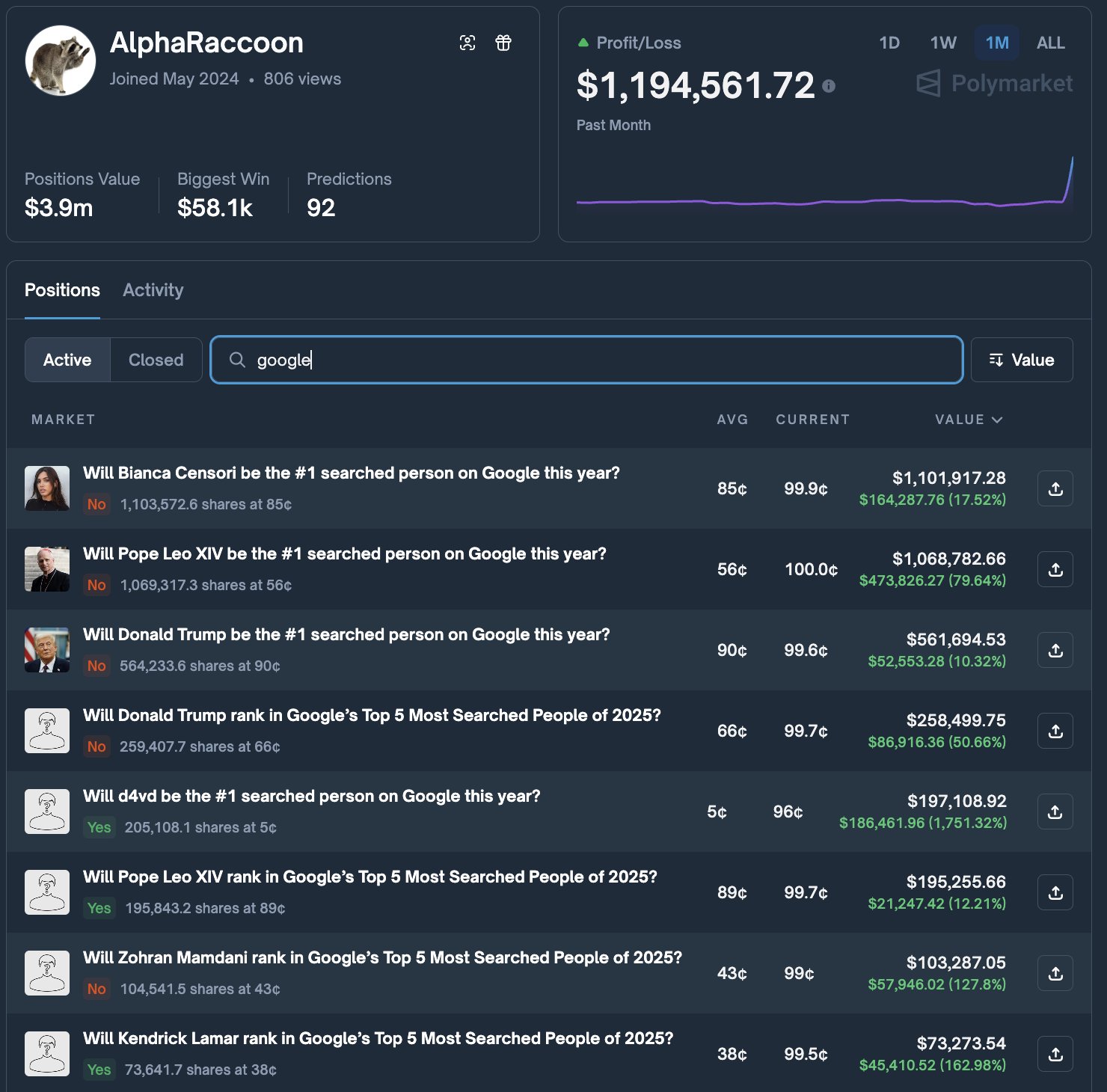
AlphaRaccoon’s betting history. Source: Jeong Haeju

Allegations of manipulation aren’t limited to insider trading. A November report from researchers at the Columbia Business School found that wash trading — i.e., “buying and selling securities without taking a net position, for the purpose of artificially inflating recorded volume” — accounted for 60% of volume on Polymarket in December 2024.

Related: Polymarket rife with ‘artificial trading,’ Columbia University researchers find

This fell substantially but rose to nearly 20% of total volume by October 2025 and has comprised an average of 25% of all trading on Polymarket.

Wash trading “doesn’t add liquidity or information to the market,” said Yash Kanoria, a professor at Columbia University’s business school. This is especially important, given claims that prediction markets provide more accurate and dynamic analyses of a situation.

Jason Wingard, a distinguished visiting professor at Harvard University and executive chairman of the Education Board, wrote that prediction markets create a “‘truth signal’ that moves faster than polls, pundits, or official reports. When thousands of people are willing to lose money on what they think will happen, the result is a dynamic forecast of political outcomes, corporate decisions, economic trends, and cultural shifts.”

Regulation battles as prediction markets ponder new assets

Prediction platforms have won important regulatory approvals this year. In November, Polymarket secured regulatory approval from the US Commodity Futures Trading Commission (CFTC) to operate an intermediated trading platform.

Polymarket founder and CEO Shayne Coplan said, “This approval allows us to operate in a way that reflects the maturity and transparency that the US regulatory framework demands.”

Kalshi is also regulated by the CFTC, meaning that, on paper, it should be allowed to operate in all 50 states.

However, state regulators have taken issue with these platforms. Kalshi is currently facing legal battles with gaming regulators in Nevada, New Jersey, New York, Massachusetts, Maryland and Ohio over whether its platform constitutes a gambling enterprise.

Others see the potential for risks to the financial and credit systems. Bank of America analysts wrote, “Easy access and gamified interfaces encourage frequent and impulsive wagers, which can lead to overextension of credit and rising loan defaults.”

“For investors this convergence of entertainment and speculative finance signals heightened behavioral risk that could pressure credit quality, increase delinquencies, and impact earnings for issuers and subprime lenders.”

They said these risks could pressure credit quality and that online betting markets “introduce a new risk for lenders, one that they have not had to deal with historically and underwriting models may need to be adapted.”

The Connecticut Department of Consumer Protection has served cease-and-desist orders to Robinhood, Kalshi and Crypto.com. It stated that, in addition to lacking proper gambling licenses, the platforms pose “a serious risk to consumers who may not realize that wagers placed on these illegal platforms offer no protections for their money or information.”

Mansour’s plan to turn “any difference in opinion” into a tradable asset may sound novel, but betting platforms will first have to face regulatory scrutiny and a host of ethical issues.

Magazine: 6 reasons Jack Dorsey is definitely Satoshi... and 5 reasons he’s not


Пов'язані матеріали

The AI Agent Era Accelerates Its Arrival: Questflow Defines a New Paradigm of Financial Intelligence with On-Chain AI Brokerage

The AI Agent era is accelerating, with the CB Insights AI 100 list highlighting global investment confidence. The focus has shifted from whether AI works to its speed of deployment and ability to manage complex workflows, with autonomous AI Agents driving this transformation. At the forefront is Questflow, a Singapore-based startup redefining financial intelligence through its on-chain AI brokerage. Unlike tools that merely provide data dashboards, Questflow deploys AI Agents that proactively scan markets, form judgments, and execute trades via a conversational interface—operating 24/7 without requiring manual confirmation for each decision. This embodies the new AI paradigm of agents capable of executing multi-step workflows autonomously. Questflow's mission is to democratize institutional-grade trading intelligence. Historically reserved for the ultra-wealthy, this capability is now accessible starting from just $1 through Questflow's "AI Clone + Copy Trade" model. The platform charges only a 1% execution fee, aligning its incentives directly with users and eliminating traditional management or performance fees. The timing is opportune, aligning with key trends identified by CB Insights: the scalable deployment of AI Agents, accelerated AI adoption in financial services, and the maturation of on-chain infrastructure. With robust liquidity on platforms like Hyperliquid and Polymarket, alongside advancements in AI reasoning and non-custodial wallet security, Questflow is positioned to merge the roles of broker, fund, and exchange into a single, accessible platform for millions.

链捕手2 хв тому

The AI Agent Era Accelerates Its Arrival: Questflow Defines a New Paradigm of Financial Intelligence with On-Chain AI Brokerage

链捕手2 хв тому

Why Pricing Social Interactions is Doomed to Fail?

Titled "Why Putting a Price on Social Interaction Is Doomed to Fail," this article critiques attempts to monetize social networks directly through SocialFi models, arguing their inevitable failure stems from a fundamental misunderstanding of media dynamics. Using Marshall McLuhan's theory of "hot" and "cold" media, the author posits that social networks are inherently "cold" media. Their value isn't contained in individual posts but is co-created through user participation, interpretation, and fragmented, ongoing interaction (e.g., replies, shares). This ambiguity and need for user involvement are core to their function. The article asserts that SocialFi projects like Friend.tech failed because introducing real-time, tradable financial pricing (a definitive "hot" signal) into this "cold" environment doesn't add a layer—it replaces the medium's essence. The unambiguous price signal overshadows and nullifies the nuanced, participatory social signal. Users become traders, not participants, and when speculative profits vanish, the underlying social ecosystem—never genuinely cultivated—collapses entirely. This principle extends beyond crypto. The author argues platforms like Twitter have gradually "heated up" through metrics (likes, retweets counts, algorithmically defined value), shifting users from participants to performers and eroding organic engagement. The solution isn't to abandon capital but to manage its entry point. Successful models like Substack, Patreon, or Bandcamp allow capital to "condense" at specific, isolated nodes (e.g., subscriptions, one-time payments) without permeating and "heating" every social interaction. They preserve the core "cold," participatory medium while enabling monetization at designated boundaries. The NFT boom and bust serves as a stark parallel: the ancient "cold" medium of collecting (valued for story, community, gradual accumulation) was rapidly destroyed by platforms that introduced real-time floor prices, rarity scores, and trading dashboards, transforming collectors into speculators and vaporizing cultural value when prices fell. The core lesson: "Liquidity equals heat." Injecting high liquidity and definitive pricing into a "cold" participatory medium doesn't optimize it; it fundamentally alters and destroys its value-creating mechanism. The future lies not in pricing every social gesture but in finding precise, non-invasive points for capital to condense without overheating the entire ecosystem.

marsbit10 хв тому

Why Pricing Social Interactions is Doomed to Fail?

marsbit10 хв тому

Jensen Huang's CMU Speech: In the AI Era, Don't Just Watch, Build

Jensen Huang, CEO of NVIDIA and a first-generation immigrant, delivered the commencement address to Carnegie Mellon University's class of 2026. He shared his personal journey from a humble background to founding NVIDIA, emphasizing resilience, learning from failure, and the responsibility that comes with leadership. Huang framed the present moment as the dawn of the AI revolution, a shift he believes is more profound than previous computing waves. He described AI as fundamentally resetting computing—moving from human-written software to machines that understand, reason, and use tools. This will create a new industry for generating intelligence and transform every sector. While acknowledging AI's potential to automate tasks and displace some jobs, Huang distinguished between the *tasks* of a job and its core *purpose*. He argued AI will augment human capability, not replace humans. The real risk, he stated, is not AI itself, but people being left behind by those who effectively use AI. He presented AI as a generational opportunity for massive infrastructure investment—in chip factories, data centers, energy grids, and advanced manufacturing—that could re-industrialize nations like the U.S. and bridge the digital divide by making computing and intelligent tools accessible to all. Huang called for a balanced approach: advancing AI safely and responsibly, establishing prudent policies, ensuring broad access, and encouraging universal participation. He urged the graduates not to fear the future but to engage with optimism and ambition, reminding them of CMU's motto, "My heart is in the work." His core message was clear: this is their moment to actively build and shape the AI-powered future, not merely observe it.

marsbit1 год тому

Jensen Huang's CMU Speech: In the AI Era, Don't Just Watch, Build

marsbit1 год тому

Торгівля

Спот
Ф'ючерси
活动图片