How Japan’s 2.30% bond yield could spark a global crypto opportunity

ambcryptoОпубліковано о 2026-03-24Востаннє оновлено о 2026-03-24

Анотація

Japan's 10-year government bond yield rising to 2.30% could create a long-term bullish opportunity for crypto, according to analysis. As a major energy importer, Japan faces inflation from rising oil prices, pressuring its bond market. With USD/JPY nearing 160, Japanese authorities may intervene by selling U.S. Treasuries to support the yen. As the largest foreign holder of U.S. debt, such a move could weaken the dollar. Historically, a weaker dollar drives liquidity into crypto. Although recent FOMC decisions strengthened the dollar and caused a short-term crypto drop, this is viewed as a temporary shock. Broader macro pressures, including recession risks, may ultimately reduce dollar strength and benefit crypto markets over time.

No country has been spared from the economic stress triggered by ongoing geopolitical crises.

According to The Kobeissi Letter, Asian markets are now entering a structurally driven energy shock. For crypto investors, the implications extend beyond short-term volatility. Instead, what matters is how these macro shifts play out “over time,” determining whether the current dip evolves into a broader opportunity.

Notably, Japan serves as a key case study. With roughly 90% of its energy imported, rising oil prices are directly feeding into inflation. Consequently, this pressure is now showing up in bond markets, with Japan’s 10-year government bond yield climbing to 2.30%, nearing levels last seen in 1999.
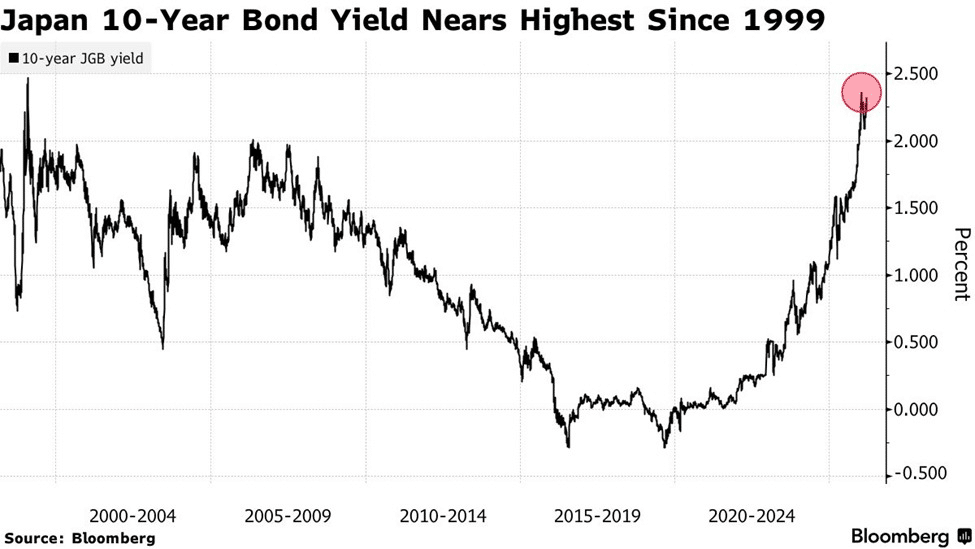
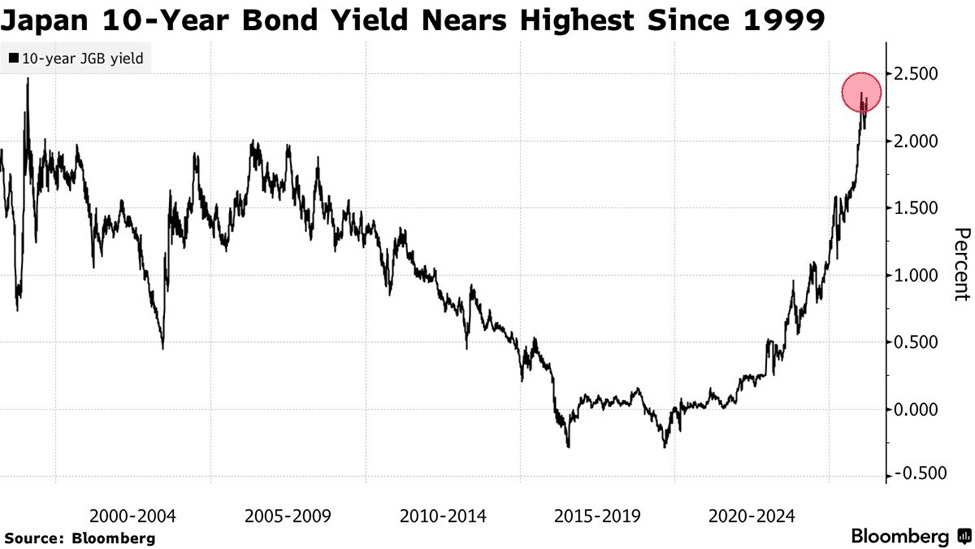
Source: Bloomberg

So naturally, the question becomes, how do crypto investors position themselves around this?

From a technical lens, USD/JPY is approaching the 160 level, reflecting sustained yen weakness against the U.S. dollar. Historically, this level has acted as a trigger point for intervention. The mechanism is critical: to support the yen, Japanese authorities intervene by selling U.S. Treasuries to buy their domestic currency.

Why does this matter? Japan is the largest foreign holder of U.S. Treasuries, with roughly $1.1 trillion in holdings. If Japan starts selling, it signals money moving out of U.S. assets and back into yen. That shift reduces demand for the dollar, putting downward pressure on it.

Historically, a weaker dollar has supported liquidity and driven capital into crypto. So the question is, with the crypto market still capped amid ongoing geopolitical uncertainty, could this weakening dollar setup be creating a longer-term bullish opportunity?

Recession fears push investors to rethink crypto exposure

The focus isn’t on oil. Instead, it’s on the U.S. bond market, where the real action is unfolding.

For context, the latest FOMC meeting kept interest rates steady, signaling that rate cuts are unlikely anytime soon. That move pushed the U.S. Dollar Index (DXY) above 100 and sent the 10-year Treasury yield up nearly 4%, back to levels last seen in July 2025.

Crypto markets reacted immediately, dropping 5.5% for the week, underscoring the familiar inverse relationship with the dollar. Yet, smart money appears unconcerned about a sustained trend, treating this as a short-term shock rather than a structural shift.
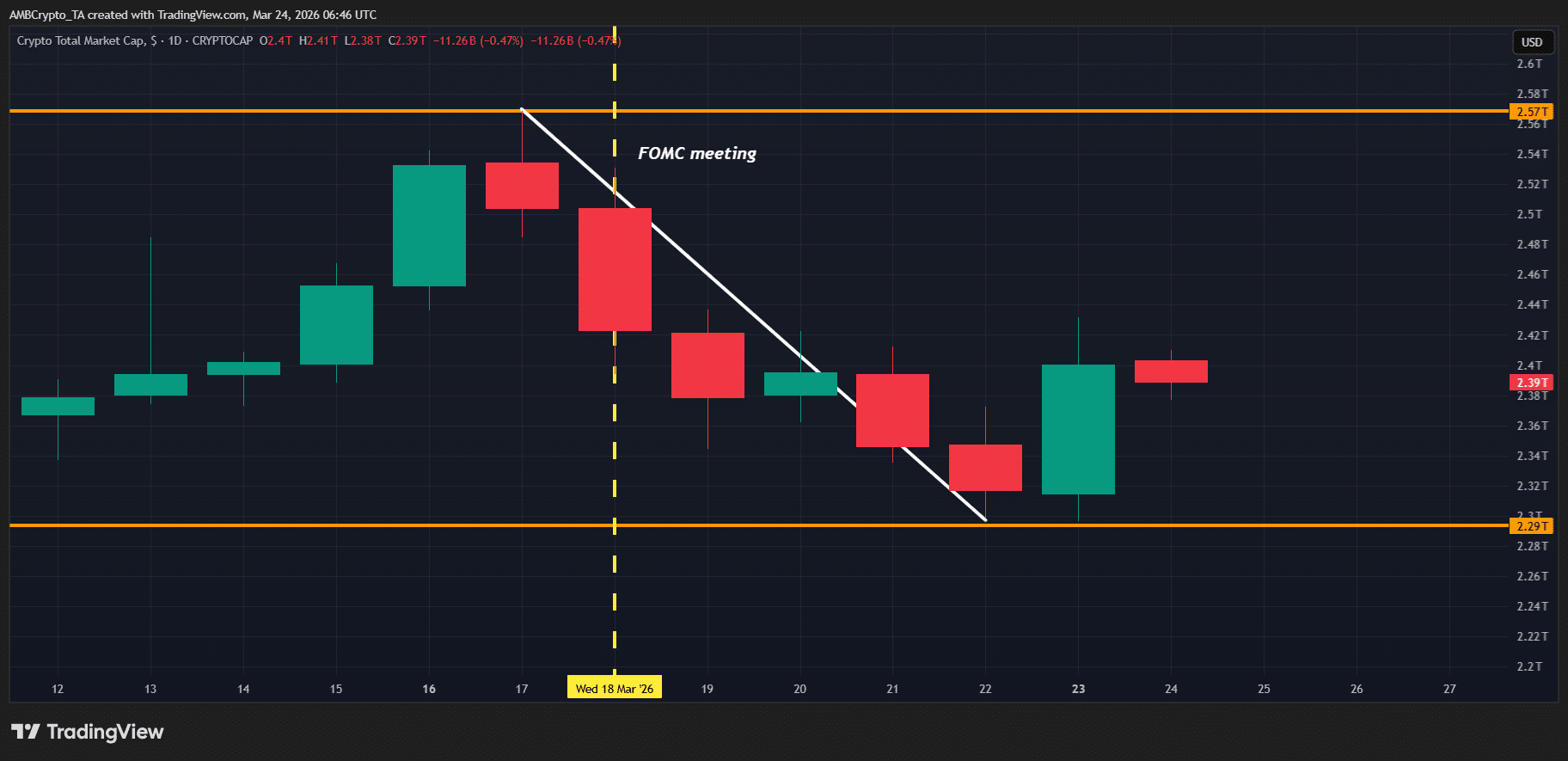
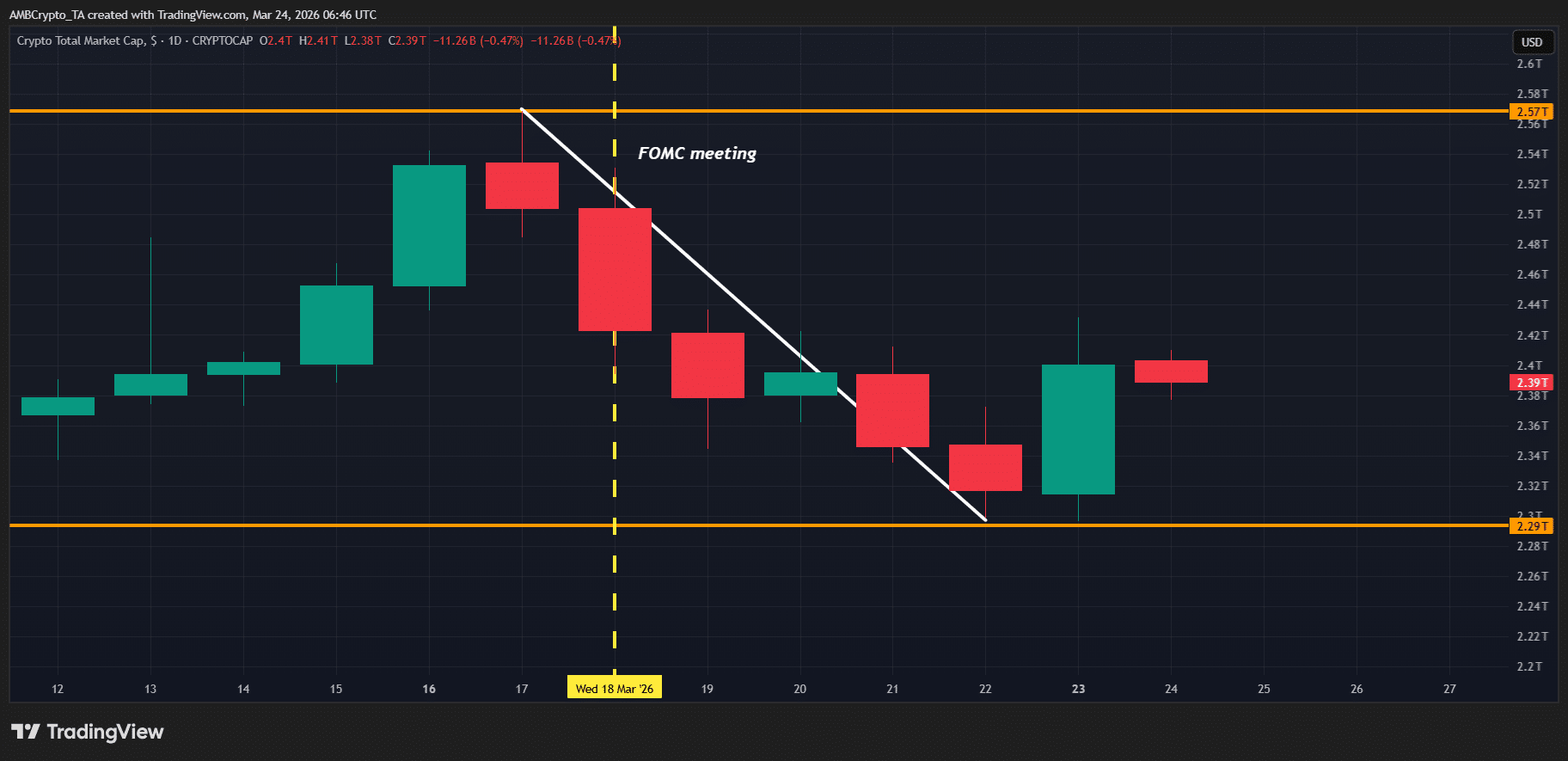
Source: TradingView (TOTAL/USD)

Goldman Sachs, for instance, has raised the U.S. recession probability to 30%, a 5 percentage point increase from prior estimates. The drivers include rising oil prices, tighter financial conditions, and ongoing Middle East tensions.

The implications are clear: slower GDP growth (1.25%-1.75% in H2) and rising unemployment (4.6%) put pressure on the economy, while the door remains open for rate cuts later this year. Notably, Japan is already showing similar stress, reflecting how these pressures are playing out across Asian markets.

Taken together, these shifts could reroute global capital flows, weigh on the U.S. dollar over time, and create potential opportunities for crypto. This suggests that much of the current volatility in risk assets is likely a short-term reaction rather than a long-term trend.


Final Summary

  • Rising yields, yen interventions, and weaker U.S. dollar conditions could create long-term opportunities for crypto.
  • The recent FOMC triggered a crypto drawdown, but smart money views it as a temporary shock rather than a lasting trend.


Пов'язані питання

QHow could Japan's rising 10-year government bond yield (2.30%) potentially create a global crypto opportunity?

AJapan's rising bond yield reflects inflationary pressures from high energy imports. To support the weakening yen, Japanese authorities may sell U.S. Treasuries (as the largest foreign holder), reducing dollar demand. Historically, a weaker dollar drives liquidity into crypto, creating a potential long-term bullish opportunity.

QWhat is the significance of USD/JPY approaching the 160 level mentioned in the article?

AThe 160 level for USD/JPY historically acts as a trigger point for intervention by Japanese authorities. To support the yen, they would sell U.S. Treasuries and buy yen, which could weaken the U.S. dollar and potentially drive capital into crypto assets.

QHow did the recent FOMC meeting impact crypto markets according to the article?

AThe FOMC kept rates steady, signaling no imminent cuts, which pushed the U.S. Dollar Index (DXY) above 100 and raised the 10-year Treasury yield. Crypto markets dropped 5.5% for the week, showing an inverse relationship with the dollar, but smart money views this as a short-term shock rather than a structural shift.

QWhy does Goldman Sachs' increased U.S. recession probability (to 30%) matter for crypto investors?

AGoldman Sachs raised the recession probability due to rising oil prices, tighter financial conditions, and Middle East tensions. This suggests potential slower GDP growth and rising unemployment, which could lead to future rate cuts, a weaker dollar, and rerouted global capital flows that may benefit crypto as an alternative asset.

QWhat key factors does the article suggest could drive long-term crypto opportunities despite short-term volatility?

AThe article highlights rising bond yields (especially in Japan), potential yen intervention leading to U.S. Treasury sales, a subsequently weaker U.S. dollar, and macroeconomic shifts like recession fears and possible future rate cuts as factors that could create long-term crypto opportunities, with current volatility seen as temporary.

Пов'язані матеріали

Will the Next Crypto Bull Run Start with On-Chain Trading of SpaceX?

This article presents a scenario-based forecast for the crypto industry from 2026 to 2029, arguing that the next major cycle will be driven not by technological narratives but by legal access to real-world assets. The author predicts that by mid-2026, pre-IPO perpetual contracts for top private companies like SpaceX, OpenAI, and Anthropic on platforms like Hyperliquid will become the primary gateway for accessing quality assets, as most crypto-native tokens fail to capture real value. The much-hyped AI x Crypto intersection largely fails except for prediction markets, which thrive on betting on AI model supremacy. By 2027, public blockchain foundations are forced to choose between catering to retail speculation or building compliant infrastructure for institutions, with many opting for the latter. Growth in stablecoins and tokenized private credit/equity hits a "triple ceiling" due to regulatory and political uncertainty rather than market demand. The pivotal shift is forecast for 2028. A major liquidation event in pre-IPO perpetuals exposes the structural flaw of synthetic markets lacking a real underlying asset anchor. In response, regulatory changes finally allow the public solicitation of private securities resales to verified accredited investors. This creates a legitimate secondary market for real company equity, which then becomes the core asset class of the new bull market, relegating synthetic perps to a niche role. By 2029, the industry becomes "boring" but foundational. Tokens without claims on real cash flows or assets cease trading. Stablecoin growth is steady but politically capped. Crypto infrastructure fades from view as it gets absorbed into traditional finance backends. The article's central thesis is that the key bottleneck for crypto's next phase is legal and regulatory channels for real asset ownership, not technology.

marsbit1 год тому

Will the Next Crypto Bull Run Start with On-Chain Trading of SpaceX?

marsbit1 год тому

The Value Distribution of Stablecoins

**Summary: The Value Distribution of Stablecoins** The article argues that stablecoins are evolving from mere trading tools into broader channels for dollar access. It divides the stablecoin ecosystem into four layers to analyze how value is distributed: 1. **Issuance Layer:** Mints stablecoins, holds reserve assets, and captures the spread between reserve yield and user costs (e.g., Tether, Circle). This layer currently earns the largest profit margin. 2. **Infrastructure Layer:** Connects stablecoins to the traditional financial system, handling fiat on/off-ramps, banking integration, compliance (KYC/AML), and asset management (e.g., Bridge, BVNK). This is the "unglamorous" but critical work, building the essential bridges between crypto and real-world finance. 3. **Acquiring/Distribution Layer:** Integrates stablecoins into merchant systems, manages payment flows, and provides enterprise financial software (e.g., Stripe, Coinbase). They act as the access point for businesses. 4. **Application Layer:** The end-users and businesses that ultimately use stablecoins for payments, settlements, or as a store of value. They benefit from convenience but have little pricing power. The core thesis is that while the issuance layer currently dominates profits, the often-overlooked **infrastructure layer holds significant long-term potential**. The real challenge and barrier to mass adoption is not the on-chain transfer of stablecoins (which is simple), but the complex "last mile" integration into existing business workflows, banking systems, and regulatory frameworks across different countries. Companies in this layer are currently in a "land grab" phase, investing heavily to build networks, secure bank partnerships, and establish compliance pathways. While their position is currently pressured by the profitable issuers above and distribution platforms below, the article suggests that if stablecoins become a default financial rail for businesses, the infrastructure providers who have done the hard work of integration will ultimately gain strong pricing power and become entrenched, essential players.

marsbit7 год тому

The Value Distribution of Stablecoins

marsbit7 год тому

The Value Distribution of Stablecoins

The Value Distribution of Stablecoins The article argues that stablecoins are evolving from a mere trading tool into a broad "dollar channel." It analyzes the industry's value chain through four layers: 1. **Issuance Layer (e.g., Tether, Circle):** The top layer that mints stablecoins, holds reserve assets, and captures the thickest interest rate spread. 2. **Infrastructure Layer (e.g., Bridge, BVNK):** Connects stablecoins to the traditional financial system, handling critical but complex "dirty work" like fiat on/off-ramps, banking integration, compliance (KYC/AML), and cross-border settlement. 3. **Acquiring/Distribution Layer (e.g., Stripe, Coinbase):** Embeds stablecoins into merchant systems, manages payment flows, and integrates with enterprise software. 4. **Application Layer:** End-users and businesses that ultimately use stablecoins for payments, settlement, or storing value. The author posits that while the issuance layer currently captures the most profit, the most overlooked and potentially critical layer is infrastructure. The core challenge for stablecoin adoption isn't the on-chain transfer (which is simple), but bridging the gap between blockchain and the real-world financial system. This involves solving practical problems for businesses: fiat conversion, reconciliation, tax handling, and user onboarding. Infrastructure companies are currently in a difficult "land-grab" phase—building networks, securing banking relationships, and achieving compliance country-by-country. They face pressure from both the profitable issuance layer above and distribution platforms below. However, the author suggests this layer is building a crucial moat. Once stablecoins become a default business rail, the infrastructure players who have done the hard work of integration may gain significant, durable value and pricing power.

链捕手7 год тому

The Value Distribution of Stablecoins

链捕手7 год тому

Торгівля

Спот
Ф'ючерси
活动图片




