How Far is the Current U.S. Stock Bull Market from Historical Bubble Peaks?

marsbitОпубліковано о 2026-06-09Востаннє оновлено о 2026-06-09

Анотація

Title: How Far Is the Current U.S. Stock Bull Market from Historical Bubble Peaks? Summary: According to Goldman Sachs' chief U.S. equity strategist, current market exuberance ranks at the 86th historical percentile. While approaching, this level remains notably below the extremes seen at the peaks of the 2000 dot-com bubble (100th percentile) and the 2021 bull market (95th percentile). The recent 15% surge in the S&P 500 over two months represents one of the strongest volatility-adjusted rallies in over 50 years, primarily fueled by AI-related enthusiasm and backed by significant upward revisions to earnings estimates, providing a more fundamental basis than past momentum-driven peaks. Key risk signals—speculative frenzy, deteriorating growth, heavy equity issuance, and Federal Reserve tightening—are all closer to their historical triggers than a few months ago but are not yet fully activated. For instance, IPO activity is recovering, and market breadth remains narrow, though not at dot-com bubble extremes. The strategist cautions that while the current cycle may not replicate past peaks exactly and a downturn does not require extreme euphoria, risks are accumulating. The overall assessment is that the bull market still has room to run, but the window of opportunity is gradually narrowing.

Original Author: Zhao Ying

Original Source: Wall Street News

The latest assessment from Goldman Sachs' chief U.S. stock strategist shows that the current market euphoria has climbed to the 86th historical percentile, approaching but not yet reaching the extreme levels seen at the peaks of the 2000 dot-com bubble and the 2021 bull market.

Over the past two months, the S&P 500 index surged 15% before Friday's pullback, a gain ranking in the 99th percentile of historical data since 1980. In his latest report, Goldman Sachs' chief U.S. stock strategist Ben Snider pointed out that, although the four historical signals of a bull market peak — speculative frenzy, deteriorating growth, massive equity issuance, and Fed tightening — are not fully in place yet, each is closer to its trigger threshold than it was a few months ago.

For the market, this judgment means there is still room for the current bull market, but risks are accumulating. Snider explicitly stated "we're not there yet," while also warning that markets don't need investors to be extremely euphoric to decline, and historical patterns may not repeat themselves in this cycle.

The Strength of the Rally: The Strongest Volatility-Adjusted Rebound in 50 Years

The speed of this rebound has already left its mark in history. According to Goldman Sachs data, the S&P 500's roughly 15% gain over about two months, relative to realized volatility, yields a return/volatility ratio near 4, the highest level in over 50 years.
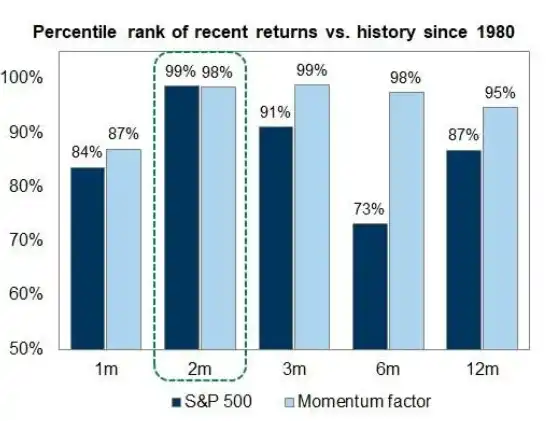
Artificial intelligence is the core theme driving this market phase. AI concept stocks, the momentum factor, and major indices are rising in sync, forming a high level of resonance.
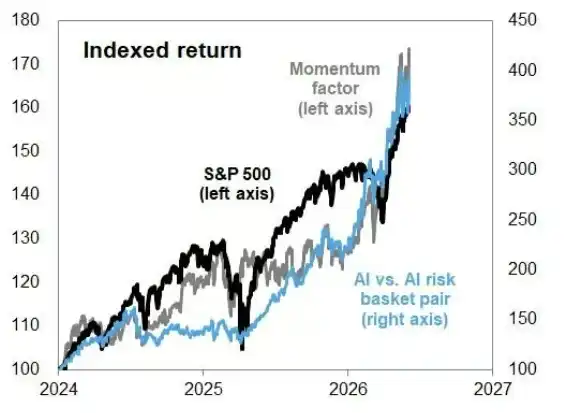
Snider notes that unlike similar momentum-driven rallies in the past (such as late 1999 and late 2021), the main support for this round of gains comes from substantial recent upward revisions to earnings expectations, rather than a pure sentiment bubble. This provides a somewhat more solid fundamental backing for the current upswing.

Euphoria Indicator: 86th Percentile, Below Two Historical Peaks

To quantify current market sentiment, Snider constructed a comprehensive evaluation framework covering four categories and nine indicators. Historical data shows that at the peak of the 2000 dot-com bubble, the median ranking of these indicators reached the 100th historical percentile; at the 2021 bull market high, it was the 95th percentile. The current reading is the 86th percentile — above the historical average, but still significantly short of the previous two extreme peaks.
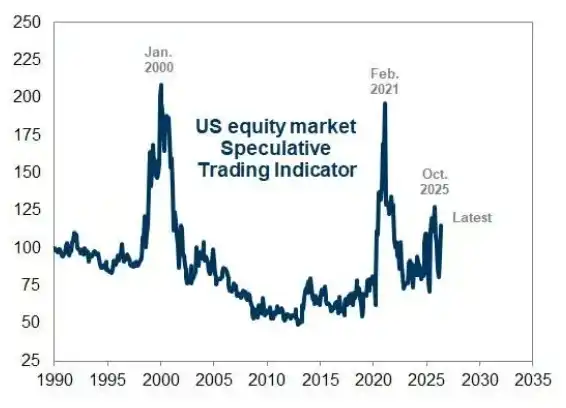
Specifically, Goldman Sachs' speculative trading indicator has risen in recent months but remains below levels at the end of 2025 and far below the peaks of 2000 and 2021. Among various speculative trading activities, the trading volume of high-valuation stocks has increased significantly recently, while the trading activity of unprofitable stocks is relatively mild. In addition, both equity call option volume and retail margin balances are trending upward, indicating investor sentiment is heating up.

Notably, the market breadth of this rally is extremely narrow, but it has not yet reached the extreme concentration seen during the dot-com bubble.

Four Risk Signals: Not Triggered Yet, but Distance is Shortening

Goldman Sachs' analytical framework attributes the end of historically high-valuation, high-concentration bull markets to four types of factors: speculative frenzy, deteriorating growth prospects, extremely bloated equity issuance, and Federal Reserve policy tightening. Snider points out that none of these four conditions fully matches the current environment, but each is closer to its warning line than at the beginning of the year.

IPO activity is reviving, with pressure beginning to show on the equity issuance side; rising input costs are compressing corporate profit margins, posing a potential threat to growth prospects; interest rate market pricing has started to reflect an increased probability of Fed rate hikes, although Goldman Sachs economists believe actual hikes are unlikely.

Snider also emphasizes that market declines do not require investors to be extremely euphoric as a precondition, and the euphoric characteristics seen at past bull market peaks may not reappear in identical form in this cycle. This means that even though current indicators have not yet reached historical extremes, investors should not view this as a sufficient guarantee of a safety margin.

Overall, Goldman Sachs' assessment offers a cautious but not pessimistic judgment: the euphoria level of this bull market is "getting closer and closer" to the historical peak range, but has not arrived yet. The key support for this judgment is that the current gains still have improving earnings expectations as fundamental backing, rather than being purely sentiment-driven. However, with the momentum factor remaining strong, market concentration high, and some risk signals quietly intensifying, Snider's report essentially serves as a reminder to investors: the window is still open, but it is slowly narrowing.


Пов'язані питання

QAccording to the Goldman Sachs report, how does the current market euphoria level compare to historical bubble peaks like 2000 and 2021?

AThe current market euphoria level is at the 86th percentile historically. This is above the historical average but still significantly below the peaks of the 2000 dot-com bubble (100th percentile) and the 2021 bull market (95th percentile).

QWhat is unique about the recent rally in the S&P 500 compared to historical momentum-driven rallies?

AUnlike previous momentum-driven rallies (e.g., late 1999 and 2021), the recent surge is primarily supported by significant upward revisions to near-term earnings expectations, providing a more solid fundamental foundation rather than being driven purely by sentiment.

QWhat are the four classic risk signals that historically signaled the end of high-valuation, concentrated bull markets, according to Goldman Sachs?

AThe four classic risk signals are: 1) Speculative fervor, 2) Deteriorating growth prospects, 3) Extremely high levels of equity issuance, and 4) Federal Reserve policy tightening.

QWhat is the status of these four risk signals in the current market environment?

ANone of the four risk signals are fully met in the current environment. However, Goldman Sachs notes that each one is closer to its triggering threshold than it was several months ago.

QWhat is Goldman Sachs' overall assessment of the current bull market's stage?

AGoldman Sachs' assessment is cautiously optimistic. They believe the bull market still has room to run as it is not yet at an extreme peak, but they warn that risks are accumulating, the window of opportunity is still open but is gradually narrowing.

Пов'язані матеріали

Long-Divided Must Unite, Long-United Must Divide: When L1 Becomes Its Own Rollup, What Is Ethereum's Endgame?

"The Inevitable Cycle: When L1 Becomes Its Own Rollup – What is Ethereum's Endgame?" For years, the Ethereum community grappled with concerns that L2s were fragmenting the ecosystem and eroding L1's value. While L2s provided cheaper execution, they also splintered liquidity and the unified user experience of a single chain. This has prompted a fundamental reassessment of the relationship between L1 and L2. Ethereum's roadmap is evolving. The "Scale" initiative merges L1 and L2 expansion into a holistic framework. L1 itself is advancing with higher gas limits, statelessness, and zkEVM verification, no longer content to be just a low-throughput settlement layer. Consequently, the primary value proposition of L2s is shifting from merely providing cheap blockspace to offering L1 cannot easily provide: application-specific optimizations, privacy features, and flexible governance models. L2s are becoming a spectrum of execution environments with varying degrees of security inheritance from Ethereum. A critical challenge in this multi-chain future is interoperability. The vision is to make Ethereum "feel like one chain again." This relies on advancements in native account abstraction (like EIP-7702) and intent-based architectures (Open Intents Framework), where users declare desired outcomes, and solvers handle the complex cross-chain execution. Furthermore, shortening Ethereum's finality time from minutes to seconds is crucial, as it underpins trust between chains for bridges, stablecoins, and cross-chain applications. Perhaps the most provocative idea is that Ethereum L1 itself could become a form of "its own Rollup." As zkEVM and proof systems mature, high-performance nodes could execute transactions and generate validity proofs. Regular validators would then verify these proofs instead of re-executing all transactions. This blurs the traditional L1/L2 hierarchy, making "Rollup" more of a general execution-verification architecture. Native Rollup aims to integrate L2 validation more directly into the Ethereum protocol, allowing L2s to inherit L1's security more fully and move away from reliance on security councils. In the end, L2s are not destined to replace L1 or be made obsolete by it. The likely future is a unified system where diverse execution environments—each optimized for specific use cases like DeFi, gaming, or privacy—coexist. They will share a common foundation of security, liquidity, and verifiable state, seamlessly connected to restore a cohesive user experience. The next phase for Ethereum is not just about scaling through separation, but about intelligently reintegrating what was separated back into a coherent whole.

链捕手2 хв тому

Long-Divided Must Unite, Long-United Must Divide: When L1 Becomes Its Own Rollup, What Is Ethereum's Endgame?

链捕手2 хв тому

Agent Race Ends, Super Workbench Takes Over

The era of fragmented AI agents is ending. Over the past month, China's tech giants—Tencent, Alibaba, and ByteDance—have simultaneously shifted strategy: instead of launching new, standalone AI agents, they are consolidating their various agent projects into unified "super workbenches." Tencent integrated its QClaw teams into WorkBuddy, a strategic product hailed as a potential third flagship after QQ and WeChat. Alibaba is merging its QoderWork, Wukong, and MuleRun agents into a new "Qianwen Office" platform under DingTalk's leadership. ByteDance rebranded its TRAE SOLO coding agent to TRAE Work, signaling a broader focus on workflow collaboration. This convergence marks a pivotal industry consensus. The initial exploration phase, where companies rapidly built numerous overlapping agents for different scenarios, proved costly and inefficient. With open-source tools eroding technical barriers, competition has shifted from agent creation to resource consolidation and cost control. Historically, platform wars are won not by creating more products, but by simplifying them—as seen with browsers unifying web access and super-apps consolidating services. Now, the "super workbench" aims to become the unified AI entry point for work. This reflects a deeper market realization: the primary audience for AI is no longer just programmers (a market in the tens of millions) but all knowledge workers (a market of billions). The real opportunity lies in augmenting everyday tasks—managing emails, documents, data, and meetings—across the entire workday. The core battleground is becoming control over the primary AI entry point that employees use daily. Tencent's WorkBuddy leverages WeChat and Tencent Docs; Alibaba's Qianwen Office taps into DingTalk's organizational data; ByteDance's TRAE Work integrates with Feishu's workflows. Whoever owns this "super workbench" gains strategic control over orchestrating enterprise data and APIs. This shift is redefining enterprise software. Traditional SaaS applications, valued for their user interfaces, will recede into the background. Their core functionalities will be exposed as standardized "Skills" or APIs for the super workbench's agents to invoke. Software value will shift from selling user seats to charging based on API calls and outcomes delivered. The evolution of agents is moving through clear stages: first as novel standalone products, then as consolidated primary work entry points, and finally as pervasive, invisible capabilities embedded into the digital fabric. The recent moves by major tech firms signal the transition from the first stage into the second, accelerating toward the third. In the end, the most successful agent technology may become invisible—like electricity or the HTTP protocol—a fundamental, unnamed infrastructure powering work itself.

marsbit30 хв тому

Agent Race Ends, Super Workbench Takes Over

marsbit30 хв тому

Michael Saylor: 110 Reasons to Oppose BIP-110

Michael Saylor presents 110 arguments against Bitcoin Improvement Proposal (BIP) 110, a soft fork aimed at restricting certain non-monetary data storage uses (like inscriptions) on the Bitcoin blockchain. He acknowledges the proponents' valid concerns—such as node costs, fee pressure, and preserving Bitcoin's monetary focus—but fundamentally disagrees with the proposed solution. Saylor argues that BIP 110 represents a dangerous precedent of using consensus rules to enforce value judgments on transaction validity, moving away from Bitcoin's core principles of neutrality and permissionless innovation. His key objections are organized into eleven categories: 1) It violates neutrality and hard consensus by banning currently valid transactions. 2) It fails to meet the high burden of proof required for a consensus change, lacking concrete data on the alleged crisis. 3) Its seven bundled technical restrictions are overly broad, targeting generic script functionalities and blocking future upgrade paths. 4) It sacrifices compatibility and future optionality by closing off designed upgrade hooks. 5) Its temporary rules add significant complexity (grandfathering, expiry states) without sufficient justification. 6) The economic and security impacts, particularly on miner revenue and fee markets, are uncertain and unmodeled. 7) Superior, market-based tools (fee markets, relay/mining policies) already exist to manage blockchain load. 8) It stifles innovation by creating a chilling effect for developers. 9) Its modified activation mechanism (55% threshold, forced signaling) is aggressive and risks network splits. 10) The precedent it sets—using consensus to suppress disliked but legal uses—is more dangerous than the problem it aims to solve. 11) A better path exists: improving measurements, refining resource-based policies, and allowing market forces to work. Saylor concludes that Bitcoin's strength lies in its neutral rules, open markets, and hard consensus. Changing these foundational elements to target specific use cases is an unnecessary and risky "iatrogenic" intervention. He advocates for guarding Bitcoin's neutrality rather than acting as its redeemer.

marsbit45 хв тому

Michael Saylor: 110 Reasons to Oppose BIP-110

marsbit45 хв тому

Торгівля

Спот
活动图片


