How Far is the Current U.S. Stock Bull Market from Historical Bubble Peaks?

marsbitОпубліковано о 2026-06-09Востаннє оновлено о 2026-06-09

Анотація

Title: How Far Is the Current U.S. Stock Bull Market from Historical Bubble Peaks? Summary: According to Goldman Sachs' chief U.S. equity strategist, current market exuberance ranks at the 86th historical percentile. While approaching, this level remains notably below the extremes seen at the peaks of the 2000 dot-com bubble (100th percentile) and the 2021 bull market (95th percentile). The recent 15% surge in the S&P 500 over two months represents one of the strongest volatility-adjusted rallies in over 50 years, primarily fueled by AI-related enthusiasm and backed by significant upward revisions to earnings estimates, providing a more fundamental basis than past momentum-driven peaks. Key risk signals—speculative frenzy, deteriorating growth, heavy equity issuance, and Federal Reserve tightening—are all closer to their historical triggers than a few months ago but are not yet fully activated. For instance, IPO activity is recovering, and market breadth remains narrow, though not at dot-com bubble extremes. The strategist cautions that while the current cycle may not replicate past peaks exactly and a downturn does not require extreme euphoria, risks are accumulating. The overall assessment is that the bull market still has room to run, but the window of opportunity is gradually narrowing.

Original Author: Zhao Ying

Original Source: Wall Street News

The latest assessment from Goldman Sachs' chief U.S. stock strategist shows that the current market euphoria has climbed to the 86th historical percentile, approaching but not yet reaching the extreme levels seen at the peaks of the 2000 dot-com bubble and the 2021 bull market.

Over the past two months, the S&P 500 index surged 15% before Friday's pullback, a gain ranking in the 99th percentile of historical data since 1980. In his latest report, Goldman Sachs' chief U.S. stock strategist Ben Snider pointed out that, although the four historical signals of a bull market peak — speculative frenzy, deteriorating growth, massive equity issuance, and Fed tightening — are not fully in place yet, each is closer to its trigger threshold than it was a few months ago.

For the market, this judgment means there is still room for the current bull market, but risks are accumulating. Snider explicitly stated "we're not there yet," while also warning that markets don't need investors to be extremely euphoric to decline, and historical patterns may not repeat themselves in this cycle.

The Strength of the Rally: The Strongest Volatility-Adjusted Rebound in 50 Years

The speed of this rebound has already left its mark in history. According to Goldman Sachs data, the S&P 500's roughly 15% gain over about two months, relative to realized volatility, yields a return/volatility ratio near 4, the highest level in over 50 years.
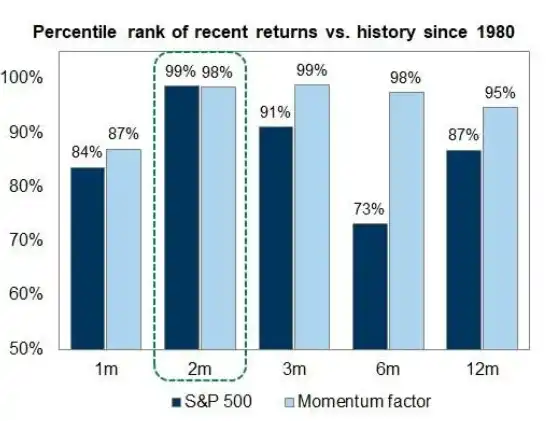
Artificial intelligence is the core theme driving this market phase. AI concept stocks, the momentum factor, and major indices are rising in sync, forming a high level of resonance.
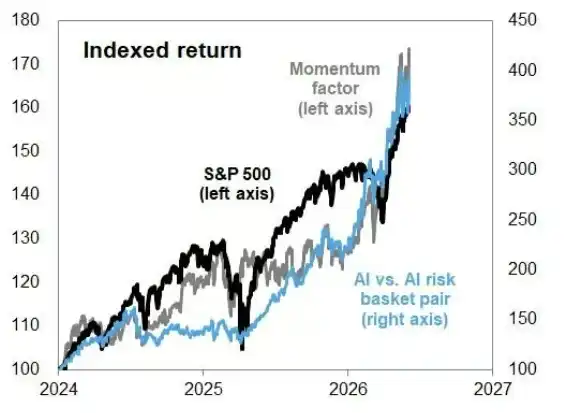
Snider notes that unlike similar momentum-driven rallies in the past (such as late 1999 and late 2021), the main support for this round of gains comes from substantial recent upward revisions to earnings expectations, rather than a pure sentiment bubble. This provides a somewhat more solid fundamental backing for the current upswing.

Euphoria Indicator: 86th Percentile, Below Two Historical Peaks

To quantify current market sentiment, Snider constructed a comprehensive evaluation framework covering four categories and nine indicators. Historical data shows that at the peak of the 2000 dot-com bubble, the median ranking of these indicators reached the 100th historical percentile; at the 2021 bull market high, it was the 95th percentile. The current reading is the 86th percentile — above the historical average, but still significantly short of the previous two extreme peaks.
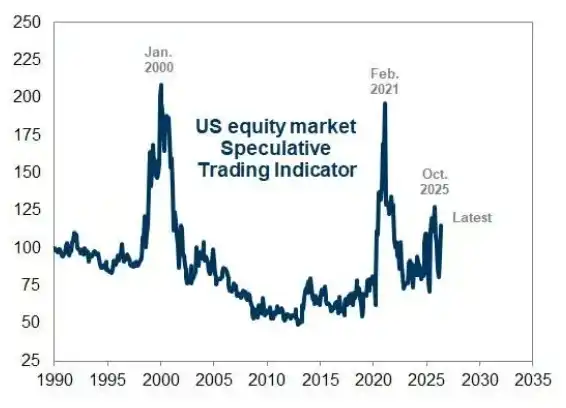
Specifically, Goldman Sachs' speculative trading indicator has risen in recent months but remains below levels at the end of 2025 and far below the peaks of 2000 and 2021. Among various speculative trading activities, the trading volume of high-valuation stocks has increased significantly recently, while the trading activity of unprofitable stocks is relatively mild. In addition, both equity call option volume and retail margin balances are trending upward, indicating investor sentiment is heating up.

Notably, the market breadth of this rally is extremely narrow, but it has not yet reached the extreme concentration seen during the dot-com bubble.

Four Risk Signals: Not Triggered Yet, but Distance is Shortening

Goldman Sachs' analytical framework attributes the end of historically high-valuation, high-concentration bull markets to four types of factors: speculative frenzy, deteriorating growth prospects, extremely bloated equity issuance, and Federal Reserve policy tightening. Snider points out that none of these four conditions fully matches the current environment, but each is closer to its warning line than at the beginning of the year.

IPO activity is reviving, with pressure beginning to show on the equity issuance side; rising input costs are compressing corporate profit margins, posing a potential threat to growth prospects; interest rate market pricing has started to reflect an increased probability of Fed rate hikes, although Goldman Sachs economists believe actual hikes are unlikely.

Snider also emphasizes that market declines do not require investors to be extremely euphoric as a precondition, and the euphoric characteristics seen at past bull market peaks may not reappear in identical form in this cycle. This means that even though current indicators have not yet reached historical extremes, investors should not view this as a sufficient guarantee of a safety margin.

Overall, Goldman Sachs' assessment offers a cautious but not pessimistic judgment: the euphoria level of this bull market is "getting closer and closer" to the historical peak range, but has not arrived yet. The key support for this judgment is that the current gains still have improving earnings expectations as fundamental backing, rather than being purely sentiment-driven. However, with the momentum factor remaining strong, market concentration high, and some risk signals quietly intensifying, Snider's report essentially serves as a reminder to investors: the window is still open, but it is slowly narrowing.


Пов'язані питання

QAccording to the Goldman Sachs report, how does the current market euphoria level compare to historical bubble peaks like 2000 and 2021?

AThe current market euphoria level is at the 86th percentile historically. This is above the historical average but still significantly below the peaks of the 2000 dot-com bubble (100th percentile) and the 2021 bull market (95th percentile).

QWhat is unique about the recent rally in the S&P 500 compared to historical momentum-driven rallies?

AUnlike previous momentum-driven rallies (e.g., late 1999 and 2021), the recent surge is primarily supported by significant upward revisions to near-term earnings expectations, providing a more solid fundamental foundation rather than being driven purely by sentiment.

QWhat are the four classic risk signals that historically signaled the end of high-valuation, concentrated bull markets, according to Goldman Sachs?

AThe four classic risk signals are: 1) Speculative fervor, 2) Deteriorating growth prospects, 3) Extremely high levels of equity issuance, and 4) Federal Reserve policy tightening.

QWhat is the status of these four risk signals in the current market environment?

ANone of the four risk signals are fully met in the current environment. However, Goldman Sachs notes that each one is closer to its triggering threshold than it was several months ago.

QWhat is Goldman Sachs' overall assessment of the current bull market's stage?

AGoldman Sachs' assessment is cautiously optimistic. They believe the bull market still has room to run as it is not yet at an extreme peak, but they warn that risks are accumulating, the window of opportunity is still open but is gradually narrowing.

Пов'язані матеріали

Podcast Notes | Conversation with GSR Asset Management Head: To Determine if This Crypto Rally is Real, Just Watch the Lending Rates on Aave

Podcast Summary: Dialogue with GSR's Head of Asset Management: To Determine if This Crypto Rally is Real, Just Check Lending Rates on Aave Andy Baehr, Managing Director of Asset Management at GSR, discusses the current crypto market, characterizing it as stuck in a state of "ambivalence" with short-lived, unsustainable rallies. He outlines a simple framework: the market moves between "ambivalence" and "conviction" (sustained upward momentum). Currently, every rally resembles a single-stage rocket booster that quickly fizzles out. Baehr identifies three key signals to watch: 1) DeFi lending rates, 2) the potential passage of the CLARITY Act, and 3) the market forming a consensus on the "Fed hawkish peak." He emphasizes that the most immediate indicator for the sustainability of the recent CPI-triggered rally is the USDC borrowing rate on Aave, currently around 3.75%—close to U.S. Treasury yields. The absence of a credit spread indicates low leverage demand and a lack of market energy. He explains that a healthy, sustained rally requires layered buying pressure. Last year's rally progressed from an ETH short squeeze to crypto-native trader influx and finally to ETF inflows. Currently, this structure is missing. Other potential structural buyers like Digital Asset Treasury (DAT) companies are absent, and ETF flows have proven transient. Baehr notes that while small-cap crypto tokens outperformed large caps in Q2—a potential sign of capitation in major assets—capital is also flowing to more exciting opportunities like AI stocks and tech IPOs, leaving crypto sidelined. Regarding DeFi, he highlights that platforms like Aave provide a clear, real-time signal of leverage demand through their supply/demand-driven interest rates. A significant, sustained rate increase would signal genuine market conviction. He also observes the quiet emergence of fixed-income-like products and vaults in DeFi. On regulation, the probability of the CLARITY Act passing before the August 7th deadline has dropped linearly from 75% to below 40% on Polymarket. Baehr suggests its passage would be treated as a bullish surprise, a potent driver for price movement. However, political hurdles, including ethical clause debates and disclosures about the First Family's crypto profits, remain significant obstacles. Ultimately, the market awaits clarity on the Fed's terminal rate under Chair Warsh. Until the "Fed Solstice"—the point where the market collectively understands the peak of hawkish policy—sustained conviction will be difficult to achieve.

marsbit2 хв тому

Podcast Notes | Conversation with GSR Asset Management Head: To Determine if This Crypto Rally is Real, Just Watch the Lending Rates on Aave

marsbit2 хв тому

7 Months After the Collapse of Huiwang, Southeast Asia's Escrow Platforms Undergo a Major Reshuffle

Following the collapse of Huione Pay—dubbed the "Alipay of Southeast Asia"—seven months ago, the region's underground financial guarantee platform sector is undergoing a significant reshuffle. This power vacuum has been swiftly filled by emerging platforms such as XinBi, Tiger/Navigator, JinBei (renamed JinBo), Dali/Tiancheng, and FullyLight. These platforms, operating largely via Telegram and offering services like escrow for illicit transactions, have absorbed the vast user base and markets left behind by Huione. While positioning themselves as "trust intermediaries," their primary clientele consists of networks involved in online scams, money laundering, illegal gambling, and even human trafficking. For instance, the Tiger/Navigator platform explicitly provides "escrow" services for kidnapping-for-ransom operations ("强押车交易"). Data underscores the immense scale: Huione alone processed over $103 billion in cryptocurrency payments and facilitated over $31 billion through its escrow market before its downfall, linking it to Cambodia's notorious Prince Group. Since its collapse, competitors have seen explosive growth. For example, the XinBi platform has accumulated over $1.6 billion in total USDT revenue, while platforms like NewPay, OkPay (under Dali), and FullyLight Wallet collectively processed over $4.8 billion in USDT in a single year. This ecosystem thrives in regions like Cambodia and Myanmar, where regulatory gaps allow these platforms to act as critical financial infrastructure for sprawling cybercrime industries, from scam compounds to online casinos. The article concludes that the moniker "Southeast Asian Alipay" is a misnomer, obscuring the platforms' fundamental role in enabling serious criminal enterprises rather than representing legitimate financial innovation.

Odaily星球日报1 год тому

7 Months After the Collapse of Huiwang, Southeast Asia's Escrow Platforms Undergo a Major Reshuffle

Odaily星球日报1 год тому

The Changing Landscape: What Are Crypto VCs Experiencing?

Title: The Shifting Landscape of Crypto Venture Capital The era of dedicated crypto venture capital funds is undergoing a significant transformation. Once essential for navigating the sector's complexity and high risk, these specialized funds are now facing an identity crisis as the market matures. This shift mirrors historical patterns in other specialized investment classes like cleantech and SPACs, where initial information advantages dissipate as technologies become mainstream and integrated into existing industry frameworks. The article argues that crypto is reaching a critical inflection point, transitioning from a "building phase" to an "integration phase." Major players like Stripe, BlackRock, and Visa now engage with crypto not for its novel mechanics but as a foundational financial infrastructure. Their needs—regulatory compliance, banking partnerships, distribution channels—align with traditional fintech, a domain easily understood by large, generalist funds like Sequoia and Founders Fund. This evolution creates a "barbell effect" within the VC landscape. On one end are massive, diversified platforms that can incorporate crypto as one vertical among many. On the other are small, nimble funds focused on niche, experimental projects. The middle ground—medium-sized dedicated crypto funds—is being squeezed out. Their typical fund size makes it impossible to generate sufficient returns solely from early-stage crypto bets, yet they cannot compete with giants for later-stage deals. Consequently, leading crypto-native firms like Paradigm and Framework Ventures are expanding into AI, robotics, and other sectors, driven partly by LP pressure for better returns amid a broader VC DPI crisis. Others, like Dragonfly and a16z, have narrowed their crypto focus predominantly to financial infrastructure like stablecoins, reframing the sector's core narrative. For crypto entrepreneurs, this consolidation presents challenges. While generalist funds offer larger checks and broader resources, crypto projects now compete fiercely with AI for attention and capital within these firms. Furthermore, the long-term, non-commercial foundational work that built the ecosystem—funded by dedicated crypto VCs—is less likely to attract generalist capital focused on direct returns. The conclusion is that "crypto investor" as a standalone category is becoming obsolete, akin to "internet investor." Crypto is becoming a baseline infrastructure layer. The future will see a barbell structure: large-scale growth financing handled by generalist funds, while pioneering, speculative projects are funded by small, specialized vehicles. The dedicated crypto funds of the 2017-2021 boom, which incubated core infrastructure, are giving way to this new, bifurcated reality.

Foresight News1 год тому

The Changing Landscape: What Are Crypto VCs Experiencing?

Foresight News1 год тому

Торгівля

Спот
活动图片




