How Does Backpack's Staking Token-to-Equity Conversion Work?

marsbitОпубліковано о 2026-02-25Востаннє оновлено о 2026-02-25

Анотація

Backpack, a Solana-based wallet and exchange platform founded by ex-FTX members, has announced a novel staking-to-equity conversion plan. Users who stake its native token for at least one year can convert those tokens into real company equity at a fixed ratio, with 20% of equity reserved for this purpose. The platform emerged after FTX’s collapse, having lost 80% of its operational funds, and gradually built its user base through its Mad Lads NFT community and a compliant exchange. It recently acquired FTX Europe and secured regulatory licenses. Backpack’s tokenomics include a 1 billion total supply, with 62.5% pre-IPO allocation. The TGE will release 25% of tokens, entirely to users. The model ties token distribution to IPO milestones—a rare hybrid approach in crypto. This move aims to transform users from token holders into legal company owners. However, it faces significant regulatory challenges, particularly from the SEC, which may view the token as a security. The dual-structure of token and equity could also complicate IPO investor relations. While innovative, the plan operates in a regulatory grey area—attempting to bridge decentralized tokenomics with traditional equity financing.

Original | Odaily Planet Daily (@OdailyChina)

Author | DingDang (@XiaMiPP)
On February 24, Backpack CEO Armani Ferrante announced a staking-to-equity conversion plan, allowing users who stake Backpack's native token for at least one year to exchange these tokens for real company equity at a fixed ratio. The company has reserved 20% of its equity for this plan.

This brief statement conveys far more information than a conventional TGE narrative.

In traditional TGE narratives, users are seen as traffic and community token holders; in this design, Backpack attempts to elevate users from product users to legal company owners.

The question is: Can it really work? Is this a financial innovation or a high-risk experiment dancing on the edge of regulation? Does it change the power structure, or is it just a more advanced form of chip management? To understand this, we must look back at Backpack's own history.

Backpack: A Company Rising from the Ruins

Backpack is a "wallet + exchange" integrated platform centered on the Solana ecosystem, founded by Armani Ferrante, a former member of FTX and Alameda Research. It was established after the collapse of FTX, emphasizing compliance and user custody.

However, unlike the "trading first, ecosystem later" development path of centralized exchanges like Binance, Backpack's path is the reverse. It started with a wallet and NFTs, gradually accumulating users, community, and technical foundations, and eventually launched an exchange.

Looking back at Backpack's history. In 2022, the collapse of FTX not only tore apart the credit structure of the entire crypto industry but also directly impacted projects associated with it. Backpack had just completed a $20 million funding round led by FTX Ventures and Jump Crypto before FTX's collapse. But as the empire crumbled, about 80% of Backpack's operating funds evaporated. At that time, Backpack was positioned as a "wallet + xNFT operating system," aiming to provide Solana users with a safer, integrated entry point, avoiding reliance on centralized platforms.

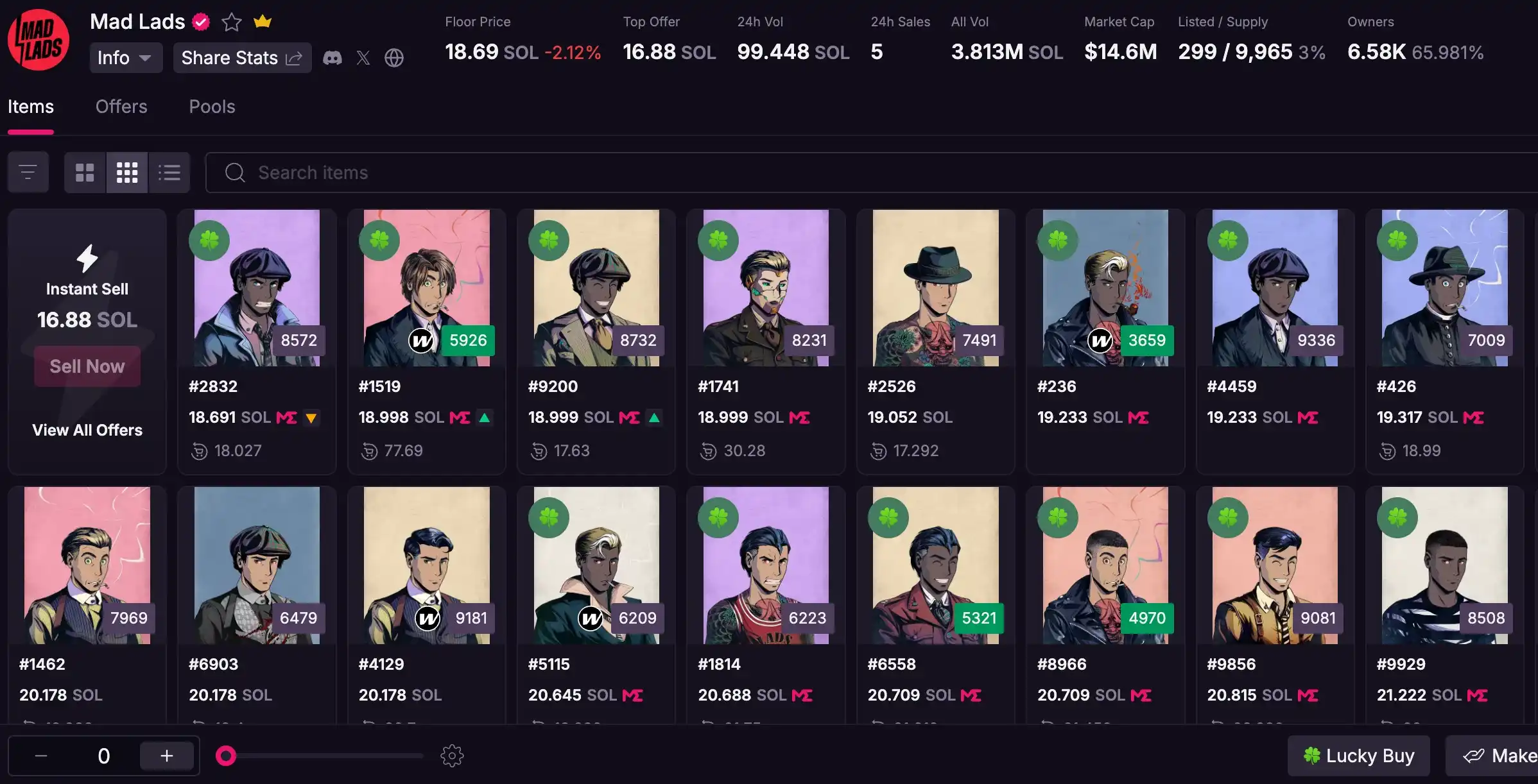
In April 2023, during the bear market trough, Backpack quietly launched the Mad Lads NFT series, with a minting price of 6.9 SOL. It quickly became one of the top NFT communities on Solana, with the floor price once reaching 229.4 SOL. Today, despite the overall decline of NFTs, the Mad Lads floor price remains at 18.8 SOL, more than double the original minting price.
In November of the same year, Backpack obtained a Dubai VARA license and launched Backpack Exchange, though it was only in a limited testing phase at the time. By then, it had accumulated user trust through its wallet and NFTs, leveraging the exchange to monetize traffic. In February 2024, Backpack completed a $17 million Series A funding round, valuing the company at $120 million. In January 2025, it acquired FTX Europe's assets for $32.7 million, obtaining a European MiFID II license, further strengthening its compliance foundation and committing to handle FTX EU customer claims.

Backpack was born with a silver spoon but rebuilt from the ruins. After nearly three years, Backpack has accumulated a trading volume of over $400 billion and user assets exceeding $350 million.

Now, it is poised for a greater leap.

Token Issuance Plan and Equity Linkage

On February 17, Backpack announced the start of identity verification before TGE, the first step for users to claim tokens.

According to Backpack's token economic model, the total token supply is 1 billion. The pre-IPO total supply is 625 million tokens (62.5%), released in three phases:

  • Phase 1 (TGE): Releases 25% of the total supply, or 250 million tokens. Of these, 240 million (24%) are allocated to points holders, and 10 million (1%) to Mad Lads holders. This phase is 100% allocated to users, with no internal team share.
  • Phase 2 (Pre-IPO): Accounts for 37.5%, or 375 million tokens, as "growth-triggered unlocks," released gradually based on key milestones (such as regulatory approvals, new product launches, and geographic expansion).
  • Phase 3 (Post-IPO): Also accounts for 37.5%, or 375 million tokens, deposited into company treasury, locked for one year after IPO, for the team and investors.

From its token distribution plan, we can already see that token issuance is closely tied to an IPO. Backpack is currently negotiating terms for a new $50 million funding round at a valuation of $1 billion. At this valuation, the 20% equity reserved is worth $200 million.

In the short history of the cryptocurrency industry, token issuance has quietly evolved from an optional financing tool to an almost "instinctive choice" and default path for nearly all projects. As users, we are familiar with this method, but Backpack's approach goes beyond what we know.

From an industry perspective, this model fills a gap. Coinbase successfully IPOed in 2021 but never issued a native token; DeFi projects like Uniswap issued governance tokens but did not pursue an equity listing. Backpack is attempting a "dual-track" system: tokens for community incentives and equity for long-term ownership, which is unprecedented in the crypto industry.

Is Token Issuance + IPO Feasible?

Although this plan is bold and innovative, it faces regulatory challenges.

Under U.S. regulatory context, most tokens could be considered securities by the SEC. If so, companies must comply with registration, disclosure, and anti-fraud rules. If an IPO is pursued in the future, the SEC will review the history of token issuance, structural design, and potential compliance violations.

More complex is the potential "ownership conflict" between equity and tokens: IPO investors worry about dilution of rights (such as voting rights and dividends), while token holders expect value capture, which could be seen as "dual financing" or misleading behavior. Especially during the Gensler era (2022-2024), enforcement tightened, and many projects abandoned IPOs altogether.

In short, token issuance takes the "decentralized/on-chain financing" fast lane, while an IPO takes the "centralized/compliant/equity financing" slow lane. Backpack is trying to drive both vehicles simultaneously, which requires极强的 structural design and regulatory communication skills. Otherwise, it could face delays in listing or regulatory fines.

While there is no complete precedent in the crypto industry, there are partial ones. Coinbase, also a centralized exchange, completed its IPO in 2021, but it had considered issuing a token. Backpack co-founder Can Sun revealed in a podcast two years ago that he participated in Coinbase's上市 work, helping design its token economic model. Although Coinbase ultimately chose a pure equity listing, this experience provided valuable reference for Backpack. At that time, he already planned to realize this unfulfilled ambition at Backpack.

Can It Change the Industry?

Today, the reality of the crypto industry is that many tokens lose over 80% of their value within a year of listing. "Peak at issuance" has almost become a curse. Backpack seems to be寻找 another path: giving tokens the possibility of converting to equity,推动 incentive methods to change.

In the past, the familiar model was "earn tokens with product," where projects first build a good product, and users earn token rewards through usage, such as fee sharing, liquidity mining, airdrops, etc. Token value comes from the product's actual performance. Backpack's approach更像 using token expectations to feed company valuation, i.e., equity binding, IPO narrative, using the expected value of tokens to quickly gather funds, community, and attention, thereby raising the company's valuation and accelerating financing and product iteration. Tokens are no longer just reward tools but valuation engines.

Of course, this transformation is full of uncertainty. How will regulators define it? How to balance rights between equity and tokens? Will the market really buy into the narrative of future shareholders? These questions have no ready answers. But in a pessimistic moment for the crypto industry, Backpack is at least trying to provide a new tension.

Backpack once rebuilt from the ruins; this time, it is building a bridge in the cracks of the system.


Пов'язані питання

QWhat is the core mechanism of Backpack's staking-to-equity conversion plan?

AUsers who stake Backpack's native token for at least one year have the opportunity to convert these tokens into real company equity at a fixed ratio, with 20% of the company's equity reserved for this plan.

QHow did Backpack's development path differ from traditional centralized exchanges like Binance?

ABackpack started with a wallet and NFT ecosystem (e.g., Mad Lads NFT) to build user trust and community, then launched its exchange, whereas traditional exchanges like Binance typically prioritize trading services first before expanding into ecosystems.

QWhat are the three phases of Backpack's token economic model?

APhase 1 (TGE): 25% of total supply allocated to users; Phase 2 (Pre-IPO): 37.5% unlocked based on milestones like regulatory approvals; Phase 3 (Post-IPO): 37.5% reserved for team and investors, locked for one year after IPO.

QWhat regulatory challenges does Backpack face with its dual-token and equity model?

AThe SEC may classify the token as a security, requiring compliance with registration and disclosure rules. The dual structure could also create ownership conflicts between equity investors and token holders, potentially leading to regulatory scrutiny or delays in IPO.

QHow does Backpack's approach aim to change the typical 'peak at launch' token trend?

ABy linking token staking to real equity ownership and an IPO narrative, Backpack uses token expectations to boost company valuation, attract funding, and shift incentives from short-term rewards to long-term ownership, potentially breaking the cycle of post-launch token depreciation.

Пов'язані матеріали

How Many Tokens Away Is Yang Zhilin from the 'Moon Chasing the Light'?

The article explores the intense competition between two leading Chinese AI companies, DeepSeek and Kimi (Moon Dark Side), and the mounting pressure on Yang Zhilin, the founder of Kimi. While DeepSeek re-emerged after 15 months of silence with its powerful V4 model—boasting 1.6 trillion parameters and low-cost, long-context capabilities—Kimi has been focusing on long-context processing and multi-agent systems with its K2.6 model. Yang faces a threefold challenge: technological rivalry, commercialization pressure, and investor expectations. Despite Kimi’s high valuation (reaching $18 billion), its revenue heavily relies on a single product with low paid conversion rates, while DeepSeek’s strategic silence and open-source influence have strengthened its market position and valuation prospects, now targeting over $20 billion. Both companies reflect broader trends in China’s AI ecosystem: Kimi aims for global influence through open-source contributions and agent-based advancements, while DeepSeek prioritizes foundational innovation and hardware independence, notably shifting to Huawei’s chips. Their competition is seen as vital for China’s AI progress, with the gap between top Chinese and U.S. models narrowing to just 2.7% on the Elo rating scale. Ultimately, the article argues that this rivalry, though anxiety-inducing for leaders like Zhilin, is essential for driving innovation and solidifying China’s role in the global AI landscape.

marsbit6 год тому

How Many Tokens Away Is Yang Zhilin from the 'Moon Chasing the Light'?

marsbit6 год тому

TechFlow Intelligence Bureau: ChatGPT Helps Amateur Mathematician Crack 60-Year-Old Problem, CFTC Sues New York Regulator Over Coinbase and Gemini

An amateur mathematician, with the assistance of ChatGPT, has solved a combinatorial mathematics puzzle originally proposed by Hungarian mathematician Paul Erdős in the 1960s. This marks another milestone in AI-aided mathematical research, demonstrating the evolving capabilities of large language models in formal reasoning. In other AI developments, OpenAI introduced a new privacy filter tool for enterprise API usage, automatically screening sensitive data. Meanwhile, the Qwen3.6-27B model achieved 100 tokens per second on a single RTX 5090 GPU using quantization, significantly lowering the cost barrier for local AI deployment. In crypto and Web3, the U.S. CFTC sued New York’s financial regulator, challenging its oversight of Coinbase and Gemini—a first-of-its-kind federal-state regulatory clash. Following a vulnerability, KelpDAO and major DeFi protocols established a recovery fund. Tether froze $344 million in assets linked to Iran’s central bank upon U.S. Treasury request, highlighting the centralized control risks in stablecoins. Separately, Litecoin underwent a 3-hour chain reorganization to undo a privacy-layer exploit. In the U.S., former President Trump invoked the Defense Production Act to address power grid bottlenecks affecting AI data centers and dismissed the entire National Science Board, raising concerns over research independence. A retail trader gained 250% on a $600k Intel options bet amid AI-related speculation. Xiaomi announced its first performance electric vehicle, targeting rivals like Tesla. Meanwhile, iPhone users reported devices automatically reinstalling a hidden app daily, suspected to be MDM-related. A Chinese securities report noted that A-share institutional crowding has reached its second-longest streak since 2007, signaling high valuations and potential style rotation. The day’s developments reflect a dual narrative: AI is enabling unprecedented individual breakthroughs, while centralized power structures—whether governmental or corporate—are becoming more assertive, underscoring that decentralization is as much a political-economic challenge as a technical one.

marsbit6 год тому

TechFlow Intelligence Bureau: ChatGPT Helps Amateur Mathematician Crack 60-Year-Old Problem, CFTC Sues New York Regulator Over Coinbase and Gemini

marsbit6 год тому

Торгівля

Спот
Ф'ючерси

Популярні статті

Як купити F

Ласкаво просимо до HTX.com! Ми зробили покупку Synfutures (F) простою та зручною. Дотримуйтесь нашої покрокової інструкції, щоб розпочати свою криптовалютну подорож.Крок 1: Створіть обліковий запис на HTXВикористовуйте свою електронну пошту або номер телефону, щоб зареєструвати обліковий запис на HTX безплатно. Пройдіть безпроблемну реєстрацію й отримайте доступ до всіх функцій.ЗареєструватисьКрок 2: Перейдіть до розділу Купити крипту і виберіть спосіб оплатиКредитна/дебетова картка: використовуйте вашу картку Visa або Mastercard, щоб миттєво купити Synfutures (F).Баланс: використовуйте кошти з балансу вашого рахунку HTX для безперешкодної торгівлі.Треті особи: ми додали популярні способи оплати, такі як Google Pay та Apple Pay, щоб підвищити зручність.P2P: Торгуйте безпосередньо з іншими користувачами на HTX.Позабіржова торгівля (OTC): ми пропонуємо індивідуальні послуги та конкурентні обмінні курси для трейдерів.Крок 3: Зберігайте свої Synfutures (F)Після придбання Synfutures (F) збережіть його у своєму обліковому записі на HTX. Крім того, ви можете відправити його в інше місце за допомогою блокчейн-переказу або використовувати його для торгівлі іншими криптовалютами.Крок 4: Торгівля Synfutures (F)Легко торгуйте Synfutures (F) на спотовому ринку HTX. Просто увійдіть до свого облікового запису, виберіть торгову пару, укладайте угоди та спостерігайте за ними в режимі реального часу. Ми пропонуємо зручний досвід як для початківців, так і для досвідчених трейдерів.

191 переглядів усьогоОпубліковано 2024.12.21Оновлено 2025.03.21

Як купити F

Обговорення

Ласкаво просимо до спільноти HTX. Тут ви можете бути в курсі останніх подій розвитку платформи та отримати доступ до професійної ринкової інформації. Нижче представлені думки користувачів щодо ціни F (F).

活动图片