How Difficult is Chip Making? A Division Error Costs 475 Million Dollars

marsbitОпубліковано о 2026-06-15Востаннє оновлено о 2026-06-15

Анотація

How Hard Is It to Make a Chip? A Division Error Cost $475 Million Chip expert Shi Kan, a researcher at the Chinese Academy of Sciences and a popular tech creator, explains the immense challenges of chip development. Chips are foundational to modern technology, but their creation is extraordinarily difficult. The journey from sand to a functional chip involves complex design and manufacturing, but a critical bottleneck is verification—ensuring the design works flawlessly before costly production. A single, undetected bug can have catastrophic consequences, as illustrated by the infamous 1994 Intel Pentium FDIV bug. A flaw in the floating-point division unit forced a recall costing $475 million. Unlike software, chips cannot be easily patched after manufacture, making "first-time success" paramount. However, industry surveys show only 24% of chip projects achieve this; over three-quarters require at least one costly re-spin due to design flaws. Verification has thus become the dominant phase, consuming up to 70% of the design cycle. The core challenge is a "verification impossible triangle" between high performance, good debuggability, and low cost. Exhaustively verifying a modern CPU core could take 15,000 years with software simulation, or 30 years with advanced hardware emulation—timeframes utterly impractical for development. Despite being essential, verification is often seen as unglamorous "dirty work," receiving less academic attention than fields like AI. Shi and hi...

Hello everyone, I'm Shi Kan from the Institute of Computing Technology at the Chinese Academy of Sciences, a 'slash technology worker'. I have over a decade of experience in the chip industry, and currently, I conduct academic research related to chips at the Chinese Academy of Sciences; at the same time, I am also a science and technology Bilibili UP host 'Lao Shi Tan Xin', and my viewers call me 'Lao Shi'.

Chips: The Cornerstone of Modern Society

When it comes to chips, everyone surely knows their importance.
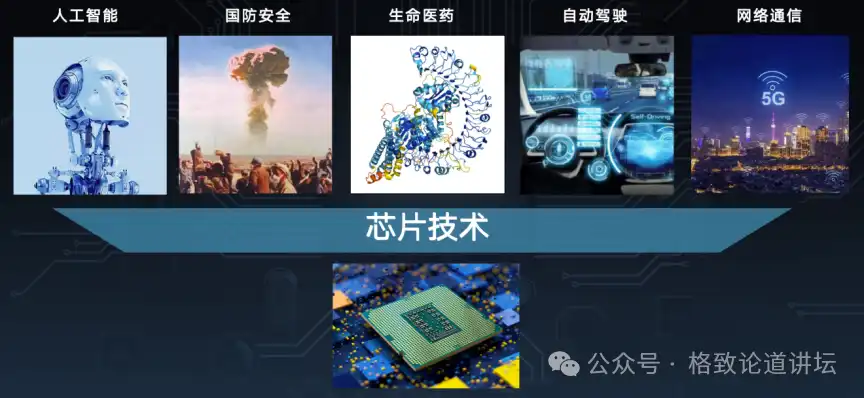
Whether it's the currently hot artificial intelligence, life sciences and medicine, autonomous driving, network communications, and so on, almost all the technologies of modern society you can imagine are inseparable from chips—this foundational technology of the information age.

I have been involved in chip work for a long time, and the chip development process is actually a very interesting one, mainly due to two aspects.

Firstly, the applications of chips are extremely wide-ranging. Once you enter this industry, you probably don't have to worry about unemployment because many industries require chip technology.

The second reason might be more important: chip development is a very difficult endeavor. As chip engineers, we need to constantly learn and enrich ourselves to face and embrace this era full of opportunities and challenges.

So the question arises: what exactly makes chip technology so difficult?

Why Are Chips So Difficult?

Completed: 10%//////////

Everyone might know that the manufacturing process of a chip is essentially an evolution journey of a grain of sand. Sand might be something inexhaustible and abundant on this planet; but turning low-value sand into high-value chips adds up to nothing but human intelligence.
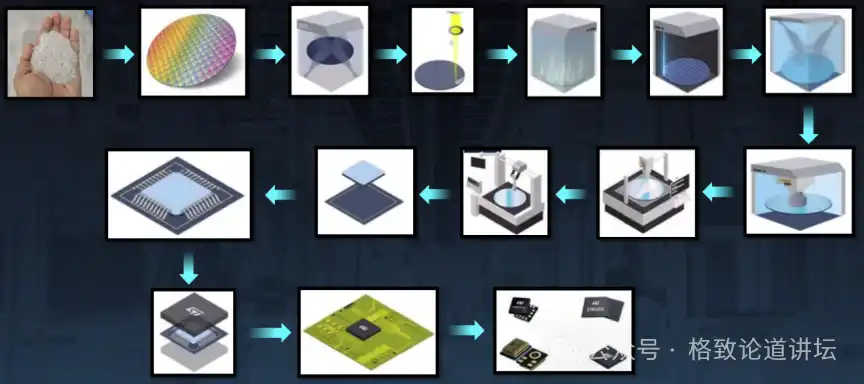
Starting from sand, we need to purify it to obtain wafers. Then, through a series of steps such as photolithography, ion implantation, etching, packaging, and so on, the abundant, inexhaustible sand is transformed into the final tiny chip.

So, having said all that, with so many steps, chip manufacturing is actually only part of the entire chip development process; it does not equal chip development itself.
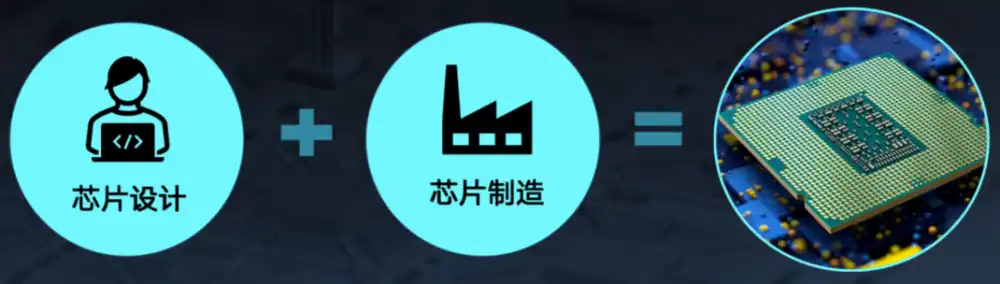
There is another crucial step, which is chip design. It refers to completing the circuit design according to requirements and making the circuit function properly. Then, we hand over the designed circuit to chip manufacturers for the later stages of manufacturing, ultimately obtaining the physical chip.

But there is another question here: how do you ensure that the chip's functionality matches your initial design?
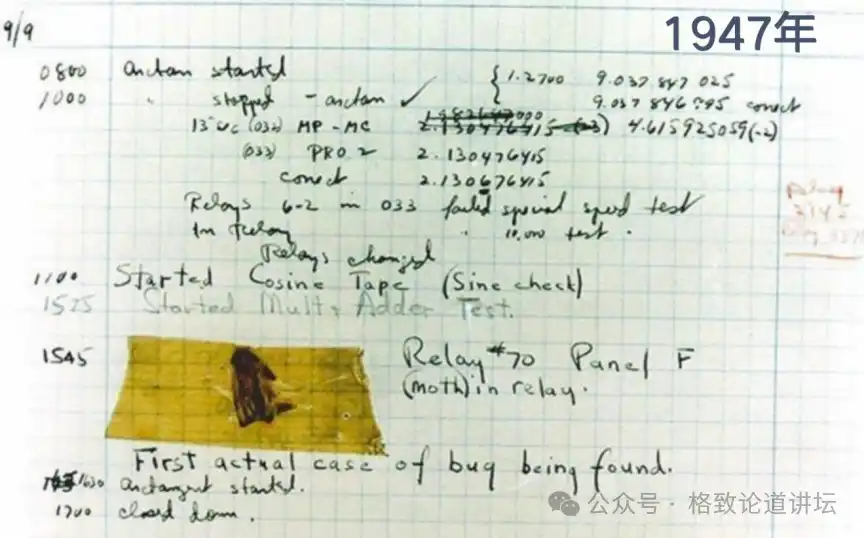
There is an interesting little story here. In 1947, a very famous female programmer named Grace Hopper found her computer wasn't working. After careful investigation and exploration, she discovered that a moth had flown into a relay of the computer. So, she carefully used tweezers to remove this moth and taped it onto a piece of paper.

This might be the first 'bug' discovered in the entire history of computer development, meaning a vulnerability.

If the previous example seems too distant, we actually have more examples. Here's a math problem for everyone: What is the final result of this expression? Actually, this problem is simple because the numerator and denominator in the later part are the same and can cancel out; then the numbers before and after the minus sign are also the same, so subtracting the same number should result in 0. However, in actual computers and chips, the result might not be this.
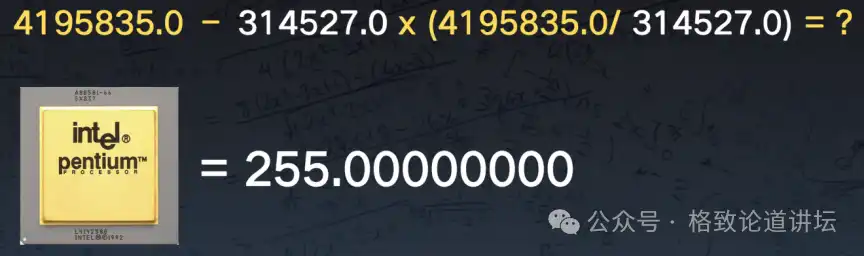
For example, in an Intel Pentium chip, the result was 255.00000000. What happened? It turned out that when an American scientist was conducting scientific research, he kept getting incorrect calculations when running this expression. Finally, he discovered that there was an undetected design flaw in a floating-point division unit of this chip.

Don't underestimate this design flaw; its consequences were actually very serious. In the 1990s, Intel spent $475 million to recall all problematic Pentium chips worldwide.

So, returning to the earlier question: what exactly makes chip technology so difficult?

In my view, the difficulty of chips lies in the need to succeed on the first try. Making chips is not like software, where you can patch and fix various problems later. In contrast, once a chip completes the evolution journey from sand to chip, you may have already spent tens of thousands, millions, or even hundreds of millions to complete the tape-out and manufacturing, making it very difficult to modify afterwards.

Then, the next question is: how many chip projects today can achieve success on the first try?

The 'Bottleneck' of Chip Verification

Completed: 40%//////////

According to survey data, only 24% of chip projects can achieve success on the first try. That is to say, 3/4 of chip projects, due to various major and minor undetected design flaws, require at least one more tape-out, which consumes a lot of time and money.
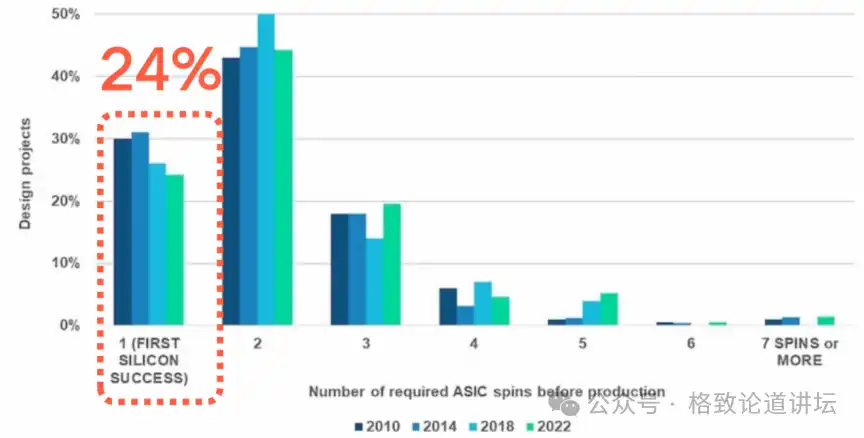
Therefore, the key question is: how can we ensure, as much as possible, that chips have as few or no bugs/design flaws as possible before tape-out and manufacturing? This is the direction I have been dedicated to researching over the past few years.
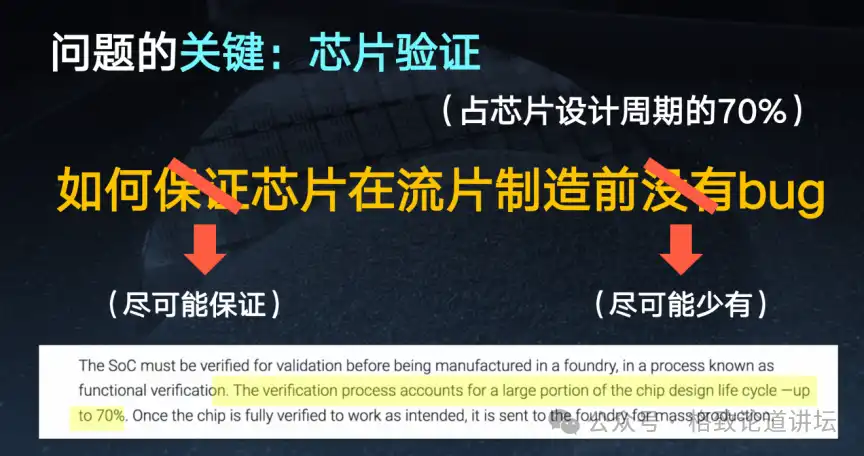
Also according to this research data, throughout the entire chip development process, especially with the current development of AI and various high-tech fields, chips are becoming increasingly complex. As a result, chip verification has become a very high proportion of the entire chip development cycle, even exceeding half, reaching 70% of the entire chip design cycle.

But unfortunately, chip verification is also a difficult task. I list some astronomical numbers here, such as the Earth's circumference, the possible number of stars in the Milky Way, or the length of a light-year.

In chip verification, there is also an astronomical number, which is the number of cycles needed to fully verify a CPU core. What exactly does this astronomical number represent?

If we use the most advanced software simulation technology available today to fully verify a CPU core, it would take at least 15,000 years. Using the most advanced hardware emulation technology can slightly reduce this time to 30 years. But we all know that developing a chip cannot wait 15,000 years, nor can it wait 30 years.
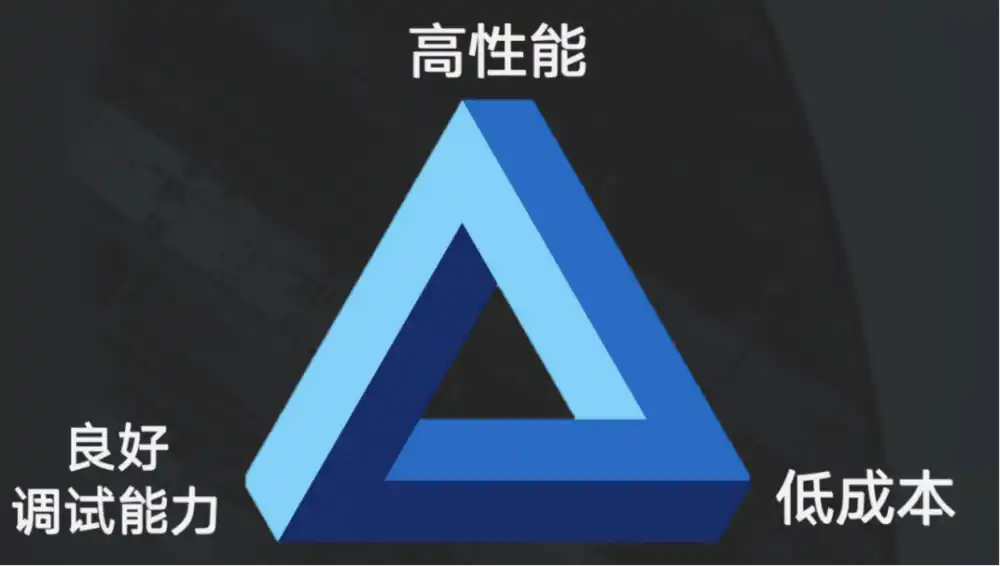
So, what is the essence of the problem? We have actually been researching this over the past few years. We found that in chip verification, there exists a so-called 'impossible triangle', namely the high performance of chip verification, good debugging capability, and low cost; these three factors crucial to chip verification cannot be satisfied simultaneously. For current mainstream research or methods, at most, two out of the three can be achieved, and this is the fundamental reason for the low efficiency of chip verification.

Someone Must Do Something Different

Completed: 60%//////////

Due to these reasons, chip verification has not seen significant development over the past period.

In chip companies, chip engineers may spend more time writing test cases and running regression verification. Essentially, it's dirty and tiring work. The same goes for academia; very few scholars are devoted to chip verification research, especially compared to current hot fields like artificial intelligence, research related to chip verification is very scarce.

So, an academic leader once told me that in the same amount of time, they could publish three or even more papers in the field of artificial intelligence, but in chip verification, they might not even publish one.

Unfortunately, what they said is true.

However, someone must do something different.

Therefore, over the past few years, I have led a team in conducting research related to chip verification and have built an agile verification research system from scratch. The core of this research system is a verification platform called ENCORE, which is based on a special chip—the Field-Programmable Gate Array (FPGA). ENCORE can significantly improve verification efficiency while achieving good verification debuggability.
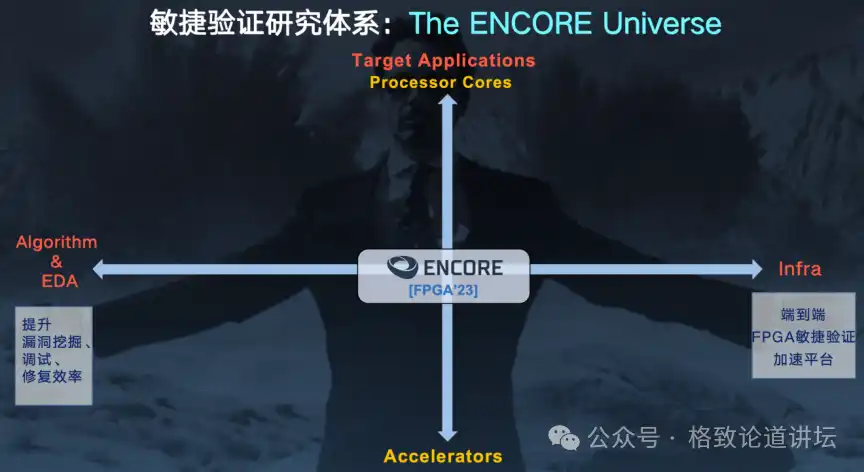
To build this agile verification research system, on one hand, we need to continuously optimize the efficiency of vulnerability mining, debugging, and repair at the algorithmic level; on the other hand, we also hope to build an end-to-end agile verification acceleration platform based on programmable logic chips (FPGAs). At the application level, we hope this platform can be suitable for both general-purpose processor verification, such as CPUs or GPUs, and specialized chip verification, such as the currently very popular AI accelerators.
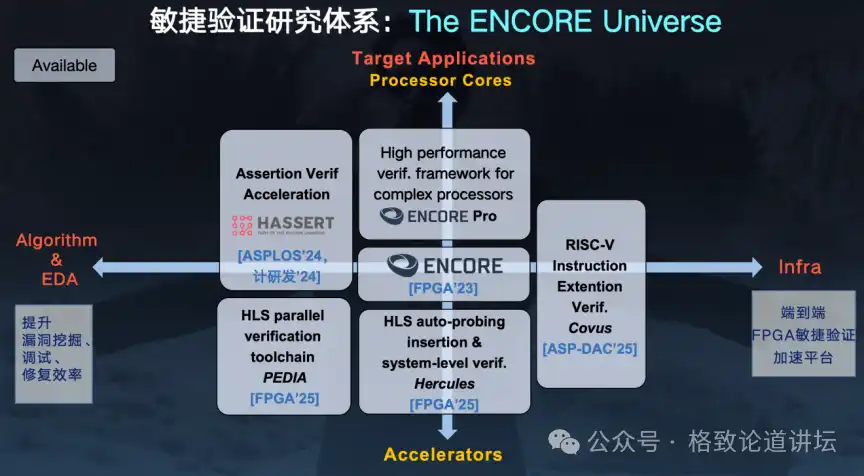
Over the past period, we have done a lot of cutting-edge exploratory work in this field, including the aforementioned ENCORE and many new research projects. We have also published these research results at many internationally renowned academic conferences.
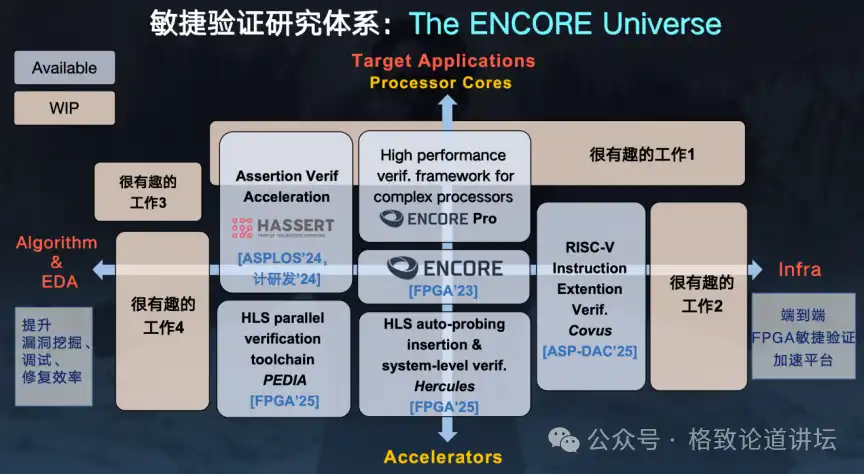
We are actually working on some interesting projects afterwards, but since these works have not been published yet, I won't show them to you one by one for now.

Letting More People Understand Chips

Completed: 80%//////////

However, during the research process, I gradually realized that these scientific or academic achievements are mainly for people within our small circle who only understand chip verification and related fields. So, how can we let more people see our work, understand our research, and even participate in our endeavors?

Naturally, I thought of chip science popularization, which also feels very interesting to me. I have been engaged in science popularization for four or five years, starting from text initially to later making videos on Bilibili. Chip science popularization has not only brought me many gains but also helped me meet many like-minded friends, as well as viewers who like and support me.
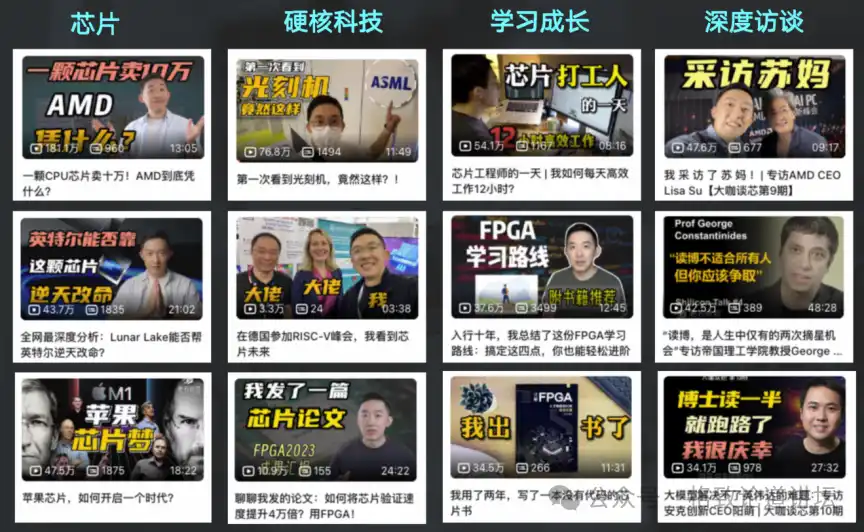
However, making chip science popularization videos is not a simple task, especially in today's era of short video proliferation. A fellow science popularization blogger and leader told me that in the same amount of time it takes me to produce one long, hardcore chip science popularization video, they could make 10 or even more short videos related to hot topics, and the traffic could be many times greater than mine.

Unfortunately, what they said is also true.

But based on this, I think there still needs to be people who persist in doing difficult things. I hope to combine chip science popularization and chip verification—two equally difficult but equally interesting things—and use video and text formats to show everyone what we have done, the papers we have published, and the open-source chip projects our entire large team is researching.

Besides chips, I will also share hardcore technologies like artificial intelligence and computers with everyone, as well as share my growth experiences, the books I have read, and the knowledge I have acquired. I know that I am not a genius myself, nor am I a so-called all-around expert or guru. I would rather be a 'guide' for everyone, sharing the path I have walked.

So, returning to the question I wanted to share with everyone today: chip research and chip science popularization, which one is more interesting? Of course, for me, both are equally interesting. The reason is simple: because they are equally difficult. At the same time, they both require me to persist very long-term and enduringly.

Many people say we need to do difficult and right things. But the problem actually is: how do you judge if something is right before you do it? If something is seen as sitting on a cold bench in others' eyes, or seen as doing dirty, tiring work, would you still persist in doing it?

Therefore, I prefer to do difficult and long-term things, such as academic research in chip verification, or making long hardcore chip science popularization videos. Because if something is difficult and requires long-term persistence, then it is probably right.

That's all I wanted to share with you today. I am Lao Shi, thank you, everyone!

This article comes from the WeChat public account: Gezhi Lundaotan , Author: Shi Kan, Original Title: 'How Difficult is Chip Making? A Division Error Costs 475 Million Dollars | Shi Kan'

Трендові криптовалюти

Пов'язані питання

QWhat was the main point of the story about the Intel Pentium chip flaw mentioned in the article?

AThe story illustrated a critical design bug in the Pentium chip's floating-point division unit. A calculation that should have resulted in '0' instead produced '255.00000000'. This seemingly minor error forced Intel to spend $475 million on a global recall of the faulty chips in the 1990s, highlighting the high cost of failure in chip development.

QAccording to the article, why is chip development so difficult, especially compared to software development?

AChip development is exceptionally difficult because it requires 'first-time success'. Unlike software, which can be patched and updated after release, a physical chip cannot be easily modified once manufactured (or 'taped out'). The entire expensive process, from sand to finished silicon, costing potentially hundreds of millions, must be redone to fix design flaws.

QWhat percentage of chip projects achieve first-time success according to the survey data cited by the author?

AAccording to the survey data presented by the author, only 24% of chip projects achieve first-time success. This means approximately three-quarters (76%) of projects require at least one re-spin or re-fabrication due to various undetected design bugs, leading to significant extra time and cost.

QWhat is the 'impossible triangle' in chip verification, as explained in the article?

AIn chip verification, the 'impossible triangle' refers to the three crucial factors—high performance, good debuggability, and low cost. The article states that these three factors cannot be satisfied simultaneously with current mainstream methods. Engineers and researchers can only achieve a maximum of two out of these three, which fundamentally limits verification efficiency.

QWhat are the two 'hard but long-term' pursuits that the author, Shi Kan ('Lao Shi'), is committed to?

AThe author is committed to two challenging, long-term endeavors. First, he leads academic research in chip verification, specifically developing an agile verification framework called ENCORE based on FPGAs. Second, he creates hardcore, long-form chip and technology popular science content (like his Bilibili channel videos), aiming to make complex topics accessible to a wider audience beyond academic circles.

Пов'язані матеріали

Options Don't Work in DeFi? Vitalik Might Not Agree

For years, the prevailing view has been that options struggle to gain traction in DeFi due to complexity, fragmented liquidity, and lack of natural demand compared to products like perpetual futures. However, a recent algorithmic stablecoin design proposed by Vitalik Buterin presents a different perspective, using options not as a standalone trading product, but as foundational infrastructure for other financial instruments. In this design, one unit of ETH is split into two components: a "stable" side (P) that retains value up to a specified strike price, and an "upside" side (N) that captures all appreciation above that strike. Combined, they always equal one ETH, eliminating debt, margin, and liquidation risks inherent in typical collateralized debt position (CDP) stablecoins. The stable component essentially mimics the payoff of a covered call option. To function as a stablecoin, this structure requires continuously rolling deep in-the-money calls, which introduces challenges like rollover slippage, predictable transaction flow vulnerable to front-running, and persistent liquidity needs. A core hurdle is finding consistent buyers for the leveraged ETH upside exposure (N). While it offers leverage without funding rates or liquidation, it must compete with simpler alternatives like direct call options or perpetuals. The system's scalability depends on a sustained demand for this specific form of leverage. The author draws parallels to their experience with Rysk, where earlier versions of DeFi options protocols struggled. The breakthrough came with Rysk V12, which aligns incentives: asset holders generate yield by selling covered calls against their holdings, while market makers efficiently acquire the desired option exposure. This demonstrates that options can find product-market fit when embedded as a risk distribution and pricing engine within structured products, stablecoins, or yield-generating assets, rather than marketed as a complex direct trading instrument. Vitalik's proposal reinforces this architectural approach—using fully collateralized, non-custodial, and physically settled options as a fundamental building block. The real opportunity for options in DeFi may lie not in becoming the next perpetual swap, but in powering the next generation of on-chain financial products.

marsbit25 хв тому

Options Don't Work in DeFi? Vitalik Might Not Agree

marsbit25 хв тому

Conversation with Investor Zheng Di: MicroStrategy's Coin Sale Experiment, AI Economy, and Opportunities in US Stocks

Frontier tech investor Zheng "Didier" Di discusses the recent Bitcoin price drop, the financial strategy shift at MicroStrategy, the AI-driven surge in U.S. stocks, and the evolving role of crypto exchanges. Didier posits that the recent BTC decline stems less from macro factors or ETF outflows, and more from market repricing due to MicroStrategy's new financial structure. Following a wave of preferred stock and debt issuance (STRC, STRZ, etc.), MicroStrategy must now manage cash flow to pay dividends, potentially leading to a market expectation of sustained, small-scale BTC sales to maintain its "per-share bitcoin neutral" principle. Didier views this as a financial "experiment" testing market capacity for such recurring sell pressure, which, while creating near-term structural headwinds, likely avoids a true "death spiral" absent major new external shocks. Shifting to AI, Didier argues that tokens are becoming the new form of labor, with AI models and compute (tokenized inputs) increasingly replacing human roles in execution and middle-management. This drives enterprise efficiency and higher margins, fueling the sustained rally in U.S. semiconductor, data center, and infrastructure stocks. He foresees an emerging "machine economy" where automated agents transact and collaborate on-chain. Regarding crypto exchanges offering U.S. equities, Didier sees this as a natural evolution. With few crypto-native assets generating lasting value, exchanges are pivoting towards real-world assets (RWAs) like stocks and bonds. This doesn't necessarily cannibalize crypto but reflects a maturing industry focusing on blockchain's core utilities: decentralized choice and efficient settlement. He notes that trading logic for crypto natives doesn't need to drastically change, as meme-driven and fundamentalist strategies find analogs in U.S. markets. The "1011 event" (likely referring to a major market crash) severely damaged crypto market liquidity, marking a probable end to the altcoin speculative cycle, with capital flowing towards the deeper liquidity of U.S. markets. For the macro outlook, Didier is cautious about near-term market pressure from potential mega-IPOs (e.g., SpaceX) and the U.S. midterm elections, which could bring more regulatory scrutiny. Long-term, he remains bullish on AI's productivity gains and its convergence with blockchain/Web3, predicting a shift from speculative frenzy to a more institutionalized, industrial phase for the crypto sector.

marsbit1 год тому

Conversation with Investor Zheng Di: MicroStrategy's Coin Sale Experiment, AI Economy, and Opportunities in US Stocks

marsbit1 год тому

Playnance’s $GCOIN Lists on KoinBX Amid Rapid Growth in India

Playnance's native token, $GCOIN, has been listed on the cryptocurrency exchange KoinBX as of June 18. This move aims to enhance accessibility for its rapidly growing community, particularly in India, where the blockchain-powered Web3 iGaming ecosystem has gained significant traction. Over 130 partners in Playnance's "Be the Boss" program have built communities engaging thousands of active players in the region. The "Be the Boss" model allows participants to create and manage their own gaming communities, earning rewards tied to community activity. CEO Pini Peter noted India's high engagement, with community leaders successfully building player networks. One partner, Dr. Nicolas, reported earning over $57,000 through the program in recent months, highlighting both the financial rewards and the opportunity to grow an engaged community. $GCOIN serves as the ecosystem's core utility token, incentivizing participation and aligning the interests of players and community leaders ("Bosses"). The listing on KoinBX is part of Playnance's strategy to expand globally, increasing the token's utility and accessibility by combining community ownership, gamified engagement, and blockchain-based incentives. Founded in 2020, Playnance is a Web3 iGaming infrastructure company focused on creating live, non-custodial, on-chain products to onboard mainstream users. It currently processes approximately one million transactions daily, aiming to simplify the user experience while maintaining full on-chain transparency.

TheNewsCrypto1 год тому

Playnance’s $GCOIN Lists on KoinBX Amid Rapid Growth in India

TheNewsCrypto1 год тому

STRC Hits Historic Low, Saylor's Perpetual Motion Machine Grinds to a Halt

STRC, the perpetual preferred stock issued by MicroStrategy to fund its Bitcoin purchases, hit a historic low of $85.32, a 17% discount to its $100 par value. Designed as a "digital credit engine" to trade stably near par and enable continuous share issuance for buying Bitcoin, its plunge signals a breakdown in this model. Three key factors drove the decline: 1. Bitcoin's price fell over 50% from its peak, trading around $63,000 amid hawkish Fed signals. 2. MicroStrategy's cash reserves were depleted after a $1.5 billion convertible note repayment, slashing the dividend coverage for STRC's 11.5% yield to ~7 months. The company then sold 32 BTC to cover dividends—Michael Saylor's first Bitcoin sale since 2022—damaging the "never sell" narrative. 3. A competing Bitcoin-backed preferred stock, Strive's SATA, offers a higher yield (~13%) and daily dividends, drawing investors away from STRC. The drop triggers a negative cycle: STRC below par halts ATM share issuances, cutting off a key funding source for Bitcoin buys and potentially forcing more BTC sales for dividends, further eroding confidence. While Saylor argues the model is mathematically sound—needing only 2.3% annual Bitcoin growth to sustain itself—the market is testing the resilience of the leveraged Bitcoin treasury strategy in a bear market. The STRC price now reflects rising skepticism about this financial machinery's durability during downturns.

marsbit2 год тому

STRC Hits Historic Low, Saylor's Perpetual Motion Machine Grinds to a Halt

marsbit2 год тому

Торгівля

Спот
Ф'ючерси

Популярні статті

Як купити CHIP

Ласкаво просимо до HTX.com! Ми зробили покупку USD.AI (CHIP) простою та зручною. Дотримуйтесь нашої покрокової інструкції, щоб розпочати свою криптовалютну подорож.Крок 1: Створіть обліковий запис на HTXВикористовуйте свою електронну пошту або номер телефону, щоб зареєструвати обліковий запис на HTX безплатно. Пройдіть безпроблемну реєстрацію й отримайте доступ до всіх функцій.ЗареєструватисьКрок 2: Перейдіть до розділу Купити крипту і виберіть спосіб оплатиКредитна/дебетова картка: використовуйте вашу картку Visa або Mastercard, щоб миттєво купити USD.AI (CHIP).Баланс: використовуйте кошти з балансу вашого рахунку HTX для безперешкодної торгівлі.Треті особи: ми додали популярні способи оплати, такі як Google Pay та Apple Pay, щоб підвищити зручність.P2P: Торгуйте безпосередньо з іншими користувачами на HTX.Позабіржова торгівля (OTC): ми пропонуємо індивідуальні послуги та конкурентні обмінні курси для трейдерів.Крок 3: Зберігайте свої USD.AI (CHIP)Після придбання USD.AI (CHIP) збережіть його у своєму обліковому записі на HTX. Крім того, ви можете відправити його в інше місце за допомогою блокчейн-переказу або використовувати його для торгівлі іншими криптовалютами.Крок 4: Торгівля USD.AI (CHIP)Легко торгуйте USD.AI (CHIP) на спотовому ринку HTX. Просто увійдіть до свого облікового запису, виберіть торгову пару, укладайте угоди та спостерігайте за ними в режимі реального часу. Ми пропонуємо зручний досвід як для початківців, так і для досвідчених трейдерів.

377 переглядів усьогоОпубліковано 2026.04.21Оновлено 2026.06.02

Як купити CHIP

Обговорення

Ласкаво просимо до спільноти HTX. Тут ви можете бути в курсі останніх подій розвитку платформи та отримати доступ до професійної ринкової інформації. Нижче представлені думки користувачів щодо ціни CHIP (CHIP).

活动图片