How Did the Idealism of Western Founders Get 'Taken Over' by Chinese Buyers?

比推Опубліковано о 2026-01-22Востаннє оновлено о 2026-01-22

Анотація

Over the course of two days, two major decentralized social protocols, Lens Protocol and Farcaster, were acquired—by Mask Network and Neynar, respectively. Combined, these protocols had raised over $200 million, with Farcaster recently valued at $1 billion. This follows the earlier acquisition of Steem by Tron in 2020, meaning two out of three prominent decentralized social protocols are now been taken over by Chinese-led teams. The author explores why Chinese buyers are stepping in. One reason may be pricing: these acquisitions often target once-prominent projects now in decline. For instance, Farcaster’s monthly revenue has dropped over 95%, and Lens has only 50,000 monthly active users. Another factor is cultural: while Western founders often approach decentralized social with idealism—emphasizing user-owned data and censorship resistance—Chinese acquirers tend to view it as a business opportunity, prioritizing usability and growth over ideology. Suji Yan, founder of Mask Network, explicitly aims to move “decentralized social from the lab to daily life.” However, past acquisitions like Steem—which led to a community fork—highlight risks when new ownership clashes with original values. The piece questions whether true decentralization is possible when protocols can be sold, suggesting that technical decentralization doesn’t prevent centralized commercial control. Ultimately, the piece argues that the vision for a better social infrastructure remains, but the builders a...

Author: David, Deep Tide TechFlow

Original Title: Web3 Social, Still Dominated by the Chinese


Within two days, two decentralized social protocols changed hands.

On January 20th, Lens Protocol announced it was being taken over by Mask Network. On January 21st, Farcaster announced it was acquired by Neynar, one of its clients.

These two protocols raised over $200 million combined. Farcaster was valued at $1 billion last year, with investors including a16z and Paradigm. Lens is backed by DeFi giant Aave.

Now, the founders have "stepped back from daily operations to work on new projects."
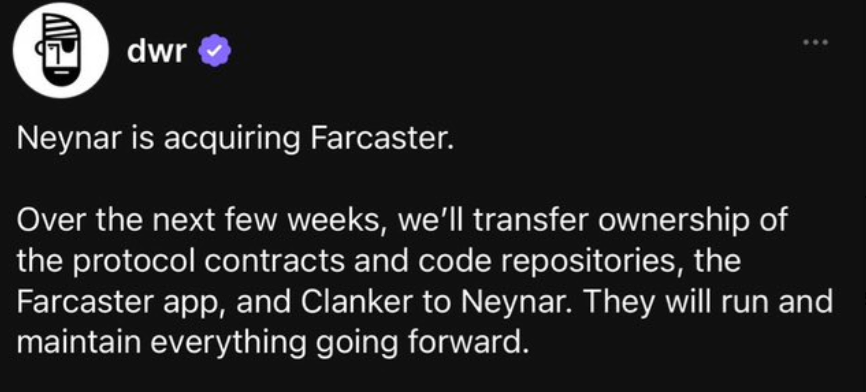
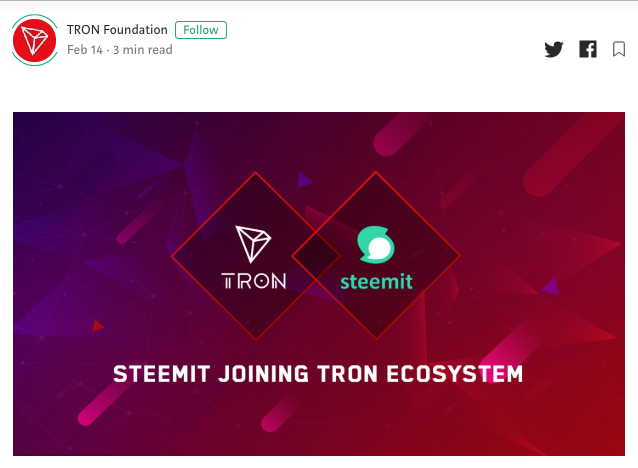
Including Steem, another well-known project acquired by Tron in 2020, two out of these three phenomenal decentralized social protocols have now been taken over by Chinese teams.

You might have forgotten about Steem. It was the pioneer of "writing to earn" launched in 2016, a benchmark project for the entire Web3 social track at its peak. After being acquired by Justin Sun, the community forked and left, which we'll discuss later.

The founder of Mask Network, which took over Lens, is Suji Yan. Chinese, dropped out of UIUC at 20 to start a business, previously wrote articles for Caixin and Jiemian.

Founded Mask in 2017, focusing on overlaying Web3 features on traditional social platforms like Twitter.

Mask has been on an acquisition spree: acquired two large Japanese instances of Mastodon in 2022, bought Orb, the most active client on Lens, last year, and now has taken over Lens itself.

Suji Yan positions himself as the "Tencent of Web3".

On the Farcaster side, the two founders of Neynar, which took it over, are of Indian descent, both former Coinbase employees. But the reality that two out of three protocols were taken over by Chinese teams still holds.

Why the Chinese?

One possible explanation is capability endowment. The two most successful countries globally in making social products are the United States and China. WeChat, Douyin (TikTok), Xiaohongshu (Little Red Book) – Chinese teams have proven they can scale social products to billions of users.

But this explanation has a problem. Building products and acquiring protocols are not the same thing. Protocols are infrastructure, not directly facing users. You can build products on them, but the protocol itself doesn't generate the user experience.

Another reasonable explanation is price.

Looking at Brother Sun's (Justin Sun) acquisition list: bought BitTorrent for $140 million in 2018, Poloniex in 2019, Steemit in 2020, and HTX (formerly Huobi) in 2022.

These targets have a common trait:

They were all once glorious but are on a downward trend. BitTorrent was the pioneer of P2P downloading, Poloniex was once a top US exchange, HTX was once one of China's top three exchanges.

Justin Sun isn't buying the best; he's buying the cheapest good stuff.

Now Farcaster is valued at $1 billion but its monthly revenue has dropped to $10,000, down over 95% year-over-year. Founder Dan Romero admitted last month in a post that "after 4.5 years of trying the social-first approach, it didn't work";

Lens has only 50,000 monthly active users, and the Aave team wants to offload it to focus on its DeFi core business.

The most valuable time for these protocols has passed, but the technical foundation and brand remain. In A-share market terms, this is called:

Fallen out of value (Undervalued).

There's a more subtle line of thought: decentralized social is a belief in the West, but a business in China.

Western founders in this space often carry a degree of idealism. Users should own their data, social graphs should be portable, platforms shouldn't have censorship power... Farcaster's slogan is "sufficiently decentralized", Lens's is "user-owned social".

But after five years, users don't care.

Ordinary people don't care who owns the data, or whether the social graph can be taken away. They care if there are people to chat with, if there is interesting content, if there are associated assets that can skyrocket.

Chinese buyers taking over is, in a way, taking this business from the idealists and handing it to the pragmatists.

Suji Yan says what Mask wants to do is "bring decentralized social from the lab into daily life". Translating that:

Stop talking about ideals, first make people willing to use it.

Of course, the last time a Chinese entity acquired a decentralized social protocol, the outcome wasn't pretty.

In 2020, Justin Sun bought Steem. After the acquisition, he collaborated with exchanges to take control of Steem's network governance. The original community's reaction was a collective fork to create a new chain, Hive, using code to exclude Justin Sun's wallet.
A fork is the most extreme form of protest in the blockchain world – we're not playing with you anymore, we'll copy everything and leave on our own.

Steemit is still running, but more active users have long since moved to Hive.

So the question is, will it be different this time?

Regarding Mask taking over Lens, the official term is "stewardship", not the word "acquisition". The founders will continue as advisors, and the protocol remains open.

But the fact that a "decentralized protocol" can be acquired itself already says something. Contracts can be transferred, codebases can be transferred, Apps can be transferred. So where is the "decentralization"?

After the disillusionment, decentralization is just a technical architecture, not a business model. Technically decentralized does not prevent someone from having the final say commercially.

After Lens changed leadership, Vitalik posted. He said every post he made in 2026 was through Firefly, which is precisely the multi-platform client under Mask Network.

He also said: "If we want a better society, we need better tools for mass communication."

This is true. But who builds this tool, who operates it, who decides what it looks like – decentralization doesn't answer these questions.

The answer now might be: the Chinese will build it.


Twitter:https://twitter.com/BitpushNewsCN

Bitpush TG Discussion Group:https://t.me/BitPushCommunity

Bitpush TG Subscription: https://t.me/bitpush

Original link:https://www.bitpush.news/articles/7605174

Пов'язані питання

QWhat are the two decentralized social protocols that recently changed ownership, and who acquired them?

ALens Protocol was acquired by Mask Network, and Farcaster was acquired by Neynar, one of its clients.

QWhy are Chinese buyers particularly interested in acquiring these Western-founded decentralized social protocols?

AChinese buyers see these protocols as undervalued assets with strong technical foundations and brand recognition, and they approach them from a pragmatic, business-oriented perspective rather than idealistic beliefs in decentralization.

QWhat was the outcome of the previous acquisition of a decentralized social platform by a Chinese buyer, specifically Tron's acquisition of Steem?

AAfter Tron acquired Steem, the original community forked the chain to create Hive, effectively excluding Tron's wallets and moving most active users away from Steemit.

QHow does the acquisition of decentralized protocols like Lens and Farcaster challenge the notion of 'decentralization'?

AThe ability to acquire these protocols highlights that decentralization is primarily a technical architecture rather than a governance model, as ownership and control can still be centralized in the hands of a few entities.

QWhat is Mask Network's stated goal for Lens Protocol, as mentioned in the article?

AMask Network aims to move decentralized social protocols 'from the laboratory into daily life,' focusing on practicality and user adoption rather than idealistic principles.

Пов'язані матеріали

The Value Distribution of Stablecoins

**Summary: The Value Distribution of Stablecoins** The article argues that stablecoins are evolving from mere trading tools into broader channels for dollar access. It divides the stablecoin ecosystem into four layers to analyze how value is distributed: 1. **Issuance Layer:** Mints stablecoins, holds reserve assets, and captures the spread between reserve yield and user costs (e.g., Tether, Circle). This layer currently earns the largest profit margin. 2. **Infrastructure Layer:** Connects stablecoins to the traditional financial system, handling fiat on/off-ramps, banking integration, compliance (KYC/AML), and asset management (e.g., Bridge, BVNK). This is the "unglamorous" but critical work, building the essential bridges between crypto and real-world finance. 3. **Acquiring/Distribution Layer:** Integrates stablecoins into merchant systems, manages payment flows, and provides enterprise financial software (e.g., Stripe, Coinbase). They act as the access point for businesses. 4. **Application Layer:** The end-users and businesses that ultimately use stablecoins for payments, settlements, or as a store of value. They benefit from convenience but have little pricing power. The core thesis is that while the issuance layer currently dominates profits, the often-overlooked **infrastructure layer holds significant long-term potential**. The real challenge and barrier to mass adoption is not the on-chain transfer of stablecoins (which is simple), but the complex "last mile" integration into existing business workflows, banking systems, and regulatory frameworks across different countries. Companies in this layer are currently in a "land grab" phase, investing heavily to build networks, secure bank partnerships, and establish compliance pathways. While their position is currently pressured by the profitable issuers above and distribution platforms below, the article suggests that if stablecoins become a default financial rail for businesses, the infrastructure providers who have done the hard work of integration will ultimately gain strong pricing power and become entrenched, essential players.

marsbit5 год тому

The Value Distribution of Stablecoins

marsbit5 год тому

The Value Distribution of Stablecoins

The Value Distribution of Stablecoins The article argues that stablecoins are evolving from a mere trading tool into a broad "dollar channel." It analyzes the industry's value chain through four layers: 1. **Issuance Layer (e.g., Tether, Circle):** The top layer that mints stablecoins, holds reserve assets, and captures the thickest interest rate spread. 2. **Infrastructure Layer (e.g., Bridge, BVNK):** Connects stablecoins to the traditional financial system, handling critical but complex "dirty work" like fiat on/off-ramps, banking integration, compliance (KYC/AML), and cross-border settlement. 3. **Acquiring/Distribution Layer (e.g., Stripe, Coinbase):** Embeds stablecoins into merchant systems, manages payment flows, and integrates with enterprise software. 4. **Application Layer:** End-users and businesses that ultimately use stablecoins for payments, settlement, or storing value. The author posits that while the issuance layer currently captures the most profit, the most overlooked and potentially critical layer is infrastructure. The core challenge for stablecoin adoption isn't the on-chain transfer (which is simple), but bridging the gap between blockchain and the real-world financial system. This involves solving practical problems for businesses: fiat conversion, reconciliation, tax handling, and user onboarding. Infrastructure companies are currently in a difficult "land-grab" phase—building networks, securing banking relationships, and achieving compliance country-by-country. They face pressure from both the profitable issuance layer above and distribution platforms below. However, the author suggests this layer is building a crucial moat. Once stablecoins become a default business rail, the infrastructure players who have done the hard work of integration may gain significant, durable value and pricing power.

链捕手5 год тому

The Value Distribution of Stablecoins

链捕手5 год тому

Торгівля

Спот
Ф'ючерси
活动图片





