How crypto is used in 2025: YouTube, Pokémon cards and more

cointelegraphОпубліковано о 2025-12-15Востаннє оновлено о 2025-12-15

Анотація

In 2025, cryptocurrency is increasingly used in specific digital workflows, though not yet as everyday money. A major use case is for payments: freelancers, YouTubers, and creators receive income in stablecoins like USDC and USDT, bypassing traditional payment delays and fees. Platforms like YouTube now allow payouts via PayPal’s PYUSD. Crypto is also used for purchasing digital goods and services, such as domain registrations, VPNs, and hosting, with companies like Namecheap and Mullvad accepting it. Additionally, crypto supports the digitization of physical collectibles, with tokenized versions of items like Pokémon cards gaining popularity. In DeFi and GameFi, users engage in token swaps, yield farming, and play-to-earn games, though these remain niche. Decentralized autonomous organizations (DAOs) use crypto for onchain governance, though participation is limited to crypto-native users. While challenges like banking restrictions and bot cheating persist, crypto is growing by reducing friction in global digital transactions.

For years, one of the simplest and most effective criticisms of cryptocurrency was the same question repeated over and over: “Where can you actually use it?”

Bitcoin (BTC) was pitched as money, but outside a handful of novelty merchants, it rarely behaved like one. The question lingered through bull markets and crashes, reinforcing the idea that crypto was something to hold, trade or argue about rather than something to use.

That looks different in 2025. Crypto is still not everyday money at the checkout counter, but it is used across specific digital workflows, where speed or direct settlement are prioritized over familiarity.

Here are the places where people are actually using crypto today.

YouTubers and freelancers get paid in crypto

One of the most common ways people use crypto today is to pay for work and receive income online. Freelancers, contractors and creators use stablecoins like USDC (USDC) or Tether’s USDt (USDT) to settle payments directly between wallets, without relying on traditional payment processors.

A recent example comes from YouTube. The world’s largest video-sharing platform reportedly enabled US-based content creators to cash out using PayPal’s stablecoin, PayPal USD (PYUSD).
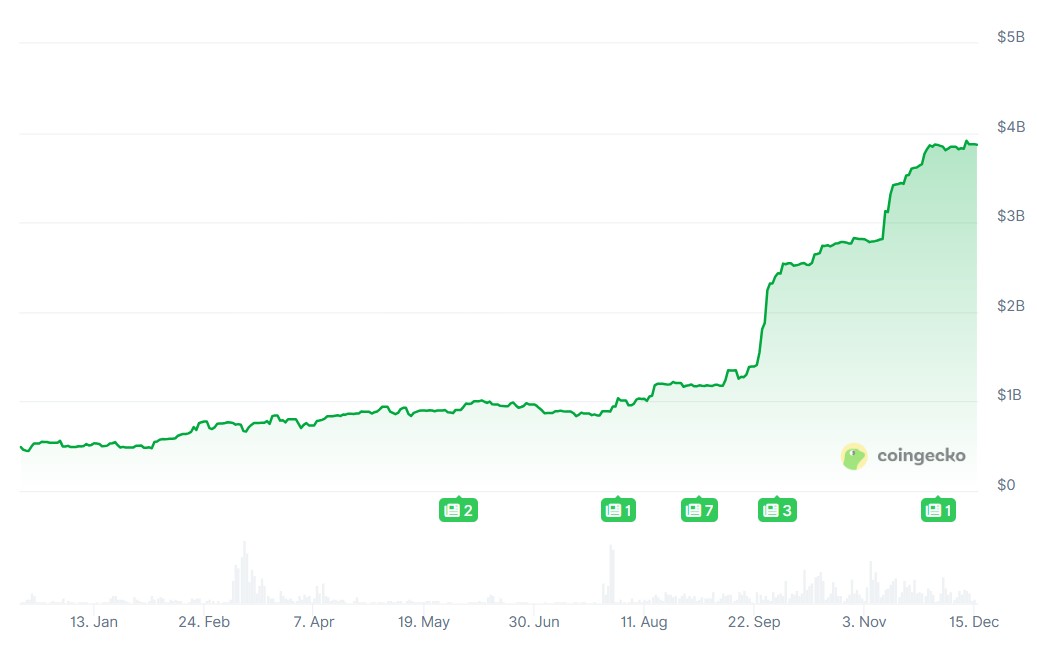
PayPal’s stablecoin is closing in on a $4-billion market capitalization. Source: CoinGecko

For clients and employers, this removes delays, fees and transfer limits that often come with international payments. This model is especially common in remote work and creator economies.

However, those who opt for crypto payments may still face difficulties when converting crypto into fiat. Industry participants have said banks continue to close or restrict the accounts of crypto firms with little explanation despite a more crypto-friendly stance taken by the current US administration.

Use crypto to purchase digital goods

Beyond paying individuals, crypto is also used to settle payments with businesses. This is most common among online services with global customers, where traditional payment systems introduce friction through fees, delays or regional restrictions.

Domain registrars, hosting providers and privacy-focused software companies are among the most visible adopters. Providers like Mullvad VPN allow customers to pay using cryptocurrency, while Namecheap and Porkbun accept crypto for domain registrations and hosting services. On Sept. 9, Namecheap CEO Richard Kirkendall said the company received a $2-million BTC payment for a domain sale.
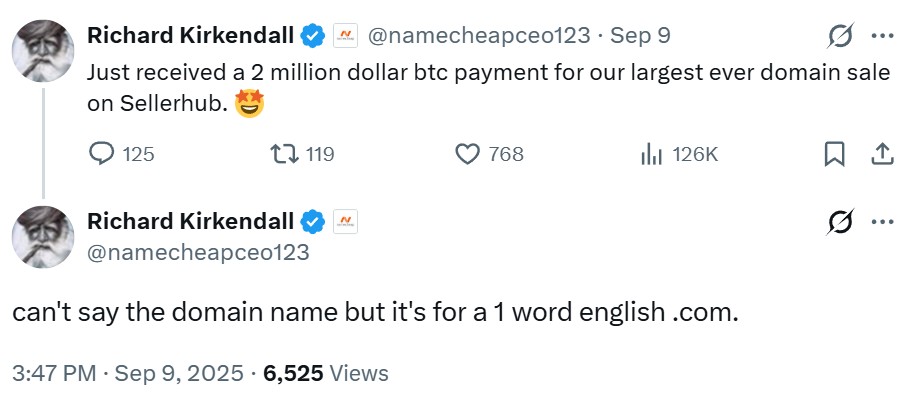
Namesake received Bitcoin for one of its largest sales ever. Source: Richard Kirkendall

More recently, mainstream payments and commerce platforms have started integrating stablecoin payments. Stripe has enabled businesses to accept USDC payments and launched the public testnet of its own stablecoin blockchain, Tempo. Shopify has piloted stablecoin-based checkout options for merchants selling internationally.

Related: Bitcoin decouples from stocks in second half of 2025

Clearer regulatory treatment of stablecoins in the US, driven by the signing of the GENIUS Act into law, has reduced uncertainty for some merchants considering these pilots.

Digitizing and extending physical collectible cultures

Crypto has also found use in the digitization of collectible cultures that were already thriving offline. In 2025, interest in physical collectibles surged again, driven by renewed demand for Pokémon cards, Labubu figures and other toys.

Alongside that revival, digital and tokenized versions of collectibles gained traction as an extension rather than a replacement of physical collecting.

Tokenized Pokémon-style cards and digital gachas — popular randomized item vending machines — became popular ways for collectors to participate in familiar formats online, especially as marketplaces and communities shifted from binders and display cases to apps and web platforms.

Collectors can spend between $50 and $250 to test their luck on tokenized versions of legendary Pokémon cards. Source: Collector Crypt

Crypto’s niche inside DeFi and GameFi

In decentralized finance (DeFi), users swap tokens, provide liquidity to farm yield, lend assets or borrow against collateral through smart contracts.

Blockchain-based games operate in a similar way. Often, blockchain and crypto add economic layers to games running on Web2 infrastructure. Players use crypto to buy or trade in-game items and move assets between marketplaces.

Related: How prediction markets raise insider trading and credit risks

A popular model is play-to-earn gaming, where players earn crypto through gameplay. A well-known example is Axie Infinity, which became a primary source of income for some communities in the Philippines during the pandemic. In 2025, play-to-earn games are more likely to provide extra income rather than a primary livelihood. Developers also face persistent challenges, including cheaters using bots to farm rewards, which takes value away from fair players.

According to DappRadar, World of Dypians, which operates across multiple chains, including Ethereum and BNB Chain, leads blockchain games with more than 1 million unique active wallets interacting with the game. Treasure-collecting game Pixudi Runs, which also operates across multiple chains, such as Sei and Polygon, ranks second with nearly 570,000 active wallets.

Blockchain games remain niche but attract thousands of active wallets daily. Source: DappRadar

Running organizations with crypto onchain

Deeper in DeFi, crypto is used to coordinate decentralized autonomous organizations (DAOs). In these groups, tokenholders are the members. They use their tokens to vote on proposals, approve spending and decide how the organization is run. Votes are recorded onchain, and once a proposal passes, actions such as payments or rule changes are carried out automatically through smart contracts.
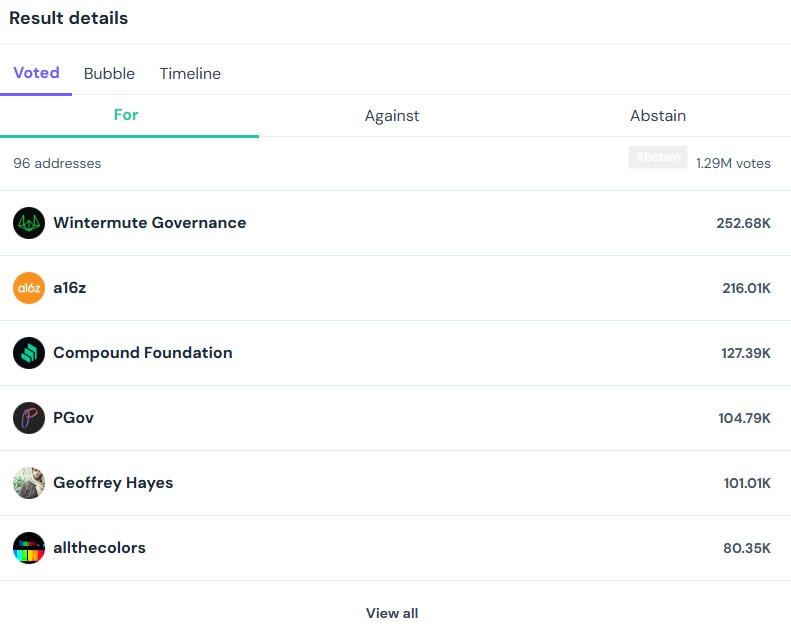
Voting power is concentrated among large tokenholders, many of whom often abstain from governance votes. Source: Tally

DAOs are mostly used to manage crypto-native projects. Taking part usually means holding governance tokens, navigating onchain voting proposals and managing a wallet. These requirements make DAO governance impractical for most casual users.

As a result, DAOs remain largely the domain of people already active in the crypto ecosystem.

Crypto’s current uses are broader than its early ambitions, and development continues. Financial companies are using blockchains to tokenize real-world assets, settle transactions with stablecoins and test onchain versions of traditional financial products.

Other experiments, such as wallet-based identity systems and Bitcoin-backed lending, remain in early stages. But they follow familiar patterns, with crypto most likely to integrate into existing services and remove frictions created by intermediaries.

Magazine: Big questions: Would Bitcoin survive a 10-year power outage?

Пов'язані матеріали

From South Korea to the United States: Blue-Collar Jobs Are Becoming Increasingly Popular, Thanks to AI

AI is reshaping the labor market's value proposition. The traditional four-year college degree is losing its appeal as a guaranteed career path, while skilled blue-collar trades like electricians, welders, and plumbers are experiencing historic demand and wage premiums. This shift is driven by dual pressures: AI's displacement of certain white-collar roles and a booming need for physical infrastructure and data center construction. Data confirms the trend. In the U.S., vocational school revenue surged, and a significant portion of recent layoffs are AI-related. Surveys show a majority of Gen Z adults plan to pursue blue-collar work, citing better job security against AI automation. Vocational education interest has exploded recently. Experts cite a psychological shift as younger generations seek tangible, AI-resistant careers and avoid high student debt. In many cases, salaries for skilled trades now match or exceed those requiring a bachelor's degree. In South Korea, semiconductor vocational high schools boast near-total employment, with graduates securing high-paying roles at companies like Samsung. The shortage is structural, exacerbated by a retiring baby boomer workforce and massive infrastructure projects. Companies like JPMorgan Chase, Meta, and Lowe's are investing heavily in training programs. However, overcoming historical stigma and a "perception gap" around trade careers remains a key challenge to closing the talent gap.

marsbit42 хв тому

From South Korea to the United States: Blue-Collar Jobs Are Becoming Increasingly Popular, Thanks to AI

marsbit42 хв тому

Qualcomm: AI Hype Subsides, When Will Smartphones Emerge from the Gloom?

Qualcomm reported its Q3 FY2026 results (ending June 2026), with revenue of $9.95B, down 4% YoY but above expectations. Gross margin declined to 53.1%, pressured by rising costs across manufacturing and memory. Key business segments showed mixed performance: Handset revenue fell 19.6% YoY to $5.09B, dragged by an 11% decline in non-Apple Android shipments and weaker high-end mix. Conversely, Automotive revenue surged 61% to $1.59B, and IoT grew 9% to $1.83B. Core operating profit dropped 41% YoY due to margin compression and higher expenses. Management's Q4 FY2026 guidance projects revenue of $9.7B-$10.5B, in line with consensus, but Non-GAAP EPS guidance of $2.05-$2.25 fell short of expectations. Amidst persistent weakness in its core handset market, Qualcomm is pursuing growth in AI, focusing on Edge AI (smartphones, PCs, automotive) and Data Center AI. Its data center strategy includes four pillars: AI accelerators (e.g., AI200), commercial CPUs (Dragonfly C1000), custom silicon, and connectivity solutions. While these initiatives initially boosted its stock, concerns over AI capital expenditure sustainability have since erased those gains. The company targets $5B in data center revenue for FY2027 and $15B for FY2029. The report concludes that with the traditional handset business still under pressure, the data center opportunity is currently viewed as a longer-term option, and a more conservative valuation based on core operations may be warranted until AI contributions materialize.

marsbit47 хв тому

Qualcomm: AI Hype Subsides, When Will Smartphones Emerge from the Gloom?

marsbit47 хв тому

From TPU to Self-Evolving Agents: How Jeff Dean Predicts the Next Step in AI

At the 2026 YC Startup School, Jeff Dean outlined his vision for AI's next phase, shifting focus from simply scaling models to building intelligent, autonomous systems. He believes AI's progress is no longer just about creating smarter models, but about integrating them into systems capable of long-term, iterative work, automated experimentation, and continuous learning. This evolution moves the competition from "who has the bigger model" to "who can best organize intelligence." Dean suggests AI capabilities are now comparable to a junior engineer, enabling the automation of complex workflows. However, the true challenge and opportunity lie in managing these AI "workers" at scale. He emphasizes the importance of **context engineering**—structuring tools, memory, and feedback loops—over raw model power. For startups, this means building deep expertise in niche domains where general models currently fail (near 0-1% success rates), leveraging proprietary data, specialized tools, and domain-specific evaluators. A recurring theme is re-examining fundamental constraints. Dean's past work, like moving Google's search index to memory or creating the TPU, stemmed from questioning outdated assumptions about hardware and cost. He sees similar inflection points today, particularly in **specialized inference hardware** to drastically reduce latency and energy consumption for real-time Agent operation. Notably, he points out that in modern AI systems, the dominant cost is often not computation but **data movement**. Reliable, long-running Agents require robust system design, borrowing concepts from distributed computing like checkpointing, state management, and parallel exploration to handle failures and maintain progress over days or weeks. As AI automates execution, the scarcest human skills will shift to **defining clear specifications**, **judging what problems are worth solving** (taste), and designing effective feedback loops. Ultimately, Dean's framework prioritizes understanding the problem deeply, identifying the true bottlenecks, and systematically building closed-loop systems where AI can not only perform tasks but also improve AI itself.

marsbit47 хв тому

From TPU to Self-Evolving Agents: How Jeff Dean Predicts the Next Step in AI

marsbit47 хв тому

Торгівля

Спот
活动图片




