How Can War News Turn into Millions in Profits a Step Ahead?

比推Опубліковано о 2026-03-02Востаннє оновлено о 2026-03-02

Анотація

The article "How War News Turns into Millions in Profits" explores the rise of prediction markets like Polymarket and Kalshi as digital arenas for wagering on geopolitical events, using the hypothetical U.S.-Israel airstrike on Iran on February 28, resulting in the death of Iran’s Supreme Leader Ali Khamenei, as a case study. These platforms saw surging trading volumes, with Polymarket’s market on "Will Khamenei be ousted by February 28?" reaching $95.93 million in daily volume. While Polymarket operates with anonymity and a profit-based fee model, Kalshi faced controversy for refusing to fully pay out on contracts tied to deaths, citing ethical concerns. The piece also highlights suspicions of insider trading, with some wallets making highly timed, profitable bets ahead of the strike. The trend raises questions about morality, market manipulation, and the need for stricter regulation as prediction markets blur the lines between real-world conflict and digital profit-seeking.

Author: Ma He, Foresight News

Original Title: Prediction Platforms Are Becoming the Digital Battlefield of Postmodern Warfare


On February 28, the United States and Israel jointly launched an airstrike against Iran, resulting in the death of Iran's Supreme Leader Ali Khamenei. This attack shook Middle Eastern geopolitics. In the 21st century, the flames of war continue to spread everywhere, and its impact has also stirred up huge waves in the prediction markets of the crypto world.

Polymarket and Kalshi became another "battlefield" outside the actual war zone. Traders placed bets on the timing of the attack, regime change, and ceasefire dates, with trading volumes soaring to astronomical figures.

In war, some are always quietly making a fortune.

Polymarket became a "barometer" of the conflict. Since last December, they had set up a market for "When will the US strike Iran?" covering various date options.

The prediction market "Will Khamenei step down by February 28?" saw a daily trading volume of $95.93 million on February 28, becoming one of the platform's largest geopolitical markets ever. Its trading volume reached $54.15 million on March 31.
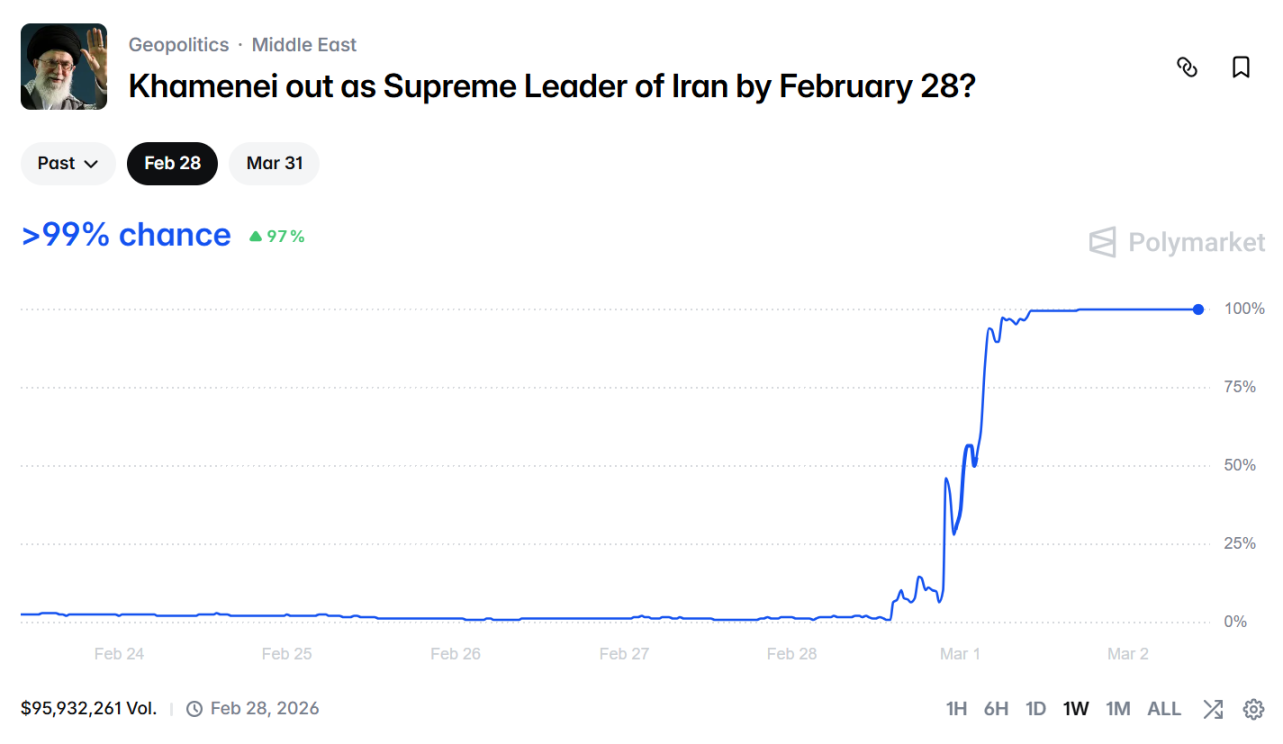
After the attack was confirmed, this market quickly settled to "Yes" (it is still in the final dispute period), as Khamenei's death directly led to him "stepping down."

Although Polymarket currently does not charge any transaction fees for the vast majority of its regular markets (including all political, geopolitical, pop culture, and long-term macro events), in early 2026, Polymarket introduced fees for specific high-frequency trading markets. The expansion of its brand influence has a significantly positive impact on its revenue growth.

Furthermore, the global version of Polymarket uses a profit-based fee model. Its core logic is: users do not need to pay fees when placing buy or sell orders daily, but when users close a position for profit, the platform charges a 2% fee on the net profit. This model only taxes the "winners."

Taking the example in the image, if the total net profit of the winners is $10 million, the income from this single prediction market alone would reach $200,000.

Traders flocked there not only for the thrill but also because these markets reflect news in real time—much faster than traditional media. As soon as news of the attack broke, contract prices instantly jumped, demonstrating the market's "efficiency."

There are always winners in war. In the past, those who profited from conflicts were often arms dealers, oil giants, or intelligence peddlers—think of Lockheed during World War II or the oil tycoons during the Cold War, who made fortunes through contracts and resource monopolies. Ordinary people? At best, they were bystanders; war meant loss and uncertainty for them. But now, crypto prediction markets have颠覆ed this landscape. Platforms like Polymarket allow retail investors to also bet on geopolitical events, from the date of US-Iran airstrikes to the probability of regime change, sharing a piece of the pie with just a few clicks.

However, participating in this game also blurs ethical boundaries. This shift is striking: the "dividends" of war have spread from the physical supply chain to the digital gambling table. Arms dealers are still making money, but prediction markets have turned ordinary users into new players. They don't produce missiles, but they can "predict" explosions on the blockchain and profit handsomely.

When conflicts escalate, platform trading volumes explode; the war economy has gone digital.

But this also raises many questions—does the thrill of making money dilute compassion for real suffering?

Kalshi, as another player, also got a share of the pie. Their "Will Khamenei step down?" market had a trading volume of tens of millions of dollars (slightly varying by source). On the day of the attack, trading volume in this market surged, reaching tens of millions of dollars in a single day.

But Kalshi's handling of the situation sparked controversy. A clause in the platform's rules states "no settlement on death," meaning that if stepping down is due to death, the "Yes" contract will not be paid in full.

After the attack, Kalshi suspended the market. CEO Tarek Mansour posted on X to explain: they oppose profiting from an individual's death, so they would settle at the last traded price before the death and refund all fees in full. Mansour emphasized that this was to uphold "moral bottom lines" and avoid the platform becoming a "death betting pool." Some users complained that this was like changing the rules mid-game, but Kalshi insisted this was a pre-set term, with details clarified just the day before the attack.
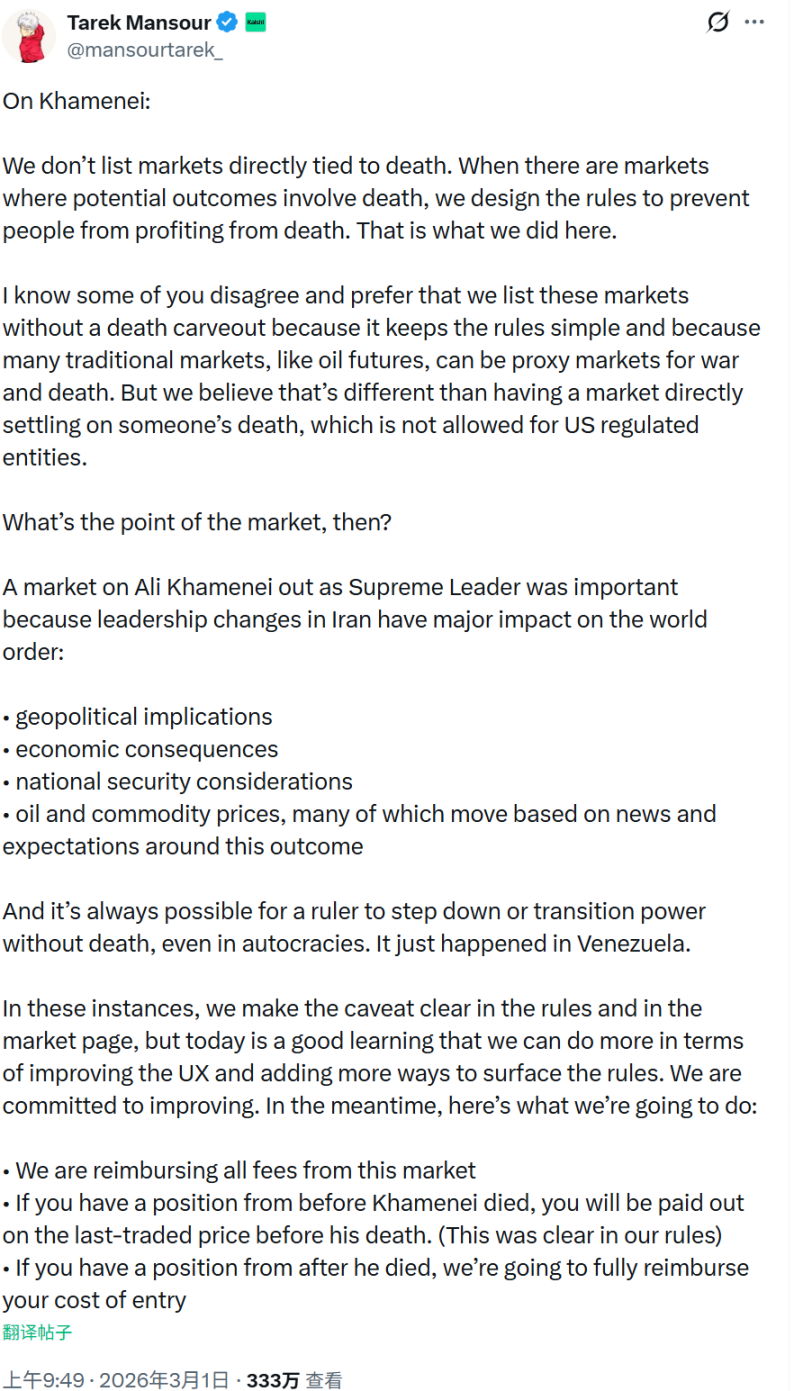
As a result, the platform lost money but gained a reputation for "not making money from the dead."

Polymarket has high user anonymity, attracting global funds; Kalshi is more compliant but restricts markets related to war and assassination.

However, while most players bet based on gut feeling, some insiders are also quietly making a fortune.

On Polymarket, the timing of some accounts' bets was so precise that it raised suspicions of insider trading. Blockchain analysis company Bubblemaps discovered that six newly created wallets placed bets on a US strike against Iran on February 28 just hours before the attack, collectively profiting about $1 million.
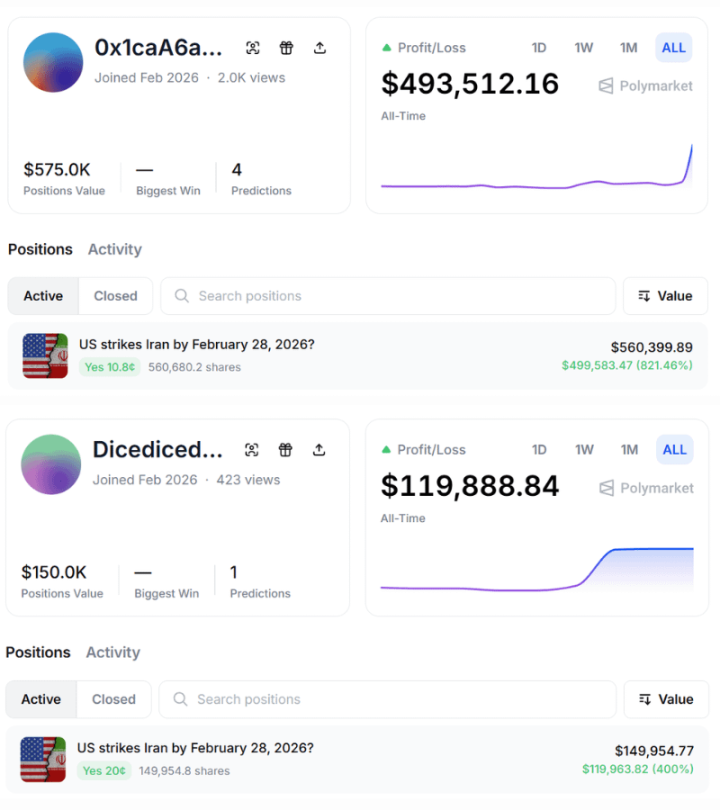
These 6 wallets were all created in February of this year. Almost all their trading was concentrated on contracts predicting the timing of the US military strike. Some positions were established hours before the first news of explosions emerged from Tehran, with contract purchase prices as low as around $0.10. Analysts stated that such concentrated betting behavior before major geopolitical events is characteristic of "suspected insider trading" previously seen in prediction markets.

However, the report also pointed out that the related accounts had incurred losses in other predictions before, and the US government had publicly warned weeks earlier that military action was possible. Therefore, the timing of the trades alone is not sufficient to directly prove illegal activity.

These are not isolated cases. Polymarket has faced similar质疑 in the past, such as during the 2024 Super Bowl or the Venezuela incident. But this time the scale is larger, involving national security. The CFTC has warned about insider trading in the past, and Kalshi recently penalized famous YouTube creator MrBeast's team editor, Artem Kaptur, for insider trading. Polymarket operates overseas with loose regulation, becoming a gray area.

US Representative Ritchie Torres is promoting legislation called the "2026 Public Integrity in Financial Prediction Markets Act," which aims to restrict government officials with access to non-public information from trading on related prediction markets. Meanwhile, Polymarket has faced regulatory restrictions or bans in multiple countries in recent years, including the Netherlands, France, Italy, and Singapore.

Of course, not everyone won. Many bet on the wrong date and suffered heavy losses. Currently, Polymarket has updated its website's top display, pinning all prediction markets related to the Iran situation to the top.
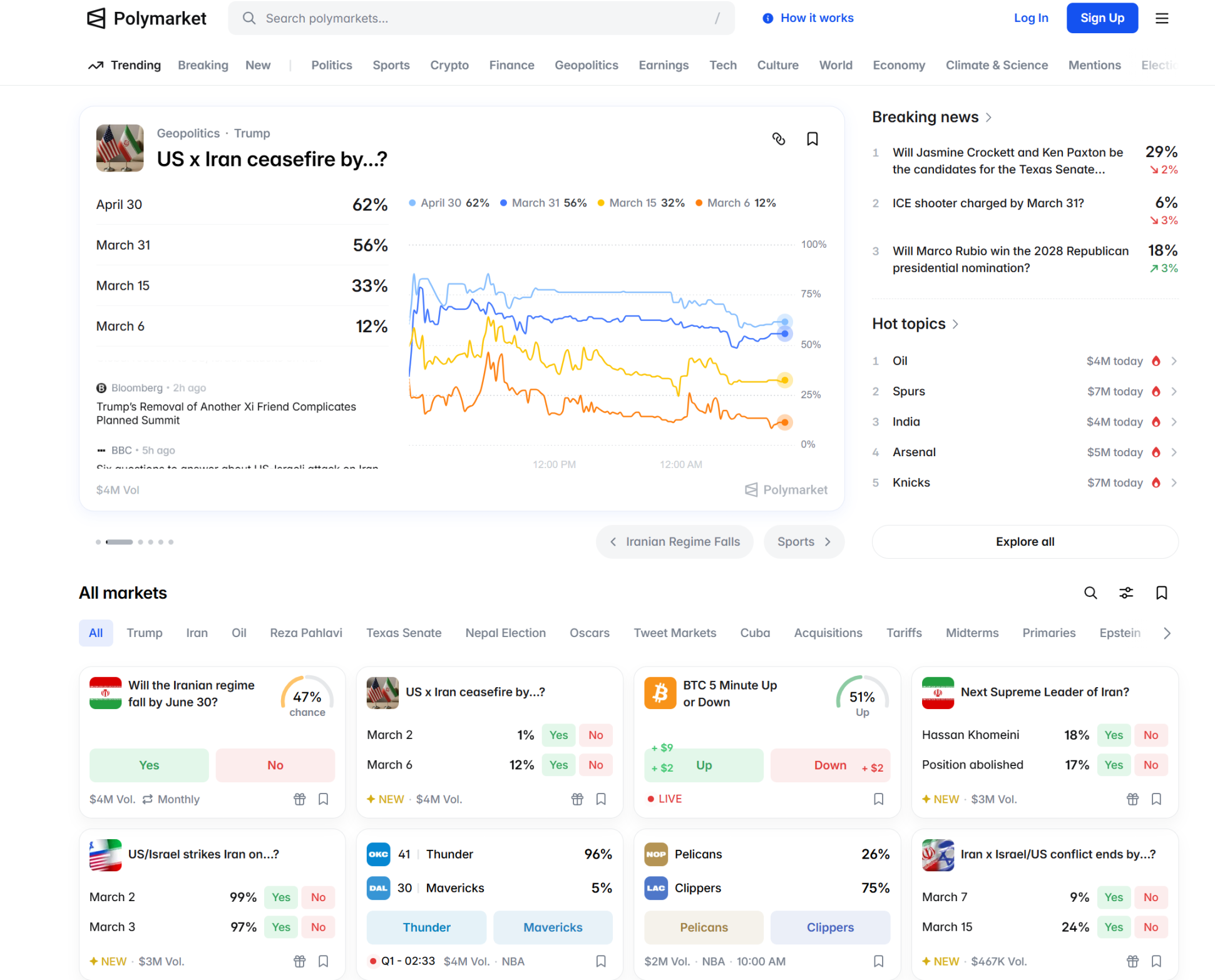
Overall, this "war profit" exposed the double-edged sword of prediction markets: on one hand, they provide real-time data intelligence and insights; on the other hand, they are easily manipulated or exploited with insider information.

Under the trend of "everything can be bet on," future betting in prediction markets may require stricter regulation and clearer rules. After all, the stakes are real money, but behind them are real lives.


Twitter:https://twitter.com/BitpushNewsCN

Bitpush TG Discussion Group:https://t.me/BitPushCommunity

Bitpush TG Subscription: https://t.me/bitpush

Original link:https://www.bitpush.news/articles/7615813

Пов'язані питання

QWhat are the two main prediction markets discussed in the article that saw massive trading volumes related to the US-Israel airstrike on Iran?

AThe two main prediction markets discussed are Polymarket and Kalshi.

QHow does Polymarket's global version generate revenue from its users?

APolymarket's global version uses a profit-based fee model, charging users a 2% fee on their net profits only when they close a winning position, effectively taxing only the 'winners'.

QWhat controversial action did Kalshi take regarding its market on 'Whether Khamenei would step down' after the airstrike, and why?

AKalshi paused its market and settled it based on the last trading price before the event, citing a pre-existing 'no settlement on death' clause. The CEO stated this was to uphold moral standards and avoid profiting from an individual's death.

QWhat evidence suggests potential insider trading on Polymarket related to the airstrike?

ABlockchain analysis firm Bubblemaps found six newly created wallets that placed bets on the US striking Iran on February 28th just hours before the attack, collectively profiting approximately $1 million.

QWhat legislative action is mentioned in the article as a response to concerns about prediction markets?

AUS Representative Ritchie Torres is promoting legislation called the '2026 Financial Prediction Market Public Integrity Act,' which aims to restrict government officials with non-public information from trading on such prediction markets.

Пов'язані матеріали

Beyond the Stadium: The Profitable Games Surrounding the World Cup

"Beyond the Pitch: The Profit Game Around the World Cup" The FIFA World Cup transcends being a sporting spectacle, evolving into a massive global arena for speculation and profit-seeking. The 2026 tournament has amplified this dynamic, creating a multi-layered ecosystem of financial opportunism alongside the football. **Prediction markets** have surged into the mainstream. Platforms like Polymarket and Kalshi saw trading volumes for World Cup contracts soar, attracting new users with their financial trading model and high-profile, chain-based wealth stories that overshadow traditional sports betting in terms of growth and narrative. However, **traditional sportsbooks** remain the dominant force, leveraging established user habits, legal markets, and comprehensive product offerings to handle the vast majority of speculative wagers, with projections suggesting record-breaking betting volumes. Capital markets also react. **"Concept stocks"** in countries like South Korea and Japan experience volatile price swings based on team performance and anticipated fan spending on items like chicken, beer, and viewing parties, effectively becoming a stock market reflecting fan sentiment. The **ticket resale market** has become a sophisticated arena for arbitrage. Prices fluctuate wildly based on team draws and star power, with sellers sometimes listing tickets they don't yet own in a practice akin to short-selling, while FIFA's own "Right to Buy" tokens add another layer of speculative trading. **Collectibles and merchandise** offer another avenue. Panini sticker albums, with their inherent scarcity and nostalgic value, can become high-value collectibles. Limited-edition or locally themed jerseys command significant premiums on secondary markets, and even counterfeit vendors profit from fans' desire for affordable match-day identity. The **cryptocurrency** space has seen a frenzy of speculative, unauthorized World Cup-themed meme coins on chains like Solana. These tokens, often exploiting team names and player imagery, experience extreme pump-and-dump cycles, creating stories of massive gains for a few early entrants and steep losses for many others. Finally, an entire industry thrives on **providing information and tools** to other speculators. Developers create platforms like SeatSidekick to track ticket inventory and prices, while paid Telegram groups and subscriptions sell betting tips and predictions, monetizing the widespread desire for an informational edge. In essence, the World Cup has become a compressed, global laboratory for speculation. While the games determine champions on the field, a parallel, complex network of financial transactions—spanning prediction contracts, bets, stocks, tickets, collectibles, crypto, and information services—settles its own scores in the global market.

marsbit25 хв тому

Beyond the Stadium: The Profitable Games Surrounding the World Cup

marsbit25 хв тому

How Does Codex Use a Computer? Three Entry Points and Permission Boundaries

This article explains the three primary methods for Codex to interact with a computer, each with distinct use cases, permission boundaries, and trust levels. **1. Computer Use:** This offers the broadest access, allowing Codex to visually control and interact with the graphical user interface of authorized macOS/Windows apps, system settings, and even iOS simulators. It's ideal for tasks lacking APIs or structured tools, such as operating legacy software or multi-app workflows. However, it's the slowest method and has the widest permission scope, requiring careful supervision for sensitive actions. **2. Chrome Extension:** This grants Codex access to the user's logged-in Chrome browser state, including cookies, profiles, and open tabs. It's best for tasks requiring user identity across websites like Gmail, LinkedIn, Salesforce, or internal dashboards. Its key advantage is multi-tab control for complex workflows. While more powerful for browser-based tasks than Computer Use, it carries higher sensitivity as actions are performed under the user's identity. **3. In-App Browser:** This is a browser isolated within the Codex thread, separate from the user's personal browsing data. It excels in web development and debugging scenarios—previewing local servers, testing responsive layouts, or annotating designs directly on the page. Its isolation is a strength for development but a limitation for tasks requiring login sessions. The core principle is to choose the narrowest, safest, and most structured interface for the task. Use plugins or MCPs first, resort to visual control (Computer Use) only for GUI-dependent tasks, employ the Chrome extension for identity-reliant browser work, and prefer the In-App Browser for isolated development. **Appshots** are clarified as a fourth, complementary tool for *inputting* context—capturing a screenshot of a window to point Codex to something—rather than a method for Codex to *act*. Together, this layered approach highlights a key to AI agent productization: not granting unlimited permissions, but constraining them within clear boundaries for specific tasks while preserving user oversight.

marsbit1 год тому

How Does Codex Use a Computer? Three Entry Points and Permission Boundaries

marsbit1 год тому

The "Iron Rule" of Chip Equipment Is Being Broken

For years, the semiconductor equipment industry followed an unwritten "iron rule": suppliers offered steep discounts for new tool introductions (Design-in) and faced consistent price pressure during repeat orders, especially during market downturns. This long-standing buyer's market dynamic is now being upended. Recently, SK Hynix's primary equipment suppliers have reportedly requested a 3-4% price *increase*, a nearly unprecedented move. This shift is driven by a severe supply-demand imbalance fueled by the AI compute boom. Securing equipment has become an urgent arms race as chipmakers' expansion speed dictates their ability to fulfill massive AI chip orders. Key areas feeling the strain include: **TCB (Thermal Compression Bonding) Equipment:** Demand is exploding, driven by the simultaneous needs of HBM4 memory stacking, AI chip Chip-on-Substrate (C2S), and logic Chiplet Chip-on-Wafer (C2W) packaging. Players like Hanmi Semiconductor, Hanwha Semitech, and ASMPT are receiving major orders. While hybrid bonding is seen as the future, TCB remains the pragmatic choice for HBM4 mass production, with its lifecycle extended by relaxed specifications and ongoing technological upgrades. **Test Equipment Bottlenecks:** Ironically, AI-driven shortages are now crippling test equipment manufacturing. Critical components like FPGAs, Driver ICs, and CPUs face severe shortages and extended lead times (up to 52 weeks for FPGAs), as AI data center and server vendors prioritize supply. This creates a paradoxical cycle: AI chip shortages drive fab expansion, which requires more test equipment, whose production is delayed because its key parts are diverted to make AI chips. The industry is entering a broad, AI-powered upcycle. SEMI forecasts global semiconductor equipment sales to hit a record $156 billion by 2027, fueled by investment in advanced logic/foundry, HBM-driven DRAM, and advanced packaging (like CoWoS). Major players like TSMC, SK Hynix, and Micron are aggressively ramping capital expenditure. In conclusion, leading equipment vendors are no longer just selling tools; they are selling the critical capability to deliver AI-era capacity. Pricing power is shifting decisively to those with indispensable technology in key process nodes like advanced logic, HBM, and advanced packaging, rewriting the industry's traditional power structure.

marsbit2 год тому

The "Iron Rule" of Chip Equipment Is Being Broken

marsbit2 год тому

Торгівля

Спот
Ф'ючерси
活动图片