How Can War News Turn into Millions in Profits a Step Ahead?

比推Опубліковано о 2026-03-02Востаннє оновлено о 2026-03-02

Анотація

The article "How War News Turns into Millions in Profits" explores the rise of prediction markets like Polymarket and Kalshi as digital arenas for wagering on geopolitical events, using the hypothetical U.S.-Israel airstrike on Iran on February 28, resulting in the death of Iran’s Supreme Leader Ali Khamenei, as a case study. These platforms saw surging trading volumes, with Polymarket’s market on "Will Khamenei be ousted by February 28?" reaching $95.93 million in daily volume. While Polymarket operates with anonymity and a profit-based fee model, Kalshi faced controversy for refusing to fully pay out on contracts tied to deaths, citing ethical concerns. The piece also highlights suspicions of insider trading, with some wallets making highly timed, profitable bets ahead of the strike. The trend raises questions about morality, market manipulation, and the need for stricter regulation as prediction markets blur the lines between real-world conflict and digital profit-seeking.

Author: Ma He, Foresight News

Original Title: Prediction Platforms Are Becoming the Digital Battlefield of Postmodern Warfare


On February 28, the United States and Israel jointly launched an airstrike against Iran, resulting in the death of Iran's Supreme Leader Ali Khamenei. This attack shook Middle Eastern geopolitics. In the 21st century, the flames of war continue to spread everywhere, and its impact has also stirred up huge waves in the prediction markets of the crypto world.

Polymarket and Kalshi became another "battlefield" outside the actual war zone. Traders placed bets on the timing of the attack, regime change, and ceasefire dates, with trading volumes soaring to astronomical figures.

In war, some are always quietly making a fortune.

Polymarket became a "barometer" of the conflict. Since last December, they had set up a market for "When will the US strike Iran?" covering various date options.

The prediction market "Will Khamenei step down by February 28?" saw a daily trading volume of $95.93 million on February 28, becoming one of the platform's largest geopolitical markets ever. Its trading volume reached $54.15 million on March 31.
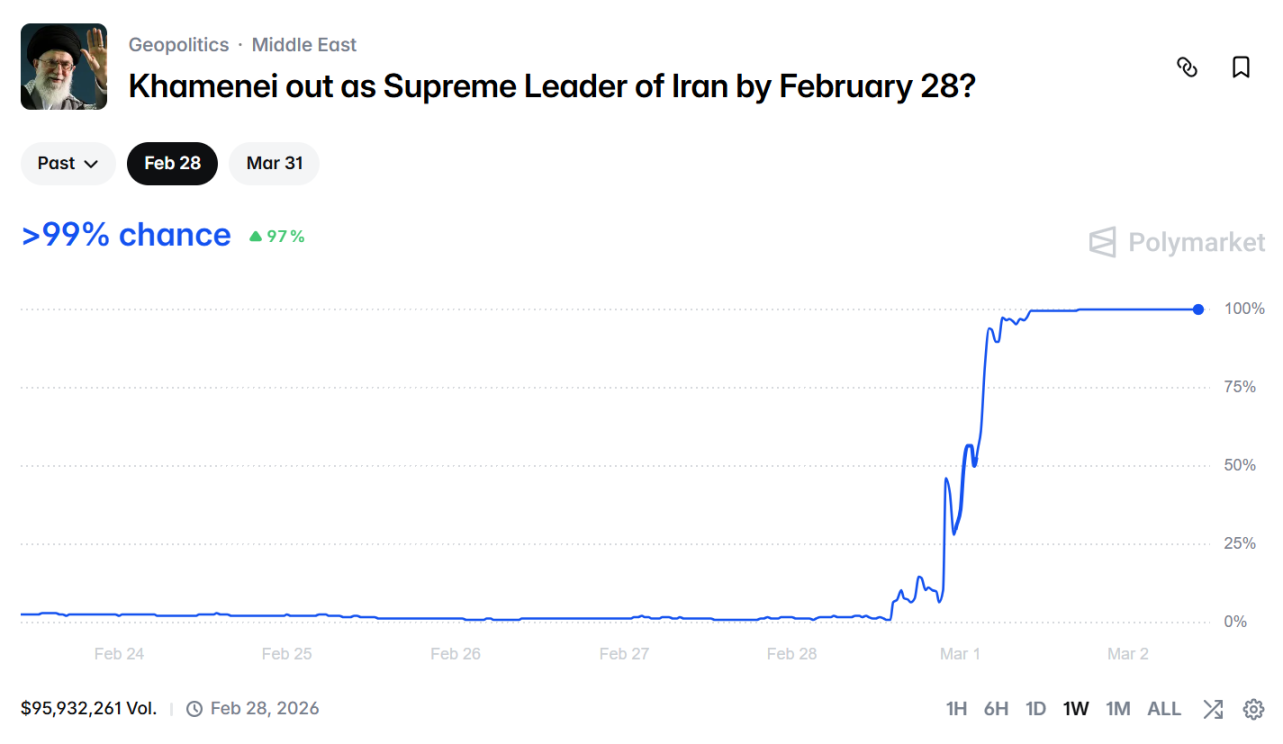
After the attack was confirmed, this market quickly settled to "Yes" (it is still in the final dispute period), as Khamenei's death directly led to him "stepping down."

Although Polymarket currently does not charge any transaction fees for the vast majority of its regular markets (including all political, geopolitical, pop culture, and long-term macro events), in early 2026, Polymarket introduced fees for specific high-frequency trading markets. The expansion of its brand influence has a significantly positive impact on its revenue growth.

Furthermore, the global version of Polymarket uses a profit-based fee model. Its core logic is: users do not need to pay fees when placing buy or sell orders daily, but when users close a position for profit, the platform charges a 2% fee on the net profit. This model only taxes the "winners."

Taking the example in the image, if the total net profit of the winners is $10 million, the income from this single prediction market alone would reach $200,000.

Traders flocked there not only for the thrill but also because these markets reflect news in real time—much faster than traditional media. As soon as news of the attack broke, contract prices instantly jumped, demonstrating the market's "efficiency."

There are always winners in war. In the past, those who profited from conflicts were often arms dealers, oil giants, or intelligence peddlers—think of Lockheed during World War II or the oil tycoons during the Cold War, who made fortunes through contracts and resource monopolies. Ordinary people? At best, they were bystanders; war meant loss and uncertainty for them. But now, crypto prediction markets have颠覆ed this landscape. Platforms like Polymarket allow retail investors to also bet on geopolitical events, from the date of US-Iran airstrikes to the probability of regime change, sharing a piece of the pie with just a few clicks.

However, participating in this game also blurs ethical boundaries. This shift is striking: the "dividends" of war have spread from the physical supply chain to the digital gambling table. Arms dealers are still making money, but prediction markets have turned ordinary users into new players. They don't produce missiles, but they can "predict" explosions on the blockchain and profit handsomely.

When conflicts escalate, platform trading volumes explode; the war economy has gone digital.

But this also raises many questions—does the thrill of making money dilute compassion for real suffering?

Kalshi, as another player, also got a share of the pie. Their "Will Khamenei step down?" market had a trading volume of tens of millions of dollars (slightly varying by source). On the day of the attack, trading volume in this market surged, reaching tens of millions of dollars in a single day.

But Kalshi's handling of the situation sparked controversy. A clause in the platform's rules states "no settlement on death," meaning that if stepping down is due to death, the "Yes" contract will not be paid in full.

After the attack, Kalshi suspended the market. CEO Tarek Mansour posted on X to explain: they oppose profiting from an individual's death, so they would settle at the last traded price before the death and refund all fees in full. Mansour emphasized that this was to uphold "moral bottom lines" and avoid the platform becoming a "death betting pool." Some users complained that this was like changing the rules mid-game, but Kalshi insisted this was a pre-set term, with details clarified just the day before the attack.
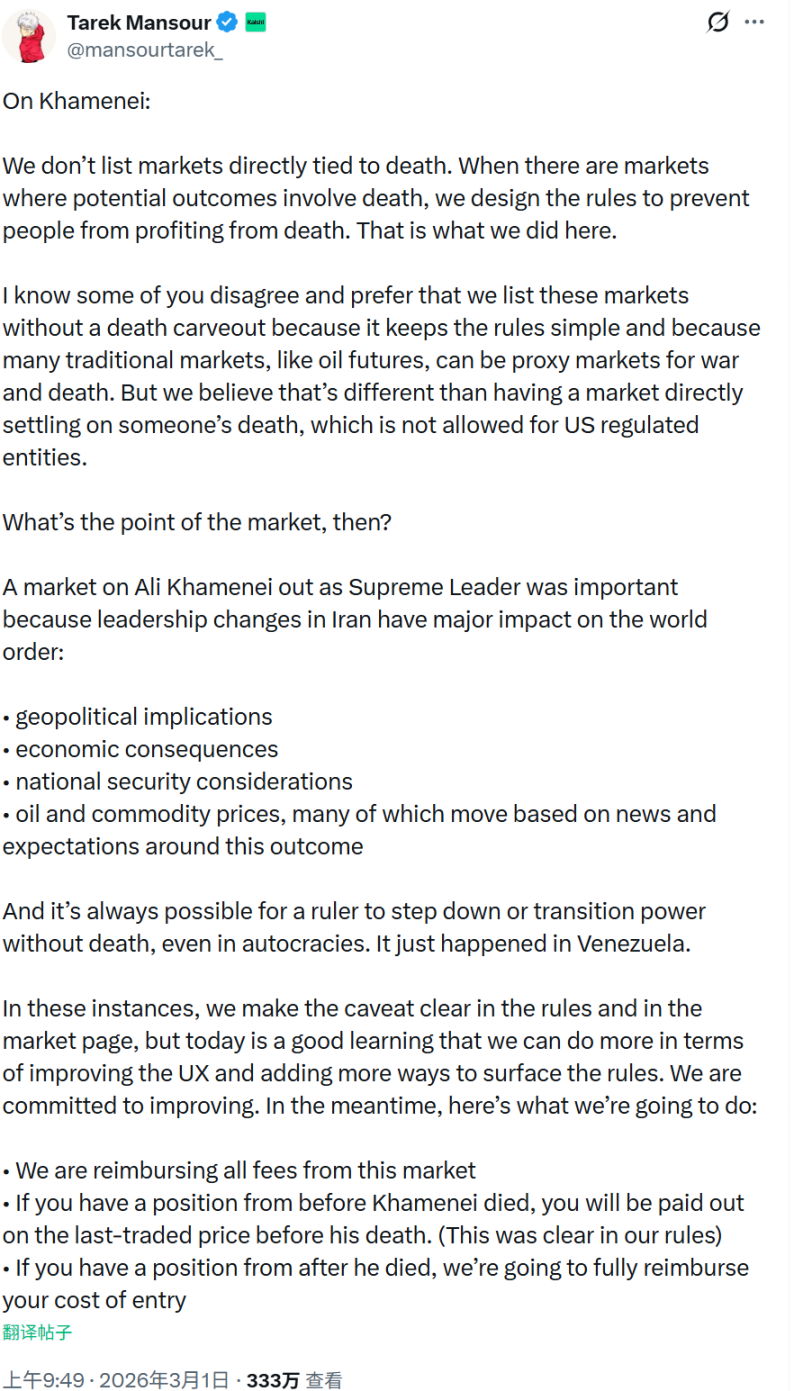
As a result, the platform lost money but gained a reputation for "not making money from the dead."

Polymarket has high user anonymity, attracting global funds; Kalshi is more compliant but restricts markets related to war and assassination.

However, while most players bet based on gut feeling, some insiders are also quietly making a fortune.

On Polymarket, the timing of some accounts' bets was so precise that it raised suspicions of insider trading. Blockchain analysis company Bubblemaps discovered that six newly created wallets placed bets on a US strike against Iran on February 28 just hours before the attack, collectively profiting about $1 million.
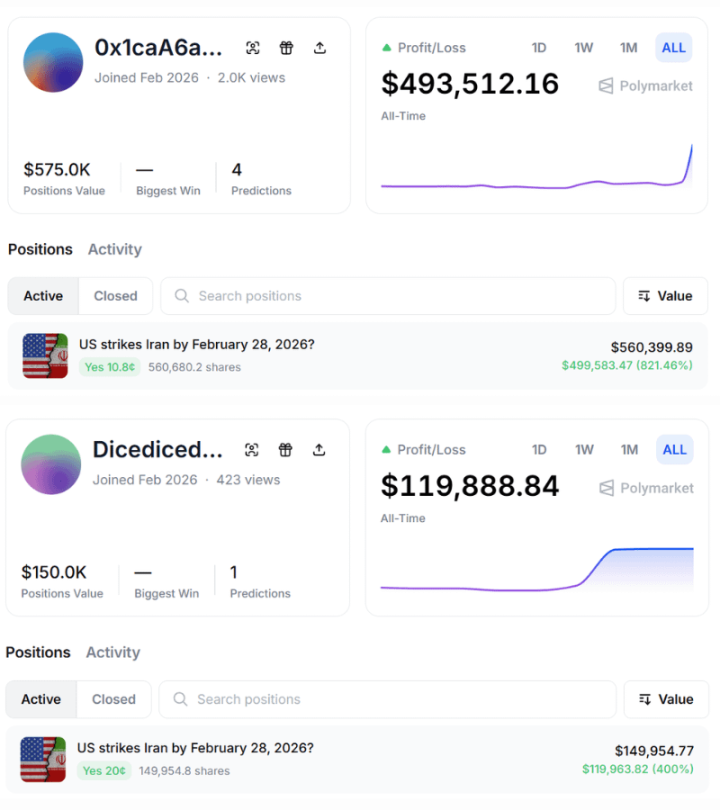
These 6 wallets were all created in February of this year. Almost all their trading was concentrated on contracts predicting the timing of the US military strike. Some positions were established hours before the first news of explosions emerged from Tehran, with contract purchase prices as low as around $0.10. Analysts stated that such concentrated betting behavior before major geopolitical events is characteristic of "suspected insider trading" previously seen in prediction markets.

However, the report also pointed out that the related accounts had incurred losses in other predictions before, and the US government had publicly warned weeks earlier that military action was possible. Therefore, the timing of the trades alone is not sufficient to directly prove illegal activity.

These are not isolated cases. Polymarket has faced similar质疑 in the past, such as during the 2024 Super Bowl or the Venezuela incident. But this time the scale is larger, involving national security. The CFTC has warned about insider trading in the past, and Kalshi recently penalized famous YouTube creator MrBeast's team editor, Artem Kaptur, for insider trading. Polymarket operates overseas with loose regulation, becoming a gray area.

US Representative Ritchie Torres is promoting legislation called the "2026 Public Integrity in Financial Prediction Markets Act," which aims to restrict government officials with access to non-public information from trading on related prediction markets. Meanwhile, Polymarket has faced regulatory restrictions or bans in multiple countries in recent years, including the Netherlands, France, Italy, and Singapore.

Of course, not everyone won. Many bet on the wrong date and suffered heavy losses. Currently, Polymarket has updated its website's top display, pinning all prediction markets related to the Iran situation to the top.
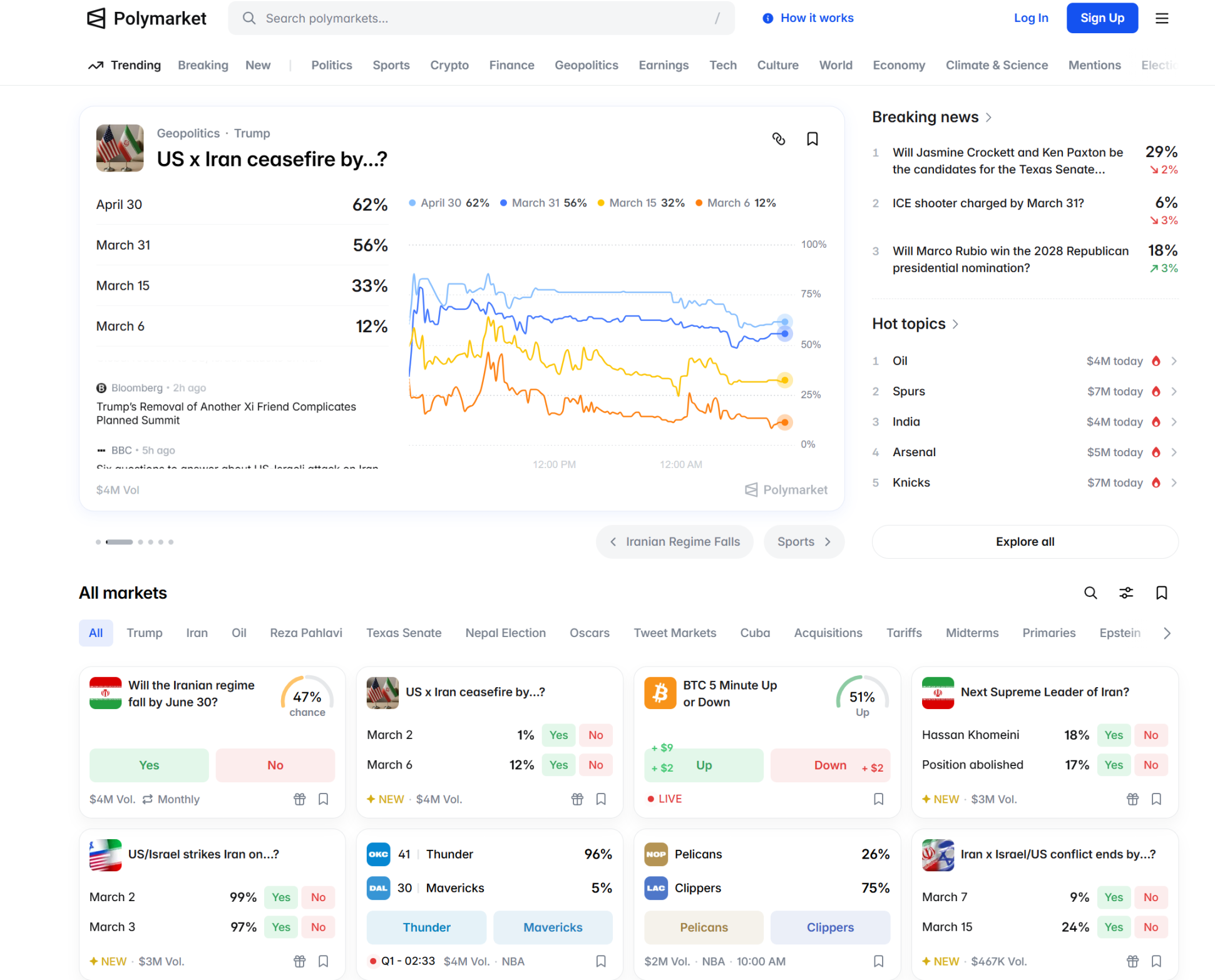
Overall, this "war profit" exposed the double-edged sword of prediction markets: on one hand, they provide real-time data intelligence and insights; on the other hand, they are easily manipulated or exploited with insider information.

Under the trend of "everything can be bet on," future betting in prediction markets may require stricter regulation and clearer rules. After all, the stakes are real money, but behind them are real lives.


Twitter:https://twitter.com/BitpushNewsCN

Bitpush TG Discussion Group:https://t.me/BitPushCommunity

Bitpush TG Subscription: https://t.me/bitpush

Original link:https://www.bitpush.news/articles/7615813

Пов'язані питання

QWhat are the two main prediction markets discussed in the article that saw massive trading volumes related to the US-Israel airstrike on Iran?

AThe two main prediction markets discussed are Polymarket and Kalshi.

QHow does Polymarket's global version generate revenue from its users?

APolymarket's global version uses a profit-based fee model, charging users a 2% fee on their net profits only when they close a winning position, effectively taxing only the 'winners'.

QWhat controversial action did Kalshi take regarding its market on 'Whether Khamenei would step down' after the airstrike, and why?

AKalshi paused its market and settled it based on the last trading price before the event, citing a pre-existing 'no settlement on death' clause. The CEO stated this was to uphold moral standards and avoid profiting from an individual's death.

QWhat evidence suggests potential insider trading on Polymarket related to the airstrike?

ABlockchain analysis firm Bubblemaps found six newly created wallets that placed bets on the US striking Iran on February 28th just hours before the attack, collectively profiting approximately $1 million.

QWhat legislative action is mentioned in the article as a response to concerns about prediction markets?

AUS Representative Ritchie Torres is promoting legislation called the '2026 Financial Prediction Market Public Integrity Act,' which aims to restrict government officials with non-public information from trading on such prediction markets.

Пов'язані матеріали

That Year, Elon Musk and I Talked About His "Space Dream"

"The Year I Talked to Musk About His 'Space Dream'" by Zhang Peng. On June 12, 2024, SpaceX, now incorporating X, xAI, and Starlink, completed a historic IPO, reaching a $2 trillion valuation. This piece reflects on a 2014 conversation between the author, founder of GeekPark, and Elon Musk during his first public appearance in China at the GeekPark Singularity Summit. Their discussion centered on Musk's motivations and unique mindset. Musk described himself not as a CEO but as an "engineer" driven to solve fundamental problems. He explained his work on Tesla aimed to shift the automotive industry's paradigm toward sustainable transport, while SpaceX was born from a desire to make humanity a multi-planetary species, drastically reducing space access costs through reusability. He emphasized persistence in the face of likely failure, noting that traditional entities like NASA, with abundant resources, often lacked the imperative for radical innovation that drives commercial ventures. Musk dismissed the idea of entering politics, believing change is best achieved through compelling products. The author sees the 2020 successful Crew Dragon launch as a pivotal moment, marking the maturation of commercial spaceflight and the true beginning of a scalable, industry-driven space age. He views Musk as a pioneer clearing the path for broader participation, expressing hope that affordable space travel will become a reality, fueled by commercial momentum.

marsbit23 хв тому

That Year, Elon Musk and I Talked About His "Space Dream"

marsbit23 хв тому

US Government Suddenly Halts Anthropic's Strongest Model, "Quasi-IPO Stock Price" Plunges 3.7% Overnight

U.S. Government Halts Anthropic's Top AI Models, 'Pre-IPO' Price Drops 3.7% On June 12, the U.S. government ordered Anthropic to shut down access to its two most powerful AI models, Claude Fable 5 and Claude Mythos 5, citing national security concerns. The directive, issued by the Department of Commerce, required Anthropic to block access for all foreign nationals, leading the company to disable the models globally for all users. Anthropic strongly opposed the move, arguing the government's basis was a "narrow jailbreak vulnerability" and warning that applying such a standard industry-wide would effectively halt all frontier model deployments. The news impacted Anthropic's implied valuation in speculative markets. The Anthropic perpetual contract on Hyperliquid fell approximately 3.7% to around $1,627, down from highs above $1,800 following the models' release. Unauthorized tokenized products linked to Anthropic on Solana also saw significant declines. The models, launched just days earlier on June 9, represented a major capability leap for Anthropic. Fable 5 was its first public release of a "Mythos"-tier model above its flagship Claude Opus. The shutdown creates an ironic situation for Anthropic, a company founded on "AI safety" principles, and adds uncertainty to its ongoing IPO preparations. The company is actively engaging with regulators to resolve what it calls a "misunderstanding" and restore service.

marsbit43 хв тому

US Government Suddenly Halts Anthropic's Strongest Model, "Quasi-IPO Stock Price" Plunges 3.7% Overnight

marsbit43 хв тому

SpaceX IPO Creates Trillion-Dollar Billionaire: Musk's Wealth Equals Half of Crypto Market

SpaceX's record-breaking IPO has propelled Elon Musk to become the first modern billionaire with a personal net worth exceeding $1 trillion, reaching $1.11 trillion according to Bloomberg. This staggering wealth surpasses the total market capitalization of all cryptocurrencies excluding Bitcoin and equals roughly half of the entire crypto market's value. The milestone highlights extreme wealth concentration and the significant devaluation of the altcoin market, whose total cap has nearly halved since late 2025 as capital flows into large tech stocks. SpaceX's Nasdaq debut saw its valuation hit $2.2 trillion, with shares soaring from a $135 offer price to close at $161. Its first-day trading volume of $85 billion set a new global IPO record. Musk owns 42% of the company. Despite his wealth dwarfing the altcoin sector, Musk maintains deep ties to digital assets. He personally holds Bitcoin, Ethereum, and Dogecoin, while his companies, SpaceX and Tesla, collectively hold over 30,000 Bitcoin, ranking among the top corporate BTC holders globally. His acquisition and integration of financial data tools into X (formerly Twitter) further connect his ecosystem to the markets. Ultimately, Musk's trillion-dollar status underscores the immense wealth controlled by tech founders, though this fortune remains largely tied to volatile stock prices rather than liquid assets.

Foresight News51 хв тому

SpaceX IPO Creates Trillion-Dollar Billionaire: Musk's Wealth Equals Half of Crypto Market

Foresight News51 хв тому

Hardcore First Look | Ocean Embodied Intelligence Company 'Shihang Intelligence' Secures Record-Breaking 1 Billion in Funding, Zhu Xiaohu, Temasek Place Bets

Breaking News | Ocean Embodied Intelligence company "Shihang Intelligent" secures a record-breaking 1 billion RMB (approximately 10 billion yuan) in Series A financing, with investment from Zhu Xiaohu and Temasek. Author: Qiu Xiaofen | Editor: Yuan Silai Ocean Embodied Intelligence company "Shihang Intelligent" has completed its Series A funding round, raising over 1 billion RMB. This marks the largest single funding round in the global marine robotics field to date. Investors include upstream momentum funds from chip companies "Moore Thread" and "Kunlunxin," Singapore's state-owned investment platform Vertex Growth, and listed company Dyneo, among others. Existing investors like GSR Ventures (whose founder Zhu Xiaohu has invested for the fifth time), Vertex Ventures China, Hua Ying Capital, and Long Capital also significantly increased their investments. Founder and CEO Chen Xiaobo, a 1989-born alumnus of Harbin Engineering University, is a long-time expert in underwater robotics. He received the National Defense Science and Technology Progress Award at age 28 (the youngest recipient) and led the development of China's first commercial underwater cleaning robot. The funds will be used for core technology R&D, global market expansion, and building the industry chain ecosystem to scale the application of marine robots in complex underwater scenarios. The ocean is considered one of the most challenging environments for robotics due to low light, high turbidity, complex currents, limited communication, high pressure, and corrosion. "Shihang Intelligent" focuses on developing core underlying technologies for marine robots, covering six key systems: power, control, sensing, navigation, sealing, and deployment. Its robots are capable of operating at depths from 0 to 10,000 meters with full degrees of freedom, performing complex maneuvers, autonomous navigation, and multi-robot collaboration. Applications include ship cleaning, underwater security, offshore wind power, marine ranching, and seabed inspection. The company's order value for the first half of 2026 alone has exceeded 1 billion RMB. Its "Orca Robot" is used by major shipping companies and has performed maintenance on over a thousand large vessels. In April of this year, the company launched its ocean embodied large model "Cangqiong CEORION." Unlike traditional remote-controlled or pre-programmed robots, this model integrates environmental perception, task understanding, and action generation into a single end-to-end architecture. Trained on millions of hours of commercial operation data and simulation data, it covers 12 major underwater operation scenarios. In simulations, it achieved over 90% task success rate and over 70% zero-shot adaptation capability to unseen environments. A built-in physics reasoning module reduces collision risk by 80%, enabling autonomous operation even with weak or no communication. Recently, "Shihang Intelligent" was selected as a core technology partner for Singapore's Maritime and Port Authority national hull inspection and cleaning program. These advancements indicate marine robotics is moving from pilot projects to scaled applications, with real-world operations generating valuable data to continuously improve robot capabilities. CEO Chen Xiaobo stated the company will continue investing in core marine robotics technology, the embodied intelligence model, and global application scenarios to expand into more high-risk, high-difficulty, and high-value underwater operations.

marsbit1 год тому

Hardcore First Look | Ocean Embodied Intelligence Company 'Shihang Intelligence' Secures Record-Breaking 1 Billion in Funding, Zhu Xiaohu, Temasek Place Bets

marsbit1 год тому

Торгівля

Спот
Ф'ючерси
活动图片





