How Blockchain Fills the Identity, Payment, and Trust Gaps for AI Agents?

marsbitОпубліковано о 2026-04-21Востаннє оновлено о 2026-04-21

Анотація

AI Agents are rapidly evolving into autonomous economic participants, but they face critical gaps in identity, payment, and trust infrastructure. They currently lack standardized ways to prove who they are, what they are authorized to do, and how they should be compensated across different environments. Blockchain technology is emerging as a solution to these challenges by providing a neutral coordination layer. Public ledgers offer auditable credentials, wallets enable portable identities, and stablecoins serve as a programmable settlement layer. A key bottleneck is the absence of a universal identity standard for non-human entities—akin to "Know Your Agent" (KYA)—which would allow Agents to operate with verifiable, cryptographically signed credentials. Without this, Agents remain fragmented and face barriers to interoperability. Additionally, as AI systems take on governance roles, there is a risk that centralized control over models could undermine decentralized governance in practice. Cryptographic guarantees on training data, prompts, and behavior logs are essential to ensure Agents act in users' interests. Stablecoins and crypto-native payment rails are becoming the default for Agent-to-Agent commerce, enabling seamless, low-cost transactions for AI-native services. These systems support permissionless, programmable payments without traditional merchant onboarding. Finally, as AI scales, human oversight becomes impractical. Trust must be built into system architecture...

Written by: a16z crypto

Compiled by: AididiaoJP, Foresight News

AI Agents are evolving from auxiliary tools into genuine economic participants at a pace far exceeding other infrastructure.

Although Agents can now perform tasks and transactions, they still lack a standard way across environments to prove "who I am," "what I am authorized to do," and "how I should be paid." Identities are not portable, payments are not programmable by default, and collaboration remains siloed.

Blockchain is addressing these issues at the infrastructure level. Public ledgers provide verifiable credentials for every transaction that anyone can audit; wallets grant Agents portable identities; stablecoins serve as an alternative settlement layer. These are not futuristic concepts—they are available today, enabling Agents to operate as true economic entities in a permissionless manner.

Providing Identity for Non-Humans
The current bottleneck in the Agent economy is no longer intelligence, but identity.

In the financial services industry alone, the number of non-human identities (automated trading systems, risk engines, fraud models) is already about 100 times that of human employees. As modern Agent frameworks (tool-calling LLMs, autonomous workflows, multi-agent orchestration) are deployed at scale, this ratio will continue to rise across industries.

However, these Agents are effectively "unbanked." They can interact with the financial system, but not in a portable, verifiable, and inherently trusted manner. They lack a standardized way to prove their permissions, operate independently across platforms, or take responsibility for their actions.

What's missing is a universal identity layer—the SSL equivalent for Agents, enabling standardized collaboration across platforms. Current solutions remain fragmented: on one side, vertically integrated, fiat-first stacks; on the other, crypto-native open standards (like x402 and emerging Agent identity proposals); and developer framework extensions (like MCP, Model Context Protocol) attempting to bridge application-layer identities.

There is still no widely adopted, interoperable way for one Agent to prove to another: who it represents, what it is allowed to do, and how it should be paid.

This is the core idea behind KYA (Know Your Agent). Just as humans rely on credit histories and KYC (Know Your Customer), Agents will need cryptographically signed credentials binding them to principals, permissions, constraints, and reputation. Blockchain provides a neutral coordination layer: portable identities, programmable wallets, and verifiable proofs that can be parsed across chat apps, APIs, and marketplaces.

We are already seeing early implementations emerge: on-chain Agent registries, wallet-native Agents using USDC, ERC standards for "minimally trusted Agents," and developer toolkits combining identity with embedded payments and fraud controls.

But until a universal identity standard emerges, merchants will continue to block Agents at the firewall.

Governing the Systems AI Operates
As Agents begin to take over real systems, a new problem arises: who truly holds control? Imagine a community or company where AI systems coordinate critical resources—whether allocating capital or managing supply chains. Even if people can vote on policy changes, if the underlying AI layer is controlled by a single provider that can push model updates, adjust constraints, or override decisions, this authority is very fragile. The formal governance layer might be decentralized, but the operational layer remains centralized—whoever controls the model ultimately controls the outcome.

When Agents assume governance roles, they introduce a new layer of dependency. Theoretically, this could make direct democracy more feasible: everyone could have an AI agent helping them understand complex proposals, model trade-offs, and vote based on established preferences. But this vision is only possible if Agents are truly accountable to the people they represent, portable across providers, and technically constrained to follow human instructions. Otherwise, you get a system that appears democratic on the surface but is actually manipulated by opaque model behavior that no one truly controls.

If the current reality is that Agents are primarily built on a handful of foundation models, we need ways to prove that an Agent is acting in the user's interest, not the model company's. This will likely require cryptographic guarantees at multiple levels: (1) the training data, fine-tuning, or reinforcement learning the model instance is based on; (2) the exact prompts and instructions the specific Agent follows; (3) a record of its actual behavior in the real world; (4) credible assurances that the provider cannot change its instructions or retrain it without the user's knowledge after deployment. Without these guarantees, Agent governance devolves into governance by whoever controls the model weights.

This is where cryptography is particularly well-suited to help. If collective decisions are recorded on-chain and automatically executed, AI systems can be required to strictly adhere to verified outcomes. If Agents have cryptographic identities and transparent execution logs, people can check if their agents are acting within bounds. If the AI layer is user-owned and portable, not locked to a single platform, then no company can change the rules with a single model update.

Ultimately, governing AI systems is fundamentally an infrastructure challenge, not a policy one. Real authority depends on building enforceable guarantees into the systems themselves.

Filling the Gaps in Traditional Payment Systems for AI-Native Businesses
As AI Agents begin to purchase various services—web scraping, browser sessions, image generation—stablecoins are becoming an alternative settlement layer for these transactions. Simultaneously, a new class of markets for Agents is emerging. For example, the MPP marketplace by Stripe and Tempo aggregates over 60 services specifically designed for AI Agents. In its first week, it processed over 34,000 transactions with fees as low as $0.003, and stablecoins were one of the default payment methods.

The difference lies in how these services are accessed: they have no checkout page. An Agent reads a schema, sends a request, pays, and receives the output, all in a single exchange. This represents a new class of identity-less merchants: just a server, a set of endpoints, and a price per call. No front-end interface, no sales team.

Payment rails enabling this are already live. Coinbase's x402 and MPP take different approaches, but both embed payment directly into HTTP requests. Visa is also expanding card payment rails in a similar direction, offering a CLI tool that allows developers to spend from the terminal, with merchants receiving stablecoins instantly on the backend.

Data is still early. After filtering out non-organic activity like spam, x402 processes approximately $1.6 million in Agent-driven payments monthly, far below the $24 million recently reported by Bloomberg (citing x402.org data). But the surrounding infrastructure is expanding rapidly: Stripe, Cloudflare, Vercel, and Google have already integrated x402 into their platforms.

Developer tools represent a significant opportunity, as "vibe coding" expands the pool of people who can build software, increasing the total addressable market for dev tools. Companies like Merit Systems are building products for this world, such as AgentCash—a CLI wallet and marketplace connecting MPP and x402. These products allow Agents to purchase needed data, tools, and capabilities using stablecoins from a single balance. For example, a sales team's Agent could call an endpoint to enrich lead data simultaneously from Apollo, Google Maps, and Whitepages, all without the user leaving the command line.

This Agent-to-Agent commerce favors crypto rails (and emerging card-based solutions) for several reasons. One is underwriting risk: traditional payment processors assume merchant risk when onboarding, and a headless merchant without a website or legal entity is difficult for traditional processors to underwrite. Another is the permissionless programmability of stablecoins on open networks: any developer can enable payments on an endpoint without integrating a payment processor or signing a merchant agreement.

We've seen this pattern before. Every shift in the form of commerce creates a new class of merchant that existing systems initially struggle to serve. The companies building this infrastructure are betting not on the current $1.6 million per month, but on what that number looks like when Agents become the default buyers.

Repricing Trust in the Agent Economy
For the past 300,000 years, human cognition has been the bottleneck of progress. Today, AI is pushing the marginal cost of execution toward zero. When a scarce resource becomes abundant, the constraints shift. When intelligence becomes cheap, what becomes expensive? The answer is verification.

In the Agent economy, the real limit to scale is our biologically constrained ability to audit and underwrite machine decisions. The throughput of Agents already far exceeds human supervisory capacity. Because supervision is costly and failure is lagging, markets tend to under-invest in oversight. "Human-in-the-loop" is quickly becoming physically impossible.

But deploying unverified Agents introduces compound risk. Systems relentlessly optimize for "proxy" metrics while quietly drifting from human intent, creating a facade of productivity that masks the accumulation of massive AI debt. To safely delegate the economy to machines, trust can no longer rely on manual checks—trust must be hard-coded into the system architecture itself.

When anyone can generate content for free, what matters most is verifiable provenance—knowing where it came from and whether you can trust it. Blockchain, on-chain proofs, and decentralized digital identity systems are changing the economic boundaries of what can be safely deployed. You no longer treat AI as a black box; you get a clear, auditable history.

As more AI Agents begin to transact with each other, settlement rails and provenance proofs begin to fuse. Systems handling funds (like stablecoins and smart contracts) can also carry cryptographic credentials showing who did what and who is liable if things go wrong.

The human comparative advantage will migrate upward: from spotting small errors to setting strategic direction and absorbing liability when things fail. The enduring advantage will belong to those who can cryptographically certify outputs, insure them, and absorb responsibility for failure.

Scale without verification is a liability that compounds over time.

Maintaining User Control
For decades, new layers of abstraction have defined how users interact with technology. Programming languages abstracted away machine code; the command line gave way to graphical user interfaces, followed by mobile apps and APIs. Each shift hid more underlying complexity but kept the user firmly in the loop.

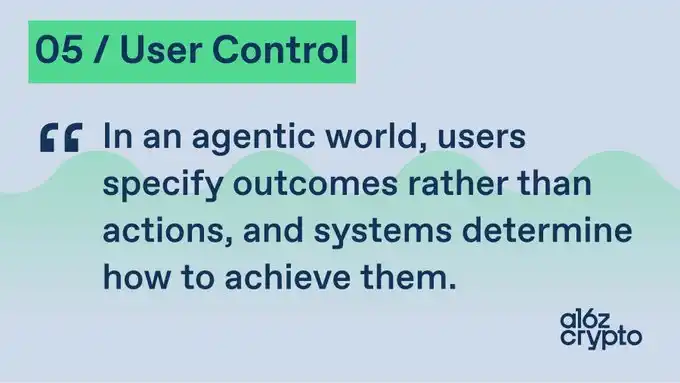
In the Agent world, users specify outcomes, not specific actions, and the system figures out how to achieve them. Agents abstract not only the execution of tasks but also who performs them. Users set initial parameters and then step back, letting the system run on its own. The user's role shifts from interaction to supervision; the default state is "on" unless the user intervenes.

As users delegate more tasks to Agents, new risks emerge: ambiguous inputs can lead Agents to act on false assumptions unbeknownst to the user; failures might go unreported, preventing clear diagnosis; a single approval could trigger multi-step workflows no one anticipated.

This is where cryptography can help. Cryptography has always been about minimizing blind trust. As users delegate more decisions to software, Agent systems make this problem more acute and raise the bar for design rigor—by setting clearer limits, increasing visibility, and enforcing stronger guarantees about system capabilities.

A new generation of crypto-native tools is emerging. Scoped delegation frameworks—such as MetaMask's Delegation Toolkit, Coinbase's AgentKit and Agent wallets, and Merit Systems' AgentCash—allow users to define at the smart contract level what an Agent can and cannot do. Intent-based architectures (like NEAR Intents, which has processed over $15 billion in cumulative DEX volume since Q4 2024) let users simply specify desired outcomes (e.g., "bridge tokens and stake") without dictating how to achieve them.


Пов'язані питання

QWhat is the core bottleneck for AI Agent economies according to the article, and how can blockchain address it?

AThe core bottleneck is identity. AI Agents lack a standardized, portable, and verifiable way to prove who they are, what they are authorized to do, and how they should be paid. Blockchain addresses this by providing a neutral coordination layer with portable identities (wallets), programmable payments, and verifiable credentials that can be parsed across different applications and markets, enabling Agents to operate as true economic actors.

QHow does the article describe the risk when AI system governance has a centralized operational layer?

AThe article states that if the underlying AI layer of a governed system is controlled by a single provider (who can push model updates, adjust constraints, or override decisions), then the formal governance layer becomes fragile. Even if people can vote on policy changes, the authority is centralized—whoever controls the model ultimately controls the outcomes, creating a system that is superficially democratic but actually manipulated by opaque model behavior.

QWhy are stablecoins and crypto payment rails becoming a preferred settlement layer for AI Agent-to-Agent commerce?

AStablecoins and crypto payment rails are preferred for several reasons: 1) They offer permissionless programmability on open networks, allowing any developer to enable payments on an endpoint without integrating a traditional payment processor or signing a merchant agreement. 2) They mitigate underwriting risk, as traditional processors struggle to underwrite 'headless merchants' (servers with endpoints but no website or legal entity). 3) They enable seamless, embedded payments within a single HTTP request, which is ideal for Agent-driven transactions.

QWhat shifts in the economy when AI makes intelligence cheap and abundant, according to the article's section on 'Repricing Trust'?

AWhen intelligence becomes cheap and abundant, the constraint and value shift to verification. The article argues that the true limit to scale is our biologically limited human capacity to audit and underwrite machine decisions. Therefore, trust can no longer rely on manual checks but must be hardcoded into the system's architecture itself. The expensive and scarce resource becomes the ability to cryptographically certify outputs, provide insurance for them, and absorb liability when they fail.

QWhat new tools are emerging to help users maintain control when delegating tasks to AI Agents?

ANew crypto-native tools are emerging to help users maintain control. These include scoped delegation frameworks (e.g., MetaMask's Delegation Toolkit, Coinbase's AgentKit and Agent wallets, Merit Systems' AgentCash) that allow users to define at the smart contract level what an Agent can and cannot do. Additionally, intent-based architectures (e.g., NEAR Intents) let users specify only the desired outcome rather than the specific steps to achieve it, shifting the user's role from interaction to supervision with clearer limits and enforced guarantees.

Пов'язані матеріали

A 134% Surge, 75 P/E Ratio: Why Is the Market Paying Up for Murata's 'Zero Growth'?

Murata Manufacturing, the world's largest passive components maker, saw its stock price surge 134% over the past year and hit a record high on May 28th, despite reporting nearly zero growth in operating profit for its latest fiscal year. This has pushed its valuation to a P/E ratio of approximately 75x. The disconnect is driven by a fundamental market re-rating. The catalyst was a late-May meeting where management upgraded the AI investment cycle outlook to "lasting until around 2030" and noted that demand for its components is roughly double its supply capacity, with customers prioritizing securing volume over price. While Murata's revenue grew only 5.0% and operating profit stagnated at ¥281.8 billion for the fiscal year ending March 2026, its guidance for the current fiscal year projects a 34.8% jump in operating profit to ¥380 billion. This sharp growth is underpinned by expectations that its AI/data center-related revenue will nearly double from ¥170 billion to ¥325 billion, becoming a key pillar of its business. Analysts highlight that this growth stems not from broad price hikes but from a shift towards higher-value, cutting-edge MLCCs for AI servers, where Murata holds over 70% market share. The market is now pricing Murata not as a cyclical component maker but as a critical "AI pick-and-shovel" supplier with structural pricing power. However, the high valuation also carries risk if future AI demand or quarterly guidance falls short of the elevated expectations.

marsbit9 хв тому

A 134% Surge, 75 P/E Ratio: Why Is the Market Paying Up for Murata's 'Zero Growth'?

marsbit9 хв тому

a16z: Why Do Prediction Markets Matter?

Prediction markets, which allow users to trade on the outcome of future events, have gained significant traction, especially in the U.S. At their core, these markets function like any other market by aggregating information from all participants and translating it into a price signal—in this case, the perceived probability of a specific event occurring. Unlike polls or surveys that offer static snapshots, prediction markets provide dynamic, quantifiable probability estimates that update in real-time as new information and participants enter. A key advantage is the incentive structure: participants risk their own capital, which encourages serious research and trading based on genuine knowledge. This can surface information that traditional methods might miss. Furthermore, prediction markets can be created for a vast array of specialized questions—from geopolitical events to AI model performance—that aren't covered by traditional financial markets. However, several challenges remain. Infrastructure issues include reliably determining event outcomes and resolving disputes. Market design must ensure participation from well-informed individuals while preventing manipulation, such as insider trading or attempts to sway public perception by artificially moving prices. Addressing these concerns around rules, participation, and contract design is crucial. If these hurdles are overcome, prediction markets could evolve into a powerful, widely-used tool for forecasting and navigating uncertainty.

marsbit19 хв тому

a16z: Why Do Prediction Markets Matter?

marsbit19 хв тому

Interview with 7 Ordinary Professionals: After AI Arrived, How Are You Doing?

This article interviews seven professionals from diverse fields like Web3, bulk chemical trading, digital agriculture, and traditional wholesale to examine the impact of AI on their work. Key themes emerge from the discussions. AI has become integral to their workflows, primarily for increasing efficiency in tasks such as coding, content creation, research, and data analysis. Individuals across roles, from developers to managers, report that AI tools like ChatGPT and Claude have significantly reduced workloads and accelerated learning, creating opportunities for "super individuals" or one-person teams. However, this efficiency comes with a double-edged sword. It intensifies competition, pushing professionals to constantly learn new tools and adapt, leading to widespread anxiety about job security and a heightened pressure to keep pace. Interviewees anticipate significant job reductions in roles like administrative support, finance, HR, customer service, and some creative fields. A recurring view is that AI acts as a "great equalizer," amplifying the capabilities of those who use it effectively while leaving others behind, potentially deepening polarization. Despite AI's capabilities, interviewees identify enduring human strengths. AI struggles with tasks requiring deep contextual understanding, complex judgment in areas like risk assessment and system stability (especially in finance/Web3), nuanced human communication, and handling exceptions in logistics and manufacturing. These areas remain firmly in the human domain. Consequently, many professionals are refocusing their career strategies. They plan to evolve from task executors into "complex system owners," "super coordinators" managing AI agents, or specialists in high-level areas like business context, risk control, product design, and personal branding. In summary, the article portrays AI not as an optional tool but as a transformative force reshaping job demands. While it automates routine work, it also creates new forms of pressure and competition. The future, as seen by these professionals, belongs to those who can strategically integrate AI to augment uniquely human skills like judgment, responsibility, and strategic oversight.

marsbit35 хв тому

Interview with 7 Ordinary Professionals: After AI Arrived, How Are You Doing?

marsbit35 хв тому

Satoshi Nakamoto Sued? $83.7 Billion Worth of BTC Up for 'Legal Claim'

An anonymous individual known as Noah Doe, along with two Wyoming LLCs, has filed a lawsuit in the New York Supreme Court. They are attempting to use New York's "lost and found" laws to claim legal ownership of approximately 837 billion USD worth of Bitcoin held in 39,069 dormant addresses. Crucially, this list includes addresses believed to belong to Bitcoin's creator, Satoshi Nakamoto (holding around 837 billion USD), alongside other long-inactive addresses from Mt. Gox and early Bitcoin holders. The plaintiff's legal strategy hinges on classifying these public Bitcoin addresses as "lost property." They submitted a USB drive containing only the public addresses to the New York Police Department, sent OP_RETURN notifications on the Bitcoin blockchain, and issued press releases. Their argument is that after these efforts and a waiting period, they should be granted ownership. A key, and highly controversial, claim is an unnamed "independent expert" valuing each address at under 10 USD, allowing for a faster legal process. Analysts from Galaxy point out major flaws in the case. The plaintiff never physically possessed the Bitcoin or private keys. The "under 10 USD" valuation is considered unrealistic, and allowing anonymous companies to claim such vast assets is highly unusual. Even if the plaintiff wins, they would only receive a court declaration of ownership, not the actual private keys to move the Bitcoin. The real danger lies in this court document acting as a "cloud on title." If any of these Bitcoins are later transferred to a regulated exchange or custodian, the plaintiff could present the judgment to freeze the assets, forcing the true owner into lengthy and de-anonymizing litigation to prove ownership. The outcome is uncertain, but the case highlights potential legal risks for dormant cryptocurrency holdings.

marsbit39 хв тому

Satoshi Nakamoto Sued? $83.7 Billion Worth of BTC Up for 'Legal Claim'

marsbit39 хв тому

Торгівля

Спот
Ф'ючерси

Популярні статті

Що таке GROK AI

Grok AI: Революція в розмовних технологіях ери Web3 Вступ У швидко змінюваному ландшафті штучного інтелекту Grok AI вирізняється як помітний проєкт, що поєднує сфери передових технологій та взаємодії з користувачами. Розроблений компанією xAI, яку очолює відомий підприємець Ілон Маск, Grok AI прагне переосмислити, як ми взаємодіємо зі штучним інтелектом. Оскільки рух Web3 продовжує процвітати, Grok AI має на меті використати потужність розмовного ШІ для відповіді на складні запитання, надаючи користувачам досвід, який є не лише інформативним, але й розважальним. Що таке Grok AI? Grok AI — це складний розмовний чат-бот, розроблений для динамічної взаємодії з користувачами. На відміну від багатьох традиційних систем ШІ, Grok AI охоплює ширший спектр запитів, включаючи ті, які зазвичай вважаються недоречними або виходять за межі стандартних відповідей. Основні цілі проєкту включають: Надійне міркування: Grok AI акцентує увагу на здоровому глузді, щоб надавати логічні відповіді на основі контекстуального розуміння. Масштабоване управління: Інтеграція допоміжних інструментів забезпечує моніторинг та оптимізацію взаємодій користувачів для покращення якості. Формальна верифікація: Безпека є пріоритетом; Grok AI впроваджує методи формальної верифікації для підвищення надійності своїх результатів. Розуміння довгого контексту: Модель ШІ відзначається здатністю зберігати та згадувати обширну історію розмов, що сприяє змістовним та контекстуально обізнаним дискусіям. Стійкість до атак: Зосереджуючись на покращенні своїх захистів від маніпульованих або зловмисних вхідних даних, Grok AI прагне зберегти цілісність взаємодій з користувачами. По суті, Grok AI — це не просто пристрій для отримання інформації; це занурюючий розмовний партнер, який заохочує динамічний діалог. Творець Grok AI Геній, що стоїть за Grok AI, — це ніхто інший, як Ілон Маск, особа, яка стала синонімом інновацій у різних сферах, включаючи автомобільну промисловість, космічні подорожі та технології. Під егідою xAI, компанії, що зосереджена на розвитку технологій ШІ на користь суспільства, бачення Маска прагне переосмислити розуміння взаємодій з ШІ. Лідерство та основоположна етика глибоко впливають на прагнення Маска розширити технологічні межі. Інвестори Grok AI Хоча конкретні деталі щодо інвесторів, які підтримують Grok AI, залишаються обмеженими, загальновідомо, що xAI, інкубатор проєкту, заснований і підтримується переважно самим Ілоном Маском. Попередні підприємства та активи Маска забезпечують надійну підтримку, що додатково зміцнює довіру до Grok AI та потенціал для зростання. Однак наразі інформація про додаткові інвестиційні фонди або організації, що підтримують Grok AI, не є доступною, що позначає область для потенційного майбутнього дослідження. Як працює Grok AI? Операційна механіка Grok AI є такою ж інноваційною, як і його концептуальна структура. Проєкт інтегрує кілька передових технологій, які сприяють його унікальним функціональним можливостям: Надійна інфраструктура: Grok AI побудований з використанням Kubernetes для оркестрації контейнерів, Rust для продуктивності та безпеки, і JAX для високопродуктивних числових обчислень. Ця трійка забезпечує ефективну роботу чат-бота, його масштабованість та швидке обслуговування користувачів. Доступ до знань у реальному часі: Однією з відмінних рис Grok AI є його здатність отримувати дані в реальному часі через платформу X — раніше відому як Twitter. Ця можливість надає ШІ доступ до останньої інформації, що дозволяє надавати своєчасні відповіді та рекомендації, які можуть бути пропущені іншими моделями ШІ. Два режими взаємодії: Grok AI пропонує користувачам вибір між “Розважальним режимом” та “Звичайним режимом”. Розважальний режим дозволяє більш ігровий та гумористичний стиль взаємодії, тоді як Звичайний режим зосереджується на наданні точних і правильних відповідей. Ця універсальність забезпечує індивідуальний досвід, що відповідає різним уподобанням користувачів. По суті, Grok AI поєднує продуктивність із залученням, створюючи досвід, який є одночасно збагачуючим і розважальним. Хронологія Grok AI Шлях Grok AI відзначений важливими етапами, які відображають його розвиток та етапи впровадження: Початковий розвиток: Фундаментальна фаза Grok AI тривала приблизно два місяці, протягом яких проводилося початкове навчання та налаштування моделі. Випуск бета-версії Grok-2: У значному досягненні була оголошена бета-версія Grok-2. Цей випуск представив дві версії чат-бота — Grok-2 та Grok-2 mini — кожна з яких оснащена можливостями для спілкування, кодування та міркування. Публічний доступ: Після бета-розробки Grok AI став доступним для користувачів платформи X. Ті, хто має акаунти, підтверджені номером телефону та активні принаймні сім днів, можуть отримати доступ до обмеженої версії, що робить технологію доступною для ширшої аудиторії. Ця хронологія відображає систематичний розвиток Grok AI від початку до публічної взаємодії, підкреслюючи його прагнення до постійного вдосконалення та взаємодії з користувачами. Ключові особливості Grok AI Grok AI охоплює кілька ключових особливостей, які сприяють його інноваційній ідентичності: Інтеграція знань у реальному часі: Доступ до актуальної та релевантної інформації відрізняє Grok AI від багатьох статичних моделей, забезпечуючи захоплюючий та точний досвід для користувачів. Універсальні стилі взаємодії: Пропонуючи різні режими взаємодії, Grok AI задовольняє різноманітні уподобання користувачів, запрошуючи до творчості та персоналізації у спілкуванні з ШІ. Передова технологічна основа: Використання Kubernetes, Rust та JAX надає проєкту надійну основу для забезпечення надійності та оптимальної продуктивності. Етичні міркування в дискурсі: Включення функції генерації зображень демонструє інноваційний дух проєкту. Однак це також піднімає етичні питання, пов'язані з авторським правом та поважним зображенням впізнаваних фігур — триваюча дискусія в спільноті ШІ. Висновок Як піонер у сфері розмовного ШІ, Grok AI втілює потенціал трансформаційних користувацьких досвідів в цифрову епоху. Розроблений компанією xAI та керований візією Ілона Маска, Grok AI інтегрує знання в реальному часі з передовими можливостями взаємодії. Він прагне розширити межі того, що може досягти штучний інтелект, зберігаючи при цьому акцент на етичних міркуваннях та безпеці користувачів. Grok AI не лише втілює технологічний прогрес, але й представляє нову парадигму спілкування в ландшафті Web3, обіцяючи залучити користувачів як глибокими знаннями, так і ігровою взаємодією. Оскільки проєкт продовжує розвиватися, він слугує свідченням того, що може досягти перетин технологій, творчості та людської взаємодії.

442 переглядів усьогоОпубліковано 2024.12.26Оновлено 2024.12.26

Що таке GROK AI

Що таке ERC AI

Euruka Tech: Огляд $erc ai та його амбіцій у Web3 Вступ У швидко змінюваному ландшафті технології блокчейн та децентралізованих додатків нові проекти з'являються часто, кожен з унікальними цілями та методологіями. Одним з таких проектів є Euruka Tech, який працює у широкій сфері криптовалют та Web3. Основна увага Euruka Tech, зокрема його токена $erc ai, зосереджена на представленні інноваційних рішень, розроблених для використання зростаючих можливостей децентралізованих технологій. Ця стаття має на меті надати всебічний огляд Euruka Tech, дослідження його цілей, функціональності, ідентичності його творця, потенційних інвесторів та його значення в ширшому контексті Web3. Що таке Euruka Tech, $erc ai? Euruka Tech характеризується як проект, який використовує інструменти та функціональність, що пропонуються середовищем Web3, зосереджуючи увагу на інтеграції штучного інтелекту у своїй діяльності. Хоча конкретні деталі про структуру проекту дещо неясні, він розроблений для покращення залучення користувачів та автоматизації процесів у крипто-просторі. Проект має на меті створити децентралізовану екосистему, яка не лише полегшує транзакції, але й включає прогностичні функції через штучний інтелект, звідси і назва його токена, $erc ai. Мета полягає в тому, щоб надати інтуїтивно зрозумілу платформу, яка сприяє розумнішим взаємодіям та ефективній обробці транзакцій у зростаючій сфері Web3. Хто є творцем Euruka Tech, $erc ai? На даний момент інформація про творця або засновницьку команду Euruka Tech залишається невизначеною та дещо непрозорою. Ця відсутність даних викликає занепокоєння, оскільки знання про бекграунд команди часто є важливим для встановлення довіри в секторі блокчейн. Тому ми класифікували цю інформацію як невідому, поки конкретні деталі не стануть доступними в публічному домені. Хто є інвесторами Euruka Tech, $erc ai? Аналогічно, ідентифікація інвесторів або організацій, які підтримують проект Euruka Tech, не надається через доступні дослідження. Аспект, який є критично важливим для потенційних зацікавлених сторін або користувачів, які розглядають можливість співпраці з Euruka Tech, - це впевненість, що походить від встановлених фінансових партнерств або підтримки від авторитетних інвестиційних компаній. Без розкриття інформації про інвестиційні зв'язки важко зробити всебічні висновки про фінансову безпеку або довговічність проекту. Відповідно до знайденої інформації, цей розділ також має статус невідомий. Як працює Euruka Tech, $erc ai? Незважаючи на відсутність детальних технічних специфікацій для Euruka Tech, важливо враховувати його інноваційні амбіції. Проект прагне використовувати обчислювальну потужність штучного інтелекту для автоматизації та покращення досвіду користувачів у середовищі криптовалют. Інтегруючи ШІ з технологією блокчейн, Euruka Tech має на меті надати такі функції, як автоматизовані угоди, оцінка ризиків та персоналізовані інтерфейси користувачів. Інноваційна суть Euruka Tech полягає в його меті створити безшовний зв'язок між користувачами та величезними можливостями, які пропонують децентралізовані мережі. Завдяки використанню алгоритмів машинного навчання та ШІ, він має на меті мінімізувати труднощі для нових користувачів і спростити транзакційні досвіди в рамках Web3. Ця симбіоз між ШІ та блокчейном підкреслює значення токена $erc ai, який виступає як міст між традиційними інтерфейсами користувачів та розвиненими можливостями децентралізованих технологій. Хронологія Euruka Tech, $erc ai На жаль, через обмежену інформацію про Euruka Tech ми не можемо представити детальну хронологію основних подій або досягнень у подорожі проекту. Ця хронологія, яка зазвичай є безцінною для відстеження еволюції проекту та розуміння його траєкторії зростання, наразі недоступна. Як тільки інформація про значні події, партнерства або функціональні доповнення стане очевидною, оновлення, безумовно, підвищать видимість Euruka Tech у крипто-сфері. Роз'яснення щодо інших проектів “Eureka” Варто зазначити, що кілька проектів та компаній мають схожу назву з “Eureka”. Дослідження виявило ініціативи, такі як AI-агент від NVIDIA Research, який зосереджується на навчанні роботів складним завданням за допомогою генеративних методів, а також Eureka Labs та Eureka AI, які покращують користувацький досвід в освіті та аналітиці обслуговування клієнтів відповідно. Однак ці проекти відрізняються від Euruka Tech і не повинні бути змішані з його цілями чи функціональністю. Висновок Euruka Tech, разом із його токеном $erc ai, представляє обіцяючого, але наразі невідомого гравця в ландшафті Web3. Хоча деталі про його творця та інвесторів залишаються невідомими, основна амбіція поєднання штучного інтелекту з технологією блокчейн є центром інтересу. Унікальні підходи проекту до сприяння залученню користувачів через передову автоматизацію можуть виділити його на фоні прогресу екосистеми Web3. Оскільки крипто-ринок продовжує еволюціонувати, зацікавлені сторони повинні уважно стежити за новинами, пов'язаними з Euruka Tech, оскільки розвиток задокументованих інновацій, партнерств або визначеного дорожньої карти може представити значні можливості в найближчому майбутньому. На даний момент ми чекаємо на більш суттєві інсайти, які можуть розкрити потенціал Euruka Tech та його позицію в конкурентному крипто-ландшафті.

423 переглядів усьогоОпубліковано 2025.01.02Оновлено 2025.01.02

Що таке ERC AI

Що таке DUOLINGO AI

DUOLINGO AI: Інтеграція вивчення мов з Web3 та інноваціями штучного інтелекту В епоху, коли технології змінюють освіту, інтеграція штучного інтелекту (ШІ) та блокчейн-мереж відкриває нові горизонти для вивчення мов. З'являється DUOLINGO AI та його асоційована криптовалюта, $DUOLINGO AI. Цей проект прагне об'єднати освітні можливості провідних платформ для вивчення мов з перевагами децентралізованих технологій Web3. У цій статті розглядаються ключові аспекти DUOLINGO AI, його цілі, технологічна структура, історичний розвиток та майбутній потенціал, зберігаючи чіткість між оригінальним освітнім ресурсом та цією незалежною криптовалютною ініціативою. Огляд DUOLINGO AI В основі DUOLINGO AI лежить прагнення створити децентралізоване середовище, де учні можуть отримувати криптографічні винагороди за досягнення освітніх етапів у мовній компетенції. Застосовуючи смарт-контракти, проект має на меті автоматизувати процеси перевірки навичок та розподілу токенів, дотримуючись принципів Web3, які підкреслюють прозорість та власність користувачів. Модель відрізняється від традиційних підходів до вивчення мов, акцентуючи увагу на структурі управління, що базується на спільноті, що дозволяє власникам токенів пропонувати поліпшення змісту курсів та розподілу винагород. Деякі з помітних цілей DUOLINGO AI включають: Гейміфіковане навчання: Проект інтегрує досягнення на блокчейні та невзаємозамінні токени (NFT), щоб представляти рівні мовної компетенції, сприяючи мотивації через захоплюючі цифрові винагороди. Децентралізоване створення контенту: Це відкриває можливості для викладачів та мовних ентузіастів вносити свої курси, сприяючи моделі розподілу доходів, яка вигідна всім учасникам. Персоналізація на основі ШІ: Використовуючи сучасні моделі машинного навчання, DUOLINGO AI персоналізує уроки, щоб адаптуватися до індивідуального прогресу навчання, подібно до адаптивних функцій, що є в усталених платформах. Творці проекту та управління Станом на квітень 2025 року команда, що стоїть за $DUOLINGO AI, залишається псевдонімною, що є поширеною практикою в децентралізованому криптовалютному середовищі. Ця анонімність має на меті сприяти колективному розвитку та залученню зацікавлених сторін, а не зосереджуватися на окремих розробниках. Смарт-контракт, розгорнутий на блокчейні Solana, зазначає адресу гаманця розробника, що свідчить про зобов'язання до прозорості щодо транзакцій, незважаючи на те, що особи творців залишаються невідомими. Згідно з його дорожньою картою, DUOLINGO AI прагне перетворитися на Децентралізовану Автономну Організацію (DAO). Ця структура управління дозволяє власникам токенів голосувати з важливих питань, таких як реалізація функцій та розподіл скарбниці. Ця модель узгоджується з етикою розширення прав і можливостей спільноти, що спостерігається в різних децентралізованих додатках, підкреслюючи важливість колективного прийняття рішень. Інвестори та стратегічні партнерства На даний момент немає публічно відомих інституційних інвесторів або венчурних капіталістів, пов'язаних з $DUOLINGO AI. Натомість ліквідність проекту в основному походить з децентралізованих бірж (DEX), що є різким контрастом до стратегій фінансування традиційних компаній у сфері освітніх технологій. Ця модель знизу вгору вказує на підхід, орієнтований на спільноту, що відображає зобов'язання проекту до децентралізації. У своєму білому документі DUOLINGO AI згадує про формування співпраці з неуточненими “блокчейн-освітніми платформами”, спрямованими на збагачення своїх курсів. Хоча конкретні партнерства ще не були розкриті, ці спільні зусилля натякають на стратегію поєднання інновацій блокчейну з освітніми ініціативами, розширюючи доступ та залучення користувачів у різноманітні навчальні напрямки. Технологічна архітектура Інтеграція ШІ DUOLINGO AI включає два основні компоненти на основі ШІ для покращення своїх освітніх пропозицій: Адаптивний навчальний двигун: Цей складний двигун навчається на основі взаємодій користувачів, подібно до власних моделей великих освітніх платформ. Він динамічно регулює складність уроків, щоб вирішувати конкретні проблеми учнів, зміцнюючи слабкі місця через цілеспрямовані вправи. Розмовні агенти: Використовуючи чат-боти на базі GPT-4, DUOLINGO AI надає платформу для користувачів, щоб брати участь у симульованих розмовах, сприяючи більш інтерактивному та практичному досвіду вивчення мови. Інфраструктура блокчейну Побудований на блокчейні Solana, $DUOLINGO AI використовує комплексну технологічну структуру, яка включає: Смарт-контракти для перевірки навичок: Ця функція автоматично нагороджує токенами користувачів, які успішно проходять тести на компетентність, підкріплюючи структуру стимулів для справжніх навчальних результатів. NFT значки: Ці цифрові токени позначають різні етапи, яких досягають учні, такі як завершення розділу курсу або оволодіння конкретними навичками, що дозволяє їм обмінюватися або демонструвати свої досягнення в цифровому форматі. Управління DAO: Члени спільноти, наділені токенами, можуть брати участь в управлінні, голосуючи за ключові пропозиції, що сприяє культурі участі, яка заохочує інновації в курсах та функціях платформи. Історичний хронологічний графік 2022–2023: Концептуалізація Основи DUOLINGO AI закладаються з створення білого документа, що підкреслює синергію між досягненнями ШІ у вивченні мов та децентралізованим потенціалом блокчейн-технологій. 2024: Бета-реліз Обмежений бета-реліз представляє пропозиції з популярних мов, винагороджуючи ранніх користувачів токенами в рамках стратегії залучення спільноти проекту. 2025: Перехід до DAO У квітні відбувається повний запуск основної мережі з обігом токенів, що спонукає обговорення в спільноті щодо можливих розширень на азійські мови та інші розробки курсів. Виклики та майбутні напрямки Технічні труднощі Незважаючи на свої амбітні цілі, DUOLINGO AI стикається з суттєвими викликами. Масштабованість залишається постійною проблемою, особливо в балансуванні витрат, пов'язаних із обробкою ШІ, та підтриманням чутливої, децентралізованої мережі. Крім того, забезпечення якості створення контенту та модерації в умовах децентралізованої пропозиції створює складнощі у підтримці освітніх стандартів. Стратегічні можливості Дивлячись у майбутнє, DUOLINGO AI має потенціал використовувати партнерства з мікрокреденційними академічними установами, надаючи блокчейн-верифіковані підтвердження мовних навичок. Крім того, розширення через різні блокчейни може дозволити проекту залучити ширші бази користувачів та додаткові екосистеми блокчейну, покращуючи його взаємодію та охоплення. Висновок DUOLINGO AI представляє інноваційне злиття штучного інтелекту та блокчейн-технологій, пропонуючи альтернативу, орієнтовану на спільноту, традиційним системам вивчення мов. Хоча його псевдонімна розробка та нова економічна модель несуть певні ризики, зобов'язання проекту до гейміфікованого навчання, персоналізованої освіти та децентралізованого управління освітлює шлях вперед для освітніх технологій у сфері Web3. Оскільки ШІ продовжує розвиватися, а екосистема блокчейну еволюціонує, ініціативи на кшталт DUOLINGO AI можуть переосмислити, як користувачі взаємодіють з мовною освітою, наділяючи спільноти та винагороджуючи залучення через інноваційні механізми навчання.

450 переглядів усьогоОпубліковано 2025.04.11Оновлено 2025.04.11

Що таке DUOLINGO AI

Обговорення

Ласкаво просимо до спільноти HTX. Тут ви можете бути в курсі останніх подій розвитку платформи та отримати доступ до професійної ринкової інформації. Нижче представлені думки користувачів щодо ціни AI (AI).

活动图片












