How Bitcoin ETFs Are Taking A Key Role In Price Discovery And Liquidity – Analyst

bitcoinistОпубліковано о 2026-04-04Востаннє оновлено о 2026-04-04

Анотація

U.S. Bitcoin Spot ETFs, launched in January 2024, have become a major bullish driver and a structural component of the Bitcoin market, extending beyond mere investment vehicles. With cumulative net inflows of $55.96 billion and net assets of $86.22 billion—representing 6.44% of Bitcoin's market cap—these ETFs are significantly influencing liquidity and price discovery. Their daily trading volume often rivals major exchanges like Coinbase, shifting traditional price discovery mechanisms. Additionally, the ETFs' holdings of 1.3 million BTC create a structural supply lock, reducing circulating liquidity. The approval of in-kind creation/redemption and arbitrage activities by authorized sponsors help maintain price alignment with the spot market. Japanese investors, with over $12.53 trillion in household assets, could further amplify market impact if local Bitcoin ETFs are approved. Currently, Bitcoin trades around $66,889, with weekly gains of 1.14%, though trading volume has declined by 41.68%, indicating cautious sentiment. Prices remain 47% below the cycle’s all-time high of $126,100.

The US Bitcoin Spot ETFs are credited as a major bullish driver in the concluding market cycle, for heralding a heavy wave of institutional investment in the premier cryptocurrency. Interestingly, on-chain data shows these funds are transforming into key structural components of the Bitcoin market, moving beyond just investment vehicles.

Bitcoin ETF Adoption Redefines Market Dynamics

The US Bitcoin Spot ETFs were launched in January 2024, marking a historic moment for institutional participation in the digital asset market. These funds have turned out to be a monumental success, attracting a present cumulative total net inflow of $55.96 billion and net assets of $86.22 billion, accounting for 6.44% of the current BTC market cap. In a QuickTake post on April 3, market analysis page XWIN Research Japan explains that the growth of the Bitcoin ETFs market is allowing these investment products to influence key market aspects such as liquidity and price discovery.
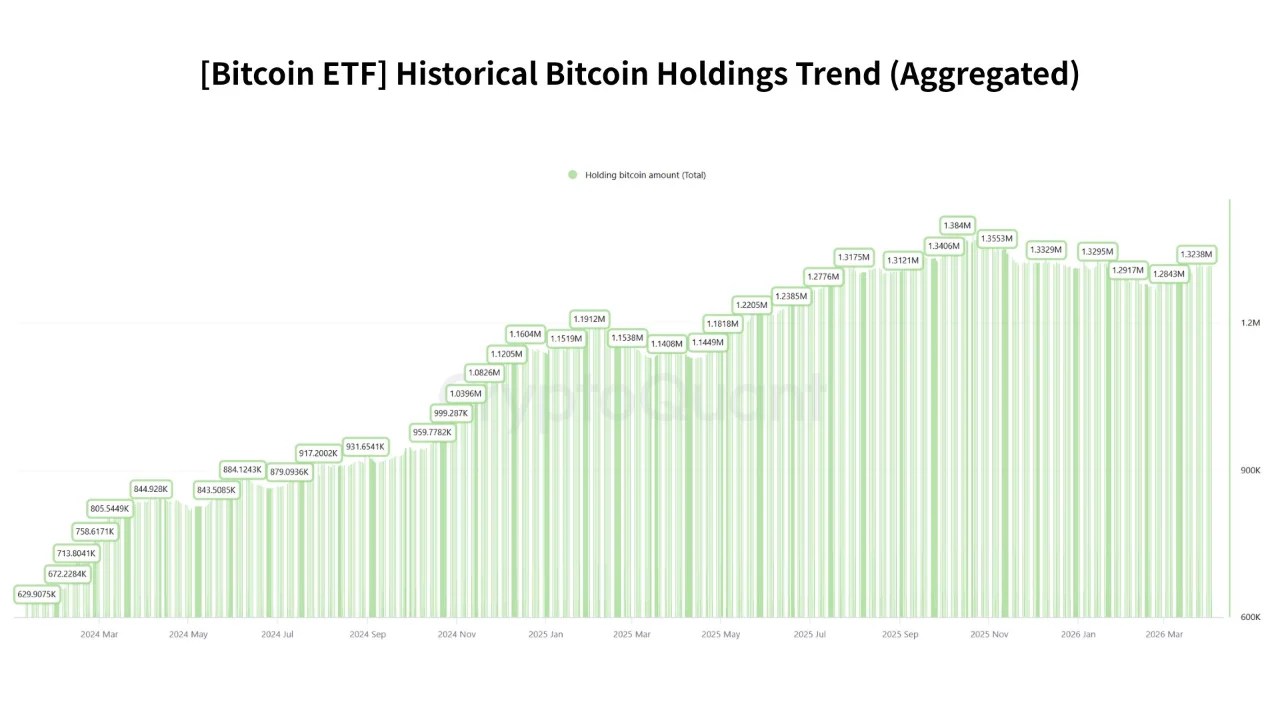
Source: CryptoQuant

For context, the average daily trading volume of the Bitcoin Spot ETFs is estimated to be in the multi-billion dollar range, with BlackRock’s IBIT intermittently experiencing levels similar to the Coinbase exchange. This observation suggests that these investment funds now play a major role in price discovery, which has been historically tied to trading volume observed on the centralized exchanges. Meanwhile, the net assets of 1.3 million BTC represent more than just inflows. XWIN Research Japan describes this development as a structural supply lock, reducing BTC liquidity in active circulation.

In particular, these changing dynamics have been attributed to the constant efforts by authorized sponsors to arbitrage price gaps as well as the approval of in-kind creation/redemption, thus ensuring that ETFs reflect spot market price and showcase a capital efficiency that encourages continued institutional adoption.

Bitcoin ETFs In Japan?

Meanwhile, XWIN Research Japan also highlighted the potential role of Japanese investors in expanding the Bitcoin ETFs market influence. With over ¥2,000 trillion ($12.53 billion) in household assets, even small allocations to a potential Bitcoin spot ETF market would result in significant inflows capable of altering the demand-supply market.

At press time, Bitcoin trades at $66,889 following a minor 1.14% gain over the last week. Meanwhile, daily trading volume is down by 41.68%, suggesting that market participants remain largely apprehensive despite recent gains. Over the last week, the premier cryptocurrency maintained a price range of $66,000-$69,000, amid multiple retest attempts of the lower boundary zone. The bear market remains active with present spot prices still about 47% away from the cycle’s all-time high at $126,100.

BTC trading at $67,030 on the daily chart | Source: BTCUSDT chart on Tradingview.com

Пов'язані питання

QWhat role do US Bitcoin Spot ETFs play in the Bitcoin market beyond being investment vehicles?

AUS Bitcoin Spot ETFs are transforming into key structural components of the Bitcoin market, influencing liquidity and price discovery. They act as a structural supply lock by holding a significant amount of BTC (1.3 million BTC), reducing the active circulating supply.

QHow much cumulative net inflow and net assets have US Bitcoin Spot ETFs attracted since their launch?

AUS Bitcoin Spot ETFs have attracted a cumulative total net inflow of $55.96 billion and net assets of $86.22 billion, accounting for 6.44% of the current BTC market cap.

QWhy are Bitcoin Spot ETFs considered important for price discovery in the Bitcoin market?

ABitcoin Spot ETFs are important for price discovery because their average daily trading volume is in the multi-billion dollar range, with some like BlackRock's IBIT intermittently experiencing levels similar to major exchanges like Coinbase. This high volume allows them to play a major role in determining Bitcoin's price.

QWhat potential impact could Japanese investors have on the Bitcoin ETF market?

AJapanese investors, with over ¥2,000 trillion ($12.53 billion) in household assets, could significantly expand the Bitcoin ETF market's influence. Even small allocations to a potential Bitcoin spot ETF in Japan would result in substantial inflows capable of altering the demand-supply dynamics.

QWhat was Bitcoin's price and trading volume situation at the time of the article's publication?

AAt the time of publication, Bitcoin was trading at $66,889 with a minor 1.14% gain over the last week. However, daily trading volume was down by 41.68%, indicating that market participants remained largely apprehensive despite recent gains.

Пов'язані матеріали

Beyond the Stadium: The Profitable Games Surrounding the World Cup

"Beyond the Pitch: The Profit Game Around the World Cup" The FIFA World Cup transcends being a sporting spectacle, evolving into a massive global arena for speculation and profit-seeking. The 2026 tournament has amplified this dynamic, creating a multi-layered ecosystem of financial opportunism alongside the football. **Prediction markets** have surged into the mainstream. Platforms like Polymarket and Kalshi saw trading volumes for World Cup contracts soar, attracting new users with their financial trading model and high-profile, chain-based wealth stories that overshadow traditional sports betting in terms of growth and narrative. However, **traditional sportsbooks** remain the dominant force, leveraging established user habits, legal markets, and comprehensive product offerings to handle the vast majority of speculative wagers, with projections suggesting record-breaking betting volumes. Capital markets also react. **"Concept stocks"** in countries like South Korea and Japan experience volatile price swings based on team performance and anticipated fan spending on items like chicken, beer, and viewing parties, effectively becoming a stock market reflecting fan sentiment. The **ticket resale market** has become a sophisticated arena for arbitrage. Prices fluctuate wildly based on team draws and star power, with sellers sometimes listing tickets they don't yet own in a practice akin to short-selling, while FIFA's own "Right to Buy" tokens add another layer of speculative trading. **Collectibles and merchandise** offer another avenue. Panini sticker albums, with their inherent scarcity and nostalgic value, can become high-value collectibles. Limited-edition or locally themed jerseys command significant premiums on secondary markets, and even counterfeit vendors profit from fans' desire for affordable match-day identity. The **cryptocurrency** space has seen a frenzy of speculative, unauthorized World Cup-themed meme coins on chains like Solana. These tokens, often exploiting team names and player imagery, experience extreme pump-and-dump cycles, creating stories of massive gains for a few early entrants and steep losses for many others. Finally, an entire industry thrives on **providing information and tools** to other speculators. Developers create platforms like SeatSidekick to track ticket inventory and prices, while paid Telegram groups and subscriptions sell betting tips and predictions, monetizing the widespread desire for an informational edge. In essence, the World Cup has become a compressed, global laboratory for speculation. While the games determine champions on the field, a parallel, complex network of financial transactions—spanning prediction contracts, bets, stocks, tickets, collectibles, crypto, and information services—settles its own scores in the global market.

marsbit3 хв тому

Beyond the Stadium: The Profitable Games Surrounding the World Cup

marsbit3 хв тому

How Does Codex Use a Computer? Three Entry Points and Permission Boundaries

This article explains the three primary methods for Codex to interact with a computer, each with distinct use cases, permission boundaries, and trust levels. **1. Computer Use:** This offers the broadest access, allowing Codex to visually control and interact with the graphical user interface of authorized macOS/Windows apps, system settings, and even iOS simulators. It's ideal for tasks lacking APIs or structured tools, such as operating legacy software or multi-app workflows. However, it's the slowest method and has the widest permission scope, requiring careful supervision for sensitive actions. **2. Chrome Extension:** This grants Codex access to the user's logged-in Chrome browser state, including cookies, profiles, and open tabs. It's best for tasks requiring user identity across websites like Gmail, LinkedIn, Salesforce, or internal dashboards. Its key advantage is multi-tab control for complex workflows. While more powerful for browser-based tasks than Computer Use, it carries higher sensitivity as actions are performed under the user's identity. **3. In-App Browser:** This is a browser isolated within the Codex thread, separate from the user's personal browsing data. It excels in web development and debugging scenarios—previewing local servers, testing responsive layouts, or annotating designs directly on the page. Its isolation is a strength for development but a limitation for tasks requiring login sessions. The core principle is to choose the narrowest, safest, and most structured interface for the task. Use plugins or MCPs first, resort to visual control (Computer Use) only for GUI-dependent tasks, employ the Chrome extension for identity-reliant browser work, and prefer the In-App Browser for isolated development. **Appshots** are clarified as a fourth, complementary tool for *inputting* context—capturing a screenshot of a window to point Codex to something—rather than a method for Codex to *act*. Together, this layered approach highlights a key to AI agent productization: not granting unlimited permissions, but constraining them within clear boundaries for specific tasks while preserving user oversight.

marsbit1 год тому

How Does Codex Use a Computer? Three Entry Points and Permission Boundaries

marsbit1 год тому

The "Iron Rule" of Chip Equipment Is Being Broken

For years, the semiconductor equipment industry followed an unwritten "iron rule": suppliers offered steep discounts for new tool introductions (Design-in) and faced consistent price pressure during repeat orders, especially during market downturns. This long-standing buyer's market dynamic is now being upended. Recently, SK Hynix's primary equipment suppliers have reportedly requested a 3-4% price *increase*, a nearly unprecedented move. This shift is driven by a severe supply-demand imbalance fueled by the AI compute boom. Securing equipment has become an urgent arms race as chipmakers' expansion speed dictates their ability to fulfill massive AI chip orders. Key areas feeling the strain include: **TCB (Thermal Compression Bonding) Equipment:** Demand is exploding, driven by the simultaneous needs of HBM4 memory stacking, AI chip Chip-on-Substrate (C2S), and logic Chiplet Chip-on-Wafer (C2W) packaging. Players like Hanmi Semiconductor, Hanwha Semitech, and ASMPT are receiving major orders. While hybrid bonding is seen as the future, TCB remains the pragmatic choice for HBM4 mass production, with its lifecycle extended by relaxed specifications and ongoing technological upgrades. **Test Equipment Bottlenecks:** Ironically, AI-driven shortages are now crippling test equipment manufacturing. Critical components like FPGAs, Driver ICs, and CPUs face severe shortages and extended lead times (up to 52 weeks for FPGAs), as AI data center and server vendors prioritize supply. This creates a paradoxical cycle: AI chip shortages drive fab expansion, which requires more test equipment, whose production is delayed because its key parts are diverted to make AI chips. The industry is entering a broad, AI-powered upcycle. SEMI forecasts global semiconductor equipment sales to hit a record $156 billion by 2027, fueled by investment in advanced logic/foundry, HBM-driven DRAM, and advanced packaging (like CoWoS). Major players like TSMC, SK Hynix, and Micron are aggressively ramping capital expenditure. In conclusion, leading equipment vendors are no longer just selling tools; they are selling the critical capability to deliver AI-era capacity. Pricing power is shifting decisively to those with indispensable technology in key process nodes like advanced logic, HBM, and advanced packaging, rewriting the industry's traditional power structure.

marsbit1 год тому

The "Iron Rule" of Chip Equipment Is Being Broken

marsbit1 год тому

Торгівля

Спот
Ф'ючерси
活动图片