How a Listed Company Died: Gambling $1.46 Billion on WLFI, with $540 Million Ending Up in Trump Family's Pockets

Foresight NewsОпубліковано о 2026-07-09Востаннє оновлено о 2026-07-09

Анотація

The article details the downfall of AI Financial Corporation (formerly Alt5 Sigma), a Nasdaq-listed fintech company. In August 2025, the company, whose board overlapped with the crypto project World Liberty Financial (WLFI), was acquired via a $750 million WLFI token payment. It then raised another $750 million in cash from investors to buy more WLFI tokens, totaling a $1.46 billion bet at ~$0.20 per token. The strategy proved disastrous. WLFI's price plummeted ~70% to ~$0.057, causing over $750 million in unrealized losses on the largely locked-up tokens. With its core payment business being sold, AI Financial now holds illiquid tokens, ~$10.5 million in depleting cash, and a going-concern warning from the SEC. Its stock fell over 90%. Crucially, of the $750 million cash used to buy WLFI tokens, an estimated $540 million flowed to Trump-affiliated entities due to WLFI's revenue-sharing structure, contributing to Trump's reported $1.4+ billion in 2025 crypto-related income. The case highlights the extreme risks for public companies making large, illiquid bets on single crypto assets.


Author:ChandlerZ,Foresight News


According to a July 7 report by The Wall Street Journal, World Liberty Financial (WLFI) treasury firm AI Financial Corporation (Nasdaq: AIFC, formerly Alt5 Sigma) is in talks with Tokyo blockchain company Perpetuals.com to sell its core payment business Alt5 Sigma Canada for up to $15 million.


Alt5 Sigma Canada generated approximately $25 million in revenue last year and is AI Financial's only remaining operational business. Perpetuals.com's offer of $15 million includes a $5 million upfront payment in stock, with the remaining $10 million contingent on achieving future revenue targets. The buyer will also assume certain liabilities.


As a condition of the deal, Perpetuals.com agreed to explore promoting WLFI's USD1 stablecoin in Europe and to license its trading technology to AI Financial.


If the transaction is completed, AI Financial's asset composition will consist of: no operating revenue, WLFI tokens with a nominal value of about $700 million but largely locked up, $10.5 million in cash (which continues to be consumed), and an SEC going concern warning.


But 12 months ago, this company was called Alt5 Sigma, its stock price was $9.76, and it was a normally operating Nasdaq-listed payment company.


The $1.46 Billion Token Gamble


AI Financial's predecessor was Alt5 Sigma, a Nasdaq-listed fintech company whose main businesses included the crypto payment gateway ALT5 Pay and the digital asset OTC trading platform ALT5 Prime, having cumulatively processed over $5 billion in cryptocurrency transactions. It was included in the Russell 3000E index in 2025. The company also previously had a biotechnology business (developing the orphan drug JAN123 for chronic pain), planned to be spun off as a separate entity, Alyea Therapeutics.


The company's downfall began with a deal in August 2025.


On August 11, 2025, the Trump family's crypto project World Liberty Financial announced the acquisition of a controlling stake in the then-Nasdaq-listed payment company Alt5 Sigma via token payment, with a transaction price of $750 million in WLFI tokens.


Interestingly, AI Financial's board chairman, Zachary Witkoff, also served as WLFI's co-founder and CEO, and board member Zachary Folkman was also a WLFI co-founder. The buyer and seller were highly overlapping at the board level.


Following the acquisition, Alt5 Sigma immediately issued additional shares to external investors at $7.50 per share, raising another $750 million in cash, all of which was used to purchase more WLFI tokens. Combined, the listed company spent approximately $1.46 billion to acquire about 7.28 billion WLFI tokens at an average price of about $0.20.


Token Down 70%, Stock Down 90%, Cash Left at $10.5 Million


However, WLFI tokens continued to decline after the deal. As of July 9, 2026, the token price was about $0.057, approximately 70% lower than AI Financial's $0.20 purchase cost. The book value of AI Financial's 7.28 billion tokens shrank from $1.46 billion to about $706 million, marking an unrealized loss of over $750 million.


These tokens also face strict lock-up restrictions: 3.53 billion tokens are non-transferable for 12 months, only allowed for collateral, staking, and lending; another 3.75 billion tokens require additional conditions such as shareholder approval, charter amendments, and resale registration to be unlocked. AI Financial holds tokens nominally worth $700 million, but the vast majority cannot be liquidated in the foreseeable future.


This led to a comprehensive deterioration in AI Financial's financials. The company recorded a net loss of $271.5 million in Q1 2026, including $348.3 million in unrealized losses from its WLFI holdings. The company's cash balance is only $10.5 million.


On May 18, 2026, AI Financial formally issued a "substantial doubt about ability to continue as a going concern" warning in an SEC filing, stating the company might not survive the year. The company's stock price fell from about $9.76 before the deal to about $0.55, a drop of over 90%, with a market cap of about $77 million.
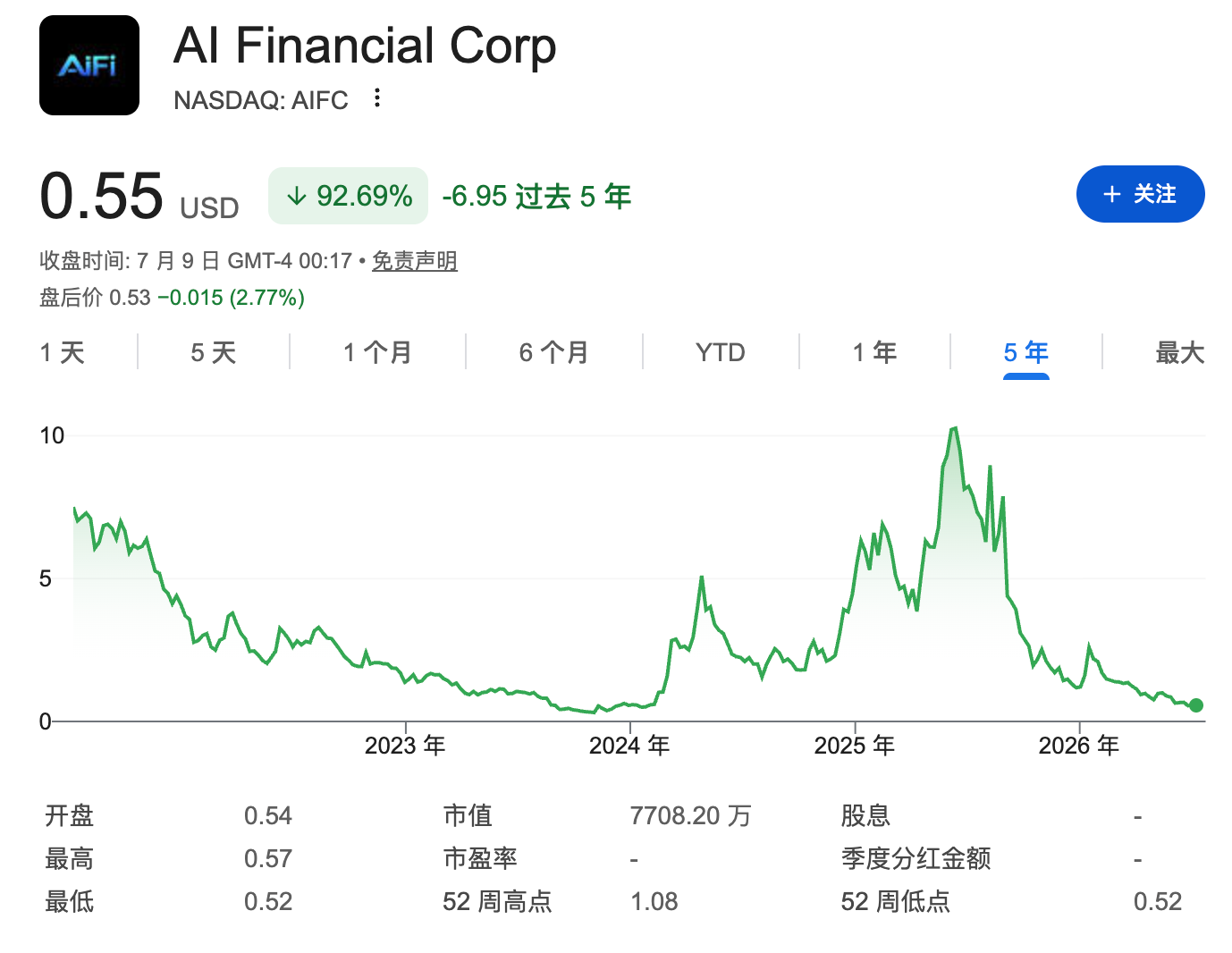


The SEC filing also disclosed material weaknesses in internal controls, the need to restate 2024 financial data, and that the external asset manager Kraken, previously responsible for managing the WLFI token position, did not renew its 30-day contract, leaving the token position currently without an external manager.


Where Did the $540 Million Go?


The most critical flow of funds in this deal lies in WLFI's token sale revenue-sharing structure. According to WLFI's token sale agreement, the Trump family is entitled to 75% of the net proceeds from token sales. When AI Financial used $750 million in cash (from proceeds raised by issuing additional shares to investors) to purchase WLFI tokens, this money flowed directly into WLFI's token sale revenue pool.


According to CNBC estimates, Trump-affiliated entities received approximately $540 million from this.


According to a recent Bloomberg report, U.S. President Trump's latest annual financial disclosure shows he made at least $1.4 billion in 2025 from crypto and meme coin-related businesses. This includes over $594 million in sales revenue from World Liberty Financial, the crypto company he co-founded with his son and senior government official Steven Witkoff; $636 million in royalty income from licensing agreements for his meme coin business CIC Digital LLC, which holds at least $60 million in cryptocurrency in its digital wallet; and nearly $197 million in gains from the sale of Stablecoin Holdco equity.


The disclosure indicates crypto income is Trump's largest source of income to date by far. This income far exceeds the $77 million in resort-related income from his Mar-a-Lago resort and the $25 million from his Northern Virginia golf club. The disclosure lists over 680 pages of transaction records, including stock purchases and sales, covering companies like Amazon and Apple.


The story of AI Financial is perhaps not an isolated corporate misstep. In recent years, more and more listed companies have begun trying to boost their valuations by holding Bitcoin, Ethereum, or other cryptocurrencies, with the Strategy model being widely emulated.


However, for token assets lacking mature market pricing, with limited liquidity, and subject to strict lock-up arrangements, transforming a company's balance sheet into a massive single-token exposure is a high-leverage trust experiment involving the underlying asset's liquidity, governance structure, commercial cash flow, and transparency among stakeholders.


A single misstep could lead to a point of no return.

Пов'язані питання

QWhat were the two main stages of the bet AI Financial (formerly Alt5 Sigma) made on WLFI tokens, and what was the total cost?

AThe bet occurred in two stages. First, in August 2025, the company (then Alt5 Sigma) was acquired by WLFI, paying the Trump family project 7.5 billion WLFI tokens for a controlling stake. Second, Alt5 Sigma subsequently raised $750 million in cash through a public stock offering and used all of it to purchase additional WLFI tokens. The combined cost of these two actions was approximately $1.46 billion for about 7.28 billion WLFI tokens.

QWhat is the current financial and operational state of AI Financial as described in the article?

AAI Financial is in severe financial distress. It has issued a 'going concern' warning, meaning it may not survive the year. Its cash balance is only $10.5 million and declining. Its only operating business, Alt5 Sigma Canada, is being sold. Its primary asset is a large, illiquid position in WLFI tokens that has lost about 70% of its value and is mostly locked up. The company also faces an SEC warning and reported a net loss of $271.5 million in Q1 2026.

QHow did the structure of WLFI's token sales benefit the Trump family, specifically from the deal with AI Financial?

AAccording to WLFI's token sale agreement, the Trump family was entitled to 75% of the net proceeds from token sales. When AI Financial used the $750 million it raised from investors to buy WLFI tokens, that money flowed into WLFI's sales revenue pool. Based on this structure, CNBC estimated that Trump-affiliated entities received approximately $540 million from this specific transaction.

QWhat are the major constraints on the WLFI tokens held by AI Financial, preventing the company from using them to solve its liquidity crisis?

AThe tokens are subject to strict lock-up restrictions. Approximately 3.53 billion tokens cannot be transferred for 12 months, though they can be used for staking or as collateral. Another 3.75 billion tokens have additional unlock conditions requiring shareholder approval, charter amendments, and resale registration. Therefore, while nominally worth hundreds of millions, the vast majority of these tokens cannot be sold for cash in the foreseeable future.

QAccording to the article, what broader trend in corporate strategy does the AI Financial case illustrate, and what are the inherent risks?

AThe case illustrates the trend of public companies holding cryptocurrencies or tokens to boost their valuation, often mimicking the 'Strategy' of early corporate Bitcoin adopters. The inherent risks, especially with tokens like WLFI, include: lack of mature market pricing, limited liquidity, strict lock-up arrangements, and the high-stakes gamble of converting a company's balance sheet into a large, single-asset exposure. This tests the trust in the asset's underlying liquidity, governance, business model, and the transparency between involved parties.

Пов'язані матеріали

Paradigm's New Playbook: Crypto in One Hand, AI and Robotics in the Other

Title: Paradigm's New Strategy: Crypto in One Hand, AI and Robotics in the Other On July 8, 2026, top-tier venture capital firm Paradigm announced the successful $12 billion close of its fourth fund, marking a strategic evolution beyond its pure-play crypto roots. While remaining committed to cryptocurrency, the firm is now formally extending its investment focus to include artificial intelligence, robotics, and other frontier technologies. This shift was foreshadowed by a subtle but significant change to its official social media description earlier in March, from "A research-driven crypto investment firm" to a broader "We build and invest in the companies and ideas shaping the frontier." The move is driven by the firm's recognition of transformative technological waves beyond crypto, particularly in AI and robotics, and a response to the shifting capital allocation landscape. Despite significant AI sector fundraising, Paradigm emphasizes its commitment remains grounded in deep technical rigor. A key intersection for Paradigm lies in AI Agents, where decentralized blockchain networks and stablecoins are seen as a natural financial infrastructure for autonomous digital operations. The firm is active in promoting open-source, decentralized AI (e.g., investing in Nous Research) and building agent-friendly blockchains (e.g., incubating Tempo). It is also developing tools like EVMbench (with OpenAI) and the Centaur AI Agent platform. Within its crypto stronghold, Paradigm will continue focusing on core infrastructure areas. These include derivatives and new liquidity layers (e.g., Hyperliquid), prediction markets (with plans for a proprietary trading terminal), and developer tools (continuing development of Reth and Foundry). In summary, Paradigm's expansion reflects a broader realignment in venture capital, where the intense capital concentration in AI and the search for exponential growth compel even crypto-native funds to broaden their narratives. However, this does not signify an abandonment of crypto; instead, the focus is sharpening on real-world financial applications like stablecoins, RWA, on-chain derivatives, prediction markets, and the convergence of Crypto and AI Agents.

Foresight News6 хв тому

Paradigm's New Playbook: Crypto in One Hand, AI and Robotics in the Other

Foresight News6 хв тому

The Preferred Stock Domino Effect: Strive Incurs a 7.08 Million Dollar Loss, Strategic Risk Spreading in a Chain Reaction

"Priority Stock Domino Effect": Strive's $7.08 Million Loss Reveals Chain-Reaction Risk in Bitcoin Reserve Sector Bitcoin reserve company-issued preferred shares are no longer just yield assets but a credit test for balance sheet health. While focus remains on Strategy, Strive, the 7th largest public Bitcoin holder, disclosed a tangible spillover effect: its holding of Strategy's (STRC) preferred shares lost $7.08 million in fair value over eight days, despite no change in share count. This exposes a clear cross-company risk transmission channel within the sector. Strive's filing shows its 505,000 STRC shares fell from ~$88.59 to ~$74.57 per share. While Strive remains solvent with 19,864 BTC and $141.7M cash, the loss signals that preferred stock risks can spread via inter-company holdings, shifting their perception from stable income to credit-like, high-risk assets dependent on issuer liquidity and dividend sustainability. In response, Strategy unveiled a "Digital Credit Capital Framework," raising STRC's annual dividend to 12%, mandating a 12-month cash reserve for dividends, and authorizing up to $1B each for STRC/common stock buybacks and a $1.25B Bitcoin sale plan to bolster reserves. This marks a shift to active credit risk management, formally incorporating potential Bitcoin sales to stabilize its capital structure. Third-party valuation tools, like Farside's calculator estimating STRC's net present value at ~$49.89, highlight that pricing now hinges critically on perpetual dividend sustainability and the issuer's ability to pay amid market volatility. Bitcoin's price (~$62k) remains below Strategy's average cost basis ($75,651), intensifying focus on reserve policies. The market faces two scenarios: 1) Contained risk, where STRC's discount narrows and stress is limited to Strategy; or 2) Systemic risk, where deep STRC discounts persist, dividend hikes fail, Bitcoin sales commence, and pressure spreads to other issuers like Strive's SATA shares. Key indicators to watch are STRC/SATA discount levels, dividend coverage credibility, equity issuance rates, and any actual Bitcoin divestment. Strive's future reports will be crucial in determining if its loss is an isolated event or the first sign of sector-wide credit risk contagion via preferred shares.

marsbit11 хв тому

The Preferred Stock Domino Effect: Strive Incurs a 7.08 Million Dollar Loss, Strategic Risk Spreading in a Chain Reaction

marsbit11 хв тому

Are the Frantic Acquisitions of Crypto Companies by Giants Good or Bad?

In a bear market, giants are actively acquiring crypto companies. Recent months have seen at least five major deals: Samsung Securities bought a 2% stake in Upbit operator Dunamu; Robinhood acquired WonderFi for $180 million to enter the Canadian market; Figure purchased Kiavi for $717 million to expand into on-chain real estate credit; Franklin Templeton bought 250Digital to launch Franklin Crypto; and Blockworks acquired data platform Messari at a steep discount—over 90% less than its 2022 $300 million valuation. These moves highlight a strategic shift. Cash-rich giants are consolidating resources at low cost, targeting companies with established compliance frameworks to navigate tightening global regulations. Acquisitions like WonderFi and the Upbit stake provide immediate market access and licensed user bases. Figure's deal signals real-world asset (RWA) tokenization moving from concept to large-scale implementation, with Kiavi's $7+ billion annual transaction volume being integrated into on-chain capital markets. Franklin Crypto's launch targets institutional investors like pension funds, offering them tailored, compliant crypto strategies. For these strategic players, bear markets present an ideal entry point: valuations are depressed, speculative noise is minimized, and they can acquire robust technology and compliance infrastructure at a fraction of the cost. This acquisition wave marks a transitional phase for crypto—from a wild frontier toward an institutional, regulated financial system. Giants are positioning themselves to capture future growth when macroeconomic conditions and liquidity improve, leaving latecomers behind.

marsbit1 год тому

Are the Frantic Acquisitions of Crypto Companies by Giants Good or Bad?

marsbit1 год тому

Торгівля

Спот
活动图片