Hot Interactions Collection | xStocks Points Event Now Live; Tempo Mainnet Launches (March 25)

Odaily星球日报Опубліковано о 2026-03-25Востаннє оновлено о 2026-03-25

Анотація

This article highlights three major interactive opportunities in the crypto space: 1. **xStocks**: A tokenized stock platform backed by Kraken, allowing users to trade tokenized versions of real-world assets. It recently launched an xPoints rewards program where users can earn points by holding tokenized stocks, borrowing/lending, and providing liquidity. Users can connect their wallet, complete daily check-ins, and join the Telegram for bonus points. 2. **Tempo**: A payment-focused Layer 1 blockchain incubated by Stripe and Paradigm. Unlike typical blockchains, it uses stablecoins like USDC/USDT for gas fees. After raising $500M in funding, it has now launched its mainnet. Users can create a wallet using a passkey and bridge USDC to the Tempo network via Stargate. 3. **Forte Protocol**: A blockchain infrastructure project focused on compliance and economic tools, which raised $910M in 2021. It has launched two Galxe quests: one for social media tasks (X account required) and another for Galxe subscribers or users with a high Human Passport score.

Original | Odaily Planet Daily (@OdailyChina)

Author | Asher (@Asher_ 0210)

xStocks: U.S. Stock Tokenization Platform

Project Introduction

Backed Finance is an infrastructure provider responsible for issuing on-chain representations of traditional financial assets, including stocks, ETFs, and bonds. The company was acquired by Kraken in December 2025 and launched xStocks in June of the same year, offering tokenized stock products backed by real stocks held by Swiss custody partners. Currently, xStocks is integrated into multiple centralized platforms, including Kraken, Gate, Bybit, and Bitget, and supports Ethereum, Solana, and Tron.

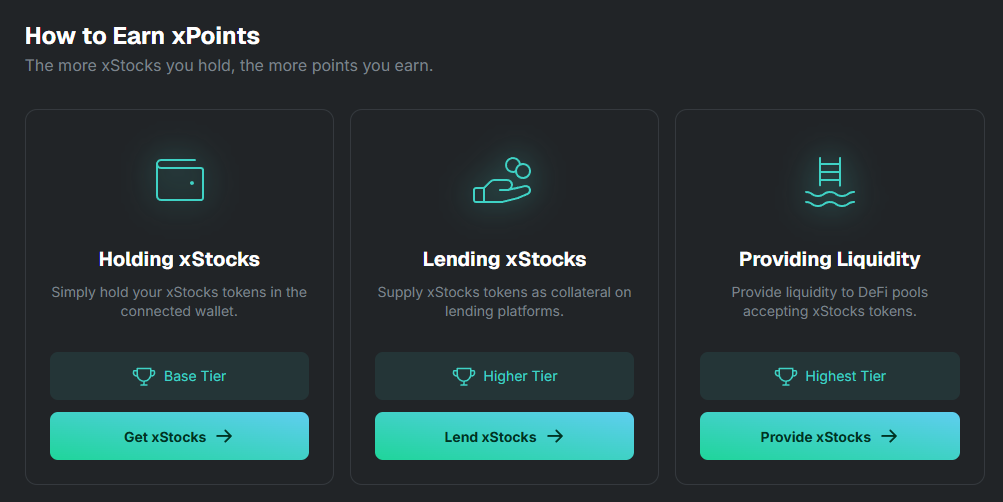
On March 11, xStocks announced on platform X the launch of the xPoints rewards program. On March 18, it announced that points (xPoints) are now viewable. Users automatically accumulate points by holding tokenized stocks in their wallets, establishing positions in lending markets, and providing liquidity on DEXs.

Interaction Tutorial

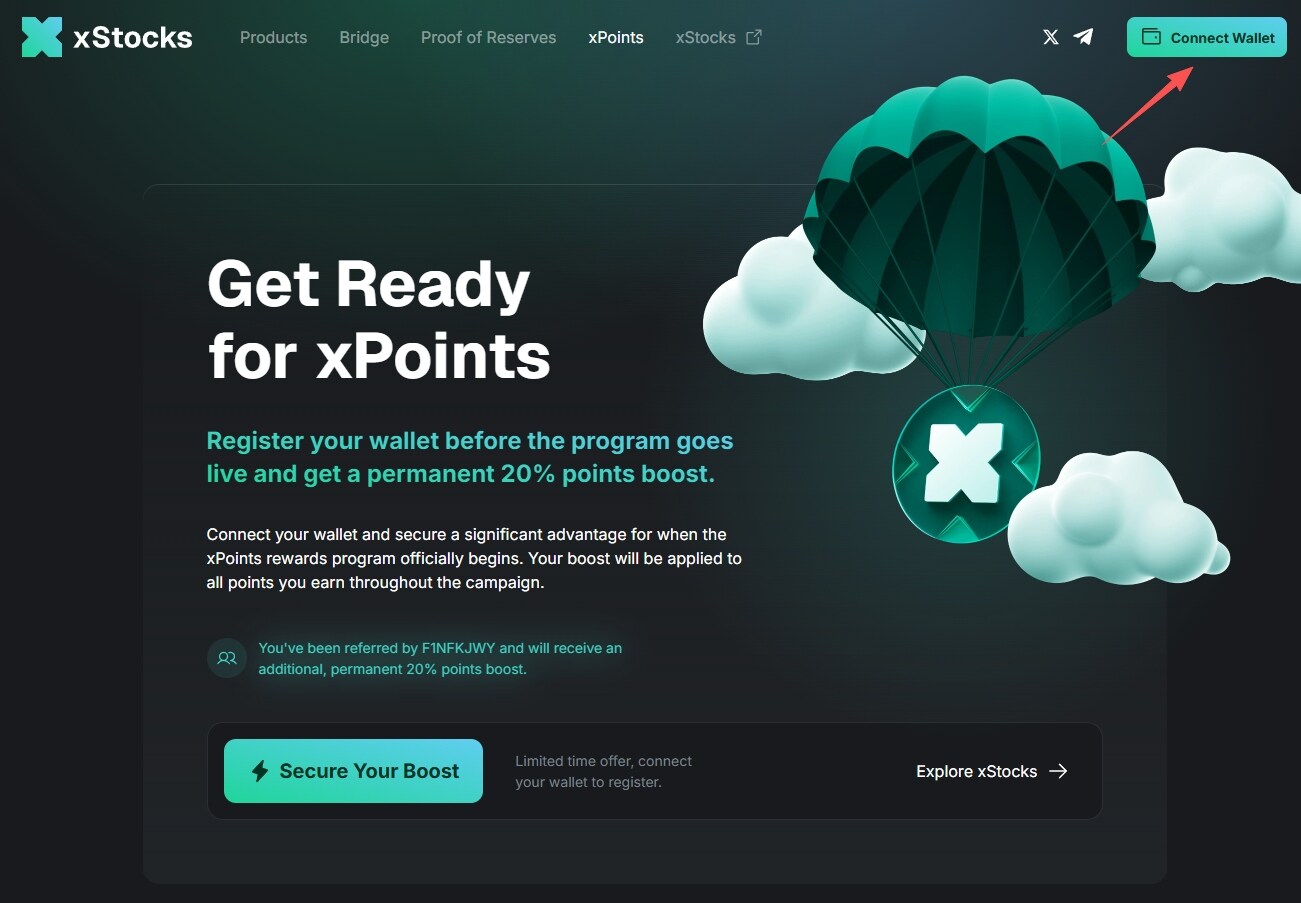
STEP 1. Go to the official website (Link: https://defi.xstocks.fi/points), click "Connect Wallet" to log in.
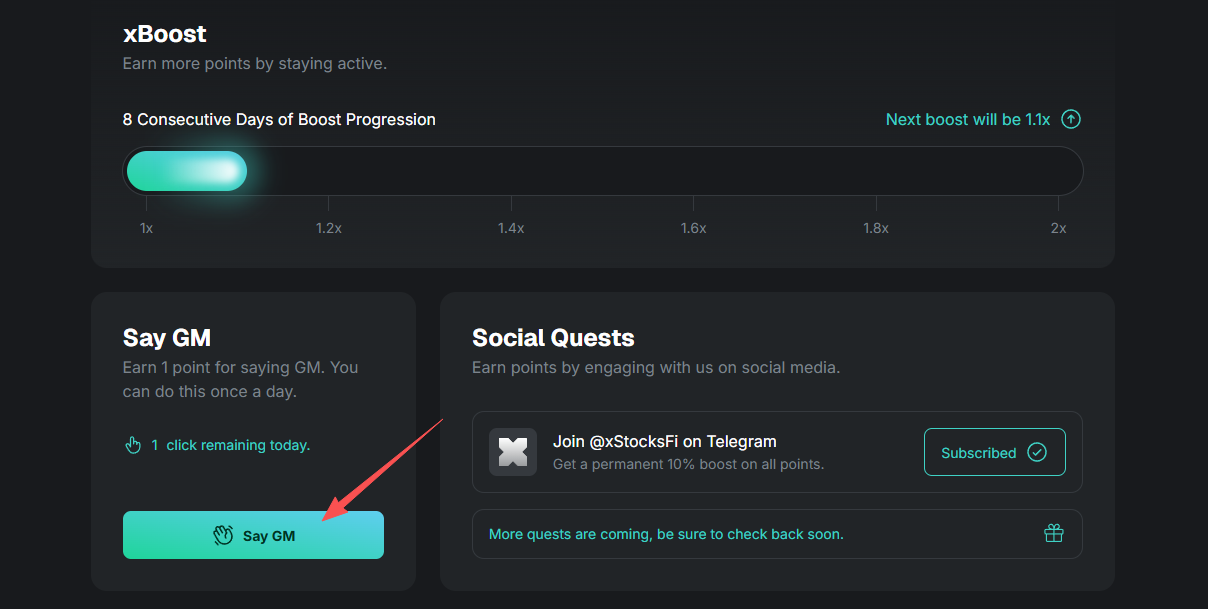
STEP 2. Click GM (daily check-in type task) to earn points. Additionally, joining the official TG and verifying will grant a 10% points bonus.
STEP 3. Earn points through three main methods: holding xStocks tokens, borrowing xStocks tokens, and providing liquidity for xStocks tokens, with increasing weight for each method.
Tempo: L1 Project Focused on the Payments Track

Project Introduction

Tempo is an L1 project focused on payments, jointly incubated by Stripe and Paradigm. Its biggest difference from traditional public chains is that it does not issue its own native token but directly accepts mainstream stablecoins like USDC and USDT as Gas.

According to ROOTDATA data, Tempo completed a $500 million Series A funding round on October 8, 2025, led by venture capital giants Greenoaks and Joshua Kushner's Thrive Capital. This round valued Tempo at $5 billion, with participation from Sequoia Capital, Ribbit Capital, and Ron Conway's SV Angel.

On March 18, Tempo announced the launch of its mainnet, marking the official transition of its stablecoin payment system from the testing phase to practical application.

Interaction Tutorial

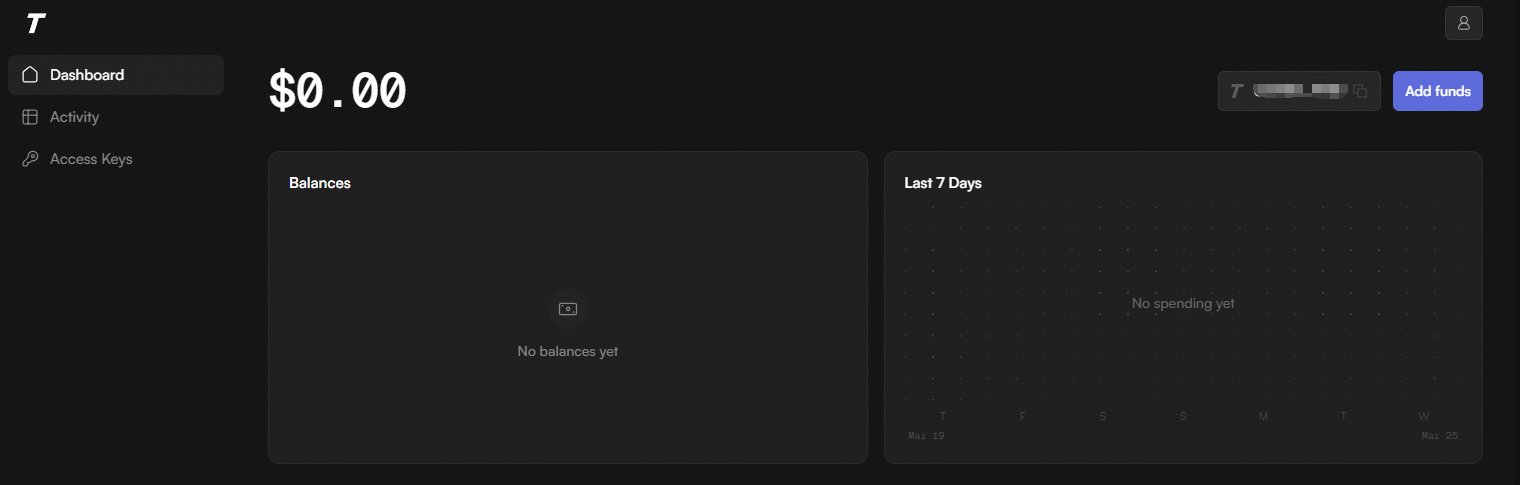
STEP 1. Create a Tempo wallet (Link: https://wallet.tempo.xyz/welcome) by logging in using your computer/phone's Passkey.
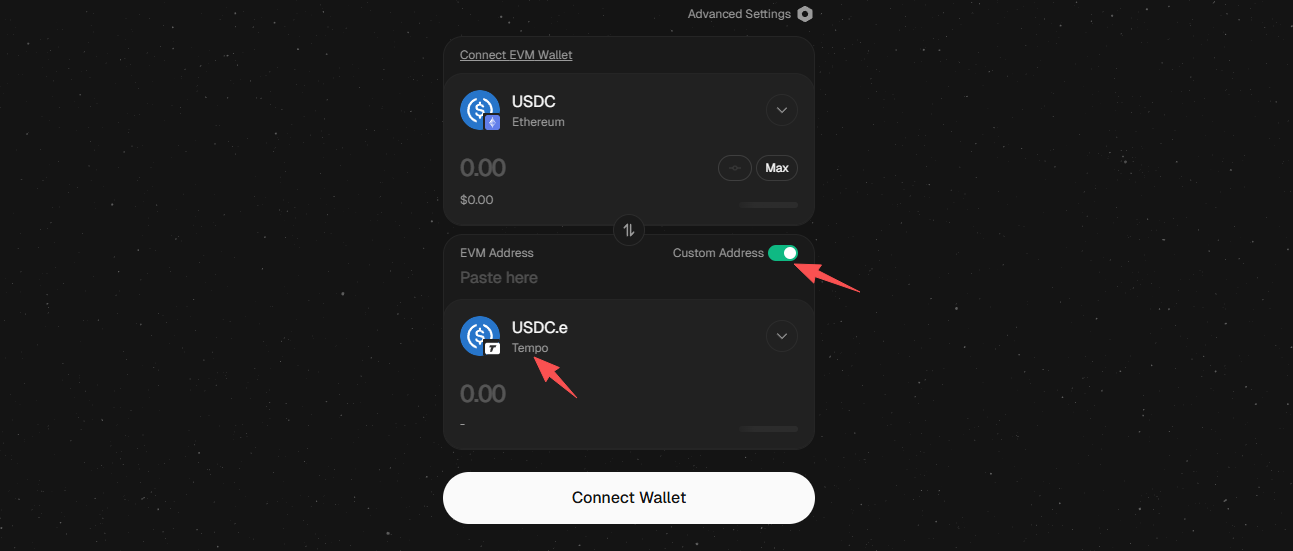
STEP 2. Bridge USDC (Link: https://stargate.finance/). Select USDC, choose the Tempo network as the destination chain, select "Custom address" for the recipient address, paste the newly created Tempo wallet address, and confirm the bridge.
Forte Protocol: Blockchain Infrastructure Focused On-Chain Compliance and Economic Tools

Project Introduction

The Forte Protocol project was established in 2018. It is a set of open-source on-chain compliance and economic rule engines, providing open-source on-chain solutions aimed at creating a secure environment to support healthy and stable digital asset economies. Its trust and privacy protection solutions enable developers to manage compliance risks, promote economic stability, and leverage instant liquidity.

According to ROOTDATA data, Forte Protocol completed two funding rounds as early as 2021, raising a total of $910 million.

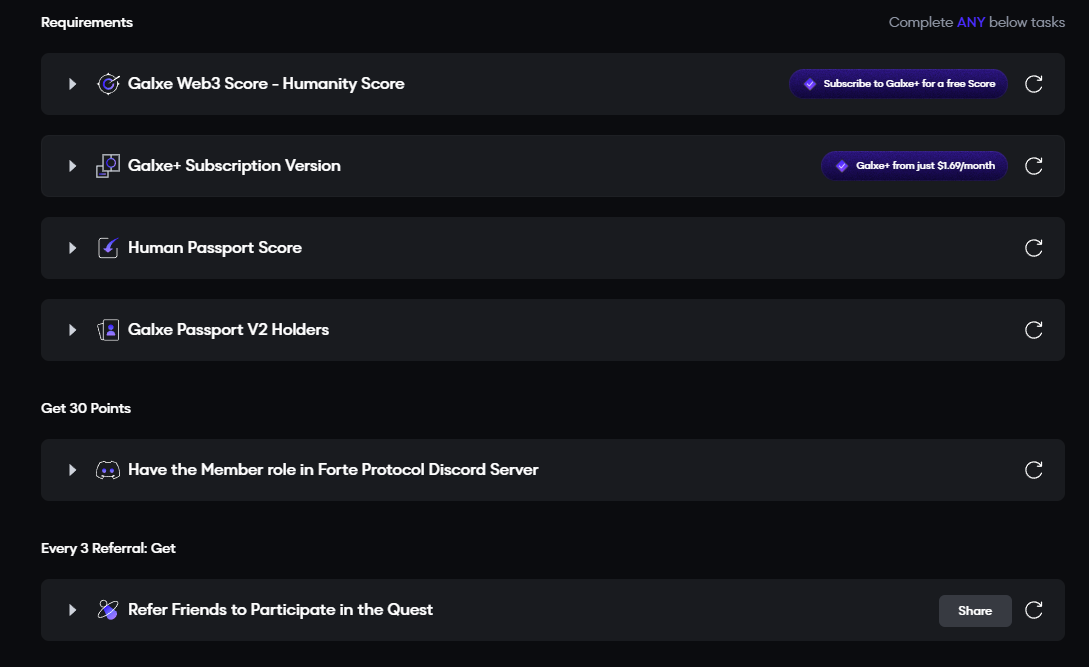
Recently, Forte Protocol launched Season 0 tasks on Galxe. Currently, there are 2 tasks available to participate in.

Interaction Tutorial

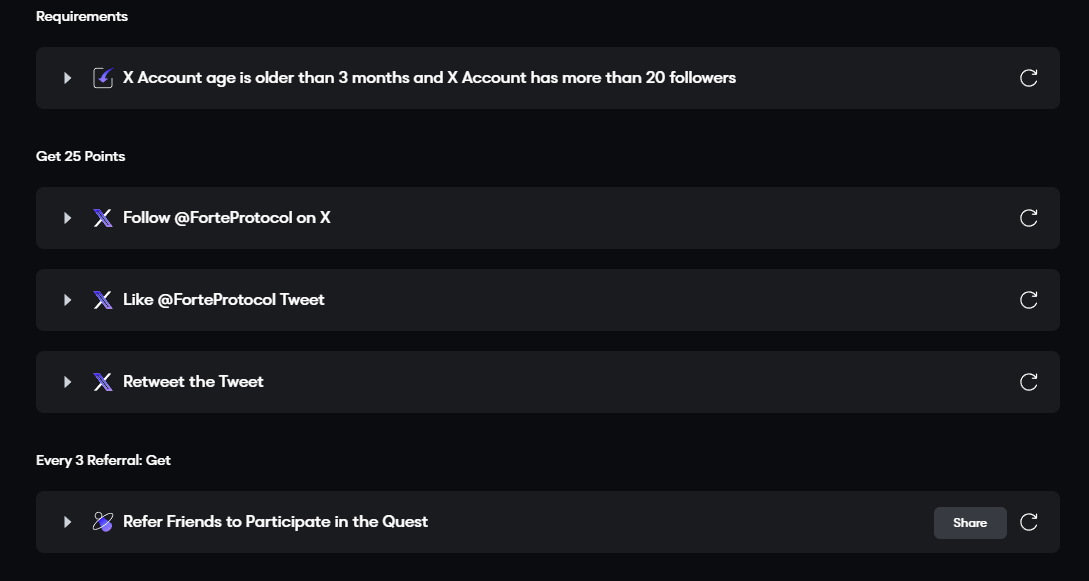
Galxe Task One: Spread the Word (Link: https://app.galxe.com/quest/ForteProtocol/GCHxctYayA?referral_code=GRFr2JLgLym0F_CjZtICIKop6-k3a5AWWjkhuI2Kg5uvmw): X account must be older than 3 months with more than 20 followers, and complete social tasks.
Galxe Task Two: (Link: https://app.galxe.com/quest/ForteProtocol/GCLHFtYfPg?referral_code=GRFr2JPsJmm0Fjrq5tICIKopwKZDR_ow6bG-TQ5tpNQM1dw): Requires a Galxe subscription membership or a Human Passport score that meets the requirements.
Пов'язані питання

QWhat is xStocks and what recent activity did they launch?

AxStocks is a tokenized stock platform that provides on-chain representations of traditional financial assets like stocks, ETFs, and bonds, backed by real stocks held by Swiss custodians. They recently launched an xPoints points program where users can earn points by holding tokenized stocks, establishing positions in lending markets, and providing liquidity on DEXs.

QWhich major exchange acquired Backed Finance, the company behind xStocks?

AKraken acquired Backed Finance in December 2025.

QWhat is Tempo and what makes it different from traditional blockchains?

ATempo is a payment-focused Layer 1 blockchain project incubated by Stripe and Paradigm. Unlike traditional blockchains, it does not have a native token and instead uses mainstream stablecoins like USDC and USDT for gas fees.

QHow much funding did Tempo raise in its Series A round and what was it valued at?

ATempo raised $500 million in its Series A funding round, which valued the company at $5 billion.

QWhat is Forte Protocol and what type of tasks did they recently launch on Galxe?

AForte Protocol is a blockchain infrastructure project focused on on-chain compliance and economic tools. They recently launched 'Season 0' tasks on Galxe, including a 'Spread the Word' social media task and another task requiring a Galxe subscription or a specific Human Passport score.

Пов'язані матеріали

Fei-Fei Li's Team Clarifies the Concept of 'World Models', Sora Merely a Renderer

"World Models" has become a widely used yet confusing term in AI. To address this, a team led by Fei-Fei Li and World Labs proposed a functional taxonomy based on the Partially Observable Markov Decision Process framework. This taxonomy categorizes systems called "world models" into three distinct projections: Renderers, Simulators, and Planners. Renderers, like OpenAI's Sora and other video generation models, focus on producing photorealistic visual outputs for human perception. They prioritize visual fidelity over physical accuracy. Simulators, such as NVIDIA Omniverse, aim to compute precise future environmental states for computational tasks like engineering analysis or digital twins. Planners, like Vision-Language-Action models, take in observations and goals to output executable actions for robots or agents. The article clarifies that most current "world models," including Sora, are primarily Renderers. They generate convincing visuals but lack the core ability to simulate state transitions based on actions, a key requirement for a true world model in classic reinforcement learning definitions. This conceptual confusion has practical implications, leading to potential misalignment in technology selection, investment, and public understanding of AI capabilities. Clear categorization is crucial. It helps enterprises avoid costly mistakes (e.g., using a renderer for robot training), allows investors to accurately assess markets, and enables researchers to build comparable benchmarks. While future systems may integrate these functions, recognizing current boundaries is essential for honest assessment and progress.

marsbit1 год тому

Fei-Fei Li's Team Clarifies the Concept of 'World Models', Sora Merely a Renderer

marsbit1 год тому

Bloomberg Uncovered: How Do China's Wealthy Circumvent the Annual $50,000 Limit to Transfer Assets?

**Summary: How Wealthy Chinese Circumvent $50,000 Annual Foreign Exchange Limits** Despite China's strict capital controls, including an annual $50,000 per person foreign exchange quota, an estimated $150 billion in funds still leaves the country annually via various gray and underground channels. This report outlines the evolution of China's "capital wall" and the methods used to bypass it. **The Evolving Capital Controls:** * **Foundation (1994):** The system of "current account convertibility with strict capital account controls" was established. * **Quota Set (2007):** The $50,000 individual annual forex purchase limit was formalized. * **Crackdown Begins (2015-2017):** Following market volatility, enforcement tightened. Banks were required to scrutinize transactions, and channels like using UnionPay cards for Hong Kong insurance premiums or buying overseas property were blocked. * **Digital & Legal Upgrades (2024-2026):** Enhanced algorithms now flag suspicious patterns (e.g., "smurfing"). The Common Reporting Standard (CRS) provides Chinese tax authorities with data on citizens' offshore accounts. Unlicensed cross-border brokers have been targeted. **Five Primary Methods for Moving Capital:** 1. **Underground Banking / "Hawala" (Duiqiao):** The largest-scale method. No money crosses borders. Clients pay RMB to a domestic account; an overseas associate deposits equivalent foreign currency into the client's offshore account. Risks include high fees, account freezes, and legal penalties. 2. **"Smurfing" or "Ant Moving":** Using multiple individuals' $50,000 quotas to pool funds for one offshore recipient. Increasingly detected by anti-money laundering algorithms. 3. **Trade Invoice Manipulation:** Businesses over-invoice imports or under-invoice exports via offshore shell companies, creating a pretext to transfer excess funds abroad under the guise of trade. 4. **Channel Migration:** After a crackdown on internet brokers, funds flow toward more compliant but costly channels like major banks' cross-border wealth management services or Qualified Domestic Institutional Investor (QDII) quotas. 5. **Structural Arrangements:** High-net-worth individuals use complex, high-cost legal structures involving offshore trusts, insurance, and investment migration programs to transfer asset ownership. **Regulatory Response: Focusing on People, Not Just Money** The current strategy extends oversight from enterprises to **individual residents**. Tools like CRS allow retroactive visibility into offshore assets. Cryptocurrencies, once seen as a potential loophole, are now actively monitored and prosecuted as an illegal channel. The underlying driver remains: with significant wealth concentrated among millions of affluent households seeking diversification amid domestic economic shifts, the incentive to move assets offshore persists despite regulatory barriers.

marsbit1 год тому

Bloomberg Uncovered: How Do China's Wealthy Circumvent the Annual $50,000 Limit to Transfer Assets?

marsbit1 год тому

Торгівля

Спот
Ф'ючерси
活动图片