Hoskinson Blasts Ripple CEO Garlinghouse In Fresh Public Rant

bitcoinistОпубліковано о 2026-01-19Востаннє оновлено о 2026-01-19

Анотація

Cardano founder Charles Hoskinson criticized Ripple CEO Brad Garlinghouse in a video on January 18, 2026, for supporting the US Clarity Act, which Hoskinson argues would expand the SEC's authority and harm the crypto industry. He claimed the bill, with 137 amendments, would treat all new projects as securities by default, forcing them to seek regulatory relief. Hoskinson called this worse than the current regulatory uncertainty, accusing Garlinghouse and others of compromising too easily. He warned that passing a flawed bill would make meaningful change nearly impossible, citing the long-standing Securities Exchange Act of 1933. Hoskinson also expressed concerns about the industry moving toward custodial wallets, KYC, and reversible transactions, which he believes betray crypto's original revolutionary ethos. At the time of reporting, XRP was trading at $1.95.

Cardano founder Charles Hoskinson took aim at Ripple CEO Brad Garlinghouse in a January 18, 2026 video, criticizing what he framed as an industry push to accept the US Clarity Act on terms that would expand the Securities and Exchange Commission’s authority over new projects.

Speaking on Jan 18, Hoskinson used a wide-ranging monologue on market fatigue, industry morale, and the mission behind Cardano and Midnight to zero in on a regulatory flashpoint: a bill he described as swollen by “137 amendments” and tilted toward the SEC. In his telling, the proposal would force crypto projects to “go beg and plead” for relief, with “all new projects” treated as securities by default.

Why Hoskinson Blasted Ripple CEO Garlinghouse

Hoskinson argued that the outcome would be a strategic own-goal, worse, in his view, than the policy uncertainty the industry has been trying to escape. “How is that any better than what Scary Gary [Gensler] gave us under Biden?” he said, referring to the SEC’s enforcement action against the crypto industry under former US President Joe Biden, before extending the critique to lobbying and political dealmaking more broadly.

Hoskinson’s sharpest remarks came when he cited unnamed industry figures he suggested are urging compromise, then called out Garlinghouse directly. “Still got people like Brad [Garlinghouse] saying well it’s not perfect but we just got to get something,” he said. “You know, it’s better than no clarity. Hand it to the same people who sued us. Hand it to the same people who put us out of business, who subpoenaed us, who put us in jail. That’s better. That’s what we fought for.”

He then framed the decision as effectively irreversible once legislated, invoking the long life of US securities law to argue that a flawed framework would calcify. “And tell me, how do we change it? Like we changed the Securities Exchange Act of 1933,” Hoskinson said. “93 years later, have we been able to change it? No. You pass it, you own it forever. Sorry, Brad. It’s not better than chaos. Take the chaos and fight for what’s right. Fight for integrity.”

While the Garlinghouse jab was the most explicit, Hoskinson placed it inside a larger narrative: that crypto’s purpose is being reduced to a lobbying-driven contest for acceptable market access rather than an attempt to redesign how value and identity are handled online.

He argued that the industry is at risk of normalizing a world of “custodial wallet” defaults, pervasive KYC, and reversible transactions, outcomes he associated with legacy power structures rather than the original “revolution” ethos.

“I didn’t sign up to hand the revolution to 15 banks,” he said, describing a future where transactions can be “frozen at a whim.” Hoskinson linked those concerns to a broader critique of technological surveillance and what he called the loss of individual “agency,” suggesting the industry’s incentive structure is pulling leaders toward comfort and access rather than confrontation.

The remarks landed amid a separate thread in his talk: a rebuke of what he called “toxic learned hopelessness” in crypto discourse. Hoskinson said he had stopped using X/Twitter, still broadcasting, but not reading or engaging—arguing that constant outrage and demands for instant announcements distort how long negotiations and product development actually work.

At press time, XRP traded at $1.95.
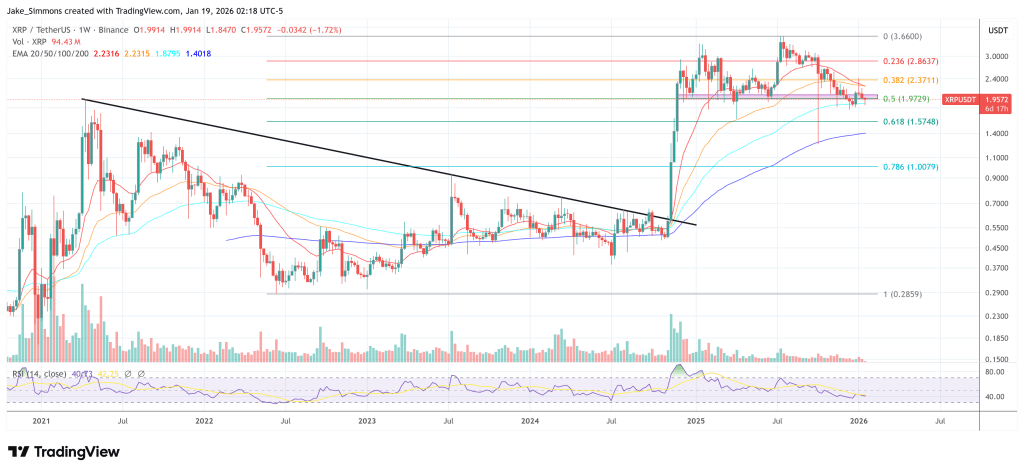
XRP falls into the red support zone again, 1-week chart | Source: XRPUSDT on TradingView.com

Пов'язані питання

QWhat was the main criticism Charles Hoskinson directed at Brad Garlinghouse in his January 18, 2026 video?

AHoskinson criticized Garlinghouse for advocating to accept the US Clarity Act despite its flaws, arguing that compromising with a bill that expands SEC authority and treats all new projects as securities by default is worse than regulatory chaos.

QAccording to Hoskinson, what negative outcomes would the proposed regulatory framework lead to for the crypto industry?

AHoskinson argued it would force crypto projects to beg for relief, treat all new projects as securities by default, normalize custodial wallets, pervasive KYC, and reversible transactions, ultimately handing control to traditional banks and allowing transactions to be frozen at a whim.

QWhy does Hoskinson believe that passing a flawed regulatory framework would be effectively irreversible?

AHe invoked the long life of US securities law, specifically referencing the Securities Exchange Act of 1933 which hasn't been changed in over 93 years, arguing that once such a framework is passed, the industry would be stuck with it forever.

QBeyond criticizing Garlinghouse, what broader concern did Hoskinson express about the crypto industry's direction?

AHe expressed concern that the industry's purpose is being reduced to a lobbying-driven contest for acceptable market access rather than a revolution to redesign how value and identity are handled online, and that leaders are being pulled toward comfort and access rather than confrontation.

QWhat did Hoskinson say about his own engagement with social media platform X/Twitter?

AHoskinson stated that he had stopped using X/Twitter in terms of reading or engaging with content, though he still broadcasts, due to what he called 'toxic learned hopelessness' and the distortion that constant outrage and demands for instant announcements create.

Пов'язані матеріали

How Many Tokens Away Is Yang Zhilin from the 'Moon Chasing the Light'?

The article explores the intense competition between two leading Chinese AI companies, DeepSeek and Kimi (Moon Dark Side), and the mounting pressure on Yang Zhilin, the founder of Kimi. While DeepSeek re-emerged after 15 months of silence with its powerful V4 model—boasting 1.6 trillion parameters and low-cost, long-context capabilities—Kimi has been focusing on long-context processing and multi-agent systems with its K2.6 model. Yang faces a threefold challenge: technological rivalry, commercialization pressure, and investor expectations. Despite Kimi’s high valuation (reaching $18 billion), its revenue heavily relies on a single product with low paid conversion rates, while DeepSeek’s strategic silence and open-source influence have strengthened its market position and valuation prospects, now targeting over $20 billion. Both companies reflect broader trends in China’s AI ecosystem: Kimi aims for global influence through open-source contributions and agent-based advancements, while DeepSeek prioritizes foundational innovation and hardware independence, notably shifting to Huawei’s chips. Their competition is seen as vital for China’s AI progress, with the gap between top Chinese and U.S. models narrowing to just 2.7% on the Elo rating scale. Ultimately, the article argues that this rivalry, though anxiety-inducing for leaders like Zhilin, is essential for driving innovation and solidifying China’s role in the global AI landscape.

marsbit3 год тому

How Many Tokens Away Is Yang Zhilin from the 'Moon Chasing the Light'?

marsbit3 год тому

TechFlow Intelligence Bureau: ChatGPT Helps Amateur Mathematician Crack 60-Year-Old Problem, CFTC Sues New York Regulator Over Coinbase and Gemini

An amateur mathematician, with the assistance of ChatGPT, has solved a combinatorial mathematics puzzle originally proposed by Hungarian mathematician Paul Erdős in the 1960s. This marks another milestone in AI-aided mathematical research, demonstrating the evolving capabilities of large language models in formal reasoning. In other AI developments, OpenAI introduced a new privacy filter tool for enterprise API usage, automatically screening sensitive data. Meanwhile, the Qwen3.6-27B model achieved 100 tokens per second on a single RTX 5090 GPU using quantization, significantly lowering the cost barrier for local AI deployment. In crypto and Web3, the U.S. CFTC sued New York’s financial regulator, challenging its oversight of Coinbase and Gemini—a first-of-its-kind federal-state regulatory clash. Following a vulnerability, KelpDAO and major DeFi protocols established a recovery fund. Tether froze $344 million in assets linked to Iran’s central bank upon U.S. Treasury request, highlighting the centralized control risks in stablecoins. Separately, Litecoin underwent a 3-hour chain reorganization to undo a privacy-layer exploit. In the U.S., former President Trump invoked the Defense Production Act to address power grid bottlenecks affecting AI data centers and dismissed the entire National Science Board, raising concerns over research independence. A retail trader gained 250% on a $600k Intel options bet amid AI-related speculation. Xiaomi announced its first performance electric vehicle, targeting rivals like Tesla. Meanwhile, iPhone users reported devices automatically reinstalling a hidden app daily, suspected to be MDM-related. A Chinese securities report noted that A-share institutional crowding has reached its second-longest streak since 2007, signaling high valuations and potential style rotation. The day’s developments reflect a dual narrative: AI is enabling unprecedented individual breakthroughs, while centralized power structures—whether governmental or corporate—are becoming more assertive, underscoring that decentralization is as much a political-economic challenge as a technical one.

marsbit3 год тому

TechFlow Intelligence Bureau: ChatGPT Helps Amateur Mathematician Crack 60-Year-Old Problem, CFTC Sues New York Regulator Over Coinbase and Gemini

marsbit3 год тому

Торгівля

Спот
Ф'ючерси
活动图片





