Hormuz Blockade, Oil Prices Surpass $100, Why Aren't U.S. Stocks Falling?

marsbitОпубліковано о 2026-04-14Востаннє оновлено о 2026-04-14

Анотація

Amidst the U.S.-Iran negotiation breakdown and the subsequent blockade of the Strait of Hormuz, which pushed oil prices above $100 per barrel, the S&P 500 surprisingly rose by 1% on April 13, erasing all losses since the outbreak of the Iran conflict and reaching 6,886 points. Major financial institutions like J.P. Morgan, Morgan Stanley, and BlackRock concurrently expressed bullish outlooks, emphasizing that corporate earnings resilience far outweighs geopolitical shocks. Data from LSEG I/B/E/S showed Q1 2026 earnings growth expectations for the S&P 500 increased to 13.9%, up from 12.7% pre-conflict. The "Magnificent Seven" tech giants saw their valuation premium narrow, making equities more attractive. Historical analysis from UBS and LPL Research indicates that geopolitical shocks typically see markets recover within six weeks. Meanwhile, retail investors on Reddit expressed confusion, questioning why negative news didn’t trigger declines, highlighting a disconnect between headline risks and market pricing. The consensus among institutions is that strong earnings and limited conflict impact justify buying the dip.

Author: Claude, Deep Tide TechFlow

Deep Tide Guide: U.S.-Iran negotiations break down, the Hormuz Strait blockade is initiated, oil prices return above $100, yet the S&P 500 closed up 1% on Monday, completely erasing all losses since the Iran war to reach 6886 points. J.P. Morgan, Morgan Stanley, and BlackRock all expressed bullish views on the same day, with a consistent core logic: corporate profit resilience far outweighs the impact of geopolitical shocks. The investment section of Reddit exploded with activity, with retail investors exclaiming, 'The market simply ignores the news.'

On the first trading day after the breakdown of U.S.-Iran negotiations, U.S. stocks charted a curve that left everyone puzzled.

On April 13 (Monday), the S&P 500 closed up 69 points, a gain of 1%, at 6886 points; the Dow Jones Industrial Average rose 302 points, up 0.6%; the Nasdaq Composite Index increased by 1.2%. On the same day, Trump announced on a social platform that the U.S. Navy would immediately initiate a blockade operation in the Hormuz Strait. Brent crude oil broke through $100 per barrel during the session before pulling back to close around $98.16, while WTI crude closed at $97.82.
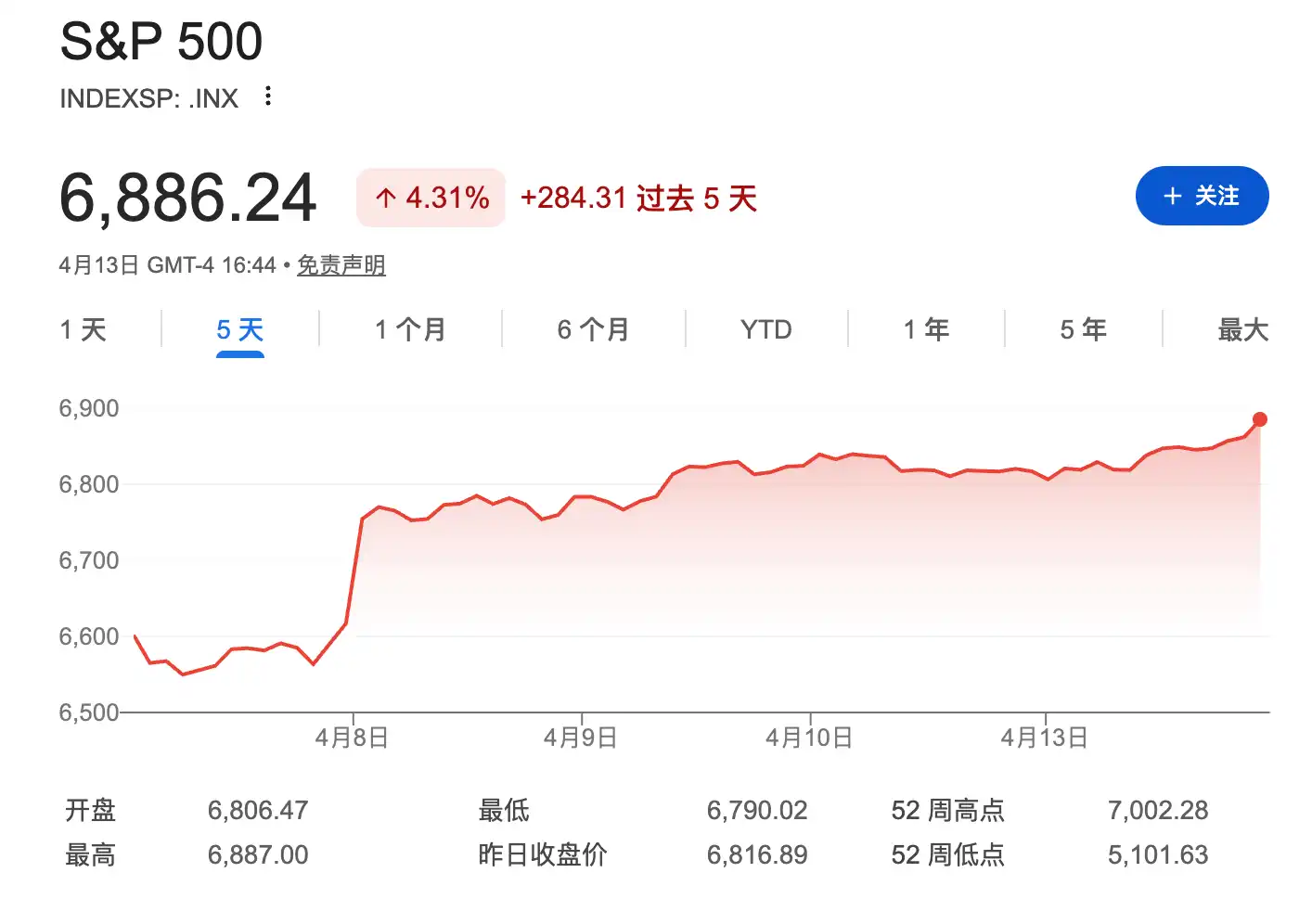
The S&P 500 rose to its highest level since the end of February that day, fully recovering all the losses incurred since the outbreak of the Iran war. The simultaneous occurrence of surging oil prices and rising stock markets seems logically contradictory. However, the largest institutions on Wall Street provided a highly consistent explanation: corporate profits remain strong, the persistence of geopolitical shocks is limited, and the current moment presents a window for buying on the dip.

Three Major Institutions Bullish on the Same Day, Core Logic Points to Profit Resilience

J.P. Morgan, in a research report authored by strategist Mislav Matejka, stated that declines driven by geopolitical shocks should ultimately prove to be buying opportunities.

Morgan Stanley strategist Michael Wilson's team judged that the recent sell-off in the S&P 500 resembled a correction rather than the start of a sustained downturn, with supporting factors coming from improved profit growth and a return to reasonable valuations. Morgan Stanley continues to be bullish on cyclical sectors such as financials, industrials, and consumer discretionary, as well as high-quality growth targets like AI hyperscale computing.

On the same day, the BlackRock Investment Institute upgraded its rating on U.S. stocks from 'neutral' to 'overweight,' making it the most active mover among the three. Jean Boivin, head of the BlackRock Investment Institute, stated that the valuation premium of the technology sector has been eroded, while the sector's expected profit growth rate for 2026 has risen to 43%, higher than last year's 26%.

BlackRock pointed out in its weekly market report that the two signposts triggering its decision to increase exposure have appeared: first, there is tangible evidence showing that navigation through the Hormuz Strait is resuming, and second, the sustained damage of the conflict to the macroeconomy has proven to be manageable.

The three institutions cited the same set of data: according to LSEG I/B/E/S data, as of April 10, the expected Q1 profit growth rate for the S&P 500 is 13.9%, higher than the pre-war 12.7%. In other words, nearly seven weeks after the conflict erupted, analysts have not only failed to lower profit expectations but have instead raised them.

Valuation Contraction of the 'Magnificent Seven' Becomes a Reason to Buy

J.P. Morgan specifically mentioned in its report that the forward P/E premium of the 'Magnificent Seven' (Nvidia, Apple, Microsoft, Meta, Google, Amazon, and Tesla) has narrowed significantly from the previous level of 1.7 times the S&P 500 to 1.2 times.

This data constitutes a key argument for Wall Street bulls: the problem of top-heavy concentration that has suppressed market breadth over the past two years is being alleviated on its own due to valuation regression.

BlackRock pointed out that the valuation premium of the technology sector relative to the other ten sectors has fallen to its lowest level since mid-2020. The company stated that against the backdrop of firm corporate profit expectations and limited damage to global growth, it has decided to increase exposure to U.S. stocks and emerging markets.

Historical Data Backs It Up: Geopolitical Shocks Are Usually Digested Within Six Weeks

The optimism of Wall Street institutions is not without basis. Research from UBS shows that when the S&P 500 falls 5% to 10% within three to four weeks, it historically usually returns to pre-conflict levels within six months.

A review of geopolitical shock events since World War II by LPL Research shows that the average first-day reaction is approximately a 1% decline, the average peak-to-trough decline is about 5%, the average time to bottom is about 19 days, and the average recovery cycle is about 42 days.

UBS stated in a mid-March research report that from the outbreak of the conflict on February 28 to March 13, global stocks fell only about 5%, while crude oil prices rose about 40% during the same period. The stock market's 'insensitivity' to the oil price shock itself validates the above historical pattern.

On April 6, UBS lowered its year-end target price for the S&P 500 from 7700 to 7500 and its mid-term target from 7300 to 7000, but maintained its overall judgment that U.S. stocks are 'attractive,' with the 2026 EPS forecast unchanged at $310.

Reddit Investors' Soul-Searching Question: 'The Market Simply Ignores the News'

While the consensus among institutions can be explained by data, the reaction in retail communities more directly reflects current market sentiment.

In the r/stocks subreddit, a post titled roughly 'Do you believe it now? The market doesn't move because of the news' received 923 upvotes and 159 comments. The poster's core point was: the market moves first, then finds reasons later. This Hormuz blockade is the most typical case he has experienced. A large number of comments expressed confusion about the disconnect between geopolitical risks and market pricing.
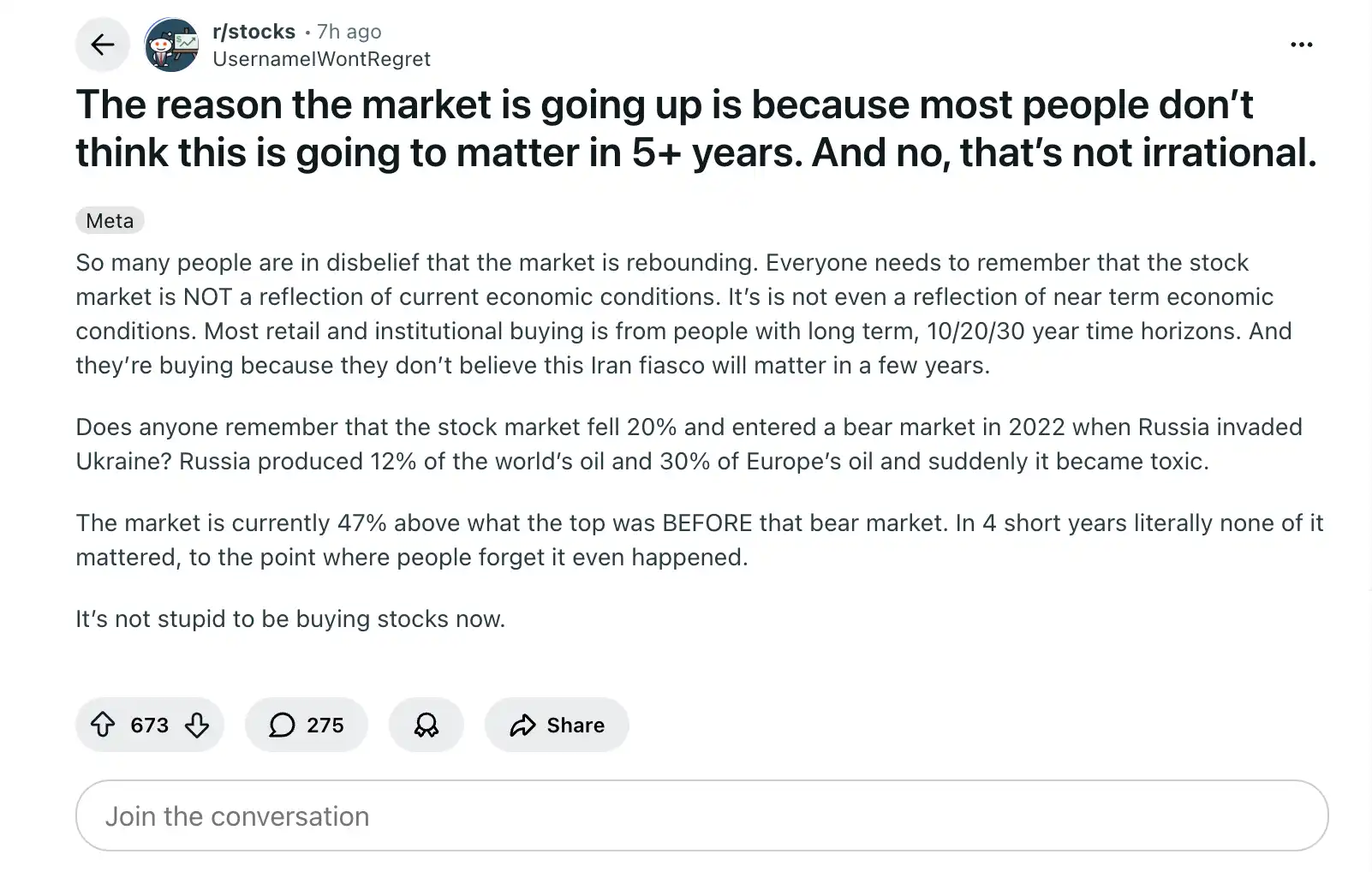
'The market is rising because most people think this won't matter in 5 years; this is not irrational.' This post received 344 upvotes and 199 comments, representing the typical stance of long-term investors.

In the r/wallstreetbets subreddit, a post with 504 upvotes pointed out that the physical oil market is 'screaming supply shock,' but the stock market remains calm, leaving traders不知所措 (at a loss) due to the contradictory signals between the two markets.

The confusion of retail investors and the confidence of institutions form a sharp contrast, but the underlying logic is actually two sides of the same coin: institutions are betting on profit resilience and the limited nature of the conflict, while retail investors are confused about why bad news hasn't translated into declines.

The answer might be simple: the market already completed a round of pricing in March and is currently in a rebound phase where 'bad news is exhausted.'


Пов'язані питання

QWhy did the US stock market rise despite the blockade of the Strait of Hormuz and oil prices above $100?

AMajor financial institutions like JPMorgan, Morgan Stanley, and BlackRock believe that strong corporate earnings resilience far outweighs the impact of geopolitical shocks, making the market a buying opportunity.

QWhat was the core logic provided by Wall Street institutions for being bullish on US stocks?

AThe core logic is that corporate profit growth remains robust, geopolitical shocks are limited in duration, and valuations have become more attractive, particularly in sectors like technology.

QHow did the valuation of the 'Magnificent Seven' tech stocks change, and why was it significant?

AThe forward P/E premium of the 'Magnificent Seven' narrowed from 1.7 times the S&P 500 to 1.2 times, reducing market concentration issues and making valuations more appealing for investors.

QWhat historical data supports the idea that geopolitical shocks are short-lived for the stock market?

AHistorical data from UBS and LPL Research shows that markets typically recover from geopolitical shocks within about six weeks, with an average peak-to-trough decline of around 5% and a recovery period of about 42 days.

QHow did retail investors on platforms like Reddit react to the market's performance amid the geopolitical tension?

ARetail investors expressed confusion and disbelief, with many noting that the market seemed to ignore negative news, highlighting a disconnect between geopolitical risks and market pricing.

Пов'язані матеріали

Annual Salary of Millions Competing for Electricians, Meta Rushes to Open Its Own Technical School

The AI boom is facing an unexpected bottleneck: a severe shortage of skilled construction workers and electricians. As tech giants like Meta, OpenAI, and Alphabet race to build massive data centers—such as OpenAI's $16 billion "Stargate" project—they are hitting a critical labor wall. The U.S. needs an estimated 130,000 more electricians, 240,000 construction workers, and 150,000 supervisors by 2030 for AI infrastructure alone, but tens of thousands of electrician jobs go unfilled each year. While AI companies offer high premiums, with electricians earning up to $280,000 annually, worker scarcity still causes massive losses—delays on a single project can cost $14.2 million per month. The complexity of building AI data centers, which require immense power (equivalent to powering hundreds of thousands of homes), sophisticated electrical systems, and advanced liquid cooling solutions, demands highly skilled technicians who are in short supply. To combat this, companies are investing heavily in training. Meta has committed $115 million to a free training school offering tuition, housing, and stipends, targeting 5,000 new workers. OpenAI is partnering with unions to secure skilled labor. These efforts are paying off, with a significant rise in Gen Z interest in trade schools over college. However, the power demands are staggering. AI data centers are driving a rapid surge in electricity consumption, projected to account for up to 12% of U.S. power use by 2028 and raising costs for consumers. Furthermore, the construction boom is project-based, leading to a potential future glut of trained workers once building peaks, which could depress wages industry-wide. The race for AI supremacy now depends as much on skilled hands as on advanced chips.

marsbit36 хв тому

Annual Salary of Millions Competing for Electricians, Meta Rushes to Open Its Own Technical School

marsbit36 хв тому

OpenAI No Longer Sells Its Most Expensive Model for Profit

OpenAI is shifting its business strategy away from promoting its most expensive, flagship models for every task. Recent price cuts—80% for GPT-5.6 Luna and 20% for Terra—signal a deeper change: the company now actively advises users that many tasks don't require the most powerful model. Instead, OpenAI recommends a tiered approach: use the high-end GPT-5.6 Sol for complex planning and analysis, then delegate execution to cheaper models like Luna. This mirrors moves by Anthropic, which recently launched Claude Opus 5 at half the price of its top model, Fable 5. Both companies are de-emphasizing flagship models as primary revenue drivers, using them instead for brand prestige and technological showcases. The industry is entering a "mass-market" phase, similar to automotive, where high-volume, cost-effective models handle daily operations and drive scale. OpenAI's price reductions are partly enabled by AI models themselves optimizing underlying code and infrastructure, creating a self-reinforcing cycle of efficiency gains and cost reduction. Competition is shifting from "who is smartest" to "who offers the best value." The goal is no longer selling individual models but fostering widespread API adoption and ecosystem lock-in. By making AI calls cheap and ubiquitous, companies like OpenAI aim to become the indispensable, utility-like infrastructure powering automated workflows—the "water and electricity" of software, quietly embedded everywhere.

marsbit36 хв тому

OpenAI No Longer Sells Its Most Expensive Model for Profit

marsbit36 хв тому

Will the Fed Definitely Raise Interest Rates in September? How Will Crypto and U.S. Stocks Withstand the Pressure?

The market's expectation for a September Fed rate hike surged dramatically in early August, jumping from under 50% to over 80% within a week. This shift followed a contentious July FOMC meeting, where a 9-3 vote to hold rates revealed growing dissent from hawkish members advocating for an immediate hike to combat persistent inflation. The primary catalyst for this repricing is rising oil prices, driven by renewed geopolitical tensions around the Strait of Hormuz, which threaten global supply. Energy costs directly influence inflation metrics, making the upcoming July CPI report (due August 12th) a critical data point. If it shows inflation reaccelerating, the probability of a September hike will solidify. For Bitcoin and crypto assets, this is typically bearish news. Bitcoin continues to behave as a high-beta, liquidity-sensitive risk asset. A rate hike raises the opportunity cost of holding non-yielding assets and could drive capital toward money markets, pressuring crypto prices in the short term. However, historical patterns suggest that if a hike is perceived as the end of a tightening cycle rather than the start, any negative price impact may be brief. U.S. stocks, particularly crypto-linked equities like Coinbase and growth-oriented tech stocks, are also vulnerable. Higher rates increase discount rates in valuation models, putting pressure on high-multiple companies. This coincides with a pivotal tech earnings season where investor focus has shifted from massive AI capital expenditure to tangible revenue and cash flow generation. Companies with negative cash flow and weak growth narratives could face heightened volatility if borrowing costs rise in September. In summary, a September Fed hike has evolved into a mainstream market scenario. Key factors to watch are oil prices, the July CPI report, and Fed communications, which will determine the final decision and its impact on volatile crypto and equity markets.

marsbit46 хв тому

Will the Fed Definitely Raise Interest Rates in September? How Will Crypto and U.S. Stocks Withstand the Pressure?

marsbit46 хв тому

Торгівля

Спот
活动图片




