Hong Kong Unveils New Rules To Allow Crypto Margin Financing And Perpetual Contracts

bitcoinistОпубліковано о 2026-02-12Востаннє оновлено о 2026-02-12

Анотація

Hong Kong's Securities and Futures Commission (SFC) has introduced new rules allowing licensed virtual asset brokers to offer crypto margin financing and perpetual contracts to professional investors. Under the ASPIRe roadmap's Pillar P, eligible clients with strong credit and sufficient collateral can use Bitcoin and Ether as collateral for margin trading. The move aims to enhance market liquidity, provide risk management tools, and strengthen Hong Kong's position as a global virtual asset hub. The SFC emphasized the need for robust risk controls, as these products carry distinct risks. Executive Director Eric Yip stated that these measures are part of a broader strategy to cultivate market depth and investor confidence through regulated innovation.

Hong Kong financial authorities have announced new rules to expand the scope of product offerings, allowing the integration of crypto margin financing and perpetual contracts into the local virtual assets market.

Hong Kong Approves Crypto Margin Financing, Perps

On Wednesday, Hong Kong’s Securities and Futures Commission (SFC) unveiled a framework for licensed corporations that provide virtual asset dealing services (VA brokers) to offer virtual asset financing.

According to the SFC’s circular, the financial watchdog will permit VA brokers to extend credit to margin clients with strong credit profiles and sufficient securities collateral, under Pillar P of its Access, Safeguards, Products, Infrastructure and Relationships (ASPIRe) roadmap.

This will allow eligible margin clients to “increase their participation in VA trading, which can enhance the liquidity of Hong Kong’s VA market. At the same time, this can also facilitate the development of VA financing in a risk-controlled environment.”

Under the new guidance, only the two leading cryptocurrencies, Bitcoin (BTC) and Ether (ETH), will be eligible as VA collateral. The regulator also released a high-level framework for licensed virtual asset trading platforms to offer crypto perpetual contracts to professional investors.

“Under the ASPIRe roadmap, Pillar P reflects the SFC’s commitment to expanding the scope of product offerings, including Perps. This initiative aims to deepen market liquidity, broaden risk management tools for investors, and further strengthen Hong Kong’s position as a leading global virtual asset hub,” the watchdog affirmed.

The SFC emphasized that the introduction of Perps will bring new opportunities to the market, but noted that it also carries “a range of risks that are distinct from those associated with traditional futures or spot trading of virtual assets.”

Therefore, the framework requires platform operators to have robust management measures and transparent processes governing valuation, margining, collateralization, and liquidation management.

Hong Kong Digital Landscape In ‘Defining Stage’

Speaking at Consensus Hong Kong 2026 on Wednesday, Eric Yip, SFC’s Executive Director of Intermediaries, shared his views on the watchdog’s regulatory enhancements for the next phase of Hong Kong’s crypto assets ecosystem.

Yip affirmed that Hong Kong’s crypto asset development has entered a “defining stage, shaped by the SFC’s ASPIRe roadmap that outlines a future-proof regulatory framework aimed at deepening market quality, resilience, and global competitiveness.”

He emphasized this year’s focus on liquidity, “cultivating market depth, strengthening price discovery, and building investor confidence through a strategic blend of expanded access and responsible product innovation.”

As the executive explained, the SFC is expanding the city’s crypto product suite under Pillar P while maintaining regulatory guardrails aligned with traditional financial market standards.

Notably, Yip highlighted the SFC’s greenlight of crypto margin financing, which will be anchored to the existing securities margin financing framework. He noted that it will provide clarification on the use of crypto assets as collateral, “enabling responsible leverage that supports liquidity without undermining financial stability.”

In addition, he also outlined the new high-level framework for leveraged perpetual contracts for professional investors, which sets out a principles-based model.

Discussing how to bridge innovation and regulatory clarity, he pointed to the upcoming Digital Asset Accelerator to be set up under Pillar Re, which will serve as a structured communication channel between the regulatory agency and industry innovators.

He concluded that “liquidity does not emerge organically; it must be cultivated through openness, strong governance, and a purposeful regulatory design. Through targeted access reforms, product expansion, and structured innovation support, Hong Kong is well-positioned to become a leading global digital assets centre where liquidity thrives on a foundation of integrity, resilience, and international cooperation.”
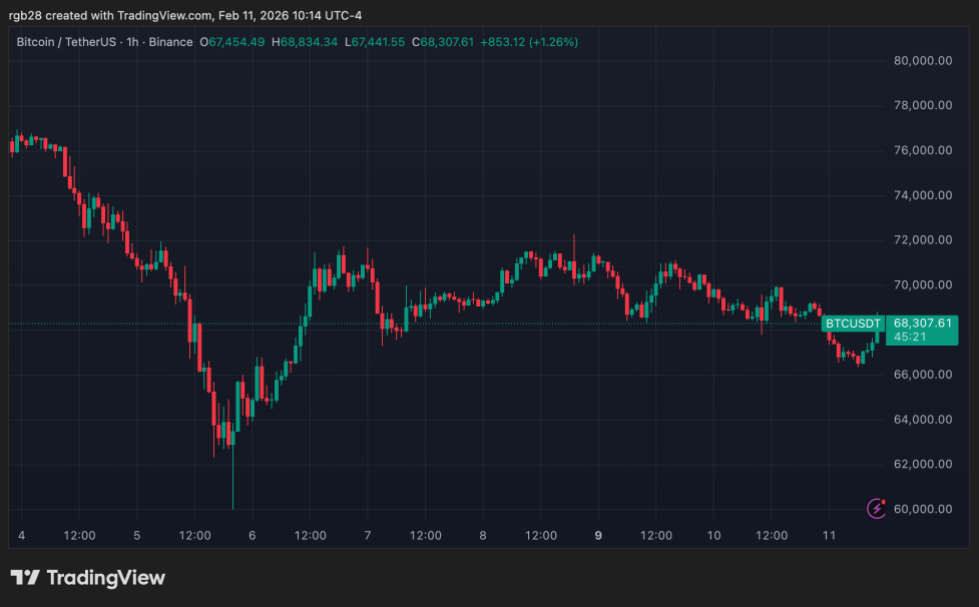
Bitcoin trades at $68,307 in the one-week chart. Source: BTCUSDT on TradingView


Пов'язані питання

QWhat new financial products has Hong Kong's SFC approved for the virtual assets market?

AHong Kong's SFC has approved crypto margin financing and perpetual contracts for professional investors.

QWhich two specific cryptocurrencies are eligible to be used as collateral under the new margin financing rules?

AOnly Bitcoin (BTC) and Ether (ETH) are eligible as virtual asset collateral under the new guidance.

QWhat is the name of the SFC's roadmap that outlines this new regulatory framework?

AThe regulatory framework is part of the SFC's ASPIRe (Access, Safeguards, Products, Infrastructure and Relationships) roadmap.

QAccording to the SFC executive, what stage has Hong Kong's crypto asset development entered?

AAccording to Eric Yip, Hong Kong's crypto asset development has entered a 'defining stage'.

QWhat is the primary goal of introducing these new products like margin financing and perpetual contracts?

AThe primary goals are to enhance market liquidity, broaden risk management tools for investors, and strengthen Hong Kong's position as a leading global virtual asset hub.

Пов'язані матеріали

Bitcoin Withdrawals Continue: 8 Years of Storage in a Coldcard Cold Wallet Ended in Zero

Coldcard Hardware Wallet Hacked: Losses Mount Due to Vulnerable Seed Generation A critical vulnerability in Coldcard hardware wallets has led to a continued wave of fund thefts. According to Galaxy Research, the total stolen has reached 1,367.05 BTC (approx. $88.6 million) from 4,585 addresses, a significant increase from the initial 594.5 BTC reported on July 30, 2026. Most of the stolen funds remain on the attackers' addresses. The issue is not with the current firmware, which Coinkite has updated, but with seed phrases generated on vulnerable devices between March 2021 and the release of fixed firmware versions. Due to a programmer error, devices switched from using a hardware random number generator to the software-based Yasmarang generator, which was initialized with publicly accessible data like the chip's serial number. This made the seed phrases predictable through offline brute-force attacks, meaning wallets remain at risk until funds are moved to a new wallet generated with the patched firmware. Affected devices include Mk2/Mk3 with firmware 4.0.1–4.1.9 (and up to 5.0.3), Mk4/Mk5 up to version 5.6.0, and Q models up to 1.5.0Q. The only exceptions are seeds created with a high-entropy method like at least 50 independent dice rolls or a strong unique BIP-39 passphrase. All other owners must generate a new seed on the fixed firmware and transfer their assets. A case highlighting the human impact involves a 39-year-old long-term investor who lost 2 BTC (approx. $130,000) in minutes. He had accumulated the Bitcoin over eight years through physical labor, viewing it as a financial lifeline and a retirement plan in a country suffering from hyperinflation. His story underscores that even conservative "buy and hold in cold storage" strategies can be compromised by such underlying technical flaws. From a technical perspective, this incident echoes historical failures where weak random number generators undermined cryptographic security, challenging the assumption that offline storage is automatically foolproof.

cryptonews.ru3 год тому

Bitcoin Withdrawals Continue: 8 Years of Storage in a Coldcard Cold Wallet Ended in Zero

cryptonews.ru3 год тому

Торгівля

Спот
活动图片




