Hong Kong Professionals Association Urges Regulators To Ease Crypto Reporting Rules

bitcoinistОпубліковано о 2026-01-20Востаннє оновлено о 2026-01-20

Анотація

Hong Kong Securities & Futures Professionals Association (HKSFPA) has urged regulators to ease certain aspects of the OECD’s Crypto Asset Reporting Framework (CARF) and related amendments to Hong Kong’s Common Reporting Standard (CRS). While generally supportive, the association raised concerns about record-keeping obligations for dissolved entities and uncapped penalties for minor technical errors. It proposed appointing third-party custodians for dissolved firms and introducing penalty caps for unintentional errors. The group also recommended a simplified registration process for crypto service providers with no annual filings. Hong Kong is among 76 jurisdictions committed to implementing CARF by 2028 as part of its broader strategy to become a global crypto hub.

A Hong Kong industry group has urged the city’s regulators to ease aspects of the Organisation for Economic Co-operation and Development’s (OECD) crypto reporting rules ahead of its implementation.

Association Pushes To Soften CARF Requirements

On Monday, the Hong Kong Securities & Futures Professionals Association (HKSFPA) released a response to the implementation of the OECD’s Crypto Asset Reporting Framework (CARF) and the related amendments made to Hong Kong’s Common Reporting Standard (CRS).

In their official response, the association shared its concerns about certain elements of the CARF and CRS amendments, warning that they could create operational and liability risks for market participants.

Notably, the HKSFPA affirmed that it mostly supports the proposals, but urged regulators to ease the record-keeping requirements for dissolved entities. “We generally agree with the six-year retention period to align with existing inland revenue and CRS standards,” they explained, “but we have concerns regarding the obligations placed on individuals post-dissolution.”

The industry group argued that holding directors or principal officers personally liable for record-keeping after dissolution poses significant practical challenges, noting that former officers of dissolved companies may lack the resources, infrastructure, and legal standing to maintain sensitive personal data of former clients.

As a result, they suggested the government “allow for the appointment of a designated third-party custodian (such as a liquidator or a licensed corporate service provider) to fulfill this obligation, rather than placing indefinite personal liability and logistical burden on former individual officers.”

Moreover, the association also cautioned that the proposed uncapped per-account penalties for minor technical errors. They asserted that this could lead to “disproportionately astronomical fines for systemic software errors affecting thousands of accounts where there was no intent to defraud.”

To solve this, they proposed a “reasonable cap” on total penalties for unintentional administrative errors or first-time offenses to ensure that the per-account calculation “is reserved for cases of willful negligence or intentional evasion.”

Additionally, the group suggested a “lite” registration or a simplified annual declaration process for Reporting Crypto-Asset Service Providers (RCASPs) that anticipate filing Nil Returns, to reduce administrative costs while still satisfying the Inland Revenue Department’s oversight requirements.

Hong Kong’s Crypto Hub Efforts

Notably, Hong Kong is among the 76 markets committed to implementing the upcoming crypto reporting framework, which is the OECD’s new global standard for exchanging tax information on crypto assets.

The CARF is designed to prevent tax evasion by bringing crypto users across borders under global tax transparency rules, similar to the OECD’s existing CRS for traditional finance. Hong Kong will be among the 27 jurisdictions that will begin their first cross-border exchanges of crypto reporting data in 2028.

Over the past few years, Hong Kong financial authorities have been actively working to develop a comprehensive framework that supports the expansion of the digital assets industry, part of its strategy to become a leading crypto hub in the world.

As reported by Bitcoinist, the city is exploring rules to allow insurance companies to invest in cryptocurrencies and the infrastructure sector. The Hong Kong Insurance Authority recently proposed a framework that could channel insurance capital into cryptocurrencies and stablecoins.

Moreover, the Hong Kong Monetary Authority (HKMA) is expected to grant the first batch of stablecoin issuer licenses in the first few months of the year. The HKMA enacted the Stablecoins Ordinance in August, which directs any individual or entity seeking to issue a stablecoin in Hong Kong, or any Hong Kong Dollar-pegged token, to obtain a license from the regulator.

Multiple companies have applied for the license, with over 30 applications filed in 2025, including logistics technology firm Reitar Logtech and the overseas arm of Chinese mainland financial technology giant Ant Group.
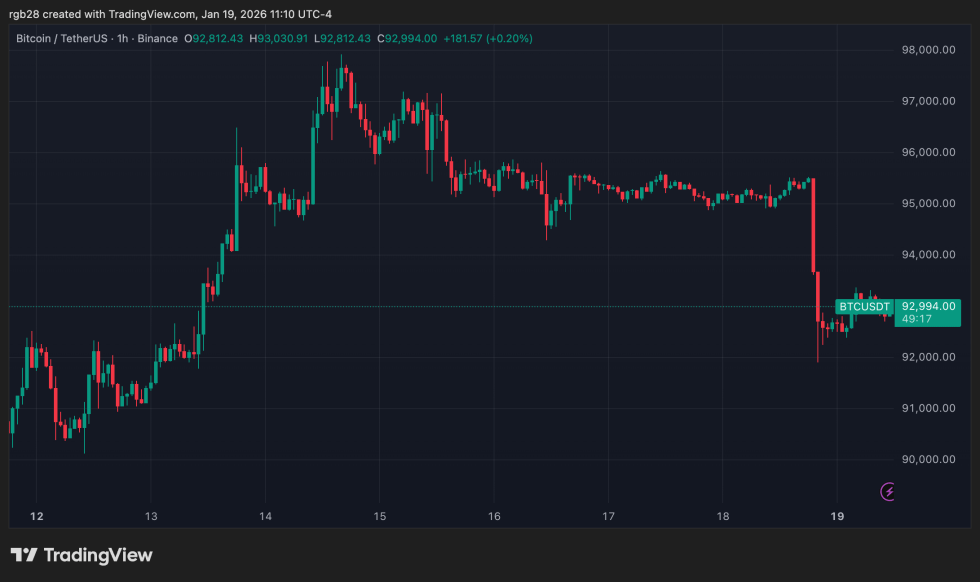
Bitcoin (BTC) trades at $92,994 in the one-week chart. Source: BTCUSDT on TradingView


Пов'язані питання

QWhat is the main concern raised by the Hong Kong Securities & Futures Professionals Association (HKSFPA) regarding the OECD's Crypto Asset Reporting Framework (CARF)?

AThe HKSFPA is concerned that certain elements of CARF and related CRS amendments could create operational and liability risks for market participants, particularly regarding record-keeping requirements for dissolved entities and uncapped penalties for minor technical errors.

QWhat specific suggestion did the HKSFPA make to address the record-keeping burden on dissolved entities?

AThe association suggested allowing the appointment of a designated third-party custodian (such as a liquidator or licensed corporate service provider) to fulfill record-keeping obligations instead of placing indefinite personal liability on former individual officers.

QHow did the HKSFPA propose to handle penalties for unintentional administrative errors in crypto reporting?

AThey proposed implementing a reasonable cap on total penalties for unintentional administrative errors or first-time offenses, reserving per-account penalty calculations for cases of willful negligence or intentional evasion.

QWhen will Hong Kong begin its first cross-border exchanges of crypto reporting data under CARF?

AHong Kong will begin its first cross-border exchanges of crypto reporting data in 2028, as one of the 27 jurisdictions committed to implementing the framework.

QWhat recent regulatory development in Hong Kong involves stablecoin issuance?

AThe Hong Kong Monetary Authority (HKMA) enacted the Stablecoins Ordinance in August, requiring any individual or entity seeking to issue a stablecoin in Hong Kong to obtain a license, with the first batch of licenses expected to be granted in early 2025.

Пов'язані матеріали

What Happens to Ethereum Developer Tools After the Grants Run Out?

On February 27th, the Ethereum Foundation (EF) announced Project Odin, a structured sustainability support program designed for a select group of strategic, previously grant-funded teams. Unlike a standard grant, Odin offers a long-term advisory mechanism focused on helping these teams establish credible, sustainable paths within a two-year framework, thereby reducing long-term dependence on single funding sources. The program addresses a critical post-grant challenge: how essential public goods, especially major developer tools, can achieve financial sustainability beyond initial funding. While grants from EF and programs like Gitcoin or RetroPGF remain vital for startups and research, they often fall short for mature, widely-used infrastructure. Tools like compilers, languages, and network stacks are deeply embedded but struggle with monetization, trapped between being too foundational to lose and too public to generate natural revenue. Project Odin provides teams with a dedicated Strategic Advisor to guide them through a three-phase process: 1) analyzing current funding and realistic options, 2) validating potential paths with stakeholders, and 3) executing plans, which may include crafting support contracts, service agreements, or other recurring revenue models. The first pilot participant is Vyper, a critical smart contract language for the EVM, highlighting the need for sustainable models for core infrastructure. The initiative reframes the public goods conversation from "who should be funded" to "how do already-proven teams avoid perpetual funding crises?" It encourages ecosystem participants—protocols and projects that depend on these tools—to view sustainable support not just as charity, but as essential risk management for their own operational supply chains.

marsbit21 хв тому

What Happens to Ethereum Developer Tools After the Grants Run Out?

marsbit21 хв тому

MARA Reports Q1 Revenue Below Expectations, Net Loss of $1.3 Billion, Stock Plunges After Hours

Bitcoin mining firm MARA Holdings reported disappointing Q1 2024 results, causing its stock to erase all daily gains and fall 3.44% in after-hours trading. Revenue dropped 18% year-over-year to $174.6 million, missing Wall Street estimates of $192.7 million. The company posted a net loss of $1.3 billion, a significant increase from a $533.4 million loss a year ago, primarily driven by unrealized losses on its holdings of 38,689 Bitcoin, which depreciated in value during the quarter. MARA also sold over 15,100 BTC in late March to repurchase debt at a discount. The broader mining environment remains challenging due to a 35% decline in Bitcoin's price from its all-time high and a nearly 30% increase in mining difficulty over the past year. MARA's market cap ranking among U.S. miners has slipped to seventh. Critically, the company announced a strategic pivot away from Bitcoin mining expansion. It stated it has no plans to purchase new mining equipment and is fully transitioning toward AI data centers. Its strategy involves retrofitting existing mining sites for AI and high-performance computing (HPC) and leveraging its recent $1.5 billion acquisition of Long Ridge Energy & Power, a gas-fired power plant and data center. This infrastructure could eventually support 600 MW of AI compute capacity, allowing MARA to redeploy up to 90% of its non-custodial mining power for AI and IT workloads.

marsbit21 хв тому

MARA Reports Q1 Revenue Below Expectations, Net Loss of $1.3 Billion, Stock Plunges After Hours

marsbit21 хв тому

The AI Investment Landscape Is Being Reshaped: Beyond the 'Magnificent Seven', What Opportunities Lie in the Semiconductor Supply Chain?

AI Investment Map is Reshaping: Opportunities Beyond the 'Magnificent Seven' Since ChatGPT ignited the AI wave, investment initially focused on the "Magnificent Seven" tech giants dominating cloud infrastructure. However, the rise of DeepSeek and debates on AI capital expenditure effectiveness are shifting this dynamic. Investors now recognize opportunities deeper in the supply chain—the companies providing the essential "picks and shovels." Early concerns about an AI investment "arms race" and potential low returns were partly alleviated by strong Q1 earnings from cloud providers, validating robust compute demand. This has highlighted a more certain investment thesis: regardless of which AI applications ultimately win, massive capital expenditure will first fuel demand for semiconductors and related components. This "pick-and-shovel" logic has driven semiconductor ETFs to record highs. Key beneficiaries include: * **Memory Chipmakers (e.g., SK Hynix, Samsung, Micron)**: High Bandwidth Memory (HBM) is a critical bottleneck for AI training. * **Photonics Companies**: Crucial for high-speed data transfer within AI data centers. * **The Broader "AI-11" Semiconductor Ecosystem**: This encompasses foundries & lithography (TSMC, ASML), logic & custom chips (AMD, Broadcom, Intel, Marvell), and enterprise storage (SanDisk, Western Digital). Every dollar of AI infrastructure spending flows through this chain. While the "Magnificent Seven" remain dominant in market size, their earnings growth premium over the rest of the S&P 500 ("S&P 493") is narrowing. Market attention and marginal investment are shifting towards the expanding semiconductor supply chain. The investment narrative is evolving from "betting on the ultimate AI winner" to "investing in the certainty of the infrastructure build-out." Understanding this shift from the demand side to the supply side is key to identifying future AI investment opportunities.

marsbit50 хв тому

The AI Investment Landscape Is Being Reshaped: Beyond the 'Magnificent Seven', What Opportunities Lie in the Semiconductor Supply Chain?

marsbit50 хв тому

Торгівля

Спот
Ф'ючерси
活动图片