Hong Kong proceeds with licensing regimes for virtual asset dealers and custodians

cointelegraphОпубліковано о 2025-12-24Востаннє оновлено о 2025-12-24

Анотація

Hong Kong regulators are moving forward with new licensing requirements for cryptocurrency dealers and custodians following the conclusion of consultations. The Financial Services and the Treasury Bureau (FSTB) and the Securities and Futures Commission (SFC) announced the decision, which is part of a broader effort to strengthen oversight of the digital asset sector. This builds on the city’s existing regulatory framework, which already mandates licensing for crypto trading platforms and recently enacted a stablecoin licensing regime. Hong Kong aims to position itself as a trusted crypto hub with comprehensive regulations covering stablecoins, tokenization, and now dealer and custody services. Separately, the SFC also launched a consultation for licensing crypto advisory and management service providers, linking the proposals to anti-money laundering and counter-terrorist financing rules.

Hong Kong regulators will proceed with legislating licensing regimes for crypto dealers and custodians after wrapping up consultations, as part of a broader push to tighten oversight.

In a Wednesday announcement, the city’s Financial Services and the Treasury Bureau (FSTB) and the Securities and Futures Commission (SFC) said that they had concluded consultations on proposed licensing regimes, which would require firms providing crypto dealings or custody services in Hong Kong to obtain licenses once the framework takes effect.

The move adds to the city’s expanding crypto licensing framework. Earlier in 2025, Hong Kong brought its Stablecoin Ordinance into force, opening a new licensing regime for stablecoin issuers.

Hong Kong already requires crypto trading platforms to be licensed. The current mandatory regime builds on earlier opt-in framework introduced in 2020, with 11 companies having received approval from the SFC to date.
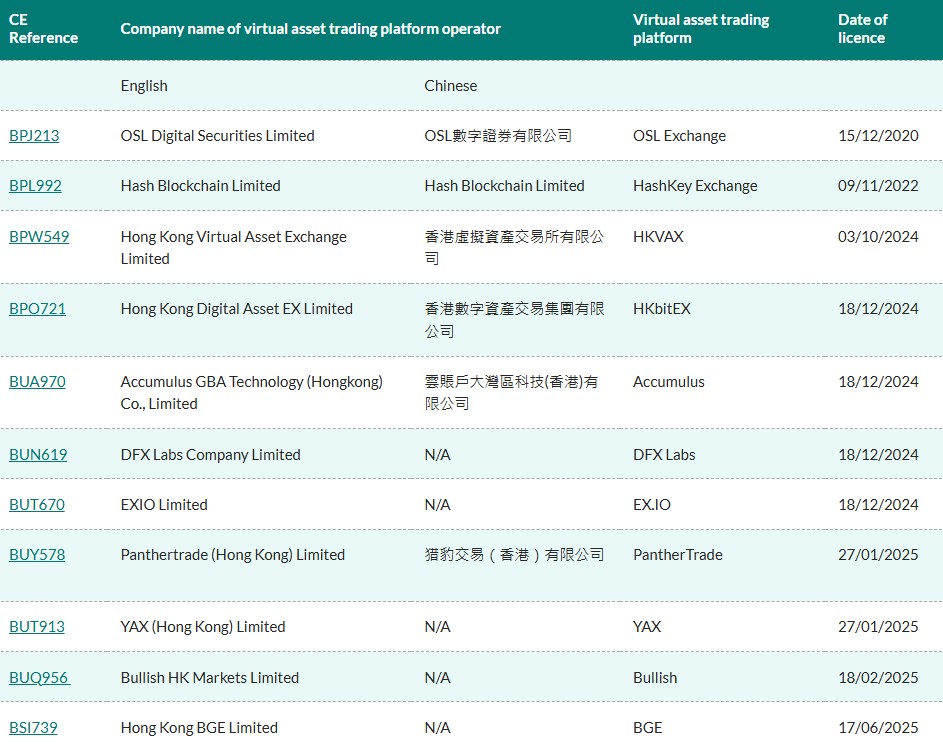
Hong Kong has rejected more applicants for its crypto exchange license than it approved. Source: SFC

Related: Crypto may enter insurers’ portfolios as Hong Kong reviews capital rules

Hong Kong’s broader crypto initiatives

Hong Kong has long expressed its ambitions to develop into a crypto hub. The city already functions as a financial hub with its business-friendly tax regimes and its reputation as a finance gateway between mainland China and global capital markets.

Beyond crypto licensing rules, Hong Kong has also tested tokenization initiatives. In Thursday’s announcement, regulators added that the pending introduction of licensing regimes for crypto dealers and custodians is part of the city’s effort to establish a comprehensive regulatory framework for digital assets alongside stablecoins and tokenization.

​Julia Leung, CEO of the SFC, said that the further development of Hong Kong’s crypto regulatory framework would help the city maintain its position in global digital asset market developments by “fostering a trusted, competitive and sustainable ecosystem.”

Related: Hong Kong launches CARF crypto tax consultation to combat evasion

New advisory and management consultation

The SFC also published a consultation paper on the same day, seeking public feedback on proposals to introduce licensing regimes for crypto advisory service providers and management service providers.

The consultation links the proposed regimes to Hong Kong’s existing Anti‐Mone‐Laundering (AML) framework and Counter‐Terrorist Financing Ordinance, and sets out how advisory and management activities involving digital assets will be brought within the regulatory framework.

It also invites comments on matters such as licensing scope, regulatory powers, sanctions and appeal arrangements, which will be taken into account in finalizing the proposals.


Трендові криптовалюти

Пов'язані питання

QWhat are the key licensing regimes that Hong Kong is proceeding with for virtual assets?

AHong Kong is proceeding with licensing regimes for virtual asset dealers and custodians, as well as for advisory service providers and management service providers.

QWhich regulatory bodies announced the conclusion of consultations on the proposed licensing frameworks?

AThe Financial Services and the Treasury Bureau (FSTB) and the Securities and Futures Commission (SFC) announced the conclusion of consultations on the proposed licensing regimes.

QWhat earlier crypto-related licensing regime did Hong Kong bring into force in 2025?

AIn early 2025, Hong Kong brought its Stablecoin Ordinance into force, which opened a new licensing regime for stablecoin issuers.

QAccording to the SFC CEO, what is the goal of further developing Hong Kong's crypto regulatory framework?

AAccording to SFC CEO Julia Leung, the goal is to help Hong Kong maintain its position in global digital asset market developments by 'fostering a trusted, competitive and sustainable ecosystem'.

QWhat existing frameworks are the proposed licensing regimes for advisory and management services linked to?

AThe proposed regimes are linked to Hong Kong's existing Anti-Money Laundering (AML) framework and Counter-Terrorist Financing Ordinance.

Пов'язані матеріали

Annual Salary of Millions Competing for Electricians, Meta Rushes to Open Its Own Technical School

The AI boom is facing an unexpected bottleneck: a severe shortage of skilled construction workers and electricians. As tech giants like Meta, OpenAI, and Alphabet race to build massive data centers—such as OpenAI's $16 billion "Stargate" project—they are hitting a critical labor wall. The U.S. needs an estimated 130,000 more electricians, 240,000 construction workers, and 150,000 supervisors by 2030 for AI infrastructure alone, but tens of thousands of electrician jobs go unfilled each year. While AI companies offer high premiums, with electricians earning up to $280,000 annually, worker scarcity still causes massive losses—delays on a single project can cost $14.2 million per month. The complexity of building AI data centers, which require immense power (equivalent to powering hundreds of thousands of homes), sophisticated electrical systems, and advanced liquid cooling solutions, demands highly skilled technicians who are in short supply. To combat this, companies are investing heavily in training. Meta has committed $115 million to a free training school offering tuition, housing, and stipends, targeting 5,000 new workers. OpenAI is partnering with unions to secure skilled labor. These efforts are paying off, with a significant rise in Gen Z interest in trade schools over college. However, the power demands are staggering. AI data centers are driving a rapid surge in electricity consumption, projected to account for up to 12% of U.S. power use by 2028 and raising costs for consumers. Furthermore, the construction boom is project-based, leading to a potential future glut of trained workers once building peaks, which could depress wages industry-wide. The race for AI supremacy now depends as much on skilled hands as on advanced chips.

marsbit1 год тому

Annual Salary of Millions Competing for Electricians, Meta Rushes to Open Its Own Technical School

marsbit1 год тому

OpenAI No Longer Sells Its Most Expensive Model for Profit

OpenAI is shifting its business strategy away from promoting its most expensive, flagship models for every task. Recent price cuts—80% for GPT-5.6 Luna and 20% for Terra—signal a deeper change: the company now actively advises users that many tasks don't require the most powerful model. Instead, OpenAI recommends a tiered approach: use the high-end GPT-5.6 Sol for complex planning and analysis, then delegate execution to cheaper models like Luna. This mirrors moves by Anthropic, which recently launched Claude Opus 5 at half the price of its top model, Fable 5. Both companies are de-emphasizing flagship models as primary revenue drivers, using them instead for brand prestige and technological showcases. The industry is entering a "mass-market" phase, similar to automotive, where high-volume, cost-effective models handle daily operations and drive scale. OpenAI's price reductions are partly enabled by AI models themselves optimizing underlying code and infrastructure, creating a self-reinforcing cycle of efficiency gains and cost reduction. Competition is shifting from "who is smartest" to "who offers the best value." The goal is no longer selling individual models but fostering widespread API adoption and ecosystem lock-in. By making AI calls cheap and ubiquitous, companies like OpenAI aim to become the indispensable, utility-like infrastructure powering automated workflows—the "water and electricity" of software, quietly embedded everywhere.

marsbit1 год тому

OpenAI No Longer Sells Its Most Expensive Model for Profit

marsbit1 год тому

Торгівля

Спот

Популярні статті

Як купити VIRTUAL

Ласкаво просимо до HTX.com! Ми зробили покупку Virtuals Protocol (VIRTUAL) простою та зручною. Дотримуйтесь нашої покрокової інструкції, щоб розпочати свою криптовалютну подорож.Крок 1: Створіть обліковий запис на HTXВикористовуйте свою електронну пошту або номер телефону, щоб зареєструвати обліковий запис на HTX безплатно. Пройдіть безпроблемну реєстрацію й отримайте доступ до всіх функцій.ЗареєструватисьКрок 2: Перейдіть до розділу Купити крипту і виберіть спосіб оплатиКредитна/дебетова картка: використовуйте вашу картку Visa або Mastercard, щоб миттєво купити Virtuals Protocol (VIRTUAL).Баланс: використовуйте кошти з балансу вашого рахунку HTX для безперешкодної торгівлі.Треті особи: ми додали популярні способи оплати, такі як Google Pay та Apple Pay, щоб підвищити зручність.P2P: Торгуйте безпосередньо з іншими користувачами на HTX.Позабіржова торгівля (OTC): ми пропонуємо індивідуальні послуги та конкурентні обмінні курси для трейдерів.Крок 3: Зберігайте свої Virtuals Protocol (VIRTUAL)Після придбання Virtuals Protocol (VIRTUAL) збережіть його у своєму обліковому записі на HTX. Крім того, ви можете відправити його в інше місце за допомогою блокчейн-переказу або використовувати його для торгівлі іншими криптовалютами.Крок 4: Торгівля Virtuals Protocol (VIRTUAL)Легко торгуйте Virtuals Protocol (VIRTUAL) на спотовому ринку HTX. Просто увійдіть до свого облікового запису, виберіть торгову пару, укладайте угоди та спостерігайте за ними в режимі реального часу. Ми пропонуємо зручний досвід як для початківців, так і для досвідчених трейдерів.

458 переглядів усьогоОпубліковано 2024.12.23Оновлено 2026.06.02

Як купити VIRTUAL

Обговорення

Ласкаво просимо до спільноти HTX. Тут ви можете бути в курсі останніх подій розвитку платформи та отримати доступ до професійної ринкової інформації. Нижче представлені думки користувачів щодо ціни VIRTUAL (VIRTUAL).

活动图片












