Hinton Praises, Gemini Core Contributor Speaks: In the Future, There Will Be Billions of Superhuman AI Einsteins

marsbitОпубліковано о 2026-07-04Востаннє оновлено о 2026-07-04

Анотація

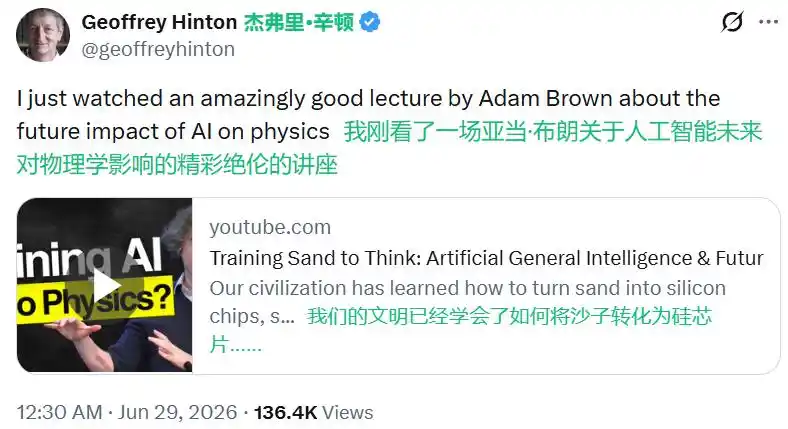
In his speech "Training Sand to Think: Artificial General Intelligence & Future of Physics," Adam Brown, a core contributor to Gemini, outlines the rapid and transformative evolution of AI. He describes how large language models (LLMs), grown rather than programmed through pre-training and fine-tuning, have progressed from performing poorly on high-school math tests to achieving gold-medal level at the International Mathematical Olympiad and recently making a genuine mathematical breakthrough by disproving a decades-old conjecture. Brown attributes this acceleration to the "Scaling Law," where predictable performance gains come from increasing compute, data, and model size. He draws parallels to the history of chess AI, predicting a similar trajectory for scientific research: moving from tools to "centaur" human-AI collaboration, and eventually to autonomous, superhuman "AI scientists." Even if progress halted today, AI already reshapes physics as a tireless tutor, powerful programming assistant, and exhaustive literature reviewer. However, Brown argues progress will continue due to immense economic runway and technical optimizations. He envisions a near-future golden age of human-AI collaboration in science, potentially leading to billions of replicated, superhuman AI researchers, making the coming years the most exciting in physics' history.

Recently, Adam Brown, a core contributor to Gemini and head of the Blueshift team at DeepMind, delivered a lengthy speech titled 'Training Sand to Think: Artificial General Intelligence and the Future of Physics' at the Perimeter Institute for Theoretical Physics, attracting widespread attention. In his talk, he described witnessing AI progress from a 'kindergarten level' all the way to a doctoral level, and extrapolated: if this trend continues, what will become of physics?

Speech Title: Training Sand to Think: Artificial General Intelligence & Future of Physics

Speech URL: https://www.youtube.com/watch?v=Mw60FH5iflI&t=3s

The speech was also highly praised by Nobel laureate in Physics and Turing Award winner Geoffrey Hinton, who called it 'amazingly good.'
Before delving into this amazing speech, it's necessary to introduce the speaker, Adam Brown.
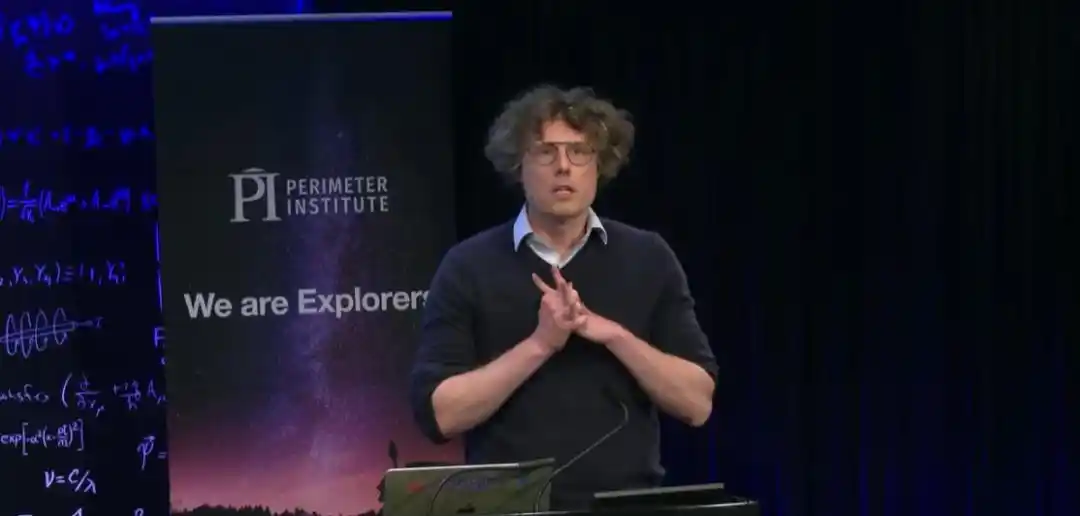
Brown's career is a textbook case of 'how a theoretical physicist's fate was changed by AI.' He studied a joint degree in Physics and Philosophy at Oxford, earned his Ph.D. from Columbia University, and subsequently taught in the physics departments at Princeton and Stanford. At Stanford, he taught Einstein's general relativity, researching topics ranging from the Big Bang, cosmic inflation, multiverses, black holes, and quantum computing, to ideas that sound like science fiction plots such as 'space elevators,' 'bubbles of nothing,' and the ultimate fate of the universe, while also maintaining a long-standing interest in the deep connections between physics and computer science.

In 2018, Brown joined Google. Today, he leads a team called Blueshift within DeepMind, focusing on enhancing AI's scientific and reasoning capabilities, and is also one of the core contributors to the Gemini large language model.

At the beginning of his speech, he mentioned that he had written about forty theoretical physics papers in his career but had stopped writing them by hand in recent years. The reason wasn't a lack of ideas, but that he felt writing papers one by one by hand was more like a 'guilty pleasure' because what he should really be doing now is participating in building a machine that can generate knowledge 'on an industrial scale.'

This opening statement set the tone for the entire talk: someone at the center of the 'AI+Science' technological storm trying to describe its true shape to his peers.

With the aid of AI, we have also summarized the key points of Brown's remarkable speech.

From Sand to Thinking Machines

Brown summarized the unique position of human civilization in one sentence: We have learned to purify sand into silicon, make chips from silicon, assemble chips into neural networks, and now we have learned to train these neural networks to think.

He particularly emphasized that this time it's different from any previous 'computational tool.' From the abacus to pocket calculators, humans have long had various tools to assist scientific research, but those were single-purpose tools, only capable of completing a single step in a process, leaving the rest for humans to do.

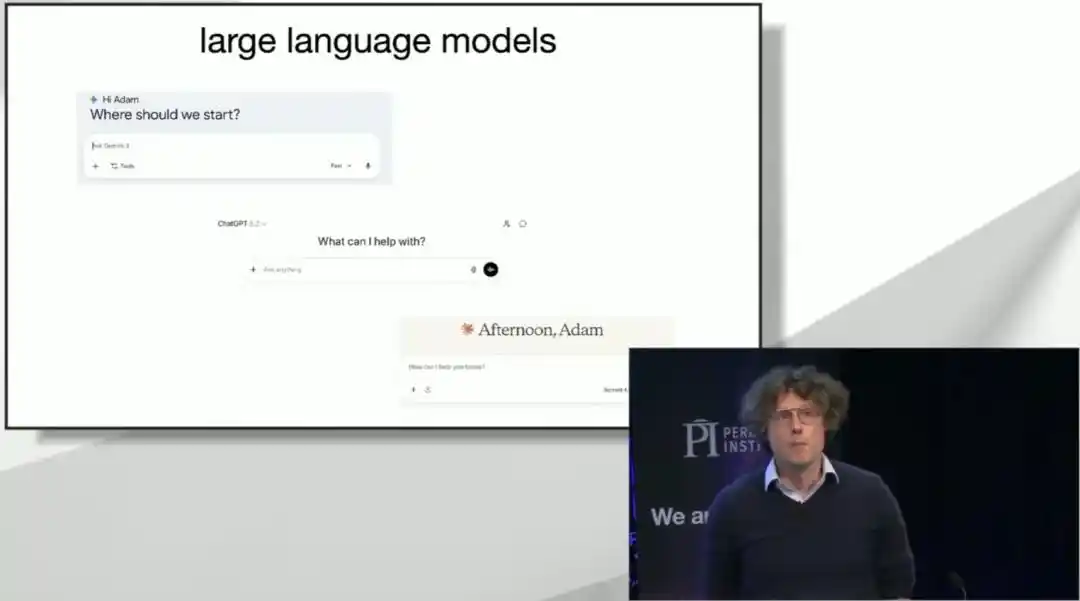
Large language models (LLMs) are different; they possess the potential to complete the entire workflow of a theoretical physicist, which is precisely the meaning of the term 'general intelligence.' Brown believes that LLMs are likely the fundamental substrate humans will use to build artificial general intelligence.

He reminded the audience that while they may have used chatbots like ChatGPT, Gemini, or Claude, they might not have noticed a quiet fact: these systems quietly passed the Turing test years ago, and almost no one specifically celebrated it.
Neural Networks are 'Grown,' Not 'Programmed'

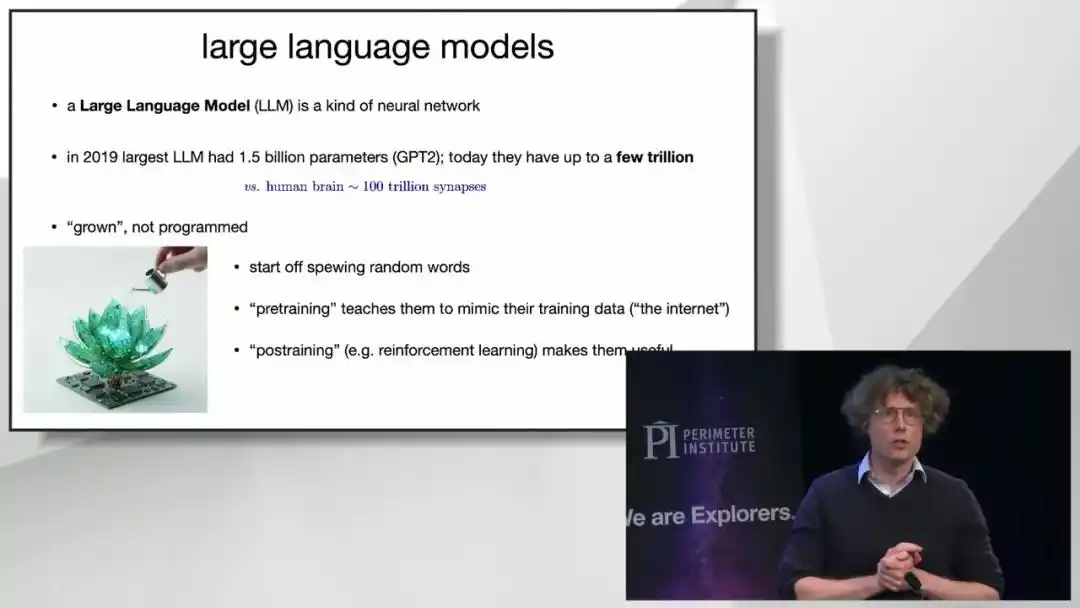
To understand why large models are fundamentally different from traditional computer programs, Brown offered a core metaphor: LLMs are not programmed; they are grown. That is, they are cultivated rather than coded.
The specific process consists of two stages.

The first stage is called 'pre-training.' Engineers start with a set of randomly connected, nearly nonsensical artificial neurons and have it continuously try to predict the 'next word' in a piece of text. If it guesses correctly, the corresponding neural pathways are strengthened; if wrong, they are weakened. This process is extremely long: after seeing a million words, the model's output is still mostly gibberish; after reading tens of millions to billions of words, it can produce grammatically correct but somewhat stiff sentences; only after reading the entire internet (tens of trillions of words) can it engage in fluent, coherent conversations on almost any topic.

The second stage is called 'post-training,' which Brown describes as sending the model to 'finishing school.' A model fresh out of pre-training only mechanically predicts the next word, speaking rudely and uncooperatively. Post-training's task is to teach it to be polite and willing to cooperate with users, not just play a word completion game. Today, the parameter count of mainstream large models has jumped from billions a decade ago to several trillions, still far below the scale of the human brain's roughly one hundred trillion synaptic connections, but this scale is already sufficient for miracles to happen.

Physicists' Unexpected Role: Scaling Law Ignited This Revolution

Brown specifically mentioned that physicists played an unexpected role at the beginning of this AI revolution: they brought the mindset of the 'Scaling Law.'

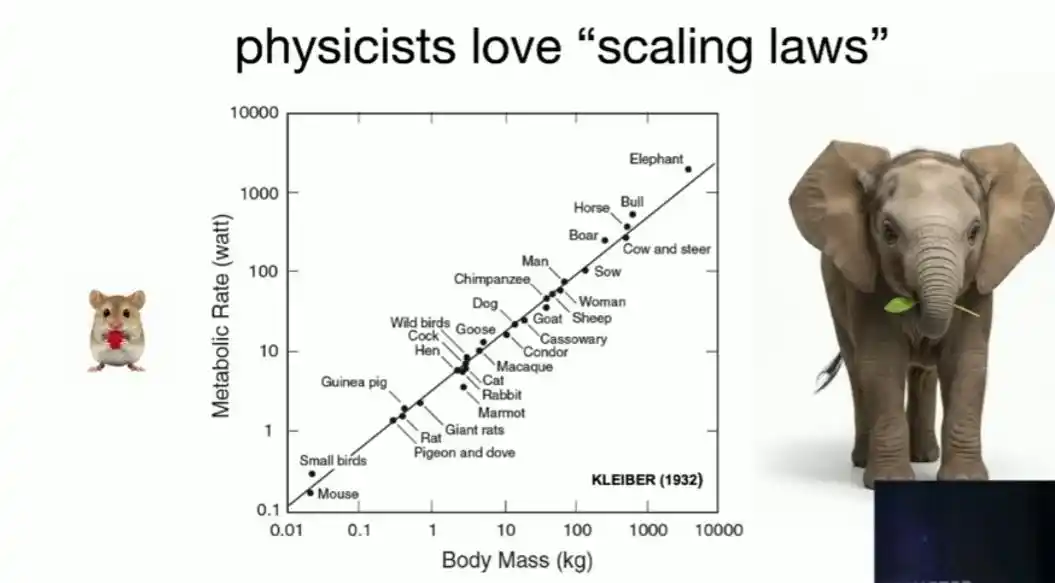
Physicists are inherently obsessed with finding simple power-law relationships: if you double Alice's height, her surface area becomes four times larger, and her weight becomes eight times larger—this is the simplest dimensional analysis. Kleiber's discovery nearly a century ago of a power-law relationship between animal metabolic rate and body weight is a more subtle example—it took physicists many years later to explain its underlying principle using the fractal dimension of the vascular system.
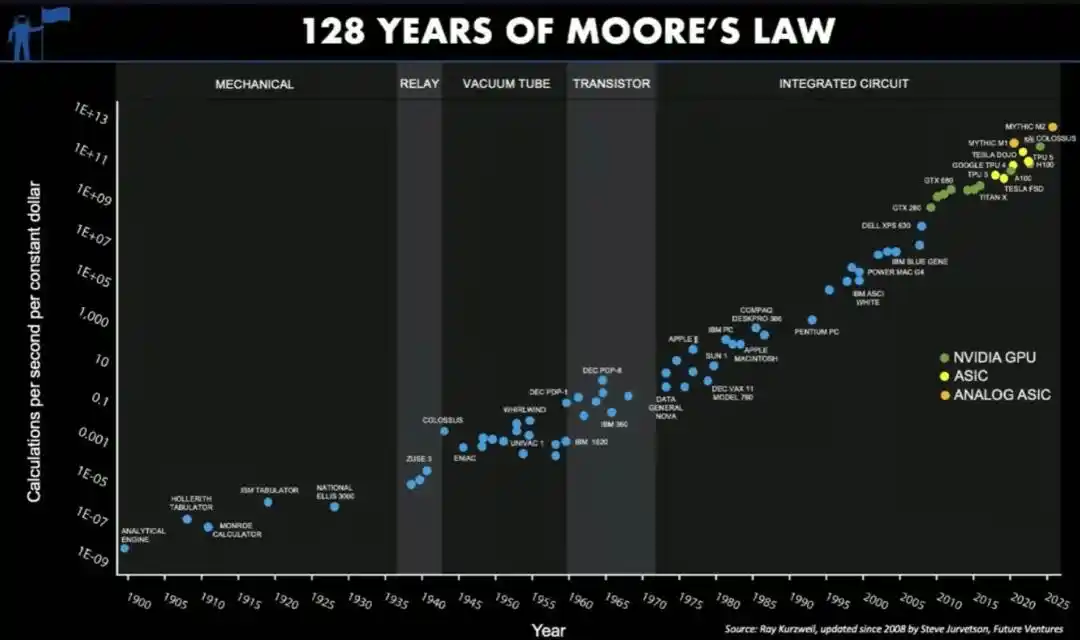
Not to mention the famous Moore's Law:
In 2020, several researchers with physics backgrounds applied this mindset to neural networks and discovered that as long as the computational power used for training, data volume, and model scale were proportionally increased, the model's performance on the 'predict the next word' task would improve steadily along a straight line on a log-log coordinate system.
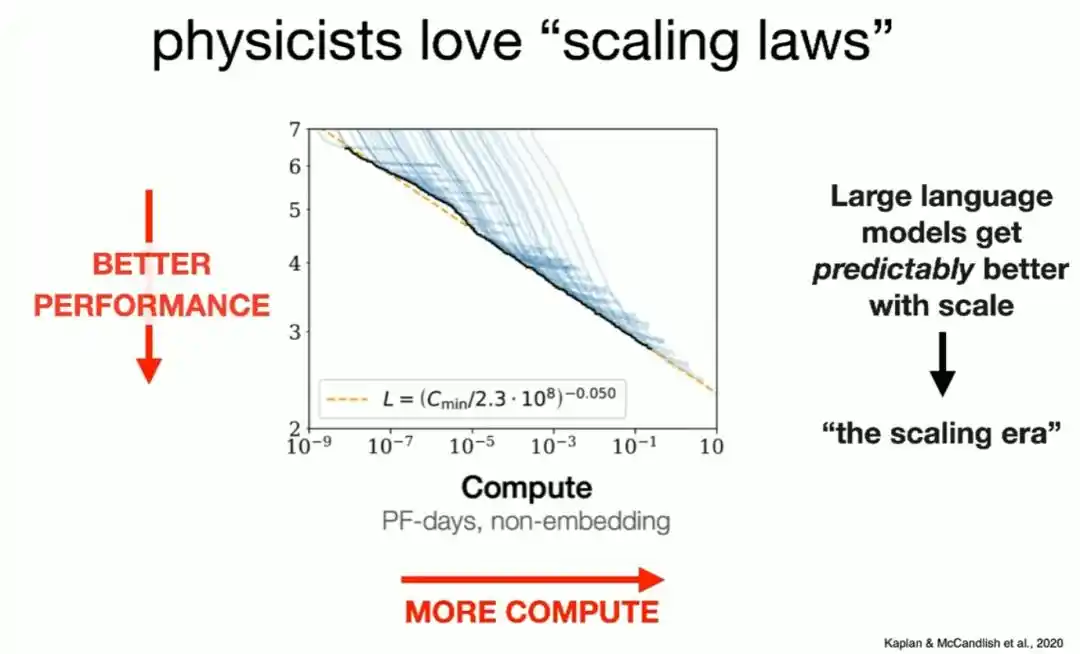
This curve was later extended by a full eight orders of magnitude and still held.

Brown joked that this chart was 'simple enough for venture capitalists to understand,' and it directly told capital markets: invest money (i.e., compute) and get a stronger model in return.

This simple curve was precisely the starting point of the Scaling era over the past six years.

However, Brown also pointed out that just scaling compute is only part of the story. Over the past decade, the compute consumed by cutting-edge AI training has grown about fourfold annually, and the funds invested in training have grown about 2.7 times per year.
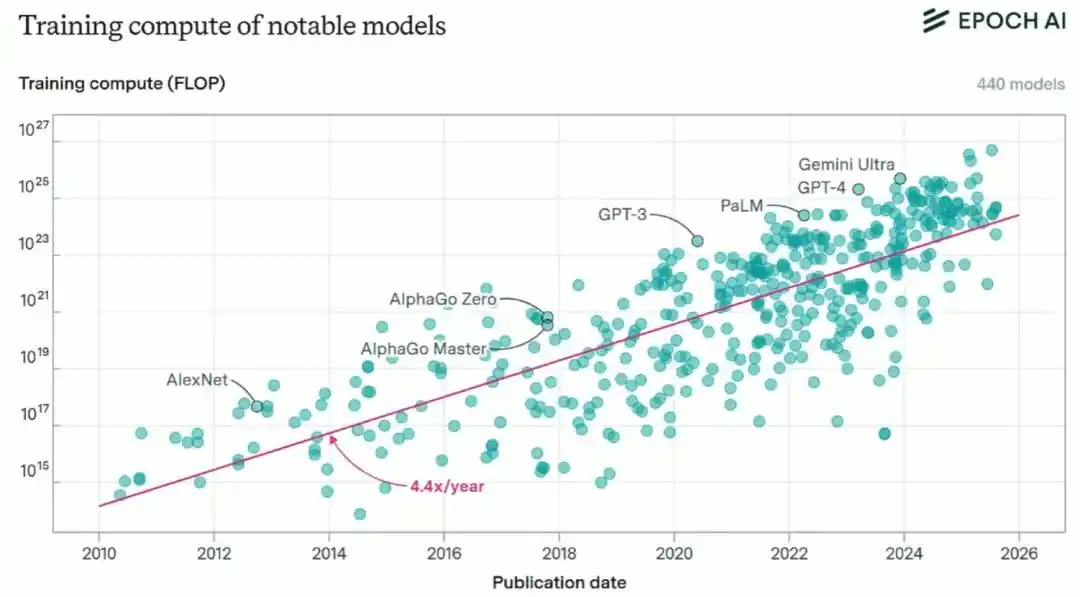
Currently, a top-tier training run requires compute costing several hundred million dollars, while the annual US GDP is nearly thirty trillion dollars, meaning there is still a very long growth runway for this curve.
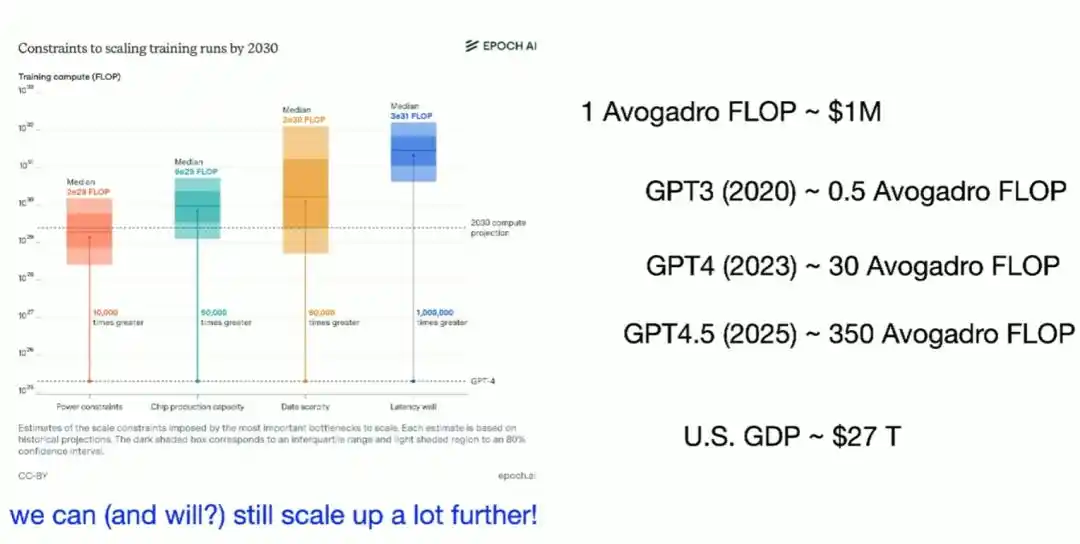
But more important than scaling compute is the continuous refinement at the algorithmic level: Researchers constantly identify inefficiencies in the training pipeline and improve them; this is the true 'primary engine' behind AI progress over the past decade.

The 'Short History' of Benchmarks: From Preschool to PhD

If Scaling Law explains 'why AI gets stronger,' then the rise and fall of a series of benchmarks record 'exactly how strong AI has become.' Brown used a set of test scores to depict a dizzying curve.

Four years ago, a benchmark called MATH for high school math problems emerged. The researchers had a computer science Ph.D. student who wasn't particularly good at math take the test, scoring about 40%; they also had a three-time International Mathematical Olympiad (IMO) gold medalist take it, scoring 90%. At that time, the most advanced large model could only manage 6%—almost indistinguishable from random guessing, as the model couldn't even understand what the questions were asking.

The prediction market at the time thought that by 2025, a model achieving 50% would be 'reckless optimism.' The benchmark's creator publicly stated that if a model actually achieved this, he would be 'quite shocked.'
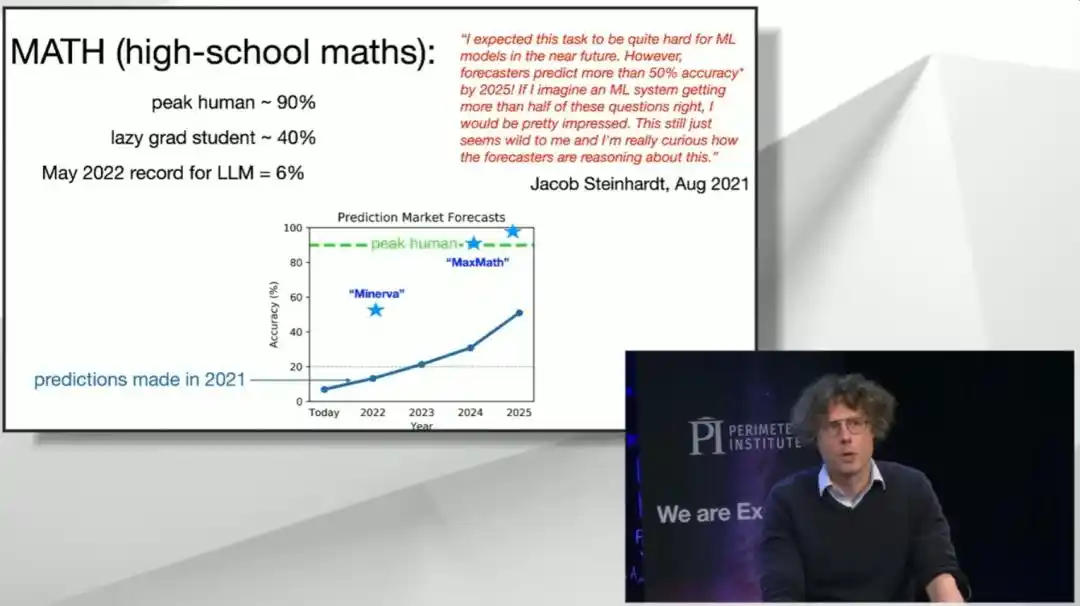
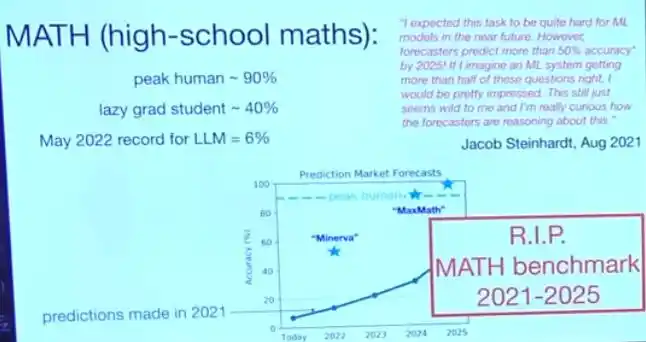
As it turned out, this 50% threshold was crossed 'immediately' by a system called Minerva. By mid-2024, Brown's team's system scored 90% on this benchmark. They even held a 1990s-style roller disco party to celebrate. However, just six months later, off-the-shelf large models were solving these problems nearly perfectly. The MATH benchmark thus 'died,' and it went directly from 'too difficult' to 'too easy,' with almost no pause in between.
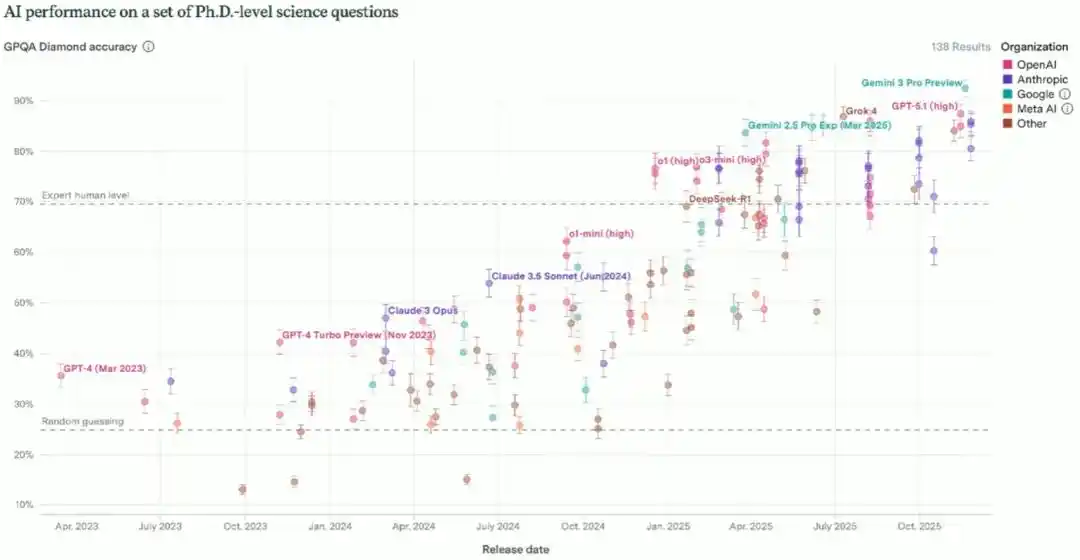
Next to fall was the GPQA test aimed at graduate students, simulating the difficulty of first-year Ph.D. qualifying exams, with human experts averaging around 70%. Starting close to random guessing, models surged past expert level between 2024 and 2025, now achieving near-perfect scores. To rule out the possibility that 'the model just memorized the answers,' Brown's team specifically designed new questions from the same distribution that had never appeared on the internet, and the model's performance barely declined.
Brown even presented his own graduate-level final exams on general relativity and quantum mechanics, which he had personally graded at Stanford (these questions had never been online), and the model also achieved perfect scores within a year and a half. He half-joked that even his own exam questions had 'unfortunately fallen.'
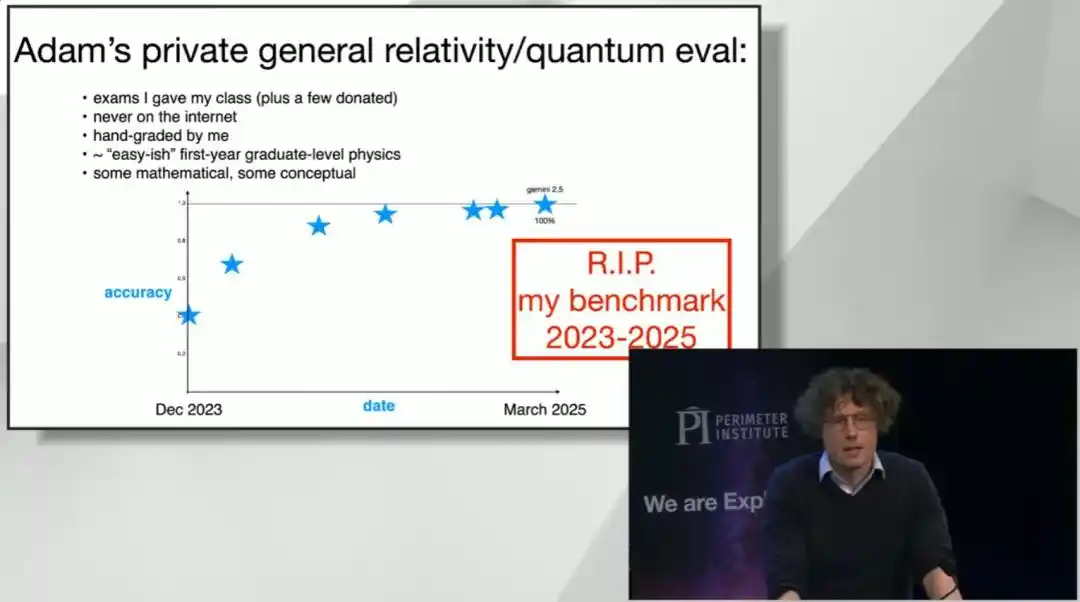
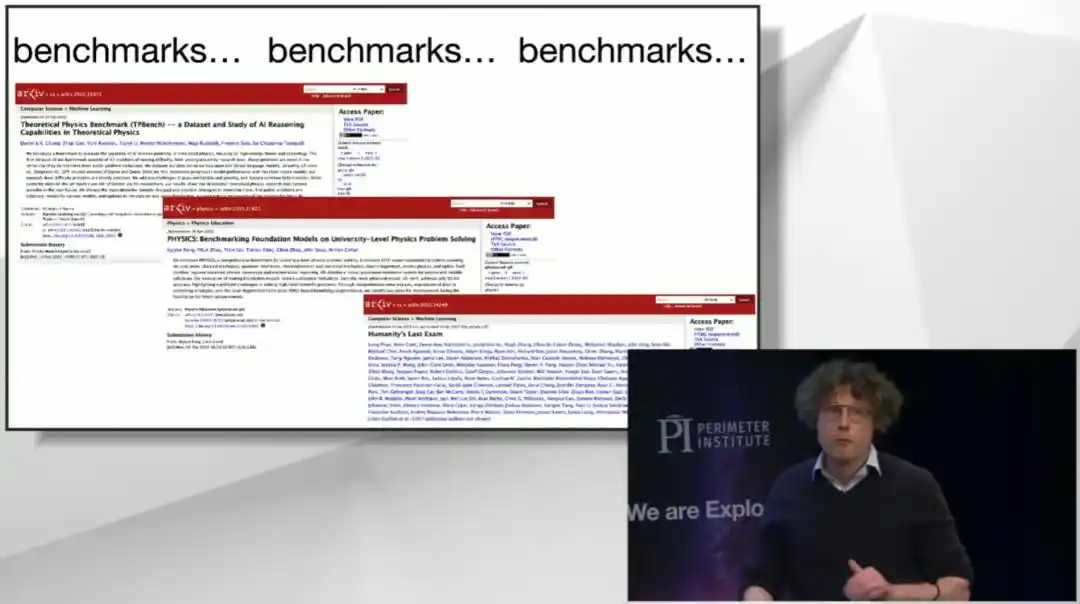
Since then, the list of fallen benchmarks has grown longer, including a super-difficult comprehensive test once called 'Humanity's Last Exam.'
But the most symbolic leap occurred on the International Mathematical Olympiad.

Crossing the IMO Threshold

Just over a year ago, a Turing Award winner told Brown in person that large models would never be able to solve problems at the level of the International Mathematical Olympiad (IMO) because that required genuine creativity, not something that could be faked by rote memorization. IMO problems are known as 'the hardest problems within the scope of high school mathematics': the smartest teenagers in the world train for one to two years to compete, and winning a gold medal by solving a few of the six problems is an exceptional feat.
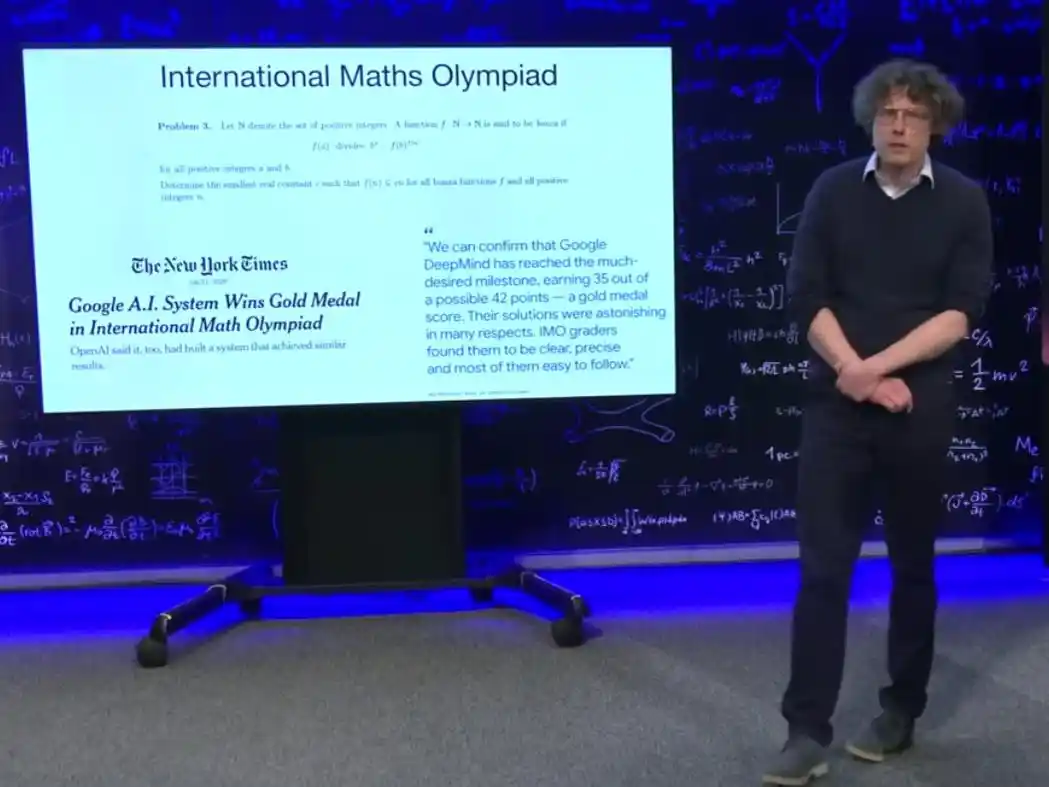
Last summer, this threshold was crossed. Brown's team's system solved five out of six problems on an IMO-level test, achieving gold medal standard. Moreover, the system didn't brute-force its way through with long, incomprehensible formal proofs. The IMO President publicly commented that these solutions were 'surprising in many ways,' with graders finding them clear, precise, mostly easy to understand, and employing mathematical abstractions similar to those used by humans.

Brown also candidly showcased a 'failure case' of large models.

A classic brainteaser goes: A father and son are in a car accident; the father dies, the son is taken to the operating room, and the surgeon sees the boy and says, 'I can't operate on him, he's my son.' The question is how this is possible (the standard answer is the surgeon is the boy's mother). This question tests whether the reader assumes the surgeon is male. Large models handle this 'viral internet puzzle' with ease because they've seen it thousands of times in training data. But when Brown reversed the puzzle: the mother dies, and the surgeon is specifically noted as 'the boy's father,' then asked the same question, the model completely failed to notice the reversal and mechanically applied the standard answer of 'the surgeon is the other parent.'

Brown said this exposes a specific 'quirk' left by the model's training method.

Centaur Collaboration: AI Writes Proofs Mathematicians Will Co-Author

Ten months after crossing the IMO threshold, Brown's team accomplished something he considers even more significant: genuine, previously unknown mathematical research.

Last September, Brown's team collaborated with several professional mathematicians in a mode he calls the 'Centaur' model—the centaur being a half-human, half-horse creature from Greek mythology, but here, the 'non-human half' is an LLM.
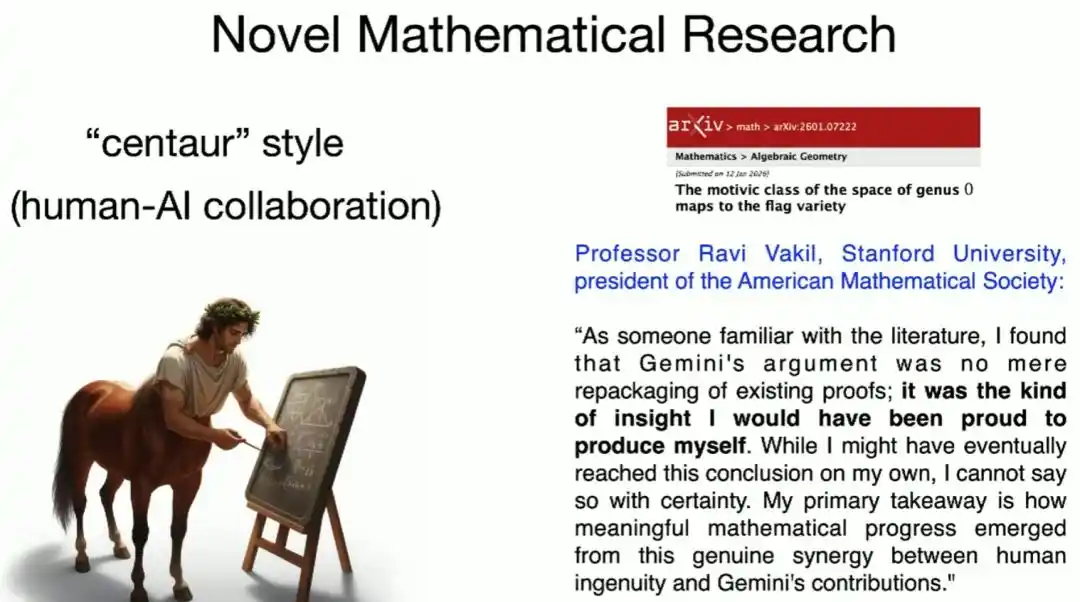
The entire process was a continuous dialogue: the model proposed candidate proof ideas, human experts judged which were valuable and guided the model to delve deeper, ultimately producing a complete mathematical paper under human guidance. One of the paper's co-authors is a Stanford professor and the current president of the American Mathematical Society. This professor's evaluation was that the arguments proposed by Gemini were by no means simple repackaging of existing proofs but represented insights he himself would be proud of.

Brown emphasized that this was, at the time (late last year), the highest level large models had reached in mathematics. But he immediately added: in terms of the true significance of 'highest level,' this was still far from it.

The Real Turning Point: AI Independently Solves an 80-Year-Old Conjecture

Entering 2026, the situation changed dramatically—for the better. Brown began with a near-provocative joke: 'Just last week, LLMs hadn't made any truly significant mathematical breakthroughs.' Now, that statement is no longer true.
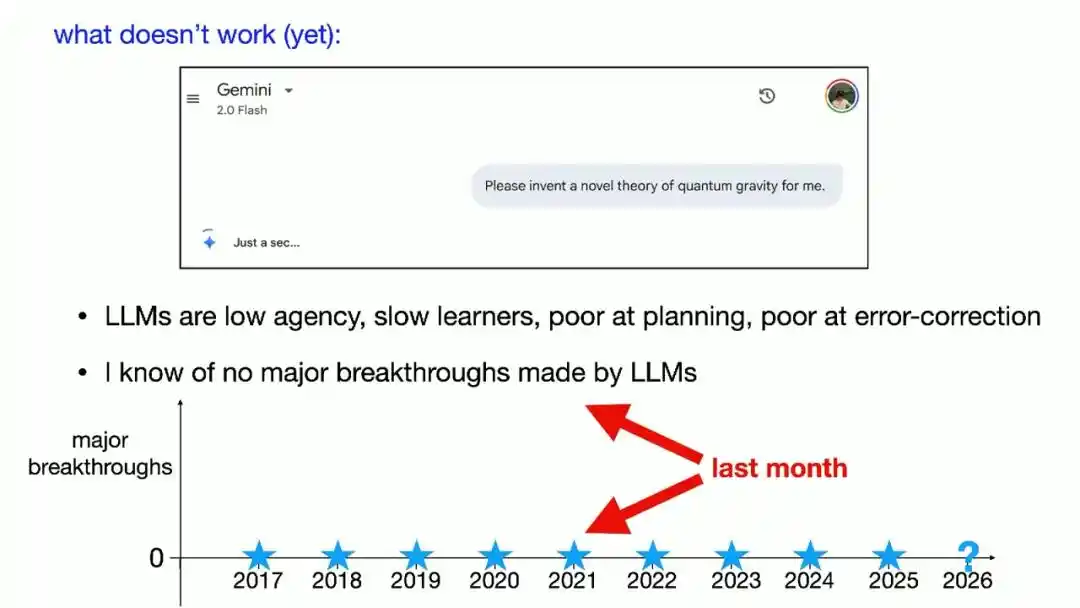
Many have already heard about this major event. Erdős's 1946 'Unit Distance Conjecture,' believed for eighty years by the mathematical community to have the square grid configuration as the known optimal solution. A large model inside OpenAI independently provided a counterexample, using tools from algebraic number theory to construct a series of point sets where the number of unit distance pairs exceeded the previously accepted upper bound. This effectively disproved a long-held belief.
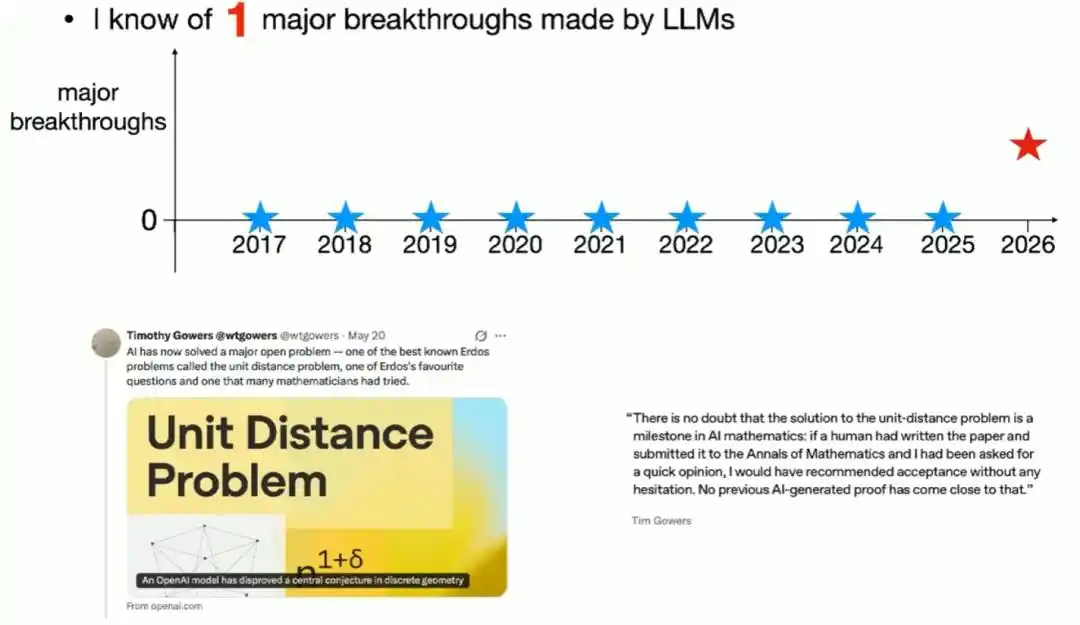
It's worth noting that this problem was not obscure; many had tried before, but mathematicians spent significant effort always wandering in the direction of 'proving' rather than 'disproving' the conjecture. Brown specifically mentioned that Fields Medalist Timothy Gowers participated in reviewing this result and gave it high praise.

Brown judges this to be the first genuinely significant breakthrough by large models in mathematics, and he believes it certainly won't be the last—'the floodgates have opened.' As model capabilities continue to surpass 'the threshold required to produce breakthroughs,' he expects more similar results to appear in succession.

He half-jokingly added that in retrospect, the reason this problem was cracked first is probably because its structure happened to fall within large models' 'comfort zone.' Next, models will first solve problems 'friendly to AI,' then gradually tackle those 'less friendly' ones.

The Prophecy from Chess

To convince the audience that this curve will continue to rise, Brown presented a graph that at first glance looked like a casually drawn line: a steadily climbing straight line. Of course, this graph wasn't drawn out of thin air; it was taken directly from real data on chess computer strength over time, with the y-axis being the Elo rating measuring playing strength and the x-axis being the year.
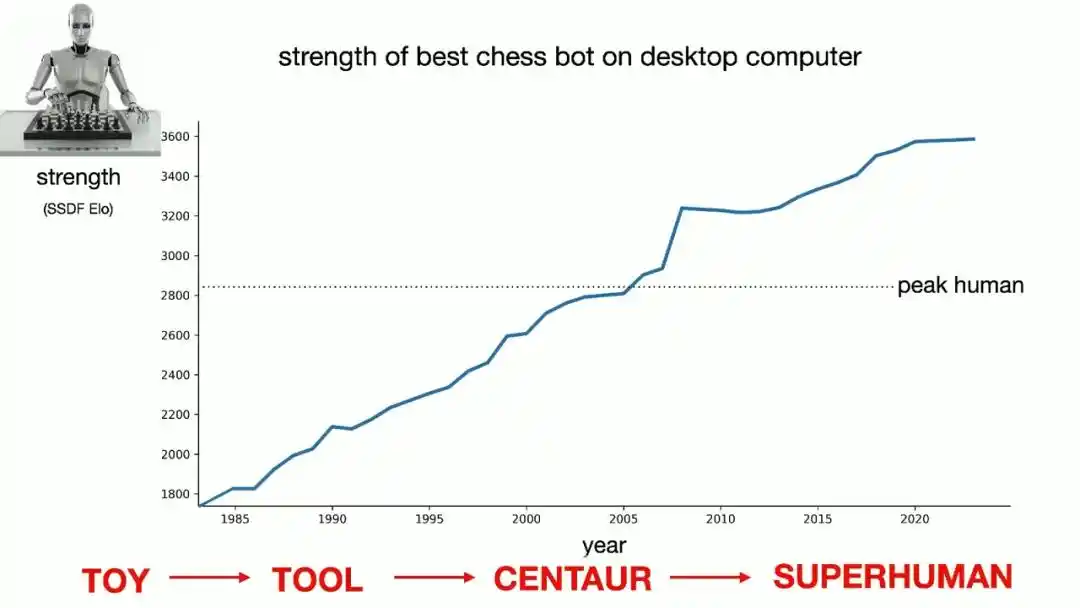
Brown outlined four historical stages of chess AI:

Initially, the 'Toy Era,' where getting a computer to make a single reasonable move was considered a miracle;

Then, the 'Tool Era,' where computers were only useful in specific aspects like endgame calculation or opening memorization;

Next, the 'Centaur Era,' where the strongest chess entity in the universe was the collaboration between grandmasters and the deep search capabilities of computers;

And now, humanity has fully entered the 'Superhuman Era': when top human players collaborate with computers, the optimal strategy is simply to let the computer play on its own.

Brown believes these four stages can be closely mapped to the field of scientific research.
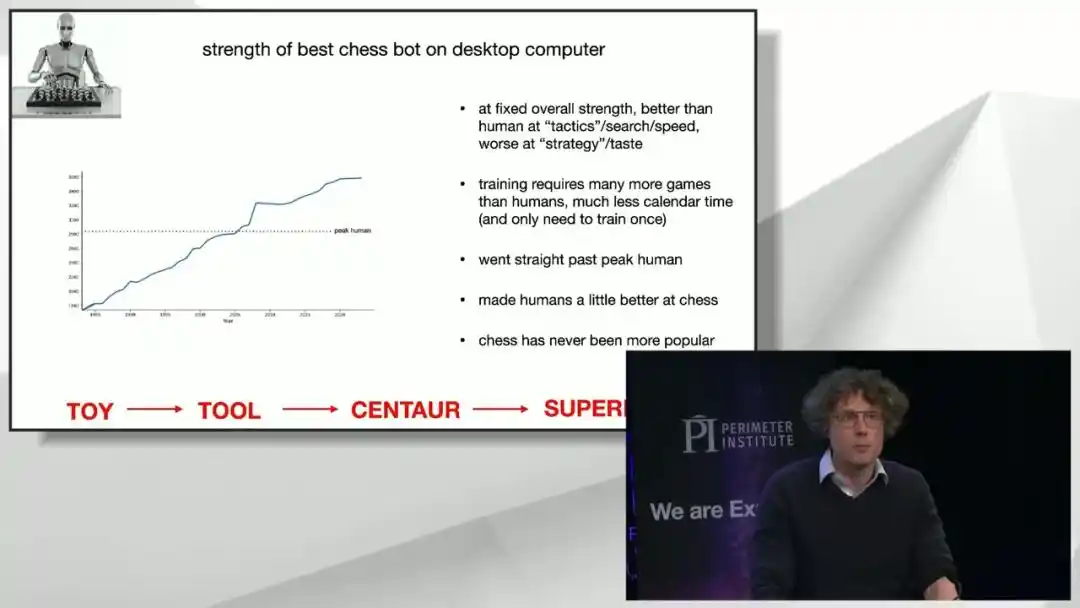
The first pattern is: at comparable overall strength, computers surpass humans in tactics and search speed but are weaker in strategy and 'taste' judgment. This precisely matches the characteristics currently exposed by large models in mathematical and physical research: they excel at applying existing lemmas and techniques but are less adept at judging 'which overall direction to take,' though this shortcoming is rapidly shrinking.

The second pattern is: the number of games needed to 'experience' for training a chess AI far exceeds the total number of games a human can play in a lifetime, but because machines can tirelessly play against themselves at high speed, the actual 'calendar time' required is far shorter than training a human chess player.

The third pattern is that once computer chess strength surpassed peak human level, it never stopped, as there is no physical or logical reason for it to conveniently stop near human level.

The fourth comforting fact is: the rise of chess AI has actually improved the overall level of human chess players; the strongest human players today are stronger than at any time in history, partly thanks to learning from super-strong AIs; and the game of chess itself has never been more popular.

Brown's implication is clear: if scientific research follows this trajectory, humanity will likely first encounter fully autonomous 'AI scientists,' followed by something akin to 'AI Einsteins'... What happens after that, he admits, is beyond his predictive abilities.
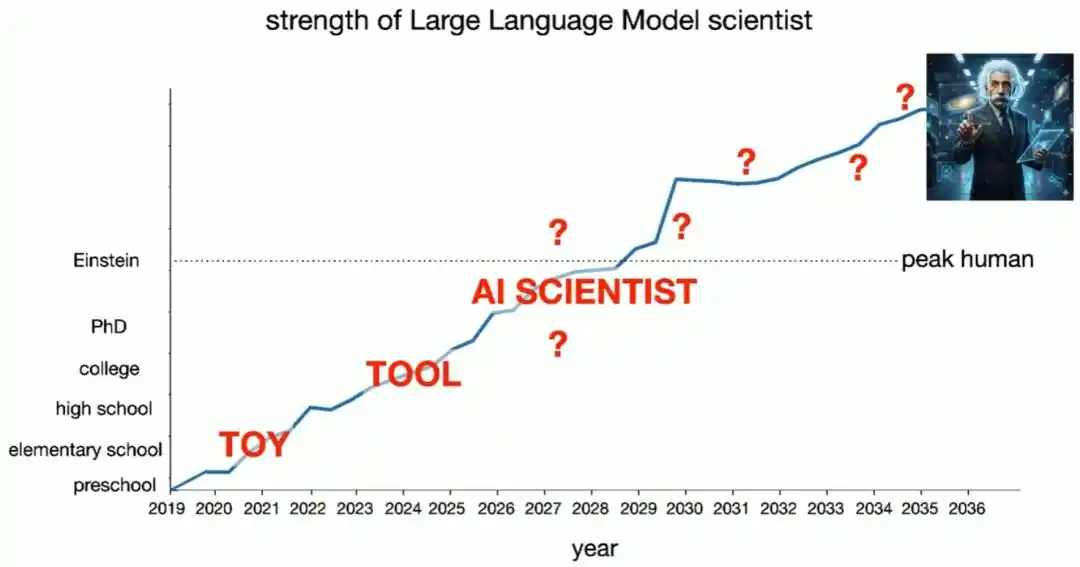
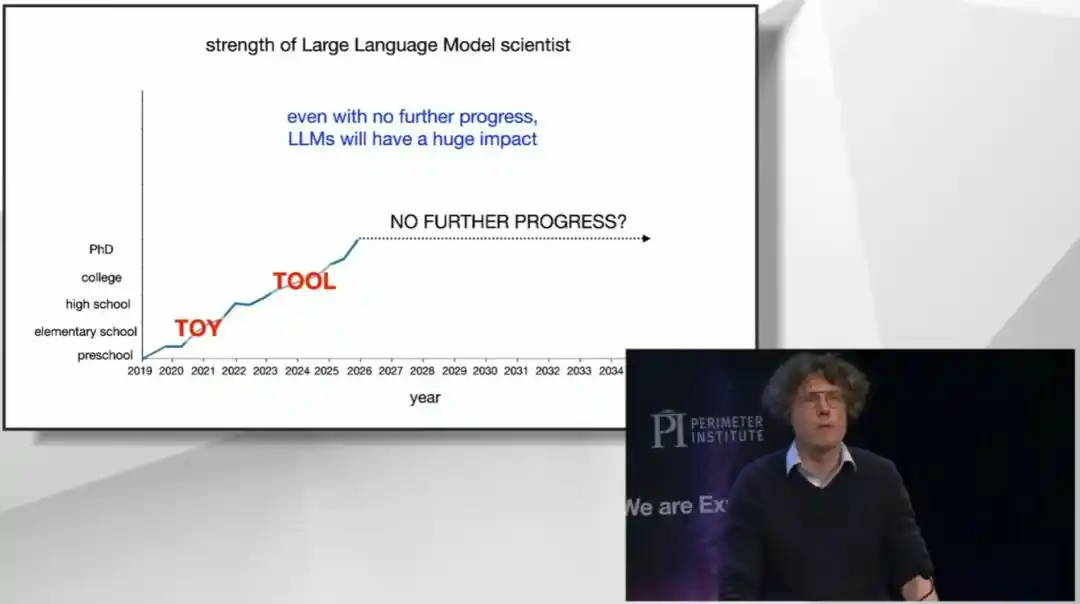
Even if Progress Stops Here, Physics Has Already Been Transformed

Brown also raised a cautionary 'pessimistic hypothesis': what if large model capabilities completely stagnate starting today?
He bluntly stated that what truly 'doesn't work' right now is directly asking the model, 'Please invent a brand new theory of quantum gravity for me.' The answer would likely be worthless, sleep-inducing 'AI nonsense.'

More generally, current large models still have four obvious shortcomings: low autonomy, slow learning speed, poor planning ability, and weak error-correction capability.
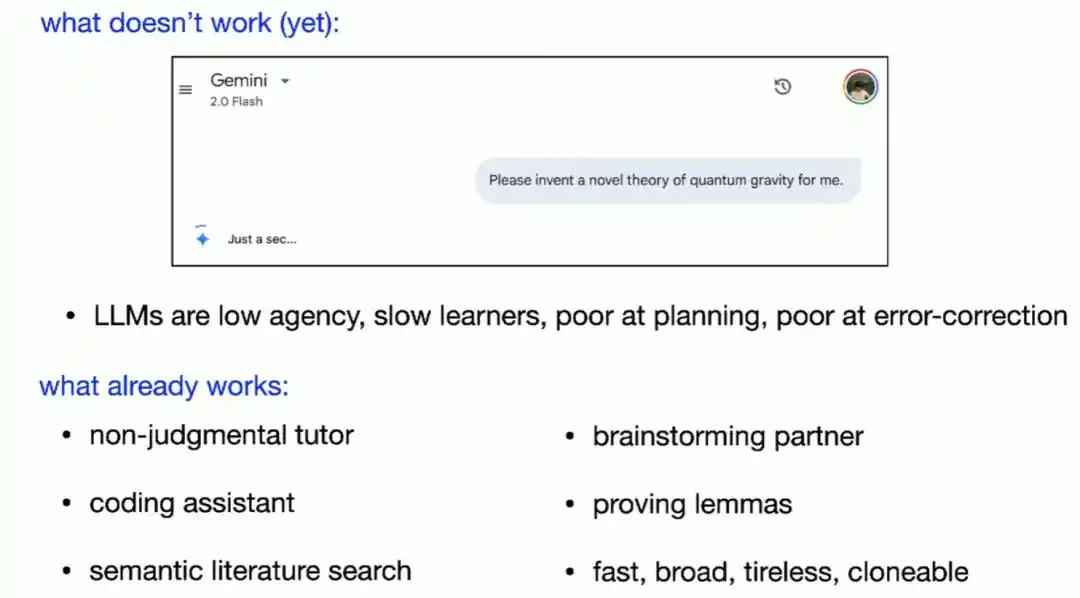
Brown admitted that all four shortcomings have significantly improved over the past year, but none have been completely solved. Consequently, a system that can ace graduate-level exams in every discipline has yet to produce results that could be called 'major breakthroughs.'

While preparing for this speech, he even specifically drew this as a flat 'straight line' marked with a question mark, self-deprecatingly admitting it was perhaps the only chart in the entire talk that 'didn't keep rising.' But he added that before the end of 2026, people would probably start arguing about how to define the term 'major breakthrough.' As it turned out, this day arrived even sooner than he himself anticipated.

However, even if progress truly stopped at this moment, Brown believes large models are already sufficient to completely transform the landscape of physics research.

He listed several already mature and still-improving use cases:

As a 'non-judgmental private tutor,' available at 3 AM to answer a physicist's own unclear knowledge gaps without waking a world-class expert;

As a programming assistant, now so strong that 'calling it just a programming assistant feels somewhat insulting.' Many physics problems previously considered 'not programming problems' can now be reframed as coding problems to solve;

As a literature retrieval tool, capable of reading an entire field's paper repository and directly telling you if an idea has already been explored; additionally, serving as a brainstorming partner.

Brown summarized that the core advantages of large models are: they are fast, broad in coverage, tireless, and can be replicated indefinitely. It takes decades to train a physicist, but once a powerful model is trained, you can run thousands of copies simultaneously—this alone is enough to 'completely change' the discipline.

Conclusion: The Golden Age of Physics

At the end of his speech, Brown gave his judgment on 'why progress won't stop.'
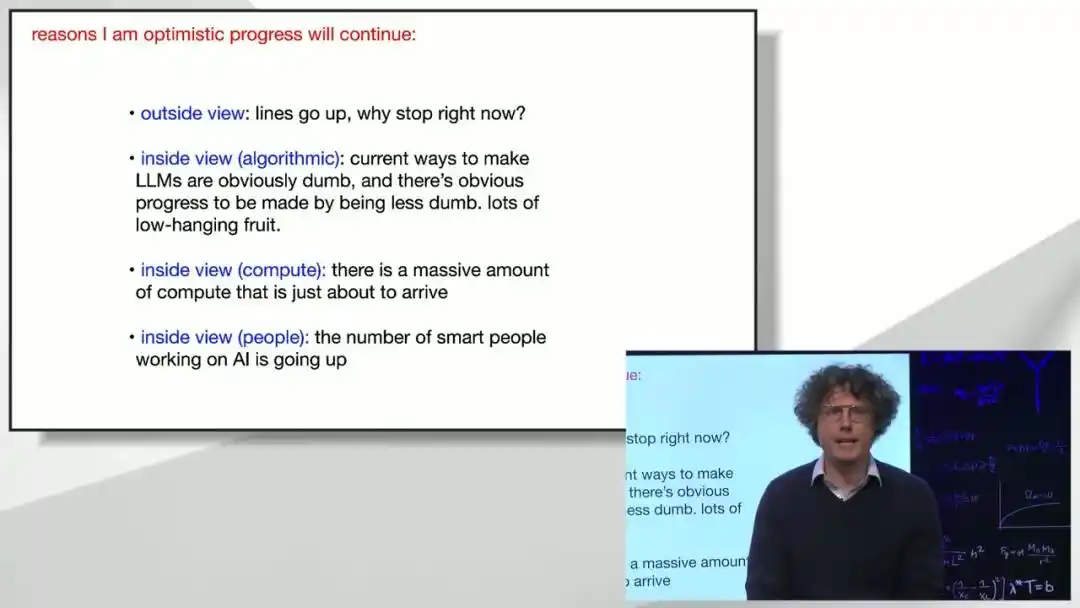
From a macroeconomic perspective, the funds currently invested in training still represent a very small fraction of global GDP, leaving ample room for growth. From a technical internal perspective, current methods for training large models are 'far less sophisticated than they appear.' Many obvious yet untried improvement ideas remain to be explored. Combined with the continuous influx of talent and compute into the field, Brown judges that current model architectures and compute scales are already sufficient to lead to Artificial General Intelligence, even without entirely new theoretical breakthroughs.

He also responded to a long-standing pessimistic view that large models only do 'pattern matching' and cannot generate genuinely new ideas.
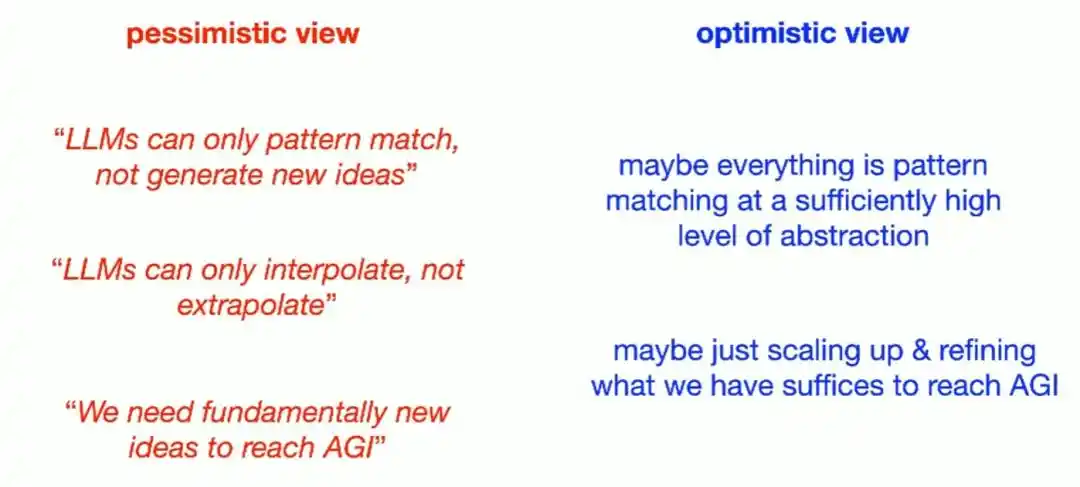
Brown's view is that if you abstract to a high enough level, almost all human creations that seem like 'major breakthroughs' are essentially a form of higher-dimensional pattern matching. A recurring phrase in this field that has been repeatedly validated is: 'these models just want to learn.' No matter how many seemingly reasonable theoretical reasons suggest they shouldn't learn well, their performance always exceeds expectations.

Brown's conclusion is that in the next few years, we will usher in a golden 'Centaur' era of human-AI collaboration: these tools will be placed in the hands of human physicists, mathematicians, and experts across fields, jointly kickstarting a new Renaissance in science and mathematics.

Further ahead, if 'creating an AI Einstein' is truly achieved, since replicating a trained model comes at almost no extra cost, humanity will likely soon have billions of 'superhuman-level AI Einsteins' operating simultaneously. This sounds like science fiction, but it's happening.
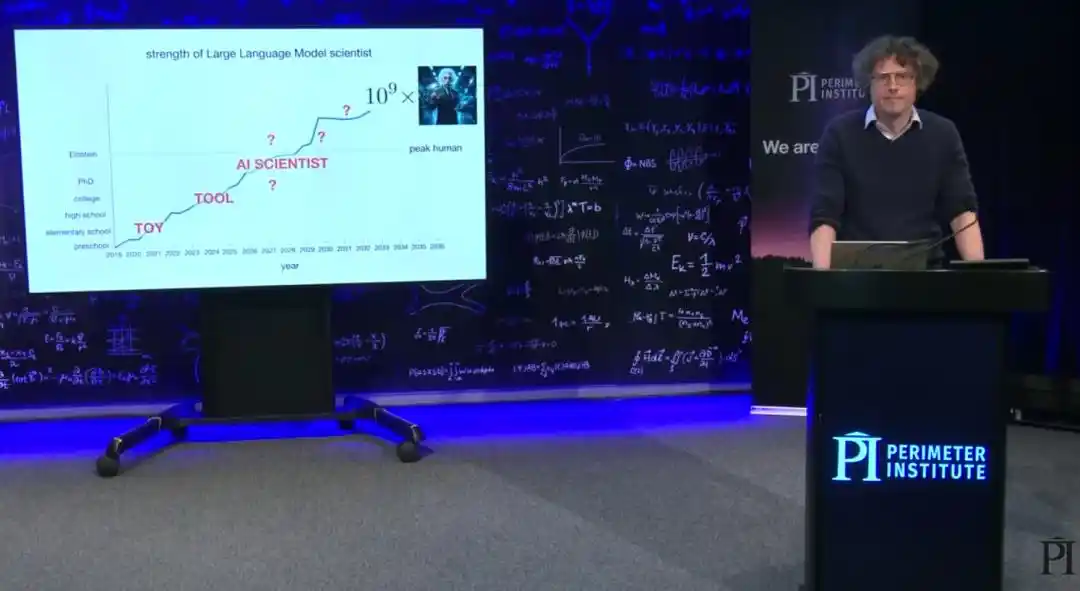
Brown said that in the long run, where AI will ultimately take physics is as difficult for him to predict as for anyone else. He even believes that the continuous improvement of AI capabilities is making the future of the entire world harder to predict. But one thing he is sure of: the next few years will be the most exciting time in the history of physics. He expects the problems that have plagued his entire career to be answered one by one in the not-too-distant future.

This article is from the WeChat public account 'Machine Heart' (ID: almosthuman2014), Author: Following AI.


Трендові криптовалюти

Пов'язані питання

QWhat is the title of Adam Brown's speech mentioned in the article, and who praised it as 'amazingly good'?

AThe title of Adam Brown's speech is 'Training Sand to Think: Artificial General Intelligence & Future of Physics.' It was praised as 'amazingly good' by Nobel laureate and Turing Award winner Geoffrey Hinton.

QAccording to Adam Brown, how are Large Language Models (LLMs) fundamentally different from traditional computer programs?

AAdam Brown states that LLMs are not 'programmed' but 'grown.' They are developed through a two-stage process: pre-training on vast amounts of text to predict the next word, and post-training (akin to 'finishing school') to make them more useful and polite, rather than being explicitly coded with rules.

QWhat was the significant mathematical breakthrough achieved by an AI model regarding Erdős' 1946 'unit distances' conjecture?

AAn AI model independently found a counterexample to Erdős' 1946 'unit distances' conjecture. It constructed a set of points with more unit distance pairs than was previously thought possible for a given number of points, effectively disproving the long-standing conjecture.

QWhat analogy does Brown use to describe the likely future stages of AI in scientific research, based on the history of chess AI?

ABrown uses the history of chess AI to describe four likely stages for AI in science: 1) Toy Stage (early capabilities), 2) Tool Stage (useful for specific tasks), 3) Centaur Stage (deep human-AI collaboration), and 4) Superhuman Stage (AI surpassing human capabilities and operating autonomously).

QWhat are the current four major shortcomings of large models that Brown identifies, even if progress were to stop today?

AThe four major shortcomings Brown identifies are: 1) Low autonomy, 2) Slow learning speed (compared to runtime inference), 3) Poor planning ability, and 4) Weak error-correction capability. Despite these, he believes AI has already reshaped physics research.

Пов'язані матеріали

Valuation of $8 Billion, Up 200% in 8 Months! What's Behind Crypto-Friendly Bank Erebor Bank's Rise?

Erebor Bank, a digital bank founded by Palmer Luckey and backed by Peter Thiel, is in talks for new funding at a target valuation of $8 billion, double its $4.35 billion valuation from December. This surge is driven by explosive deposit growth, which soared from $1.1 billion in March to approximately $4.05 billion within a quarter, alongside adding nearly 400 new clients. The bank, launched in February 2026, holds a full national bank charter from the OCC, a strategic choice to avoid reliance on partner banks. It aims to serve tech startups, defense contractors, and crypto-native businesses, addressing gaps left by Silicon Valley Bank's collapse. Core promises include lending against non-traditional assets like hardware, offering 24/7 settlement, and integrating stablecoin services with traditional banking. It has already enabled stablecoin deposits and withdrawals on the Sui network. However, its current financials show minimal lending activity and a net loss, with high liquidity in cash and securities. The valuation hinges on future potential to monetize deposits through lending and crypto services. The bank's experienced management team includes veterans from Wells Fargo and crypto compliance firms. Risks are significant. Its concentrated customer base and exposure to volatile sectors like crypto and venture capital echo SVB's vulnerabilities. Its entire model depends on continued regulatory favor towards digital assets, which could shift. Erebor represents a high-profile experiment at the intersection of banking, crypto, and industrial policy, with its execution and market demand yet to be fully proven.

marsbit15 хв тому

Valuation of $8 Billion, Up 200% in 8 Months! What's Behind Crypto-Friendly Bank Erebor Bank's Rise?

marsbit15 хв тому

$8 Billion Valuation, 2x Growth in 8 Months! What Makes Crypto-Friendly Bank Erebor Bank So Special?

Erebor Bank, a crypto-friendly U.S. bank founded by Palmer Luckey, is reportedly in talks for a new funding round targeting a valuation of at least $8 billion, double its $4.35 billion valuation from December. Despite being operational for only a few months, its rapid growth—deposits surged from $1.1 billion in March to approximately $4.05 billion within a quarter, adding nearly 400 clients—has attracted investor interest. The bank aims to fill the void left by Silicon Valley Bank's collapse, targeting startups and businesses with non-traditional assets like defense contracts and digital tokens. Its strategy involves holding its own banking license to offer services like stablecoin deposits, payments, and 24/7 on-chain settlement. While digital assets are a core long-term focus, recent growth has been driven more by financing for U.S. manufacturing and defense sectors. Erebor's leadership combines Luckey's tech/defense background with a seasoned financial team. It received a national bank charter from the OCC in early 2026, benefiting from a favorable regulatory climate for digital assets. However, the bank faces significant risks, including reliance on a concentrated client base, exposure to crypto market volatility, potential regulatory shifts, and the unproven demand for its integrated banking model. Investors are betting on its future potential to monetize deposits through lending and crypto services, despite current losses typical for a new bank.

链捕手18 хв тому

$8 Billion Valuation, 2x Growth in 8 Months! What Makes Crypto-Friendly Bank Erebor Bank So Special?

链捕手18 хв тому

Торгівля

Спот

Популярні статті

Що таке GROK AI

Grok AI: Революція в розмовних технологіях ери Web3 Вступ У швидко змінюваному ландшафті штучного інтелекту Grok AI вирізняється як помітний проєкт, що поєднує сфери передових технологій та взаємодії з користувачами. Розроблений компанією xAI, яку очолює відомий підприємець Ілон Маск, Grok AI прагне переосмислити, як ми взаємодіємо зі штучним інтелектом. Оскільки рух Web3 продовжує процвітати, Grok AI має на меті використати потужність розмовного ШІ для відповіді на складні запитання, надаючи користувачам досвід, який є не лише інформативним, але й розважальним. Що таке Grok AI? Grok AI — це складний розмовний чат-бот, розроблений для динамічної взаємодії з користувачами. На відміну від багатьох традиційних систем ШІ, Grok AI охоплює ширший спектр запитів, включаючи ті, які зазвичай вважаються недоречними або виходять за межі стандартних відповідей. Основні цілі проєкту включають: Надійне міркування: Grok AI акцентує увагу на здоровому глузді, щоб надавати логічні відповіді на основі контекстуального розуміння. Масштабоване управління: Інтеграція допоміжних інструментів забезпечує моніторинг та оптимізацію взаємодій користувачів для покращення якості. Формальна верифікація: Безпека є пріоритетом; Grok AI впроваджує методи формальної верифікації для підвищення надійності своїх результатів. Розуміння довгого контексту: Модель ШІ відзначається здатністю зберігати та згадувати обширну історію розмов, що сприяє змістовним та контекстуально обізнаним дискусіям. Стійкість до атак: Зосереджуючись на покращенні своїх захистів від маніпульованих або зловмисних вхідних даних, Grok AI прагне зберегти цілісність взаємодій з користувачами. По суті, Grok AI — це не просто пристрій для отримання інформації; це занурюючий розмовний партнер, який заохочує динамічний діалог. Творець Grok AI Геній, що стоїть за Grok AI, — це ніхто інший, як Ілон Маск, особа, яка стала синонімом інновацій у різних сферах, включаючи автомобільну промисловість, космічні подорожі та технології. Під егідою xAI, компанії, що зосереджена на розвитку технологій ШІ на користь суспільства, бачення Маска прагне переосмислити розуміння взаємодій з ШІ. Лідерство та основоположна етика глибоко впливають на прагнення Маска розширити технологічні межі. Інвестори Grok AI Хоча конкретні деталі щодо інвесторів, які підтримують Grok AI, залишаються обмеженими, загальновідомо, що xAI, інкубатор проєкту, заснований і підтримується переважно самим Ілоном Маском. Попередні підприємства та активи Маска забезпечують надійну підтримку, що додатково зміцнює довіру до Grok AI та потенціал для зростання. Однак наразі інформація про додаткові інвестиційні фонди або організації, що підтримують Grok AI, не є доступною, що позначає область для потенційного майбутнього дослідження. Як працює Grok AI? Операційна механіка Grok AI є такою ж інноваційною, як і його концептуальна структура. Проєкт інтегрує кілька передових технологій, які сприяють його унікальним функціональним можливостям: Надійна інфраструктура: Grok AI побудований з використанням Kubernetes для оркестрації контейнерів, Rust для продуктивності та безпеки, і JAX для високопродуктивних числових обчислень. Ця трійка забезпечує ефективну роботу чат-бота, його масштабованість та швидке обслуговування користувачів. Доступ до знань у реальному часі: Однією з відмінних рис Grok AI є його здатність отримувати дані в реальному часі через платформу X — раніше відому як Twitter. Ця можливість надає ШІ доступ до останньої інформації, що дозволяє надавати своєчасні відповіді та рекомендації, які можуть бути пропущені іншими моделями ШІ. Два режими взаємодії: Grok AI пропонує користувачам вибір між “Розважальним режимом” та “Звичайним режимом”. Розважальний режим дозволяє більш ігровий та гумористичний стиль взаємодії, тоді як Звичайний режим зосереджується на наданні точних і правильних відповідей. Ця універсальність забезпечує індивідуальний досвід, що відповідає різним уподобанням користувачів. По суті, Grok AI поєднує продуктивність із залученням, створюючи досвід, який є одночасно збагачуючим і розважальним. Хронологія Grok AI Шлях Grok AI відзначений важливими етапами, які відображають його розвиток та етапи впровадження: Початковий розвиток: Фундаментальна фаза Grok AI тривала приблизно два місяці, протягом яких проводилося початкове навчання та налаштування моделі. Випуск бета-версії Grok-2: У значному досягненні була оголошена бета-версія Grok-2. Цей випуск представив дві версії чат-бота — Grok-2 та Grok-2 mini — кожна з яких оснащена можливостями для спілкування, кодування та міркування. Публічний доступ: Після бета-розробки Grok AI став доступним для користувачів платформи X. Ті, хто має акаунти, підтверджені номером телефону та активні принаймні сім днів, можуть отримати доступ до обмеженої версії, що робить технологію доступною для ширшої аудиторії. Ця хронологія відображає систематичний розвиток Grok AI від початку до публічної взаємодії, підкреслюючи його прагнення до постійного вдосконалення та взаємодії з користувачами. Ключові особливості Grok AI Grok AI охоплює кілька ключових особливостей, які сприяють його інноваційній ідентичності: Інтеграція знань у реальному часі: Доступ до актуальної та релевантної інформації відрізняє Grok AI від багатьох статичних моделей, забезпечуючи захоплюючий та точний досвід для користувачів. Універсальні стилі взаємодії: Пропонуючи різні режими взаємодії, Grok AI задовольняє різноманітні уподобання користувачів, запрошуючи до творчості та персоналізації у спілкуванні з ШІ. Передова технологічна основа: Використання Kubernetes, Rust та JAX надає проєкту надійну основу для забезпечення надійності та оптимальної продуктивності. Етичні міркування в дискурсі: Включення функції генерації зображень демонструє інноваційний дух проєкту. Однак це також піднімає етичні питання, пов'язані з авторським правом та поважним зображенням впізнаваних фігур — триваюча дискусія в спільноті ШІ. Висновок Як піонер у сфері розмовного ШІ, Grok AI втілює потенціал трансформаційних користувацьких досвідів в цифрову епоху. Розроблений компанією xAI та керований візією Ілона Маска, Grok AI інтегрує знання в реальному часі з передовими можливостями взаємодії. Він прагне розширити межі того, що може досягти штучний інтелект, зберігаючи при цьому акцент на етичних міркуваннях та безпеці користувачів. Grok AI не лише втілює технологічний прогрес, але й представляє нову парадигму спілкування в ландшафті Web3, обіцяючи залучити користувачів як глибокими знаннями, так і ігровою взаємодією. Оскільки проєкт продовжує розвиватися, він слугує свідченням того, що може досягти перетин технологій, творчості та людської взаємодії.

476 переглядів усьогоОпубліковано 2024.12.26Оновлено 2024.12.26

Що таке GROK AI

Що таке ERC AI

Euruka Tech: Огляд $erc ai та його амбіцій у Web3 Вступ У швидко змінюваному ландшафті технології блокчейн та децентралізованих додатків нові проекти з'являються часто, кожен з унікальними цілями та методологіями. Одним з таких проектів є Euruka Tech, який працює у широкій сфері криптовалют та Web3. Основна увага Euruka Tech, зокрема його токена $erc ai, зосереджена на представленні інноваційних рішень, розроблених для використання зростаючих можливостей децентралізованих технологій. Ця стаття має на меті надати всебічний огляд Euruka Tech, дослідження його цілей, функціональності, ідентичності його творця, потенційних інвесторів та його значення в ширшому контексті Web3. Що таке Euruka Tech, $erc ai? Euruka Tech характеризується як проект, який використовує інструменти та функціональність, що пропонуються середовищем Web3, зосереджуючи увагу на інтеграції штучного інтелекту у своїй діяльності. Хоча конкретні деталі про структуру проекту дещо неясні, він розроблений для покращення залучення користувачів та автоматизації процесів у крипто-просторі. Проект має на меті створити децентралізовану екосистему, яка не лише полегшує транзакції, але й включає прогностичні функції через штучний інтелект, звідси і назва його токена, $erc ai. Мета полягає в тому, щоб надати інтуїтивно зрозумілу платформу, яка сприяє розумнішим взаємодіям та ефективній обробці транзакцій у зростаючій сфері Web3. Хто є творцем Euruka Tech, $erc ai? На даний момент інформація про творця або засновницьку команду Euruka Tech залишається невизначеною та дещо непрозорою. Ця відсутність даних викликає занепокоєння, оскільки знання про бекграунд команди часто є важливим для встановлення довіри в секторі блокчейн. Тому ми класифікували цю інформацію як невідому, поки конкретні деталі не стануть доступними в публічному домені. Хто є інвесторами Euruka Tech, $erc ai? Аналогічно, ідентифікація інвесторів або організацій, які підтримують проект Euruka Tech, не надається через доступні дослідження. Аспект, який є критично важливим для потенційних зацікавлених сторін або користувачів, які розглядають можливість співпраці з Euruka Tech, - це впевненість, що походить від встановлених фінансових партнерств або підтримки від авторитетних інвестиційних компаній. Без розкриття інформації про інвестиційні зв'язки важко зробити всебічні висновки про фінансову безпеку або довговічність проекту. Відповідно до знайденої інформації, цей розділ також має статус невідомий. Як працює Euruka Tech, $erc ai? Незважаючи на відсутність детальних технічних специфікацій для Euruka Tech, важливо враховувати його інноваційні амбіції. Проект прагне використовувати обчислювальну потужність штучного інтелекту для автоматизації та покращення досвіду користувачів у середовищі криптовалют. Інтегруючи ШІ з технологією блокчейн, Euruka Tech має на меті надати такі функції, як автоматизовані угоди, оцінка ризиків та персоналізовані інтерфейси користувачів. Інноваційна суть Euruka Tech полягає в його меті створити безшовний зв'язок між користувачами та величезними можливостями, які пропонують децентралізовані мережі. Завдяки використанню алгоритмів машинного навчання та ШІ, він має на меті мінімізувати труднощі для нових користувачів і спростити транзакційні досвіди в рамках Web3. Ця симбіоз між ШІ та блокчейном підкреслює значення токена $erc ai, який виступає як міст між традиційними інтерфейсами користувачів та розвиненими можливостями децентралізованих технологій. Хронологія Euruka Tech, $erc ai На жаль, через обмежену інформацію про Euruka Tech ми не можемо представити детальну хронологію основних подій або досягнень у подорожі проекту. Ця хронологія, яка зазвичай є безцінною для відстеження еволюції проекту та розуміння його траєкторії зростання, наразі недоступна. Як тільки інформація про значні події, партнерства або функціональні доповнення стане очевидною, оновлення, безумовно, підвищать видимість Euruka Tech у крипто-сфері. Роз'яснення щодо інших проектів “Eureka” Варто зазначити, що кілька проектів та компаній мають схожу назву з “Eureka”. Дослідження виявило ініціативи, такі як AI-агент від NVIDIA Research, який зосереджується на навчанні роботів складним завданням за допомогою генеративних методів, а також Eureka Labs та Eureka AI, які покращують користувацький досвід в освіті та аналітиці обслуговування клієнтів відповідно. Однак ці проекти відрізняються від Euruka Tech і не повинні бути змішані з його цілями чи функціональністю. Висновок Euruka Tech, разом із його токеном $erc ai, представляє обіцяючого, але наразі невідомого гравця в ландшафті Web3. Хоча деталі про його творця та інвесторів залишаються невідомими, основна амбіція поєднання штучного інтелекту з технологією блокчейн є центром інтересу. Унікальні підходи проекту до сприяння залученню користувачів через передову автоматизацію можуть виділити його на фоні прогресу екосистеми Web3. Оскільки крипто-ринок продовжує еволюціонувати, зацікавлені сторони повинні уважно стежити за новинами, пов'язаними з Euruka Tech, оскільки розвиток задокументованих інновацій, партнерств або визначеного дорожньої карти може представити значні можливості в найближчому майбутньому. На даний момент ми чекаємо на більш суттєві інсайти, які можуть розкрити потенціал Euruka Tech та його позицію в конкурентному крипто-ландшафті.

453 переглядів усьогоОпубліковано 2025.01.02Оновлено 2025.01.02

Що таке ERC AI

Що таке DUOLINGO AI

DUOLINGO AI: Інтеграція вивчення мов з Web3 та інноваціями штучного інтелекту В епоху, коли технології змінюють освіту, інтеграція штучного інтелекту (ШІ) та блокчейн-мереж відкриває нові горизонти для вивчення мов. З'являється DUOLINGO AI та його асоційована криптовалюта, $DUOLINGO AI. Цей проект прагне об'єднати освітні можливості провідних платформ для вивчення мов з перевагами децентралізованих технологій Web3. У цій статті розглядаються ключові аспекти DUOLINGO AI, його цілі, технологічна структура, історичний розвиток та майбутній потенціал, зберігаючи чіткість між оригінальним освітнім ресурсом та цією незалежною криптовалютною ініціативою. Огляд DUOLINGO AI В основі DUOLINGO AI лежить прагнення створити децентралізоване середовище, де учні можуть отримувати криптографічні винагороди за досягнення освітніх етапів у мовній компетенції. Застосовуючи смарт-контракти, проект має на меті автоматизувати процеси перевірки навичок та розподілу токенів, дотримуючись принципів Web3, які підкреслюють прозорість та власність користувачів. Модель відрізняється від традиційних підходів до вивчення мов, акцентуючи увагу на структурі управління, що базується на спільноті, що дозволяє власникам токенів пропонувати поліпшення змісту курсів та розподілу винагород. Деякі з помітних цілей DUOLINGO AI включають: Гейміфіковане навчання: Проект інтегрує досягнення на блокчейні та невзаємозамінні токени (NFT), щоб представляти рівні мовної компетенції, сприяючи мотивації через захоплюючі цифрові винагороди. Децентралізоване створення контенту: Це відкриває можливості для викладачів та мовних ентузіастів вносити свої курси, сприяючи моделі розподілу доходів, яка вигідна всім учасникам. Персоналізація на основі ШІ: Використовуючи сучасні моделі машинного навчання, DUOLINGO AI персоналізує уроки, щоб адаптуватися до індивідуального прогресу навчання, подібно до адаптивних функцій, що є в усталених платформах. Творці проекту та управління Станом на квітень 2025 року команда, що стоїть за $DUOLINGO AI, залишається псевдонімною, що є поширеною практикою в децентралізованому криптовалютному середовищі. Ця анонімність має на меті сприяти колективному розвитку та залученню зацікавлених сторін, а не зосереджуватися на окремих розробниках. Смарт-контракт, розгорнутий на блокчейні Solana, зазначає адресу гаманця розробника, що свідчить про зобов'язання до прозорості щодо транзакцій, незважаючи на те, що особи творців залишаються невідомими. Згідно з його дорожньою картою, DUOLINGO AI прагне перетворитися на Децентралізовану Автономну Організацію (DAO). Ця структура управління дозволяє власникам токенів голосувати з важливих питань, таких як реалізація функцій та розподіл скарбниці. Ця модель узгоджується з етикою розширення прав і можливостей спільноти, що спостерігається в різних децентралізованих додатках, підкреслюючи важливість колективного прийняття рішень. Інвестори та стратегічні партнерства На даний момент немає публічно відомих інституційних інвесторів або венчурних капіталістів, пов'язаних з $DUOLINGO AI. Натомість ліквідність проекту в основному походить з децентралізованих бірж (DEX), що є різким контрастом до стратегій фінансування традиційних компаній у сфері освітніх технологій. Ця модель знизу вгору вказує на підхід, орієнтований на спільноту, що відображає зобов'язання проекту до децентралізації. У своєму білому документі DUOLINGO AI згадує про формування співпраці з неуточненими “блокчейн-освітніми платформами”, спрямованими на збагачення своїх курсів. Хоча конкретні партнерства ще не були розкриті, ці спільні зусилля натякають на стратегію поєднання інновацій блокчейну з освітніми ініціативами, розширюючи доступ та залучення користувачів у різноманітні навчальні напрямки. Технологічна архітектура Інтеграція ШІ DUOLINGO AI включає два основні компоненти на основі ШІ для покращення своїх освітніх пропозицій: Адаптивний навчальний двигун: Цей складний двигун навчається на основі взаємодій користувачів, подібно до власних моделей великих освітніх платформ. Він динамічно регулює складність уроків, щоб вирішувати конкретні проблеми учнів, зміцнюючи слабкі місця через цілеспрямовані вправи. Розмовні агенти: Використовуючи чат-боти на базі GPT-4, DUOLINGO AI надає платформу для користувачів, щоб брати участь у симульованих розмовах, сприяючи більш інтерактивному та практичному досвіду вивчення мови. Інфраструктура блокчейну Побудований на блокчейні Solana, $DUOLINGO AI використовує комплексну технологічну структуру, яка включає: Смарт-контракти для перевірки навичок: Ця функція автоматично нагороджує токенами користувачів, які успішно проходять тести на компетентність, підкріплюючи структуру стимулів для справжніх навчальних результатів. NFT значки: Ці цифрові токени позначають різні етапи, яких досягають учні, такі як завершення розділу курсу або оволодіння конкретними навичками, що дозволяє їм обмінюватися або демонструвати свої досягнення в цифровому форматі. Управління DAO: Члени спільноти, наділені токенами, можуть брати участь в управлінні, голосуючи за ключові пропозиції, що сприяє культурі участі, яка заохочує інновації в курсах та функціях платформи. Історичний хронологічний графік 2022–2023: Концептуалізація Основи DUOLINGO AI закладаються з створення білого документа, що підкреслює синергію між досягненнями ШІ у вивченні мов та децентралізованим потенціалом блокчейн-технологій. 2024: Бета-реліз Обмежений бета-реліз представляє пропозиції з популярних мов, винагороджуючи ранніх користувачів токенами в рамках стратегії залучення спільноти проекту. 2025: Перехід до DAO У квітні відбувається повний запуск основної мережі з обігом токенів, що спонукає обговорення в спільноті щодо можливих розширень на азійські мови та інші розробки курсів. Виклики та майбутні напрямки Технічні труднощі Незважаючи на свої амбітні цілі, DUOLINGO AI стикається з суттєвими викликами. Масштабованість залишається постійною проблемою, особливо в балансуванні витрат, пов'язаних із обробкою ШІ, та підтриманням чутливої, децентралізованої мережі. Крім того, забезпечення якості створення контенту та модерації в умовах децентралізованої пропозиції створює складнощі у підтримці освітніх стандартів. Стратегічні можливості Дивлячись у майбутнє, DUOLINGO AI має потенціал використовувати партнерства з мікрокреденційними академічними установами, надаючи блокчейн-верифіковані підтвердження мовних навичок. Крім того, розширення через різні блокчейни може дозволити проекту залучити ширші бази користувачів та додаткові екосистеми блокчейну, покращуючи його взаємодію та охоплення. Висновок DUOLINGO AI представляє інноваційне злиття штучного інтелекту та блокчейн-технологій, пропонуючи альтернативу, орієнтовану на спільноту, традиційним системам вивчення мов. Хоча його псевдонімна розробка та нова економічна модель несуть певні ризики, зобов'язання проекту до гейміфікованого навчання, персоналізованої освіти та децентралізованого управління освітлює шлях вперед для освітніх технологій у сфері Web3. Оскільки ШІ продовжує розвиватися, а екосистема блокчейну еволюціонує, ініціативи на кшталт DUOLINGO AI можуть переосмислити, як користувачі взаємодіють з мовною освітою, наділяючи спільноти та винагороджуючи залучення через інноваційні механізми навчання.

484 переглядів усьогоОпубліковано 2025.04.11Оновлено 2025.04.11

Що таке DUOLINGO AI

Обговорення

Ласкаво просимо до спільноти HTX. Тут ви можете бути в курсі останніх подій розвитку платформи та отримати доступ до професійної ринкової інформації. Нижче представлені думки користувачів щодо ціни AI (AI).

活动图片