Hidden Ads No More: Under X's New Disclosure Rules, KOLs' Easy Money Model Faces Account Suspension Risks

比推Опубліковано о 2026-02-24Востаннє оновлено о 2026-02-24

Анотація

X, formerly known as Twitter, is set to enforce stricter advertising disclosure rules, as announced by product lead Nikita Bier. The new policy will require users to clearly label paid promotions with tags like #ad or #sponsored. This follows a public intervention by Bier, who warned an influential account promoting Kalshi without proper disclosure of its financial ties. The article highlights several high-engagement “stealth ads”—posts disguised as organic content that are actually paid promotions—from accounts like @jota_snchez and @FluentInFinance, which garnered millions of views without disclosure. These posts often promoted prediction markets like Polymarket and Kalshi by leveraging FOMO and misleading narratives. The new rules aim to increase transparency, impacting Web3 projects and influencers who rely on undisclosed soft promotions for user acquisition. KOLs may face higher risks, including post removal and account suspension, while projects could see rising marketing costs. Alternatively, advertisers may shift budgets to X’s official promoted post system, potentially increasing the platform’s ad revenue. The move is expected to reduce deceptive marketing practices and improve user awareness in the long term.

Author: Sanqing, Foresight News

Original Title: X's New Advertising Disclosure Rules to Launch, Potentially Ending the Crypto KOLs' 'Easy Money' Model


On February 21, X platform product lead Nikita Bier (@nikitabier) publicly intervened in a post suspected of undisclosed paid promotion, directly requesting the original poster to add a disclosure statement or face account suspension. User @infodexx posted a list of the "Most Valuable Startups of 2025," with prediction market Kalshi ranking second with a $11 billion valuation, accompanied by Kalshi's green brand image and founder's photo.

The post garnered over 420,000 views, nearly 2000 likes, and hundreds of reposts. While it appeared to be an objective ranking, it was flagged in the reader community notes as "this is a paid post." Furthermore, @infodexx's bio explicitly states "@Kalshi partner," yet the original post lacked any clear disclosure labels like #ad or #sponsored.
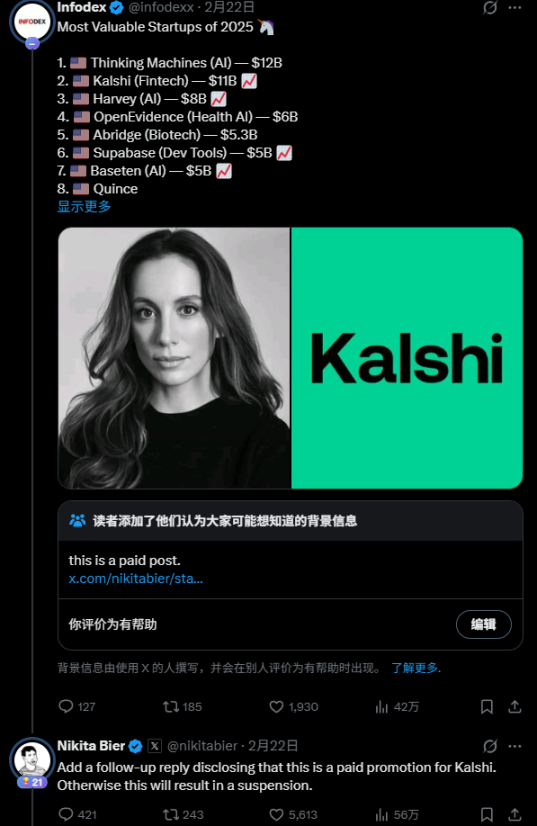
Nikita Bier replied to the post on the same day: "Please add a follow-up reply disclosing this is a paid promotion for Kalshi. Otherwise, this will result in account suspension." Later, when user @AlexFinn complained about the X platform being flooded with undisclosed ads (especially posts related to prediction markets and AI), Nikita Bier further stated: "We are launching a disclosure feature for this type of issue next week."

High-Viewership Hidden Ads Will Be Brought into the Light

Below are several examples of high-viewership "hidden ads" selected by the author. These tweets appear to be natural shares but are suspected promotions lacking any disclosure labels. They attract high views, lure degens to follow the trend, yet evade responsibility.

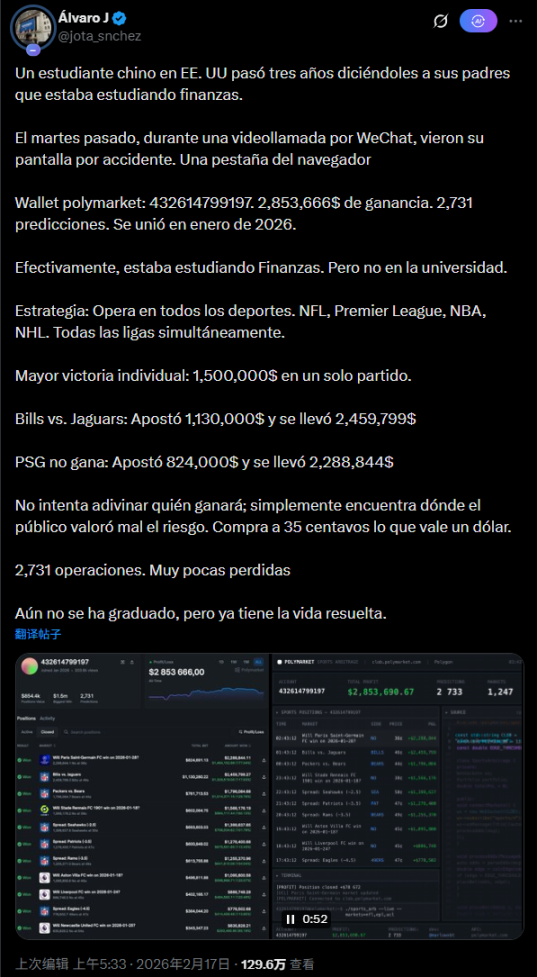
A Spanish-language account @jota_snchez shared a story about a "Chinese student making a fortune on Polymarket," with over 1.29 million views, 7313 likes, and 312 reposts. The content detailed strategies with images and videos, seeming like an inspirational post but actually softly promoting Polymarket's money-making potential. No #ad label, yet indirectly hyping the platform—a classic disguise of experience sharing.
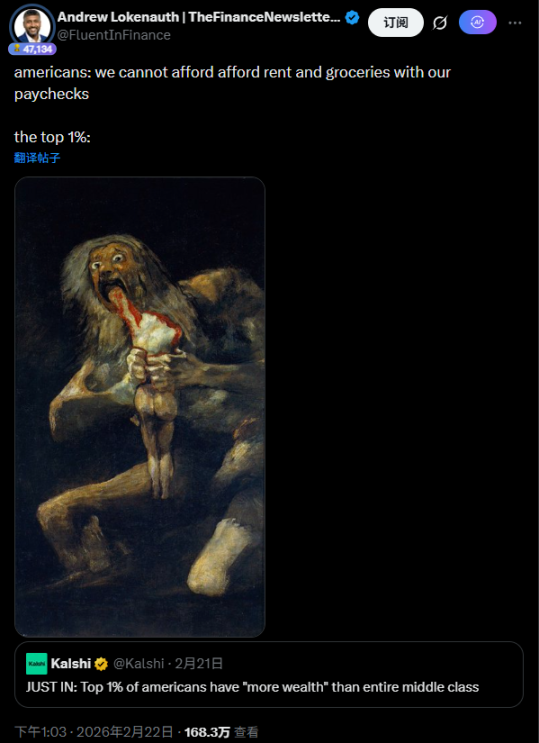
User @FluentInFinance quoted a Kalshi tweet, complaining "US 1% wealthier than middle class," with 1.68 million views, 150k+ likes, and 20k+ reposts. Superficially social commentary, it actually quoted Kalshi's "JUST IN" news, guiding users to bet on related events on the platform. Not labeled #sponsored, yet amplified exposure through high engagement. This is where Web3 degens often get tricked.
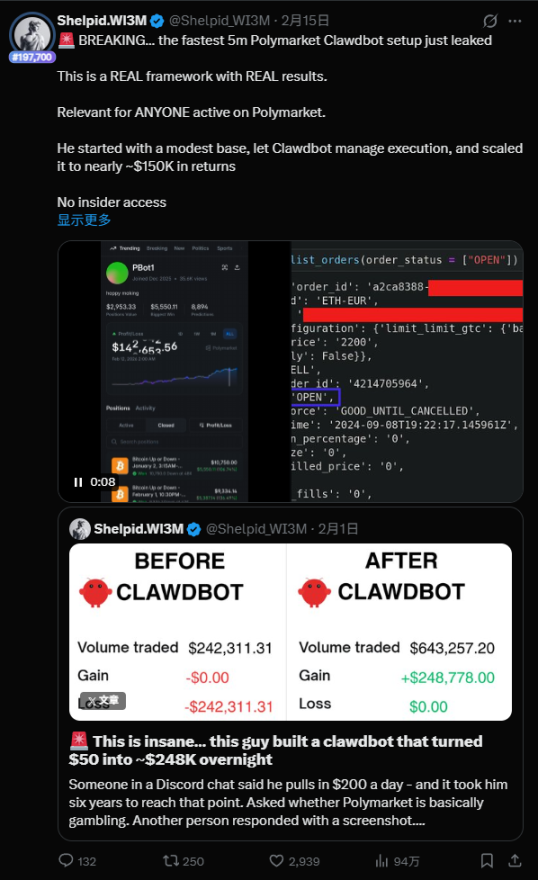
@Shelpid_WI3M "exposed" a 5-minute setup framework for Polymarket Clawdbot, with 940k views, 2940 likes, 6091 bookmarks. Detailed steps + link, seeming like a "free share" but actually promoting a copytrade tool, indirectly pulling new users to Polymarket. No disclosure of any partnership—this type of "developer perspective" hidden ad is the most deceptive for technical degens.
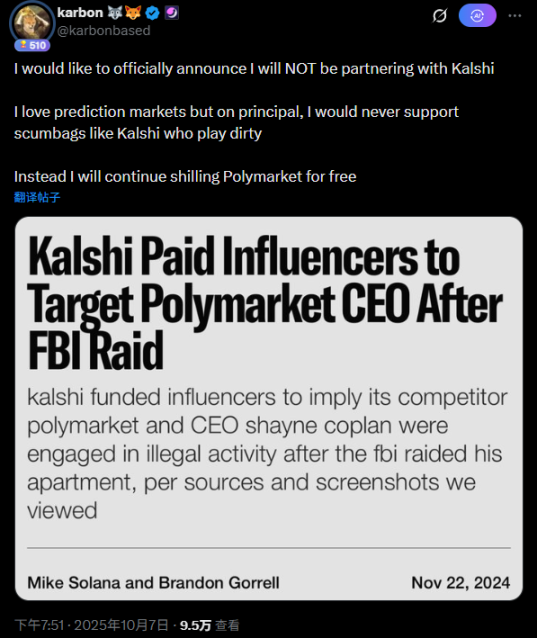
@karbonbased publicly "refused Kalshi collaboration but continues to shill Polymarket for free," with 95k views, 764 likes. Superficially a "principled" refusal, it actually promotes Polymarket indirectly. The word "free" is most suspicious—what's truly free in Web3? No #ad, yet using moral high ground to induce followers.
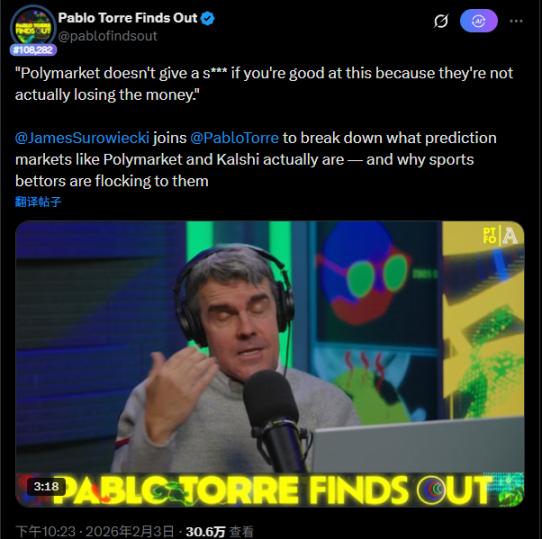
@pablofindsout uploaded a video discussing the nature of Polymarket and Kalshi, with 300k views, 1657 likes. Citing expert opinions, seemingly neutral but actually amplifying platform exposure—an unlabeled sponsored隐形广告片 (stealth ad video).
These examples show that high viewership does not equal sincerity. They rely on FOMO for viral spread but avoid disclosure, costing wallets dearly. After the new rules, similar tweets will be restricted.

Impact of X's New Rules on Web3 Marketing

For Web3 project teams, this means a significant increase in marketing costs. Many prediction market projects (like Polymarket and Kalshi) rely on KOLs' soft ads to drive user FOMO entry at low cost.

Now, the new rules require any content involving payment, gifts, affiliate links, or material incentives to be prominently labeled with "#ad," "sponsored," or "paid partnership," etc. Otherwise, the tweet will be directly removed, and the account faces suspension or even permanent ban.

In the short term, growth for these platforms will slow down. KOLs will hesitate to share freely, collaboration thresholds will be raised, and budgets will be forced towards more expensive channels.

For KOLs, the most direct impact is the end of the "low-effort easy money" model. In the past, many projects heavily relied on KOLs' "soft ad" strategy: disguising promotions as neutral experience sharing, data-driven complaints, or viral memes to create FOMO and drive user participation at low cost.

Now, forced explicit disclosure means KOLs can no longer hide commercial relationships and dare not casually "share naturally." Once detected by AI or reported, the risk of tweet deletion and account suspension is extremely high.

This will also raise the collaboration threshold between projects and KOLs. As risks increase, KOLs' rates may rise. But in the long run, this is positive for the Web3 ecosystem. Increased transparency will restore user trust in promoted content, reducing rug pulls and short-term speculation.

A common alternative is shifting to X's official Promoted Post system: these ads automatically carry "Promoted" or "Ads" labels, handled uniformly by the platform for disclosure, avoiding manual labeling risks. However, this also means project teams pay directly to X, concentrating more ad revenue into the platform's hands rather than dispersing it to KOLs.

X's move also likely aims to enhance its own advertising monetization capability. By enforcing explicit disclosure and promoting official ad tools, the platform can attract more budgets into its own system, capturing the share of "hidden ads" that originally flowed to KOLs, further strengthening its position as an ad revenue source, especially in competitive fields like prediction markets and AI content.


Twitter:https://twitter.com/BitpushNewsCN

Bitpush TG Discussion Group:https://t.me/BitPushCommunity

Bitpush TG Subscription: https://t.me/bitpush

Original article link:https://www.bitpush.news/articles/7614106

Пов'язані питання

QWhat new policy is X platform introducing regarding paid promotions?

AX platform is introducing a new policy that requires any content involving paid promotions, giveaways, affiliate links, or material incentives to be clearly labeled with disclosures such as '#ad', 'sponsored', or 'paid partnership'. Failure to comply will result in post removal and potential account suspension or permanent ban.

QWho is Nikita Bier and what action did he take on February 21st?

ANikita Bier is the Product Lead at X platform. On February 21st, he publicly intervened on a post by user @infodexx that was suspected of being an undisclosed paid promotion. He instructed the user to add a disclosure statement or face account suspension.

QWhat are some examples of high-engagement 'stealth ads' mentioned in the article?

AExamples include a Spanish account @jota_snchez sharing a story about a Chinese student making money on Polymarket (1.29M views), @FluentInFinance criticizing wealth inequality while referencing Kalshi (1.68M views), and @Shelpid_WI3M sharing a 'setup framework' for a Polymarket tool (940k views). All lacked proper disclosure tags.

QHow will the new disclosure rules impact Web3 projects and KOLs according to the article?

AFor Web3 projects, marketing costs will rise as they can no longer rely on low-cost, undisclosed KOL soft promotions. For KOLs, their 'easy money' model of sharing undisclosed ads will end, forcing them to properly label content. This raises the cooperation threshold and may increase KOL pricing due to higher risks.

QWhat is a potential alternative for advertisers under the new rules, and what is X platform's possible motive?

AA common alternative is to use X's official Promoted Post system, which automatically labels ads as 'Promoted' or 'Ads'. The article suggests X's motive may be to increase its own advertising revenue by redirecting budgets from KOL 'stealth ads' to its official ad platform, especially in competitive areas like prediction markets and AI content.

Пов'язані матеріали

KOL's Perspective: Why Is SOL Set to Rise from This Point?

**Summary: Why SOL is Positioned for Growth at This Level** The article argues that SOL is poised for an upward move from its current price point, citing several key factors. Primarily, SOL has just broken out of a 4-month consolidation phase. This breakout signals a return of risk appetite to the broader crypto market, as SOL is seen as a key indicator of overall crypto health. The token's ownership has reportedly shifted from short-term traders and tourists to long-term accumulators, leading to low volume. Any meaningful increase in trading activity could thus trigger significant upward momentum. Fundamental strengths include strong institutional adoption, integration with DeFi and RWAs (Real-World Assets), and the potential benefits from the Clarity Act. Despite its high volatility—having dropped 70% from its all-time high but still up 12x from its bear market low—SOL is highlighted as one of the few tokens from the last cycle to reach new highs. It boasts a robust ecosystem of applications, users, and protocols. Future catalysts include the expected influx of AI developers following the Miami Accelerate conference, which focused on AI on Solana. Furthermore, Solana is positioned as the premier chain for memecoin activity, a trend expected to continue and drive network usage and fees. The article concludes that recent price action reflects a healthy transfer to long-term holders, setting the stage for growth.

marsbit6 хв тому

KOL's Perspective: Why Is SOL Set to Rise from This Point?

marsbit6 хв тому

Those Pre-Bitcoin PoW Protocols Have Recently Been Reimplemented

This article details a recent surge in replicating pre-Bitcoin Proof-of-Work (PoW) protocols, specifically focusing on Hal Finney's 2004 RPOW (Reusable Proofs of Work). Within five days in May 2026, multiple independent builders in the Bitcoin/cypherpunk community launched projects inspired by this early electronic cash proposal. The initiative began with Fred Krueger's `rpow2.com`, a centralized but auditable system that replaced RPOW's original IBM 4758 hardware with Ed25519 signatures. Initially a faithful replica, it later adopted Bitcoin-like features (21M supply cap, difficulty adjustment) and a controversial 5.24% founder allocation. This sparked rapid forks, including `rpow4.com` which incorporated full Bitcoin parameters, a prediction market (`rpowmarket.com`), and a DEX (`rpow2swap.com`). Concurrently, Mike In Space created a prototype of Wei Dai's 1998 b-money proposal (`b-money.replit.app`), pushing the historical exploration even further back. The article contrasts these centralized, server-dependent experiments with Bitcoin's core innovation of decentralized, trustless consensus. It also highlights a parallel development: the `HASH` project on Ethereum, which uses smart contract hooks to enable a purely fair-launch, browser-mineable PoW token with 0% allocations to team or VCs. The collective activity is framed as a meme-driven, educational exploration of cypherpunk history rather than a serious financial movement, with all projects heavily disclaiming any investment value.

marsbit11 хв тому

Those Pre-Bitcoin PoW Protocols Have Recently Been Reimplemented

marsbit11 хв тому

South Korean Exchanges 'Battle' Regulators, Challenging the Boundaries of Enforcement and Legislation

South Korea's cryptocurrency industry is engaged in a rare, direct confrontation with regulators. The Financial Intelligence Unit (FIU), the primary anti-money laundering (AML) watchdog, has recently imposed heavy penalties on major exchanges like Upbit and Bithumb for alleged violations involving unregistered overseas VASPs and AML procedures. However, exchanges are now actively challenging these actions in court and through industry associations. In a significant shift, the Seoul Administrative Court ruled in favor of Upbit's operator, Dunamu, overturning part of an FIU-ordered business suspension. The court found the FIU's penalty criteria and justification insufficiently clear. Similarly, the court suspended the enforcement of a six-month business suspension against Bithumb pending a final ruling, citing potential irreversible harm to the exchange. Beyond legal battles, the industry is contesting proposed legislative amendments. The Digital Asset eXchange Alliance (DAXA) strongly opposes a draft rule that would mandate Suspicious Transaction Reports (STRs) for all crypto transfers over 10 million KRW (~$6,800). DAXA argues this "poison pill" clause violates legal principles and would overwhelm the STR system, increasing reports from 63,000 to an estimated 5.45 million annually for major exchanges, thereby crippling effective AML monitoring. This conflict highlights a structural tension in South Korea's crypto governance: comprehensive digital asset laws are still developing, while regulators rely heavily on AML enforcement. The industry's move from passive compliance to active legal and legislative challenges signifies a new phase, pressing for clearer rules and more proportionate enforcement. While short-term disputes may intensify, this clash could ultimately lead to a more mature and sustainable regulatory framework for South Korea's vibrant crypto market.

marsbit1 год тому

South Korean Exchanges 'Battle' Regulators, Challenging the Boundaries of Enforcement and Legislation

marsbit1 год тому

After 50x Storage Surge, Justin Sun Always Looks to the Next Decade

Sun Yuchen, known for his controversial stunts like a $30 million lunch with Warren Buffett (canceled due to a kidney stone) and eating a $6.2 million duct-taped banana, is often overshadowed by a significant fact: his decade-long track record of spotting major investment trends. In 2016, he famously advised young people to invest in Bitcoin, Nvidia, Tesla, and Tencent instead of buying property. A hypothetical $20,000 investment in Nvidia and Tesla from that list would now be worth over 50 million RMB. His latest major call was on November 6, 2025, predicting a "50x storage opportunity" tied to the AI boom, which materialized with Sandisk's stock surging nearly 50-fold by 2026. Looking ahead, Sun now focuses on the next frontier: Physical AI. He identifies four key areas: 1. **Embodied AI/Robotics**: He sees this reaching its "iPhone moment," with companies like UBTech and Galaxy General leading in commercialization. 2. **Drones**: Viewed as the first commercially viable form of Physical AI, revolutionizing sectors from warfare (e.g., AeroVironment's Switchblade) to logistics. 3. **Spatial Computing**: Beyond VR, it's about AI understanding physical space, a foundational technology for robotics and autonomous systems, exemplified by Apple's Vision Pro. 4. **Space Exploration**: After a 2025 suborbital flight with Blue Origin, Sun advocates for space as the ultimate frontier, discussing blockchain's potential role in space asset management and data transactions. His investment philosophy involves betting on entire, inevitable trends rather than single companies. For robotics, he sees Tesla (the body/manufacturer) and Nvidia (the brain/AI platform) as complementary plays. In defense drones, he highlights companies making tanks obsolete (AeroVironment) and those augmenting fighter jets (Kratos). For space, he participated in Blue Origin's flight and anticipates SpaceX's potential IPO to redefine the sector's valuation. Sun Yuchen's vision frames the next two decades not as a revolution in information flow (like the internet), but in the fundamental operation of the physical world through AI-powered robots, autonomous systems, and spatial intelligence, ultimately extending human and AI activity into space. While many still focus on conventional assets, he continues to look toward the next technological horizon.

marsbit2 год тому

After 50x Storage Surge, Justin Sun Always Looks to the Next Decade

marsbit2 год тому

Торгівля

Спот
Ф'ючерси
活动图片





