Harvard and Others Exit, Six Core Talents Depart in a Month: What's Happening to Ethereum?

链捕手Опубліковано о 2026-05-20Востаннє оновлено о 2026-05-20

Анотація

Ethereum faces significant internal and external pressures, marked by a wave of high-profile departures from its core development team and a loss of confidence from major institutional investors. Within four months, at least seven key figures—including researchers, protocol leads, and a former executive director—have left the Ethereum Foundation. This exodus, partly triggered by controversy over a new "mission statement" requiring employee sign-off, risks derailing critical roadmap upgrades like PeerDAS and Verkle trees, and has already contributed to delays in the planned Glamsterdam upgrade. Compounding the internal instability, major institutions are reducing their exposure. Goldman Sachs slashed its iShares Ethereum Trust holdings by approximately 70%, and Harvard's endowment fund completely exited its $87 million Ethereum ETF position. Concurrently, the Ethereum Foundation itself has been unstaking and selling ETH for "treasury rebalancing," further unsettling the market. These challenges emerge as Ethereum's competitive dominance erodes. Its share of the total DeFi market has fallen to around 54%, with rivals like Solana and Base gaining ground. In fee revenue, it was recently outpaced by newer chains like Hyperliquid. Furthermore, a trend of institutions exploring proprietary or hybrid blockchains (exemplified by Circle's Arc) threatens Ethereum's position as the premier settlement layer for institutional assets. While founder Vitalik Buterin's vision for Ethereum a...

Author: Zhou, ChainCatcher

Recently, the Ethereum Foundation has once again been hit by personnel changes, with core researchers Carl Beek and Julian Ma officially announcing their departure.

Since the beginning of this year, at least 7 core members or senior contributors have left one after another, from the Co-Executive Director to protocol researchers, from upgrade coordinators to cryptography experts. This has sparked clear concerns in the community about the Foundation's stability and execution capabilities.

Meanwhile, institutional holdings data have been released one after another. Goldman Sachs reduced its position in BlackRock's ETHA by about 70%, the Harvard University Endowment Fund completely liquidated its previously purchased nearly $87 million Ethereum ETF holdings, and Korea's seventh-largest pension relief company recorded a loss of approximately $32.73 million due to investing in an Ethereum leveraged ETF.

Furthermore, the Ethereum Foundation recently unstaked 21,271 ETH from Lido and has repeatedly sold ETH on-chain for treasury rebalancing.

The internal core team is leaving, external large capital is exiting, and the Foundation itself is reducing its holdings. Ethereum is being 'voted with their feet' by different types of participants simultaneously.

Trigger for the Departure Wave: The Signing Controversy Over the Mission Statement

The direct trigger for this wave of departures is the new 38-page Mission Statement released by the Foundation in March.

The statement explicitly states that the Foundation is not the owner or central authority of Ethereum, but merely one of many supporters. It proposes gradually reducing its own influence and introduces the concept of a walkaway test, meaning the Ethereum ecosystem should be able to operate independently and healthily even if the Foundation completely withdraws.

The statement also emphasizes the CROPS principles: Censorship Resistance & Capture Resistance, Open Source, Privacy, and Security.

Vitalik Buterin subsequently publicly expressed support, stating he would double down on Ethereum and positioning it as a "technical safe haven" — maintaining user self-sovereignty and ensuring that no individual, organization, or ideology can form absolute control in cyberspace.

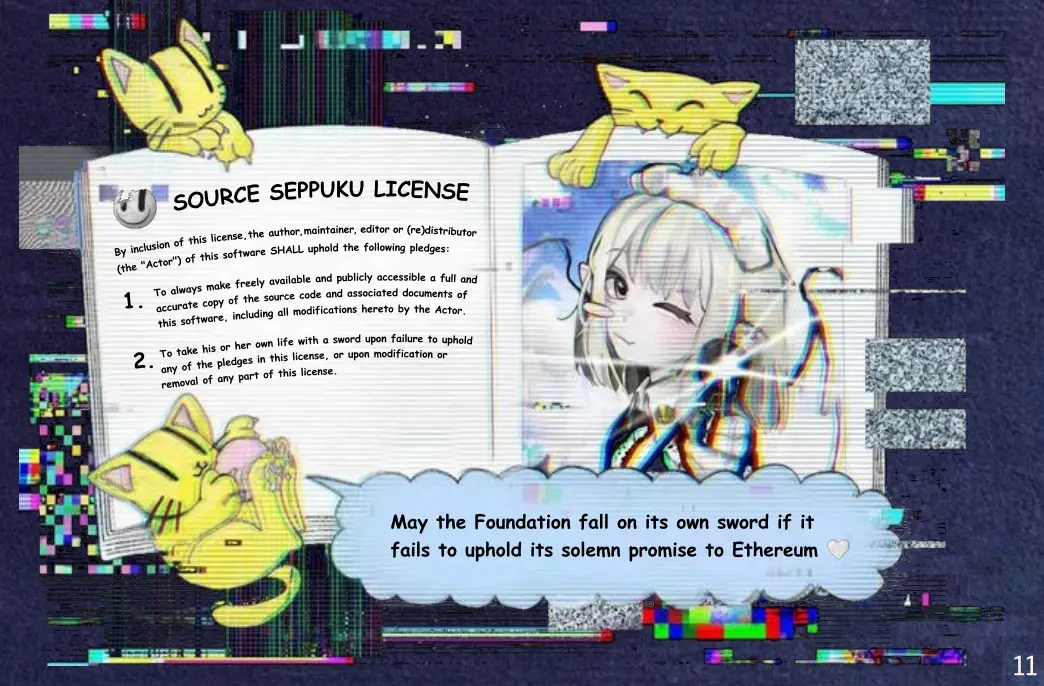
However, the execution of the statement has sparked controversy. Reportedly, the Foundation required internal employees to sign off on the statement's content, or potentially face departure or compensation adjustments. The Foundation even created a "SOURCE SEPPUKU LICENSE" meme graphic, expressing the resolve to "self-terminate" if it fails to fulfill its commitments.

This contradictory approach of "declaring an intention to step back, yet mandating loyalty signatures" became a significant catalyst for this round of departures.
Within just four months, 7 core members or senior contributors have left one after another:

  • February: Co-Executive Director Tomasz Stańczak stepped down after only 11 months in the role;
  • April: Josh Stark, deeply involved in upgrades like The Merge and Dencun, and Protocol Guild coordinator Trent Van Epps, departed;
  • May: Protocol co-leads Barnabé Monnot, Tim Beiko, Alex Stokes (on leave) as well as researcher Carl Beek (7-year tenure, led KZG ceremony and early Beacon Chain design) and Julian Ma (4-year tenure, led FOCIL and Fast Confirmation Rule) left.
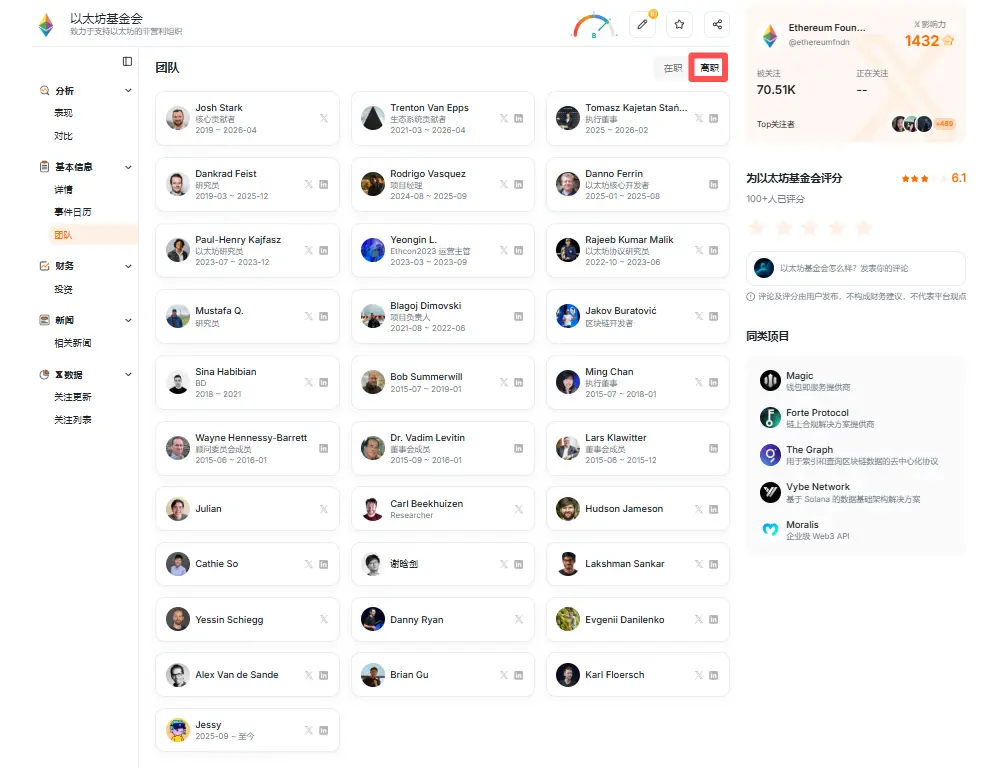
List of Ethereum Foundation Departures Source: RootData

What these people took with them is far more than just job titles; it's a wealth of tacit knowledge and intuition difficult to document. This includes the trade-offs and judgments made in past upgrades, the trust relationships between different teams, how to handle controversies during EIP proposal advancement, and the coordination skills in All Core Devs meetings that can only be understood implicitly.

Protocol Guild contributor cheeky-gorilla stated at the EthCC[9] conference that salaries for Ethereum L1 core developers are 50% to 60% lower than comparable market positions, while high-performance new chains like Monad and leading L2 projects are poaching with compensation packages over 10 times higher. He pointed out that once experienced senior researchers familiar with the underlying protocol logic are lost, key roadmap items like PeerDAS and Verkle trees face the risk of a substantive standstill.

This risk might already be materializing. The Glamsterdam upgrade, originally planned for June 2026, has seen delays. Based on the latest testnet progress and Interop meeting feedback, the actual mainnet launch is more likely to be postponed to the third quarter. The core goal of Glamsterdam is to increase the Gas limit from the current ~60 million to 200 million, a crucial step for Ethereum to enhance its mainnet competitiveness.

Recently, the EF appointed three new co-leads — Will Corcoran, Kev Wedderburn, and Fredrik Svantes — to take over the Protocol team. Their tenures at EF range from 2 to 7 years. However, trust takes time to build, coordination networks take time to rebuild, and Ethereum's upgrade pace doesn't seem to be able to wait that long.

Meanwhile, the EF recently unstaked 21,271 ETH from Lido and has repeatedly sold ETH on-chain for treasury rebalancing. Against the backdrop of personnel turmoil already raising external concerns, this series of on-chain operations has further amplified market anxiety.

Dual Pressure from External Competition and Institutional Confidence

The internal turmoil coincides with the most intense period of external competition.

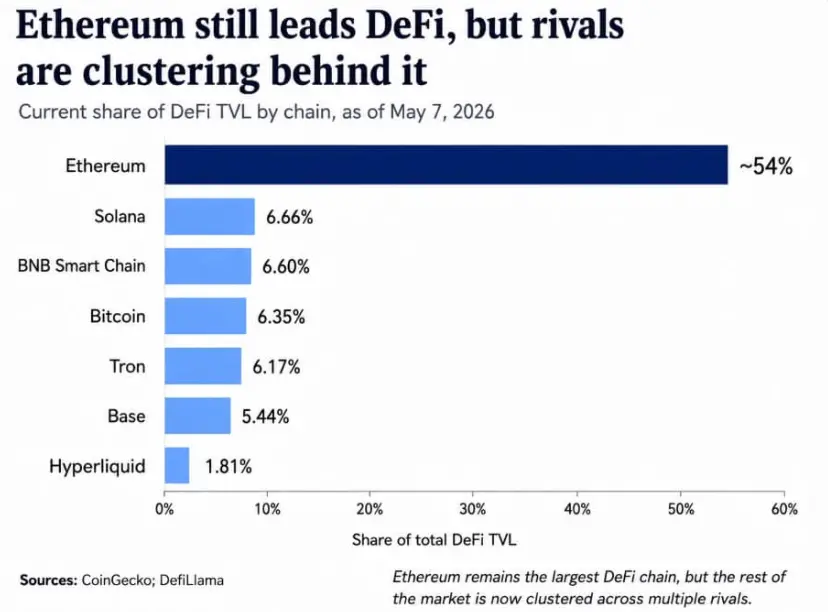
According to DefiLlama data, as of early May, Ethereum's share of Total Value Locked in DeFi has dropped from 63.5% at the beginning of 2025 to about 54% currently, hitting a near one-year low. Ethereum's DeFi TVL is approximately $45.4 billion, still significantly leading, but public chains like Solana (6.66%), BNB Chain (6.60%), Bitcoin (6.35%), Tron (6.17%), Base (5.44%), and Hyperliquid (1.81%) are gradually eroding its share.
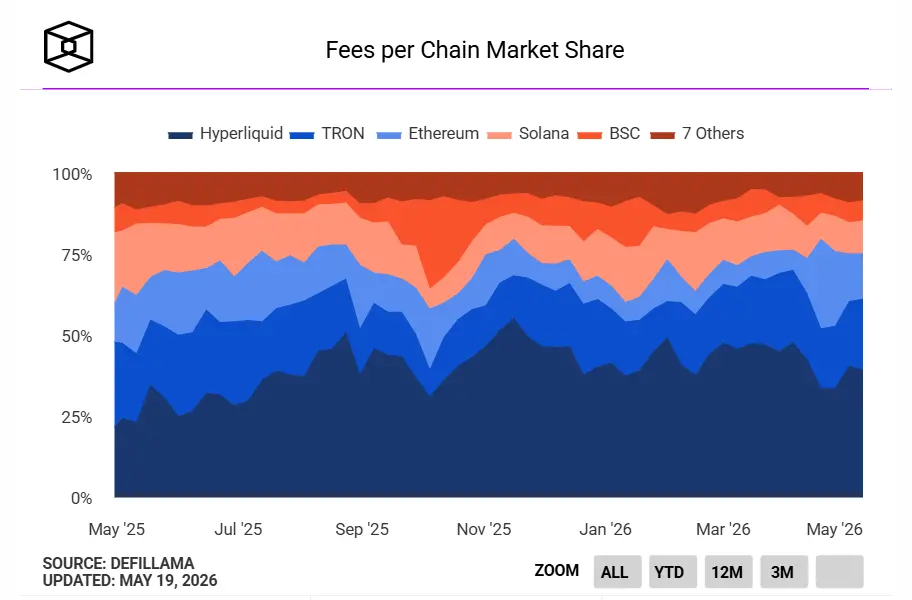
In terms of fee revenue, in the first week of May, Hyperliquid captured about 43% of the market share with approximately $11 million in fees, leading all public chains. In contrast, Ethereum's fee revenue was about $3 million, accounting for only about 13%. Solana's fee revenue was about $2 million, making up about 10%.
Regarding the RWA market, as traditional asset management institutions accelerate the push for on-chain assets, various public chains are competing for institutional issuers. The current on-chain RWA market cap exceeds $65 billion, up about 44% from around $45 billion at the beginning of the year. Among them, Ethereum currently holds about 33% market share and remains the primary deployment network for institutional tokenized assets; Provenance Blockchain accounts for about 27%, while BNB Chain, XRP Ledger, and Solana each hold about 6%.

Meanwhile, a new trend is emerging. Crypto KOL Kaylyn (@kaylyn_0x) pointed out that due to the decreasing cost and technical barriers of launching a chain, Wall Street institutions are beginning to actively explore building their own public chains or hybrid architectures to gain stronger compliance control and predictable performance. Circle's Arc public chain is a typical case; its testnet has already processed over 150 million transactions, has secured $222 million in funding from institutions like BlackRock, and its mainnet is about to launch. Its future threat to Ethereum's position as an institutional settlement layer should not be underestimated.

At the secondary market operation level, Q1 holdings reports show that Goldman Sachs significantly reduced its Ethereum exposure in the first quarter, cutting its position in BlackRock's iShares Ethereum Trust (ETHA) by about 70%, leaving only about $114 million. The Harvard University Endowment Fund completely liquidated its previously purchased nearly $87 million in Ethereum ETF holdings.

Additionally, Korea's seventh-largest pension relief company, Bumo Sarang, invested 59.5 billion won of operating funds last year into the daily double-return leveraged ETF of Ethereum-themed stock Bitmine, incurring a loss of 49.3 billion won (approximately $32.73 million).

These actions may reflect that some traditional institutions are losing patience with Ethereum's short-term returns and long-term stability.

Conclusion

Multiple signals collectively point to Ethereum's current core challenge: a dual lag in execution capability and narrative appeal regarding its positioning as an institution-grade mature infrastructure.

In his speech at the Hong Kong Web3 Carnival, Vitalik Buterin clearly stated that Ethereum is not competing on speed, but aims to be the most secure and decentralized "world computer" and "technical safe haven." His latest lengthy article further elaborates that AI-assisted formal verification is the core of Ethereum's next stage, with the goal of making Ethereum a "safety kernel" whose security can be mathematically proven.

This vision is clear, and the technical path is credible. But realizing the vision requires stable coordination capabilities and continuous accumulation of experience — it's just that precisely during this most critical window, these two things are rapidly diminishing.


Пов'язані питання

QWhat is the direct trigger for the recent wave of departures at the Ethereum Foundation according to the article?

AThe direct trigger is the Ethereum Foundation's new 38-page mission manifesto released in March. It introduced a 'walkaway test' and required internal staff to sign it, creating a perceived contradiction between announcing a reduced role and demanding formal agreement.

QHow has the competitive landscape for Ethereum changed in the DeFi space, according to the data mentioned?

AAs of early May, Ethereum's share of the total DeFi Total Value Locked (TVL) has dropped to about 54% from 63.5% at the start of 2025. Competitors like Solana, BNB Chain, Bitcoin, Tron, Base, and Hyperliquid are gradually gaining market share.

QWhat is the Glamsterdam upgrade, and why is its potential delay concerning?

AGlamsterdam is a key upgrade aimed at increasing Ethereum's gas limit from about 60 million to 200 million, a crucial step for improving the mainnet's competitiveness. Its potential delay from a planned June 2026 pushback to Q3 highlights the impact of losing experienced core developers on the project's roadmap execution.

QWhat new trend regarding blockchain infrastructure is emerging among traditional financial institutions, as mentioned in the article?

AWall Street institutions are beginning to explore building their own public or hybrid blockchains to gain greater compliance control and predictable performance. The article cites Circle's Arc blockchain, backed by BlackRock, as a prime example of this trend that could threaten Ethereum's role in institutional settlement.

QWhat is Vitalik Buterin's stated long-term vision for Ethereum's role, as mentioned in the conclusion?

AVitalik Buterin envisions Ethereum not competing on speed, but as the most secure and decentralized 'world computer' and 'technical safe haven'. He emphasizes that the next phase focuses on AI-assisted formal verification to make Ethereum a mathematically provably secure 'safe core'.

Пов'язані матеріали

Anthropic's IPO Launch: Commercial Miracle or Valuation Bubble?

Anthropic has confidentially filed for an IPO, led by Morgan Stanley and Goldman Sachs, potentially going public by October. Following its latest $650 billion funding round, its pre-IPO valuation stands at $965 billion, with projections reaching up to $2 trillion at listing, which would make it the highest-valued private company ever. The article, written by Fu Sheng, addresses skepticism that this represents an AI bubble akin to the 2000 dot-com crash. It argues the current situation differs fundamentally. Unlike the internet bubble era, which relied on speculative narratives with little revenue, Anthropic's valuation is backed by unprecedented, measurable financial performance. Key data points include: * **Revenue Growth:** ARR skyrocketed from $10 billion in early 2025 to $470 billion by May 2026, targeting $100 billion by year-end—a growth curve unmatched in business history. * **Profitability:** It achieved operating profitability in Q2 2026 with an estimated $5.6 billion profit. * **Efficiency:** With ~3,000 employees and ~$470 billion ARR, its revenue per employee exceeds $10 million. Products like Claude Code, launched less than a year ago, already generate $25 billion in annualized revenue. * **Enterprise Adoption:** It boasts a strong enterprise client base, with 8 of the Fortune 10 and over 1,000 large firms spending over $1 million annually on Claude. The valuation is framed using a traditional SaaS model (e.g., a 10x Price-to-Sales multiple on $100 billion revenue). The author contends the core question for analysts has shifted from "How big could this be?" to "How much is it earning and will earn next quarter?" The discussion extends beyond Anthropic to a broader paradigm shift: the transition from a "carbon-based" to a "silicon-based" economy. Companies are increasingly prioritizing investment in compute and AI capabilities over human resources, as these directly scale productivity and competitive advantage. Anthropic's IPO is thus positioned not just as a corporate milestone, but as a price anchor for this new economic era.

链捕手1 год тому

Anthropic's IPO Launch: Commercial Miracle or Valuation Bubble?

链捕手1 год тому

Near Returns to the AI Stage: Transformation into a Public Chain Due to 'Payroll Difficulties,' Agent and Privacy Emerge as New Growth Narratives

NEAR Returns to AI Origins: From Payroll Struggles to Blockchain, Now Focusing on AI Agents and Privacy NEAR Protocol's journey began not with grand blockchain ambitions, but from a practical hurdle: its AI startup founders, including Transformer paper co-author Illia Polosukhin, couldn't efficiently pay international developers in 2017. This led them to pivot and build a high-performance, scalable blockchain. After years navigating various crypto narratives like sharding and cross-chain interoperability, NEAR is now leveraging its AI roots to re-enter the AI arena. A key driver is its "NEAR Intents" layer, which abstracts complex cross-chain transactions. Users simply state their goal (e.g., swap BTC for ETH), and a solver network finds the optimal route. This system has processed over $20B in cross-chain volume, generating significant fee revenue. A major growth area is private transactions via "Confidential Intents/Swaps," which hide trade details until settlement to protect against MEV and front-running. Remarkably, private swaps recently accounted for over 40% of NEAR's transaction volume, highlighting strong demand but also potential regulatory scrutiny. With its AI-founder pedigree, NEAR is positioning itself at the intersection of blockchain, AI agents, and privacy, aiming to become infrastructure for the emerging agent economy while navigating the challenges of its rapid adoption.

marsbit4 год тому

Near Returns to the AI Stage: Transformation into a Public Chain Due to 'Payroll Difficulties,' Agent and Privacy Emerge as New Growth Narratives

marsbit4 год тому

From Ethereum to AI's 'CROPS': What Exactly is This Set of 'Slow Variables' That Vitalik Repeatedly Emphasizes?

In recent discussions, Vitalik Buterin has frequently emphasized the concept of "CROPS," a framework defining core values for Ethereum's development. CROPS stands for Censorship Resistance, Capture Resistance, Open Source, Privacy, and Security. Initially outlined in the Ethereum Foundation's "EF Mandate," it represents a commitment to user sovereignty, ensuring that the network resists external control, remains open, protects privacy, and prioritizes security. The relevance of CROPS extends beyond Ethereum's foundational principles, becoming crucial in the context of AI integration. As AI agents begin handling wallet operations and automated transactions, the risk increases that users may cede control over their digital assets, privacy, and intentions to centralized AI service providers. A "CROPS AI" would therefore emphasize local execution where possible, privacy-preserving remote model calls (e.g., using zero-knowledge proofs), and transparent, verifiable processes to maintain user agency. Vitalik highlights a significant convergence between "CROPS Ethereum access layer" and "CROPS AI." Both address the same fundamental challenge: how users can access powerful services—be it blockchain data via RPCs or AI models—without exposing sensitive information or relinquishing ultimate control. This intersection points toward a future digital entry point that is more private, secure, and user-controlled. Ultimately, CROPS is not merely an abstract ideal but a practical guidepost. It steers development—from protocol resilience and wallet design to AI agent safety—towards a future where users retain self-sovereignty even as digital systems grow more complex and powerful. In an era of accelerating AI adoption, these "slow variables" of censorship resistance, openness, privacy, and security may define Ethereum's enduring value.

marsbit4 год тому

From Ethereum to AI's 'CROPS': What Exactly is This Set of 'Slow Variables' That Vitalik Repeatedly Emphasizes?

marsbit4 год тому

Торгівля

Спот
Ф'ючерси

Популярні статті

Як купити CORE

Ласкаво просимо до HTX.com! Ми зробили покупку CORE (CORE) простою та зручною. Дотримуйтесь нашої покрокової інструкції, щоб розпочати свою криптовалютну подорож.Крок 1: Створіть обліковий запис на HTXВикористовуйте свою електронну пошту або номер телефону, щоб зареєструвати обліковий запис на HTX безплатно. Пройдіть безпроблемну реєстрацію й отримайте доступ до всіх функцій.ЗареєструватисьКрок 2: Перейдіть до розділу Купити крипту і виберіть спосіб оплатиКредитна/дебетова картка: використовуйте вашу картку Visa або Mastercard, щоб миттєво купити CORE (CORE).Баланс: використовуйте кошти з балансу вашого рахунку HTX для безперешкодної торгівлі.Треті особи: ми додали популярні способи оплати, такі як Google Pay та Apple Pay, щоб підвищити зручність.P2P: Торгуйте безпосередньо з іншими користувачами на HTX.Позабіржова торгівля (OTC): ми пропонуємо індивідуальні послуги та конкурентні обмінні курси для трейдерів.Крок 3: Зберігайте свої CORE (CORE)Після придбання CORE (CORE) збережіть його у своєму обліковому записі на HTX. Крім того, ви можете відправити його в інше місце за допомогою блокчейн-переказу або використовувати його для торгівлі іншими криптовалютами.Крок 4: Торгівля CORE (CORE)Легко торгуйте CORE (CORE) на спотовому ринку HTX. Просто увійдіть до свого облікового запису, виберіть торгову пару, укладайте угоди та спостерігайте за ними в режимі реального часу. Ми пропонуємо зручний досвід як для початківців, так і для досвідчених трейдерів.

239 переглядів усьогоОпубліковано 2024.12.13Оновлено 2026.06.02

Як купити CORE

Обговорення

Ласкаво просимо до спільноти HTX. Тут ви можете бути в курсі останніх подій розвитку платформи та отримати доступ до професійної ринкової інформації. Нижче представлені думки користувачів щодо ціни CORE (CORE).

活动图片












