Hands-On Guide to Participating in CZ-Supported predict.fun

Odaily星球日报Опубліковано о 2025-12-19Востаннє оновлено о 2025-12-19

Анотація

Odaily Planet Daily introduces predict.fun, a prediction market platform founded by dingaling, a former Binance employee, and backed by CZ and YZi Labs. Launched on December 17, the platform airdropped initial points to eligible users, including BNB Chain meme traders and Aster participants. Unlike traditional prediction markets like Polymarket, predict.fun allows users to earn additional yield on funds used for predictions. The step-by-step guide includes: registering on the website, checking airdrop eligibility by wallet address, depositing at least $10 to unlock a referral link, sharing the invite on Twitter, verifying the tweet, and trading to unlock points (e.g., $500 trading volume for 200 points). Only event betting counts toward trading volume. The platform emphasizes user engagement and integrated yield generation.

Original | Odaily Planet Daily (@OdailyChina)

Author | Asher (@Asher_ 0210)
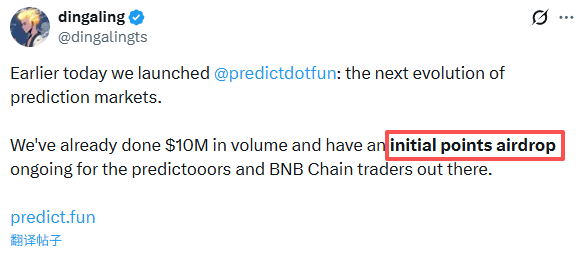
On December 17, dingaling, the founder of the prediction market platform predict.fun, announced on X that the platform is officially open and has airdropped initial points to Meme traders on BNB Chain, Aster participants, and active users of various prediction markets.
Unlike traditional prediction markets such as Polymarket and Kalshi, predict.fun has introduced a key innovation: funds used for predictions are no longer idle but can simultaneously generate additional returns during the prediction period.

It is worth mentioning that on December 4, Binance founder CZ posted on X, stating that the founder of predict.fun had worked at Binance several years ago and that the project was incubated by YZi Labs and received "investment" (for more details, read: CZ Reconciles and Joins Forces, dingaling Returns to the Prediction Trend with predict.fun).

Next, Odaily Planet Daily will guide you step-by-step through the interactive experience of participating in predict.fun.

Step-by-Step Participation Tutorial

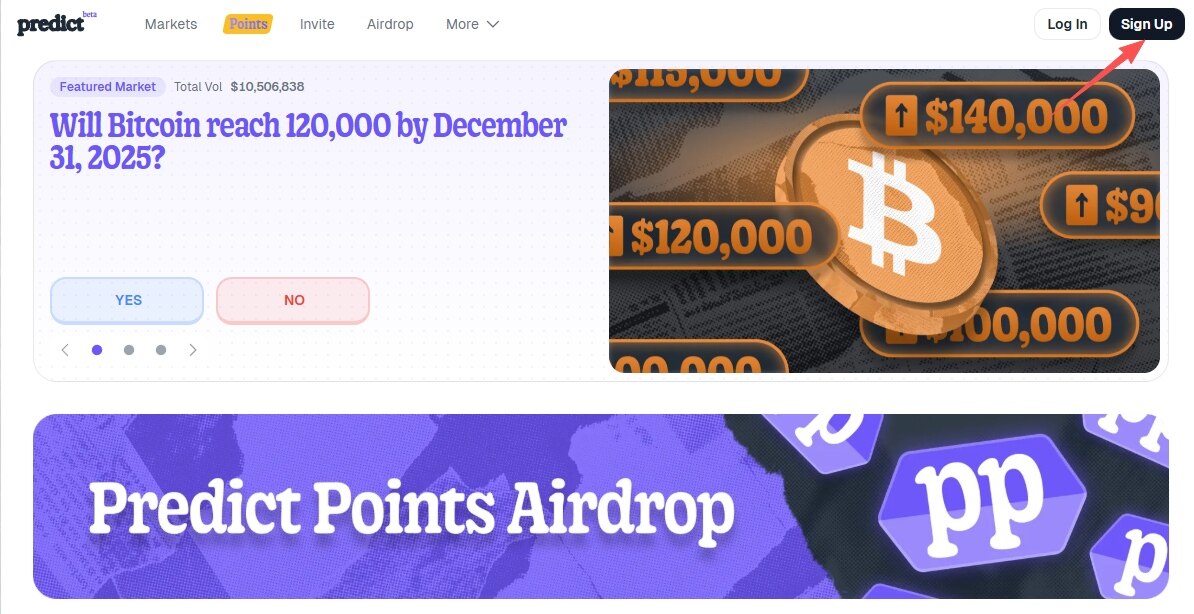
STEP 1. After logging into the project’s official website (link: https://predict.fun/), first-time users should click "Sign Up" to register and log in.
STEP 2. Click on "Airdrop" at the top to check airdrop eligibility: on the page, click "Check Wallet Eligibility" and enter your wallet address to view (as shown in the prompt below, indicating eligibility).
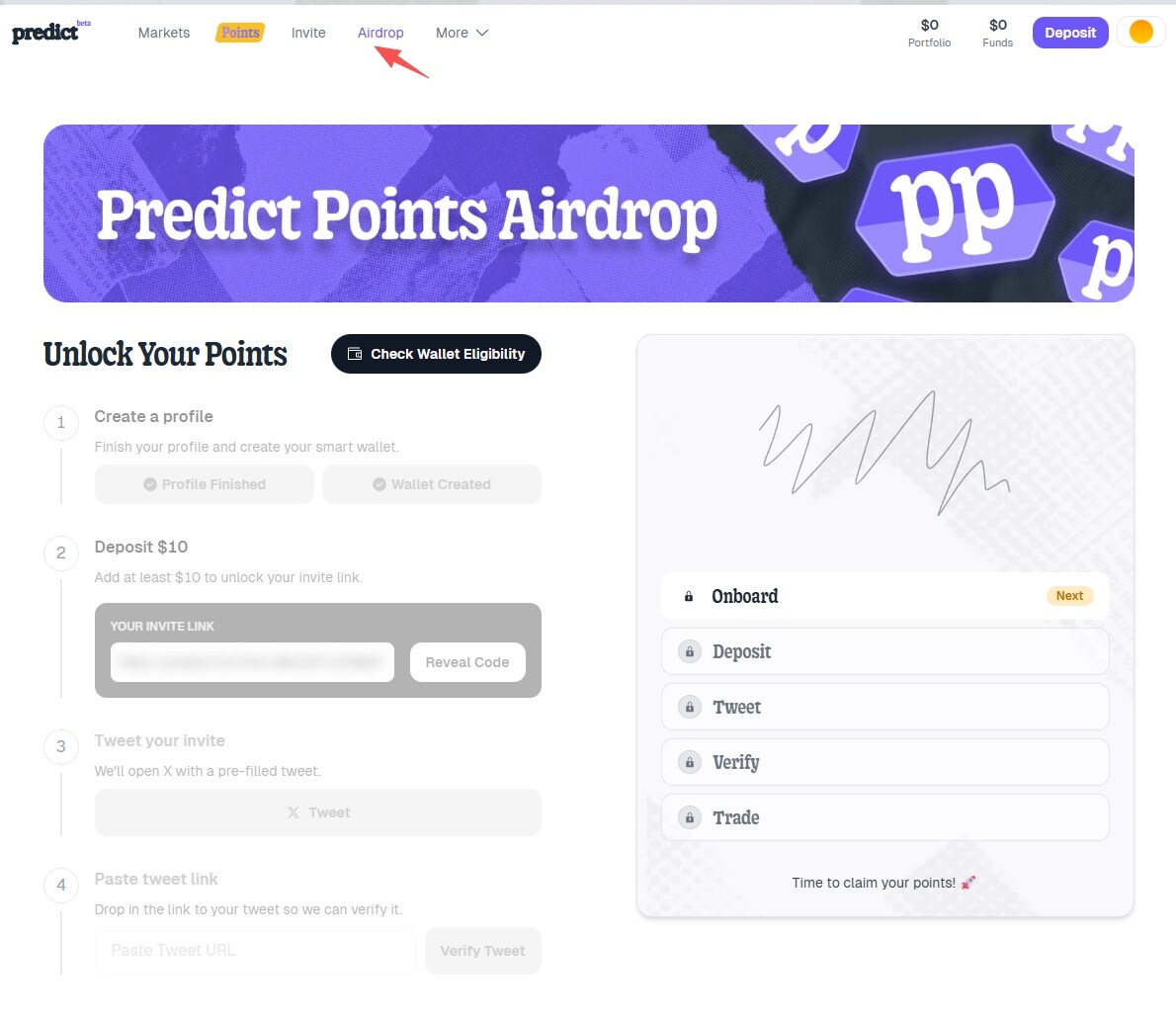
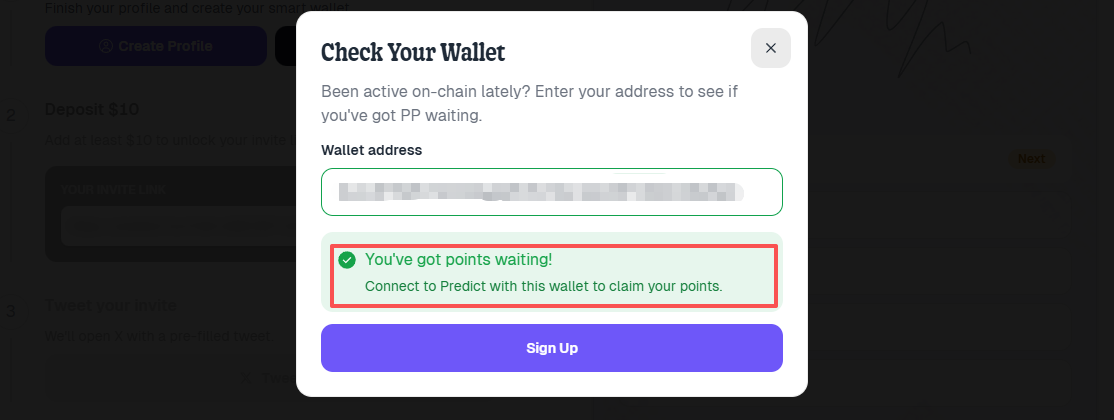
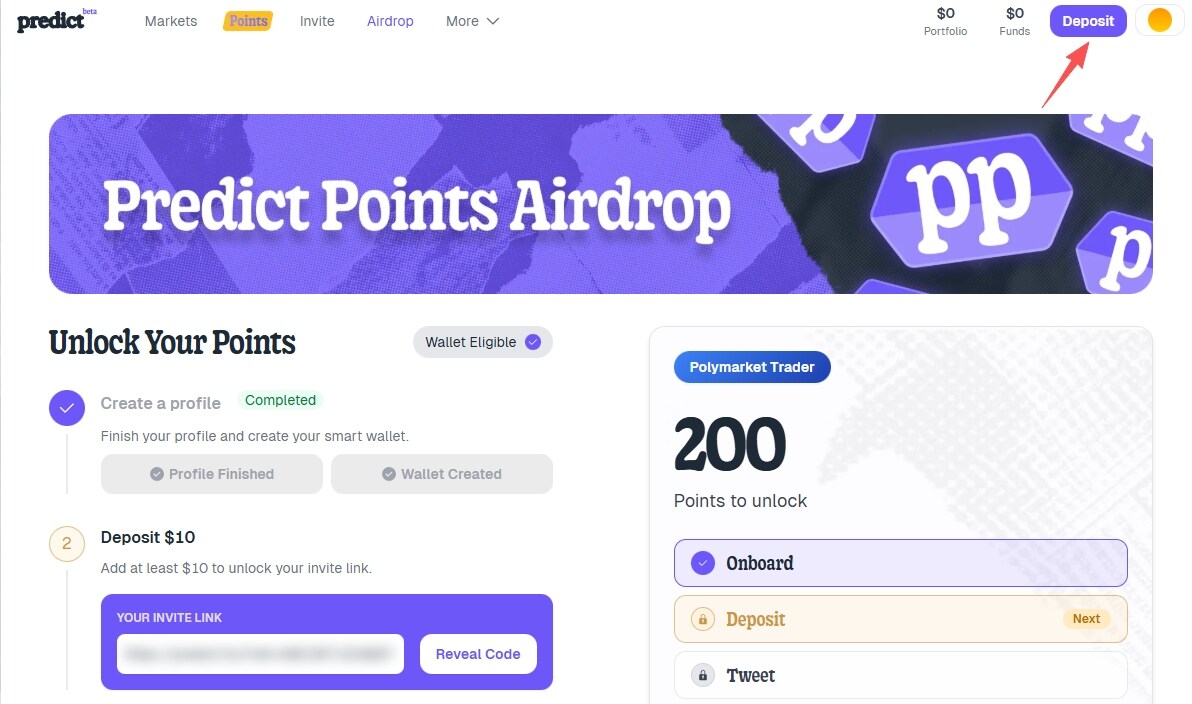
STEP 3. If eligible, click on "Deposit" at the top to deposit at least $10 into the platform and unlock your personal referral link.
STEP 4. Click "Tweet" in step 3 to share the referral tweet. The system will automatically generate a personal referral tweet, or you can edit the content yourself.
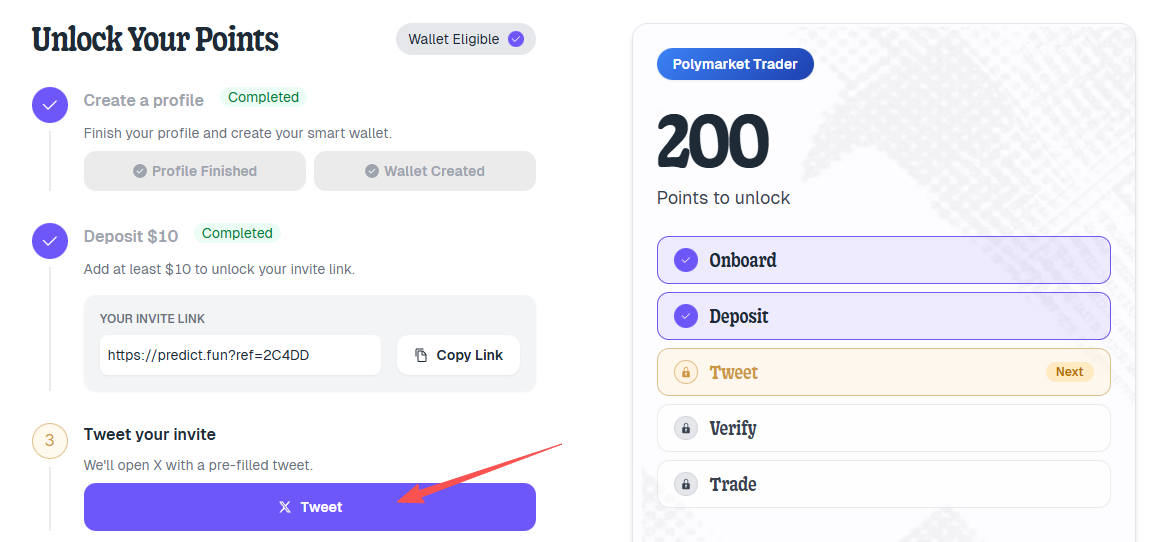
STEP 5. Fill in the link to the published referral tweet and click "Verify Tweet" to complete verification.

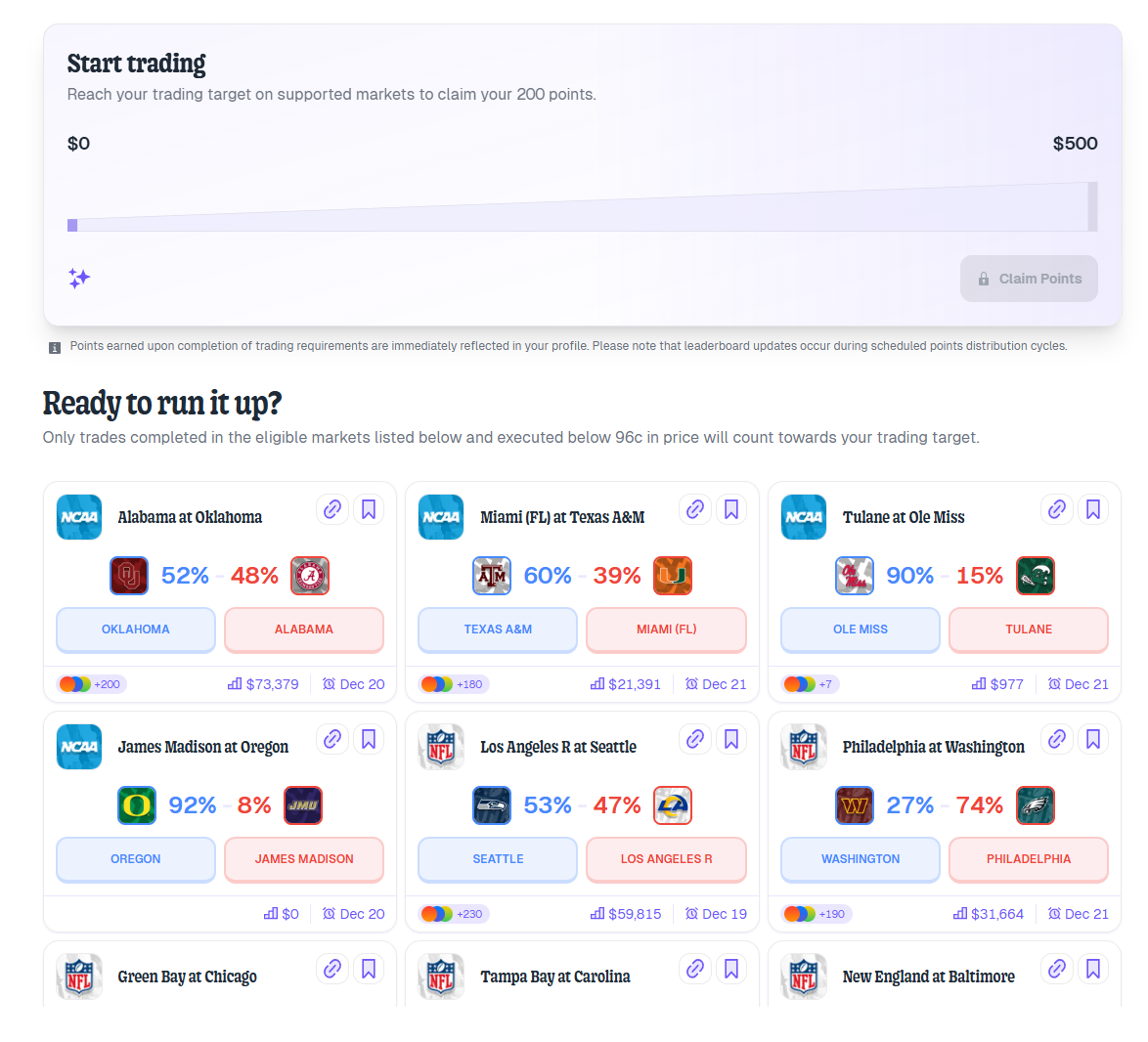
STEP 6. Unlock personal points by trading on the platform. As shown in the image, the account needs to complete $500 in trading volume to unlock 200 points. Note that only event-based bets count as valid trades.
Трендові криптовалюти

Пов'язані питання

QWhat is the key innovation of predict.fun compared to traditional prediction markets like Polymarket and Kalshi?

Apredict.fun allows users' funds to generate additional yields during the prediction period, unlike traditional platforms where funds remain idle.

QWho is the official launch of predict.fun announced by on X platform?

AThe official launch was announced by predict.fun's founder, dingaling, on the X platform.

QWhat is the minimum deposit required to unlock a personal referral link on predict.fun?

AA minimum deposit of at least $10 is required to unlock the personal referral link.

QWhich user groups received the initial airdrop of points from predict.fun?

AThe initial points airdrop was distributed to Meme traders on BNB Chain, Aster participants, and active users of various prediction markets.

QWhat is the relationship between CZ and predict.fun's founder as mentioned in the article?

ACZ mentioned that predict.fun's founder previously worked at Binance several years ago, and the project is incubated and invested in by YZi Labs.

Пов'язані матеріали

Who Decides the Rules of Bitcoin? BIP-110 Ignites Governance Debate

Bitcoin's governance is once again at the center of a heated debate, this time ignited by BIP-110, the "Reduced Data Temporary Softfork." This proposal aims to curb non-monetary data (like inscriptions and Runes) by introducing seven new consensus-layer restrictions over a year, such as limiting new output scripts to 34 bytes and restoring the OP_RETURN cap to 83 bytes. The controversy stems from BIP-110's fundamental shift: it moves the battle against "spam" from node relay and miner policies to the consensus layer, rendering currently valid transactions invalid. Supporters, arguing that default policy governance has failed (highlighted by Bitcoin Core v30's relaxation of OP_RETURN limits), see this as necessary to protect node resources and Bitcoin's monetary focus. Opponents, led by figures like Michael Saylor and Adam Back, warn it dangerously centralizes governance. Saylor listed 110 reasons against it, criticizing its low 55% miner activation threshold and potential for chain splits. Back emphasized Bitcoin's "permissionless" ethos, arguing no single group should impose value judgments via consensus rules. Further complicating matters, technical critiques suggest BIP-110 may be technically circumventable, and a "BlockSlop" vulnerability in its upgrade path poses a consensus risk. The debate has drawn in diverse stakeholders: miners (with pools like Ocean signaling support and Foundry polling clients), node operators (like Bitcoin Knots), and new players like corporate treasury holder MicroStrategy (Saylor), whose market influence adds a novel dimension. Ultimately, BIP-110 acts as a governance stress test, exposing the unresolved question: who decides Bitcoin's rules? It pits the authority of miners, node operators, developers, and capital holders against each other, with each side claiming to defend Bitcoin's core principles of neutrality and security.

marsbit5 хв тому

Who Decides the Rules of Bitcoin? BIP-110 Ignites Governance Debate

marsbit5 хв тому

Who Decides Bitcoin's Rules? BIP-110 Ignites Governance Debate

Title: Who Decides Bitcoin's Rules? BIP-110 Ignites Governance Debate A new technical proposal, BIP-110 (Reduced Data Temporary Softfork), has sparked a fundamental governance debate within the Bitcoin community. It aims to impose new consensus rules for one year to limit non-financial data (like inscriptions and Runes) on-chain, moving beyond simple node and miner policy filters to invalidate currently valid transactions. Supporters argue that default policies have failed due to workarounds, necessitating consensus-layer changes to protect Bitcoin's core monetary function from data spam. Critics, including Michael Saylor and Adam Back, contend this dangerously centralizes judgment, undermines permissionlessness, and sets a risky governance precedent. They advocate for market-based solutions like fees or Layer 2s instead. The debate exposes deeper tensions: miners are divided on activation; node operators assert their sovereignty; Bitcoin Core developers influence defaults without direct accountability; and large corporate holders like MicroStrategy now wield narrative influence. Technically, BIP-110 may not fully block data and carries a disclosed consensus bug risk. Ultimately, BIP-110 acts as a stress test, forcing the community to confront the unresolved question: who legitimately decides what Bitcoin is and how it evolves, amidst competing claims from miners, nodes, developers, and capital holders.

链捕手17 хв тому

Who Decides Bitcoin's Rules? BIP-110 Ignites Governance Debate

链捕手17 хв тому

Zcash's New Node Zakura Goes Live: Privacy Payments Can Reach 50,000 TPS, Aiming to Rival Visa and Mastercard

Zcash, a privacy-focused cryptocurrency, has launched a new full node software called Zakura version 1.0.0. Developed by Zcash co-founder Sean Bowe and Dev Ojha, with private ZEC donations, its goal is to enable Zcash to process over 50,000 transactions per second (TPS)—matching the scale of Visa and Mastercard—while maintaining full transaction privacy and verifiability. This addresses a key bottleneck, as Zcash currently handles only about 1 private transaction per second. Zakura is a fork of the Zcash Foundation's Zebra node. It features chain pruning and snapshots, reducing disk usage and allowing new nodes to sync in under two minutes. It also offers compatibility with the legacy `zcashd` client interface. The scalability challenge stems from the large data size of privacy proofs. Bowe's Tachyon project aims to use recursive proofs to reduce consensus-layer data needs from ~500 MB/s to ~100 MB/s. For wallet scalability, Valar Group is researching Private Information Retrieval (PIR) tech to allow wallets to fetch their data privately. Zakura supports fast block propagation and the upcoming "Ironwood" network upgrade (NU6.3), scheduled for activation around July 28th. Ironwood was created to contain a critical inflation bug discovered in the Orchard shielded pool in May 2024. The fix uses "turnstiles" to trap any counterfeit ZEC created during the vulnerability period within the shielded pool, preventing it from entering circulation and restoring supply integrity.

marsbit32 хв тому

Zcash's New Node Zakura Goes Live: Privacy Payments Can Reach 50,000 TPS, Aiming to Rival Visa and Mastercard

marsbit32 хв тому

Replicating the "DeepSeek Moment"? Wall Street Unanimously Says: Kimi K3 Instead Strengthens Computing Power Demand

Title: Wall Street Sees Kimi K3 as a Catalyst for Compute Demand, Not a "DeepSeek Moment 2.0" Summary: Following the release of Moonshot AI's powerful open-source model Kimi K3, initial market reaction mirrored the "DeepSeek moment" that sparked a sell-off in compute stocks earlier in 2025, fearing reduced demand for AI infrastructure. However, major Wall Street banks including UBS, Nomura, BofA, and Citi argue the opposite: K3 will accelerate, not weaken, demand for compute, memory, storage, and networking. Their analysis centers on K3's specifications—2.8 trillion parameters, 1M token context, and MoE architecture—which represent a "scale" story rather than a pure "efficiency" one like DeepSeek R1. These features increase pressure on inference, memory (especially KV cache), and storage. Analysts invoke Jevons Paradox: as high-quality models become more affordable (K3 is cheaper than top closed models but not the cheapest), usage and token volumes expand, ultimately increasing total compute consumption. The reports highlight that competition will force leading US AI labs (OpenAI, Anthropic, Google) to invest more in training and iteration to maintain their edge. Furthermore, the rise of capable open-source models like K3 is expanding the global AI developer ecosystem, with Chinese models now accounting for over 45% of developer traffic. Key beneficiaries identified across the AI infrastructure chain include memory/storage players (e.g., Micron, Samsung), compute leaders (Nvidia, TSMC), networking suppliers (due to "super-node" cluster needs for deploying K3), and cloud platforms (e.g., Alibaba) that host diverse model ecosystems. The consensus is that stronger open-source models are an entry point for the next wave of infrastructure demand diffusion, provided workload growth outpaces efficiency gains.

链捕手35 хв тому

Replicating the "DeepSeek Moment"? Wall Street Unanimously Says: Kimi K3 Instead Strengthens Computing Power Demand

链捕手35 хв тому

Торгівля

Спот

Популярні статті

Як купити FUN

Ласкаво просимо до HTX.com! Ми зробили покупку FUNTOKEN (FUN) простою та зручною. Дотримуйтесь нашої покрокової інструкції, щоб розпочати свою криптовалютну подорож.Крок 1: Створіть обліковий запис на HTXВикористовуйте свою електронну пошту або номер телефону, щоб зареєструвати обліковий запис на HTX безплатно. Пройдіть безпроблемну реєстрацію й отримайте доступ до всіх функцій.ЗареєструватисьКрок 2: Перейдіть до розділу Купити крипту і виберіть спосіб оплатиКредитна/дебетова картка: використовуйте вашу картку Visa або Mastercard, щоб миттєво купити FUNTOKEN (FUN).Баланс: використовуйте кошти з балансу вашого рахунку HTX для безперешкодної торгівлі.Треті особи: ми додали популярні способи оплати, такі як Google Pay та Apple Pay, щоб підвищити зручність.P2P: Торгуйте безпосередньо з іншими користувачами на HTX.Позабіржова торгівля (OTC): ми пропонуємо індивідуальні послуги та конкурентні обмінні курси для трейдерів.Крок 3: Зберігайте свої FUNTOKEN (FUN)Після придбання FUNTOKEN (FUN) збережіть його у своєму обліковому записі на HTX. Крім того, ви можете відправити його в інше місце за допомогою блокчейн-переказу або використовувати його для торгівлі іншими криптовалютами.Крок 4: Торгівля FUNTOKEN (FUN)Легко торгуйте FUNTOKEN (FUN) на спотовому ринку HTX. Просто увійдіть до свого облікового запису, виберіть торгову пару, укладайте угоди та спостерігайте за ними в режимі реального часу. Ми пропонуємо зручний досвід як для початківців, так і для досвідчених трейдерів.

282 переглядів усьогоОпубліковано 2025.06.25Оновлено 2026.06.02

Як купити FUN

Обговорення

Ласкаво просимо до спільноти HTX. Тут ви можете бути в курсі останніх подій розвитку платформи та отримати доступ до професійної ринкової інформації. Нижче представлені думки користувачів щодо ціни FUN (FUN).

活动图片