Hacker Attack Halves Flow, Rollback Plan Sparks Civil War in Ecosystem

marsbitОпубліковано о 2025-12-29Востаннє оновлено о 2025-12-29

Анотація

Flow, a Layer 1 blockchain built by Dapper Labs, suffered a major security breach last Saturday when a hacker exploited an execution layer vulnerability, transferring approximately $3.9 million in assets off-chain. The attack caused the price of FLOW to plummet by over 50%, dropping from $0.173 to $0.079, though it later partially recovered to around $0.107. Initially, the Flow Foundation proposed rolling back the network to a checkpoint before the attack occurred, which would have erased all transactions within a six-hour window. This decision was met with strong opposition from ecosystem partners, especially cross-chain bridges like deBridge and LayerZero, who warned that a rollback could cause asset duplication, inconsistencies, and significant losses for legitimate users. Facing community backlash and partner concerns, the foundation abandoned the rollback plan. Instead, it adopted an "Isolation Recovery Plan" developed in coordination with key partners. The new strategy involves no chain reorganization, preserves all legitimate user transactions, and temporarily restricts accounts that received illicitly minted tokens. The network will be restored in multiple stages, with full functionality expected within 24 to 48 hours. The incident has raised questions about network reliability and governance, shifting the crisis from a technical issue to a broader challenge of trust in Flow's decentralized integrity.

Author | Asher(@Asher_ 0210)
Last Saturday afternoon, a sudden hacker attack threw the Flow network into chaos. This Layer 1 network, built by the Dapper Labs team and tailored for the next generation of applications, games, and digital assets, watched helplessly as assets worth $3.9 million were transferred off-chain by exploiting an execution layer vulnerability. Following the attack, its token FLOW was halved in a short time, plummeting from $0.173 to $0.079, and has since rebounded slightly to around $0.107.
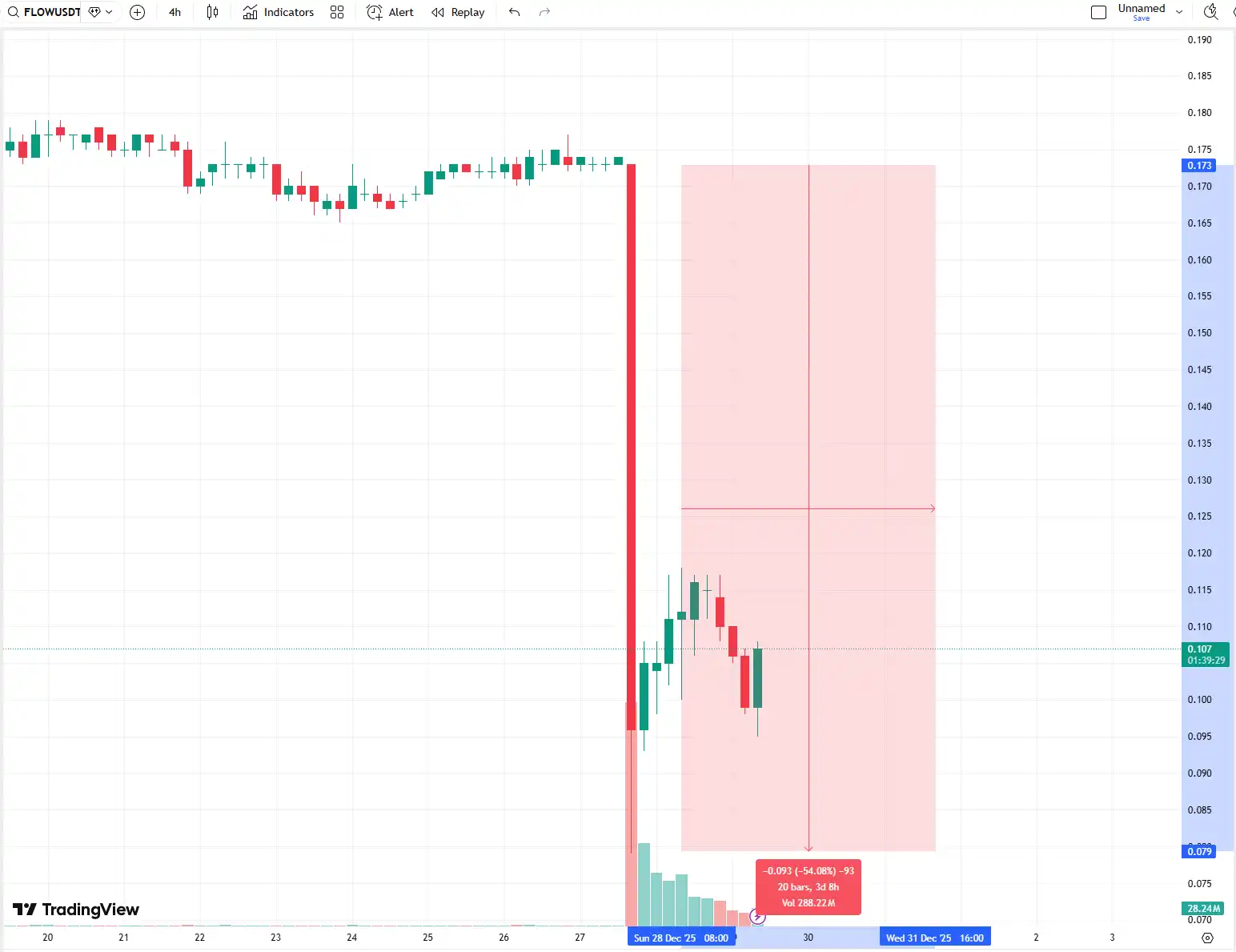
FLOW K-Line Chart

Below, Odaily Planet Daily breaks down this Flow theft incident, the official response, and why it has drawn strong skepticism from Flow's partners and community.

Flow Official Emergency Response: Isolate Network and Announce Rollback Plan

After the attack, the Flow Foundation quickly responded and confirmed the details of the incident. The attacker exploited an execution layer vulnerability to transfer approximately $3.9 million in assets; the incident did not affect users' existing balances, and user deposits remain safe. The relevant attack addresses have been marked, and money laundering paths are being continuously tracked. The Foundation has submitted asset freeze requests to Circle, Tether, and several major exchanges.

To clean up illegal on-chain transactions and fix the vulnerability, the Flow Foundation isolated the network and released a patched version of the mainnet, Mainnet 28. The Foundation's initial proposed solution was to roll back the network state to a checkpoint before the attack, specifically to Cadence block height 137363395, thereby deleting all transaction records generated within approximately 6 hours. All transactions, whether legitimate or not, would be erased together, and users would need to resubmit transactions after node restarts. The Foundation believed this plan was the safest path to restore network integrity, repeatedly emphasized that user funds would not be affected throughout the process, and promised to provide external updates on the incident's progress every two hours.

This rollback decision, seemingly decisive, quickly ignited an ecological firestorm—because the hacker's funds had already been bridged off-chain, the rollback would not affect the attacker but would only impact honest users and partners.

Cross-Chain Bridge Partners, Community Users Strongly Oppose, Rollback Plan Heavily Criticized

After the rollback plan was announced, cross-chain bridge partners within the Flow ecosystem and community users quickly faced collective skepticism. Alex Smirnov, co-founder of deBridge, a major cross-chain bridge partner of Flow, publicly criticized the decision on platform X as too hasty and made without any communication with key bridge partners beforehand. As a crucial asset channel for the Flow ecosystem, deBridge did not receive any advance notice regarding the rollback.

Smirnov pointed out that the potential damage from a rollback could far exceed that of the initial hacker attack itself. Since cross-chain assets are already circulated across multiple systems, a forced rollback would cause serious issues such as asset duplication and inconsistent custody states, ultimately harming the bridges, users, and counterparties who operated normally during the window. He disclosed that approximately $200,000 and $50,000 in deposits on deBridge fell within the rollback time window; once the rollback is executed, it could lead to funds disappearing on one side or the extreme scenario of assets being minted repeatedly.

Based on these risks, Smirnov called on Flow validators to suspend block production and validation until compensation plans, partner coordination mechanisms, and independent security team intervention plans are all clarified. Similar issues are not isolated cases. As the main cross-chain custodian for USDC on the Flow network, LayerZero also faces risks with approximately $220,000 and $180,000 in cross-chain transactions falling within the rollback window.

Beyond cross-chain bridge partners within the Flow ecosystem, users on platform X began to集中 express concerns about fund safety, developers questioned the network's reliability and governance mechanisms in extreme situations, investor sentiment turned cautious, and selling pressure intensified accordingly. Many voices pointed out that the rollback itself exposed the reality of centralized control on the chain, rapidly turning a technical accident into a crisis of trust.

Some community views further targeted the core principles of blockchain. Some argued that the rollback directly shook transaction finality and immutability, making Flow resemble an alliance chain subject to administrative intervention at critical moments. Others compared it to historical security incidents on other public chains, noting that similar situations are usually handled by isolating attacker addresses and freezing fund flows, rather than performing a global rollback of the entire network state.

Crypto KOL Wazz(@WazzCrypto) stated bluntly on platform X that Flow's rollback decision was one of the worst handling methods he had ever seen. In his view, the attacker had already transferred nearly $4 million in assets off-chain and would hardly be substantively affected by the rollback; the real cost would be borne by innocent users who used the network normally via cross-chain bridges.

Flow Official Changes Stance: Abandons Rollback, Adopts Isolated Recovery New Plan

Facing strong opposition from partners and the community, the Flow official ultimately decided to abandon the network rollback and shift to an "Isolated Recovery Plan." This plan was developed through direct consultation with cross-chain bridges, exchanges, and infrastructure partners. Key points include:

  • No rollback/reorganization, preserving all legitimate user activity;
  • No need for partners to replay transactions;
  • Over 99.9% of accounts unaffected, normal operation upon restart;
  • Temporary restriction of accounts receiving illegally minted tokens upon restart;

Additionally, the network will be restored in phases:

  • Phase 1: Cadence environment goes online, EVM temporarily restricted;
  • Phase 2: Cadence repair (approximately 24 to 48 hours);
  • Phase 3: EVM repair and restart;
  • Phase 4: Cross-chain bridges/exchanges resume operation, specific recovery time determined by operators based on actual conditions after confirming stability.

Furthermore, Dapper Labs, the team behind Flow, expressed support for this plan on platform X, stating it "preserves legitimate activity and provides a clear path to recovery."

This "abandon rollback" stance alleviated ecological tensions in the short term and avoided the systemic risk扩散 that a rollback might have triggered. As of now, the network is still in the phased coordination and recovery process, and officials state that user funds remain safe.

In the highly uncertain environment of the crypto market, this crisis may become a significant watershed in Flow's development path. Its long-term impact remains to be tested by time.


Трендові криптовалюти

Пов'язані питання

QWhat was the initial response from the Flow Foundation to the hack, and what plan did they propose?

AThe Flow Foundation quickly responded by isolating the network and proposing to roll back the network state to the checkpoint before the attack (Cadence block height 137363395), which would erase all transactions from the approximately 6-hour window.

QWhy did the cross-chain bridge partners and community strongly oppose the rollback plan?

AThey opposed it because the rollback would not affect the hacker, who had already bridged the funds off-chain, but would instead harm honest users and partners by causing issues like double-spending, asset duplication, and inconsistencies in cross-chain asset custody.

QWhat was the alternative solution Flow adopted after abandoning the rollback plan?

AFlow adopted an 'Isolation Recovery Plan' that involved no rollback, preserving all legitimate user activity, temporarily restricting accounts that received illegally minted tokens, and restarting the network in phases with coordination from bridges and exchanges.

QHow did the hack impact the price of the FLOW token?

AThe FLOW token price was halved, dropping from $0.173 to $0.079 shortly after the hack, though it later saw a small rebound to around $0.107.

QWhat major risk did deBridge highlight regarding the rollback window?

AdeBridge highlighted that about $200,000 in ETH and $50,000 in USDC on their bridge fell within the rollback window, and executing the rollback could cause those funds to vanish or be duplicated, leading to severe inconsistencies.

Пов'язані матеріали

Within Strategy's Framework, STRC's Dividend Yield Remains at 12% as Share Price Stays Below Par Value

Michael Saylor, Executive Chairman of Strategy (MSTR), confirmed that the dividend rate for its STRC perpetual preferred shares will remain at 12.00% through August 2026. The rate has increased from 9% at its July 2025 launch to the current high via a "ratchet" mechanism, which permanently raises the rate by 0.5% whenever the share price falls below $95. This mechanism is intended to push the price back toward its $100 par value and support Strategy's "at-the-market" (ATM) program for issuing new shares to fund Bitcoin purchases. However, the mechanism has not worked as intended. STRC shares closed at $89.46 on July 31, remaining about 10-11% below par value despite the record-high dividend. Competition from rival Strive's higher-yielding SATA securities has pressured demand. The persistent discount has forced Strategy to suspend new STRC issuances via its ATM program, limiting this funding channel for Bitcoin acquisitions. STRC's struggles reflect Bitcoin's own volatility, as the preferred shares historically move in tandem. Analysts have warned the ratchet structure carries long-term, one-way risk. A law firm is investigating Strategy's ability to maintain dividend payments if Bitcoin's price stays low. Retail investors own roughly 83% of outstanding STRC shares, a group seen as prone to panic selling during downturns. In response, Strategy has established financial reserves, including a liquidity cushion covering about 26 months of dividend/interest obligations, and a $2 billion share buyback program alongside a Bitcoin monetization framework, though the company emphasized it is not obligated to sell any Bitcoin.

cryptonews.ru4 хв тому

Within Strategy's Framework, STRC's Dividend Yield Remains at 12% as Share Price Stays Below Par Value

cryptonews.ru4 хв тому

Analyst: Bitcoin's Price Will Drop to $60k in August, Then Rebound to $70k

Financial analyst Andrey Poroshin has provided a new forecast for Bitcoin's price dynamics in August. Poroshin, an analyst at the Bitbanker exchange, expects the cryptocurrency market to experience a downturn this month, with prices retesting the $60,000 level due to a lack of supportive macroeconomic catalysts. He noted that the recent US Federal Reserve decision to hold interest rates did not significantly impact the market, while inflation remains above the 2% target. Poroshin stated that Bitcoin is ending July under pressure from moderate volatility and a lack of new macroeconomic stimuli, leading to continued market caution. According to his base scenario, Bitcoin will drop to a range of $60,000 to $62,000 before recovering to $70,000. He pointed out that even $70,000 remains below the cost of mining in the US, which has prompted some miners to shift towards AI data center operations. Poroshin cited the winding down of BitMEX's operations as a potential catalyst for a price rebound, suggesting the exit of weaker players often coincides with market reversals and reduced short-term selling pressure. He believes Bitcoin is currently less susceptible to geopolitical shocks, such as the Iran-US conflict, and does not expect significant market changes in August related to the pending CLARITY Act. Looking ahead, Poroshin forecasts that September will bring more active price fluctuations driven by potential Fed rate decisions and possible discussions or approval of the CLARITY Act.

cryptonews.ru5 хв тому

Analyst: Bitcoin's Price Will Drop to $60k in August, Then Rebound to $70k

cryptonews.ru5 хв тому

In Jinjiang, Fujian, a Storage Super Unicorn Lies Quiet

In Fujian's Jinjiang, a city known for sportswear, lies a quiet semiconductor giant: Fujian Jinhua Integrated Circuit Co. (JHICC). Once a promising domestic DRAM manufacturer alongside Yangtze Memory and ChangXin Memory Technologies (CXMT), its journey was derailed in 2018 when the U.S. placed it on an Entity List and filed criminal charges for alleged trade secret theft. This halted production for years. A turning point came in February 2024 when a U.S. federal court found JHICC not guilty. However, it had lost crucial time. While CXMT soared to become a top-valued A-share company in 2024, JHICC, with an estimated valuation of 80 billion RMB, was just restarting. Its current output is primarily customized DDR4 chips, not the advanced DDR5/HBM demanded for AI, but it still benefits from the broader memory chip upcycle. JHICC's story is tied to Chen Zhengkun, a veteran engineer who left Micron to lead the venture. Founded in 2016 with state-backed funding, JHICC partnered with Taiwan's UMC to develop DRAM technology. Rapid progress was cut short by the U.S. actions, which Micron initiated, partly due to its heavy reliance on the Chinese market. Post-sanctions, Chen's team worked to rebuild the production line with reduced reliance on U.S. technology. According to its records, JHICC achieved small-scale production and revenue growth under immense pressure. It now focuses on the stable "niche" DRAM market (e.g., TVs, routers) with a monthly capacity of ~40,000 wafers, aiming for 60,000 by 2026. It holds over 1,000 patents but remains on the Entity List. For Jinjiang, investing in JHICC was a bold industrial leap. The local government provided unwavering financial and logistical support during the crisis, helping the company survive. JHICC has become the anchor for a growing local semiconductor cluster. Though its scale lags behind domestic peers, JHICC's persistence symbolizes a hard-won foothold in a global market long dominated by Samsung, SK Hynix, and Micron. Having missed one boom, it seeks a place in the new AI-driven memory supercycle.

marsbit2 год тому

In Jinjiang, Fujian, a Storage Super Unicorn Lies Quiet

marsbit2 год тому

Торгівля

Спот

Популярні статті

Як купити FLOW

Ласкаво просимо до HTX.com! Ми зробили покупку Flow (FLOW) простою та зручною. Дотримуйтесь нашої покрокової інструкції, щоб розпочати свою криптовалютну подорож.Крок 1: Створіть обліковий запис на HTXВикористовуйте свою електронну пошту або номер телефону, щоб зареєструвати обліковий запис на HTX безплатно. Пройдіть безпроблемну реєстрацію й отримайте доступ до всіх функцій.ЗареєструватисьКрок 2: Перейдіть до розділу Купити крипту і виберіть спосіб оплатиКредитна/дебетова картка: використовуйте вашу картку Visa або Mastercard, щоб миттєво купити Flow (FLOW).Баланс: використовуйте кошти з балансу вашого рахунку HTX для безперешкодної торгівлі.Треті особи: ми додали популярні способи оплати, такі як Google Pay та Apple Pay, щоб підвищити зручність.P2P: Торгуйте безпосередньо з іншими користувачами на HTX.Позабіржова торгівля (OTC): ми пропонуємо індивідуальні послуги та конкурентні обмінні курси для трейдерів.Крок 3: Зберігайте свої Flow (FLOW)Після придбання Flow (FLOW) збережіть його у своєму обліковому записі на HTX. Крім того, ви можете відправити його в інше місце за допомогою блокчейн-переказу або використовувати його для торгівлі іншими криптовалютами.Крок 4: Торгівля Flow (FLOW)Легко торгуйте Flow (FLOW) на спотовому ринку HTX. Просто увійдіть до свого облікового запису, виберіть торгову пару, укладайте угоди та спостерігайте за ними в режимі реального часу. Ми пропонуємо зручний досвід як для початківців, так і для досвідчених трейдерів.

300 переглядів усьогоОпубліковано 2024.12.10Оновлено 2026.06.02

Як купити FLOW

Обговорення

Ласкаво просимо до спільноти HTX. Тут ви можете бути в курсі останніх подій розвитку платформи та отримати доступ до професійної ринкової інформації. Нижче представлені думки користувачів щодо ціни FLOW (FLOW).

活动图片












