Hacker Attack Cuts Flow in Half, Rollback Plan Sparks Civil War Within Ecosystem

Odaily星球日报Опубліковано о 2025-12-29Востаннє оновлено о 2025-12-29

Анотація

A severe hack targeting the Flow blockchain, developed by Dapper Labs, led to the theft of approximately $3.9 million due to an execution layer vulnerability. The incident caused the token FLOW to plummet by over 50%, dropping from $0.173 to $0.079, though it later partially recovered to around $0.107. Initially, the Flow Foundation proposed rolling back the network to a checkpoint before the attack to remove all transactions within a six-hour window, aiming to eliminate fraudulent activity. However, this plan faced strong opposition from cross-chain bridge partners and community members. Key partners, including deBridge and LayerZero, warned that a rollback could cause severe issues like double-spending and inconsistent asset states across chains, potentially harming legitimate users and bridge operators. Under significant criticism, Flow abandoned the rollback plan and instead adopted an "Isolation and Recovery" strategy. This new approach involves no chain reorganization, preserves all legitimate user transactions, and temporarily restricts accounts that received illicitly minted assets. The recovery is being executed in phases, with Cadence environment repairs prioritized first, followed by gradual reactivation of EVM functionality and cross-chain services. The incident sparked a broader debate about decentralization and chain integrity, with critics arguing that the initial rollback proposal revealed excessive centralization. The revised recovery plan has eased some t...

Original | Odaily Planet Daily (@OdailyChina)

Author | Asher (@Asher_ 0210)
Last Saturday afternoon, a sudden hacker attack threw the Flow network into chaos. This Layer 1 network, built by the Dapper Labs team and tailored for the next generation of applications, games, and digital assets, watched helplessly as assets worth $3.9 million were transferred off-chain due to an exploited execution layer vulnerability. Following the attack, its token FLOW was temporarily cut in half, plummeting from $0.173 to $0.079, and has since rebounded slightly to around $0.107.
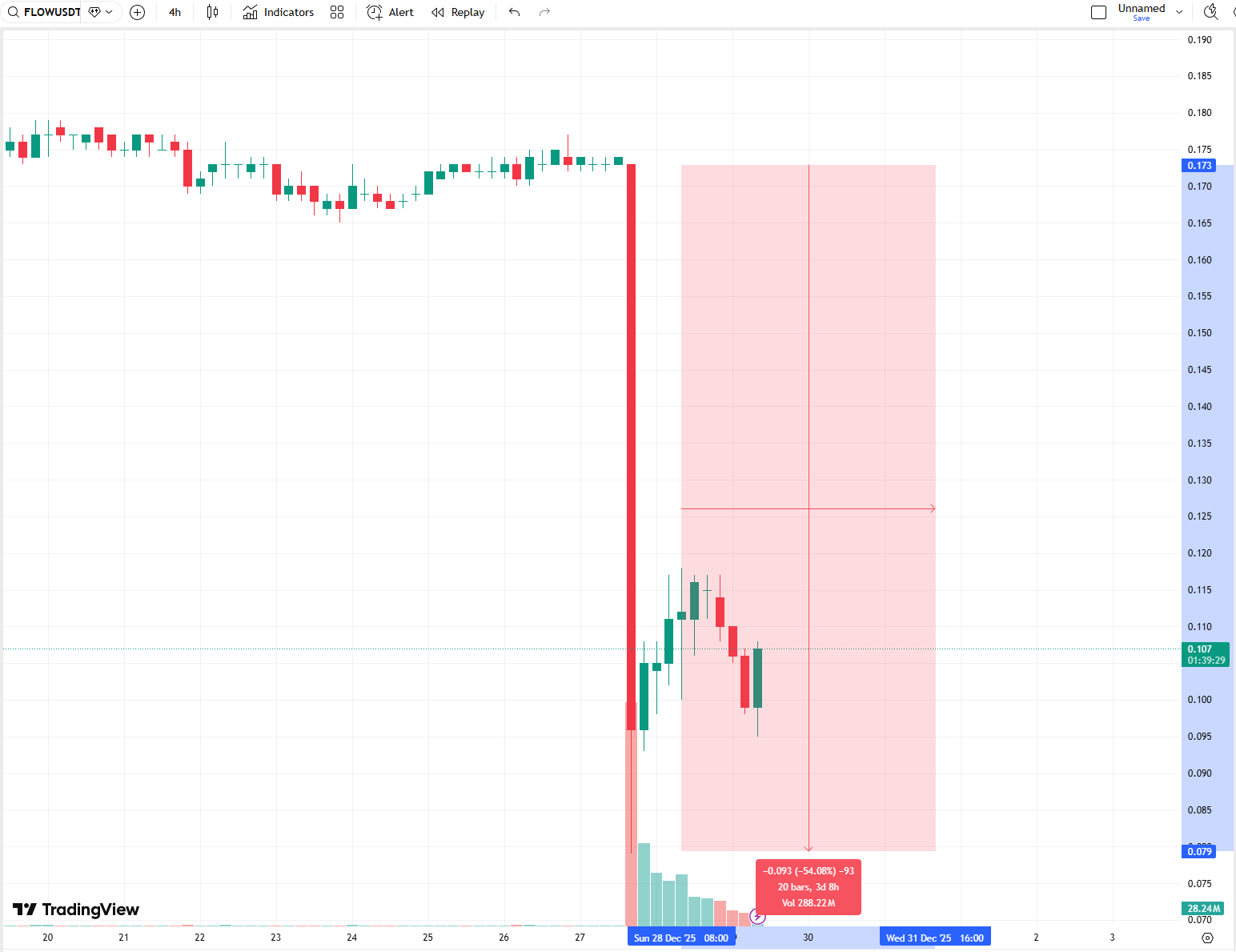
FLOW K-Line Chart

Below, Odaily Planet Daily breaks down this Flow theft incident, the official response, and why it has sparked strong质疑 (questioning/doubts) from Flow's partners and community.

Flow Official Emergency Response: Isolate Network, and Announce Rollback Plan

After the attack, the Flow Foundation quickly responded and confirmed the details of the incident. The attacker exploited an execution layer vulnerability to transfer approximately $3.9 million in assets; the incident did not affect users' existing balances, and user deposits remain safe. The relevant attack addresses have been marked, money laundering paths are being continuously tracked, and the Foundation has submitted asset freeze requests to Circle, Tether, and several major exchanges.

To clean up illegal on-chain transactions and repair the vulnerability, the Flow Foundation isolated the network and simultaneously published Mainnet 28, a patched version for the mainnet vulnerability. The Foundation's initial proposed solution was to roll back the network state to a checkpoint before the attack, specifically to Cadence block height 137363395, thereby deleting all transaction records generated within approximately a 6-hour window. Regardless of whether the transactions were legitimate, they would all be erased, and users would need to resubmit transactions after node restart. The Foundation believed this plan was the safest path to restore network integrity, repeatedly emphasized that user funds would not be affected throughout the process, and promised to provide external updates on progress every two hours.

This rollback decision, seemingly decisive, quickly ignited an ecosystem firestorm—because the hacker's funds had already been bridged off-chain, the rollback would not affect the attacker but would only impact honest users and partners.

Cross-Chain Bridge Partners, Community Users Strongly Oppose, Rollback Plan Heavily Criticized

After the rollback plan was announced, cross-chain bridge partners within the Flow ecosystem and community users quickly faced collective质疑 (questioning/doubts). Alex Smirnov, co-founder of deBridge, a major cross-chain bridge partner for Flow, publicly criticized the decision on platform X as too hasty and stated that no prior communication had been made with key bridge partners beforehand. As a crucial asset channel for the Flow ecosystem, deBridge did not receive any advance notice regarding the rollback.

Smirnov pointed out that the potential damage from a rollback could far exceed that of the initial hack itself. Since cross-chain assets had already circulated across multiple systems, a forced rollback would cause serious issues like asset duplication and inconsistent custodial states, ultimately harming the bridges, users, and counterparties who operated normally during the window. He disclosed that approximately $200,000 and $50,000 in deposits on deBridge fell within the rollback time window; once the rollback was executed, it could lead to funds disappearing on one side or the extreme case of assets being double-minted.

Based on these risks, Smirnov called on Flow validators to suspend block production and validation until compensation plans, partner coordination mechanisms, and plans for independent security team involvement were all clarified. Similar issues were not isolated cases. As the main cross-chain custodian for USDC on the Flow network, LayerZero also faced risks with approximately $220,000 and $180,000 in cross-chain transactions falling within the rollback window.

Beyond cross-chain bridge partners within the Flow ecosystem, users on platform X began集中 (concentratedly) expressing concerns about fund safety, developers questioned the network's reliability and governance mechanisms under extreme circumstances, investor sentiment turned cautious accordingly, and selling pressure intensified. A significant number of voices directly pointed out that the rollback itself exposed the reality of centralized control on the chain, rapidly turning a technical incident into a crisis of trust.

Some community views further targeted the core principles of blockchain. Some argued that the rollback directly shook transaction finality and immutability, making Flow resemble an alliance chain subject to administrative intervention at a critical moment. Others compared it to historical security incidents on other public chains, pointing out that similar situations are usually handled by isolating attacker addresses and freezing fund flows, rather than performing a global rollback of the entire network state.

Crypto KOL Wazz (@WazzCrypto) stated bluntly on platform X that Flow's rollback decision was one of the worst handling methods he had ever seen. In his view, the attacker had already transferred nearly $4 million in assets off-chain and would hardly be substantively affected by the rollback; the real cost would instead be borne by innocent users who used the network normally via cross-chain bridges.

Flow Official Changes Stance: Abandons Rollback, Adopts New Isolation Recovery Plan

Facing strong opposition from partners and the community, the Flow official team ultimately decided to abandon the network rollback and shift to an "Isolation Recovery Plan". This plan was developed through direct consultation with cross-chain bridges, exchanges, and infrastructure partners. Key points include:

  • No rollback/reorganization, preserving all legitimate user activity;
  • No need for partners to replay transactions;
  • Over 99.9% of accounts unaffected, normal operation upon restart;
  • Temporary restriction of accounts that received illegally minted tokens upon restart;

Furthermore, the network will be restored in phases:

  • Phase 1: Cadence environment goes online, EVM temporarily restricted;
  • Phase 2: Cadence repair (approx. 24 to 48 hours);
  • Phase 3: EVM repair and restart;
  • Phase 4: Cross-chain bridges/exchanges resume operation, specific recovery time determined by operators based on actual conditions after confirming stability.

Additionally, Dapper Labs, the team behind Flow, expressed support for this plan on platform X, stating it "preserves legitimate activity and provides a clear path to recovery".

This "abandon rollback" stance alleviated ecosystem tensions in the short term and avoided the systemic risk扩散 (spread/proliferation) a rollback might have caused. As of now, the network is still in a phased coordination and recovery process, with officials stating user funds remain safe.

In the highly uncertain environment of the crypto market, this crisis may become a significant watershed in Flow's development path. Its long-term impact remains to be tested by time.


Пов'язані питання

QWhat was the immediate impact of the hack on the Flow network's native token, FLOW?

AThe FLOW token experienced a sharp price drop, falling from $0.173 to $0.079, effectively halving its value in a short period. It later saw a small rebound to around $0.107.

QWhat was the initial recovery plan proposed by the Flow Foundation after the hack, and why was it controversial?

AThe initial plan was to roll back the network state to a checkpoint before the attack, which would have erased all transactions from a 6-hour window. This was controversial because it would have affected legitimate user transactions and cross-chain bridge operations, potentially causing more damage than the hack itself, while the hacker's funds were already off-chain and unaffected.

QWhich key cross-chain bridge partner publicly criticized the rollback plan, and what was their main concern?

AAlex Smirnov, the co-founder of deBridge, publicly criticized the plan. The main concern was that the rollback was decided without prior communication with key bridge partners and would create severe problems like double-spending and inconsistent custodial states for assets that had already been bridged to other chains during that window.

QWhat was the final recovery solution that Flow adopted instead of a network rollback?

AFlow abandoned the rollback and adopted an 'Isolation Recovery Plan.' This plan involved no rollback, preserved all legitimate user activity, did not require partners to replay transactions, and temporarily restricted accounts that received illegally minted tokens. The network was to be restored in phases.

QWhat broader principle of blockchain technology did the proposed rollback crisis call into question according to the community?

AThe community argued that the proposed rollback shook the core blockchain principles of transaction finality and immutability, making Flow appear more like a centrally controlled consortium chain that could be administratively interfered with, rather than a decentralized ledger.

Пов'язані матеріали

Google and Amazon Simultaneously Invest Heavily in a Competitor: The Most Absurd Business Logic of the AI Era Is Becoming Reality

In a span of four days, Amazon announced an additional $25 billion investment, and Google pledged up to $40 billion—both direct competitors pouring over $65 billion into the same AI startup, Anthropic. Rather than a typical venture capital move, this signals the latest escalation in the cloud wars. The core of the deal is not equity but compute pre-orders: Anthropic must spend the majority of these funds on AWS and Google Cloud services and chips, effectively locking in massive future compute consumption. This reflects a shift in cloud market dynamics—enterprises now choose cloud providers based on which hosts the best AI models, not just price or stability. With OpenAI deeply tied to Microsoft, Anthropic’s Claude has become the only viable strategic asset for Google and Amazon to remain competitive. Anthropic’s annualized revenue has surged to $30 billion, and it is expanding into verticals like biotech, positioning itself as a cross-industry AI infrastructure layer. However, this funding comes with constraints: Anthropic’s independence is challenged as it balances two rival investors, its safety-first narrative faces pressure from regulatory scrutiny, and its path to IPO introduces new financial pressures. Globally, this accelerates a "tri-polar" closed-loop structure in AI infrastructure, with Microsoft-OpenAI, Google-Anthropic, and Amazon-Anthropic forming exclusive model-cloud alliances. In contrast, China’s landscape differs—investments like Alibaba and Tencent backing open-source model firm DeepSeek reflect a more decoupled approach, though closed-source models from major cloud providers still dominate. The $65 billion bet is ultimately about securing a seat at the table in an AI-defined future—where missing the model layer means losing the cloud war.

marsbit1 год тому

Google and Amazon Simultaneously Invest Heavily in a Competitor: The Most Absurd Business Logic of the AI Era Is Becoming Reality

marsbit1 год тому

Computing Power Constrained, Why Did DeepSeek-V4 Open Source?

DeepSeek-V4 has been released as a preview open-source model, featuring 1 million tokens of context length as a baseline capability—previously a premium feature locked behind enterprise paywalls by major overseas AI firms. The official announcement, however, openly acknowledges computational constraints, particularly limited service throughput for the high-end DeepSeek-V4-Pro version due to restricted high-end computing power. Rather than competing on pure scale, DeepSeek adopts a pragmatic approach that balances algorithmic innovation with hardware realities in China’s AI ecosystem. The V4-Pro model uses a highly sparse architecture with 1.6T total parameters but only activates 49B during inference. It performs strongly in agentic coding, knowledge-intensive tasks, and STEM reasoning, competing closely with top-tier closed models like Gemini Pro 3.1 and Claude Opus 4.6 in certain scenarios. A key strategic product is the Flash edition, with 284B total parameters but only 13B activated—making it cost-effective and accessible for mid- and low-tier hardware, including domestic AI chips from Huawei (Ascend), Cambricon, and Hygon. This design supports broader adoption across developers and SMEs while stimulating China's domestic semiconductor ecosystem. Despite facing talent outflow and intense competition in user traffic—with rivals like Doubao and Qianwen leading in monthly active users—DeepSeek has maintained technical momentum. The release also comes amid reports of a new funding round targeting a valuation exceeding $10 billion, potentially setting a new record in China’s LLM sector. Ultimately, DeepSeek-V4 represents a shift toward open yet realistic infrastructure development in the constrained compute landscape of Chinese AI, emphasizing engineering efficiency and domestic hardware compatibility over pure model scale.

marsbit1 год тому

Computing Power Constrained, Why Did DeepSeek-V4 Open Source?

marsbit1 год тому

Торгівля

Спот
Ф'ючерси

Популярні статті

Як купити FLOW

Ласкаво просимо до HTX.com! Ми зробили покупку Flow (FLOW) простою та зручною. Дотримуйтесь нашої покрокової інструкції, щоб розпочати свою криптовалютну подорож.Крок 1: Створіть обліковий запис на HTXВикористовуйте свою електронну пошту або номер телефону, щоб зареєструвати обліковий запис на HTX безплатно. Пройдіть безпроблемну реєстрацію й отримайте доступ до всіх функцій.ЗареєструватисьКрок 2: Перейдіть до розділу Купити крипту і виберіть спосіб оплатиКредитна/дебетова картка: використовуйте вашу картку Visa або Mastercard, щоб миттєво купити Flow (FLOW).Баланс: використовуйте кошти з балансу вашого рахунку HTX для безперешкодної торгівлі.Треті особи: ми додали популярні способи оплати, такі як Google Pay та Apple Pay, щоб підвищити зручність.P2P: Торгуйте безпосередньо з іншими користувачами на HTX.Позабіржова торгівля (OTC): ми пропонуємо індивідуальні послуги та конкурентні обмінні курси для трейдерів.Крок 3: Зберігайте свої Flow (FLOW)Після придбання Flow (FLOW) збережіть його у своєму обліковому записі на HTX. Крім того, ви можете відправити його в інше місце за допомогою блокчейн-переказу або використовувати його для торгівлі іншими криптовалютами.Крок 4: Торгівля Flow (FLOW)Легко торгуйте Flow (FLOW) на спотовому ринку HTX. Просто увійдіть до свого облікового запису, виберіть торгову пару, укладайте угоди та спостерігайте за ними в режимі реального часу. Ми пропонуємо зручний досвід як для початківців, так і для досвідчених трейдерів.

214 переглядів усьогоОпубліковано 2024.12.10Оновлено 2025.03.21

Як купити FLOW

Обговорення

Ласкаво просимо до спільноти HTX. Тут ви можете бути в курсі останніх подій розвитку платформи та отримати доступ до професійної ринкової інформації. Нижче представлені думки користувачів щодо ціни FLOW (FLOW).

活动图片












