‘Grow up... We debank Democrats, we debank Republicans:’ JPMorgan CEO

cointelegraphОпубліковано о 2025-12-08Востаннє оновлено о 2025-12-08

Анотація

JPMorgan CEO Jamie Dimon denies that the bank debanks customers based on political or religious affiliations, stating it has closed accounts for people across the political spectrum, including Democrats and Republicans, but never for those reasons. He emphasizes that debanking occurs due to compliance with government subpoenas and other risk factors, not political bias. Dimon reveals he has advocated for over 15 years to change debanking rules, which he calls "customer unfriendly," and applauds the Trump administration's efforts to address the issue. The comments follow accusations from Trump-linked entities and crypto firms, like Strike and ShapeShift, about account closures, raising concerns over financial censorship. Dimon urges reform rather than blame, noting both Democratic and Republican administrations have pressured banks.

JPMorgan CEO Jamie Dimon has denied debanking customers based on their religious or political affiliation and stated that he has actually been working to change the rules surrounding debanking for over a decade.

During an interview with Fox News’ “Sunday Morning Futures” on Sunday, Dimon said his bank has cut off services to people from all walks of life, but political affiliations have never been a factor.

Devin Nunes, the chair of the President’s intelligence advisory board and CEO of Trump Media, alleges the company was debanked by JPMorgan and that it was among more than 400 Trump‐linked individuals and organizations that had banking records subpoenaed by special counsel Jack Smith as part of an investigation.

Jack Mallers, the CEO of the Bitcoin Lightning Network payments company Strike, also accused JPMorgan of closing his personal accounts without explanation last month, which sparked concerns about another Operation Chokepoint 2.0.

Houston Morgan, the head of marketing at non-custodial crypto trading platform ShapeShift, shared a similar story in November.
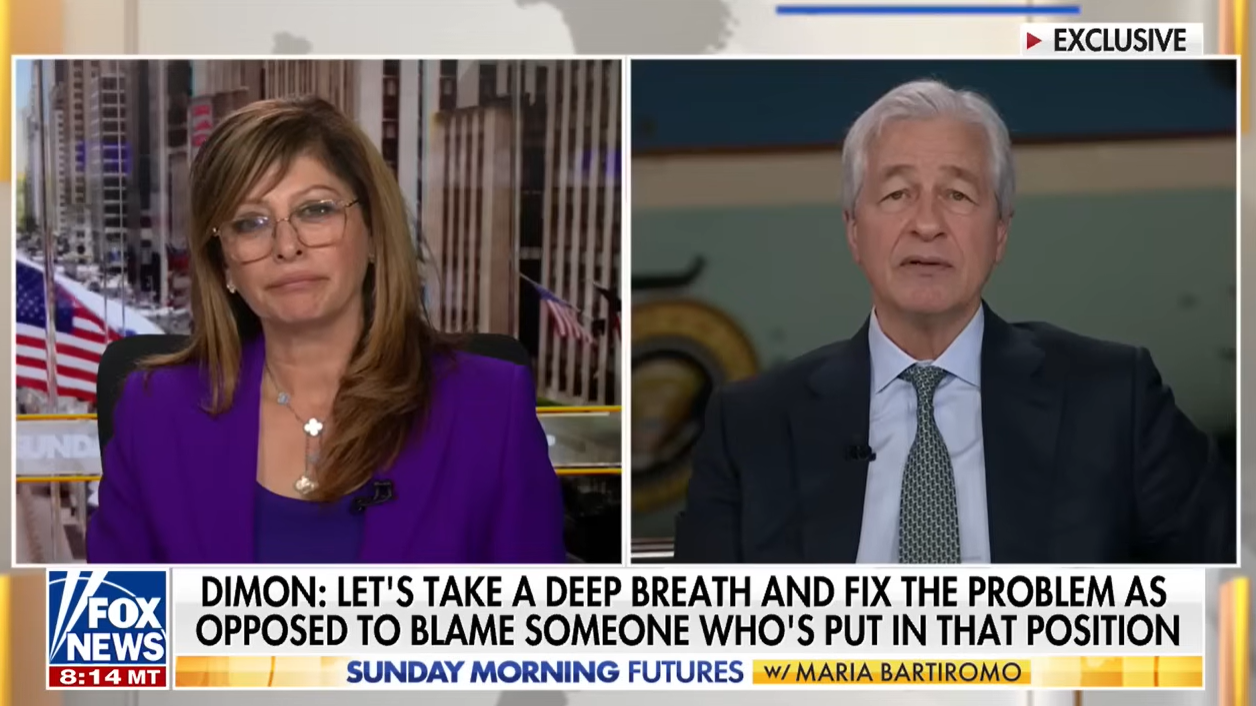
JPMorgan CEO Jamie Dimon maintains his institution doesn’t debank people for political affiliations. Source: YouTube

“People have to grow up here, OK, and stop making up things and stuff like that,” Dimon said. “I can’t talk about an individual account. We do not debank people for religious or political affiliations,” said Dimon.

“We do debank them. They have religious or political affiliations. We debank people who are Democrats. We debank people who are Republicans. We have debanked different religious folks. Never was that for that reason.”

Dimon said he wants debanking rules to change

Crypto firms have been facing account closures and denials of banking services for years, and many in the industry have stated that these actions are part of a policy-driven effort to suppress the digital assets sector.

However, Dimon said he doesn’t like debanking and wants the rules around reporting requirements that can lead to debanking to change.

“I actually applaud the Trump administration, who’s trying to say that debanking is bad and we should change the rules. Well, damn it, I have been asking to change the rules now for 15 years. So change the rules.”

“It is really customer unfriendly, and we’re debanking people because of suspected things, or negative media, or all these various things,” Dimon added.

In August, US President Donald Trump signed an executive order directing banking regulators to investigate claims of debanking made by the crypto sector and conservatives.

JPMorgan made recommendations to curb debanking: Dimon

Dimon said one of the rules banks are required to follow is sharing information with the government when subpoenaed, but he also claims JPMorgan has provided recommendations to reduce reporting and instances of debanking.

Related: Republicans urge action on market structure bill over debanking claims

“We don’t give information to the government just because they ask. We’re subpoenaed. We are required by court to give it to the government. And I have been following subpoenas with this administration, the last administration, the administration before that and the one before that. And I don’t agree with a lot of it,” Dimon said.

“The government does a lot of things that can anger banks. So, let’s just take a deep breath and fix the problems, as opposed to, like, blame someone who’s put in that position,” he added.

At the same time, Dimon said both sides of politics are equal offenders when it comes to leaning on banks.

“Democratic and Republican governments have come after us both; let’s not act like this is just one side doing this. This has been going on for a long time. And we should stop militarizing the government that kind of way.”

Magazine: When privacy and AML laws conflict: Crypto projects’ impossible choice

Пов'язані питання

QWhat did JPMorgan CEO Jamie Dimon deny regarding the bank's debanking practices?

AJamie Dimon denied that JPMorgan debanks customers based on their religious or political affiliation.

QAccording to the article, who accused JPMorgan of closing accounts without explanation, sparking concerns about Operation Chokepoint 2.0?

AJack Mallers, the CEO of the Bitcoin Lightning Network payments company Strike, accused JPMorgan of closing his personal accounts without explanation.

QHow long has Dimon stated he has been asking to change the rules surrounding debanking?

ADimon stated he has been asking to change the rules surrounding debanking for over 15 years.

QWhat action did US President Donald Trump take in August regarding debanking claims?

AIn August, US President Donald Trump signed an executive order directing banking regulators to investigate claims of debanking made by the crypto sector and conservatives.

QWhat reason does Dimon give for JPMorgan providing customer information to the government?

ADimon stated that JPMorgan provides customer information to the government because they are subpoenaed and required by court to do so, not simply because the government asks.

Пов'язані матеріали

Earning Six Figures and Still Struggling to Rent in San Francisco

A couple in San Francisco with a combined tech income over $360,000 struggled for months to find a one-bedroom apartment under $5,000 per month. Their story highlights how the AI wealth boom, driven by upcoming IPOs from companies like OpenAI and Anthropic, is dramatically escalating the city's cost of living. Even six-figure salaries are becoming insufficient for a comfortable lifestyle. The article details the financial reality for tech workers earning around $180,000 annually. After taxes, retirement contributions, and healthcare, take-home pay is roughly $7,000 per month. With average rents exceeding $3,800 and one-bedrooms often costing $4,500-$5,200, discretionary income shrinks to $1,500-$2,500. This contrasts sharply with reported median total compensations of $640,000 at OpenAI and $420,000 at Anthropic. The AI gold rush is identified as the primary driver. The scale of potential wealth from these IPOs, far surpassing previous tech booms, is flooding the housing market. Data shows San Francisco's average rent is now the highest in the U.S., with vacancy rates in desirable neighborhoods plummeting to around 3%. The overall cost of living is 65.6% above the national average. The piece features multiple professionals, including a 25-year-old with a $250,000 salary, facing housing instability, fierce competition for rentals, and a persistent, low-grade financial anxiety despite high earnings. It concludes that the rapid concentration of AI wealth is redefining what constitutes a "high salary" in San Francisco, pushing out mid-tier tech talent and creating a stark divide between those in the AI sector and everyone else.

marsbit1 год тому

Earning Six Figures and Still Struggling to Rent in San Francisco

marsbit1 год тому

Rate Hikes to Save STRC, Selling Bitcoin to Preserve Credit: Strategy Picks Its Two Most Expensive Paths

Over the past six weeks, Strategy has faced a significant crisis of confidence, with its core securities MSTR and STRC experiencing sharp price declines. The situation escalated as the company utilized dollar reserves intended for dividends and interest payments to repurchase debt, and then sold a small amount of Bitcoin for the first time since 2022—an action that contradicted its "never sell" narrative and signaled potential liquidity strain. In response, Strategy introduced a Digital Credit capital framework. This formalized a series of measures to manage the pressure down its capital structure: ordinary shareholders have already borne costs through equity dilution from an $11.5 billion ATM offering; new rules enforce a hard dollar reserve covering at least 12 months of expected dividend and interest payments; the STRC dividend rate was increased from 11.5% to 12%; and, most notably, Bitcoin was officially integrated into the capital toolkit, with board authorization to sell up to $1.25 billion worth if needed to support obligations and repurchase programs. The market reacted with a mix of relief and skepticism. While the announcement triggered a sharp single-day rally in both MSTR and STRC, the preferred shares still trade at a significant discount. Supporters view the framework as pragmatic crisis management that provides a price floor and clearer rules. Critics argue that institutionalizing Bitcoin sales undermines the core investment thesis and, with Bitcoin's price below the company's average cost basis, amounts to selling assets at a loss to maintain its financial structure. The broader context shows institutional Bitcoin buying drying up, highlighting that Strategy's challenges and new framework are now a key indicator for overall market risk sentiment. Ultimately, the framework buys time, but STRC's return to par value depends on market belief in the company's ability to cover dividends without further dilution or substantial Bitcoin sales—a task that would be easier if Bitcoin's price recovers.

链捕手1 год тому

Rate Hikes to Save STRC, Selling Bitcoin to Preserve Credit: Strategy Picks Its Two Most Expensive Paths

链捕手1 год тому

Has Bitcoin Bottomed? Unpacking 12 Key Data Indicators

Author: BitalkNews **Title: Has Bitcoin Bottomed? Analyzing 12 Key Data Indicators** The current Bitcoin price is around $59,600, representing a maximum drawdown of approximately 53% from the 2025 high. The market is in a deep correction phase. Multiple indicators suggest valuations are nearing historical lows, but a confirmed bottom requires more time. **Summary of Key Indicators:** 1. **Fear & Greed Index:** At 16, indicating "Extreme Fear," similar to levels seen during the 2022 FTX collapse. 2. **Rainbow Chart:** BTC has fallen into the "Bitcoin is dead" zone, only the second such occurrence historically. 3. **MVRV Ratio:** Currently around 1.13, near the lower historical band, pointing to a bottoming valuation area (approx. $53,200-$53,400). 4. **Realized Price:** The aggregate cost basis is ~$53,400; the current price is only about 12% above it but hasn't broken below yet. 5. **UTXO Profit/Loss Ratio:** Has dropped to its lowest level this cycle, signaling a potential "capitulation" event often seen near cycle bottoms. 6. **Long-Term Holder SOPR:** For holders >155 days, it's at 0.662, now negative, indicating seasoned investors are selling at a loss. 7. & 8. **Miner Health:** ~20% of miners are unprofitable, and actual miner revenue is below theoretical levels, indicating ongoing miner stress. 9. **ETF Flows:** U.S. spot BTC ETFs have seen sustained net outflows, including a 13-day streak with over $1.7B in weekly outflows. 10. **Strategy Risk:** Strategy's stock premium has significantly contracted, pressuring the traditional "borrow-to-buy" model. 11. **Bear Duration & Drawdown:** The correction has lasted >265 days with a ~52.5% drawdown, shorter in depth but lengthy in duration. 12. **Market Expectations (Polymarket):** Betting markets suggest an ~80% probability of BTC falling below $55,000 and a notable chance below $50,000. **Conclusion:** Bitcoin is in a deep correction with potential bottom formation. Valuation metrics are in historically low ranges, and on-chain capitulation signals are accumulating. However, a complete shakeout isn't finished—the realized price hasn't been breached, and ETF demand hasn't reversed. The area below $60,000 holds long-term appeal, but patience is advised. Key signals to watch for include a return to ETF inflows, a recovery in the Long-Term Holder SOPR, and easing miner pressure.

marsbit1 год тому

Has Bitcoin Bottomed? Unpacking 12 Key Data Indicators

marsbit1 год тому

Торгівля

Спот
活动图片