Grayscale files for NEAR ETF as major altcoins bleed – What’s next?

ambcryptoОпубліковано о 2026-01-21Востаннє оновлено о 2026-01-21

Анотація

Grayscale Investments has filed with the SEC to convert its Grayscale Near Trust (GSNR) into a spot ETF, the Grayscale Near Trust ETF, aiming to list it on NYSE Arca. This move provides traditional investors direct exposure to NEAR, the native asset of NEAR Protocol, through standard brokerage accounts, bypassing complexities of private trusts. The proposed ETF will feature staking, potentially allowing investors to earn rewards. It has institutional backing, with Coinbase serving as custodian and BNY Mellon handling administration. This filing occurs amid a broader trend of institutional crypto adoption, despite recent market weakness affecting NEAR's price. The altcoin ETF landscape is becoming more competitive, with capital shifting between various assets rather than exiting the market entirely.

The push to give Wall Street direct access to Layer-1 blockchains is growing.

After a year of major ETF filings tied to Solana [SOL] and Ripple [XRP], Grayscale Investments has now turned its attention to NEAR Protocol [NEAR].

In a Form S-1 filed with the U.S. Securities and Exchange Commission (SEC) on the 20th of January, Grayscale announced plans to convert its existing Near Trust into a spot ETF.

The proposed product will be renamed the Grayscale Near Trust ETF, signaling that NEAR is moving beyond a developer-focused project and into the institutional spotlight.

Details of Grayscale Near Trust ETF

As per the filing, Grayscale plans to upgrade the Grayscale Near Trust (GSNR) from the OTCQB over-the-counter market to the NYSE Arca exchange.

The firm is following its standard strategy, beginning with private placements for accredited investors, moving into public trading, and ultimately seeking full spot ETF approval.

After the conversion, the ETF will give investors direct exposure to NEAR, the native token of the Near Protocol, through regular brokerage accounts.

This structure removes many of the problems linked to private trusts, including low liquidity and tracking errors. That said, Grayscale has built the proposed ETF with support from major institutional partners.

Coinbase Custody Trust Company will safeguard the NEAR tokens, while BNY Mellon will manage administration and transfer services.

Additional features

The filing also highlights staking as a key feature of the proposed ETF. Unlike Bitcoin [BTC] ETFs, this fund plans to stake NEAR tokens on the network.

This approach could allow the fund to earn staking rewards that may be shared with investors, subject to regulatory approval.

This development comes as NEAR’s price faces short-term pressure. At press time, the token was trading around $1.53, down 1.84% over the past 24 hours as per CoinMarketCap.

However, the drop appears tied to broader market weakness, driven by President Trump’s tariff actions involving Greenland and several European countries.

At the same time, the altcoin ETF market is becoming increasingly divided.

Altcoin ETFs analysis

Data from SoSoValue shows mixed institutional flows. Solana and Chainlink [LINK] saw small inflows of $3.08 million and $4.05 million.

Meanwhile, Ethereum [ETH] experienced heavy outflows of nearly $230 million, followed by XRP at $53.32 million and smaller exits from Dogecoin [DOGE].

This suggests investors are actively shifting capital rather than exiting crypto altogether.

Needless to say, NEAR is not alone in this race. Recently, the Bitwise Chainlink ETF also got launched on NYSE Arca on the 14th of January.

Overall, the fast-growing ETF space suggests that 2026 will not have a single dominant winner. Instead, it may be shaped by a wider group of institutional-grade altcoins.


Final Thoughts

  • Grayscale’s move makes it easier for traditional investors to access NEAR without dealing with wallets or private trusts.
  • For NEAR, this filing is a starting point, not the finish line, with execution now becoming the key focus.


Трендові криптовалюти

Пов'язані питання

QWhat is the main purpose of Grayscale's recent filing with the SEC regarding NEAR Protocol?

AGrayscale Investments filed a Form S-1 to convert its existing Grayscale Near Trust (GSNR) into a spot ETF, called the Grayscale Near Trust ETF, to provide investors with direct exposure to NEAR through regular brokerage accounts.

QWhich two major institutional partners are supporting Grayscale's proposed NEAR ETF, and what are their roles?

ACoinbase Custody Trust Company will safeguard the NEAR tokens, and BNY Mellon will manage administration and transfer services for the proposed ETF.

QHow does the proposed Grayscale Near Trust ETF plan to generate additional returns, unlike Bitcoin ETFs?

AThe proposed ETF plans to stake NEAR tokens on the network, which could allow the fund to earn staking rewards that may be shared with investors, subject to regulatory approval.

QAccording to the article, what was cited as a reason for the short-term price pressure on NEAR and other altcoins?

AThe price drop was tied to broader market weakness, driven by President Trump’s tariff actions involving Greenland and several European countries.

QWhat does the mixed institutional flow data from SoSoValue suggest about investor behavior in the altcoin market?

AThe data shows inflows into Solana and Chainlink alongside heavy outflows from Ethereum and XRP, suggesting investors are actively shifting capital between different cryptocurrencies rather than exiting the crypto market altogether.

Пов'язані матеріали

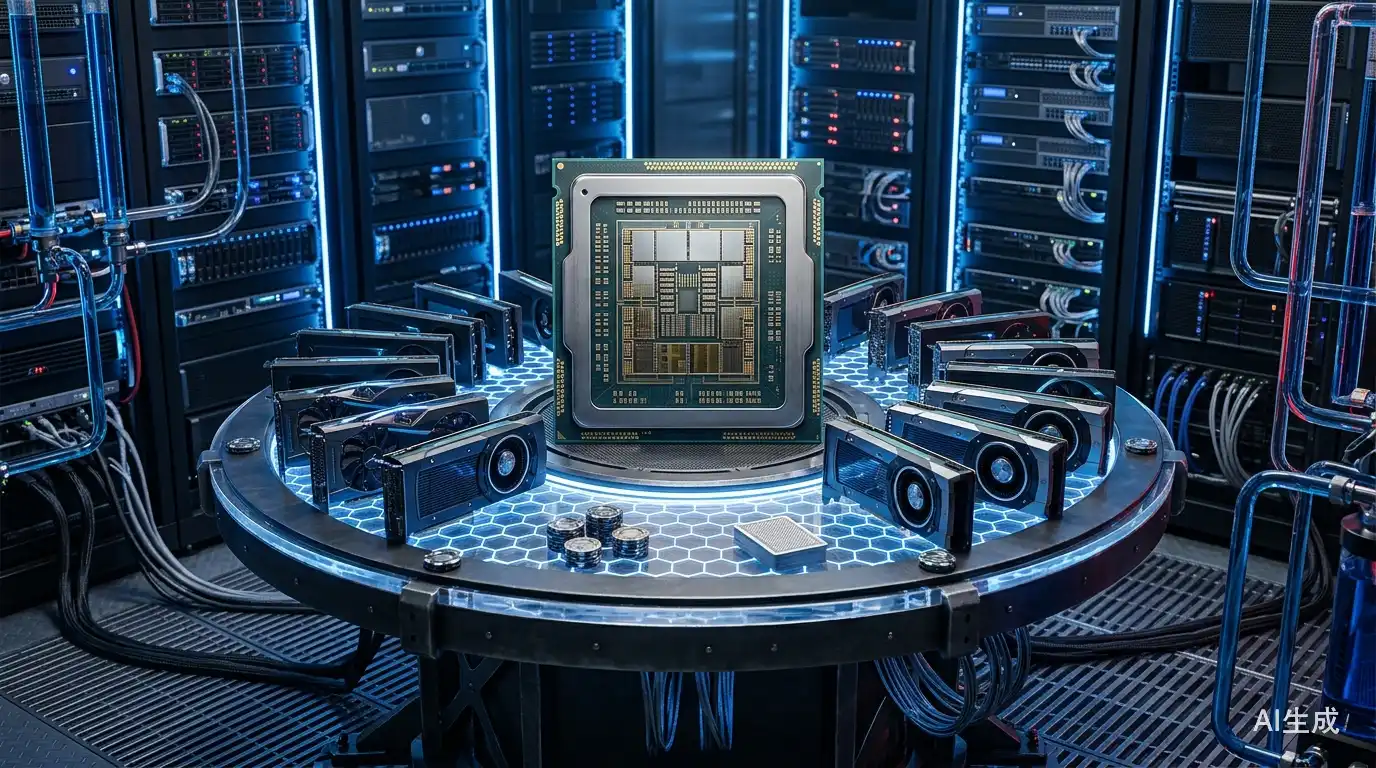
CPU Makes a Comeback to the Table, A $170 Billion "Power Seizure" Drama Begins

A new era is dawning for the server CPU (Central Processing Unit), driven by the shift from AI model training to large-scale reasoning and the rise of Agentic AI. This article explores how the CPU is reclaiming a central role in the AI data center. For years, the focus has been on the GPU (Graphics Processing Unit) for AI training. However, as AI moves to the inference and Agent phase—where tasks involve complex, multi-step reasoning, tool calls, and data management—the workload balance is flipping. Studies show CPUs now handle over 70% of the workload in Agentic AI, up from 10-30% in training. This is because Agent tasks generate massive intermediate data (KV Cache) that exceeds GPU memory, forcing it to be offloaded to the CPU's larger, more scalable memory pools. This increased importance is translating into market changes. Major players are taking note: NVIDIA launched its first standalone CPU line, Vera, based on ARM architecture and optimized for Agent performance. AMD doubled its server CPU market forecast to over $1200 billion by 2030. Analyst reports project the total server CPU market could reach $1700 billion by 2030, with AI-driven demand being a primary driver. Furthermore, the classic ratio of CPUs to GPUs in AI servers is rapidly changing, converging from 1:8 toward 1:1 for Agent deployments. This surge in demand has led to a rare industry-wide price increase of 10-15% for server CPUs from Intel and AMD, breaking a decade-long trend of "more performance for the same price." Demand is bifurcating into high-core-count CPUs for in-rack GPU support and moderate-core CPUs for standalone Agent task orchestration. In China, this global trend presents an opportunity for domestic CPU manufacturers like Hygon (海光信息) and Huawei Kunpeng, who are bolstered by both growing AI infrastructure needs and national policies promoting technological self-reliance ("xin chuang"). The maturity of their software ecosystems is also accelerating, evidenced by faster adaptation to new AI models. In conclusion, the narrative is shifting from a GPU-centric view to one where CPU-GPU synergy is critical. The CPU is no longer a peripheral component but a performance-defining bottleneck and a key growth driver in the AI hardware stack, opening a massive new market estimated in the hundreds of billions of dollars.

marsbit8 год тому

CPU Makes a Comeback to the Table, A $170 Billion "Power Seizure" Drama Begins

marsbit8 год тому

TechFlow Intelligence: AMD AI Director Publicly Criticizes Claude Code for "Becoming Dumber and Lazier", Trump Claims Full Ceasefire in Hormuz But Strait Still Has 80 Unexploded Mines

TechFlow Intelligence Report: This daily digest covers key developments in AI, crypto, hardware, and geopolitics. In AI, SK Telecom faces US export control scrutiny over its partnership with Anthropic, while a Gemini user reports being misled in a scam scenario, sparking safety debates. China's Z.AI launches the GLM-5.2 model, rivaling Claude Opus without NVIDIA chips. In crypto, Bithumb lists ReProtocol, and Upbit delists KernelDAO. On the hardware front, MIT researchers build a custom OS to study chips, ASML denies US claims its advanced lithography machines are in China, and Amazon considers selling its in-house AI chips. Apple's future A21 Pro chip may use TSMC's latest N2P process. Major tech issues include 10,000 GitHub repositories distributing malware and Apple patching a critical eavesdropping flaw in Beats earbuds. US stocks rise, led by semiconductors, with Intel surging 10.6%, while SpaceX falls 3.5%. Geopolitically, despite a US-Iran deal, the Strait of Hormuz remains risky with ~80 uncleared mines, stalling 80M barrels of oil on standby tankers. Iran postpones Switzerland talks, and Trump calls the agreement an "unconditional surrender." The report highlights a contrast: temporary geopolitical calm versus the ongoing, fundamental restructuring of tech supply chains and chip independence.

marsbit8 год тому

TechFlow Intelligence: AMD AI Director Publicly Criticizes Claude Code for "Becoming Dumber and Lazier", Trump Claims Full Ceasefire in Hormuz But Strait Still Has 80 Unexploded Mines

marsbit8 год тому

Торгівля

Спот
Ф'ючерси

Популярні статті

Як купити PUSH

Ласкаво просимо до HTX.com! Ми зробили покупку Push Protocol (PUSH) простою та зручною. Дотримуйтесь нашої покрокової інструкції, щоб розпочати свою криптовалютну подорож.Крок 1: Створіть обліковий запис на HTXВикористовуйте свою електронну пошту або номер телефону, щоб зареєструвати обліковий запис на HTX безплатно. Пройдіть безпроблемну реєстрацію й отримайте доступ до всіх функцій.ЗареєструватисьКрок 2: Перейдіть до розділу Купити крипту і виберіть спосіб оплатиКредитна/дебетова картка: використовуйте вашу картку Visa або Mastercard, щоб миттєво купити Push Protocol (PUSH).Баланс: використовуйте кошти з балансу вашого рахунку HTX для безперешкодної торгівлі.Треті особи: ми додали популярні способи оплати, такі як Google Pay та Apple Pay, щоб підвищити зручність.P2P: Торгуйте безпосередньо з іншими користувачами на HTX.Позабіржова торгівля (OTC): ми пропонуємо індивідуальні послуги та конкурентні обмінні курси для трейдерів.Крок 3: Зберігайте свої Push Protocol (PUSH)Після придбання Push Protocol (PUSH) збережіть його у своєму обліковому записі на HTX. Крім того, ви можете відправити його в інше місце за допомогою блокчейн-переказу або використовувати його для торгівлі іншими криптовалютами.Крок 4: Торгівля Push Protocol (PUSH)Легко торгуйте Push Protocol (PUSH) на спотовому ринку HTX. Просто увійдіть до свого облікового запису, виберіть торгову пару, укладайте угоди та спостерігайте за ними в режимі реального часу. Ми пропонуємо зручний досвід як для початківців, так і для досвідчених трейдерів.

580 переглядів усьогоОпубліковано 2024.12.13Оновлено 2026.06.02

Як купити PUSH

Обговорення

Ласкаво просимо до спільноти HTX. Тут ви можете бути в курсі останніх подій розвитку платформи та отримати доступ до професійної ринкової інформації. Нижче представлені думки користувачів щодо ціни PUSH (PUSH).

活动图片