GOP hardliners vexed as defense bill advances without CBDC ban

cointelegraphОпубліковано о 2025-12-11Востаннє оновлено о 2025-12-11

Анотація

A group of Republican hardliners are angered after the U.S. House passed a $900 billion defense spending bill without including a promised ban on central bank digital currencies (CBDCs). GOP Representative Keith Self stated that conservatives were explicitly assured that strong anti-CBDC language would be part of the National Defense Authorization Act (NDAA), but the promise was broken. An amendment to reinstate the ban failed to advance. The provision would have prohibited the Federal Reserve from testing, developing, or issuing a digital currency and from offering financial services directly to individuals. Some Republicans, including Marjorie Taylor Greene, criticized House leadership for not upholding the commitment, citing concerns over government control of money. The House had previously passed a separate CBDC ban in July, but it has stalled in the Senate. Self vowed to continue fighting against CBDCs in future must-pass legislation.

A group of Republicans has called foul after the US House passed a massive defense spending bill on Wednesday, which omitted a ban on central bank digital currencies (CBDC) despite promises it would be included.

“Conservatives were promised — explicitly — that strong anti-Central Bank Digital Currency (CBDC) language would be included in the National Defense Authorization Act (NDAA). That promise was broken,” GOP Representative Keith Self wrote to X on Wednesday.

The House voted 312-112 to pass the NDAA on Wednesday, sending the $900 billion annual military funding bill to the Senate in a bid to have it passed before the end of the year.

Self had filed an amendment on Tuesday to include a CBDC ban, which had been removed from the bill, but it failed to advance and did not see a vote on the House floor.

Self said a group of Republicans was “assured that anti-CBDC language would be included. Instead, we have been forced into a take-it-or-leave-it bill that breaks that promise. Without that language, I’m inclined to leave it.”
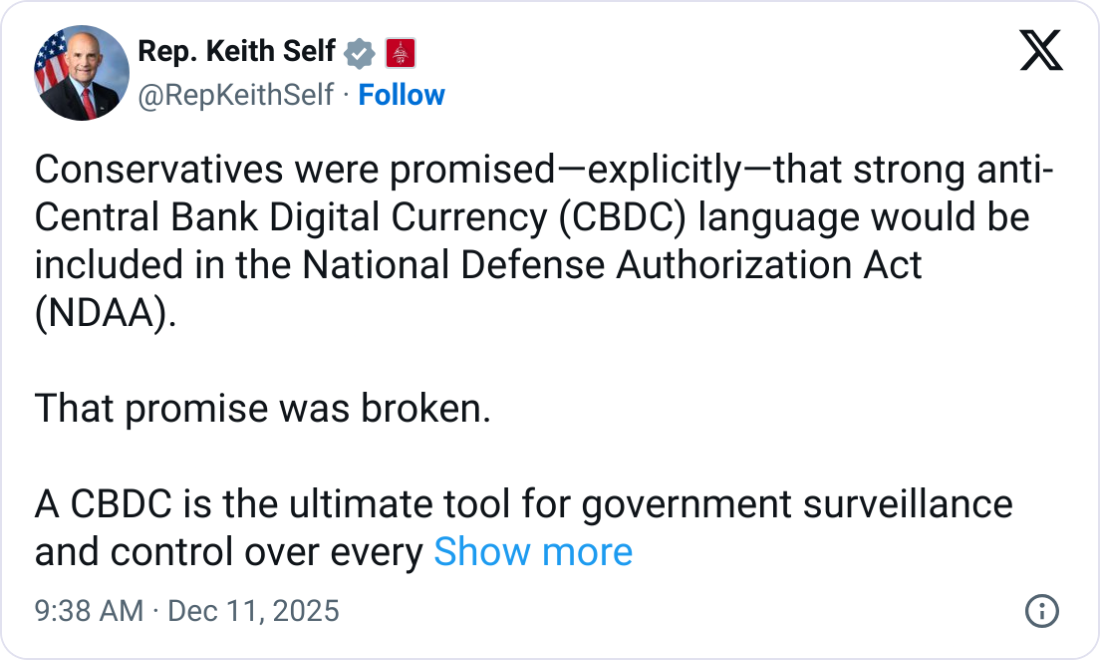
Source: Keith Self

The more than 3,000-page bill is considered must-pass legislation and typically sees non-defense-related amendments that could otherwise be stalled or heavily revised if passed as standalone bills.

In July, House Republican leaders cut a deal with a group of party hardliners to put a CBDC ban in the defense spending bill after the group refused to move forward with three crypto bills unless a CBDC ban was guaranteed.

The bills had been held up in a record-long nine-hour procedural vote and included the stablecoin-regulating GENIUS Act, which President Donald Trump had pressured the GOP to quickly pass.

Related: Does GENIUS turn stablecoin issuers into stealth buyers of US debt?

GOP Representative Marjorie Taylor Greene slammed Speaker Mike Johnson on Monday for not keeping his promise of a CBDC ban, adding she supports crypto but “will never support giving the government the ability to turn off your ability to have full control of your money and to buy and sell.”

An early House version of the bill shared in August had included a CBDC ban, before it was subjected to amendments via multiple markups and committees.

The language of the provision banned the Federal Reserve from testing, studying, developing or issuing any digital currency or asset. It would have also stopped the central bank from offering financial products or services directly to individuals.

In July, the House passed a bill banning CBDCs, the Anti-CBDC Surveillance State Act, with a slim vote of 219-210, which has stalled in the Senate.

Self said he would “fight on in the next must-pass bill to ensure a CBDC never sees the light of day. Financial freedom isn’t negotiable.”

Legal Panel: Crypto wanted to overthrow banks, now it’s becoming them in stablecoin fight

Трендові криптовалюти

Пов'язані матеріали

Comprehensive Analysis of the AI Inference Market: How Can Crypto Projects Break Through?

"AI Inference Market: A Strategic Overview and Crypto's Path to Disruption" The AI inference market, where trained models generate responses to user prompts, is now the primary economic driver, surpassing model training in value. This market is fragmented: hyperscalers (AWS, Google, Microsoft) dominate enterprise reliability; specialized providers (Together, Fireworks) optimize performance; and routing platforms like OpenRouter act as critical bottlenecks, dynamically allocating requests based on cost, latency, and privacy. Crypto AI networks are not competing directly on reliability but are carving out distinct niches: permissionless access, lower-cost supply, privacy, verifiable computation, and agent-native payments. Key projects include Chutes (decentralized inference platform), Akash & io.net (GPU marketplaces), Targon (confidential computing), Darkbloom & Venice (private, consumer-focused inference), and NuNet (orchestration for distributed workloads). The core differentiator is that traditional providers sell trust and enterprise workflows, while crypto networks offer new incentive loops, censorship resistance, and programmable access to resources like compute. For crypto projects to succeed, key metrics are paid token volume (not just usage), sustainable GPU provider revenue, integration into routers like OpenRouter, robust verification against fraud, and genuine privacy guarantees. Ultimately, market control will belong to entities that route, verify, and settle demand—not just those supplying raw compute. The inference market is evolving to resemble a financial system, with tokens as units of account, and crypto's unique value propositions position it to capture emerging segments in this expanding landscape.

Foresight News17 хв тому

Comprehensive Analysis of the AI Inference Market: How Can Crypto Projects Break Through?

Foresight News17 хв тому

The War Without a Unified Name: The Domestic Tech Giants' World Model Landscape

The article outlines the diverse and fragmented landscape of "World Models" in China's tech industry, where major players are pursuing similar goals under different names like world foundational models, physical AI, or integrated within autonomous driving and embodied intelligence systems. The core aim is to enable AI to create an internal, dynamic environment for simulation, reasoning, and learning, reducing reliance on infinite real-world data. This "data engine" allows for unlimited generation, experimentation, and iteration. The report categorizes the approaches of different companies: * **Internet Giants:** Alibaba is developing models for linguistic, virtual, and physical worlds (Qwen-AgentWorld, HappyOyster, Qwen-RobotWorld). Tencent's HY-World focuses on 3D, game, and social scenarios. ByteDance leverages its vast video data for a potential "digital twin" model. Huawei integrates its model into industrial applications like smart cars and robotics without separately branding it. Baidu embeds world model capabilities within its Apollo autonomous driving and Ernie systems. * **Automakers:** Companies like NIO, Li Auto, XPeng, and Geely are using world models as virtual "driving schools" and "testing grounds." They generate complex scenarios (e.g., rain, snow) to train and validate autonomous driving systems in simulation, aiming for more capable and safer AI drivers. * **Autonomous Driving Suppliers:** Firms such as Momenta, Horizon Robotics, Haomo.ai, and DeepRoute.ai are building the underlying "world engines." They focus on large-scale video generation for simulation, reinforcement learning, and enhancing end-to-end autonomous driving models, often integrating these capabilities into commercial products. While startups bring focus and innovation, they face challenges like limited data, compute resources, and deployment channels. Large companies possess these advantages and are rapidly transitioning world models from research projects into core business infrastructure powering products in vehicles, games, and industry. The conclusion is that world models represent an evolution and convergence of existing AI fields into crucial industrial infrastructure, moving the competition from simply building a model to effectively deploying it to understand and interact with the physical world.

marsbit33 хв тому

The War Without a Unified Name: The Domestic Tech Giants' World Model Landscape

marsbit33 хв тому

Торгівля

Спот
Ф'ючерси

Популярні статті

Як купити BAN

Ласкаво просимо до HTX.com! Ми зробили покупку Comedian (BAN) простою та зручною. Дотримуйтесь нашої покрокової інструкції, щоб розпочати свою криптовалютну подорож.Крок 1: Створіть обліковий запис на HTXВикористовуйте свою електронну пошту або номер телефону, щоб зареєструвати обліковий запис на HTX безплатно. Пройдіть безпроблемну реєстрацію й отримайте доступ до всіх функцій.ЗареєструватисьКрок 2: Перейдіть до розділу Купити крипту і виберіть спосіб оплатиКредитна/дебетова картка: використовуйте вашу картку Visa або Mastercard, щоб миттєво купити Comedian (BAN).Баланс: використовуйте кошти з балансу вашого рахунку HTX для безперешкодної торгівлі.Треті особи: ми додали популярні способи оплати, такі як Google Pay та Apple Pay, щоб підвищити зручність.P2P: Торгуйте безпосередньо з іншими користувачами на HTX.Позабіржова торгівля (OTC): ми пропонуємо індивідуальні послуги та конкурентні обмінні курси для трейдерів.Крок 3: Зберігайте свої Comedian (BAN)Після придбання Comedian (BAN) збережіть його у своєму обліковому записі на HTX. Крім того, ви можете відправити його в інше місце за допомогою блокчейн-переказу або використовувати його для торгівлі іншими криптовалютами.Крок 4: Торгівля Comedian (BAN)Легко торгуйте Comedian (BAN) на спотовому ринку HTX. Просто увійдіть до свого облікового запису, виберіть торгову пару, укладайте угоди та спостерігайте за ними в режимі реального часу. Ми пропонуємо зручний досвід як для початківців, так і для досвідчених трейдерів.

495 переглядів усьогоОпубліковано 2024.12.11Оновлено 2026.06.02

Як купити BAN

Обговорення

Ласкаво просимо до спільноти HTX. Тут ви можете бути в курсі останніх подій розвитку платформи та отримати доступ до професійної ринкової інформації. Нижче представлені думки користувачів щодо ціни BAN (BAN).

活动图片