GOP hardliners vexed as defense bill advances without CBDC ban

cointelegraphОпубліковано о 2025-12-11Востаннє оновлено о 2025-12-11

Анотація

A group of Republican hardliners are angered after the U.S. House passed a $900 billion defense spending bill without including a promised ban on central bank digital currencies (CBDCs). GOP Representative Keith Self stated that conservatives were explicitly assured that strong anti-CBDC language would be part of the National Defense Authorization Act (NDAA), but the promise was broken. An amendment to reinstate the ban failed to advance. The provision would have prohibited the Federal Reserve from testing, developing, or issuing a digital currency and from offering financial services directly to individuals. Some Republicans, including Marjorie Taylor Greene, criticized House leadership for not upholding the commitment, citing concerns over government control of money. The House had previously passed a separate CBDC ban in July, but it has stalled in the Senate. Self vowed to continue fighting against CBDCs in future must-pass legislation.

A group of Republicans has called foul after the US House passed a massive defense spending bill on Wednesday, which omitted a ban on central bank digital currencies (CBDC) despite promises it would be included.

“Conservatives were promised — explicitly — that strong anti-Central Bank Digital Currency (CBDC) language would be included in the National Defense Authorization Act (NDAA). That promise was broken,” GOP Representative Keith Self wrote to X on Wednesday.

The House voted 312-112 to pass the NDAA on Wednesday, sending the $900 billion annual military funding bill to the Senate in a bid to have it passed before the end of the year.

Self had filed an amendment on Tuesday to include a CBDC ban, which had been removed from the bill, but it failed to advance and did not see a vote on the House floor.

Self said a group of Republicans was “assured that anti-CBDC language would be included. Instead, we have been forced into a take-it-or-leave-it bill that breaks that promise. Without that language, I’m inclined to leave it.”
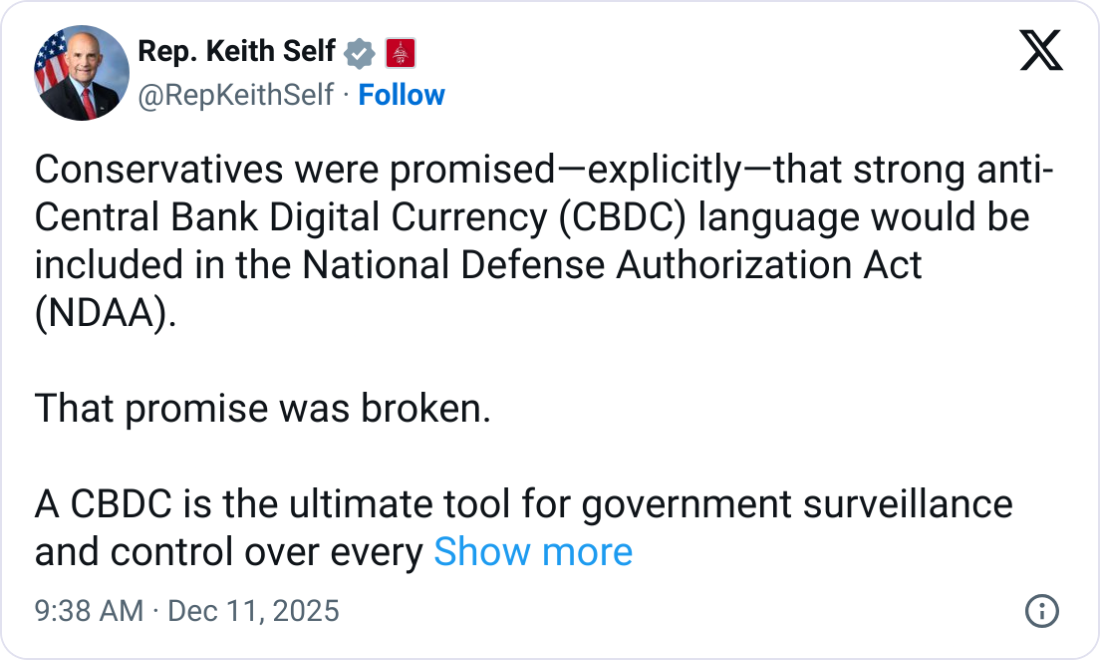
Source: Keith Self

The more than 3,000-page bill is considered must-pass legislation and typically sees non-defense-related amendments that could otherwise be stalled or heavily revised if passed as standalone bills.

In July, House Republican leaders cut a deal with a group of party hardliners to put a CBDC ban in the defense spending bill after the group refused to move forward with three crypto bills unless a CBDC ban was guaranteed.

The bills had been held up in a record-long nine-hour procedural vote and included the stablecoin-regulating GENIUS Act, which President Donald Trump had pressured the GOP to quickly pass.

Related: Does GENIUS turn stablecoin issuers into stealth buyers of US debt?

GOP Representative Marjorie Taylor Greene slammed Speaker Mike Johnson on Monday for not keeping his promise of a CBDC ban, adding she supports crypto but “will never support giving the government the ability to turn off your ability to have full control of your money and to buy and sell.”

An early House version of the bill shared in August had included a CBDC ban, before it was subjected to amendments via multiple markups and committees.

The language of the provision banned the Federal Reserve from testing, studying, developing or issuing any digital currency or asset. It would have also stopped the central bank from offering financial products or services directly to individuals.

In July, the House passed a bill banning CBDCs, the Anti-CBDC Surveillance State Act, with a slim vote of 219-210, which has stalled in the Senate.

Self said he would “fight on in the next must-pass bill to ensure a CBDC never sees the light of day. Financial freedom isn’t negotiable.”

Legal Panel: Crypto wanted to overthrow banks, now it’s becoming them in stablecoin fight

Трендові криптовалюти

Пов'язані матеріали

Bitcoin Withdrawals Continue: 8 Years of Storage in a Coldcard Cold Wallet Ended in Zero

Coldcard Hardware Wallet Hacked: Losses Mount Due to Vulnerable Seed Generation A critical vulnerability in Coldcard hardware wallets has led to a continued wave of fund thefts. According to Galaxy Research, the total stolen has reached 1,367.05 BTC (approx. $88.6 million) from 4,585 addresses, a significant increase from the initial 594.5 BTC reported on July 30, 2026. Most of the stolen funds remain on the attackers' addresses. The issue is not with the current firmware, which Coinkite has updated, but with seed phrases generated on vulnerable devices between March 2021 and the release of fixed firmware versions. Due to a programmer error, devices switched from using a hardware random number generator to the software-based Yasmarang generator, which was initialized with publicly accessible data like the chip's serial number. This made the seed phrases predictable through offline brute-force attacks, meaning wallets remain at risk until funds are moved to a new wallet generated with the patched firmware. Affected devices include Mk2/Mk3 with firmware 4.0.1–4.1.9 (and up to 5.0.3), Mk4/Mk5 up to version 5.6.0, and Q models up to 1.5.0Q. The only exceptions are seeds created with a high-entropy method like at least 50 independent dice rolls or a strong unique BIP-39 passphrase. All other owners must generate a new seed on the fixed firmware and transfer their assets. A case highlighting the human impact involves a 39-year-old long-term investor who lost 2 BTC (approx. $130,000) in minutes. He had accumulated the Bitcoin over eight years through physical labor, viewing it as a financial lifeline and a retirement plan in a country suffering from hyperinflation. His story underscores that even conservative "buy and hold in cold storage" strategies can be compromised by such underlying technical flaws. From a technical perspective, this incident echoes historical failures where weak random number generators undermined cryptographic security, challenging the assumption that offline storage is automatically foolproof.

cryptonews.ru33 хв тому

Bitcoin Withdrawals Continue: 8 Years of Storage in a Coldcard Cold Wallet Ended in Zero

cryptonews.ru33 хв тому

Торгівля

Спот

Популярні статті

Як купити BAN

Ласкаво просимо до HTX.com! Ми зробили покупку Comedian (BAN) простою та зручною. Дотримуйтесь нашої покрокової інструкції, щоб розпочати свою криптовалютну подорож.Крок 1: Створіть обліковий запис на HTXВикористовуйте свою електронну пошту або номер телефону, щоб зареєструвати обліковий запис на HTX безплатно. Пройдіть безпроблемну реєстрацію й отримайте доступ до всіх функцій.ЗареєструватисьКрок 2: Перейдіть до розділу Купити крипту і виберіть спосіб оплатиКредитна/дебетова картка: використовуйте вашу картку Visa або Mastercard, щоб миттєво купити Comedian (BAN).Баланс: використовуйте кошти з балансу вашого рахунку HTX для безперешкодної торгівлі.Треті особи: ми додали популярні способи оплати, такі як Google Pay та Apple Pay, щоб підвищити зручність.P2P: Торгуйте безпосередньо з іншими користувачами на HTX.Позабіржова торгівля (OTC): ми пропонуємо індивідуальні послуги та конкурентні обмінні курси для трейдерів.Крок 3: Зберігайте свої Comedian (BAN)Після придбання Comedian (BAN) збережіть його у своєму обліковому записі на HTX. Крім того, ви можете відправити його в інше місце за допомогою блокчейн-переказу або використовувати його для торгівлі іншими криптовалютами.Крок 4: Торгівля Comedian (BAN)Легко торгуйте Comedian (BAN) на спотовому ринку HTX. Просто увійдіть до свого облікового запису, виберіть торгову пару, укладайте угоди та спостерігайте за ними в режимі реального часу. Ми пропонуємо зручний досвід як для початківців, так і для досвідчених трейдерів.

613 переглядів усьогоОпубліковано 2024.12.11Оновлено 2026.06.02

Як купити BAN

Обговорення

Ласкаво просимо до спільноти HTX. Тут ви можете бути в курсі останніх подій розвитку платформи та отримати доступ до професійної ринкової інформації. Нижче представлені думки користувачів щодо ціни BAN (BAN).

活动图片













