Google Engineer Arrested For Using Company’s Own Search Data To Win $1.2 Million On Polymarket

bitcoinistОпубліковано о 2026-05-28Востаннє оновлено о 2026-05-28

Анотація

A Google information security engineer, Michele Spagnuolo, has been arrested and charged with commodities fraud, wire fraud, and money laundering. Prosecutors allege he used confidential internal Google search data to place bets on the crypto-based prediction market Polymarket, winning approximately $1.2 million by knowing outcomes before the public. Using an internal tool showing real-time search trends, he reportedly placed successful wagers on contracts tied to Google's "Year in Search" rankings for 2025. This is the second federal criminal case involving Polymarket insider trading in just over a month, following an April arrest of a U.S. Army sergeant accused of using classified military information. The cases highlight increasing legal scrutiny of prediction markets, with blockchain transparency aiding prosecutors. Google placed Spagnuolo on leave and is cooperating with authorities.

A Google information security engineer has been arrested and charged with commodities fraud, wire fraud, and money laundering after allegedly using confidential internal company data to place a series of bets on Polymarket — the crypto-based prediction market platform — winning approximately $1.2 million by knowing the outcomes of his wagers before the trading public did.

The US Attorney’s Office for the Southern District of New York unsealed the complaint against Michele Spagnuolo, 36 — also known by his Polymarket account alias “AlphaRaccoon” — on May 27, 2026. Spagnuolo, an Italian citizen residing in Switzerland, was arrested in New York and appeared before US Magistrate Judge Sarah Netburn, where he was released on a $2.25 million bond secured by $1 million in cash, per the DOJ’s official statement. He did not enter a plea.
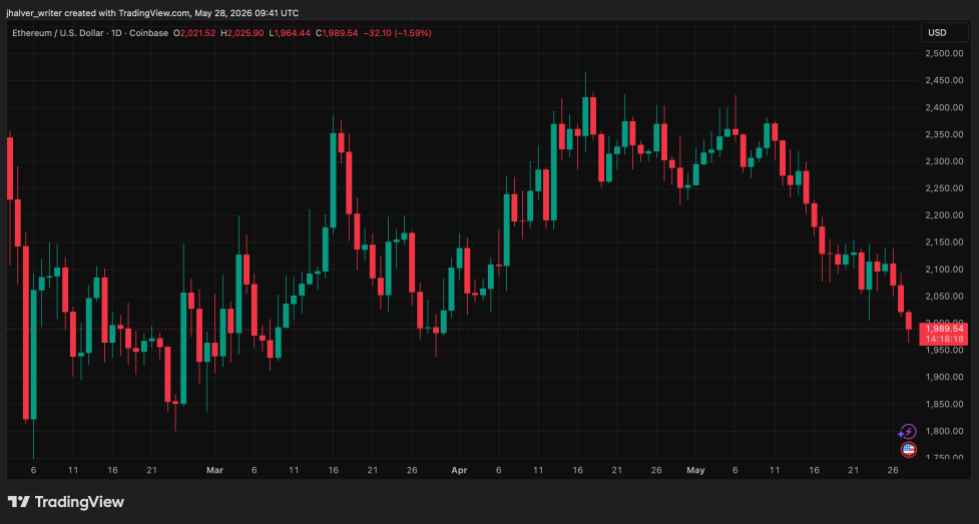
ETH's price trends to the downside on the daily chart. Source: ETHUSD on Tradingview

How The Scheme Worked

According to the unsealed complaint, Spagnuolo had access to an internal Google software tool — bearing a banner marked “Google Confidential” in red text — that provided real-time visibility into what users were searching across Google’s platform, including data that fed directly into Google’s annual “Year in Search” rankings, per the DOJ filing.

Beginning in May 2024, Spagnuolo created a Polymarket account and began placing bets on contracts tied to which individuals would rank on Google’s most-searched list for 2025 — markets Polymarket launched last fall, per the complaint.

Prosecutors allege Spagnuolo transferred approximately $3.8 million in USDC to his Polymarket address and placed bets including a $381.12 “yes” wager that the artist d4vd would rank in Google’s most-searched list and correctly predicted contracts such as “Will Zohran Mamdani rank in the Top 5 most searched” and “Will Squid Game be the number one searched TV show,” per CNBC’s reporting of the complaint. His success rate across these markets was, according to the complaint, no accident. He knew the answers before the markets settled.

The CFTC filed a simultaneous civil case against Spagnuolo seeking monetary disgorgement, restitution, and additional penalties, per the complaint. Google confirmed it had placed Spagnuolo on leave and was cooperating with law enforcement — noting that the tool he used was technically available to all employees, but that using confidential information to place bets represented a serious breach of company policy, per a statement reported by ABC News.

The Second Case In Thirty Days

The Spagnuolo arrest is the second federal criminal case tied to Polymarket insider trading in just over a month. In April 2026, US Army Special Forces Master Sergeant Gannon Ken Van Dyke was arrested for allegedly using classified military knowledge of the planned capture of Venezuelan President Nicolás Maduro to place bets on Polymarket, reportedly netting more than $400,000. Van Dyke has pleaded not guilty, per CNN’s reporting.

Polymarket’s chief legal officer Olivia Chalos said in a statement that the company worked closely with the US Attorney’s Office and the CFTC on the Spagnuolo case — noting that Polymarket is the only prediction platform to date whose cooperation has led to insider trading charges in the United States, and that the blockchain-based nature of the platform means bad actors leave footprints.

This development marks a critical and accelerating moment for the nascent prediction market sector. Two federal insider trading arrests in thirty days — one involving military classified information, the other corporate search data — arriving simultaneously with an active congressional investigation into Polymarket and Kalshi, confirms that the legal perimeter around prediction markets is closing fast. The transparency of blockchain trading, once seen primarily as a feature for users, is now functioning as a forensic trail for federal prosecutors.

Cover image from Grok, ETHUSD chart from Tradingview

Пов'язані питання

QWhat was the Google engineer accused of doing, and how much did he allegedly win?

AThe Google engineer, Michele Spagnuolo, was accused of using confidential internal search data to place bets on Polymarket's prediction markets, specifically those tied to Google's 'Year in Search' rankings. He allegedly won approximately $1.2 million by knowing the outcomes before the trading public.

QWhat specific internal tool did the Google engineer allegedly misuse, and what kind of data did it provide?

AHe allegedly misused an internal Google software tool that displayed a 'Google Confidential' banner. This tool provided real-time visibility into what users were searching across Google's platform, including data that fed directly into Google's annual 'Year in Search' rankings.

QWhat were the federal criminal charges brought against Michele Spagnuolo?

AMichele Spagnuolo was charged with commodities fraud, wire fraud, and money laundering.

QAccording to the article, what was the other recent insider trading case involving Polymarket?

AIn April 2026, US Army Special Forces Master Sergeant Gannon Ken Van Dyke was arrested. He was accused of using classified military knowledge about the planned capture of Venezuelan President Nicolás Maduro to place bets on Polymarket, allegedly netting more than $400,000.

QHow did Polymarket's chief legal officer characterize the platform's role in the Spagnuolo case?

APolymarket's chief legal officer, Olivia Chalos, stated that the company worked closely with authorities, that Polymarket is the only prediction platform whose cooperation has led to U.S. insider trading charges, and that the blockchain-based nature of the platform means bad actors leave forensic footprints.

Пов'язані матеріали

Who Funds the Agents?

**Summary: Who Funds AI Agents?** OpenAI recently shut down a feature allowing AI agents to shop for users, highlighting the challenge of creating a secure and regulated environment for agent-driven transactions. While payment infrastructure exists, a crucial governance layer—defining spending limits, fraud detection, tax handling, and return policies—is largely missing. The potential is enormous: AI agents already processed $73M across 176M transactions last year, with McKinsey forecasting this could grow to $3-5T in global consumer commerce by 2030. The core competition isn't just about processing payments, which can be very cheap (especially with crypto-based settlement), but about controlling the rules that govern agent spending. Key players like Stripe and Coinbase are racing to dominate this governance layer. Stripe's acquisition of wallet provider Privy allows it to set spending policies, identity checks, and human-in-the-loop approvals directly at the wallet level. Similarly, Coinbase's stack, including its x402 protocol and AgentKit, embeds governance rules. This vertical integration across settlement, wallet, and governance layers is becoming the dominant strategy. Control over the governance layer is where significant future value lies. If agents handle trillions in transactions, even a small fee for managing compliance, fraud prevention, and policy enforcement could generate billions in annual revenue. The companies that successfully integrate across the payment stack will capture value from idle agent balances, transaction fees, and governance services, positioning themselves as the foundational banks of the AI agent economy.

marsbit1 хв тому

Who Funds the Agents?

marsbit1 хв тому

A Nation Blocks Chips, a Giant Buys a Nuclear Power Plant: Why It's Time to Seriously Consider DeAI

**Title: Great Powers Blockade Chips, Giants Buy Nuclear Plants: Why It's Time to Seriously Consider DeAI** In May 2026, the US closed loopholes for Chinese firms to acquire advanced NVIDIA chips via overseas subsidiaries. That same month, Kenya halted a $1B geothermal data center project involving Microsoft, fearing its immense energy consumption. Meanwhile, Huawei announced mass production of its Ascend AI chip. These disparate events underscore a new reality: the competition for computing power ("compute") has escalated beyond the tech industry, becoming a geopolitical and infrastructural battleground. A new era of oligopoly is forming, with control over the AI stack—from GPU chips (NVIDIA) and cloud platforms (AWS, Azure, Google Cloud) to foundational models (OpenAI, Anthropic)—concentrating in a few Western "AI Octopus" corporations. This centralization creates systemic risks: pricing power and platform lock-in for users, infrastructure fragility, and a widening "compute divide" that threatens to marginalize nations without independent AI capacity. An "AI Iron Curtain" is deepening through export controls. In response, some nations like Saudi Arabia and the UAE are investing heavily to buy compute power, aiming to transition from oil to AI economies. The EU seeks to triple its compute capacity by 2030 to reduce dependency. However, the spending gap is vast, with four US tech giants alone planning ~$750B in AI capex for 2026. The race is increasingly constrained by energy, with AI tasks consuming up to 1000x more power than web searches, pushing firms to even acquire nuclear plants. This landscape is fueling interest in Decentralized AI (DeAI). It proposes a third way: using open protocols to coordinate a global network of idle GPUs, independent developers, and data centers, creating an AI infrastructure without a single controlling entity. Leveraging blockchain and cryptographic verification, DeAI aims to break market concentration, disperse energy demands, reduce geopolitical dependencies, and enhance transparency. While still nascent in performance and stability, DeAI's core promise is not immediate superiority but providing a crucial alternative architecture to resist monopoly, censorship, and centralized power. As specialized AI hardware costs fall and open-source models flourish, the window to build this foundation is open. The very existence of such competition serves as a vital check against the inevitable abuse of concentrated power.

marsbit56 хв тому

A Nation Blocks Chips, a Giant Buys a Nuclear Power Plant: Why It's Time to Seriously Consider DeAI

marsbit56 хв тому

Outpoll Review: A Prediction Market Platform Built for Active Traders

Outpoll Review: A Prediction Market Platform Built for Active Traders In recent years, prediction markets have grown from a niche sector to a mainstream arena, attracting billions in trading volume and institutional capital. However, the user experience and tools for traders have not kept pace. Outpoll, a new global prediction market platform, aims to fill this gap by providing enhanced trading infrastructure for active and professional traders. Built on standard prediction market principles, Outpoll allows users to trade on the outcome of specific events. It uses fully collateralized contracts with USDC settlement, charges a competitive 0.1% fee per trade, and provides clear settlement rules upfront to minimize disputes. A key focus for Outpoll is its professional-grade trading tools. The platform supports limit and market orders, as well as take-profit and stop-loss orders for open positions—features uncommon in prediction markets. For automated trading, Outpoll offers comprehensive REST and WebSocket APIs, enabling portfolio management, price arbitrage, and integration with existing tools. The platform also features a creator-led market model, where approved experts and community leaders can create and manage markets for niche topics under platform supervision. Its integrated interface combines news feeds directly with trading functions, allowing users to monitor events and manage positions seamlessly. Outpoll launched with a native Android app (available on Google Play) and plans an iOS version later this year. In summary, Outpoll distinguishes itself with trader-focused tools, practical APIs, transparent and collateralized markets, integrated news, and an expanding creator program. For active traders, its advanced order types and API access alone make it a platform worth watching. Outpoll is now globally accessible via outpoll.com and Google Play.

marsbit1 год тому

Outpoll Review: A Prediction Market Platform Built for Active Traders

marsbit1 год тому

Торгівля

Спот
Ф'ючерси
活动图片





