Goldman Sachs Predicts 11% Return: How Far Can the Optimistic Cycle of Global Stock Markets Go?

比推Опубліковано о 2026-01-14Востаннє оновлено о 2026-01-14

Анотація

Goldman Sachs Research forecasts an 11% total return (including dividends, in USD terms) for global equities over the next 12 months, anticipating a continued but more moderate bull market into 2026. While valuations are at historical highs following last year's strong performance, the rally is expected to be driven by corporate earnings growth and sustained economic expansion rather than further multiple expansion. A key theme is the importance of diversification. Investors benefited in 2025 from geographic diversification, a trend expected to continue and broaden to include factors (growth vs. value) and sectors. The analysis suggests the market is in an "optimism" phase of the cycle, which typically carries upside risk to valuations. The report highlights that while AI enthusiasm remains high, it does not constitute a bubble. The tech sector's dominance is supported by superior earnings growth, and the valuation gap between the largest tech stocks and the rest of the market is far smaller than during previous bubbles. Investors are advised to seek alpha opportunities through stock selection as correlations decrease and to consider non-tech companies that may benefit from AI-driven capital expenditure.

Author: Goldman Sachs

Compiled by: Shenchao TechFlow

Original title: Goldman Sachs Predicts: Global Stock Markets Expected to Achieve 11% Return in the Next 12 Months


  • Following last year's strong growth, Goldman Sachs Research predicts that global stock markets are expected to continue climbing in 2026, with an anticipated return of 11% over the next 12 months (including dividends, in USD terms).

  • Although last year's stock market rally has left valuations at historically high levels, corporate earnings and economic growth globally are expected to continue supporting the markets.

  • Last year, investors benefited significantly from cross-regional diversification, a trend that is likely to continue. Additionally, diversification across investment styles and sectors is expected to further enhance returns.

According to Goldman Sachs Research, the global bull market is likely to continue this year, driven by growth in corporate earnings and sustained economic expansion. However, the gains in the stock market are expected to be lower than the significant rally seen in 2025. In 2026, the global economy is expected to maintain expansion across regions, and the US Federal Reserve is anticipated to continue with moderate easing policies.

"In the current macroeconomic context, even with high valuations, a significant stock market correction or bear market without an economic recession would be unusual," wrote Peter Oppenheimer, Chief Global Equity Strategist at Goldman Sachs Research, in his report titled "Global Equity Strategy 2026 Outlook: Tech Tonic—a Broadening Bull Market."
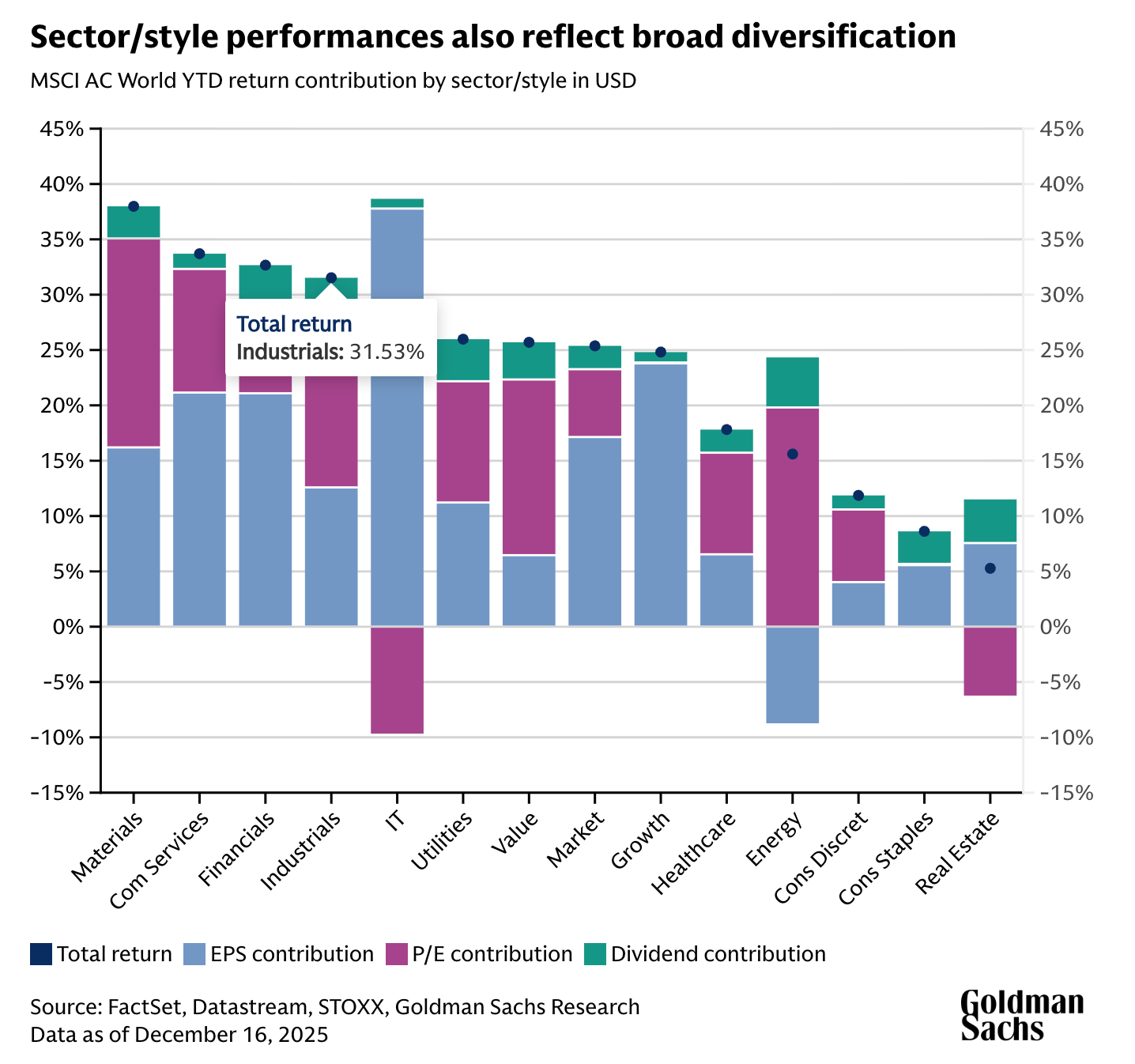
Diversification was a core theme emphasized by Goldman Sachs Research last year. In 2025, for the first time in many years, investors who diversified across regions were rewarded. Goldman Sachs analysts expect this trend to continue in 2026 and expand to include diversification across investment factors such as growth and value, as well as across various sectors. (Investment factors refer to asset characteristics such as size, value, or momentum that typically influence risk and return.)

What Is the Outlook for Global Stock Markets in 2026?

Despite the strong performance of stock markets in 2025, outperforming commodities and bonds, the rally was not smooth. At the beginning of the year, stocks underperformed, with the S&P 500 experiencing a nearly 20% correction from mid-February to April before rebounding.

Peter Oppenheimer, Chief Global Equity Strategist at Goldman Sachs Research, noted that the strong rally in global stock markets has left valuations at historically high levels across all regions, including the US, Japan, Europe, and emerging markets.
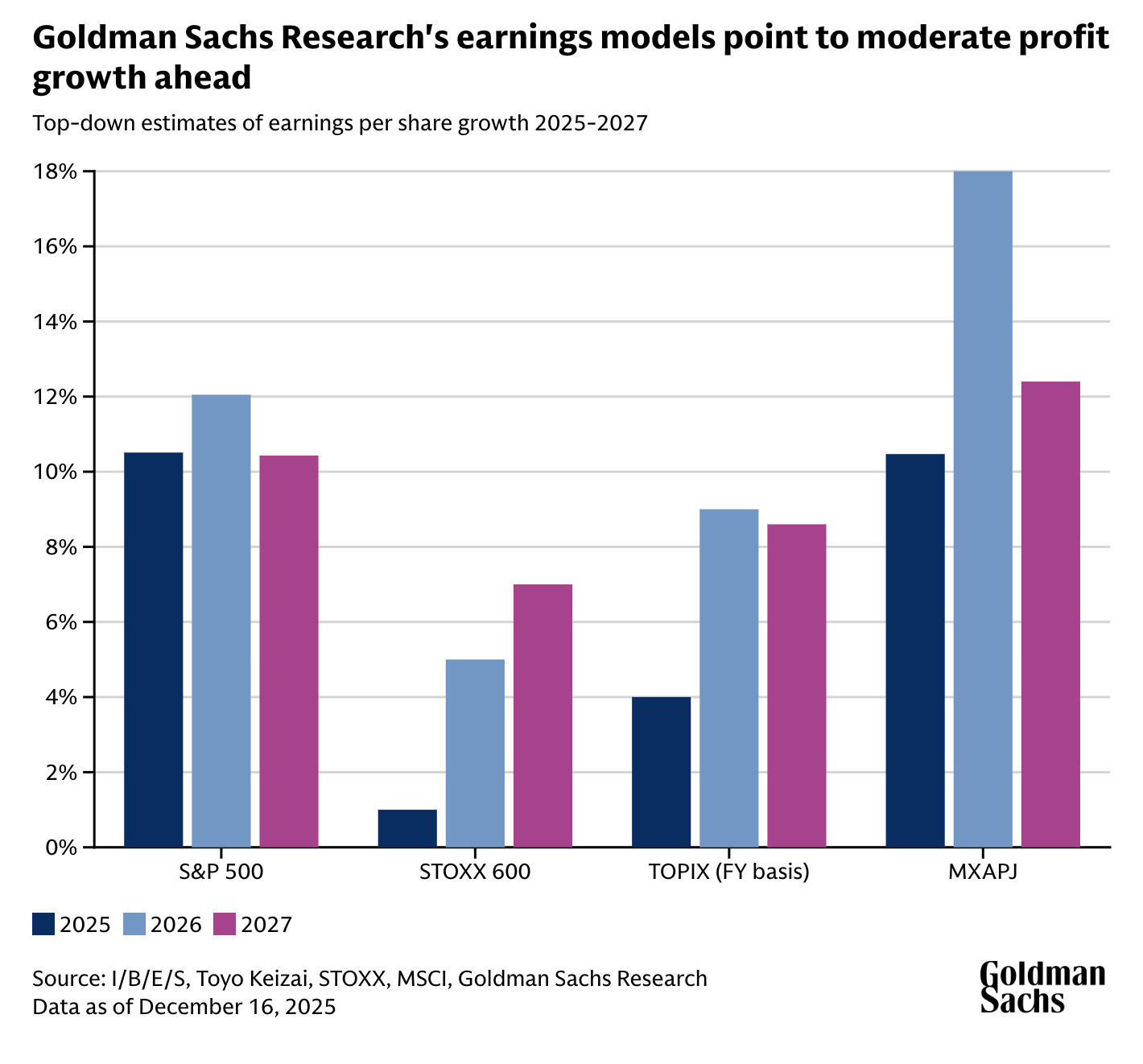
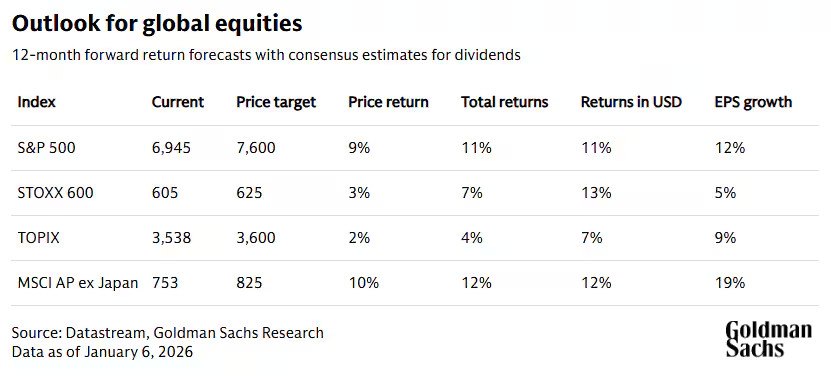
"Therefore, we believe that returns in 2026 are more likely to be driven by fundamental earnings growth rather than further valuation expansion," Oppenheimer said. According to Goldman Sachs analysts' forecasts as of January 6, 2026, global stock prices (weighted by regional market capitalization) are expected to rise by 9% over the next 12 months, achieving an 11% return in USD terms (including dividends). He added, "Most of the return will come from earnings-driven growth."

Additionally, according to another Goldman Sachs forecast, commodity indices are also expected to rise this year, with gains in precious metals once again offsetting declines in energy prices, a trend similar to 2025.

Oppenheimer's team also studied the typical evolution of market cycles: the despair phase during bear markets when stocks fall; the brief hope phase during market rebounds; the longer growth phase where returns are driven by earnings growth; and finally, the optimistic phase where investor confidence strengthens and even becomes complacent.

Their analysis suggests that stocks are currently in the optimistic phase of a cycle that began with the bear market during the COVID-19 pandemic in 2020. "This late-cycle optimistic phase is often accompanied by rising valuations, indicating that there may be some upside risk to our core forecast," Oppenheimer's team wrote.

Should Investors Diversify Their Stock Portfolios in 2026?

In 2025, geographical diversification provided significant benefits to investors, which is uncommon. US stock markets underperformed other major markets for the first time in nearly 15 years. Due to the depreciation of the US dollar, the returns from European, Chinese, and Asian stock markets were almost double the total return of the S&P 500.

Returns in US stock markets were primarily driven by earnings growth, especially from large technology companies. However, outside the US, the balance between earnings improvement and valuation expansion was more even. Last year, the growth-adjusted valuation gap between US and global markets narrowed.

"Even though absolute valuations in the US remain high, we expect these growth-adjusted valuation ratios to continue converging in 2026," Oppenheimer's team wrote.

Oppenheimer noted that diversification is still expected to provide better risk-adjusted returns in 2026. He advises investors to explore broad geographical investment opportunities, including increased focus on emerging markets. At the same time, investors should balance between growth and value stocks and pay attention to different sectors. Additionally, they can look for opportunities where correlations between stocks decrease, providing room for stock picking.
"As stock correlations decline and may remain low, we are also paying more attention to enhancing alpha," wrote Peter Oppenheimer, Chief Global Equity Strategist at Goldman Sachs Research. Alpha measures an asset's performance relative to a broader market index.

Oppenheimer added that non-technology sectors may perform strongly this year, and investors could profit from stocks benefiting from technology companies' capital expenditures. Furthermore, as new capabilities of artificial intelligence (AI) are gradually realized, market attention may increasingly focus on companies outside the technology sector that benefit from AI development.

Are AI Stocks in a Bubble?

Overall, market focus on artificial intelligence "remains intense," Goldman Sachs analysts noted. However, this does not mean there is a bubble in the AI sector. "The dominance of the technology sector in the market was not triggered by the rise of AI," Oppenheimer wrote. "This trend began after the financial crisis and has been supported by its exceptional earnings growth."

Despite the surge in stock prices of large technology companies, current valuation levels have not reached the extremes seen in previous bubble periods. For example, comparing the valuation gap between the five largest companies by market capitalization in the S&P 500 and the other 495 stocks shows that this gap is much smaller than in previous cycles, such as the peak of the tech bubble in 2000.


Twitter: https://twitter.com/BitpushNewsCN

BitPush TG Discussion Group: https://t.me/BitPushCommunity

BitPush TG Subscription: https://t.me/bitpush

Original link: https://www.bitpush.news/articles/7602780

Пов'язані питання

QWhat is Goldman Sachs' predicted 12-month return for global equities, and what factors are expected to drive this return?

AGoldman Sachs predicts an 11% return for global equities over the next 12 months (including dividends, in USD terms). This return is expected to be primarily driven by fundamental earnings growth rather than further valuation expansion, supported by corporate profit growth and continued economic expansion across regions.

QAccording to the report, what stage of the market cycle are global equities currently in, and what characterizes this phase?

AGlobal equities are currently in the 'optimism' phase of the market cycle, which began with the bear market during the COVID-19 pandemic in 2020. This phase is characterized by rising valuations and increased investor confidence, sometimes bordering on complacency.

QHow did geographic diversification benefit investors in 2025, and is this trend expected to continue in 2026?

AIn 2025, geographic diversification provided significant benefits as U.S. equities underperformed other major markets for the first time in nearly 15 years. European, Chinese, and Asian markets delivered nearly double the total return of the S&P 500. This trend is expected to continue in 2026, with further convergence in growth-adjusted valuations and better risk-adjusted returns from diversification.

QDoes Goldman Sachs report suggest that AI stocks are in a bubble, and what evidence supports this view?

ANo, the report does not suggest that AI stocks are in a bubble. While market enthusiasm for AI remains high, the dominance of the tech sector is not solely triggered by AI but began after the financial crisis and is supported by superior earnings growth. The valuation gap between the top five companies in the S&P 500 and the rest is far smaller than during previous bubbles, such as the 2000 tech bubble peak.

QWhat investment strategies does Peter Oppenheimer recommend for 2026 to enhance returns and manage risk?

APeter Oppenheimer recommends diversifying across geographies, including increased exposure to emerging markets, balancing growth and value investment styles, and diversifying across sectors. He also suggests focusing on stock picking opportunities as correlations between stocks decrease, and looking for non-tech sectors that may perform well, including companies benefiting from tech capital expenditure and AI adoption.

Пов'язані матеріали

Strategy's Loss in the Second Quarter Reaches $8.22 Billion Amid Bitcoin Decline

Strategy, the largest corporate holder of Bitcoin, reported a net loss of $8.22 billion for the second quarter. This loss was primarily driven by an $8.32 billion unrealized loss on its Bitcoin holdings due to a decline in the asset's price during the period. Despite these paper losses, the company increased its Bitcoin holdings to 843,775 BTC, a 25% growth since the start of the year. As part of a new monetization strategy, Strategy sold approximately $218.4 million worth of Bitcoin, mainly to fund dividends for preferred shareholders, with $216 million of that sold after Q2 ended. The company also built a $3.75 billion cash reserve, which it claims is sufficient to cover over two years of dividend and interest payments, aiming to insulate itself from Bitcoin's volatility while meeting obligations. Following the earnings release, Strategy's stock (MSTR) rose 4.7% in regular trading but corrected slightly after-hours. This pattern reflects how the company's accounting results are heavily tied to Bitcoin's price swings, even as its long-term strategy remains unchanged. The report indicates that Strategy is maintaining its core strategy of accumulating Bitcoin while building a financial buffer. This quarterly loss follows a recognizable pattern, with the company posting significant unrealized losses in previous quarters (e.g., $12.4 billion in Q4 2025 and ~$12.5 billion in Q1 2026) due to fair-value accounting. A key technical shift is its new monetization program, which introduces periodic selling pressure on the market, transitioning Strategy from a pure accumulator to a participant that occasionally adds supply. A critical question remains: how long can the cash reserve cover dividend obligations if a Bitcoin price downturn persists beyond two years?

cryptonews.ru7 хв тому

Strategy's Loss in the Second Quarter Reaches $8.22 Billion Amid Bitcoin Decline

cryptonews.ru7 хв тому

Will Terrorist Durov Ban Russian Officials?

Telegram founder Pavel Durov publicly reacted to being labeled a "terrorist" by Russian authorities, stating the designation came after he refused demands for mass surveillance and censorship on the platform. In a Telegram post, he highlighted that this status formally bans him from "publishing information online." Durov concluded with a statement widely circulated: Russian officials "clearly don't understand who can ban whom on the internet." This remark suggests Durov could potentially restrict official Russian government and officials' channels on Telegram, which continue to operate on the platform despite its formal blocking in Russia. The situation parallels previous, slow-moving state directives, like switching officials to domestic cars, contrasted with the current push to migrate all government communication to the Russian-made messenger MAX by 2030. However, reports indicate many officials still use Telegram via workarounds, fearing surveillance on MAX, while alternatives like BiP and KakaoTalk recently became inaccessible in Russia without a VPN. Durov has not specified any immediate actions against state channels. His statement is an initial response, with further developments depending on the authorities' reaction. The dynamic differs from 2020 when Russian regulators lifted a block on Telegram; now, Durov implies control from within the platform itself over the official accounts that persisted through that earlier blockade.

cryptonews.ru7 хв тому

Will Terrorist Durov Ban Russian Officials?

cryptonews.ru7 хв тому

DeepSeek V4 Official Version Arrives, New Capabilities Emerge, Value-for-Money King Enters the Fray

On July 31st, DeepSeek officially launched the public API beta for its DeepSeek-V4-Flash model. A key highlight is its performance on multiple Agent benchmark tests, reportedly nearing or even surpassing the level of the V4-Pro preview version from three months ago. Notably, the Flash model achieves this with significantly smaller scale (130B active parameters vs. Pro's 490B), suggesting that post-training optimization and data quality may be as crucial as raw model size. DeepSeek emphasized that the V4-Flash-0731 uses the same model architecture and size as its preview version, with improvements attributed solely to "re-trained post-training." The update also marks the official debut of DeepSeek's self-developed Agent framework, "Harness." The move signals DeepSeek's strategic push to position its cost-effective Flash model as a competitive base for Agent applications—scenarios requiring autonomous planning, tool usage, and complex task execution—where inference speed and cost are critical. By natively supporting OpenAI's Responses API format and adapting for code-generation scenarios, DeepSeek aims not just to be a cheaper alternative but to establish its own ecosystem in the Agent era. This release follows DeepSeek's record-breaking ~$50 billion fundraising round roughly two months prior, underscoring market confidence in its technology and commercialization prospects. The company is reportedly preparing for another funding round at a valuation of approximately $71 billion. The Flash model's advancement represents a step in fulfilling the high expectations that come with this valuation, setting the stage for the impending release of the V4-Pro official version and intensifying competition in the global Agent landscape.

marsbit11 хв тому

DeepSeek V4 Official Version Arrives, New Capabilities Emerge, Value-for-Money King Enters the Fray

marsbit11 хв тому

Торгівля

Спот
活动图片